Emergence of Resonating Valence-Bond Correlations in Stretched Graphene
Pith reviewed 2026-06-26 19:09 UTC · model grok-4.3
The pith
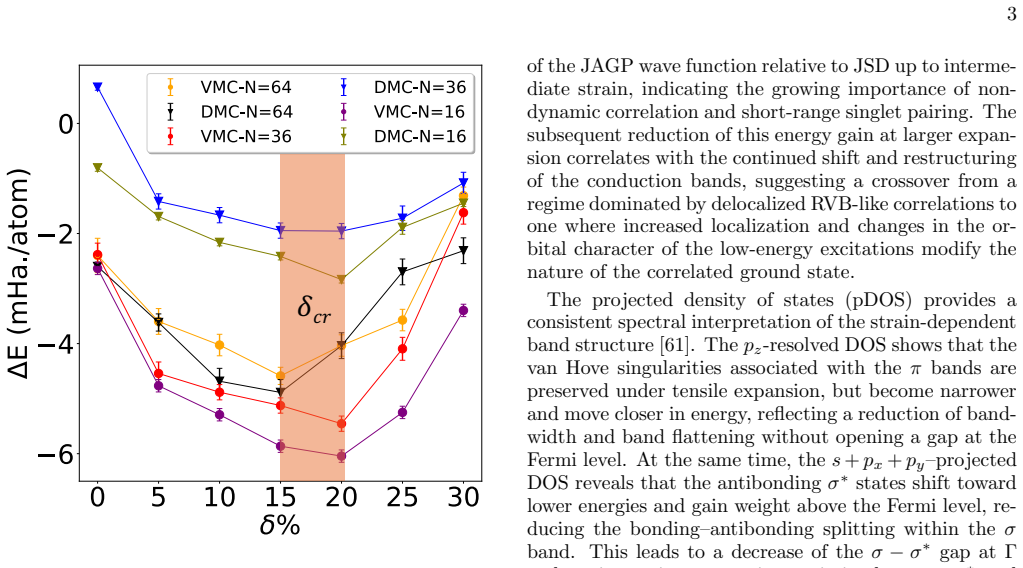
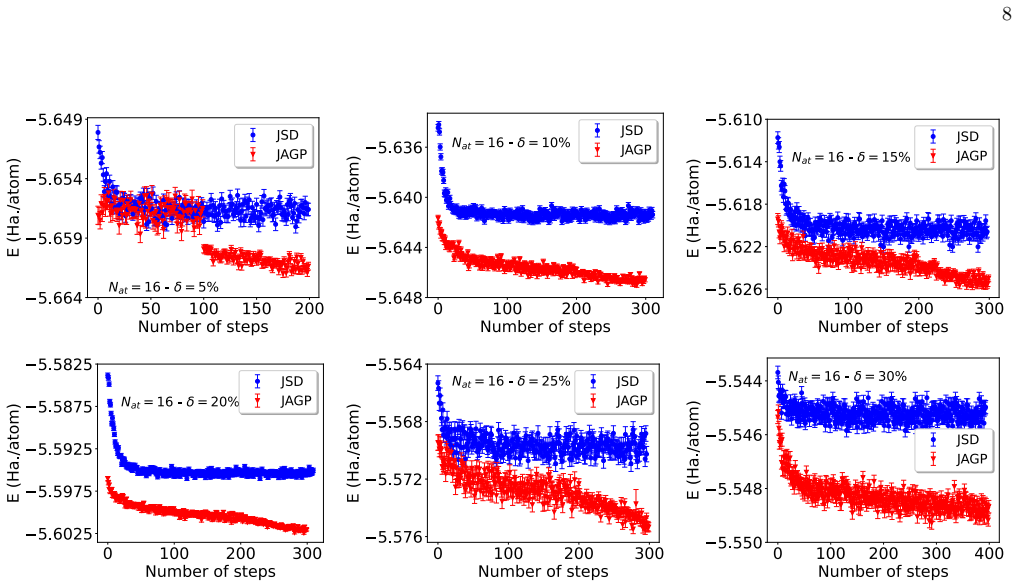
Stretching the graphene lattice increases the energy advantage of a resonating valence bond state over a single-determinant wave function up to a critical strain of 15-20 percent.
A machine-rendered reading of the paper's core claim, the machinery that carries it, and where it could break.
Core claim
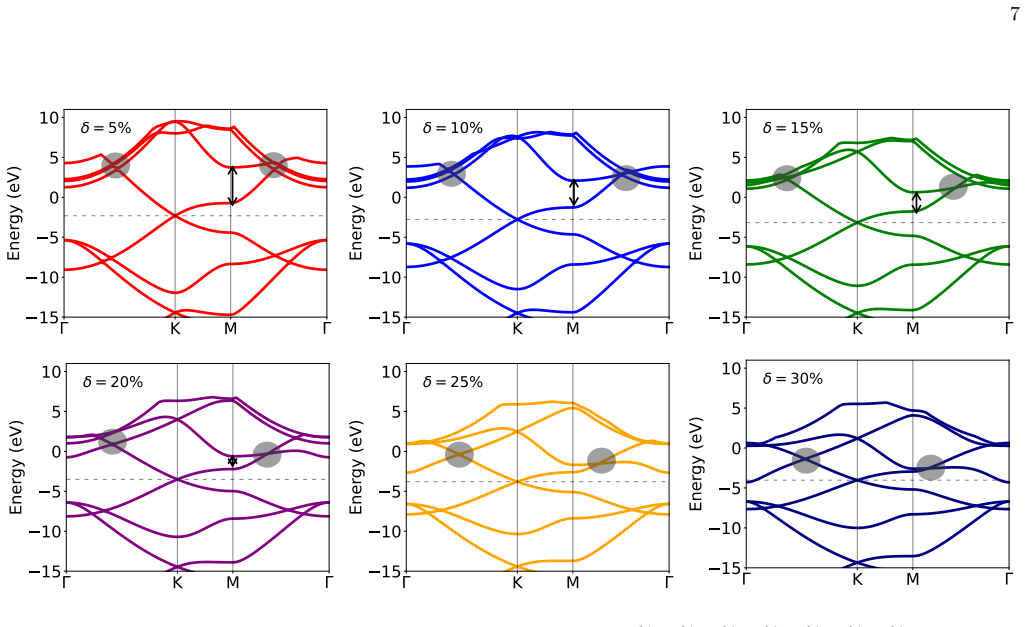
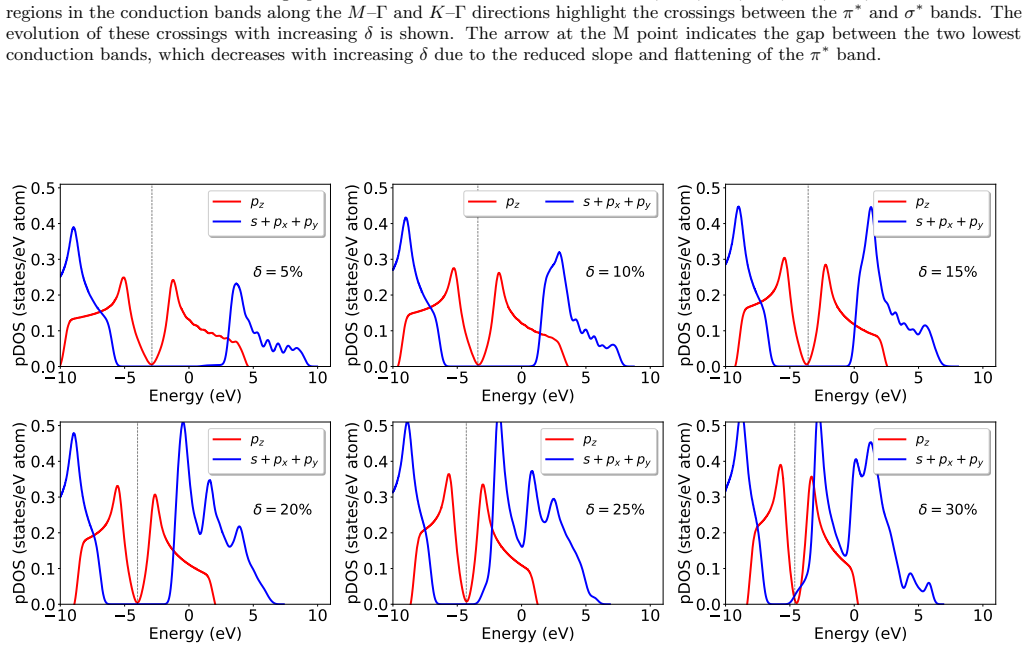
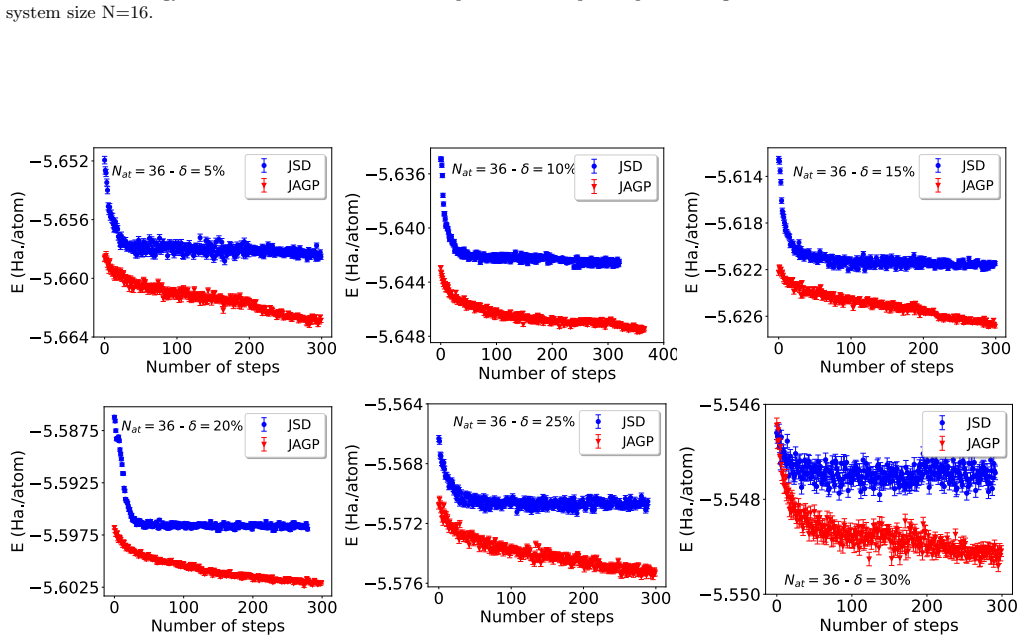
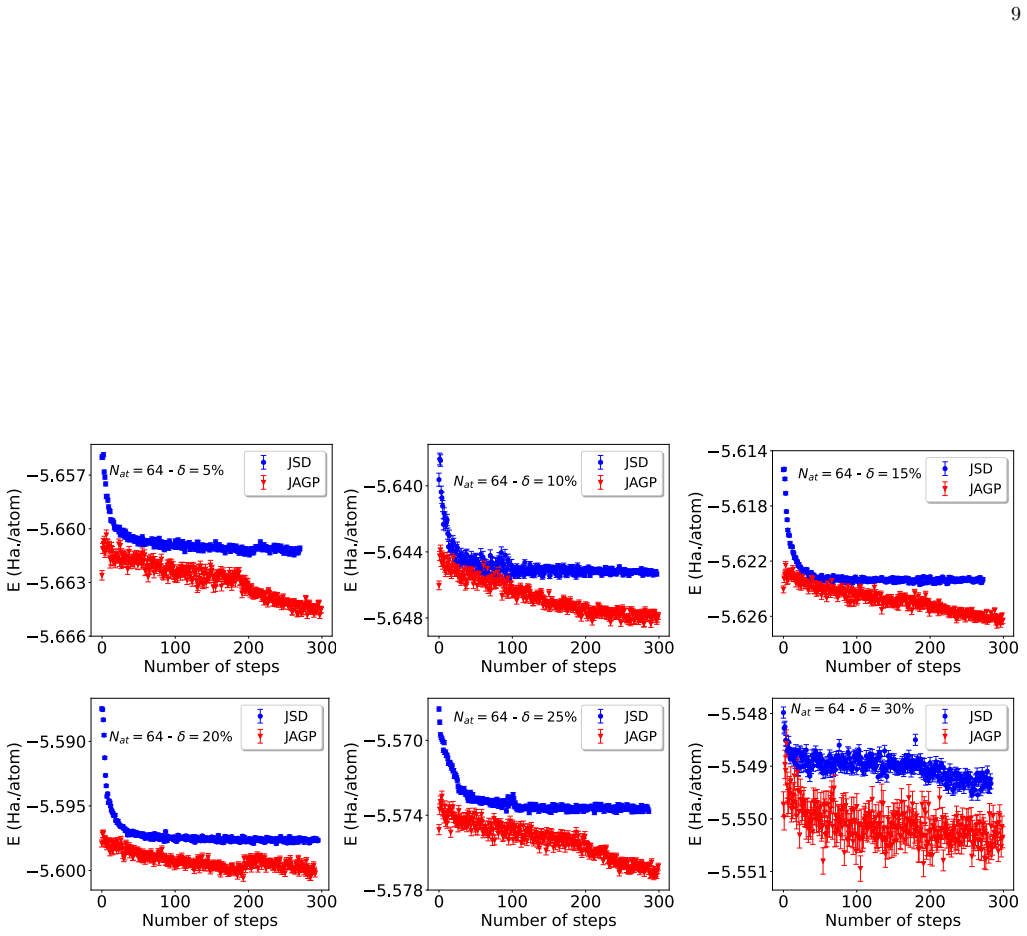
The energy gain of the RVB state relative to the single-determinant description increases with bond expansion up to a critical strain δ_cr (15% < δ_cr < 20%) and decreases beyond it. This nonmonotonic evolution signals a transition from a weakly correlated Dirac semimetal to a regime with enhanced non-dynamic correlation and short-range singlet pairing.
What carries the argument
The RVB Jastrow-antisymmetrized geminal product ansatz, which incorporates short-range singlet pairing and yields a lower variational energy than the Jastrow-Slater determinant once the lattice is stretched.
If this is right
- Below the critical strain the RVB description systematically lowers the total energy relative to the Slater determinant.
- Above the critical strain the energy advantage of the RVB state shrinks, marking a reversal in the trend of correlation strength.
- The location of the crossover coincides with the range of mechanical stability of the stretched honeycomb lattice.
- Tensile expansion therefore supplies a direct route to enhancing non-dynamic correlations and short-range singlet pairing in graphene.
Where Pith is reading between the lines
- Similar strain-driven crossovers may appear in other two-dimensional Dirac materials whose bandwidth can be tuned by lattice expansion.
- Spectroscopic signatures of the enhanced singlet correlations, such as changes in the low-energy spectral weight, could be searched for near 15-20 percent strain.
- The non-monotonic energy difference supplies a concrete target for testing whether variational superiority of the RVB ansatz tracks the true ground-state ordering.
Load-bearing premise
The RVB geminal-product ansatz is assumed to capture the dominant correlation physics more accurately than the conventional Slater determinant when the lattice expands.
What would settle it
A higher-accuracy calculation, such as an exact diagonalization on a sufficiently large cluster or a more complete quantum Monte Carlo projection, that finds the single-determinant energy lower than the RVB energy at 18 percent strain.
Figures
read the original abstract
Electronic correlations in graphene are generally considered weak due to the large bandwidth of its $\pi$ electrons. Here we show that tensile expansion of the honeycomb lattice provides a direct route to enhancing correlation effects. Using variational and diffusion quantum Monte Carlo, we compare a conventional Jastrow-Slater determinant wave function with a resonating-valence-bond (RVB) Jastrow-antisymmetrized geminal product ansatz for a series of stretched graphene lattices. We find that the energy gain of the RVB state relative to the single-determinant description increases with bond expansion up to a critical strain $\delta_{\mathrm{cr}}$, and decreases beyond it, revealing a nonmonotonic evolution of electronic correlations. The crossover is found to occur in the range $15\% < \delta_{\mathrm{cr}} < 20\%$, in agreement with mechanical stability limits. This behavior indicates a transition from a weakly correlated Dirac semimetal to a regime with enhanced non-dynamic correlation and short-range singlet pairing. Our results provide direct many-body evidence that lattice expansion drives graphene into a regime where RVB-like correlations become energetically favorable, offering a simple route to tuning correlation effects in Dirac materials.
Editorial analysis
A structured set of objections, weighed in public.
Referee Report
Summary. The paper claims that tensile expansion of the graphene honeycomb lattice enhances electronic correlations, as evidenced by variational and diffusion Monte Carlo calculations comparing a Jastrow-Slater determinant (JSD) wave function to a resonating-valence-bond Jastrow-antisymmetrized geminal product (JAGP) ansatz. The energy gain of the RVB state relative to the single-determinant description increases with bond expansion up to a critical strain δ_cr (15% < δ_cr < 20%) and decreases beyond it, indicating a transition from a weakly correlated Dirac semimetal to a regime with enhanced non-dynamic correlation and short-range singlet pairing.
Significance. If the central non-monotonic crossover holds under fixed-node projection, the work supplies direct many-body evidence that lattice strain can tune correlation effects in Dirac materials toward RVB-like physics, consistent with mechanical stability limits. The dual-ansatz comparison (JSD vs. JAGP) and use of both VMC and DMC constitute a methodological strength.
major comments (2)
- [§4 (Results) and associated figures] §4 (Results) and associated figures: the reported non-monotonic strain dependence of ΔE = E_RVB − E_JSD is extracted from the variational energies; because the JAGP and JSD ansatzes possess distinct nodal hypersurfaces, it must be shown explicitly that the peak between 15% and 20% strain survives in the fixed-node DMC energies (the abstract states both methods are used, yet the crossover is not confirmed to persist after projection).
- [§3 (Computational methods)] §3 (Computational methods): finite-size scaling, time-step extrapolation, and population-control bias for the DMC runs on the strained supercells are not detailed; without these, the claimed δ_cr window cannot be distinguished from possible strain-dependent changes in the fixed-node error.
minor comments (2)
- [Abstract] Abstract: the sentence stating that both VMC and DMC are performed should specify which energies determine the reported δ_cr range and whether error bars on ΔE are included in the supporting figures.
- [Figure captions and tables] Figure captions and tables: ensure all energy-difference plots display statistical error bars and list the supercell sizes used for each strain value.
Simulated Author's Rebuttal
We thank the referee for the careful reading and constructive comments. We address the two major points below and will revise the manuscript to incorporate the requested clarifications and additional data.
read point-by-point responses
-
Referee: [§4 (Results) and associated figures] §4 (Results) and associated figures: the reported non-monotonic strain dependence of ΔE = E_RVB − E_JSD is extracted from the variational energies; because the JAGP and JSD ansatzes possess distinct nodal hypersurfaces, it must be shown explicitly that the peak between 15% and 20% strain survives in the fixed-node DMC energies (the abstract states both methods are used, yet the crossover is not confirmed to persist after projection).
Authors: We agree that explicit confirmation in fixed-node DMC is required to establish that the non-monotonic crossover is robust against differences in nodal hypersurfaces. Our DMC data do show that the peak in ΔE survives in the same 15–20% strain window (with reduced magnitude after projection). We will add a direct comparison of DMC ΔE versus strain (e.g., as an additional panel in the relevant figure or a supplementary plot) to make this explicit. revision: yes
-
Referee: [§3 (Computational methods)] §3 (Computational methods): finite-size scaling, time-step extrapolation, and population-control bias for the DMC runs on the strained supercells are not detailed; without these, the claimed δ_cr window cannot be distinguished from possible strain-dependent changes in the fixed-node error.
Authors: We acknowledge that these technical details were insufficiently documented. In the revised §3 we will expand the description to include the finite-size scaling procedure, time-step extrapolations, and population-control bias estimates performed for the strained supercells, thereby confirming that the reported δ_cr interval is not an artifact of strain-dependent fixed-node errors. revision: yes
Circularity Check
Direct numerical comparison of independent wave-function ansatzes; no reduction to fit or self-citation
full rationale
The central result is a non-monotonic strain dependence of the variational energy difference between the Jastrow-Slater determinant and the JAGP (RVB) ansatz, obtained from explicit VMC and DMC calculations on a series of stretched lattices. No parameter is fitted to a subset of the data and then re-labeled as a prediction; the crossover at 15-20% strain emerges from the computed energies themselves. No load-bearing step invokes a uniqueness theorem or ansatz from the authors' prior work, and the abstract supplies no self-citation chain that would force the reported behavior. The derivation chain is therefore self-contained against external benchmarks.
Axiom & Free-Parameter Ledger
Reference graph
Works this paper leans on
-
[1]
Novoselov, A
K. Novoselov, A. Geim, S. Morozov, D. Jiang, Y. Zhang, S. Dubonos, I. Grigorieva, and A. Firsov, Electric field effect in atomically thin carbon films, Science306, 666 (2004)
2004
-
[2]
Geim and K
A. Geim and K. Novoselov, The rise of graphene, Nat. Mterials6, 183 (2007)
2007
-
[3]
A. C. Neto, F. Guinea, N. M. Peres, K. Novoselov, and A. K. Geim, The electronic properties of graphene, Rev. Mod. Phys.81, 109 (2009)
2009
-
[4]
Novoselov, A
K. Novoselov, A. Geim, S. V. Morozov, D. Jiang, M. I. Katsnelson, I. Grigorieva, S. Dubonos, and A. Firsov, Two-dimensional gas of massless dirac fermions in graphene, Nature438, 197 (2005)
2005
-
[5]
V. N. Kotov, B. Uchoa, V. M. Pereira, F. Guinea, and A. H. C. Neto, Electron-electron interactions in graphene: Current status and perspectives, Rev. Mod. Phys.84, 1067 (2012)
2012
-
[6]
S. D. Sarma, S. Adam, E. Hwang, and E. Rossi, Elec- tronic transport in two-dimensional graphene, Rev. Mod. Phys.83, 407 (2011)
2011
-
[7]
Y. Cao, V. Fatemi, S. Fang, K. Watanabe, T. Taniguchi, E. Kaxiras, and P. Jarillo-Herrero, Unconventional super- conductivity in magic-angle graphene superlattices, Na- ture566, 43 (2018)
2018
-
[8]
Zheng, Y
H. Zheng, Y. Gan, P. Abbamonte, and L. K. Wagner, Importance ofσbonding electrons for the accurate de- scription of electron correlation in graphene, Phys. Rev. Lett.119, 166402 (2017)
2017
-
[9]
Guinea, M
F. Guinea, M. Katsnelson, and A. Geim, Energy gaps and a zero-field quantum hall effect in graphene by strain engineering, Nat. Physics6, 30 (2010)
2010
-
[10]
G. J. Verbiest, C. Stampfer, S. E. Huber, M. Andersen, and K. Reuter, Interplay between nanometer-scale strain variations and externally applied strain in graphene, Phys. Rev. B93, 195438 (2016)
2016
-
[11]
Rakshit and P
B. Rakshit and P. Mahadevan, Absence of rippling in graphene under biaxial tensile strain, Phys. Rev. B 82, 15340782, 153407 (2010)
2010
-
[12]
Changgu, X
L. Changgu, X. Wei, J. Kysar, and J. Hone, Measure- ment of the elastic properties and intrinsic strength of monolayer graphene, Science321, 385 (2008)
2008
-
[13]
Pereira, A
V. Pereira, A. C. Neto, and N. Peres, Tight-binding ap- proach to uniaxial strain in graphene, Phys. Rev. B80, 045401 (2009)
2009
-
[14]
A. C. Neto, F. Guinea, N. Peres, K.S.Novoselov, and A. Geim, The electronic properties of graphene, Rev. Mod. Phys.81, 109 (2009)
2009
-
[15]
Uchoa and A
B. Uchoa and A. H. C. Neto, Superconducting states of pure and doped graphene, Phys. Rev. Lett.98, 146801 (2007)
2007
-
[16]
McChesney, A
J. McChesney, A. Bostwick, T. Ohta, T. Seyller, K. Horn, J. Gonzalez, and E. Rotenberg, Extended van hove singu- larity and superconducting instability in doped graphene, Phys. Rev. Lett.104, 136803 (2010)
2010
-
[17]
Pathak and V
S. Pathak and V. B. G. Baskaran, Possible high- temperature superconducting state with a d+id pairing symmetry in doped graphene, Phys. Rev. B81, 085431 (2010)
2010
-
[18]
Paiva, R
T. Paiva, R. Scalettar, W. Zheng, R. Singh, and J. Oit- maa, Ground-state and finite-temperature signatures of quantum phase transitions in the half-filled hubbard model on a honeycomb lattice, Phys. Rev. B72, 085123 (2005)
2005
-
[19]
Sorella, Y
S. Sorella, Y. Otsuka, and S. Yunoki, Absence of a spin liquid phase in the hubbard model on the honeycomb lattice, Sci. Rep.2, 992 (2012)
2012
-
[20]
Assaad and I
F. Assaad and I. Herbut, Pinning the order: The nature of quantum criticality in the hubbard model on honey- comb lattice, Phys. Rev. X3, 031010 (2013)
2013
-
[21]
Ceperley, G
D. Ceperley, G. V. Chester, and M. H. Kalos, Monte carlo simulation of a many-fermion study, Phys. Rev. B 16, 3081 (1977)
1977
-
[22]
Ceperley and B
D. Ceperley and B. Alder, Quantum monte carlo, Science 231, 555 (1986)
1986
-
[23]
W. M. C. Foulkes, L. Mitas, R. J. Needs, and G. Ra- jagopal, Quantum Monte Carlo simulations of solids, Rev. Mod. Phys.73, 33 (2001)
2001
-
[24]
Becca and S
F. Becca and S. Sorella,Quantum Monte Carlo ap- proches for correlated systems(Cambridge University, Cambridge, UK, 2017)
2017
-
[25]
Drummond, M
N. Drummond, M. Towler, and R. Needs, Jastrow corre- lation factor for atoms, molecules, and solids, Phys. Rev. B70, 235119 (2004)
2004
-
[26]
Drummond, A
N. Drummond, A. Williamson, R. Needs, and G. Galli, Electron emission from diamondoids: a diffusion quan- tum monte carlo study, Phys. Rev. Lett.95, 096801 (2005)
2005
-
[27]
Kolorenc and L
J. Kolorenc and L. Mitas, Applications of quantum monte carlo methods in condensed systems, Reports on Progress in Physics74, 026502 (2011)
2011
-
[28]
Foyevtsova, J
K. Foyevtsova, J. T. Krogel, J. Kim, P. Kent, E. Dagotto, and F. A. Reboredo, Ab initio quantum monte carlo calculations of spin superexchange in cuprates: The benchmarking case of Ca 2CuO3, Phys. Rev. X4, 031003 (2014)
2014
-
[29]
Azadi, N
S. Azadi, N. Drummond, A. Principi, R. Belosludov, and 5 M. Bahramy, Quantum Monte Carlo study of the quasi- particle effective mass of the two-dimensional uniform electron liquid, Phys. Rev. B112, 075141 (2025)
2025
-
[30]
A. Zen, J. G. Brandenburg, J. Klimes, A. Tkatchenko, D. Alfe, and A. Michaelides, Fast and accurate quantum monte carlo for molecular crystals, Proc. Nat. Acad. Sci. 115, 1724 (2018)
2018
-
[31]
Mazzola, S
G. Mazzola, S. Yunoki, and S. Sorella, Unexpectedly high pressure for molecular dissociation in liquid hydrogen by electronic simulation, Nat. Comm.5, 3487 (2014)
2014
-
[32]
Sorella, M
S. Sorella, M. Casula, and D. Rocca, Weak binding be- tween two aromatic rings: Feeling the van der waals attraction by quantum monte carlo methods, J. Chem. Phys.127, 014105 (2007)
2007
-
[33]
Mostaani, N
E. Mostaani, N. Drummond, and V. FalKo, Quantum monte carlo calculation of the binding energy of bilayer graphene, Phys. Rev. Lett.115, 115501 (2015)
2015
-
[34]
Mostaani, M
E. Mostaani, M. Szyniszewski, C. Price, R. Mae- zono, M. Danovich, R. Hunt, N. Drummond, and V. FalKo, Diffusion quantum monte carlo study of ex- citonic complexes in two-dimensional transition-metal dichalcogenides, Phys. Rev. B96, 075431 (2017)
2017
-
[35]
Spanu, S
L. Spanu, S. Sorella, and G. Galli, Nature and strength of interlayer binding in graphite, Phys. Rev. Lett.103, 2009 (196401)
2009
-
[36]
Azadi, A
S. Azadi, A. Principi, T. Kuehne, and M. Bahramy, Resonating valence bond pairing energy in graphene by quantum monte carlo, Phys. Rev. B113, L121101 (2026)
2026
-
[37]
Pauling,The Nature of the Chemical Bond(Cornell University Press, Ithaca, NY, 1960)
L. Pauling,The Nature of the Chemical Bond(Cornell University Press, Ithaca, NY, 1960)
1960
-
[38]
P. W. Anderson, The resonating valence bond state in La 2CuO4 and superconductivity, Science235, 1196 (1987)
1987
-
[39]
Capriotti, F
L. Capriotti, F. Becca, A. Parola, and S. Sorella, Res- onating valence bond wave functions for strongly frus- trated spin systems, Phys. Rev. Lett.87, 097201 (2001)
2001
-
[40]
P. W. Anderson, G. Baskaran, Z. Zou, and T. Hsu, Resonating–valence-bond theory of phase transitions and superconductivity in La 2CuO4-based compounds, Phys. Rev. Lett.58, 2790 (1987)
1987
-
[41]
Baskaran, Electronic model for CoO 2 layer based sys- tems: Chiral resonating valence bond metal and super- conductivity, Phys
G. Baskaran, Electronic model for CoO 2 layer based sys- tems: Chiral resonating valence bond metal and super- conductivity, Phys. Rev. Lett.91, 097003 (2003)
2003
-
[42]
S. A. Kivelson, I. P. B. E. Fradkin, V. Oganesyan, J. M. Tranquada, A. Kapitulnik, and C. Howald, How to detect fluctuating stripes in the high-temperature superconduc- tors, Rev. Mod. Phys.75, 1201 (2003)
2003
-
[43]
Black-Schaffer and S
A. Black-Schaffer and S. Doniach, Resonating va- lence bonds and mean-field d-wave superconductivity in graphite, Phys. Rev. B75, 134512 (2007)
2007
-
[44]
Azadi, R
S. Azadi, R. Singh, and T. D. K¨ uhne, Resonating valence bond Quantum Monte Carlo: Application to the ozone molecule, Int. J. Quantum Chem.115, 1673 (2015)
2015
-
[45]
Nakano, C
K. Nakano, C. Attaccalite, M. Barborini, L. Capriotti, M. Casula, E. Coccia, M. Dagrada, C. Genovese, Y. Luo, G. Mazzola, A. Zen, and S. Sorella, Turborvb: A many- body toolkit for ab initio electronic simulations by quan- tum Monte Carlo, J. Chem. Phys.152, 204121 (2020)
2020
-
[46]
Marchi, S
M. Marchi, S. Azadi, M. Casula, and S. Sorella, Resonat- ing valence bond wave function with molecular orbitals: Application to first-row molecules, J. Chem. Phys.131, 154116 (2009)
2009
-
[47]
Marchi, S
M. Marchi, S. Azadi, and S. Sorella, Fate of the res- onating valence bond in graphene, Phys. Rev. Lett.107, 086807 (2011)
2011
-
[48]
Annaberdiyev, G
A. Annaberdiyev, G. Wang, C. A. Melton, M. C. Ben- nett, L. Shulenburger, and L. Mitas, A new generation of effective core potentials from correlated calculations: 3d transition metal series, J. Chem. Phys.149, 134108 (2018)
2018
-
[49]
M. C. Bennett, C. A. Melton, A. Annaberdiyev, G. Wang, L. Shulenburger, and L. Mitas, A new genera- tion of effective core potentials for correlated calculations, J. Chem. Phys.147, 224106 (2017)
2017
-
[50]
J. P. Perdew and A. Zunger, Self-interaction correction to density-functional approximations for many-electron systems, Phys. Rev. B23, 5048 (1981)
1981
-
[51]
Azadi, C
S. Azadi, C. Cavazzoni, and S. Sorella, Systematically convergent method for accurate total energy calculations with localized atomic orbitals, Phys. Rev. B82, 125112 (2010)
2010
-
[52]
S. Fahy, X. W. Wang, and S. G. Louie, Variational quan- tum Monte Carlo nonlocal pseudopotential approach to solids: Formulation and application to diamond, graphite, and silicon, Phys. Rev. B42, 3503 (1990)
1990
-
[53]
C. J. Umrigar, J. Toulouse, C. Filippi, S. Sorella, and R. G. Hennig, Alleviation of the fermion-sign problem by optimization of many-body wave functions, Phys. Rev. Lett.98, 110201 (2007)
2007
-
[54]
Sorella, Green function Monte Carlo with stochastic reconfiguration, Phys
S. Sorella, Green function Monte Carlo with stochastic reconfiguration, Phys. Rev. Lett.80, 4558 (1998)
1998
-
[55]
Casula, Beyond the locality approximation in the standard diffusion Monte Carlo method, Phys
M. Casula, Beyond the locality approximation in the standard diffusion Monte Carlo method, Phys. Rev. B 74, 161102(R) (2006)
2006
-
[56]
Sorella, Wave function optimization in the variational monte carlo method, Phys
S. Sorella, Wave function optimization in the variational monte carlo method, Phys. Rev. B71, 241103 (2005)
2005
-
[57]
Giannozzi and et al., Quantum Espresso: a modular and open-source software project for quantum simula- tions of materials, J
P. Giannozzi and et al., Quantum Espresso: a modular and open-source software project for quantum simula- tions of materials, J. Phys.: Condens. Matter39, 395502 (2009)
2009
-
[58]
P. G. et al., Advanced capabilities for materials modelling with Quantum Espresso, J. Phys.: Condens. Matter29, 465901 (2017)
2017
-
[59]
J. P. Perdew, K. Burke, and M. Ernzerhof, Generalized gradient approximation made simple, Phys. Rev. Lett. 77, 3865 (1996)
1996
-
[60]
Mitas, Structure of fermion nodes and nodal cells, Phys
L. Mitas, Structure of fermion nodes and nodal cells, Phys. Rev. Lett.96, 240402 (2006)
2006
-
[61]
See Supplemental Material for details of our QMC and DFT calculations, additional figures and data
-
[62]
Sorella and E
S. Sorella and E. Tosatti, Semi-metal-insulator transition of the hubbard model in the honeycomb lattice, Euro- phys. Lett.19, 699 (1992)
1992
-
[63]
Azadi, Github
S. Azadi, Github. 6 Supplemental Materials I. DFT SIMULA TIONS The DFT calculations were performed using the Quantum ESPRESSO package [57], employing the Perdew–Burke–Ernzerhof (PBE) exchange–correlation functional [59]. A plane-wave kinetic energy cutoff of 100 Ry and a charge density cutoff of 1200 Ry were used. Ul- trasoft pseudopotentials [58] with fo...
1920
discussion (0)
Sign in with ORCID, Apple, or X to comment. Anyone can read and Pith papers without signing in.