Quantifying Compromise Risk in Exceptional Access Architectures Under Sparse and Indirect Evidence
Pith reviewed 2026-06-26 20:24 UTC · model grok-4.3
The pith
Exceptional access architectures carry strictly higher modelled compromise risk than their no-EA counterparts, independent of calibration.
A machine-rendered reading of the paper's core claim, the machinery that carries it, and where it could break.
Core claim
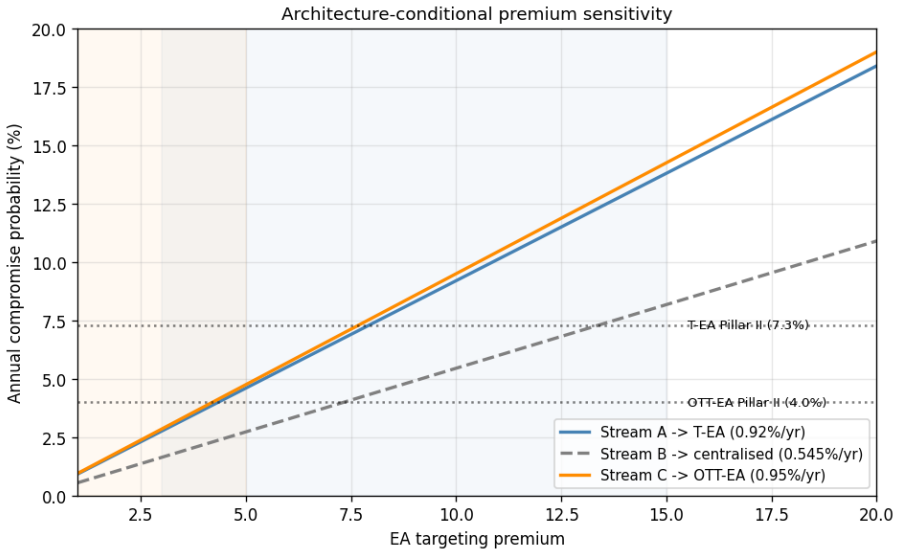
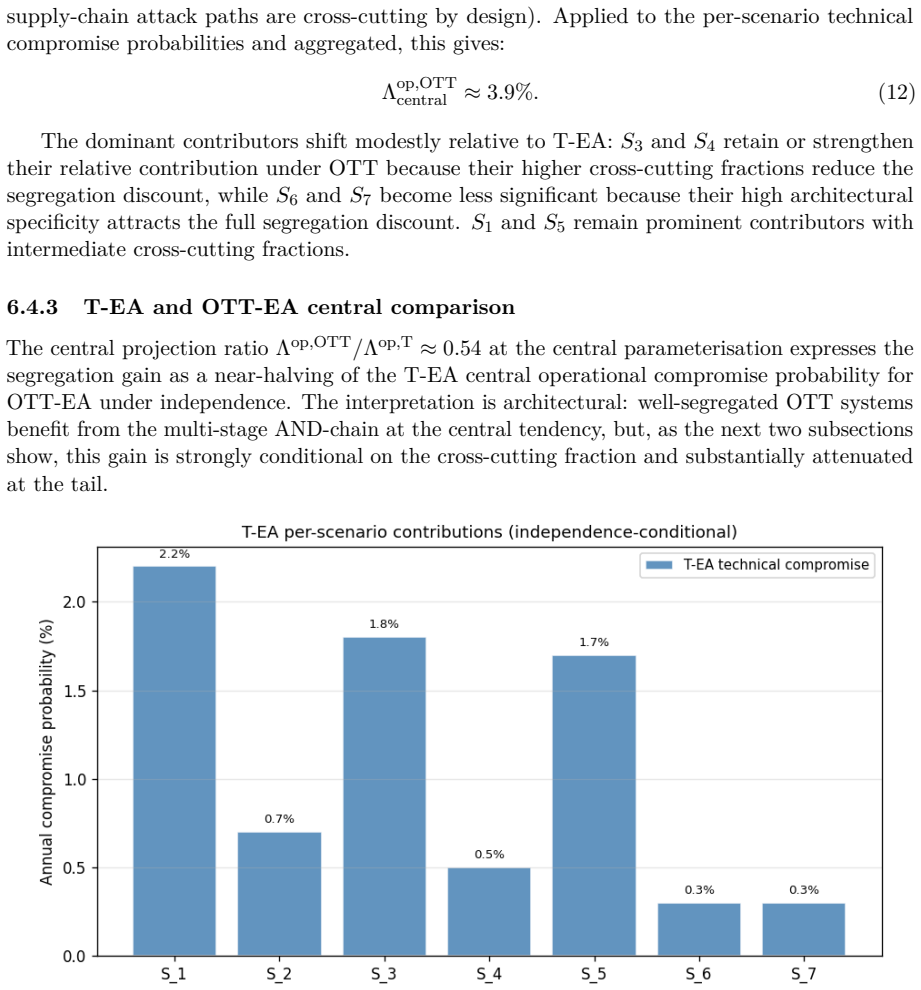
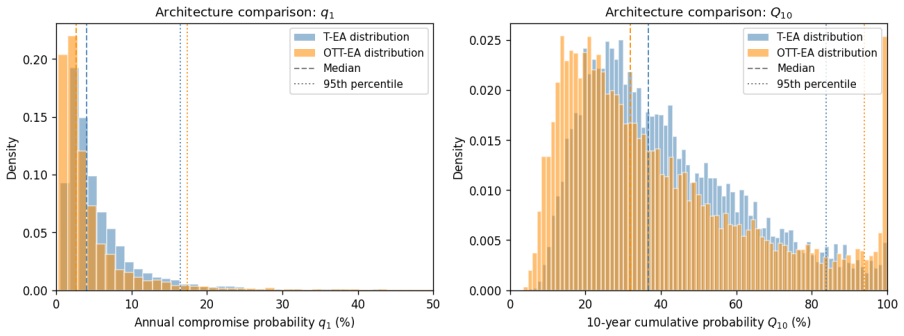
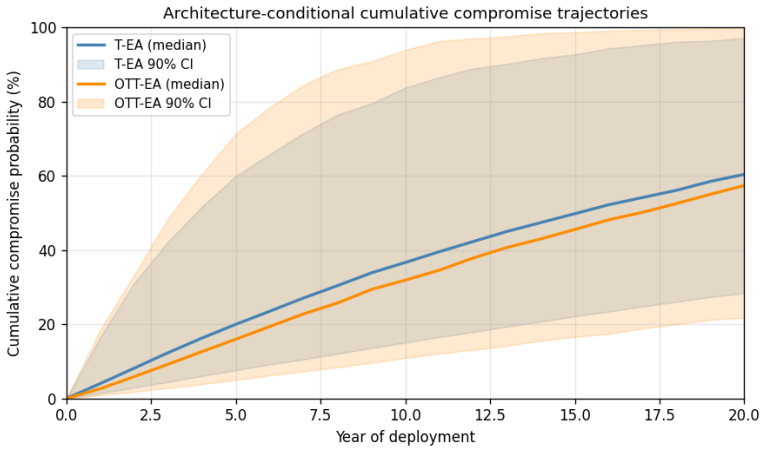
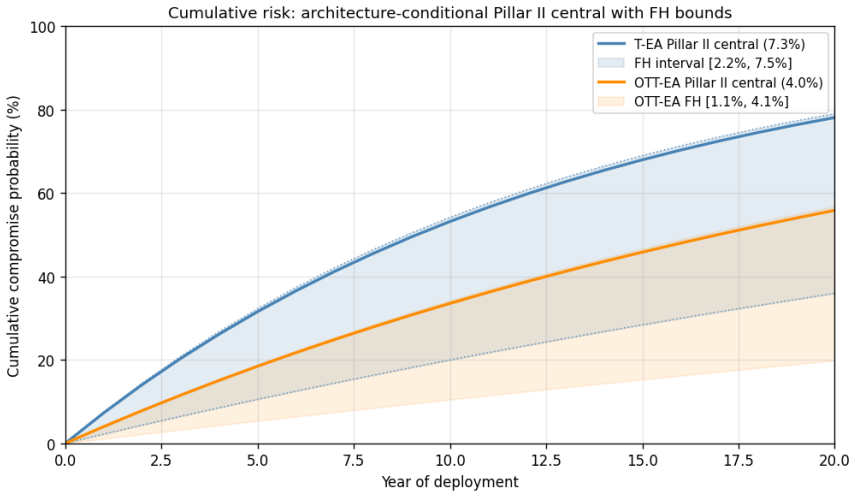
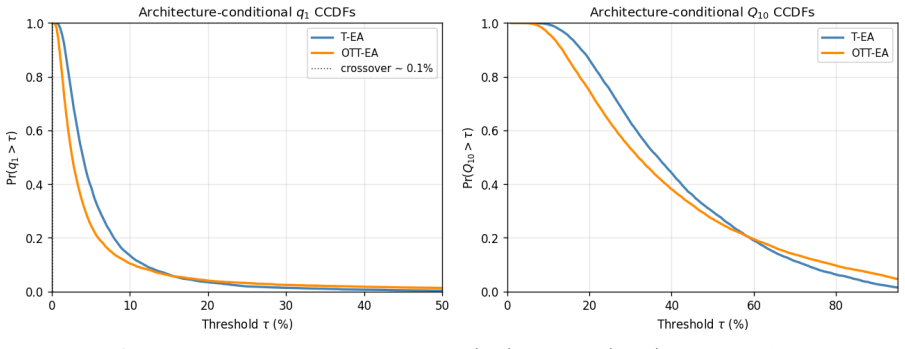
EA-equipped architectures of either class carry strictly higher modelled risk than their no-EA counterfactual, an ordering independent of calibration. T-EA risk is dominated by central tendency while OTT-EA risk is dominated by the tail under correlated campaigns. Calibration-conditional annual probability ranges span 1.4% to 12.9% for T-EA. Over multi-decade horizons cumulative compromise is well above zero; key-material exfiltration is irreversible and weighs more heavily on OTT-EA's larger user populations.
What carries the argument
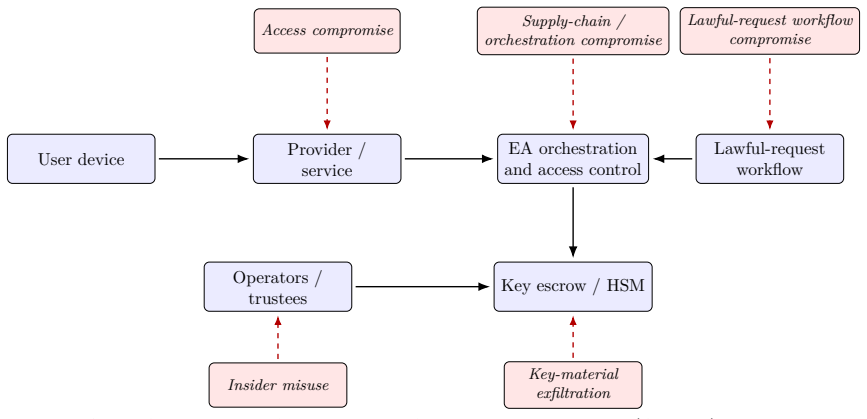
Bayesian Structural Risk Model on a parallel-subgraph attack graph, combined with historical analogues, Monte Carlo scenario layer, and channel-independence decomposition. The model separates assumption-robust structural findings from calibration-dependent results under sparse indirect evidence.
If this is right
- The risk increase for EA over no-EA holds independent of calibration choices.
- T-EA annual compromise probabilities range from 1.4% to 12.9% across the targeting-premium interval.
- Cumulative compromise probability over multi-decade periods exceeds zero for both classes.
- OTT-EA risk is more sensitive to correlated attack campaigns due to tail dominance.
- Key-material exfiltration remains irreversible and affects larger user bases under OTT-EA.
Where Pith is reading between the lines
- The separation of robust and calibration-dependent results could be tested on other security architectures that lack direct incident data.
- Policy comparisons of EA designs could use the structural risk ordering even before precise probability values are known.
- Adding explicit consequence or benefit models would be required to translate the probability increases into net policy trade-offs.
Load-bearing premise
The four analytical layers can separate findings that are robust to assumptions from those that depend on calibration when only sparse and indirect evidence is available.
What would settle it
A documented historical case in which an EA-equipped system experienced lower or equal compromise rates than a matched no-EA system over comparable time and scale, or direct evidence that the channel-independence assumption fails in a way that reverses the modelled risk ordering.
Figures
read the original abstract
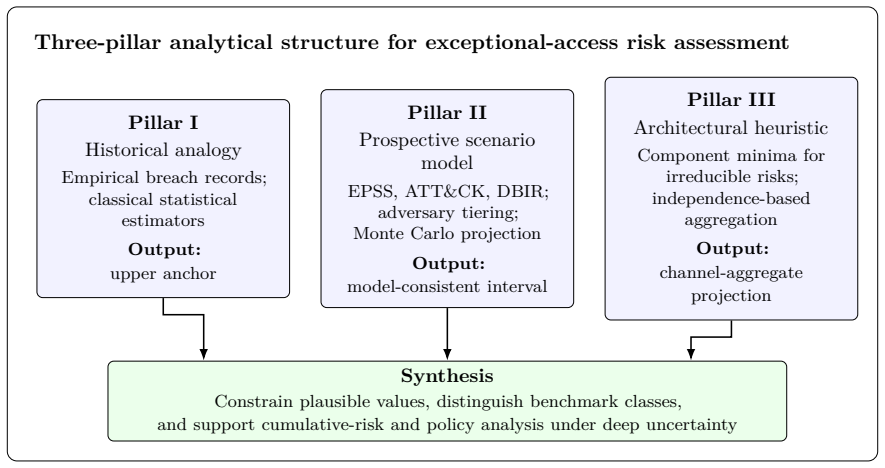
Lawful exceptional access (EA) systems hold the cryptographic keys that decrypt protected communications for authorised parties. The debate over their risks has been long and qualitative, complicated by two problems: no public dataset of EA-specific compromise events exists, so assessment must use sparse, indirect evidence; and prior work has treated structurally different designs as equivalent, though transmission-layer EA in carrier infrastructure (T-EA) and over-the-top EA at the platform layer (OTT-EA) differ in how cryptographic keys relate to ciphertext data. This paper builds a structured uncertainty framework for evaluating systemic compromise risk in EA architectures. It does not produce predictive forecasts, which the evidence cannot support; it separates findings robust to assumptions from those that depend on calibration. Four analytical layers are applied to T-EA and OTT-EA: three empirical pillars (historical analogues, a Monte Carlo scenario layer, a channel-independence decomposition) plus a Bayesian Structural Risk Model on a parallel-subgraph attack graph. The central findings are structural. First, EA-equipped architectures of either class carry strictly higher modelled risk than their no-EA counterfactual, an ordering independent of calibration. Second, the classes differ in distribution shape: T-EA risk is dominated by central tendency, OTT-EA by the tail under correlated campaigns. Third, calibration-conditional annual probability ranges span 1.4% to 12.9% for T-EA across the structured-judgement targeting-premium interval. Over multi-decade horizons, cumulative compromise is well above zero; key-material exfiltration is irreversible, weighing heavily on OTT-EA's larger user populations. The framework quantifies compromise probability, not expected harm; consequence modelling and benefit estimation are outside its scope.
Editorial analysis
A structured set of objections, weighed in public.
Referee Report
Summary. The paper develops a structured uncertainty framework for assessing systemic compromise risk in lawful exceptional access (EA) architectures under sparse and indirect evidence. It applies four analytical layers—historical analogues, Monte Carlo scenario analysis, channel-independence decomposition, and a Bayesian Structural Risk Model on a parallel-subgraph attack graph—to compare transmission-layer EA (T-EA) and over-the-top EA (OTT-EA) against no-EA counterfactuals. The central claims are structural: EA-equipped systems of either class exhibit strictly higher modelled compromise risk than no-EA, with this ordering independent of calibration; T-EA risk is dominated by central tendency while OTT-EA is dominated by the tail under correlated campaigns; and calibration-conditional annual probabilities for T-EA range from 1.4% to 12.9% across the structured-judgement targeting-premium interval. The work explicitly disclaims predictive forecasting and focuses on separating robust findings from calibration-dependent ones.
Significance. If the separation of robust structural results from calibration-dependent outputs is successfully achieved, the framework offers a disciplined approach to quantifying risks in EA systems where direct datasets are unavailable. The multi-layer decomposition and explicit use of attack graphs to model parallel paths represent a methodological contribution for policy-relevant analysis under uncertainty. The emphasis on probability rather than expected harm, combined with the irreversibility argument for key-material exfiltration, provides concrete inputs for longer-horizon discussions. The paper's restraint in not claiming forecasts is a strength.
major comments (2)
- [Bayesian Structural Risk Model and channel-independence decomposition] The central claim that the EA > no-EA risk ordering is independent of calibration (abstract and Bayesian Structural Risk Model section) requires explicit verification that the parallel-subgraph attack graph and channel-independence decomposition exclude all parameter regimes in which an EA channel is redundant or negatively correlated with existing paths. If any θ in the structured-judgement targeting-premium interval permits P(compromise | EA, θ) ≤ P(compromise | no-EA, θ) under the Monte Carlo scenario weights, the strict ordering fails and the independence assertion does not hold.
- [Four analytical layers and results separation] The separation of findings into robust versus calibration-dependent categories (abstract and § on analytical layers) is load-bearing for the paper's contribution. The manuscript must demonstrate, with concrete derivation steps, which outputs of the four layers remain invariant across the full range of the targeting-premium interval and which vary, rather than asserting the separation without showing the invariance checks.
minor comments (2)
- [Notation and calibration parameters] The definition and bounds of the 'structured-judgement targeting-premium interval' are referenced repeatedly but not given an explicit interval or elicitation procedure; this notation should be defined in a dedicated subsection or table.
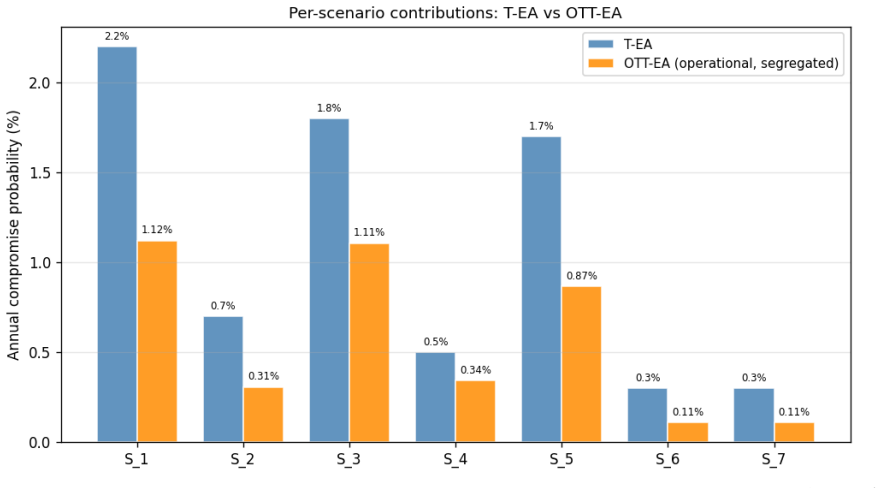
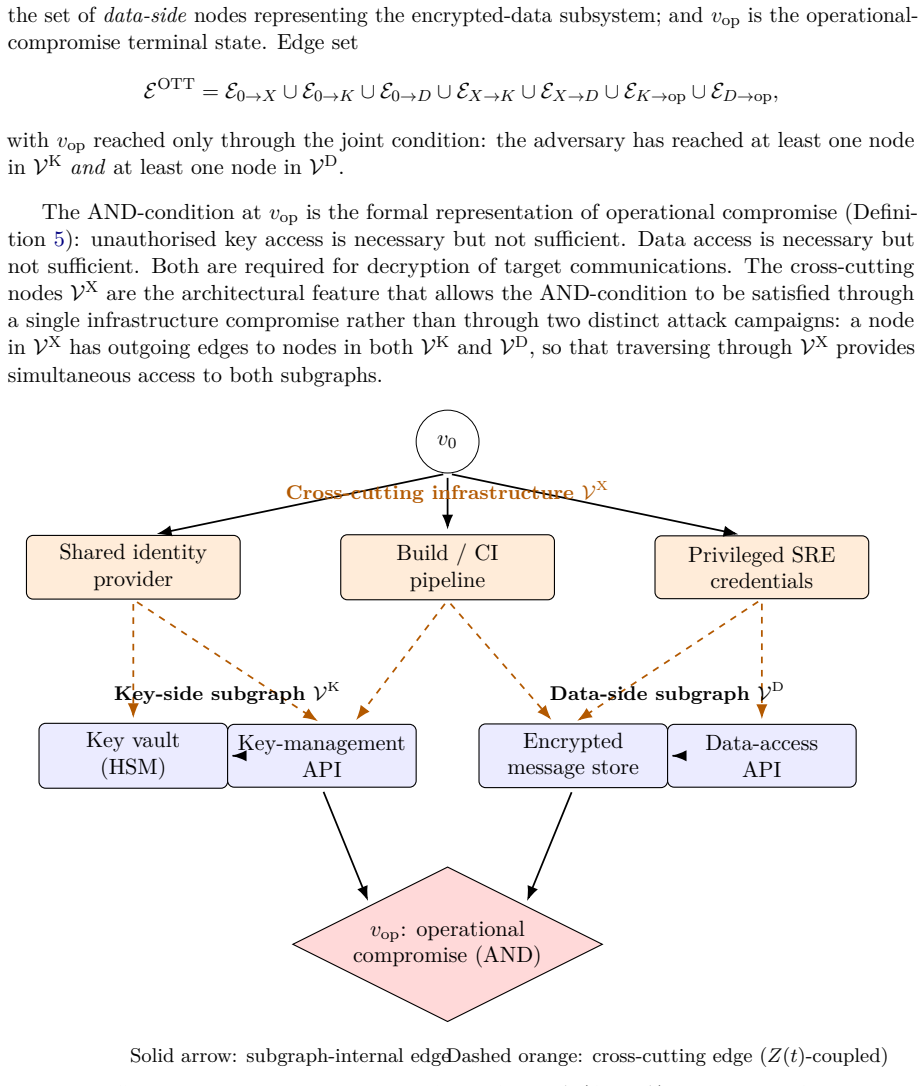
- [Figures and tables] Figure captions for the Monte Carlo scenario layer and attack-graph diagrams should include the exact parameter ranges and independence assumptions used in each panel to allow readers to trace the reported probability ranges.
Simulated Author's Rebuttal
We thank the referee for the detailed and constructive report. The comments correctly identify the need for explicit verification of the structural claims rather than assertion. We address each major comment below. Both points can be resolved by adding formal derivations and invariance checks to the revised manuscript.
read point-by-point responses
-
Referee: [Bayesian Structural Risk Model and channel-independence decomposition] The central claim that the EA > no-EA risk ordering is independent of calibration (abstract and Bayesian Structural Risk Model section) requires explicit verification that the parallel-subgraph attack graph and channel-independence decomposition exclude all parameter regimes in which an EA channel is redundant or negatively correlated with existing paths. If any θ in the structured-judgement targeting-premium interval permits P(compromise | EA, θ) ≤ P(compromise | no-EA, θ) under the Monte Carlo scenario weights, the strict ordering fails and the independence assertion does not hold.
Authors: The referee correctly notes that the independence claim requires explicit verification. The attack graph is defined with parallel subgraphs, so the EA channel constitutes an additional disjoint path. The channel-independence decomposition yields P(compromise) = 1 − ∏(1 − p_i) over paths; adding any path with p_EA > 0 therefore strictly increases the probability relative to the no-EA case. The targeting-premium interval is constructed from structured judgement such that the lower bound on p_EA is strictly positive for every θ. Negative correlation between channels is excluded by construction in the decomposition layer, which rests on the distinct attack surfaces (transmission-layer vs. application-layer). We will insert a short lemma in the revised Bayesian Structural Risk Model section proving that, for all θ in the interval and all Monte Carlo scenario weights, P(compromise | EA, θ) > P(compromise | no-EA, θ). revision: yes
-
Referee: [Four analytical layers and results separation] The separation of findings into robust versus calibration-dependent categories (abstract and § on analytical layers) is load-bearing for the paper's contribution. The manuscript must demonstrate, with concrete derivation steps, which outputs of the four layers remain invariant across the full range of the targeting-premium interval and which vary, rather than asserting the separation without showing the invariance checks.
Authors: We agree that the robust-versus-calibration-dependent separation must be shown explicitly. In the revision we will add a new subsection that performs an invariance analysis across the targeting-premium interval. For each of the four layers we will: (i) list the layer outputs (risk ordering, distribution shape, probability ranges, etc.); (ii) derive their functional dependence on the targeting-premium parameter θ; (iii) report the min/max values attained over the interval. The strict EA > no-EA ordering and the qualitative distinction between central-tendency dominance (T-EA) and tail dominance (OTT-EA) will be shown to be invariant; the numerical probability bounds will be shown to vary with θ. Tables and step-by-step derivations will be supplied. revision: yes
Circularity Check
No significant circularity; derivation relies on explicit model structure and multiple evidence layers without reduction to inputs by construction.
full rationale
The abstract and description present a Bayesian Structural Risk Model on a parallel-subgraph attack graph, combined with historical analogues, Monte Carlo scenarios, and channel-independence decomposition. The central structural claim (EA risk strictly exceeds no-EA independent of calibration) is asserted as following from this layered framework applied to sparse evidence. No equations are quoted or shown that would demonstrate the inequality reducing to a fitted parameter, self-definition, or self-citation chain. The paper explicitly states it separates robust findings from calibration-dependent ones and does not produce predictive forecasts. No self-citations, ansatz smuggling, or renaming of known results appear in the provided text. The derivation is therefore treated as self-contained against its stated assumptions and evidence layers.
Axiom & Free-Parameter Ledger
Reference graph
Works this paper leans on
-
[1]
Bellovin, Josh Benaloh, Matt Blaze, Whitfield Diffie, John Gilmore, Peter G
Harold Abelson, Ross Anderson, Steven M. Bellovin, Josh Benaloh, Matt Blaze, Whitfield Diffie, John Gilmore, Peter G. Neumann, Ronald L. Rivest, Jeffrey I. Schiller, and Bruce Schneier. The risks of key recovery, key escrow, and trusted third-party encryption. Technical report, MIT Laboratory for Computer Science, 1997
1997
-
[2]
Harold Abelson, Ross Anderson, Steven M. Bellovin, Josh Benaloh, Matt Blaze, Whitfield Diffie, John Gilmore, Matthew Green, Susan Landau, Peter G. Neumann, Ronald L. Rivest, Jeffrey I. Schiller, Bruce Schneier, Michael A. Specter, and Daniel J. Weitzner. Keys under doormats: Mandating insecurity by requiring government access to all data and communication...
-
[3]
Vincent A. W. J. Marchau, Warren E. Walker, Pieter J. T. M. Bloemen, and Steven W. Popper, editors.Decision Making under Deep Uncertainty: From Theory to Practice. Springer, 2019. ISBN 978-3-030-05252-2. doi: 10.1007/978-3-030-05252-2
-
[4]
Lempert, Steven W
Robert J. Lempert, Steven W. Popper, and Steven C. Bankes.Shaping the Next One Hundred Years: New Methods for Quantitative, Long-Term Policy Analysis. RAND Corporation,
-
[5]
ISBN 978-0-226-47321-5
-
[6]
Sarah Krouse, Dustin Volz, Aruna Viswanatha, and Robert McMillan. U.S. wiretap systems targeted in china-linked hack. The Wall Street Journal, 2024. 5 October 2024; first major report confirming access to lawful-intercept infrastructure and wiretap target lists
2024
-
[7]
good guys
Joe Mullin and Cindy Cohn. Salt typhoon hack shows there’s no security backdoor that’s only for the “good guys”. https://www.eff.org/deeplinks/2024/10/salt-typhoon-hack-shows- theres-no-security-backdoor-thats-only-good-guys, October 2024
2024
-
[8]
The Athens affair
Vassilis Prevelakis and Diomidis Spinellis. The Athens affair. https://spectrum.ieee.org/the- athens-affair, 2007
2007
-
[9]
The intelligence coup of the century
Greg Miller. The intelligence coup of the century. Washington Post investigation, with ZDF and SRF, February 2020. Joint CIA/BND ownership of Crypto AG (1970–2018); manipu- lated cipher devices sold to >100 governments enabled decryption of foreign government communications
2020
-
[10]
Yale University Press, 2017
Susan Landau.Listening In: Cybersecurity in an Insecure Age. Yale University Press, 2017. 102
2017
-
[11]
Key concepts and current technical trends in cryptography for policy makers
OECD. Key concepts and current technical trends in cryptography for policy makers. OECD Digital Economy Papers 364, Organisation for Economic Co-operation and Development, Paris, 2024
2024
-
[12]
IETF policy on wiretapping
IAB and IESG. IETF policy on wiretapping. Request for Comments RFC 2804, RFC Editor,
-
[13]
Internet Engineering Task Force policy declining to support wiretap capabilities in IETF protocols; foundational architectural-community statement on exceptional access
-
[14]
RFC 8890: The internet is for end users
Mark Nottingham. RFC 8890: The internet is for end users. https://www.rfc- editor.org/info/rfc8890/, 2020
2020
-
[15]
Principles for a more informed exceptional access debate
Ian Levy and Crispin Robinson. Principles for a more informed exceptional access debate. Lawfare, November 2018
2018
-
[16]
Open letter to GCHQ on the threats posed by the ghost proposal
Sharon Bradford Franklin and Andi Wilson Thompson. Open letter to GCHQ on the threats posed by the ghost proposal. Coalition open letter, Lawfare, May 2019. Signed by 47 civil-society organisations, security researchers, and technology companies
2019
-
[17]
Proposal for a regulation laying down rules to prevent and combat child sexual abuse
European Commission. Proposal for a regulation laying down rules to prevent and combat child sexual abuse. COM(2022) 209 final, 2022
2022
-
[18]
Identifying harmful media in end-to-end encrypted communication: Efficient private membership computation
Anunay Kulshrestha and Jonathan Mayer. Identifying harmful media in end-to-end encrypted communication: Efficient private membership computation. InProceedings of the 30th USENIX Security Symposium, pages 893–910, 2021
2021
-
[19]
Adam Young and Moti Yung.Malicious Cryptography: Exposing Cryptovirology. Wiley,
-
[20]
ISBN 978-0-7645-4975-5
-
[21]
The exact security of digital signatures—How to sign with RSA and Rabin
Mihir Bellare and Phillip Rogaway. The exact security of digital signatures—How to sign with RSA and Rabin. InAdvances in Cryptology – EUROCRYPT 1996, volume 1070 ofLecture Notes in Computer Science, pages 399–416. Springer, 1996. doi: 10.1007/3-540-68339-9_34
-
[22]
Butterworth-Heinemann, 2014
Jack Freund and Jack Jones.Measuring and Managing Information Risk: A FAIR Approach. Butterworth-Heinemann, 2014. ISBN 978-0-12-420231-3
2014
-
[23]
Lawrence A. Gordon and Martin P. Loeb. The economics of information security investment. ACM Transactions on Information and System Security, 5(4):438–457, 2002. doi: 10.1145/ 581271.581274
arXiv 2002
-
[24]
Nayot Poolsappasit, Rinku Dewri, and Indrajit Ray. Dynamic security risk management using Bayesian attack graphs.IEEE Transactions on Dependable and Secure Computing, 9 (1):61–74, 2012. ISSN 1941-0018. doi: 10.1109/TDSC.2011.34
-
[25]
CRC Press, 2nd edition, 2018
Norman Fenton and Martin Neil.Risk Assessment and Decision Analysis with Bayesian Networks. CRC Press, 2nd edition, 2018. ISBN 978-1-4398-0910-5
2018
-
[26]
Xinming Ou, Wayne F. Boyer, and Miles A. McQueen. A scalable approach to attack graph generation. InACM CCS, pages 336–345, Alexandria Virginia USA, 2006. ACM. ISBN 978-1-59593-518-2. doi: 10.1145/1180405.1180446
-
[27]
Lingyu Wang, Anyi Liu, and Sushil Jajodia. Using attack graphs for correlating, hypothes- izing, and predicting intrusion alerts.Computer Communications, 29(15):2917–2933, 2006. ISSN 0140-3664. doi: 10.1016/j.comcom.2006.04.001
-
[28]
Raj Rajagopalan, and Anoop Singhal
John Homer, Su Zhang, Xinming Ou, David Schmidt, Yanhui Du, S. Raj Rajagopalan, and Anoop Singhal. Aggregating vulnerability metrics in enterprise networks using attack graphs.Journal of Computer Security, 21(4):561–597, 2013. ISSN 0926-227X, 1875-8924. doi: 10.3233/JCS-130475. 103
-
[29]
Miles A. McQueen, Wayne F. Boyer, Mark A. Flynn, and George A. Beitel. Time-to- compromise model for cyber risk reduction estimation. In Dieter Gollmann, Fabio Massacci, and Artsiom Yautsiukhin, editors,Quality of Protection: Security Measurements and Metrics, volume 23 ofAdvances in Information Security, pages 49–64, Boston, MA, 2006. Springer US. ISBN 9...
-
[30]
Lawless.Statistical Models and Methods for Lifetime Data
Jerald F. Lawless.Statistical Models and Methods for Lifetime Data. Wiley-Interscience, 2nd edition, 2003. ISBN 9780471372111
2003
-
[31]
Carlin, Hal S
Andrew Gelman, John B. Carlin, Hal S. Stern, David B. Dunson, Aki Vehtari, and Donald B. Rubin.Bayesian Data Analysis. CRC Press / Chapman & Hall, 3rd edition, 2013. ISBN 978-1-4398-4095-5
2013
-
[32]
Tibshirani.An Introduction to the Bootstrap
Bradley Efron and Robert J. Tibshirani.An Introduction to the Bootstrap. Chapman & Hall, 1993. ISBN 978-0-412-04231-7
1993
-
[33]
James A. Hanley and Abby Lippman-Hand. If nothing goes wrong, is everything all right? interpreting zero numerators.JAMA, 249(13):1743–1745, 1983. ISSN 0098-7484. doi: 10.1001/jama.1983.03330370053031. PubMed PMID: 6827763
-
[34]
Klugman, Harry H
Stuart A. Klugman, Harry H. Panjer, and Gordon E. Willmot.Loss Models: From Data to Decisions. Wiley, 4th edition, 2012. ISBN 978-1-118-31532-3
2012
-
[35]
Comparing vulnerability severity and exploits using case-control studies.ACM Transactions on Information and System Security, 17(1):1–20,
Luca Allodi and Fabio Massacci. Comparing vulnerability severity and exploits using case-control studies.ACM Transactions on Information and System Security, 17(1):1–20,
-
[36]
doi: 10.1145/2630069
-
[37]
Exploit prediction scoring system (EPSS).Digital Threats: Research and Practice, 2(3): 1–17, 2021
Jay Jacobs, Sasha Romanosky, Benjamin Edwards, Idris Adjerid, and Michael Roytman. Exploit prediction scoring system (EPSS).Digital Threats: Research and Practice, 2(3): 1–17, 2021. doi: 10.1145/3436242
-
[38]
Jay Jacobs, Sasha Romanosky, Octavian Suciu, Benjamin Edwards, and Armin Sarabi. Enhancing vulnerability prioritization: Data-driven exploit predictions with community- driven insights. InProceedings of the 2023 IEEE European Symposium on Security and Privacy Workshops (EuroS&PW), pages 194–206, 2023. doi: 10.1109/EuroSPW59978.2023. 00027
-
[39]
Strom, Andy Applebaum, Doug P
Blake E. Strom, Andy Applebaum, Doug P. Miller, Kathryn C. Nickels, Adam G. Pennington, and Cody B. Thomas. MITRE ATT&CK: Design and philosophy. Technical Report MTR180076, MITRE Corporation, 2018
2018
-
[40]
ATT&CK enterprise matrix, version 15
MITRE Corporation. ATT&CK enterprise matrix, version 15. Technical report, MITRE Corporation, 2024. Version 15, 2024
2024
-
[41]
2024 data breach investigations report
Verizon Business. 2024 data breach investigations report. Technical report, Verizon Business, 2024
2024
-
[42]
2025 data breach investigations report
Verizon Business. 2025 data breach investigations report. Technical report, Verizon Business,
2025
-
[43]
M-Trends 2024: Special report
Mandiant. M-Trends 2024: Special report. Technical report, Google Cloud / Mandiant, 2024
2024
-
[44]
2024 global threat report
CrowdStrike. 2024 global threat report. Technical report, CrowdStrike Inc., 2024
2024
-
[45]
PRC state-sponsored actors compromise and maintain persistent access to U.S
CISA. PRC state-sponsored actors compromise and maintain persistent access to U.S. critical infrastructure. Technical Report AA24-038A, Cybersecurity and Infrastructure Security Agency, 2024. 104
2024
-
[46]
Joint statement from FBI and CISA on the People’s Republic of China (PRC) targeting of commercial telecommunications infrastruc- ture
Federal Bureau of Investigation and CISA. Joint statement from FBI and CISA on the People’s Republic of China (PRC) targeting of commercial telecommunications infrastruc- ture. https://www.cisa.gov/news-events/news/joint-statement-fbi-and-cisa-peoples-republic- china-prc-targeting-commercial-telecommunications, 2024
2024
-
[47]
Advanced data protection for iCloud
Apple Inc. Advanced data protection for iCloud. https://support.apple.com/en- gb/guide/security/sec973254c5f/web, 2024. Accessed 2026
2024
-
[48]
Bellovin, Josh Benaloh, Matt Blaze, Jon Callas, Whitfield Diffie, Susan Landau, Peter G
Harold Abelson, Ross Anderson, Steven M. Bellovin, Josh Benaloh, Matt Blaze, Jon Callas, Whitfield Diffie, Susan Landau, Peter G. Neumann, Ronald L. Rivest, Jeffrey I. Schiller, Bruce Schneier, Vanessa Teague, and Carmela Troncoso. Bugs in our Pockets: The risks of client-side scanning.Journal of Cybersecurity, 10(1):tyad020, 2024. ISSN 2057-2085. doi: 10...
-
[49]
Silvio Micali. Fair public-key cryptosystems. In Ernest F. Brickell, editor,Advances in Cryptology — CRYPTO 1992, volume 740 ofLecture Notes in Computer Science, pages 113–138, Berlin, Heidelberg, 1993. Springer. ISBN 978-3-540-48071-6. doi: 10.1007/3-540- 48071-4_9
-
[50]
Mihir Bellare and Shafi Goldwasser. Verifiable partial key escrow. InProceedings of the 4th ACM Conference on Computer and Communications Security (CCS ’97), ACM Conferences, pages 78–91. ACM, 1997. ISBN 978-0-89791-912-8. doi: 10.1145/266420.266439
-
[51]
Dorothy E. Denning and Dennis K. Branstad. A taxonomy for key escrow encryption systems.Communications of the ACM, 39(3):34–40, 1996. ISSN 0001-0782, 1557-7317. doi: 10.1145/227234.227239
-
[52]
Black tulip: Report of the investigation into the DigiNotar certificate authority breach
Hans Hoogstraaten, Ronald Prins, Daniël Niggebrugge, Danny Heppener, Frank Groenewe- gen, et al. Black tulip: Report of the investigation into the DigiNotar certificate authority breach. Technical report, Fox-IT, 2012. Project PR-110202, Version 1.0, 13 August 2012
2012
-
[53]
TURKTRUST CA problems
Kaspersky Global Research and Analysis Team. TURKTRUST CA problems. Securelist, January 2013, 2013. Two intermediate CA certificates incorrectly issued as end-entity certificates; theresultingfraudulent*.google.comcertificatewasdetectedbyGoogleChrome’s public-key pinning on 24 December 2012
2013
-
[54]
Common sense guide to mitigating insider threats, seventh edition
Software Engineering Institute. Common sense guide to mitigating insider threats, seventh edition. Technical report, CERT National Insider Threat Center, Software Engineering Institute, Carnegie Mellon University, 2022
2022
-
[55]
Microsoft Press, 2nd edition, 2004
Steve McConnell.Code Complete. Microsoft Press, 2nd edition, 2004. ISBN 978-0-7356- 1967-8
2004
-
[56]
Before we knew it: An empirical study of zero-day attacks in the real world
Leyla Bilge and Tudor Dumitras. Before we knew it: An empirical study of zero-day attacks in the real world. InProceedings of the ACM Conference on Computer and Communications Security (CCS), pages 833–844, 2012. doi: 10.1145/2382196.2382284
-
[57]
CA incident dashboard
Mozilla. CA incident dashboard. Mozilla Wiki, CA Certificate Program, 2024. Tracks publicly disclosed certificate-authority misissuance and compliance incidents reported through Mozilla Bugzilla. Accessed 2026-05-15
2024
-
[58]
Common CA database (CCADB)
Common CA Database. Common CA database (CCADB). Online registry maintained by The Linux Foundation; operated collaboratively by the Apple, Cisco, Google, Microsoft and Mozilla root programs, 2024. Population denominator for trusted root Certificate Authorities. Maintenance transferred from Mozilla to The Linux Foundation on 7 May 2024. 105
2024
-
[59]
Alhazmi, Yashwant K
Omar H. Alhazmi, Yashwant K. Malaiya, and Indrajit Ray. Measuring, analyzing and predicting security vulnerabilities in software systems.Computers & Security, 26(3):219–228,
-
[60]
doi: 10.1016/j.cose.2006.10.002
ISSN 0167-4048. doi: 10.1016/j.cose.2006.10.002
-
[61]
Omar H. Alhazmi and Yashwant K. Malaiya. Application of vulnerability discovery models to major operating systems.IEEE Transactions on Reliability, 57(1):14–22, 2008. ISSN 1558-1721. doi: 10.1109/TR.2008.916872
-
[62]
ETSI TS 102 165-1: CYBER; methods and protocols; part 1: Method and proforma for threat, vulnerability, risk analysis (TVRA)
European Telecommunications Standards Institute. ETSI TS 102 165-1: CYBER; methods and protocols; part 1: Method and proforma for threat, vulnerability, risk analysis (TVRA). Version 5.3.1, February 2025, 2025
2025
-
[63]
A new uncertainty importance measure.Reliability Engineering & System Safety, 92(6):771–784, 2007
Emanuele Borgonovo. A new uncertainty importance measure.Reliability Engineering & System Safety, 92(6):771–784, 2007. ISSN 0951-8320. doi: 10.1016/j.ress.2006.04.015
-
[64]
Committee on national security systems (CNSS) policies and instructions
Committee on National Security Systems. Committee on national security systems (CNSS) policies and instructions. https://www.cnss.gov/CNSS/issuances/Policies.cfm, 2024. Defines governance and separation of U.S. National Security Systems cryptographic domains. Ac- cessed 2026-05-15
2024
-
[65]
Announcing the commercial National Security Algorithm Suite 2.0
National Security Agency. Announcing the commercial National Security Algorithm Suite 2.0. NSA Cybersecurity Advisory, PP-22-1338, Ver. 1.0, 2022. Documents cryptographic requirements for classified and national security systems. September 2022. Accessed 2026-05- 15
2022
-
[66]
Quantum key distribution (QKD) and quantum cryptography (QC)
National Security Agency. Quantum key distribution (QKD) and quantum cryptography (QC). NSA Cybersecurity guidance, 2020. Guidance on QKD/QC for securing National Security Systems, published October 2020. Accessed 2026-05-15
2020
-
[67]
Advanced cryptography
National Cyber Security Centre. Advanced cryptography. https://www.ncsc.gov.uk/paper/advanced-cryptography, 2025. NCSC white paper on advanced cryptographic techniques. Accessed 2026-05-15
2025
-
[68]
Algorithms, key size and parameters report – 2014, 2014
European Union Agency for Network and Information Security. Algorithms, key size and parameters report – 2014, 2014. ENISA’s cryptographic-recommendations report; latest edition in this series. Accessed 2026-05-15
2014
-
[69]
ANSSI cryptographic mechanisms recommendations
Agence nationale de la sécurité des systèmes d’information. ANSSI cryptographic mechanisms recommendations. RGSv2.0, AnnexeB1(version2.04)., 2020. Frenchsovereigncryptographic authority publications. Accessed 2026-05-15
2020
-
[70]
Cryptographic mechanisms: Recom- mendations and key lengths
Bundesamt für Sicherheit in der Informationstechnik. Cryptographic mechanisms: Recom- mendations and key lengths. Technical Guideline BSI TR-02102-1, Version 2026-01, 23 January 2026., 2026. German federal cryptographic governance and standards guidance. Accessed 2026-05-15
2026
-
[71]
NATO information assurance product catalogue (NIAPC), 2024
NATO Communications and Information Agency. NATO information assurance product catalogue (NIAPC), 2024. Catalogue of evaluated information-assurance products for NATO nations and bodies. Accessed 2026-05-15
2024
-
[72]
Communications assistance for law enforcement act (CALEA)
United States Congress. Communications assistance for law enforcement act (CALEA). Public Law 103-414., 1994. Establishes lawful intercept capability requirements for telecom- munications carriers. Accessed 2026-05-15
1994
-
[73]
Lawful interception (LI); internal network interfaces; part 1: X1
European Telecommunications Standards Institute. Lawful interception (LI); internal network interfaces; part 1: X1. Technical Specification TS 103 221-1 V1.23.1, ETSI, 106 March 2026. De facto lawful-interception internal network interface specification, in use across European and global carrier networks. Multi-part series; Part 1 specifies the X1 adminis...
2026
-
[74]
Lawful interception (LI); internal network interfaces; part 2: X2/X3
European Telecommunications Standards Institute. Lawful interception (LI); internal network interfaces; part 2: X2/X3. ETSI TS 103 221-2 V1.5.2, October 2021, 2021. Defines standardized lawful interception architectures used across European and partner-state telecommunications systems. Standard family includes TS 103 221 (X1/X2/X3), TS 102 232 (handover i...
2021
-
[75]
3GPP lawful interception architecture and functions,
3rd Generation Partnership Project. 3GPP lawful interception architecture and functions,
-
[76]
Accessed 2026-05-15
Mobile-network lawful interception standards (TS 33.126/33.127/33.128) and as- sociated cryptographic and control interfaces, covering 4G and 5G carrier infrastructure. Accessed 2026-05-15
2026
-
[77]
Open letter to RSA customers
Arthur Coviello. Open letter to RSA customers. EMC Corporation, SEC Form 8-K Exhibit 99.1, March 2011, 2011
2011
-
[78]
Powerful NSA hacking tools have been revealed online
Ellen Nakashima. Powerful NSA hacking tools have been revealed online. The Washington Post, 2016. 16 August 2016
2016
-
[79]
Highly evasive attacker leverages SolarWinds supply chain to compromise multiple global victims with SUNBURST backdoor
FireEye. Highly evasive attacker leverages SolarWinds supply chain to compromise multiple global victims with SUNBURST backdoor. Mandiant Threat Intelligence Blog, 2020
2020
-
[80]
Vault 7: CIA hacking tools revealed, 2017
WikiLeaks. Vault 7: CIA hacking tools revealed, 2017
2017
discussion (0)
Sign in with ORCID, Apple, or X to comment. Anyone can read and Pith papers without signing in.