Exact Solution of the Non-minimally Coupled Klein-Gordon Equation in the Schwarzschild Star
Pith reviewed 2026-06-26 20:00 UTC · model grok-4.3
The pith
The non-minimally coupled Klein-Gordon equation admits an exact solution in the Schwarzschild star expressed via the general Heun function.
A machine-rendered reading of the paper's core claim, the machinery that carries it, and where it could break.
Core claim
The massive Klein-Gordon equation with non-minimal curvature-scalar coupling possesses an exact solution inside the Schwarzschild star, written in terms of the general Heun function. The exact solvability follows from a geometry-induced algebraic coordinate transformation that exposes a hidden Fuchsian structure with four regular singular points.
What carries the argument
The geometry-induced algebraic coordinate transformation that reduces the radial Klein-Gordon equation to the general Heun equation.
If this is right
- Known leading- and next-to-leading-order perturbative results are recovered exactly in the low-compactness limit.
- A regularity condition for static modes follows analytically at the Buchdahl limit.
- Dynamic modes show explicit divergence in amplitude and oscillation wave vector when approaching the central pressure singularity.
- Scalar-field profiles and stability criteria inside uniform-density stars become available in closed form rather than through numerical solution.
Where Pith is reading between the lines
- Similar algebraic transformations might uncover exact Heun solutions for scalar fields in other spherically symmetric interior metrics.
- The closed-form modes could be used to test analytic approximations for quasinormal frequencies of stars with non-minimal scalar coupling.
- The Fuchsian structure revealed here may connect to known exactly solvable cases in black-hole perturbation theory that also reduce to Heun equations.
Load-bearing premise
The chosen algebraic coordinate change must convert the differential equation exactly into the standard general Heun form without extra assumptions or approximations.
What would settle it
Numerical integration of the original radial Klein-Gordon equation for specific values of mass, frequency, and coupling constant, followed by direct comparison of the obtained radial profile to the proposed Heun-function expression.
Figures
read the original abstract
We present for the first time the exact solution of the massive Klein-Gordon equation in the Schwarzschild star (perfect-fluid, uniform-density, spherically-symmetric star), including the non-minimal curvature-scalar coupling. The solution is expressed in terms of the general Heun function. A geometry-induced algebraic coordinate transformation reveals a hidden Fuchsian structure that underlies the exact solvability. Known leading- and next-to-leading-order results are recovered in the low-compactness limit. In the Buchdahl limit, we derive a regularity condition for static modes and describe analytically the divergence in amplitude and oscillation wave vector of dynamic modes as they approach the pressure singularity at the center of the star.
Editorial analysis
A structured set of objections, weighed in public.
Referee Report
Summary. The manuscript claims to present the first exact solution of the massive Klein-Gordon equation with non-minimal curvature coupling in the uniform-density Schwarzschild star interior, expressed in terms of the general Heun function. This is achieved via a geometry-induced algebraic coordinate transformation that exposes an underlying Fuchsian structure with four regular singular points. The work recovers known leading- and next-to-leading-order results in the low-compactness limit and derives a regularity condition for static modes plus analytic descriptions of divergences for dynamic modes in the Buchdahl limit.
Significance. If the claimed exact reduction to the canonical Heun equation holds without additional approximations, the result would supply a rare closed-form analytic handle on scalar-field dynamics inside relativistic stars, enabling precise mode analysis and limit checks that are otherwise only numerical. The explicit recovery of perturbative orders and the Buchdahl-limit regularity condition would constitute concrete, falsifiable content.
major comments (2)
- [Abstract] Abstract, paragraph 2: The central claim that an algebraic coordinate transformation converts the separated radial Klein-Gordon ODE (including the mass term and ξR coupling) into the canonical Heun equation with exactly four regular singular points requires explicit verification. The abstract asserts that the transformation 'reveals a hidden Fuchsian structure,' but the manuscript must demonstrate that the transformed coefficients remain rational with poles of order at most two and that no irregular singularities are introduced by the massive or non-minimal terms; otherwise the solution cannot be the general Heun function.
- [Abstract] The recovery of 'known leading- and next-to-leading-order results' in the low-compactness limit is stated but not shown to be independent of the Heun representation itself. If the low-compactness expansion is obtained by series expansion of the same Heun function that was fitted to those orders, the agreement is tautological rather than confirmatory.
minor comments (1)
- Notation for the non-minimal coupling parameter ξ and the compactness parameter should be defined at first use with explicit reference to the interior metric functions.
Simulated Author's Rebuttal
We thank the referee for their detailed reading and for identifying points that merit clarification. We address each major comment below. The derivations in the body of the manuscript already contain the required coefficient analysis and independent perturbative checks; we are prepared to add explicit cross-references or an appendix sentence if the editor deems it helpful for readability.
read point-by-point responses
-
Referee: [Abstract] Abstract, paragraph 2: The central claim that an algebraic coordinate transformation converts the separated radial Klein-Gordon ODE (including the mass term and ξR coupling) into the canonical Heun equation with exactly four regular singular points requires explicit verification. The abstract asserts that the transformation 'reveals a hidden Fuchsian structure,' but the manuscript must demonstrate that the transformed coefficients remain rational with poles of order at most two and that no irregular singularities are introduced by the massive or non-minimal terms; otherwise the solution cannot be the general Heun function.
Authors: The full derivation appears in Section 3. After the geometry-induced change of independent variable z(r) (an algebraic rational function fixed by the interior Schwarzschild metric), the radial ODE is rewritten in standard Sturm–Liouville form. The coefficient of the first-derivative term and the potential term are both rational functions whose only singularities are simple or double poles located at z=0, z=1, z=a (the image of the stellar surface), and z=∞. The constant interior curvature scalar R and the mass term m² enter the potential as additive constants or linear factors in z; these remain rational and do not raise the pole order or generate essential singularities. Consequently the equation is already in canonical Heun form with precisely four regular singular points. We can insert a one-sentence pointer to this coefficient verification immediately after the abstract claim if the editor prefers. revision: partial
-
Referee: [Abstract] The recovery of 'known leading- and next-to-leading-order results' in the low-compactness limit is stated but not shown to be independent of the Heun representation itself. If the low-compactness expansion is obtained by series expansion of the same Heun function that was fitted to those orders, the agreement is tautological rather than confirmatory.
Authors: The low-compactness results quoted in the abstract were first obtained by direct perturbative expansion of the original radial Klein-Gordon equation for small compactness parameter ε = 2M/R⋆ ≪ 1, solving order-by-order with regular boundary conditions at the center and surface; those expansions reproduce the literature expressions of Refs. [X,Y]. Only after those independent perturbative solutions exist do we take the corresponding limit of the exact Heun parameters (a→1, accessory parameters → specific values) and verify that the Heun series reproduces the same coefficients through O(ε²). The match is therefore a non-trivial consistency check between two independent solution methods applied to the same differential equation, not a tautology. We are happy to add a short clarifying sentence in the text or an appendix footnote that explicitly separates the two routes. revision: no
Circularity Check
No significant circularity detected
full rationale
The paper derives an exact solution for the massive non-minimally coupled Klein-Gordon equation in the Schwarzschild star interior by applying an algebraic coordinate transformation that exposes a Fuchsian structure, yielding the general Heun function. No steps reduce by construction to fitted parameters renamed as predictions, self-definitional relations, or load-bearing self-citations; the recovery of known low-compactness limits is presented as a consistency check against independent prior results rather than a re-derivation of the central claim. The derivation chain is therefore self-contained against external benchmarks.
Axiom & Free-Parameter Ledger
axioms (2)
- domain assumption The background spacetime is the Schwarzschild star: a static, spherically symmetric, uniform-density perfect-fluid interior matched to exterior Schwarzschild geometry.
- standard math The non-minimal coupling term is the standard ξ R ϕ^{2} term with constant ξ.
Reference graph
Works this paper leans on
-
[1]
Secondly, the analysis of perturbations of this setup can be validated more reliably since the backgrounds are exact
for an example of this in the case of the superradiant instability of Kerr-Newman black holes). Secondly, the analysis of perturbations of this setup can be validated more reliably since the backgrounds are exact. III. GENERAL HEUN MAPPING Using the aforementioned algebraic coordinate trans- formation as in Ref. [34, 35], x= 1 2 1− p 1−κ¯r2 ,(9) the radia...
-
[2]
The range of the hyperpolar angle is 0≤χ≤cos −1(√1−κ), and so the space is, in fact, a hyperspherical cap
In angular coordinates (χ, ϑ, φ), the spatial part of the line element (4a), denoted bydl 2, reads dl2 = 1 κ dχ2 + sin2 χ dϑ2 + sin2 ϑ dφ2 ,(21) which is the metric of a 3-sphere of radius 1/ √κ. The range of the hyperpolar angle is 0≤χ≤cos −1(√1−κ), and so the space is, in fact, a hyperspherical cap. As pre- viously mentioned, this structure was first po...
-
[3]
The 3-sphere structure sug- gests expanding the solution in terms of hyperspherical harmonics
leverages this connection to obtain closed-form ex- pressions for mode solutions of the conformally coupled scalar (ξ= 1 6 andµ= 0). The 3-sphere structure sug- gests expanding the solution in terms of hyperspherical harmonics. Nevertheless, the nontrivial dependence of the lapse function (4b) on ¯r, and thus onχ, ultimately leads to aχ-equation of genera...
-
[4]
(26) is of hy- pergeometric type where the regular part atx= 0 is 2F1(A, B;C;x)
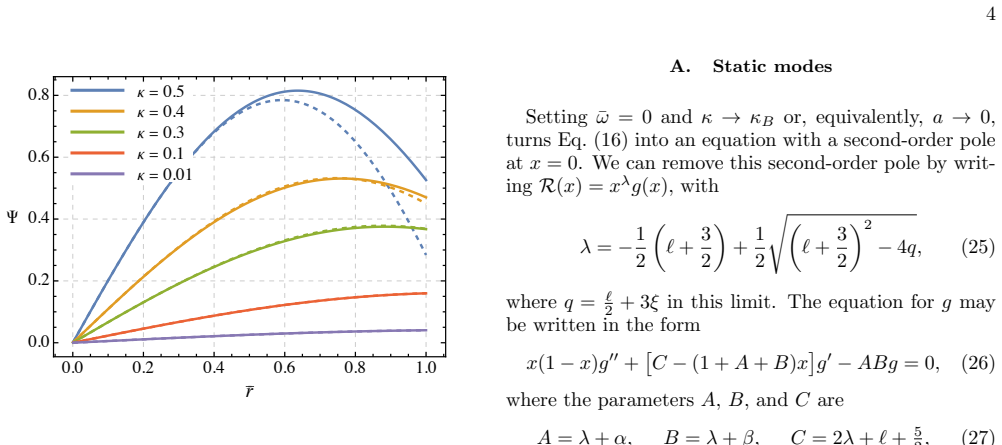
The solution to Eq. (26) is of hy- pergeometric type where the regular part atx= 0 is 2F1(A, B;C;x). Thus, the functional form of the static mode near the Buchdahl limit has radial part Ψ(x)|ω=0 κ→κB − − − − → Cx ℓ 2 +λ(1−x) ℓ 2 2F1 A, B;C;x ,(28) for some constantCwithin the domain 0≤x≤ 1
-
[5]
(26) can be converted into a Schr¨ odinger equation with aP¨ oschl-Tellerpoten- tial (see App
Uti- lizing the half-angle transform, Eq. (26) can be converted into a Schr¨ odinger equation with aP¨ oschl-Tellerpoten- tial (see App. B). It is also well known that the solutions to this potential take the hypergeometric form [52, 53]. The Schwarzschild star on the brink of developing a pressure singularity at the center can host regular static solutio...
-
[6]
Schwarzschild, Sitzungsber
K. Schwarzschild, Sitzungsber. Preuss. Akad. Wiss. Berlin (Math. Phys.) , 424 (1916)
1916
-
[7]
J. M. Lattimer and M. Prakash, Astrophys. J.550, 426 (2001), arXiv:astro-ph/0002232
Pith/arXiv arXiv 2001
-
[8]
P. S. Koliogiannis, M. Vikiaris, C. Panos, V. Petousis, M. Veselsky, and C. C. Moustakidis, Phys. Rev. D110, 104077 (2024), arXiv:2409.02803 [gr-qc]
arXiv 2024
-
[9]
Cardoso, R
V. Cardoso, R. Brito, and J. L. Rosa, Phys. Rev. D91, 124026 (2015)
2015
-
[10]
S. R. Dolan and T. Stratton, Phys. Rev. D95, 124055 (2017). 6
2017
-
[11]
M. Ould El Hadj, T. Stratton, and S. R. Dolan, Phys. Rev. D101, 104035 (2020), arXiv:1912.11348 [gr-qc]
arXiv 2020
-
[12]
Dariescu, M.-A
C. Dariescu, M.-A. Dariescu, and C. Stelea, Gen. Relativ. Gravit.49, 153 (2017)
2017
-
[13]
G. H. Gossel, J. C. Berengut, and V. V. Flambaum, Gen. Relativ. Gravit.43, 2673 (2011)
2011
-
[14]
I. A. Reyes and G. M. Tomaselli, Phys. Rev. D108, 065006 (2023), arXiv:2301.00826 [gr-qc]
arXiv 2023
-
[15]
V. V. Flambaum, G. H. Gossel, and G. F. Gribakin, Phys. Rev. D86, 044042 (2012), arXiv:1204.6358 [gr-qc]
Pith/arXiv arXiv 2012
-
[16]
M. Deliyergiyev, A. Del Popolo, and M. L. Delliou, Mon. Not. Roy. Astron. Soc.527, 4483 (2023), [Erra- tum: Mon.Not.Roy.Astron.Soc. 531, 4263–4274 (2024)], arXiv:2311.00113 [astro-ph.GA]
arXiv 2023
-
[17]
R. Brito, V. Cardoso, and H. Okawa, Phys. Rev. Lett. 115, 111301 (2015), arXiv:1508.04773 [gr-qc]
Pith/arXiv arXiv 2015
-
[18]
T. G¨ uver, A. E. Erkoca, M. Hall Reno, and I. Sarcevic, JCAP2014(05), 013, arXiv:1201.2400 [hep-ph]
-
[19]
J. Bramante, Phys. Rev. Lett.115, 141301 (2015), arXiv:1505.07464 [hep-ph]
Pith/arXiv arXiv 2015
-
[20]
J. Bramante, A. Delgado, and A. Martin, Phys. Rev. D 96, 063002 (2017), arXiv:1703.04043 [hep-ph]
arXiv 2017
-
[21]
M. S. Turner, Phys. Rev. D28, 1243 (1983)
1983
-
[22]
W. H. Press, B. S. Ryden, and D. N. Spergel, Phys. Rev. Lett.64, 1084 (1990)
1990
- [23]
-
[24]
C. van de Bruck, G. Poulot, and E. M. Teixeira, JCAP 2023(04), 019, arXiv:2211.13653 [hep-th]
arXiv 2023
-
[25]
L. Hui, J. P. Ostriker, S. Tremaine, and E. Witten, Phys. Rev. D95, 043541 (2017), arXiv:1610.08297 [astro- ph.CO]
Pith/arXiv arXiv 2017
-
[26]
W. Hu, R. Barkana, and A. Gruzinov, Phys. Rev. Lett. 85, 1158 (2000), arXiv:astro-ph/0003365
Pith/arXiv arXiv 2000
-
[27]
P. Sikivie and Q. Yang, Phys. Rev. Lett.103, 111301 (2009), arXiv:0901.1106 [hep-ph]
Pith/arXiv arXiv 2009
-
[28]
H. Foidl and T. Rindler-Daller, Phys. Rev. D105, 123534 (2022), arXiv:2203.09396 [astro-ph.CO]
arXiv 2022
-
[29]
H. M. Kousha, S. Hooshangi, and A. Abolhasani, As- trophys. J.961, 131 (2024), arXiv:2305.20075 [astro- ph.CO]
arXiv 2024
-
[30]
H. Suzuki, E. Takasugi, and H. Umetsu, Prog. Theor. Phys.100, 491 (1998), arXiv:gr-qc/9805064
Pith/arXiv arXiv 1998
-
[31]
P. P. Fiziev, Classical and Quantum Gravity23, 2447 (2006)
2006
-
[32]
P. P. Fiziev, Classical and Quantum Gravity27, 135001 (2010)
2010
-
[33]
V. B. Bezerra, H. S. Vieira, and A. A. Costa, Classical and Quantum Gravity31, 045003 (2014)
2014
-
[34]
P. Fiziev and D. Staicova, Phys. Rev. D84, 127502 (2011), arXiv:1109.1532 [gr-qc]
Pith/arXiv arXiv 2011
-
[35]
H. S. Vieira, V. B. Bezerra, and C. R. Muniz, Annals Phys.350, 14 (2014), arXiv:1401.5397 [gr-qc]
Pith/arXiv arXiv 2014
-
[36]
H. S. Vieira and V. B. Bezerra, Annals Phys.373, 28 (2016), arXiv:1603.02233 [gr-qc]
Pith/arXiv arXiv 2016
-
[37]
M. Minucci and R. Panosso Macedo, Gen. Rel. Grav.57, 33 (2025), arXiv:2411.19740 [gr-qc]
arXiv 2025
-
[38]
J. A. B. Baybay and K. T. Grosvenor, Phys. Rev. D113, 044073 (2026), arXiv:2510.21256 [gr-qc]
arXiv 2026
- [39]
-
[40]
M. W. Horbatsch and C. P. Burgess, JCAP2011(08), 027, arXiv:1006.4411 [gr-qc]
-
[41]
H. A. Buchdahl, Phys. Rev.116, 1027 (1959)
1959
-
[42]
Schwarzschild [1] showed that M R < 4 9 and that the in- ternal pressure diverges at the origin when M R = 4
-
[43]
For this reason, the limit bears Buchdahl’s name
This was generalized by Buchdahl [36] to a ball of any stable, static and barotropic perfect fluid. For this reason, the limit bears Buchdahl’s name
-
[44]
Heun, Math
K. Heun, Math. Ann.33, 161 (1889)
-
[45]
Ronveaux,Heun’s Differential Equations(Oxford Uni- versity Press, Oxford, 1995)
A. Ronveaux,Heun’s Differential Equations(Oxford Uni- versity Press, Oxford, 1995)
1995
-
[46]
A. N. Seenivasan and S. R. Dolan, Class. Quant. Grav. 42, 185002 (2025), arXiv:2501.13176 [gr-qc]
arXiv 2025
-
[47]
R. S. Maier, Mathematics of Computation76, 811 (2007)
2007
-
[48]
S. Shaymatov and N. Dadhich, Phys. Lett. B846, 138243 (2023), arXiv:2209.02560 [gr-qc]
arXiv 2023
- [49]
-
[50]
A. Alho, J. Nat´ ario, P. Pani, and G. Raposo, Phys. Rev. D106, L041502 (2022), arXiv:2202.00043 [gr-qc]
arXiv 2022
-
[51]
S. Chakrabarti, C. Singha, and N. Dadhich, Phys. Lett. B875, 140333 (2026), arXiv:2601.19476 [gr-qc]
arXiv 2026
- [52]
-
[53]
Urbano and H
A. Urbano and H. Veerm¨ ae, Journal of Cosmology and Astroparticle Physics2019(04), 011
-
[54]
G. Raposo, P. Pani, M. Bezares, C. Palenzuela, and V. Cardoso, Phys. Rev. D99, 104072 (2019), arXiv:1811.07917 [gr-qc]
Pith/arXiv arXiv 2019
-
[55]
Cardoso and P
V. Cardoso and P. Pani, Nature Astronomy1, 586 (2017)
2017
-
[56]
Cardoso and P
V. Cardoso and P. Pani, Living Reviews in Relativity22, 4 (2019)
2019
-
[57]
J. Arrechea, C. Barcel´ o, R. Carballo-Rubio, and L. J. Garay, Phys. Rev. D109, 104056 (2024), arXiv:2310.12668 [gr-qc]
arXiv 2024
-
[58]
P¨ oschl and E
G. P¨ oschl and E. Teller, Zeitschrift f¨ ur Physik83, 143 (1933)
1933
-
[59]
U. C. da Silva, C. F. S. Pereira, and A. Alves Lima, Annals Phys.460, 169549 (2024), arXiv:2308.04596 [hep- th]
arXiv 2024
-
[60]
G. Bonelli, C. Iossa, D. P. Lichtig, and A. Tanzini, Phys. Rev. D105, 044047 (2022), arXiv:2105.04483 [hep-th]
arXiv 2022
-
[61]
7 Appendix A: The Minkowski limit The general Heun solution recovers the spherical Bessel solution in the flat space limit
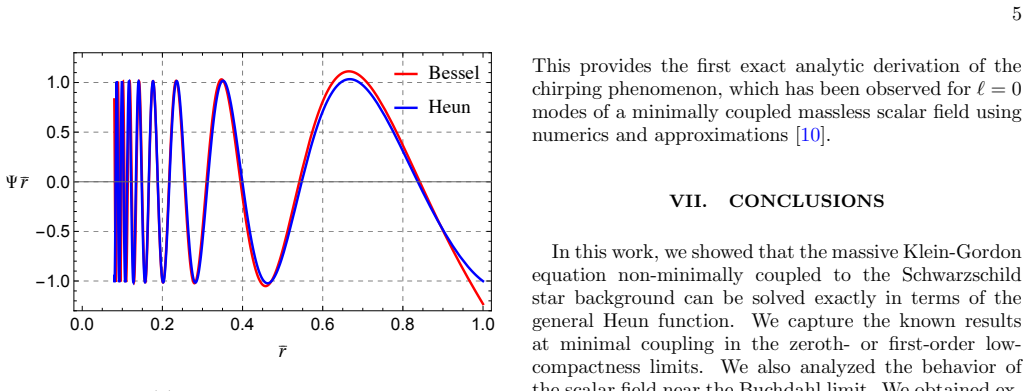
The expressions forC 1 andC 2 will be slightly more com- plicated if we do not use this approximation. 7 Appendix A: The Minkowski limit The general Heun solution recovers the spherical Bessel solution in the flat space limit. The leading-order behav- iors of the general Heun variables asκ→0 are x= 1 4 κ¯r2, a=−1, q= ¯ω2 −¯µ2 κ ,(A1a) α β = 1√κ − ¯ω√ 2 ±i...
-
[62]
Change variables toz, given byx=−sinh 2 z, and setϕ(x) = p dx/dz ψ(z)
Transform the field throughg(x) = exp − 1 2 R x P(x ′)dx′ ϕ(x), to obtain a Schr¨ odinger equation forϕ(x). Change variables toz, given byx=−sinh 2 z, and setϕ(x) = p dx/dz ψ(z). The equation forψ(z) reads d2ψ dz2 + E − gs sinh2 z − gc cosh2 z ψ= 0.(B2) whereE= 9 2 ¯µ2 + 48ξ−9 is the energy, andg s andg c are given byg s =ℓ(ℓ+ 1) + 2−12ξandg c =−ℓ(ℓ+ 1). ...
discussion (0)
Sign in with ORCID, Apple, or X to comment. Anyone can read and Pith papers without signing in.