Selective enhancement of quantum decay channels
Pith reviewed 2026-06-26 16:40 UTC · model grok-4.3
The pith
Cavity geometry enhances low-energy quantum decay rates by boosting infrared modes.
A machine-rendered reading of the paper's core claim, the machinery that carries it, and where it could break.
Core claim
In free space, quantum decays into low-energy modes are limited by low mode density despite high transition probabilities in the infrared. Inside a cavity with appropriate geometry, the mode functions gain significant infrared support, leading to enhanced probabilities and rates for low-energy decays. Resonant geometries provide sweet spots where the interaction is dramatically enhanced, allowing cavity setups to substitute for high-energy studies.
What carries the argument
The cavity geometry that controls the boundary conditions and thereby modifies the mode spectrum of the product fields towards the infrared sector.
If this is right
- Low energy decay processes can have significantly larger rates in cavities than in free space.
- Resonant cavity geometries act as enhancers for specific decay channels.
- QED processes can be studied more effectively using cavity enhancements.
- Exotic new physics processes may become observable at lower energies through this method.
Where Pith is reading between the lines
- Laboratory experiments with adjustable cavities could test enhancements in particle decays.
- This method might extend to other quantum field processes beyond decays, such as scattering.
- Connections to cavity QED experiments could provide practical implementations.
Load-bearing premise
Mode functions of product fields receive significant support towards their infrared sector inside a cavity.
What would settle it
An experiment measuring the decay rate of a quantum particle in free space versus in cavities of different geometries and observing if rates increase at resonant sizes.
Figures
read the original abstract
In the decay of quantum particles under field theoretic consideration, the decay rate is typically a convolution of the density of modes the primary field is allowed to decay into and the allowed probability density for the field to decay into such modes. In free space, though many such processes show high amplitude of such transitions towards the infrared sector, the depletion of allowed mode density in that regime arrests the efficacy of such decays at low energies. Therefore in free space, in order to enhance the decay rate, one needs the transition probability density to be rich enough towards the high energy sector where mode density support is also high enough to make the rate sufficiently large. In this work we argue that in the controlled boundary condition environment e.g. in a cavity, the mode functions of product field receive significant support towards their infrared sector, boosting the probability (and hence rates) of low energy processes. The cavity geometry offers sweet spots in terms of resonant geometry around which the interaction of a primary field with product fields receives dramatic enhancement, significantly enlarging its decay rates. Therefore, a judicious selection of cavity geometry serves as a potential substitute to studying interesting processes at high energy. The results have direct relevance for the study of QED processes and implications for the study of exotic new physics are also discussed.
Editorial analysis
A structured set of objections, weighed in public.
Referee Report
Summary. The manuscript argues that cavity boundary conditions cause the mode functions of decay-product fields to acquire significant infrared support. This boosts the convolution that determines decay rates at low energies, in contrast to free space where infrared mode density is depleted. Judicious choice of cavity geometry produces resonant enhancements that can dramatically increase rates, serving as a geometric substitute for high-energy studies, with direct relevance to QED processes and implications for exotic new physics.
Significance. If the central mechanism were demonstrated, the result would supply a novel, geometry-based method for selectively enhancing low-energy decay channels without requiring high center-of-mass energies. Such control could affect precision QED calculations and searches for beyond-Standard-Model effects. No machine-checked proofs, reproducible code, or explicit falsifiable predictions are supplied in the present manuscript.
major comments (2)
- [Abstract, paragraph 3] Abstract, paragraph 3 (§3): The claim that cavity boundary conditions cause product-field mode functions to 'receive significant support towards their infrared sector' is asserted without derivation of the mode expansion, density of states, or modified Wightman function. Standard quantization inside a finite cavity yields discrete wave-vectors with |k| ≥ π/L (or 2π/L), imposing an infrared cutoff rather than an enhancement; no explicit re-derivation overturning this cutoff is provided.
- [Abstract] Abstract: No explicit decay-rate formulas, mode functions, or numerical results are given to quantify the asserted 'dramatic enhancement' around resonant geometries. The central claim therefore rests on an unshown calculation.
minor comments (2)
- The manuscript is posted on gr-qc yet discusses QED processes; a brief statement of the gravitational or curved-space context would clarify the intended scope.
- [Abstract] The phrase 'boosting the probability (and hence rates)' is imprecise; the decay rate is the transition probability per unit time, so the distinction should be stated explicitly.
Simulated Author's Rebuttal
We thank the referee for their report. The manuscript offers a conceptual argument that cavity geometries can enhance infrared support in decay processes relative to free space. We address the major comments point by point below.
read point-by-point responses
-
Referee: [Abstract, paragraph 3] Abstract, paragraph 3 (§3): The claim that cavity boundary conditions cause product-field mode functions to 'receive significant support towards their infrared sector' is asserted without derivation of the mode expansion, density of states, or modified Wightman function. Standard quantization inside a finite cavity yields discrete wave-vectors with |k| ≥ π/L (or 2π/L), imposing an infrared cutoff rather than an enhancement; no explicit re-derivation overturning this cutoff is provided.
Authors: The manuscript advances a conceptual point that boundary conditions alter the effective mode support in the infrared relative to the free-space k² density-of-states depletion, with resonant geometries amplifying the convolution. We agree that no explicit mode expansion or Wightman-function re-derivation is supplied; the argument rests on the standard discrete spectrum in a cavity (with lowest |k| ~ π/L) combined with the observation that suitable L can populate the relevant low-momentum window more effectively than the continuum limit for the processes considered. We will incorporate a short appendix deriving the relevant mode functions and the modified convolution in a revised version. revision: yes
-
Referee: [Abstract] Abstract: No explicit decay-rate formulas, mode functions, or numerical results are given to quantify the asserted 'dramatic enhancement' around resonant geometries. The central claim therefore rests on an unshown calculation.
Authors: The central claim is presented qualitatively as a geometric mechanism that can substitute for high center-of-mass energy in selected channels. No explicit rate formulas or numerical results appear because the work is framed as a proposal highlighting the infrared-support effect rather than a complete quantitative study. We acknowledge that the absence of such calculations leaves the magnitude of the enhancement unquantified in the present text; a revised manuscript will include a sample analytic expression for the decay rate in a model cavity geometry together with an estimate of the resonant enhancement factor. revision: partial
Circularity Check
No significant circularity detected in derivation chain
full rationale
The paper presents its central claim—that cavity boundaries enhance infrared mode support for decay products—as a direct consequence of standard quantization in bounded geometries, without any self-definitional loops, fitted parameters relabeled as predictions, or load-bearing self-citations that reduce the argument to its own inputs. The abstract and described mechanism rely on the convolution of mode density with transition amplitudes under controlled boundaries, which is framed as an independent physical effect rather than a tautology. No equations, uniqueness theorems, or ansatze are quoted that collapse by construction to the input assumptions, making the derivation self-contained against external benchmarks.
Axiom & Free-Parameter Ledger
axioms (2)
- domain assumption Decay rate is a convolution of density of modes and transition probability density
- domain assumption Free-space mode density is depleted in the infrared, arresting low-energy decays
Reference graph
Works this paper leans on
-
[1]
This leads to a strong enhancement in the whole process whenever the mode frequency matches these resonant values for a specific value ofL
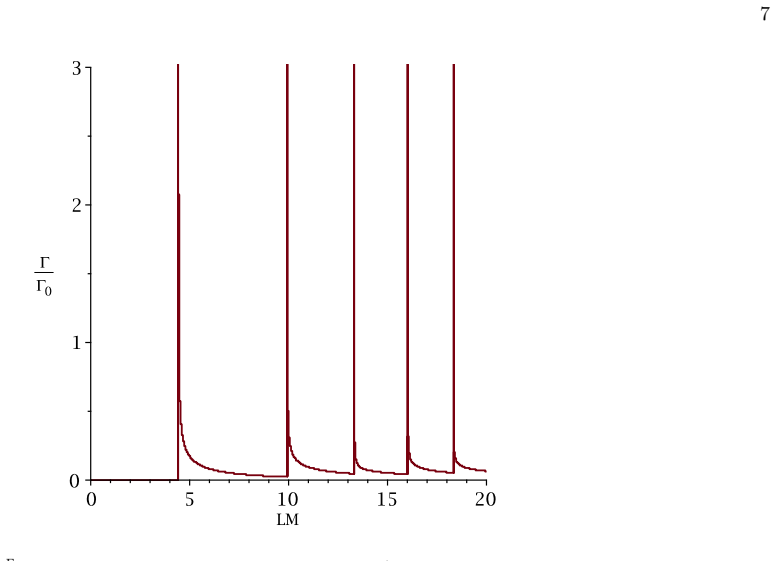
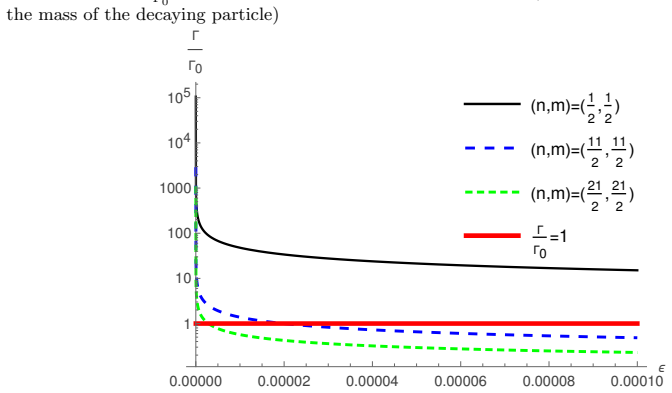
[13]. This leads to a strong enhancement in the whole process whenever the mode frequency matches these resonant values for a specific value ofL. Therefore, we can see that the decay channel of Φ intoϕ 1 gets significantly enhanced, in a cavity environment by a precise selection of the geometry such that q M2 4 − π2 L2 (n2 1 +m 2 1)− →0. In the free space...
2023
-
[2]
Andreassen, D
A. Andreassen, D. Farhi, W. Frost, and M. D. Schwartz, Phys. Rev. D95, 085011 (2017)
2017
-
[3]
Srednicki, Cross sections and decay rates (10), inQuantum Field Theory(Cambridge University Press, 2007) p
M. Srednicki, Cross sections and decay rates (10), inQuantum Field Theory(Cambridge University Press, 2007) p. 79–89
2007
-
[4]
Audretsch and P
J. Audretsch and P. Spangehl, Classical and Quantum Gravity2, 733 (1985)
1985
-
[5]
Audretsch and P
J. Audretsch and P. Spangehl, Phys. Rev. D33, 997 (1986)
1986
-
[6]
Audretsch and P
J. Audretsch and P. Spangehl, Phys. Rev. D35, 2365 (1987)
1987
-
[7]
J. C. Ward, Phys. Rev.78, 182 (1950)
1950
-
[8]
Takahashi, Nuovo Cim.6, 371 (1957)
Y. Takahashi, Nuovo Cim.6, 371 (1957)
1957
-
[9]
Nakanishi, Prog
N. Nakanishi, Prog. Theor. Phys.51, 1183 (1974)
1974
-
[10]
F. Giacosa, Found. Phys.42, 1262 (2012), arXiv:1110.5923 [nucl-th]
Pith/arXiv arXiv 2012
-
[11]
V. V. Khoze and M. Spannowsky, Nucl. Phys. B926, 95 (2018), arXiv:1704.03447 [hep-ph]
Pith/arXiv arXiv 2018
-
[12]
Crivellin, C
A. Crivellin, C. Greub, F. Saturnino, and D. M¨ uller, Phys. Rev. Lett.122, 011805 (2019)
2019
-
[13]
I. Dubovyk, A. Freitas, J. Gluza, T. Riemann, and J. Usovitsch, Phys. Lett. B783, 86 (2018), arXiv:1804.10236 [hep-ph]
Pith/arXiv arXiv 2018
-
[14]
D. J. Stargen and K. Lochan, Phys. Rev. Lett.129, 111303 (2022), arXiv:2107.00049 [gr-qc]. 9
arXiv 2022
-
[15]
This trick however, can not be employed for the massless particle decay
-
[16]
In general a more spread out state can be chosen |in⟩= Z d3 ⃗P 2E ⃗P ˜Φ( ⃗P)| ⃗P⟩, which does not change the results obtained qualitatively (see Appendix A)
For the ease of computation, we had selected the in-state as|P Φ⟩with three momentum ⃗P, and then we obtained the rate in the rest frame of this in-particle. In general a more spread out state can be chosen |in⟩= Z d3 ⃗P 2E ⃗P ˜Φ( ⃗P)| ⃗P⟩, which does not change the results obtained qualitatively (see Appendix A)
-
[17]
O. ˇCernot´ ık, A. Dantan, and C. Genes, Phys. Rev. Lett.122, 243601 (2019), arXiv:1902.10400 [quant-ph]
Pith/arXiv arXiv 2019
-
[18]
H. A. Weldon, Phys. Rev. D28, 2007 (1983)
2007
-
[19]
M. Coppola, D. Gomez Dumm, S. Noguera, and N. N. Scoccola, JHEP09, 058, arXiv:1908.10765 [hep-ph]
arXiv 1908
-
[20]
R. P. Feynman, Phys. Rev.76, 769 (1949)
1949
-
[21]
Schwinger, Phys
J. Schwinger, Phys. Rev.74, 1439 (1948)
1948
-
[22]
Y. P. Porto-Silva, S. Prakash, O. L. G. Peres, H. Nunokawa, and H. Minakata, Eur. Phys. J. C80, 999 (2020), arXiv:2002.12134 [hep-ph]
arXiv 2020
-
[23]
P. B. Pal and L. Wolfenstein, Phys. Rev. D25, 766 (1982)
1982
-
[24]
J. C. D’Olivo, J. F. Nieves, and P. B. Pal, Phys. Rev. Lett.64, 1088 (1990)
1990
-
[25]
A. H. Jaffe and M. S. Turner, Phys. Rev. D55, 7951 (1997)
1997
-
[26]
J. L. Bernal, A. Caputo, F. Villaescusa-Navarro, and M. Kamionkowski, Phys. Rev. Lett.127, 131102 (2021)
2021
-
[27]
G. Fiore and G. Modanese, Nucl. Phys. B477, 623 (1996), arXiv:hep-th/9508018
Pith/arXiv arXiv 1996
-
[28]
D. d’Enterria, M. A. Tamlihat, L. Schoeffel, H.-S. Shao, and Y. Tayalati, Phys. Lett. B846, 138237 (2023), arXiv:2306.15558 [hep-ph]. Appendix A: Decay rate calculation In this appendix, we present the full tree-level decay rate calculation, detailing each step for completeness and to reproduce Eq. (12). We express the in-state as |in⟩=N Z d3 ⃗P 2E ⃗P ˜Φ(...
arXiv 2023
discussion (0)
Sign in with ORCID, Apple, or X to comment. Anyone can read and Pith papers without signing in.