Dynamical Tides during High-Eccentricity Migration produces the Hot Jupiter Pile-up, Neptune Ridge, and Neptune Desert
Pith reviewed 2026-06-26 15:29 UTC · model grok-4.3
The pith
F-modes during high-eccentricity migration circularize orbits and unbind mass to explain hot Jupiter pile-up, Neptune ridge, and Neptune desert.
A machine-rendered reading of the paper's core claim, the machinery that carries it, and where it could break.
Core claim
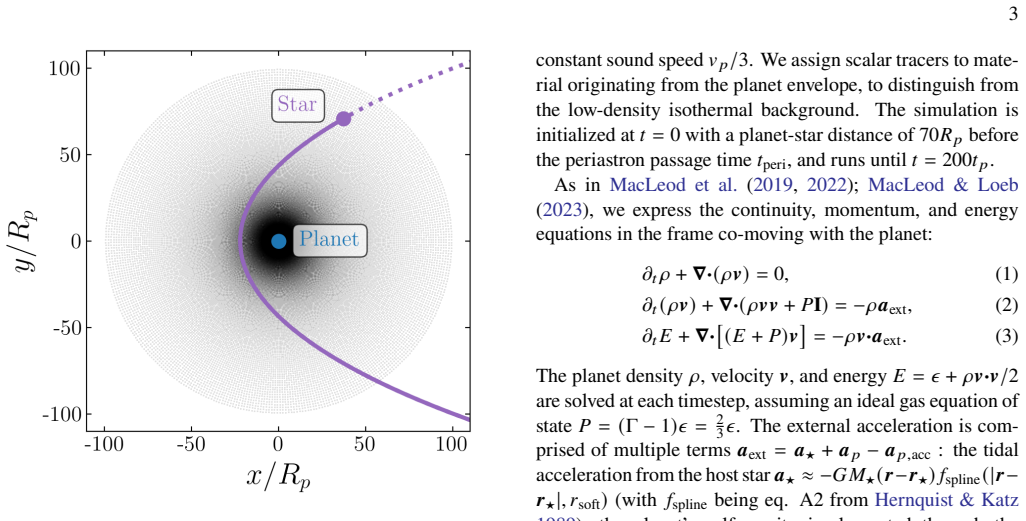
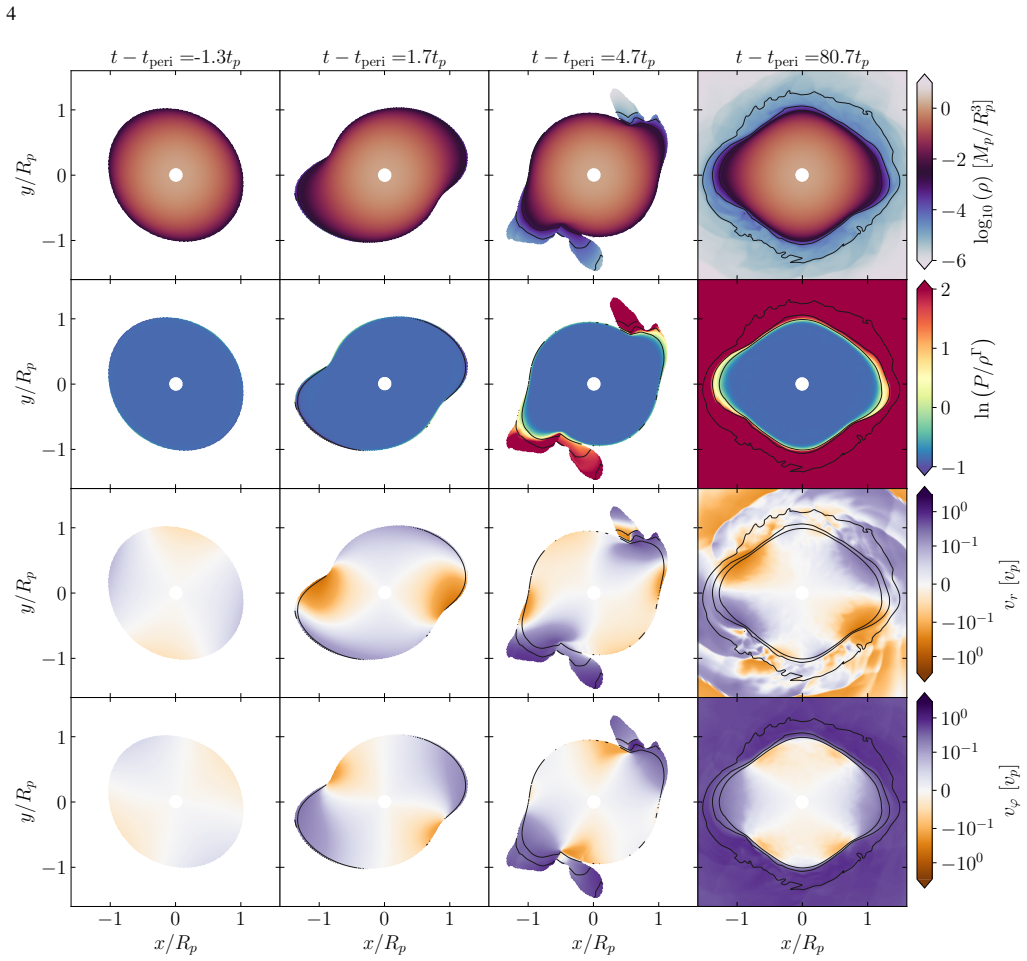
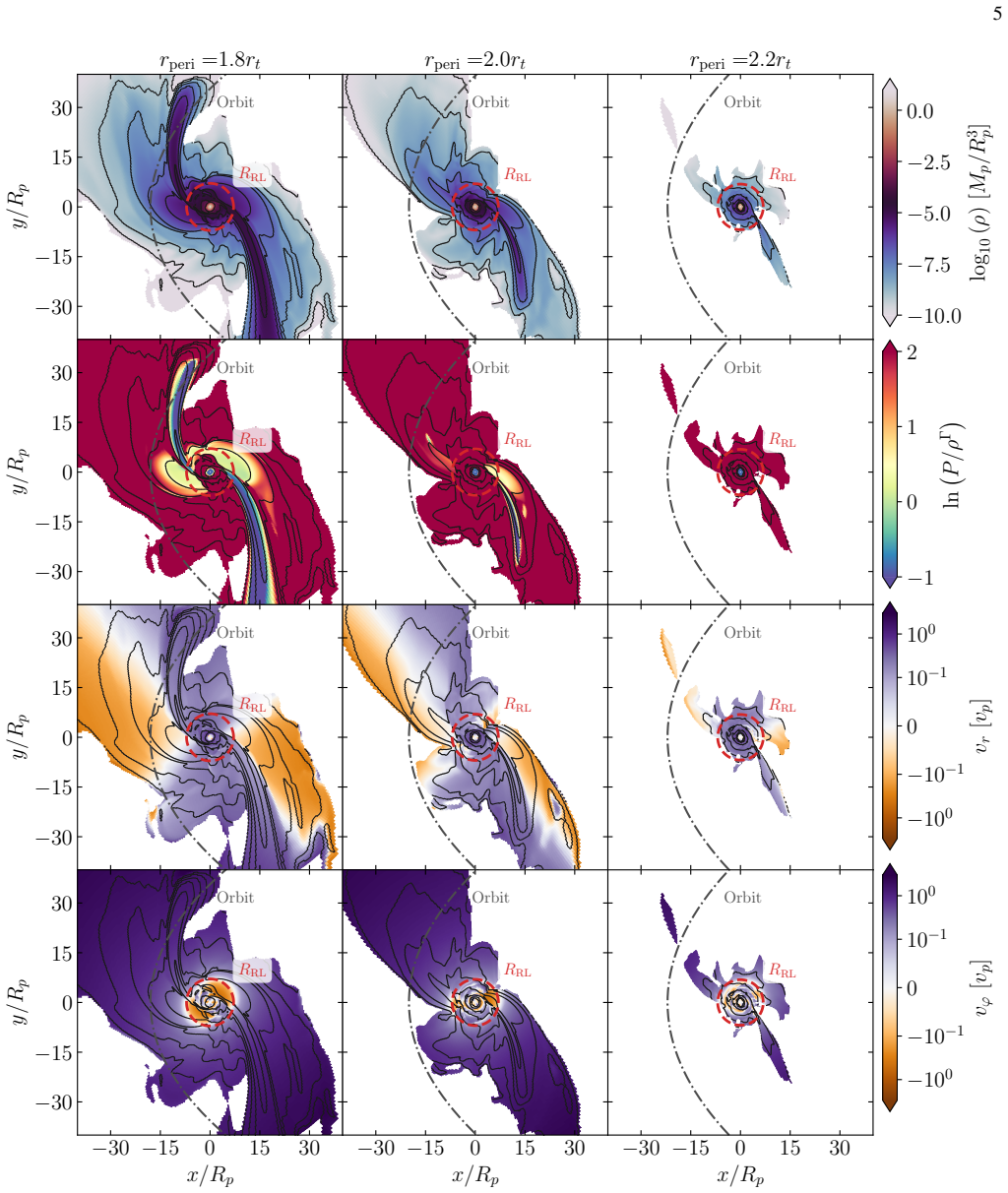
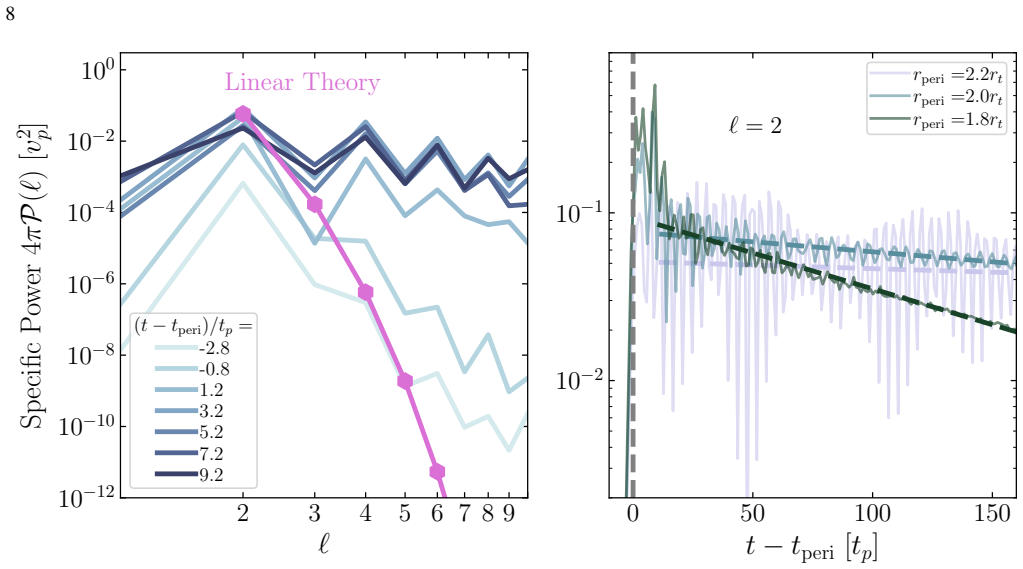
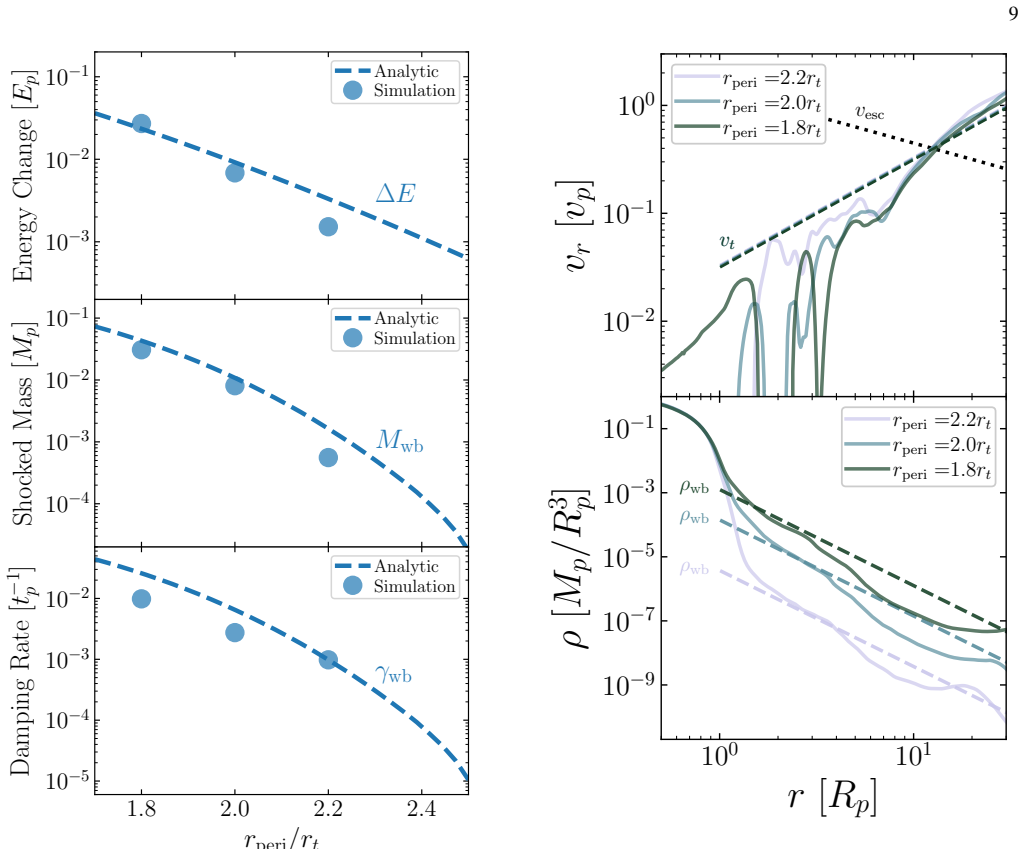
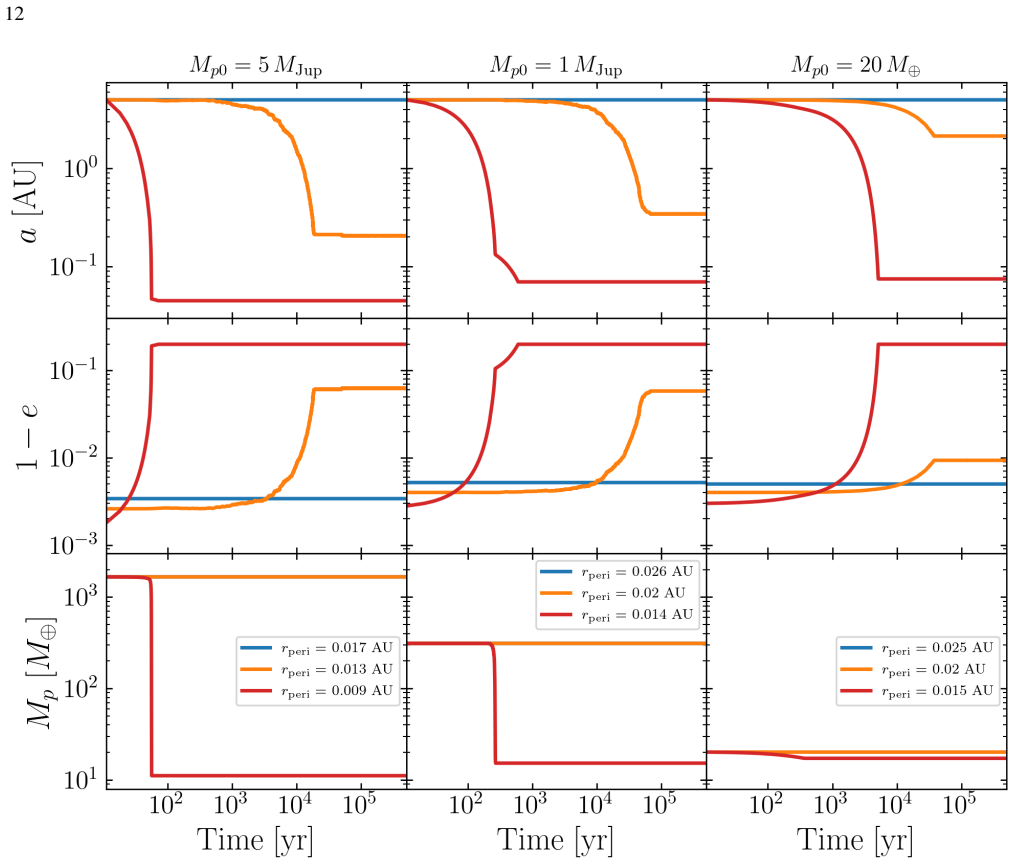
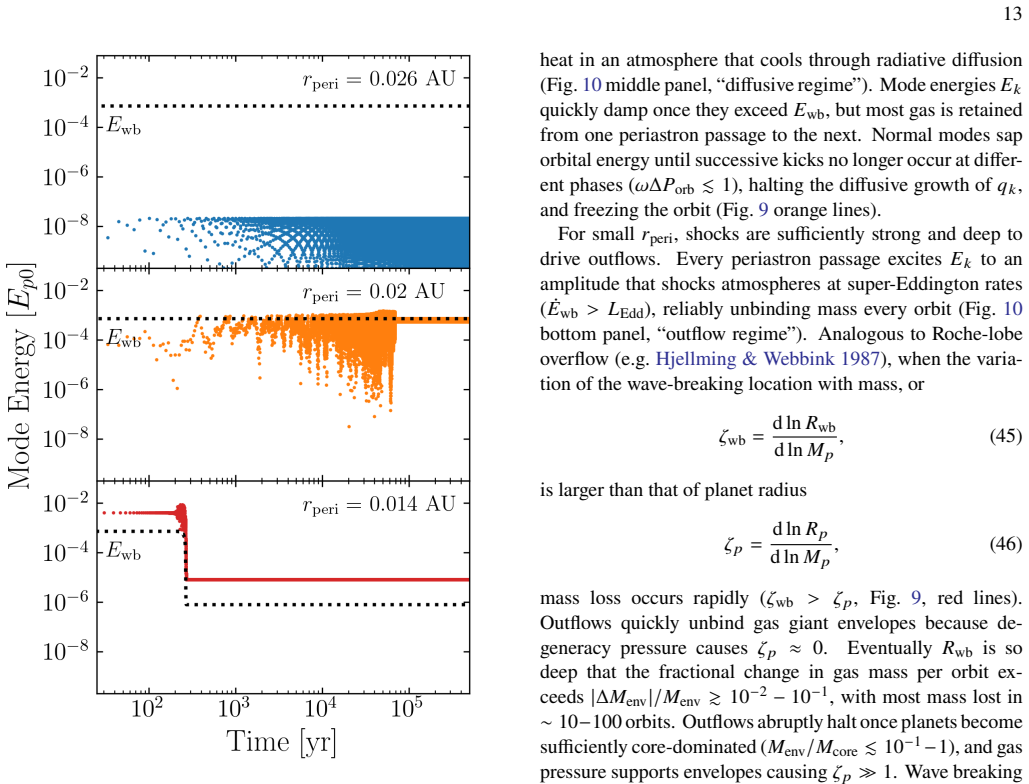
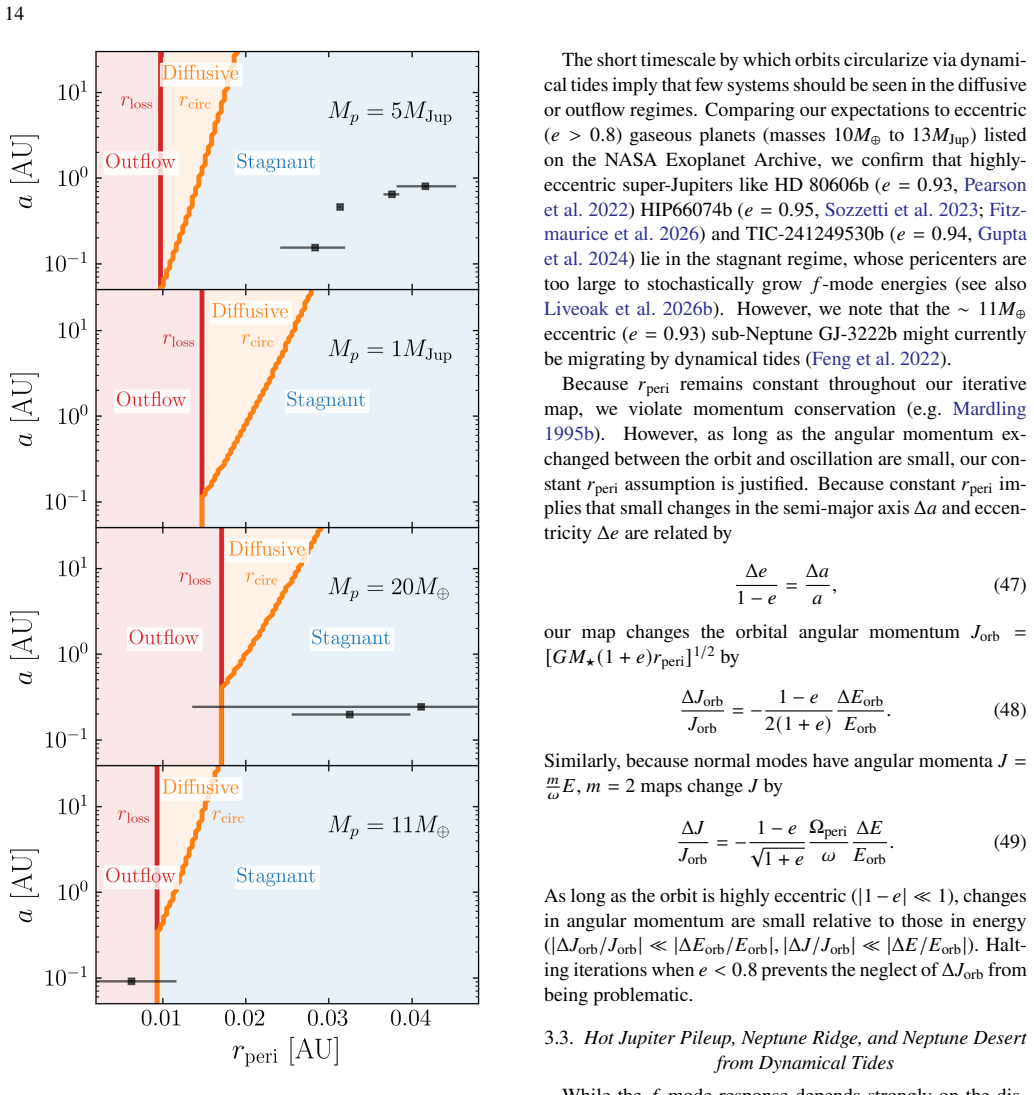
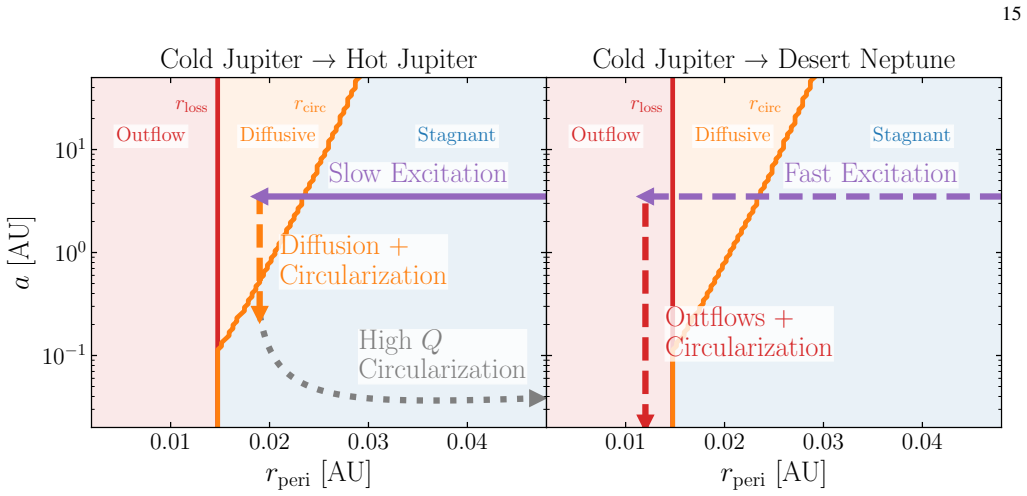
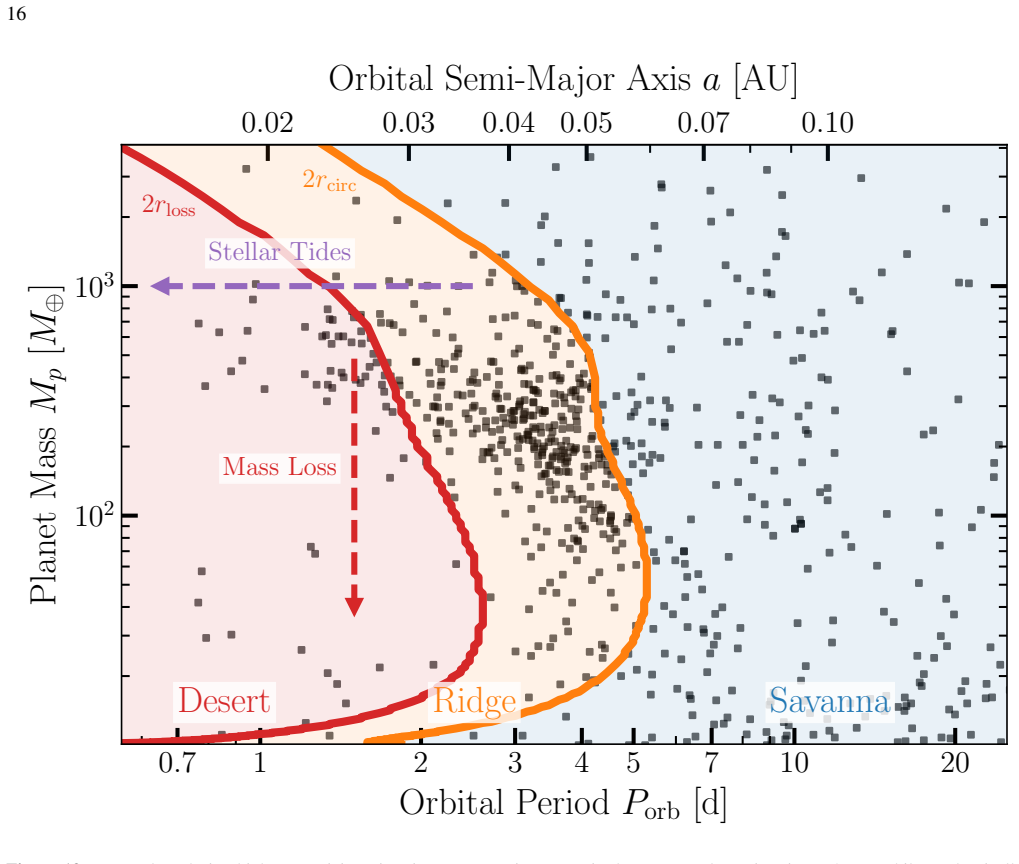
Tidally-excited f-modes act as a reservoir for orbital energy during high-eccentricity migration. Hydrodynamical simulations show that close approaches excite these modes to supersonic velocities that shock the gaseous envelopes. An iterative map tracks evolution over many passages: shallow shocks allow diffusive cooling and circularization that bunches orbits near the hot Jupiter pile-up and Neptune ridge, while deep shocks drive mass loss that places cores in the Neptune desert. Sub-Saturns in the desert are predicted to have large spin-orbit misalignments after producing luminous flares.
What carries the argument
The iterative map of planetary structural and orbital evolution driven by f-mode shocks from hydrodynamical simulations, which decides between radiative cooling and mass unbinding.
If this is right
- Sub-Saturns and Jovians cluster at orbital periods of 3 to 6 days.
- Sub-Saturn cores populate the region interior to 3 days known as the Neptune desert.
- Sub-Saturn planets in the desert arrive with large spin-orbit misalignments.
- Mass unbinding produces observable luminous flares.
- Planets formed beyond several AU can be placed at short separations by this process.
Where Pith is reading between the lines
- Observing the predicted misalignments in desert sub-Saturns would support the mass-unbinding pathway.
- The mechanism may extend to explain similar features in other exoplanet populations or different migration channels.
- Flare signatures could be searched for in time-domain surveys of young systems.
- Spin measurements of planets in the desert could distinguish this from other migration histories.
Load-bearing premise
The hydrodynamical simulations accurately predict whether f-mode shocks lead to radiative cooling or envelope unbinding across the mass and depth ranges of interest.
What would settle it
Finding sub-Saturn planets in the Neptune desert that lack large spin-orbit misalignments or associated luminous flares would indicate the mass-unbinding process does not operate as described.
Figures
read the original abstract
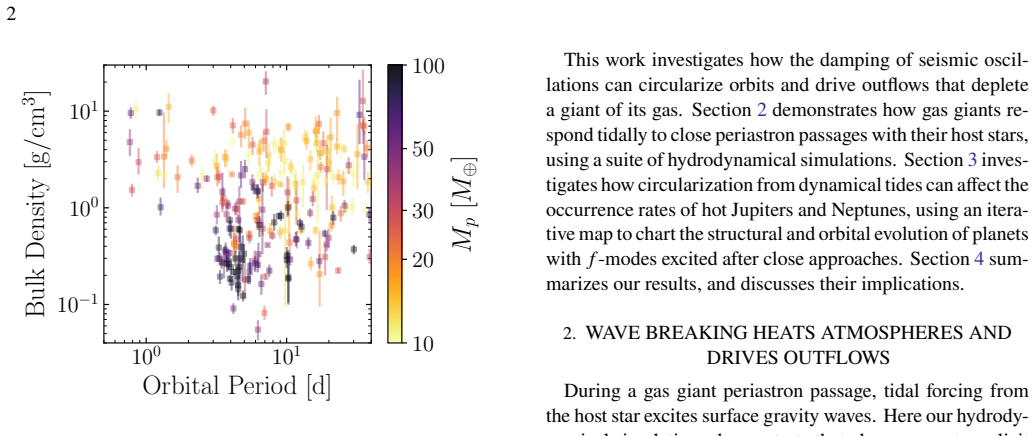
The period distribution of hot gaseous exoplanets depends strongly on mass. Clustering between the orbital periods of $\sim$3 to $\sim$5-6 days is seen for sub-Saturns ("Neptune ridge") and Jovians ("hot Jupiter pile-up"), contrasting with a sharp deficit interior to 3 days for sub-Saturns, not seen for Jovians ("Neptune desert"). During high-eccentricity migration, tidally-excited fundamental-modes (f-modes) act as a reservoir for orbital energy, and can take gaseous planets formed beyond several AU and place them at short separations. However, how f-modes relinquish their energy into the planet interior is unknown. Here, we show how f-modes can not only circularize orbits -- causing clustering near the Neptune ridge and hot-Jupiter pile-up -- but can also shock and unbind mass, leaving sub-Saturn cores in the Neptune desert. Our hydrodynamical simulations demonstrate that close approaches tidally excite f-modes, whose super-sonic velocities shock gaseous envelopes. Atmospheres cool by radiative diffusion or winds when shocks penetrate shallow versus deep depths. Planetary structural and orbital evolution is followed over many periastron passages using an iterative map: shocks that diffusively cool circularize and bunch orbits near the hot Jupiter pile-up and Neptune ridge, while shocks that drive outflows unbind envelopes and place gas giant cores in the Neptune desert. Sub-Saturns that dwell in the desert are predicted to arrive with large spin-orbit misalignments after producing luminous flares.
Editorial analysis
A structured set of objections, weighed in public.
Referee Report
Summary. The paper claims that during high-eccentricity migration, tidally excited f-modes in gaseous exoplanets produce shocks whose outcomes depend on penetration depth: shallow shocks allow radiative cooling or winds that circularize orbits and produce clustering at the Neptune ridge (~3-6 days for sub-Saturns) and hot-Jupiter pile-up, while deeper shocks unbind envelope mass, leaving cores that populate the Neptune desert (periods <3 days for sub-Saturns). This is implemented via hydrodynamical simulations that set the cooling-versus-unbinding threshold, followed by an iterative map that evolves orbital and structural parameters over many periastron passages; the work also predicts large spin-orbit misalignments and luminous flares for desert sub-Saturns.
Significance. If the depth-dependent branching holds, the mechanism supplies a single dynamical-tide channel that accounts for the mass-dependent period features without separate formation pathways and generates falsifiable predictions (misalignments, flares). The combination of hydrodynamical shock modeling with a multi-passage iterative map is a methodological strength that allows the outcomes to emerge from the physics rather than from fitted parameters.
major comments (2)
- [Hydrodynamical simulations and iterative map description] The distinction between diffusive cooling (circularization) and mass unbinding is load-bearing for the entire predicted separation into ridge, pile-up, and desert. The hydrodynamical simulations section does not report resolution or opacity sensitivity tests, nor does it validate the depth threshold against analytic shock models or observed flare luminosities; without these, the branching logic in the iterative map remains unanchored and the claimed period distributions could shift or vanish under plausible changes in envelope structure.
- [Iterative map and multi-passage evolution] The iterative map applies the single-passage outcomes repeatedly, yet the manuscript provides no demonstration that envelope mass loss or structural readjustment after the first unbinding event does not alter the shock penetration depth or cooling efficiency in subsequent passages; this assumption directly controls whether sub-Saturns remain in the desert or migrate out of it.
minor comments (2)
- Notation for the f-mode energy reservoir and the periastron distance scaling should be defined explicitly on first use rather than relying on context from the abstract.
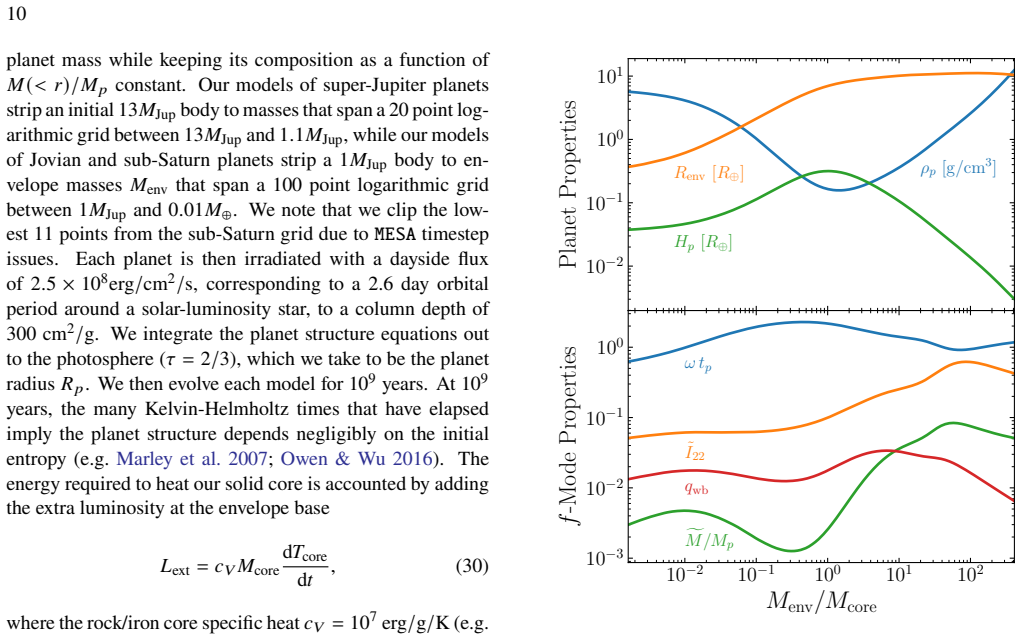
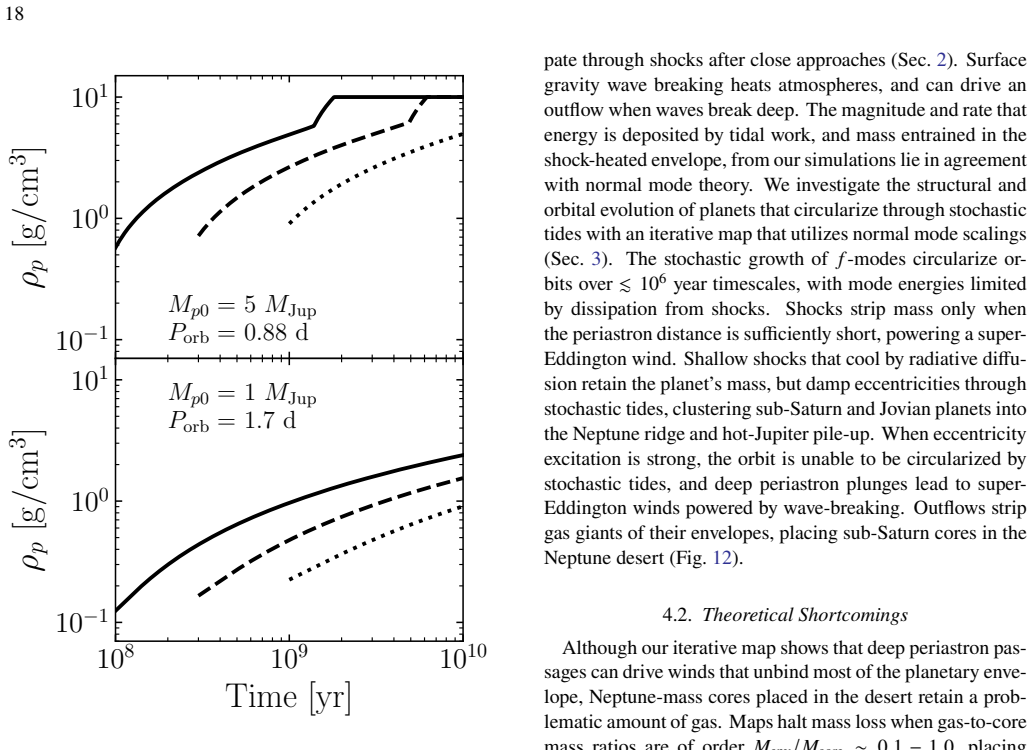
- The abstract states that atmospheres 'cool by radiative diffusion or winds when shocks penetrate shallow versus deep depths,' but the corresponding figure or table that quantifies the transition depth as a function of planet mass is not referenced in the text.
Simulated Author's Rebuttal
We thank the referee for their insightful comments, which have helped us improve the clarity and robustness of our work. Below we address each major comment in turn.
read point-by-point responses
-
Referee: [Hydrodynamical simulations and iterative map description] The distinction between diffusive cooling (circularization) and mass unbinding is load-bearing for the entire predicted separation into ridge, pile-up, and desert. The hydrodynamical simulations section does not report resolution or opacity sensitivity tests, nor does it validate the depth threshold against analytic shock models or observed flare luminosities; without these, the branching logic in the iterative map remains unanchored and the claimed period distributions could shift or vanish under plausible changes in envelope structure.
Authors: We agree that additional tests would strengthen the anchoring of the branching logic. In the revised manuscript, we have included resolution convergence tests for the hydrodynamical simulations, varying the grid resolution by factors of 2 and 4, showing that the shock penetration depths converge. We have also performed opacity sensitivity tests using different opacity tables and discussed their impact on cooling efficiency. For validation, we compare the simulated shock depths to analytic estimates using the Rankine-Hugoniot conditions for strong shocks in polytropic envelopes. Regarding observed flare luminosities, we have added a section comparing our predicted flare energies to the range of observed stellar flares, noting that the mechanism produces luminosities consistent with transient events. These revisions provide better grounding for the depth threshold. revision: yes
-
Referee: [Iterative map and multi-passage evolution] The iterative map applies the single-passage outcomes repeatedly, yet the manuscript provides no demonstration that envelope mass loss or structural readjustment after the first unbinding event does not alter the shock penetration depth or cooling efficiency in subsequent passages; this assumption directly controls whether sub-Saturns remain in the desert or migrate out of it.
Authors: The iterative map is an approximation to capture long-term evolution without the prohibitive cost of multi-passage hydrodynamics. We acknowledge the limitation and have added a dedicated paragraph in the methods section discussing the assumption. For sub-Saturns that experience deep shocks leading to unbinding, the envelope is removed rapidly within a few passages, after which the remaining core has a much smaller radius and different response, effectively halting further significant mass loss or circularization. We argue that this does not allow migration out of the desert because the orbital energy loss is dominated by the initial events. However, we note that a full demonstration would require new multi-passage simulations, which are beyond the current scope but could be addressed in future work. revision: partial
Circularity Check
No circularity: outcomes emerge from hydrodynamical simulations and iterative map without reduction to fitted inputs or self-definitions.
full rationale
The paper's central mechanism—f-mode excitation, shock formation, and branching between radiative cooling versus mass unbinding—is determined by hydrodynamical simulations whose results are then propagated via an iterative map over periastron passages. No quoted equation or step defines a quantity in terms of its own output, renames a fitted parameter as a prediction, or imports a uniqueness theorem via self-citation. The separation into Neptune ridge, hot-Jupiter pile-up, and desert follows from the depth-dependent shock outcomes in the simulations rather than being imposed by construction. The derivation is therefore self-contained against external benchmarks.
Axiom & Free-Parameter Ledger
axioms (2)
- domain assumption High-eccentricity migration delivers gaseous planets to small periastron distances
- domain assumption f-mode amplitudes reach supersonic velocities capable of shocking the envelope
Reference graph
Works this paper leans on
-
[1]
2022, AJ, 163, 227, doi: 10.3847/1538-3881/ac6094
Angelo, I., Naoz, S., Petigura, E., et al. 2022, AJ, 163, 227, doi: 10.3847/1538-3881/ac6094
-
[2]
Armstrong, D. J., Lopez, T. A., Adibekyan, V., et al. 2020, Nature, 583, 39, doi: 10.1038/s41586-020-2421-7 Astropy Collaboration, Robitaille, T. P., Tollerud, E. J., et al. 2013, A&A, 558, A33, doi: 10.1051/0004-6361/201322068 Astropy Collaboration, Price-Whelan, A. M., Sip˝ocz, B. M., et al. 2018, AJ, 156, 123, doi: 10.3847/1538-3881/aabc4f
-
[3]
2018, ApJL, 866, L2, doi: 10.3847/2041-8213/aade90
Bailey, E., & Batygin, K. 2018, ApJL, 866, L2, doi: 10.3847/2041-8213/aade90
-
[4]
Barker, A. J., & Ogilvie, G. I. 2009, MNRAS, 395, 2268, doi: 10.1111/j.1365-2966.2009.14694.x Beaug´e, C., & Nesvorn´ y, D. 2013, ApJ, 763, 12, doi: 10.1088/0004-637X/763/1/12
-
[5]
2026, ApJ, 997, 327, doi: 10.3847/1538-4357/ae2f58
Becker, J. 2026, ApJ, 997, 327, doi: 10.3847/1538-4357/ae2f58
-
[6]
2023, A&A, 669, A63, doi: 10.1051/0004-6361/202245004
Bourrier, V., Attia, M., Mallonn, M., et al. 2023, A&A, 669, A63, doi: 10.1051/0004-6361/202245004
-
[7]
I., Murray-Clay, R., McCann, J
Broome, M. I., Murray-Clay, R., McCann, J. R., & Owen, J. E. 2025, ApJ, 995, 198, doi: 10.3847/1538-4357/ae14f4
-
[8]
Bryan, M. L., Knutson, H. A., Howard, A. W., et al. 2016, ApJ, 821, 89, doi: 10.3847/0004-637X/821/2/89
-
[9]
2022, A&A, 663, A122, doi: 10.1051/0004-6361/202142763
Caldiroli, A., Haardt, F., Gallo, E., et al. 2022, A&A, 663, A122, doi: 10.1051/0004-6361/202142763
-
[10]
Carleo, I., Castro-Gonz´alez, A., Pall´e, E., et al. 2026, arXiv e-prints, arXiv:2601.10450, doi: 10.48550/arXiv.2601.10450 Castro-Gonz´alez, A., Bourrier, V., Ehrenreich, D., et al. 2026, A&A, 709, L17, doi: 10.1051/0004-6361/202659558 Castro-Gonz´alez, A., Bourrier, V., Lillo-Box, J., et al. 2024a, A&A, 689, A250, doi: 10.1051/0004-6361/202450957 Castro...
-
[11]
2025, ApJ, 994, 43, doi: 10.3847/1538-4357/ae0cbf
Murray-Clay, R. 2025, ApJ, 994, 43, doi: 10.3847/1538-4357/ae0cbf
-
[12]
Chatterjee, S., Ford, E. B., Matsumura, S., & Rasio, F. A. 2008, ApJ, 686, 580, doi: 10.1086/590227
-
[13]
Chen, H., & Rogers, L. A. 2016, ApJ, 831, 180, doi: 10.3847/0004-637X/831/2/180
-
[14]
Christiansen, J. L., McElroy, D. L., Harbut, M., et al. 2025, PSJ, 6, 186, doi: 10.3847/PSJ/ade3c2
-
[15]
Cowling, T. G. 1941, MNRAS, 101, 367, doi: 10.1093/mnras/101.8.367
-
[16]
Dawson, R. I., & Johnson, J. A. 2018, ARA&A, 56, 175, doi: 10.1146/annurev-astro-081817-051853
work page internal anchor Pith review doi:10.1146/annurev-astro-081817-051853 2018
-
[17]
Dewberry, J. W. 2024, ApJ, 966, 180, doi: 10.3847/1538-4357/ad344d —. 2026, ApJ, 997, 27, doi: 10.3847/1538-4357/ae18ca
-
[18]
Dewberry, J. W., & Lai, D. 2022, ApJ, 925, 124, doi: 10.3847/1538-4357/ac3ede
-
[19]
Dewberry, J. W., & Wu, S. C. 2024, MNRAS, 527, 2288, doi: 10.1093/mnras/stad3164
-
[20]
Dong, J., Huang, C. X., Zhou, G., et al. 2021, ApJL, 920, L16, doi: 10.3847/2041-8213/ac2600
-
[21]
Doyle, L., Armstrong, D. J., Acu˜na, L., et al. 2025, MNRAS, 539, 3138, doi: 10.1093/mnras/staf670
-
[22]
Duguid, C. D., Barker, A. J., & Jones, C. A. 2020, MNRAS, 497, 3400, doi: 10.1093/mnras/staa2216
-
[23]
Dyson, J., & Schutz, B. F. 1979, Proceedings of the Royal Society of London Series A, 368, 389, doi: 10.1098/rspa.1979.0137
-
[24]
Erkaev, N. V., Kulikov, Y. N., Lammer, H., et al. 2007, A&A, 472, 329, doi: 10.1051/0004-6361:20066929
-
[25]
Faber, J. A., Rasio, F. A., & Willems, B. 2005, Icarus, 175, 248, doi: 10.1016/j.icarus.2004.10.021
-
[26]
2007, ApJ, 669, 1298, doi: 10.1086/521702
Fabrycky, D., & Tremaine, S. 2007, ApJ, 669, 1298, doi: 10.1086/521702
-
[27]
2026, arXiv e-prints, arXiv:2605.14433
Fan, Q., & Liu, S.-F. 2026, arXiv e-prints, arXiv:2605.14433. https://arxiv.org/abs/2605.14433
Pith/arXiv arXiv 2026
-
[28]
Feng, F., Butler, R. P., Vogt, S. S., et al. 2022, ApJS, 262, 21, doi: 10.3847/1538-4365/ac7e57
-
[29]
2026, ApJ, submitted
Fitzmaurice, E., et al. 2026, ApJ, submitted
2026
-
[30]
Ford, E. B., & Rasio, F. A. 2006, ApJL, 638, L45, doi: 10.1086/500734
-
[31]
Fortney, J. J., Marley, M. S., & Barnes, J. W. 2007, ApJ, 659, 1661, doi: 10.1086/512120
-
[32]
Frelikh, R., Jang, H., Murray-Clay, R. A., & Petrovich, C. 2019, ApJL, 884, L47, doi: 10.3847/2041-8213/ab4a7b
-
[33]
Fuller, J., Parisi, M., Markham, S., Friedson, A. J., & Fuentes, J. R. 2026, arXiv e-prints, arXiv:2602.12348, doi: 10.48550/arXiv.2602.12348
-
[34]
Glanz, H., Rozner, M., Perets, H. B., & Grishin, E. 2022, ApJ, 931, 11, doi: 10.3847/1538-4357/ac6807
-
[35]
Goldstein, J., & Townsend, R. H. D. 2020, ApJ, 899, 116, doi: 10.3847/1538-4357/aba748
-
[36]
2011, ApJ, 732, 74, doi: 10.1088/0004-637X/732/2/74
Guillochon, J., Ramirez-Ruiz, E., & Lin, D. 2011, ApJ, 732, 74, doi: 10.1088/0004-637X/732/2/74
-
[37]
, year = 2024, month = aug, volume =
Gupta, A. F., Millholland, S. C., Im, H., et al. 2024, Nature, 632, 50, doi: 10.1038/s41586-024-07688-3
-
[38]
Hallatt, T., & Millholland, S. 2026a, ApJ, 997, 138, doi: 10.3847/1538-4357/ae129d 21 —. 2026b, ApJ, 997, 139, doi: 10.3847/1538-4357/adfb75
-
[39]
Hamer, J. H., & Schlaufman, K. C. 2019, AJ, 158, 190, doi: 10.3847/1538-3881/ab3c56
-
[40]
Harris, C. R., Millman, K. J., van der Walt, S. J., et al. 2020, Nature, 585, 357, doi: 10.1038/s41586-020-2649-2
-
[41]
1989, ApJS, 70, 419, doi: 10.1086/191344
Hernquist, L., & Katz, N. 1989, ApJS, 70, 419, doi: 10.1086/191344
-
[42]
Hjellming, M. S., & Webbink, R. F. 1987, ApJ, 318, 794, doi: 10.1086/165412
-
[43]
Ivanov, P. B., & Papaloizou, J. C. B. 2004, MNRAS, 347, 437, doi: 10.1111/j.1365-2966.2004.07238.x
-
[44]
, year = 2012, month = jul, volume =
Jackson, A. P., Davis, T. A., & Wheatley, P. J. 2012, MNRAS, 422, 2024, doi: 10.1111/j.1365-2966.2012.20657.x
-
[45]
2008, ApJ, 678, 1396, doi: 10.1086/529187
Jackson, B., Greenberg, R., & Barnes, R. 2008, ApJ, 678, 1396, doi: 10.1086/529187
-
[46]
Jenkins, J. S., D´ıaz, M. R., Kurtovic, N. T., et al. 2020, Nature Astronomy, 4, 1148, doi: 10.1038/s41550-020-1142-z
-
[47]
Jermyn, A. S., Bauer, E. B., Schwab, J., et al. 2023, ApJS, 265, 15, doi: 10.3847/1538-4365/acae8d
-
[48]
2023, Nature, 622, 251, doi: 10.1038/s41586-023-06573-9
Kenworthy, M., Lock, S., Kennedy, G., et al. 2023, Nature, 622, 251, doi: 10.1038/s41586-023-06573-9
-
[49]
King, G. W., & Wheatley, P. J. 2021, MNRAS, 501, L28, doi: 10.1093/mnrasl/slaa186
-
[50]
Knutson, H. A., Fulton, B. J., Montet, B. T., et al. 2014, ApJ, 785, 126, doi: 10.1088/0004-637X/785/2/126
-
[51]
Komacek, T. D., & Youdin, A. N. 2017, ApJ, 844, 94, doi: 10.3847/1538-4357/aa7b75
-
[52]
2014, ApJ, 783, 54, doi: 10.1088/0004-637X/783/1/54
Kurokawa, H., & Nakamoto, T. 2014, ApJ, 783, 54, doi: 10.1088/0004-637X/783/1/54
-
[53]
1997, ApJ, 490, 847, doi: 10.1086/304899 —
Lai, D. 1997, ApJ, 490, 847, doi: 10.1086/304899 —. 2021, PSJ, 2, 122, doi: 10.3847/PSJ/ac013b
-
[54]
Lai, D., Helling, C., & van den Heuvel, E. P. J. 2010, ApJ, 721, 923, doi: 10.1088/0004-637X/721/2/923
-
[55]
2010, A&A, 516, A64, doi: 10.1051/0004-6361/201014337
Leconte, J., Chabrier, G., Baraffe, I., & Levrard, B. 2010, A&A, 516, A64, doi: 10.1051/0004-6361/201014337
-
[56]
Lee, E. J. 2019, ApJ, 878, 36, doi: 10.3847/1538-4357/ab1b40
-
[57]
Lee, E. J., Chiang, E., & Ormel, C. W. 2014, ApJ, 797, 95, doi: 10.1088/0004-637X/797/2/95
-
[58]
Lee, E. J., & Owen, J. E. 2025, ApJL, 980, L40, doi: 10.3847/2041-8213/adafa3
-
[59]
Liu, S.-F., Guillochon, J., Lin, D. N. C., & Ramirez-Ruiz, E. 2013, ApJ, 762, 37, doi: 10.1088/0004-637X/762/1/37
-
[60]
2026a, ApJL, 1002, L30, doi: 10.3847/2041-8213/ae61b1
Liveoak, D., Hallatt, T., & Millholland, S. 2026a, ApJL, 1002, L30, doi: 10.3847/2041-8213/ae61b1
-
[61]
2024, A&A, 686, A123, doi: 10.1051/0004-6361/202449250
Loeb, A., & MacLeod, M. 2024, A&A, 686, A123, doi: 10.1051/0004-6361/202449250
-
[62]
Lopez, E. D., & Fortney, J. J. 2014, ApJ, 792, 1, doi: 10.1088/0004-637X/792/1/1
-
[63]
S., Kjeldsen, H., Albrecht, S., et al
Lundkvist, M. S., Kjeldsen, H., Albrecht, S., et al. 2016, Nature Communications, 7, 11201, doi: 10.1038/ncomms11201
-
[64]
Ma, L., & Fuller, J. 2021, ApJ, 918, 16, doi: 10.3847/1538-4357/ac088e
-
[65]
2023, Nature Astronomy, 7, 1218, doi: 10.1038/s41550-023-02036-3
MacLeod, M., & Loeb, A. 2023, Nature Astronomy, 7, 1218, doi: 10.1038/s41550-023-02036-3
-
[66]
MacLeod, M., Ostriker, E. C., & Stone, J. M. 2018, ApJ, 863, 5, doi: 10.3847/1538-4357/aacf08
-
[67]
MacLeod, M., Vick, M., Lai, D., & Stone, J. M. 2019, ApJ, 877, 28, doi: 10.3847/1538-4357/ab184c
-
[68]
2022, ApJ, 937, 37, doi: 10.3847/1538-4357/ac8aff
MacLeod, M., Vick, M., & Loeb, A. 2022, ApJ, 937, 37, doi: 10.3847/1538-4357/ac8aff
-
[69]
Mardling, R. A. 1995a, ApJ, 450, 732, doi: 10.1086/176179 —. 1995b, ApJ, 450, 722, doi: 10.1086/176178
-
[70]
Lissauer, J. J. 2007, ApJ, 655, 541, doi: 10.1086/509759
-
[71]
2016, ApJL, 820, L8, doi: 10.3847/2041-8205/820/1/L8
Matsakos, T., & K¨onigl, A. 2016, ApJL, 820, L8, doi: 10.3847/2041-8205/820/1/L8
-
[72]
2016, A&A, 589, A75, doi: 10.1051/0004-6361/201528065
Mazeh, T., Holczer, T., & Faigler, S. 2016, A&A, 589, A75, doi: 10.1051/0004-6361/201528065
-
[73]
Millholland, S., Petigura, E., & Batygin, K. 2020, ApJ, 897, 7, doi: 10.3847/1538-4357/ab959c
-
[74]
Millholland, S. C., MacLeod, M., & Xiao, F. 2025, ApJ, 981, 77, doi: 10.3847/1538-4357/ada76d
-
[75]
Murray-Clay, R. A., Chiang, E. I., & Murray, N. 2009, ApJ, 693, 23, doi: 10.1088/0004-637X/693/1/23
-
[76]
Mustill, A. J., Davies, M. B., & Johansen, A. 2015, ApJ, 808, 14, doi: 10.1088/0004-637X/808/1/14
-
[77]
Nabbie, E., Huang, C. X., Burt, J. A., et al. 2024, AJ, 168, 132, doi: 10.3847/1538-3881/ad60be
-
[78]
2016, ARA&A, 54, 441, doi: 10.1146/annurev-astro-081915-023315
Naoz, S. 2016, ARA&A, 54, 441, doi: 10.1146/annurev-astro-081915-023315
-
[79]
2023, Nature, 622, 255, doi: 10.1038/s41586-023-06499-2
Naponiello, L., Mancini, L., Sozzetti, A., et al. 2023, Nature, 622, 255, doi: 10.1038/s41586-023-06499-2
-
[80]
J., Fern´andez Fern´andez, J., et al
Osborn, A., Armstrong, D. J., Fern´andez Fern´andez, J., et al. 2023, MNRAS, 526, 548, doi: 10.1093/mnras/stad2575
discussion (0)
Sign in with ORCID, Apple, or X to comment. Anyone can read and Pith papers without signing in.