REVIEW 1 major objections 1 minor 17 references
Case-specific dynamic MQM rubrics improve span-level error detection by LLMs over fixed configurations.
Reviewed by Pith at T0; open to challenge. T0 means a machine referee read the full paper against a public rubric. the ladder, T0–T4 →
2026-06-26 14:06 UTC pith:F4IWZ5N6
load-bearing objection The paper offers a practical tweak to LLM-based MQM evaluation by making rubric subtypes case-specific instead of fixed, with reported MCC gains on WMT QE tasks, but the abstract leaves the adaptation method and controls unclear. the 1 major comments →
Rubric-as-Experts: Case-Specific MQM Rubrics for Translation Quality Evaluation
The pith
A machine-rendered reading of the paper's core claim, the machinery that carries it, and where it could break.
Core claim
The authors propose a case-specific dynamic rubric framework that adaptively constructs MQM evaluation spaces for individual translation instances by selecting suitable subtype spaces and evaluation granularity while staying grounded in the predefined MQM taxonomy, and show through experiments on WMT span-level QE benchmarks that this yields higher MCC and cleaner span-level error localization than static rubric settings.
What carries the argument
case-specific dynamic rubric framework that adaptively constructs MQM evaluation spaces for individual translation instances by selecting subtype spaces and granularity grounded in the MQM taxonomy
Load-bearing premise
Translation instances differ substantially in error complexity, ambiguity, and required evaluation granularity, making static rubric allocation suboptimal for span-level error detection.
What would settle it
A controlled replication on the same WMT span-level QE benchmarks in which the case-specific framework produces equal or lower MCC and no cleaner error localization than the static-rubric baseline.
If this is right
- The adaptive allocation consistently raises MCC on WMT span-level QE benchmarks.
- It produces cleaner span-level error localization than static settings.
- The gains hold across multiple model scales.
- Structured MQM rubrics combined with case-specific allocation form an effective strategy for LLM-based translation evaluation.
Where Pith is reading between the lines
- The method could be tested on other fine-grained evaluation tasks where instance difficulty varies, such as summarization or dialogue assessment.
- It suggests a middle path between fully static taxonomies and completely free-form rubric generation that may balance coverage and false-positive rates.
- Future implementations might measure the added prompting cost of dynamic selection against the observed quality gains.
Editorial analysis
A structured set of objections, weighed in public.
Referee Report
Summary. The paper proposes Rubric-as-Experts, a case-specific dynamic rubric framework for LLM-based translation quality evaluation under the MQM taxonomy. It observes that static rubric configurations are suboptimal because translation instances vary in error complexity and preferred granularity, and that larger subtype spaces increase coverage but also false positives. The framework adaptively selects MQM subtype spaces and evaluation granularity per instance while remaining grounded in the predefined taxonomy (rather than free-form generation). Experiments on WMT span-level QE benchmarks across model scales are reported to yield consistent MCC gains and cleaner span-level error localization relative to static rubric baselines.
Significance. If the empirical results hold, the work offers a practical middle ground between rigid static MQM rubrics and unconstrained generation, potentially improving fine-grained QE reliability. The explicit grounding in the MQM taxonomy and use of standard WMT benchmarks are strengths that make the approach falsifiable and comparable to prior work.
major comments (1)
- [Abstract] Abstract: The central empirical claim of 'consistent MCC gains' and 'cleaner span-level error localization' is stated without reference to the specific static baselines, model scales tested, number of language pairs, or any statistical significance tests. This absence in the summary of results makes it difficult to evaluate whether the reported improvements are load-bearing or sensitive to particular experimental choices.
minor comments (1)
- [Abstract] The motivation paragraph notes that 'different translation instances prefer different rubric granularities' but does not cite prior work on instance-level variation in QE to situate the observation.
Simulated Author's Rebuttal
We thank the referee for the constructive feedback on the abstract. We agree that greater specificity will improve transparency and address the concern directly by revising the abstract.
read point-by-point responses
-
Referee: [Abstract] Abstract: The central empirical claim of 'consistent MCC gains' and 'cleaner span-level error localization' is stated without reference to the specific static baselines, model scales tested, number of language pairs, or any statistical significance tests. This absence in the summary of results makes it difficult to evaluate whether the reported improvements are load-bearing or sensitive to particular experimental choices.
Authors: We agree that the abstract would benefit from explicit references to the experimental details. In the revised version we will update the abstract to name the static baselines (fixed MQM rubrics with full and reduced subtype spaces), the model scales evaluated (7B, 13B, and GPT-4-class models), the WMT language pairs used, and note that MCC gains were observed consistently across these configurations. We will also indicate where statistical significance was assessed. These additions will make the central claims immediately evaluable without altering the paper's core findings. revision: yes
Circularity Check
No significant circularity detected
full rationale
The paper motivates a dynamic, case-specific MQM rubric allocator from the observation that error complexity varies across instances, then validates the allocator via direct MCC and localization comparisons against static MQM baselines on external WMT span-level QE benchmarks. No equations, fitted parameters, or self-citations are invoked to derive the performance gains; the framework is explicitly constrained to the pre-existing MQM taxonomy rather than redefining or predicting its own evaluation targets. The derivation chain therefore consists of an empirical hypothesis tested on independent data and remains self-contained.
Axiom & Free-Parameter Ledger
Cite this review
Pith. "Pith review of Rubric-as-Experts: Case-Specific MQM Rubrics for Translation Quality Evaluation." pith.science (2026). https://pith.science/paper/F4IWZ5N6
@misc{pith2026260621559,
  author       = {Pith},
  title        = {Pith review of: Rubric-as-Experts: Case-Specific MQM Rubrics for Translation Quality Evaluation},
  year         = {2026},
  howpublished = {\url{https://pith.science/paper/F4IWZ5N6}},
  note         = {Machine review of arXiv:2606.21559}
}
read the original abstract
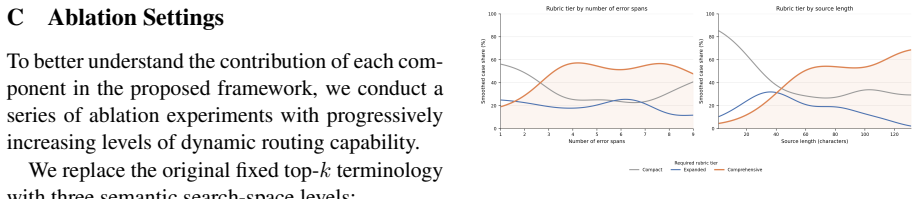
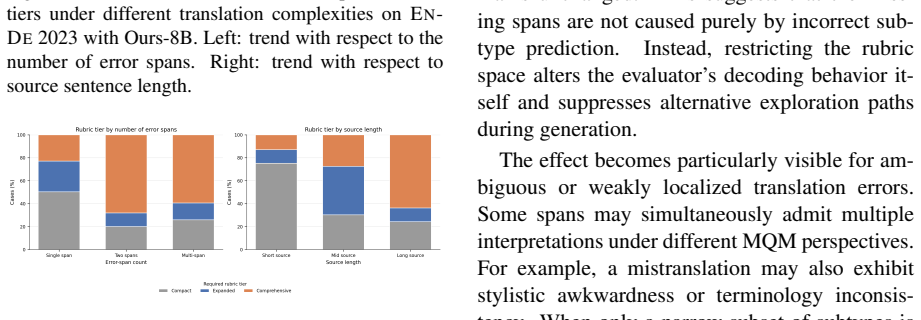
Large language models (LLMs) have shown strong potential in fine-grained translation quality evaluation (QE), yet existing MQM-based approaches typically rely on fixed rubric configurations shared across all translation samples. However, translation instances often differ substantially in error complexity, ambiguity, and required evaluation granularity, making static rubric allocation suboptimal for span-level error detection. We find that larger MQM subtype spaces improve error coverage but also introduce more false positives, while different translation instances prefer different rubric granularities, suggesting that evaluation spaces should be allocated dynamically for each case. Motivated by these observations, we propose a case-specific dynamic rubric framework that adaptively constructs MQM evaluation spaces for individual translation instances. Unlike fully free-form rubric generation methods, our framework remains grounded in the predefined MQM taxonomy while dynamically selecting suitable subtype spaces and evaluation granularity for different cases. Experiments on WMT span-level QE benchmarks across multiple model scales demonstrate that the proposed framework consistently improves MCC and produces cleaner span-level error localization compared with static rubric settings. Our results suggest that combining structured MQM rubrics with case-specific adaptive allocation is an effective strategy for fine-grained LLM-based translation evaluation.
Figures




Reference graph
Works this paper leans on
-
[1]
Qwen3 technical report. arXiv preprint arXiv:2505.09388. Qiyuan Zhang, Fuyuan Lyu, Zexu Sun, Lei Wang, Weixu Zhang, Wenyue Hua, Haolun Wu, Zhihan Guo, Y ufei Wang, Niklas Muennighoff, and 1 oth- ers. 2025. A survey on test-time scaling in large lan- guage models: What, how, where, and how well? arXiv preprint arXiv:2503.24235. A MQM Hierarchy and Prompt T...
work page internal anchor Pith review Pith/arXiv arXiv 2025
-
[5]
If no error, output {"items":[]}. Major type Representative flattened subtypes Accuracy Mistranslation; Number; Date/time; Overtranslation; Omission Audience appropriate- ness Locale-specific content; Language-dependent logic; Offensive Design and markup Font; Kerning; Layout; Truncation/text expansion; Markup tag Linguistic conventions Grammar; Agreement; ...
-
[6]
items":[{
Never output extra keys or text. USER: Task: find erroneous text in TARGET and classify each with category + severity. Return each error as exact copied text from TARGET. SOURCE: {source} TARGET: {target} A.3 Merge Prompts The merge pipeline first uses the major-category router to predict relevant MQM major types for each source–translation pair. For each ...
-
[7]
error_text must be an exact text span copied from TARGET
-
[8]
Do not output indexes; output only the erroneous text content
-
[9]
category/severity must be strings
-
[10]
If no error, output {"items":[]}
-
[11]
items":[]}. SOURCE: {source} TARGET: {target} RUBRIC_JSON: {
Never output extra keys or text. USER: Task: identify translation errors in TARGET based on SOURCE. Task: find erroneous text in TARGET and classify each with category + severity. Return each error as exact copied text from TARGET. Use rubric.checks as primary guidance for locating errors. If no error is found, output {"items":[]}. SOURCE: {source} TARGET...
-
[12]
Select only subtype names from the provided SUBTYPE_RUBRIC_JSON
-
[13]
Rank subtypes by usefulness as auxiliary rubric types for judging possible translation errors in this case
-
[14]
The selected subtypes are not final activated error labels
-
[15]
compact should contain the most essential subtype candidates
-
[16]
medium should expand the compact subtype space with additional useful subtype candidates
-
[17]
large should further expand the subtype space with broader subtype coverage
-
[18]
full should contain the most comprehensive subtype exploration space available for this major category
-
[19]
If the subtype inventory is small, return as many subtype names as available
-
[20]
major_category
Do not include duplicate subtype names or labels outside the rubric. USER: Task: select MQM subtype rubric entries that would be most useful as auxiliary rubric types for judging possible translation errors in this SOURCE/TARGET pair. Evaluate only the single major category shown in SUBTYPE_RUBRIC_JSON. Do not decide the final error type. Rank subtype def...
2023
This paper was first reviewed by grok-4.3 on June 26, 2026.
discussion (0)
Sign in with ORCID, Apple, or X to comment. Anyone can read and Pith papers without signing in.