Quantum Simulation of Generalized Parton Distributions in the Schwinger Model
Pith reviewed 2026-06-26 09:59 UTC · model grok-4.3
The pith
A quantum algorithm using Wilson fermions simulates generalized parton distributions in the Schwinger model with polynomial resource scaling.
A machine-rendered reading of the paper's core claim, the machinery that carries it, and where it could break.
Core claim
We present a quantum algorithm for simulating Generalized Parton Distributions (GPDs) in the Schwinger model. We employ Wilson fermions rather than staggered fermions for lattice discretization because they strictly preserve charge conjugation symmetry. The algorithm prepares hadronic states with non-zero momentum and measures the required light-cone correlation functions that incorporate Wilson lines. Resource requirements scale polynomially with the number of qubits and with the desired precision ε. Exact-diagonalization benchmarks extract mass spectra and GPDs (including ordinary parton distribution functions) that remain consistent with theoretical predictions and fundamental physical co
What carries the argument
Wilson fermions on the lattice, chosen because they strictly preserve charge conjugation symmetry and thereby allow faithful quantum computation of light-cone correlation functions for GPDs.
If this is right
- The algorithm requires only polynomially many qubits and gates as system size and precision increase.
- Extracted GPDs and PDFs automatically satisfy sum rules and other physical constraints built into the symmetry-preserving discretization.
- Mass spectra obtained from the same quantum circuits agree with known analytic results for the Schwinger model.
- Hadronic states carrying non-zero momentum can be prepared and used as initial states for the correlation-function measurements.
Where Pith is reading between the lines
- The same symmetry-preserving discretization could be tested in other lattice models where charge conjugation or related discrete symmetries control observable accuracy.
- Once implemented on actual quantum hardware, the polynomial scaling would allow systematic study of GPDs at volumes inaccessible to classical exact diagonalization.
- The light-cone operator construction with Wilson lines may serve as a template for quantum simulations of higher-dimensional gauge theories once qubit counts permit.
Load-bearing premise
Wilson fermions must be used because only they preserve charge conjugation symmetry strictly enough to permit accurate quantum computation of GPDs.
What would settle it
Extracting GPDs on a small lattice via the proposed algorithm and finding that they deviate from exact-diagonalization results by more than the expected statistical or discretization errors would falsify the claim that the method works.
Figures
read the original abstract
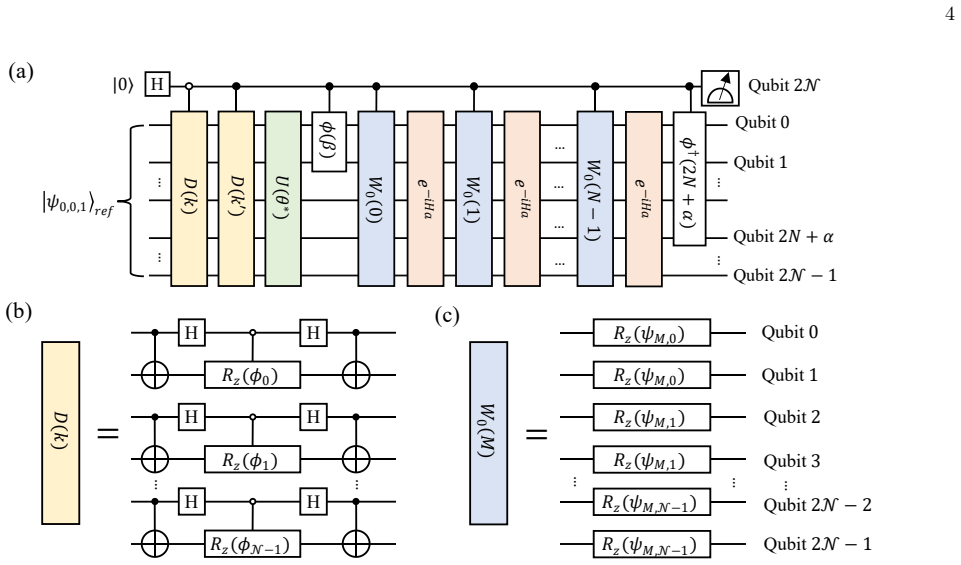
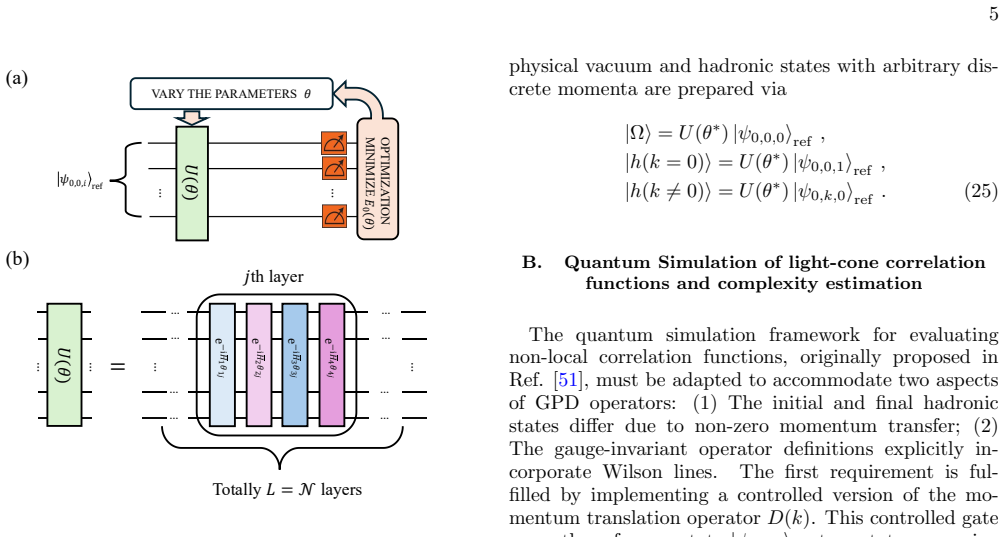
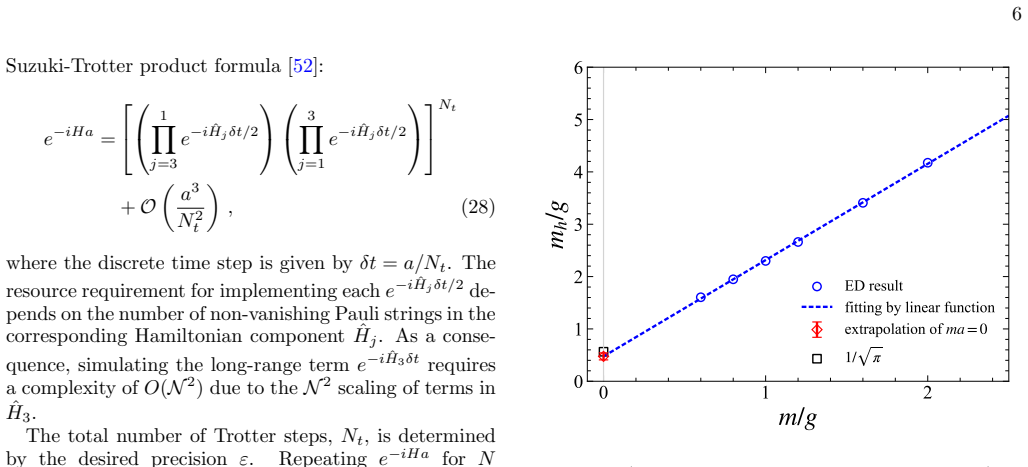
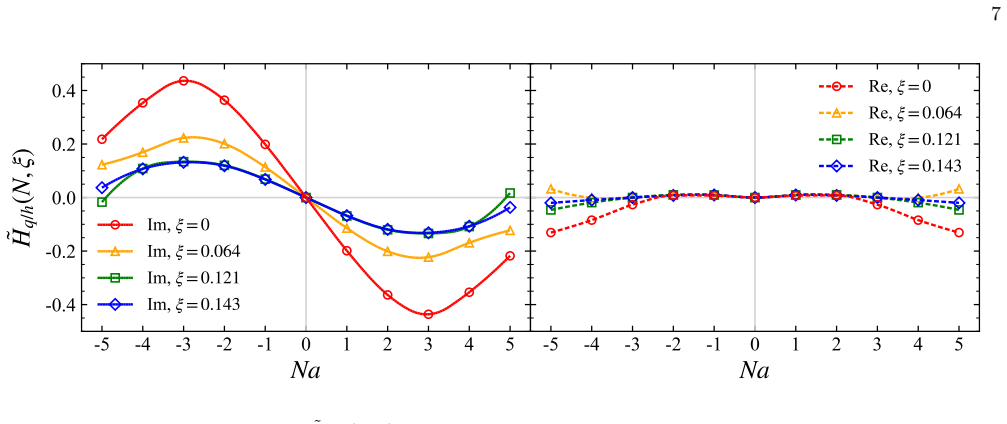
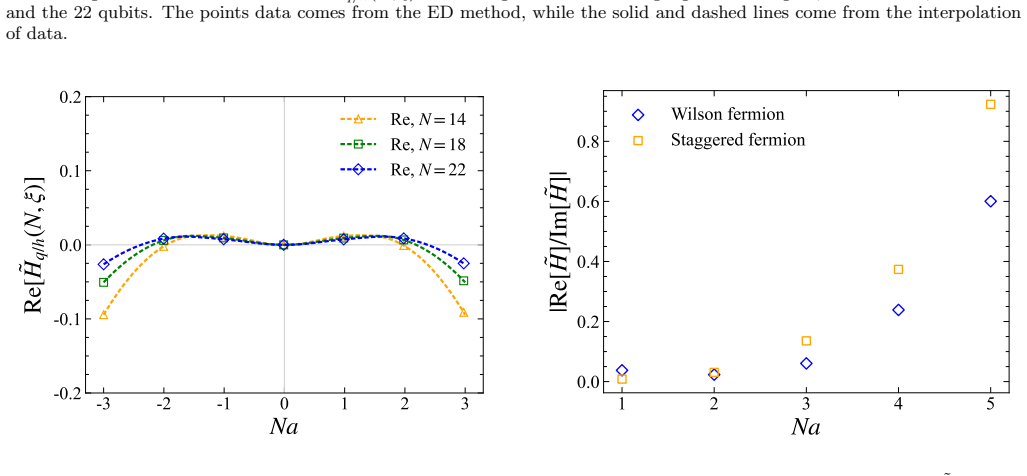
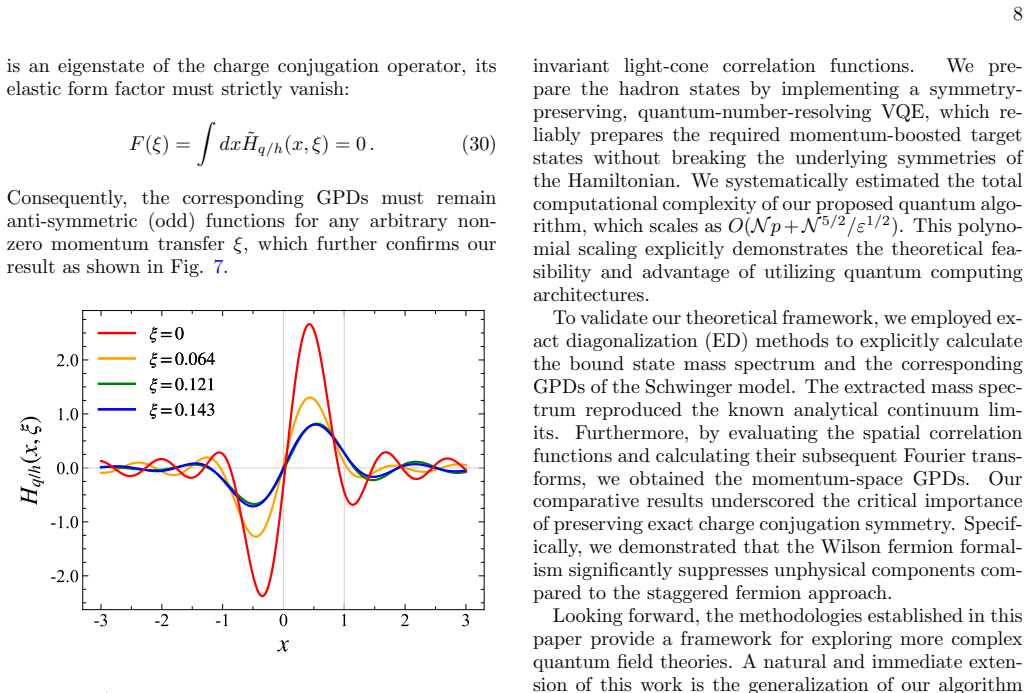
We present a quantum algorithm for simulating Generalized Parton Distributions (GPDs) in the Schwinger model. Unlike the staggered fermions widely utilized in current quantum simulations, we employ Wilson fermions for lattice discretization. This choice is critical for the quantum computation of GPDs due to their strict preservation of charge conjugation symmetry. We construct a comprehensive algorithmic framework that includes the preparation of hadronic states with non-zero momentum and the measurement of light-cone correlation functions incorporating Wilson lines. We provide a complexity analysis, demonstrating that the resources required for our algorithm scale polynomially with both the number of qubits and the desired precision $\varepsilon$. Finally, we benchmark our approach using exact diagonalization, extracting mass spectra and GPDs (also parton distribution functions) that are consistent with theoretical expectations and fundamental physical constraints.
Editorial analysis
A structured set of objections, weighed in public.
Referee Report
Summary. The manuscript presents a quantum algorithm to compute Generalized Parton Distributions (GPDs) in the Schwinger model on a lattice. It employs Wilson fermions (rather than staggered) to preserve charge conjugation symmetry, constructs protocols for preparing nonzero-momentum hadronic states and measuring light-cone correlators that include Wilson lines, supplies a complexity analysis asserting polynomial scaling in qubit number and target precision ε, and validates the approach via exact-diagonalization benchmarks that extract mass spectra and GPDs (including PDFs) stated to be consistent with theoretical expectations and physical constraints such as sum rules.
Significance. If the polynomial resource bound is shown to hold after explicit accounting for state-preparation and measurement costs, the work would constitute a meaningful step toward quantum simulation of parton distributions in gauge theories. The choice of Wilson fermions and the emphasis on charge-conjugation symmetry address a concrete obstacle for GPD calculations; the ED benchmarks supply initial evidence that the extracted quantities respect expected symmetries on small volumes.
major comments (2)
- [Complexity analysis section] Complexity analysis (the section presenting the resource bound): the claim that the full algorithm scales polynomially in qubit number and ε rests on unexamined costs of nonzero-momentum hadronic-state preparation and of measuring nonlocal light-cone operators containing Wilson lines. The manuscript must supply explicit bounds (e.g., on adiabatic gap or on shot-noise variance) showing that these primitives remain polynomial; absent such accounting the central scaling statement is not yet established.
- [Benchmarking / ED results section] Benchmarking section (exact-diagonalization results): the reported GPD and PDF values are described as “consistent with theoretical expectations,” yet no quantitative error bars, volume dependence, or explicit verification of sum-rule saturation are provided. Because the consistency claim is load-bearing for the physical correctness of the algorithm, these diagnostics must be supplied.
minor comments (2)
- Notation for the light-cone correlator and Wilson-line operator should be defined once in a single equation block rather than re-introduced in multiple places.
- The abstract states that GPDs are also extracted as parton distribution functions; a brief sentence clarifying the forward-limit relation would aid readability.
Simulated Author's Rebuttal
We thank the referee for the careful reading of our manuscript and the constructive comments. We address each major point below and indicate the revisions planned for the next version.
read point-by-point responses
-
Referee: [Complexity analysis section] Complexity analysis (the section presenting the resource bound): the claim that the full algorithm scales polynomially in qubit number and ε rests on unexamined costs of nonzero-momentum hadronic-state preparation and of measuring nonlocal light-cone operators containing Wilson lines. The manuscript must supply explicit bounds (e.g., on adiabatic gap or on shot-noise variance) showing that these primitives remain polynomial; absent such accounting the central scaling statement is not yet established.
Authors: We agree that a fully rigorous polynomial bound requires explicit control of the state-preparation and measurement primitives. The manuscript sketches the use of adiabatic evolution for nonzero-momentum states and standard sampling for the light-cone correlators, but does not derive the gap or variance bounds in detail. In the revised version we will add these explicit estimates, showing that the adiabatic gap remains inverse-polynomial in the lattice size for the Wilson-fermion Hamiltonian and that the shot-noise variance for the Wilson-line operators can be bounded polynomially in 1/ε via appropriate grouping of Pauli terms. revision: yes
-
Referee: [Benchmarking / ED results section] Benchmarking section (exact-diagonalization results): the reported GPD and PDF values are described as “consistent with theoretical expectations,” yet no quantitative error bars, volume dependence, or explicit verification of sum-rule saturation are provided. Because the consistency claim is load-bearing for the physical correctness of the algorithm, these diagnostics must be supplied.
Authors: The current text states consistency with theory and sum rules but indeed omits quantitative error bars, a systematic volume study, and explicit numerical saturation checks. Because the ED benchmarks are the primary evidence that the algorithm reproduces physical quantities, we will augment the section with statistical error bars on the extracted GPDs and PDFs, a brief discussion of finite-volume effects on the small lattices employed, and direct numerical verification that the first moments satisfy the expected sum rules within the reported precision. revision: yes
Circularity Check
No circularity; algorithm proposal and ED benchmark remain independent of inputs
full rationale
The abstract and described claims present a new algorithmic framework (Wilson-fermion discretization, state preparation, Wilson-line measurements) together with a separate complexity analysis and an independent classical exact-diagonalization benchmark. No equation or step is shown to reduce by construction to a fitted parameter, self-citation, or renamed input; the ED verification is explicitly external to the quantum algorithm and does not rely on the same fitted quantities. The derivation chain is therefore self-contained against external benchmarks.
Axiom & Free-Parameter Ledger
Reference graph
Works this paper leans on
-
[1]
A. Accardiet al., Eur. Phys. J. A52, 268 (2016), arXiv:1212.1701
Pith/arXiv arXiv 2016
-
[2]
R. Abdul Khaleket al., Nucl. Phys. A1026, 122447 (2022), arXiv:2103.05419
Pith/arXiv arXiv 2022
-
[3]
D. P. Anderleet al., Front. Phys. (Beijing)16, 64701 (2021), arXiv:2102.09222
arXiv 2021
-
[4]
CAOet al., Nucl
X. CAOet al., Nucl. Tech.43, 020001 (2024)
2024
- [5]
- [6]
-
[7]
A. V. Belitsky and A. V. Radyushkin, Phys. Rept.418, 1 (2005), arXiv:hep-ph/0504030
Pith/arXiv arXiv 2005
- [8]
- [9]
- [10]
-
[11]
Y. Fanget al., Sci. China Phys. Mech. Astron.68, 260301 (2025), arXiv:2411.11294
arXiv 2025
- [12]
-
[13]
C. W. Baueret al., PRX Quantum4, 027001 (2023), arXiv:2204.03381
arXiv 2023
-
[14]
C. W. Bauer, Z. Davoudi, N. Klco, and M. J. Savage, Nature Rev. Phys.5, 420 (2023), arXiv:2404.06298
arXiv 2023
-
[15]
M. C. Ba˜ nulset al., Eur. Phys. J. D74, 165 (2020), 9 arXiv:1911.00003
arXiv 2020
-
[16]
S. P. Jordan, K. S. M. Lee, and J. Preskill, Science336, 1130 (2012), arXiv:1111.3633
Pith/arXiv arXiv 2012
-
[17]
G. H. Low, Y. Su, Y. Tong, and M. C. Tran, PRX Quan- tum4, 020323 (2023), arXiv:2211.09133
arXiv 2023
- [18]
-
[19]
QuNu, T. Liet al., Sci. China Phys. Mech. Astron.66, 281011 (2023), arXiv:2207.13258
arXiv 2023
- [20]
-
[21]
QuNu, T. Li, W. K. Lai, E. Wang, and H. Xing, Phys. Rev. D109, 036025 (2024), arXiv:2301.04179
arXiv 2024
-
[22]
H. A. Chawdhry and M. Pellen, SciPost Phys.15, 205 (2023), arXiv:2303.04818
arXiv 2023
-
[23]
K. Lee, J. Mulligan, F. Ringer, and X. Yao, Phys. Rev. D108, 094518 (2023), arXiv:2308.03878
arXiv 2023
-
[24]
C. W. Bauer, S. Chigusa, and M. Yamazaki, Phys. Rev. A109, 032432 (2024), arXiv:2310.19881
arXiv 2024
- [25]
-
[26]
S. Grieninger and I. Zahed, Phys. Rev. D110, 116009 (2024), arXiv:2406.01891
arXiv 2024
-
[27]
T. Li, H. Xing, and D.-B. Zhang, (2024), arXiv:2406.05683
arXiv 2024
-
[28]
W. Qian, M. Li, C. A. Salgado, and M. Kreshchuk, Phys. Rev. D111, 096001 (2025), arXiv:2411.09762
arXiv 2025
- [29]
-
[30]
Z.-B. Kang, N. Moran, P. Nguyen, and W. Qian, JHEP 09, 176 (2025), arXiv:2501.09738
arXiv 2025
-
[31]
R. A. Janik, M. A. Nowak, M. M. Rams, and I. Zahed, Phys. Rev. Lett.135, 211903 (2025), arXiv:2502.12901
arXiv 2025
-
[32]
M. C. Ba˜ nuls, K. Cichy, C. J. D. Lin, and M. Schneider, (2025), arXiv:2504.07508
arXiv 2025
- [33]
-
[34]
H. A. Chawdhry, M. Pellen, and S. Williams, (2025), arXiv:2507.07194
arXiv 2025
- [35]
-
[36]
J. Barata, M. Li, W. Qian, C. A. Salgado, and J. M. Silva, (2026), arXiv:2604.11616
Pith/arXiv arXiv 2026
-
[37]
D. Zou, T. Li, J. Liang, E. Wang, and H. Xing, (2026), arXiv:2606.17003
arXiv 2026
-
[38]
I. P. Fernando and D. Keller, (2026), arXiv:2604.10025
Pith/arXiv arXiv 2026
-
[39]
NuQS, H. Lamm, S. Lawrence, and Y. Yamauchi, Phys. Rev. Res.2, 013272 (2020), arXiv:1908.10439
arXiv 2020
-
[40]
K. Ikeda, Z.-B. Kang, D. E. Kharzeev, and W. Qian, (2025), arXiv:2512.18062
Pith/arXiv arXiv 2025
- [41]
-
[42]
S. Grieninger, K. Ikeda, and I. Zahed, Phys. Rev. D110, 076008 (2024), arXiv:2404.05112
arXiv 2024
-
[43]
M. Schneider, M. C. Ba˜ nuls, K. Cichy, and C. J. D. Lin, PoSLA TTICE2024, 024 (2025), arXiv:2409.16996
arXiv 2025
-
[44]
S. Grieninger, J. Montgomery, F. Ringer, and I. Zahed, (2025), arXiv:2511.17752
arXiv 2025
-
[45]
C. M. Gustin and G. Goldstein, (2022), arXiv:2211.07826
arXiv 2022
-
[46]
K. G. Wilson, Phys. Rev. D10, 2445 (1974)
1974
-
[47]
T. V. Zacheet al., Quantum Sci. Technol.3, 034010 (2018), arXiv:1802.06704
Pith/arXiv arXiv 2018
-
[48]
J. B. Kogut and L. Susskind, Phys. Rev. D11, 395 (1975)
1975
-
[49]
Backens, A
S. Backens, A. Shnirman, and Y. Makhlin, Scientific Reports9(2019)
2019
-
[50]
J. C. Collins, D. E. Soper, and G. F. Sterman, Adv. Ser. Direct. High Energy Phys.5, 1 (1989), arXiv:hep- ph/0409313
arXiv 1989
-
[51]
J. . Pedernales, R. Di Candia, I. . Egusquiza, J. Casanova, and E. Solano, Phys. Rev. Lett.113, 020505 (2014), arXiv:1401.2430
Pith/arXiv arXiv 2014
-
[52]
A. M. Childs, Y. Su, M. C. Tran, N. Wiebe, and S. Zhu, Phys. Rev. X11, 011020 (2021), arXiv:1912.08854
arXiv 2021
-
[53]
J. S. Schwinger, Phys. Rev.128, 2425 (1962)
1962
discussion (0)
Sign in with ORCID, Apple, or X to comment. Anyone can read and Pith papers without signing in.