Composition of Radiation-Driven Winds from Type I X-ray Bursts
Pith reviewed 2026-06-26 07:02 UTC · model grok-4.3
The pith
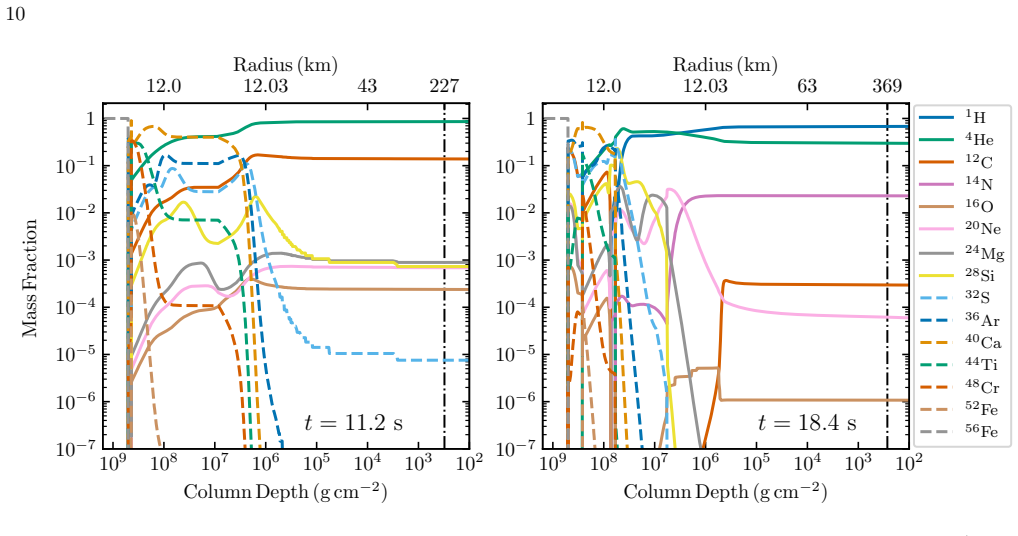
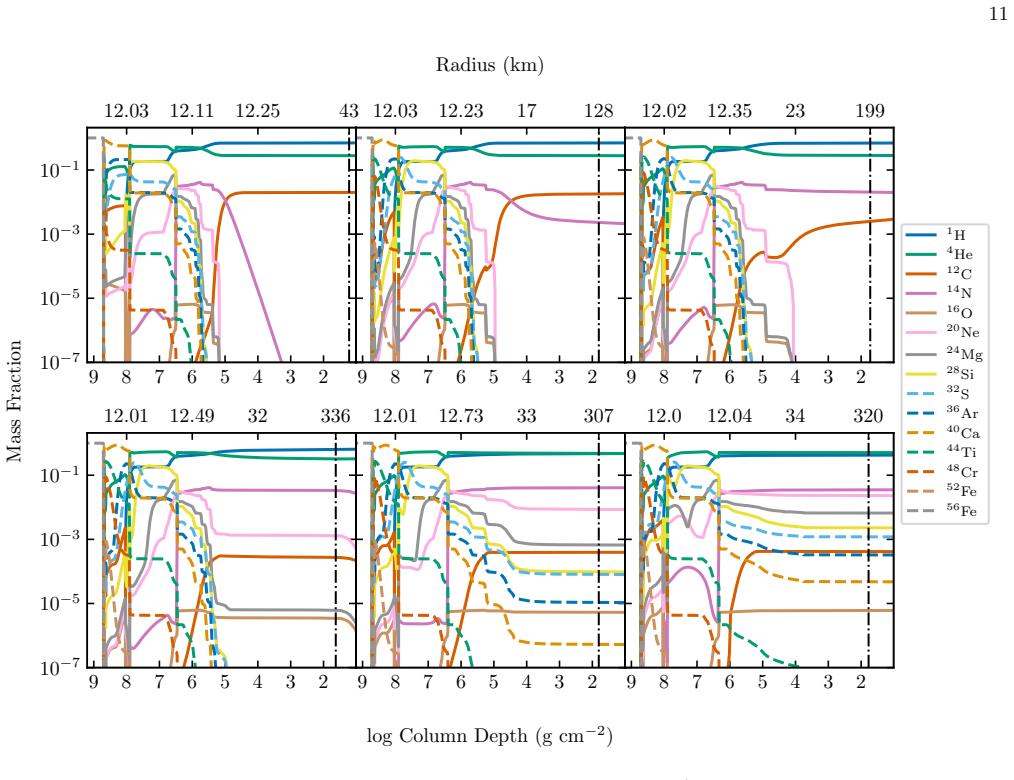
X-ray bursts igniting deep enough launch winds carrying nuclear ashes from intermediate-mass to iron-peak elements.
A machine-rendered reading of the paper's core claim, the machinery that carries it, and where it could break.
Core claim
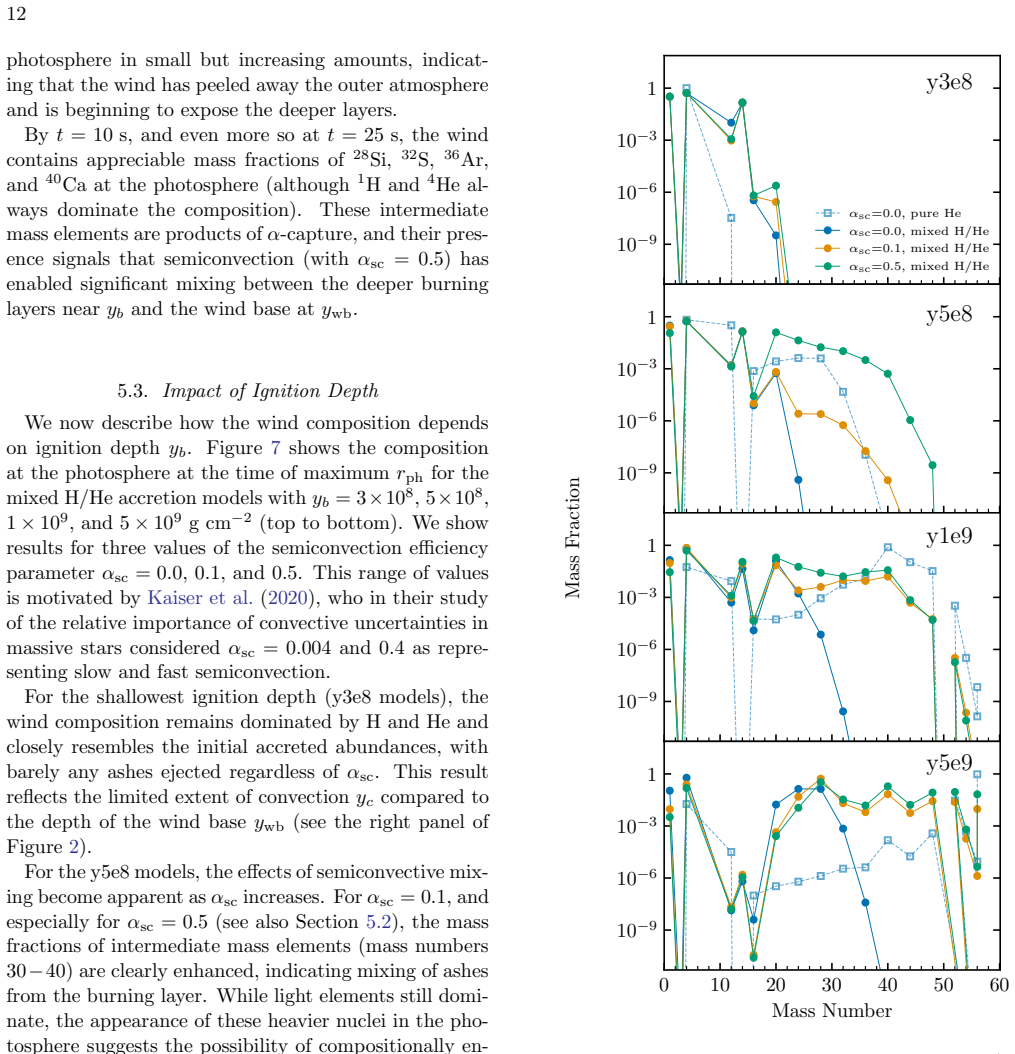
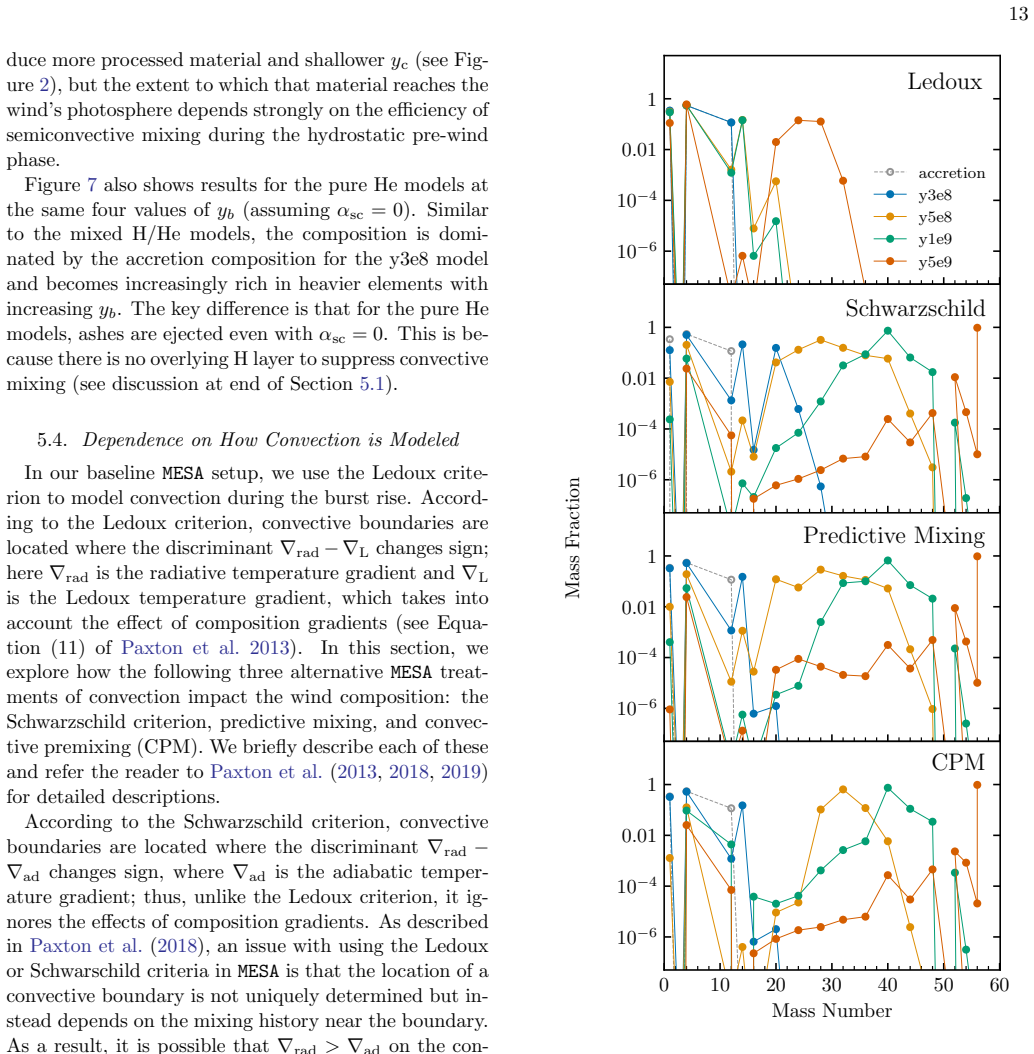
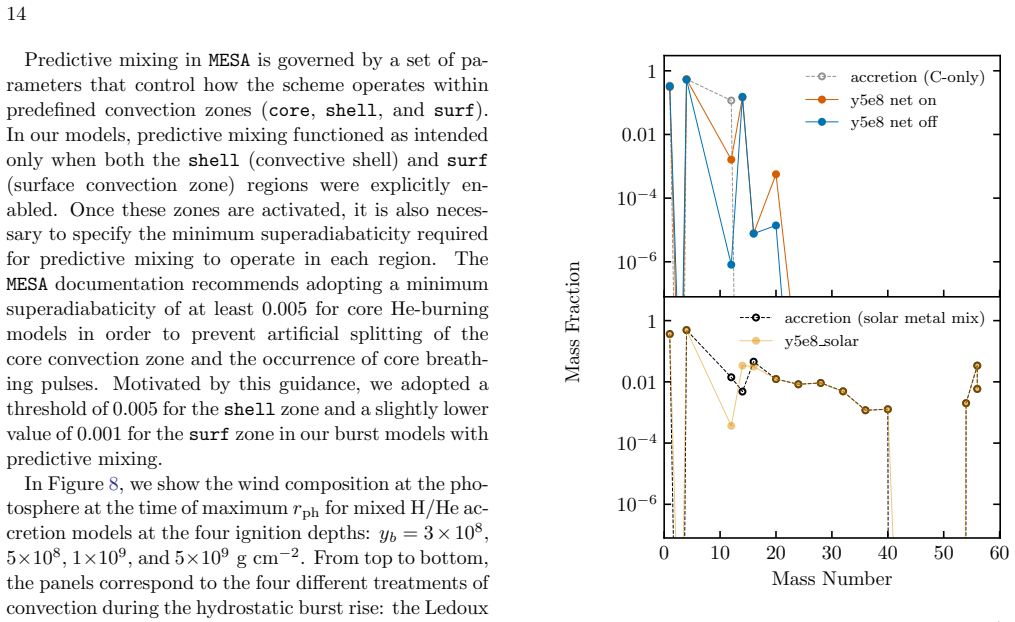
Bursts igniting at column depths greater than or equal to 5 x 10^8 g cm^{-2} produce ash-enriched winds, with ejecta ranging from intermediate-mass to iron-peak elements depending on ignition depth, accretion composition, and the treatment of convection.
What carries the argument
MESA simulations of photospheric radius expansion bursts that include the full hydrodynamic wind phase and track nuclear burning plus mixing.
If this is right
- Winds from deep ignitions can explain absorption lines of intermediate-mass elements seen by NICER in some PRE bursts.
- The ejected composition becomes a direct diagnostic of the ignition conditions on the neutron star.
- Changing how semiconvection or convective boundaries are defined alters the range of elements that reach the wind.
- Mixed hydrogen-helium accretion produces different ash mixes than pure helium accretion at the same depth.
Where Pith is reading between the lines
- Observed wind compositions could be inverted to constrain the depth at which bursts ignite on a given neutron star.
- The sensitivity to convection treatment suggests that better mixing physics would narrow the predicted range of ejecta compositions.
- If winds remove significant ash, they may change the long-term composition of material that remains on the neutron star surface.
Load-bearing premise
The several different ways of modeling convection during the burst rise capture the main mixing processes that set the wind's final composition.
What would settle it
A measured elemental abundance pattern in the wind of a single burst whose ignition column depth can be independently determined from its light curve or recurrence time.
Figures
read the original abstract
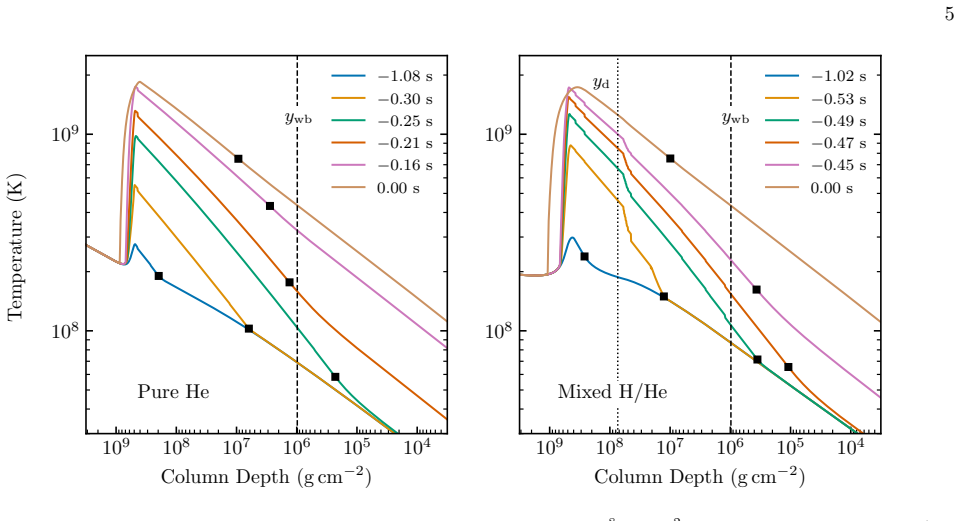
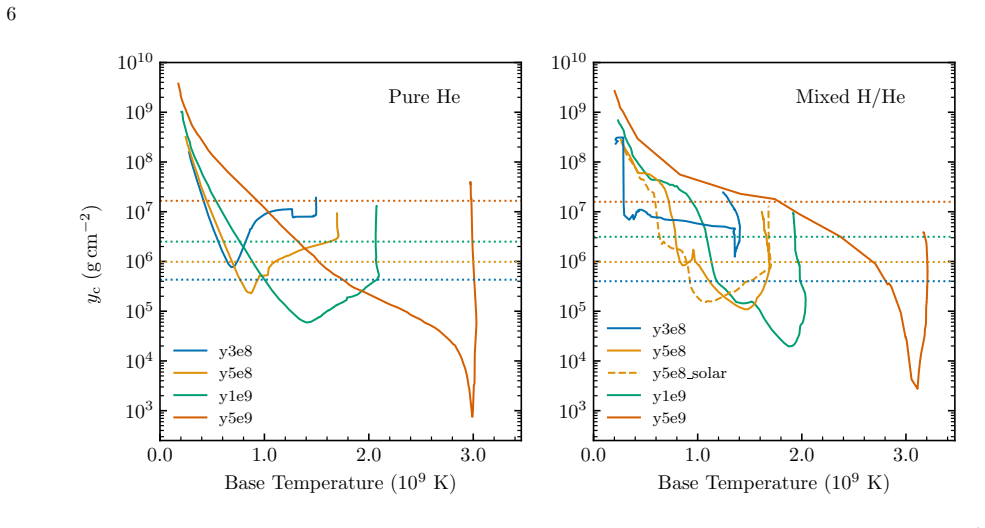
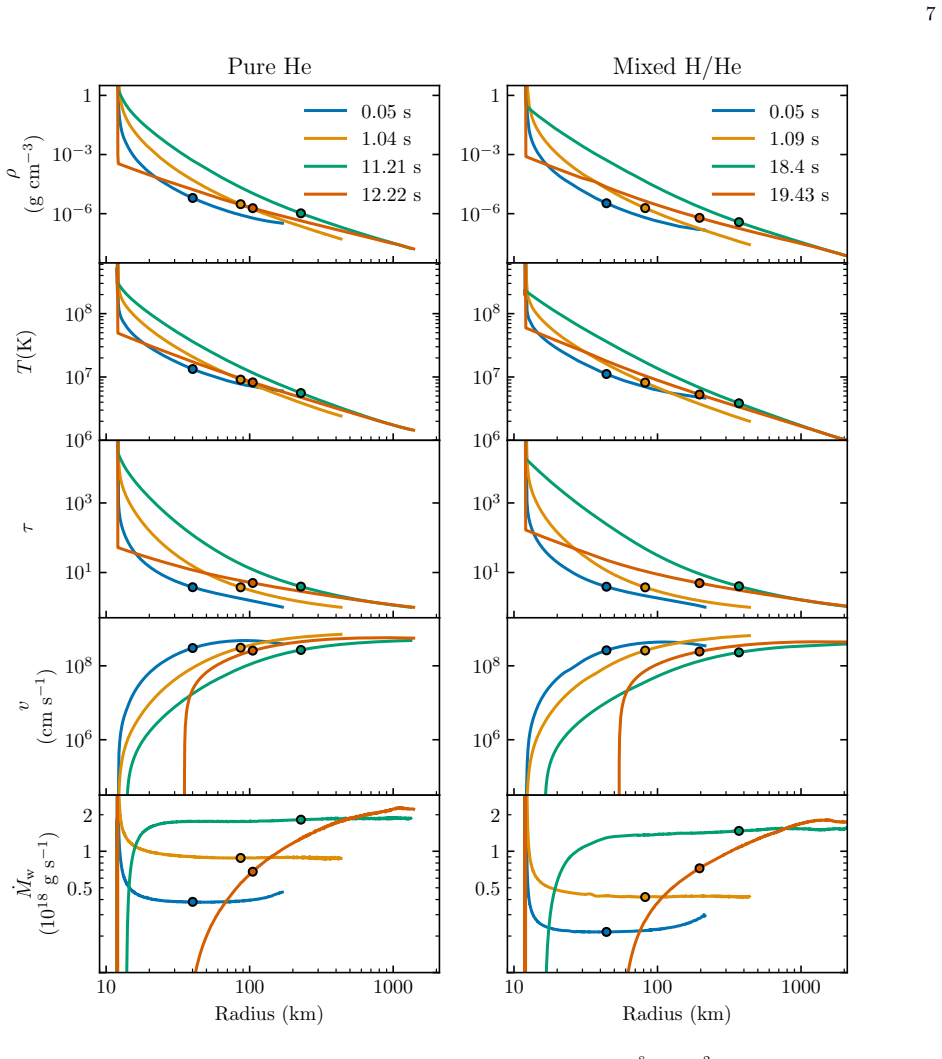
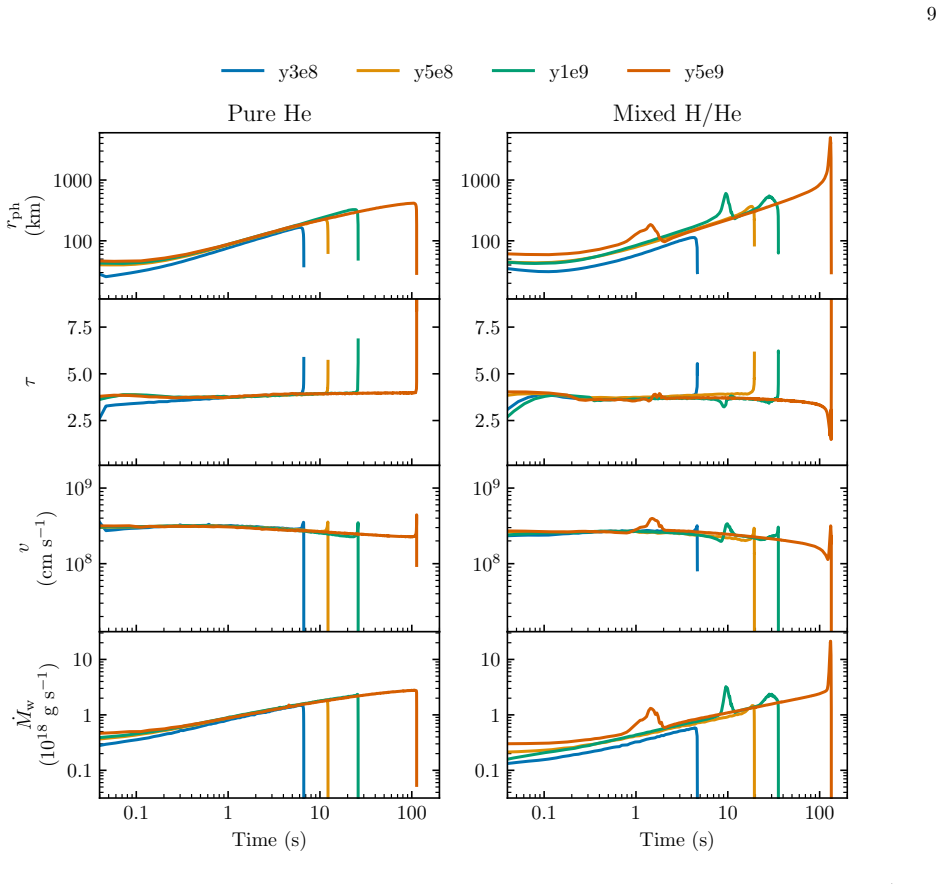
Recent NICER observations of photospheric radius expansion (PRE) X-ray bursts reveal absorption features consistent with photospheres enriched in intermediate-mass elements. These features may arise from radiation-driven winds that eject freshly synthesized nuclear ashes, offering a new probe of X-ray bursts and neutron star properties. Motivated by these observations, we use the MESA stellar evolution code to simulate PRE bursts from accretion through the hydrodynamic wind phase. We model a range of ignition depths for both pure helium and mixed hydrogen/helium accretion and explore several prescriptions for convection during burst rise. We find that the wind abundances depend sensitively on both ignition depth and convective treatment, including the efficiency of semiconvective mixing and the prescription used to define convective boundaries. Bursts igniting at column depths greater than or equal to 5 x 10^8 g cm^-2 produce ash-enriched winds, with ejecta ranging from intermediate-mass to iron-peak elements depending on ignition depth, accretion composition, and the treatment of convection.
Editorial analysis
A structured set of objections, weighed in public.
Referee Report
Summary. The manuscript uses MESA to simulate photospheric radius expansion Type I X-ray bursts from accretion through the wind phase. It models a range of ignition column depths for pure-He and mixed H/He accretion, explores multiple convection prescriptions (semiconvective efficiency and boundary definitions), and concludes that ignitions at column depths ≥5×10^8 g cm^{-2} produce radiation-driven winds enriched in intermediate-mass to iron-peak elements, with the precise composition depending on ignition depth, accretion composition, and convective treatment.
Significance. If the simulation results are robust, the work would connect NICER absorption features in PRE bursts to the ejection of nuclear ashes, providing a new observational probe of burst ignition conditions and neutron-star properties. The forward simulation approach against external nuclear-reaction libraries is a positive feature.
major comments (2)
- [section describing convective prescriptions during burst rise] The headline claim that deep ignitions (≥5×10^8 g cm^{-2}) generically produce ash-enriched winds rests on the assumption that the explored semiconvective efficiencies and convective-boundary prescriptions capture the dominant mixing physics that transports ashes to the surface. The manuscript reports sensitivity to these choices but does not demonstrate that the result survives weaker mixing or the inclusion of additional transport (e.g., rotational shear or wave-driven mixing), which would directly affect the wind composition.
- [results section on wind abundances] The reported dependence of wind abundances on ignition depth and convection treatment is presented as a central result, yet the manuscript provides no quantitative bounds on how far the free parameters (ignition column depth, semiconvective mixing efficiency) can be varied before the ash-enrichment threshold disappears. This leaves the robustness of the ≥5×10^8 g cm^{-2} cutoff untested against plausible variations in the mixing treatment.
minor comments (1)
- The abstract uses the character 'x' for multiplication in '5 x 10^8'; standard astronomical notation employs ×.
Simulated Author's Rebuttal
We thank the referee for the constructive and detailed report. The comments highlight important questions about the robustness of our mixing results, which we address below. We propose targeted revisions to better delineate the scope of the modeled physics.
read point-by-point responses
-
Referee: [section describing convective prescriptions during burst rise] The headline claim that deep ignitions (≥5×10^8 g cm^{-2}) generically produce ash-enriched winds rests on the assumption that the explored semiconvective efficiencies and convective-boundary prescriptions capture the dominant mixing physics that transports ashes to the surface. The manuscript reports sensitivity to these choices but does not demonstrate that the result survives weaker mixing or the inclusion of additional transport (e.g., rotational shear or wave-driven mixing), which would directly affect the wind composition.
Authors: We agree that the results are tied to the MESA convective prescriptions we varied (semiconvective efficiency and boundary definitions). The abstract and results section already qualify the findings as depending on convective treatment, and we do not claim the outcome is independent of mixing physics. Additional mechanisms such as rotational shear or wave-driven mixing are outside the scope of the present MESA setup and would require new model development. We will revise the discussion to explicitly state the range of mixing physics considered and to flag the potential effects of unmodeled transport as a limitation. revision: yes
-
Referee: [results section on wind abundances] The reported dependence of wind abundances on ignition depth and convection treatment is presented as a central result, yet the manuscript provides no quantitative bounds on how far the free parameters (ignition column depth, semiconvective mixing efficiency) can be varied before the ash-enrichment threshold disappears. This leaves the robustness of the ≥5×10^8 g cm^{-2} cutoff untested against plausible variations in the mixing treatment.
Authors: The manuscript already varies ignition depth across a grid that brackets the 5×10^8 g cm^{-2} threshold and tests multiple semiconvective efficiencies, with the enrichment threshold persisting in all cases examined. While an exhaustive scan of every plausible parameter combination is not feasible, the explored range covers the values typically adopted in the literature. We will add a supplementary table or figure that tabulates wind composition versus the two free parameters to make the sensitivity more quantitative. revision: partial
Circularity Check
No significant circularity; forward simulations against external libraries
full rationale
The paper performs forward MESA simulations of PRE bursts, varying ignition depth, accretion composition, and convection prescriptions (semiconvective efficiency, boundary definitions). Wind compositions are direct outputs of these runs using external nuclear-reaction libraries. No equations reduce by construction to inputs, no fitted parameters are relabeled as predictions, and no load-bearing self-citations or imported uniqueness theorems appear in the provided text. The sensitivity to convection is explicitly explored and reported rather than assumed away, keeping the derivation self-contained.
Axiom & Free-Parameter Ledger
free parameters (2)
- ignition column depth
- semiconvective mixing efficiency
axioms (2)
- domain assumption MESA stellar evolution code accurately captures the coupled hydrodynamics, nuclear burning, and radiative transfer during the burst rise and wind phase.
- domain assumption The chosen nuclear reaction network and convective boundary definitions are adequate to determine the final ash composition that reaches the wind.
Reference graph
Works this paper leans on
-
[1]
1999, NuPhA, 656, 3, doi: 10.1016/S0375-9474(99)00030-5 Astropy Collaboration, Price-Whelan, A
Angulo, C., Arnould, M., Rayet, M., et al. 1999, NuPhA, 656, 3, doi: 10.1016/S0375-9474(99)00030-5 Astropy Collaboration, Price-Whelan, A. M., Lim, P. L., et al. 2022, ApJ, 935, 167, doi: 10.3847/1538-4357/ac7c74
-
[2]
2025, Astronomy and Astrophysics, 694, A266, doi: 10.1051/0004-6361/202452878
Barra, F., Barret, D., Pinto, C., et al. 2025, Astronomy and Astrophysics, 694, A266, doi: 10.1051/0004-6361/202452878
-
[3]
1998, in NATO Advanced Science Institutes (ASI) Series C, Vol
Bildsten, L. 1998, in NATO Advanced Science Institutes (ASI) Series C, Vol. 515, NATO Advanced Science Institutes (ASI) Series C, ed. R. Buccheri, J. van Paradijs, & A. Alpar, 419
1998
-
[4]
Boutloukos, S., Miller, M. C., & Lamb, F. K. 2010, ApJL, 720, L15, doi: 10.1088/2041-8205/720/1/L15
-
[5]
Brown, E. F., & Bildsten, L. 1998, ApJ, 496, 915, doi: 10.1086/305419
-
[6]
Chugunov, A. I., Dewitt, H. E., & Yakovlev, D. G. 2007, PhRvD, 76, 025028, doi: 10.1103/PhysRevD.76.025028
-
[7]
2003, ApJ, 595, 1077, doi: 10.1086/377446
Cumming, A. 2003, ApJ, 595, 1077, doi: 10.1086/377446
-
[8]
2000, The Astrophysical Journal, 544, 453
Cumming, A., & Bildsten, L. 2000, The Astrophysical Journal, 544, 453
2000
-
[9]
Cumming, A., Macbeth, J., in ’t Zand, J. J. M., & Page, D. 2006, ApJ, 646, 429, doi: 10.1086/504698
-
[10]
Cyburt, R. H., Amthor, A. M., Ferguson, R., et al. 2010, ApJS, 189, 240, doi: 10.1088/0067-0049/189/1/240
-
[11]
1983, PASJ, 35, 17
Ebisuzaki, T., Hanawa, T., & Sugimoto, D. 1983, PASJ, 35, 17
1983
-
[12]
Fuller, G. M., Fowler, W. A., & Newman, M. J. 1985, ApJ, 293, 1, doi: 10.1086/163208
-
[13]
K., & Keek, L
Galloway, D. K., & Keek, L. 2021, in Astrophysics and Space Science Library, Vol. 461, Timing Neutron Stars:
2021
-
[14]
Belloni, M. M´ endez, & C. Zhang, 209–262, doi: 10.1007/978-3-662-62110-3 5
-
[15]
Galloway, D. K., Muno, M. P., Hartman, J. M., Psaltis, D., & Chakrabarty, D. 2008, ApJS, 179, 360, doi: 10.1086/592044
-
[16]
K., in’t Zand, J., Chenevez, J., et al
Galloway, D. K., in’t Zand, J., Chenevez, J., et al. 2020, The Astrophysical Journal Supplement Series, 249, 32, doi: 10.3847/1538-4365/ab9f2e
-
[17]
2023, The Astrophysical Journal, 954, 54, doi: 10.3847/1538-4357/ace43c
Guichandut, S., & Cumming, A. 2023, The Astrophysical Journal, 954, 54, doi: 10.3847/1538-4357/ace43c
-
[18]
2021, The Astrophysical Journal, 914, 49, doi: 10.3847/1538-4357/abfa13
Zamfir, M. 2021, The Astrophysical Journal, 914, 49, doi: 10.3847/1538-4357/abfa13
-
[19]
Harris, C. R., Millman, K. J., van der Walt, S. J., et al. 2020, Nature, 585, 357–362, doi: 10.1038/s41586-020-2649-2
-
[20]
Henyey, L., Vardya, M. S., & Bodenheimer, P. 1965, ApJ, 142, 841, doi: 10.1086/148357
-
[21]
2020, Astronomy and Astrophysics, 638, A107, doi: 10.1051/0004-6361/201936895 —
Herrera, Y., Sala, G., & Jos´ e, J. 2020, Astronomy and Astrophysics, 638, A107, doi: 10.1051/0004-6361/201936895 —. 2023, Astronomy and Astrophysics, 678, A156, doi: 10.1051/0004-6361/202346190
-
[22]
Hunter, J. D. 2007, Computing in Science and Engineering, 9, 90, doi: 10.1109/MCSE.2007.55
-
[23]
2025, arXiv e-prints, arXiv:2511.20499, doi: 10.48550/arXiv.2511.20499 17 in’t Zand, J
Iaria, R., Di Salvo, T., Anitra, A., et al. 2025, arXiv e-prints, arXiv:2511.20499, doi: 10.48550/arXiv.2511.20499 17 in’t Zand, J. J. M., & Weinberg, N. N. 2010, A&A, 520, A81
-
[24]
1996, ApJ, 470, 1015, doi: 10.1086/177926
Itoh, N., Nishikawa, A., & Kohyama, Y. 1996, ApJ, 470, 1015, doi: 10.1086/177926
-
[25]
K., Chenevez, J., Strohmayer, T
Jaisawal, G. K., Chenevez, J., Strohmayer, T. E., et al. 2025, The Astrophysical Journal, 986, 16, doi: 10.3847/1538-4357/adcc24
-
[26]
Jermyn, A. S., Bauer, E. B., Schwab, J., et al. 2023, ApJS, 265, 15, doi: 10.3847/1538-4365/acae8d
-
[27]
C., & Melia, F
Joss, P. C., & Melia, F. 1987, ApJ, 312, 700
1987
-
[28]
Joss, P. C., & Melia, F. 1987, ApJ, 312, 700, doi: 10.1086/164913
-
[29]
doi:10.1093/mnras/staa1595 , eprint =
Kaiser, E. A., Hirschi, R., Arnett, W. D., et al. 2020, Monthly Notices of the Royal Astronomical Society, 496, 1967, doi: 10.1093/mnras/staa1595
-
[30]
Kippenhahn, R., Ruschenplatt, G., & Thomas, H. C. 1980, A&A, 91, 175
1980
-
[31]
2000, NuPhA, 673, 481, doi: 10.1016/S0375-9474(00)00131-7
Langanke, K., & Mart´ ınez-Pinedo, G. 2000, NuPhA, 673, 481, doi: 10.1016/S0375-9474(00)00131-7
-
[32]
2009, Meteoritics and Planetary Science Supplement, 72, 5154
Lodders, K., & Palme, H. 2009, Meteoritics and Planetary Science Supplement, 72, 5154
2009
-
[33]
Medin, Z., von Steinkirch, M., Calder, A. C., et al. 2016, ApJ, 832, 102, doi: 10.3847/0004-637X/832/2/102
-
[34]
2019, The Astrophysical Journal, 872, 84, doi: 10.3847/1538-4357/aafede
Meisel, Z., Merz, G., & Medvid, S. 2019, The Astrophysical Journal, 872, 84, doi: 10.3847/1538-4357/aafede
-
[35]
Miller, M. C. 2013, ArXiv e-prints. https://arxiv.org/abs/1312.0029
Pith/arXiv arXiv 2013
-
[36]
Miller, M. C., & Lamb, F. K. 2016, European Physical Journal A, 52, 63, doi: 10.1140/epja/i2016-16063-8
-
[37]
1994, ApJ, 433, 276, doi: 10.1086/174643
Nobili, L., Turolla, R., & Lapidus, I. 1994, ApJ, 433, 276, doi: 10.1086/174643
-
[38]
Oda, T., Hino, M., Muto, K., Takahara, M., & Sato, K. 1994, Atomic Data and Nuclear Data Tables, 56, 231, doi: 10.1006/adnd.1994.1007 ¨Ozel, F., & Freire, P. 2016, Annual Review of Astronomy and Astrophysics, 54, 401, doi: 10.1146/annurev-astro-081915-023322
-
[39]
1986, ApJ, 302, 519, doi: 10.1086/164012
Paczynski, B., & Proszynski, M. 1986, ApJ, 302, 519, doi: 10.1086/164012
-
[40]
2011, ApJS, 192, 3, doi: 10.1088/0067-0049/192/1/3
Paxton, B., Bildsten, L., Dotter, A., et al. 2011, ApJS, 192, 3, doi: 10.1088/0067-0049/192/1/3
-
[41]
2013, ApJS, 208, 4
Paxton, B., Cantiello, M., Arras, P., et al. 2013, ApJS, 208, 4
2013
-
[42]
2015, ApJS, 220, 15
Paxton, B., Marchant, P., Schwab, J., et al. 2015, ApJS, 220, 15
2015
-
[43]
B., et al
Paxton, B., Schwab, J., Bauer, E. B., et al. 2018, ApJS, 234, 34
2018
-
[44]
2019, ApJS, 243, 10
Paxton, B., Smolec, R., Schwab, J., et al. 2019, ApJS, 243, 10
2019
-
[45]
2025, The Astrophysical Journal, 982, 18, 10.3847/1538-4357/adb726
Peng, Z., Li, Z., Pan, Y., et al. 2025, The Astrophysical Journal, 982, 18, doi: 10.3847/1538-4357/adb726
-
[46]
1985, ApJ, 289, 634
Quinn, T., & Paczynski, B. 1985, ApJ, 289, 634
1985
-
[47]
1985, ApJ, 289, 634, doi: 10.1086/162927
Quinn, T., & Paczynski, B. 1985, ApJ, 289, 634, doi: 10.1086/162927
-
[48]
2024, wmwolf/py mesa reader: 0.3.5, 0.3.5, Zenodo, doi: 10.5281/zenodo.13697200
Schwab, J., Wolf, B., Zingale, M., et al. 2024, wmwolf/py mesa reader: 0.3.5, 0.3.5, Zenodo, doi: 10.5281/zenodo.13697200
-
[49]
Steiner, A. W., Lattimer, J. M., & Brown, E. F. 2010, ApJ, 722, 33, doi: 10.1088/0004-637X/722/1/33
-
[50]
New Views of Thermonuclear Bursts
Strohmayer, T., & Bildsten, L. 2003, arXiv e-prints, astro, doi: 10.48550/arXiv.astro-ph/0301544
work page internal anchor Pith review Pith/arXiv arXiv doi:10.48550/arxiv.astro-ph/0301544 2003
-
[51]
E., Altamirano, D., Arzoumanian, Z., et al
Strohmayer, T. E., Altamirano, D., Arzoumanian, Z., et al. 2019, ApJL, 878, L27, doi: 10.3847/2041-8213/ab25eb
-
[52]
2011, A&A, 527, A139, doi: 10.1051/0004-6361/201015845
Suleimanov, V., Poutanen, J., & Werner, K. 2011, A&A, 527, A139, doi: 10.1051/0004-6361/201015845
-
[53]
2024, MESA SDK for Mac OS, 24.7.1, Zenodo, doi: 10.5281/zenodo.13768941
Townsend, R. 2024, MESA SDK for Mac OS, 24.7.1, Zenodo, doi: 10.5281/zenodo.13768941
-
[54]
Virtanen, P., Gommers, R., Oliphant, T. E., et al. 2020, Nature Methods, 17, 261, doi: 10.1038/s41592-019-0686-2
-
[55]
A., Zimmerman, G
Weaver, T. A., Zimmerman, G. B., & Woosley, S. E. 1978, ApJ, 225, 1021
1978
-
[56]
N., Bildsten, L., & Schatz, H
Weinberg, N. N., Bildsten, L., & Schatz, H. 2006, ApJ, 639, 1018
2006
-
[57]
Yu, H., & Weinberg, N. N. 2018, ApJ, 863, 53, doi: 10.3847/1538-4357/aad045
-
[58]
2025, , 696, A139, 10.1051/0004-6361/202453142
Yu, W., Li, Z., Pan, Y., et al. 2025, Astronomy and Astrophysics, 696, A139, doi: 10.1051/0004-6361/202453142
-
[59]
2025, The Astrophysical Journal, 982, 122, doi: 10.3847/1538-4357/adb71c
Zhen, G., Liu, H., Dohi, A., et al. 2025, The Astrophysical Journal, 982, 122, doi: 10.3847/1538-4357/adb71c
discussion (0)
Sign in with ORCID, Apple, or X to comment. Anyone can read and Pith papers without signing in.