MotifGen: Spatiotemporal interpolation of misaligned satellite images via multi-source generative modeling, in an application to tropical cyclones
Pith reviewed 2026-06-26 00:15 UTC · model grok-4.3
The pith
A generative model can interpolate microwave satellite images of tropical cyclones by combining data from multiple misaligned instruments and infrared observations at irregular time intervals.
A machine-rendered reading of the paper's core claim, the machinery that carries it, and where it could break.
Core claim
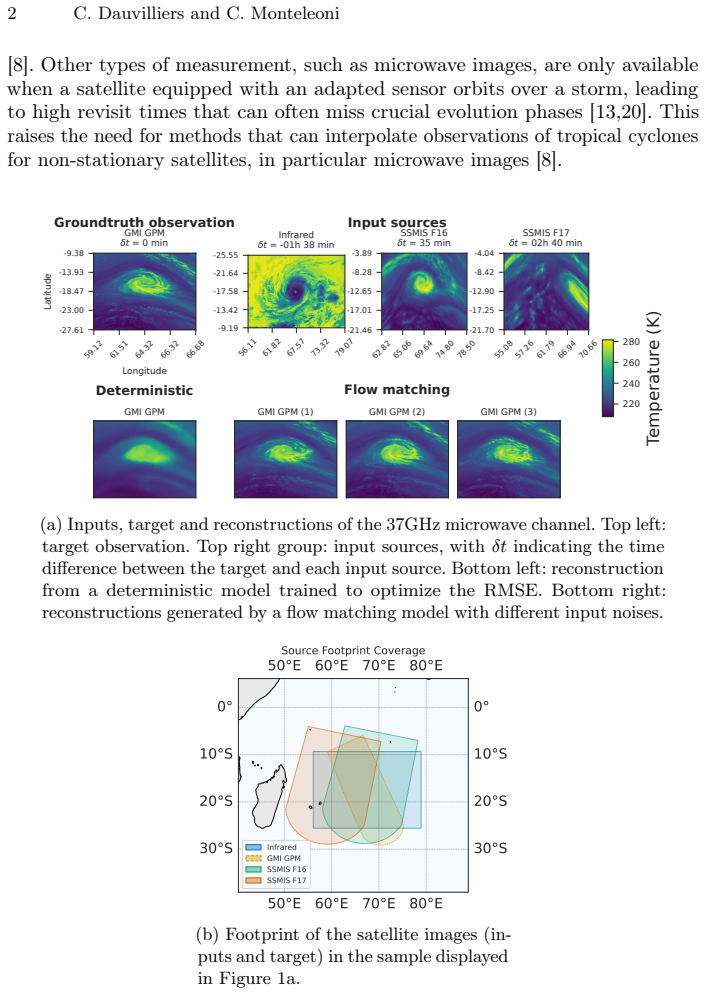
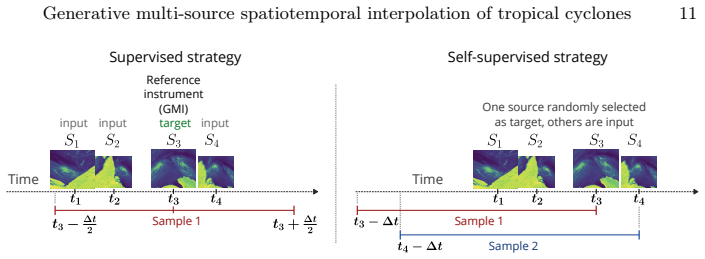
The model, trained on a self-supervised task where a random source is masked and reconstructed, interpolates missing microwave images of tropical cyclones using other microwave and infrared instruments at irregular intervals and misaligned positions, leading to lower CRPS scores and more realistic generated spectra.
What carries the argument
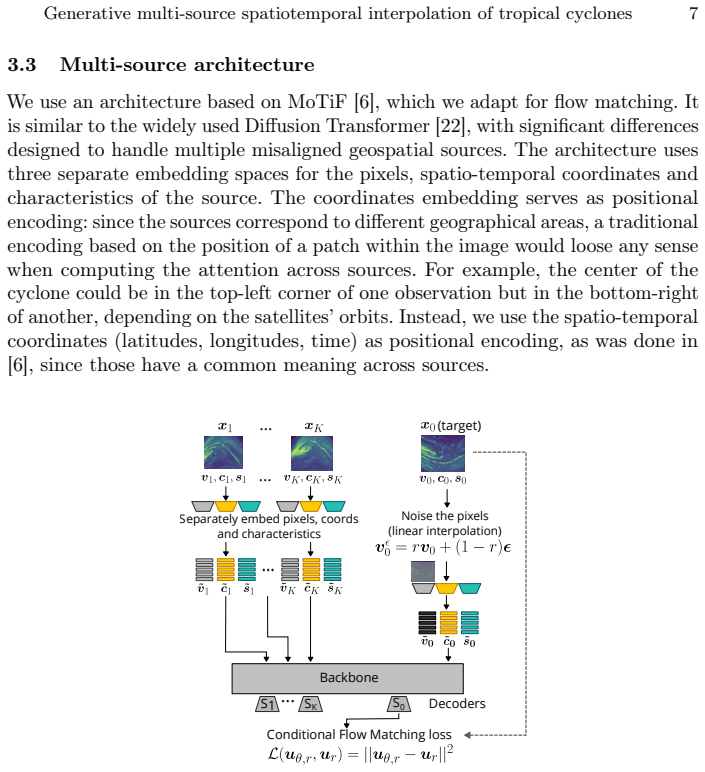
The multi-source generative model trained via self-supervised masking-and-reconstruction of random sources.
If this is right
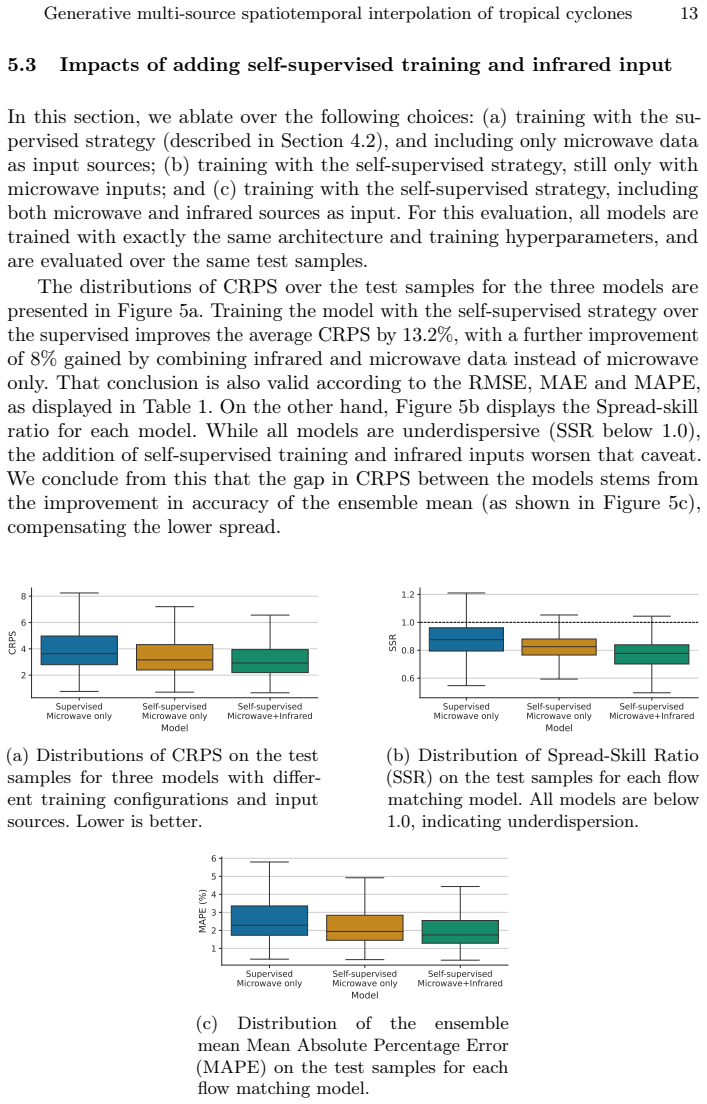
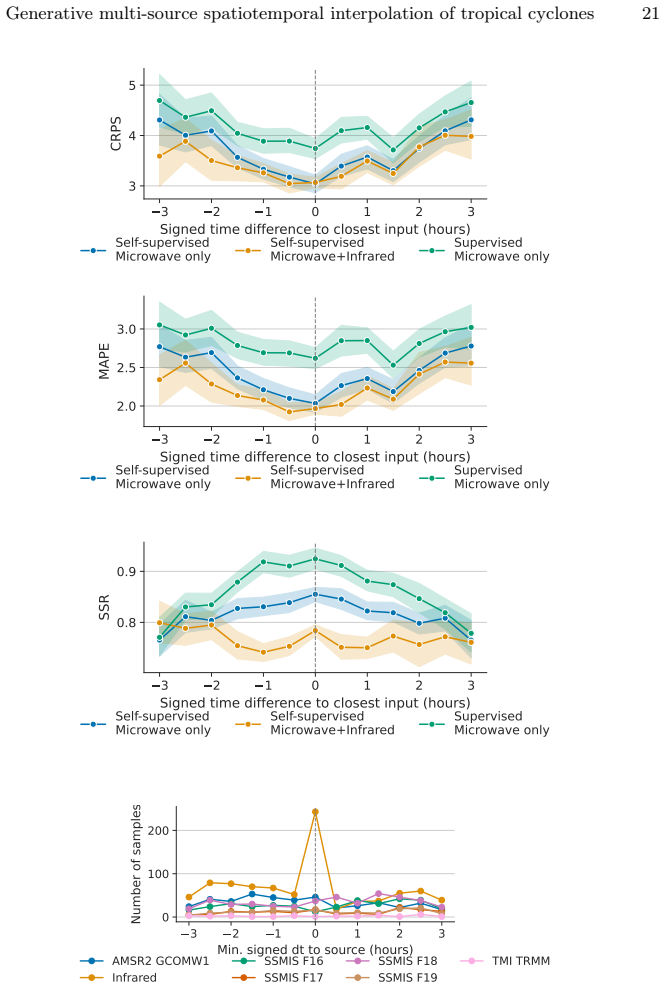
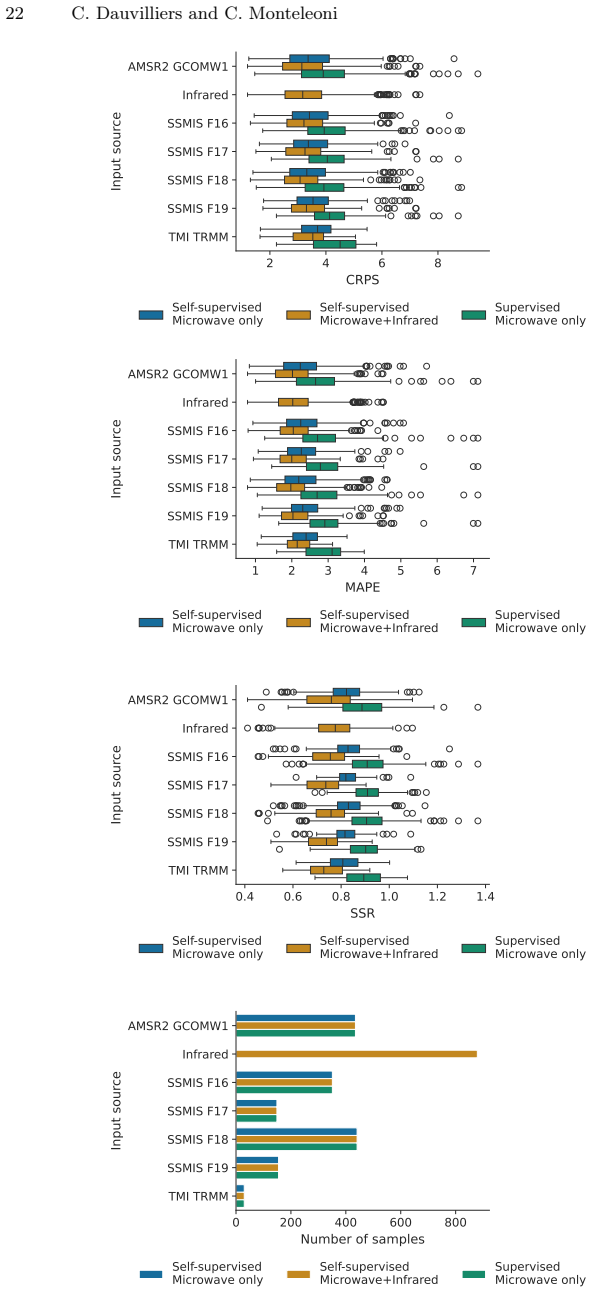
- Self-supervised training decreases the Continuous Ranked Probability Score compared to supervised training.
- Combining infrared and microwave data improves results over microwave only.
- The ensemble mean is on par with a deterministic model.
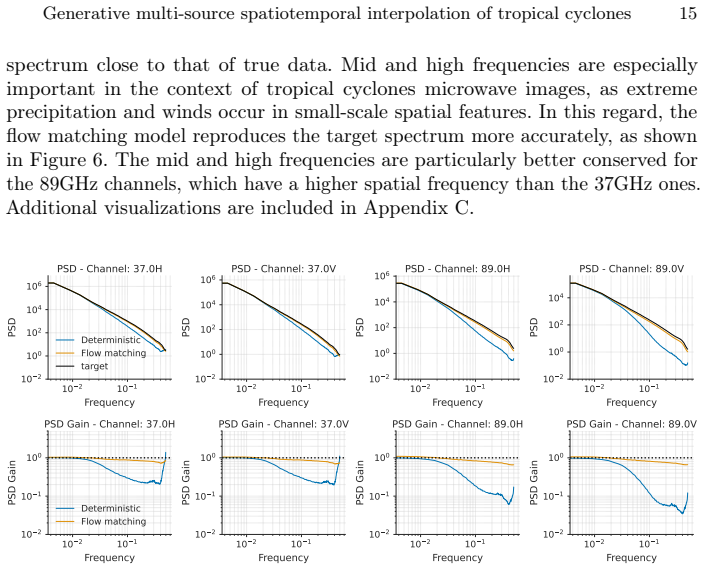
- The generated power spectrum is significantly closer to true observations.
Where Pith is reading between the lines
- The approach could be tested on other types of satellite data with similar misalignment issues.
- It may help in monitoring rapid storm evolution by providing interpolated images at more frequent times.
- Validation on cyclones with different characteristics could confirm generalization beyond training patterns.
Load-bearing premise
The self-supervised masking-and-reconstruction task on randomly chosen sources produces representations that generalize to the true missing-data distribution rather than memorizing co-occurrence patterns.
What would settle it
Evaluating the model on cyclone events with missing-data patterns that differ substantially from the training set and finding that CRPS does not decrease or that power spectra deviate from observations would disprove the central claim.
Figures
read the original abstract
Microwave satellite imagery plays a crucial role in monitoring tropical cyclone precipitation and intensity worldwide, but suffers from long revisit times, potentially missing rapid storm evolution phases. While this raises the need for an interpolation method, it is made challenging by the high level of heterogeneity of microwave data coming from different instruments. In this work, we introduce the first generative model that can be applied to multiple geospatial sources that change across samples, occur at irregular time intervals, are misaligned geographically, and come from instruments with varying characteristics. We apply this model to the case of spatio-temporal interpolation of tropical cyclone microwave images from other microwave and infrared instruments. We train using a self-supervised task in which a random source is masked and reconstructed, and show that it leads to a significant decrease in Continuous Ranked Probability Score over supervised training. We show a further improvement by combining infrared and microwave data compared to microwave only. Using these improvements, the generative model produces an ensemble mean on par with that of a deterministic model, while generating a power spectrum significantly closer to that of true observations. To the best of our knowledge, this is the first generative model that interpolates microwave images of cyclones by combining multiple microwave instruments and infrared observations at irregular time intervals.
Editorial analysis
A structured set of objections, weighed in public.
Referee Report
Summary. The manuscript introduces MotifGen, a generative model for spatiotemporal interpolation of misaligned multi-source satellite images at irregular intervals, applied to tropical cyclone microwave imagery. It combines data from multiple microwave instruments and infrared observations, trains via self-supervised random source masking and reconstruction, and reports a statistically significant CRPS reduction relative to supervised training, further gains from IR+MW fusion, an ensemble mean comparable to deterministic baselines, and a power spectrum closer to observations. The work claims to be the first generative model handling this combination of heterogeneity, misalignment, and irregular timing.
Significance. If the self-supervised regime produces representations that transfer to operational missingness, the approach could improve probabilistic nowcasting of cyclone precipitation and intensity by filling long microwave revisit gaps with realistic ensemble variability. The multi-source generative handling of heterogeneous geospatial data represents a technical step beyond single-instrument deterministic interpolation.
major comments (2)
- [Methods (self-supervised masking procedure)] The self-supervised training procedure (described in the methods) masks a randomly chosen source per sample. Real satellite missingness, however, is structured by fixed orbital periods, swath widths, and alignment constraints rather than uniform random selection. No ablation or hold-out experiment is reported that evaluates the model on gaps generated from actual satellite revisit schedules instead of the training masking distribution. This directly affects the central claim that the learned representations generalize to the true missing-data distribution.
- [Results (CRPS and power-spectrum experiments)] The results section reports CRPS reductions and power-spectrum improvements but provides no quantitative details on total number of training samples, number of distinct cyclones, train-test split (e.g., by storm or by time), or how error bars / statistical significance on CRPS were computed. Without these, the magnitude and robustness of the claimed gains cannot be assessed.
minor comments (2)
- [Abstract and Results] The abstract states that the ensemble mean is 'on par' with a deterministic model; the corresponding figure or table should report the exact metric values (e.g., RMSE or MAE) for both to allow direct comparison.
- [Notation and model description] Notation for the multiple instruments and their misalignment parameters should be introduced once in a dedicated table or equation block rather than scattered across the text.
Simulated Author's Rebuttal
We thank the referee for the constructive comments. We address each major point below and will revise the manuscript to incorporate clarifications and additional details.
read point-by-point responses
-
Referee: [Methods (self-supervised masking procedure)] The self-supervised training procedure (described in the methods) masks a randomly chosen source per sample. Real satellite missingness, however, is structured by fixed orbital periods, swath widths, and alignment constraints rather than uniform random selection. No ablation or hold-out experiment is reported that evaluates the model on gaps generated from actual satellite revisit schedules instead of the training masking distribution. This directly affects the central claim that the learned representations generalize to the true missing-data distribution.
Authors: We agree that real satellite missingness follows structured orbital patterns rather than purely random selection. The random per-sample source masking was selected to ensure the model learns to handle arbitrary combinations of heterogeneous sources, which is a core requirement of the multi-instrument setting. This is consistent with self-supervised strategies in other multi-modal domains. To directly address the concern, the revised manuscript will include a discussion of this design choice and report results from an additional ablation that simulates structured gaps drawn from typical microwave revisit schedules. revision: yes
-
Referee: [Results (CRPS and power-spectrum experiments)] The results section reports CRPS reductions and power-spectrum improvements but provides no quantitative details on total number of training samples, number of distinct cyclones, train-test split (e.g., by storm or by time), or how error bars / statistical significance on CRPS were computed. Without these, the magnitude and robustness of the claimed gains cannot be assessed.
Authors: We apologize for the missing quantitative details. The revised manuscript will explicitly report the total number of training samples, the number of distinct cyclones, the train-test split strategy (by time to prevent temporal leakage), and the exact procedure used to compute error bars and statistical significance on the CRPS values. revision: yes
Circularity Check
No significant circularity; self-supervised objective is independent training signal
full rationale
The paper trains a generative model via a self-supervised random-source-masking task and reports empirical gains (CRPS reduction, power-spectrum fidelity) versus supervised baselines and MW-only variants. No equations, fitted parameters, or self-citations are described that would render the reported improvements tautological by construction. The masking regime is presented as a methodological choice whose generalization to real orbital missingness is an empirical question, not a definitional reduction. The derivation chain remains self-contained against external benchmarks.
Axiom & Free-Parameter Ledger
Reference graph
Works this paper leans on
-
[1]
Asperti, A., Merizzi, F., Paparella, A., Pedrazzi, G., Angelinelli, M., Colamonaco, S.: Precipitation nowcasting with generative diffusion models (Sep 2023).https: //doi.org/10.48550/arXiv.2308.06733
-
[2]
In: Leonardis, A., Ricci, E., Roth, S., Russakovsky, O., Sattler, T., Varol, G
Astruc, G., Gonthier, N., Mallet, C., Landrieu, L.: OmniSat: Self-supervised Modality Fusion for Earth Observation. In: Leonardis, A., Ricci, E., Roth, S., Russakovsky, O., Sattler, T., Varol, G. (eds.) Computer Vision – ECCV 2024, vol. 15086, pp. 409–427. Springer Nature Switzerland, Cham (2025). https: //doi.org/10.1007/978-3-031-73390-1_24
-
[3]
Bi, K., Xie, L., Zhang, H., Chen, X., Gu, X., Tian, Q.: Accurate medium-range global weather forecasting with 3D neural networks. Nature619(7970), 533–538 (Jul 2023). https://doi.org/10.1038/s41586-023-06185-3 Generative multi-source spatiotemporal interpolation of tropical cyclones 17
-
[4]
Cong, Y., Khanna, S., Meng, C., Liu, P., Rozi, E., He, Y., Burke, M., Lobell, D.B., Ermon, S.: SatMAE: Pre-training Transformers for Temporal and Multi-Spectral Satellite Imagery
-
[5]
Couairon, G., Singh, R., Charantonis, A., Lessig, C., Monteleoni, C.: ArchesWeather &ArchesWeatherGen:AdeterministicandgenerativemodelforefficientMLweather forecasting (Dec 2024).https://doi.org/10.48550/arXiv.2412.12971
-
[6]
Environmental Data Science4, e36 (Jan 2025).https://doi.org/10.1017/eds.2025.10014
Dauvilliers, C., Monteleoni, C.: MoTiF: A self-supervised model for multi-source forecasting with application to tropical cyclones. Environmental Data Science4, e36 (Jan 2025).https://doi.org/10.1017/eds.2025.10014
-
[7]
An Image is Worth 16x16 Words: Transformers for Image Recognition at Scale
Dosovitskiy, A., Beyer, L., Kolesnikov, A., Weissenborn, D., Zhai, X., Unterthiner, T., Dehghani, M., Minderer, M., Heigold, G., Gelly, S., Uszkoreit, J., Houlsby, N.: An Image is Worth 16x16 Words: Transformers for Image Recognition at Scale (Jun 2021). https://doi.org/10.48550/arXiv.2010.11929
work page internal anchor Pith review Pith/arXiv arXiv doi:10.48550/arxiv.2010.11929 2021
-
[8]
Tropical Cyclone Research and Review12(4), 259–266 (Dec 2023)
Duong, Q.P., Wimmers, A., Herndon, D., Tan, Z.M., Zhuo, J.Y., Knaff, J., Al Ab- dulsalam, I., Horinouchi, T., Miyata, R., Avenas, A.: Objective satellite methods including AI algorithms reviewed for the tenth International workshop on tropical cyclones (IWTC-10). Tropical Cyclone Research and Review12(4), 259–266 (Dec 2023). https://doi.org/10.1016/j.tcrr...
-
[9]
Scaling Rectified Flow Transformers for High-Resolution Image Synthesis
Esser, P., Kulal, S., Blattmann, A., Entezari, R., Müller, J., Saini, H., Levi, Y., Lorenz, D., Sauer, A., Boesel, F., Podell, D., Dockhorn, T., English, Z., Lacey, K., Goodwin, A., Marek, Y., Rombach, R.: Scaling Rectified Flow Transformers for High-Resolution Image Synthesis (Mar 2024).https://doi.org/10.48550/arXiv. 2403.03206
work page internal anchor Pith review Pith/arXiv arXiv doi:10.48550/arxiv 2024
-
[10]
Fortin, V., Abaza, M., Anctil, F., Turcotte, R.: Why Should Ensemble Spread Match the RMSE of the Ensemble Mean? Journal of Hydrometeorology15(4), 1708–1713 (Aug 2014).https://doi.org/10.1175/JHM-D-14-0008.1
-
[11]
https://doi.org/10.48550/arXiv.2409.16319
Guilloteau, C., Kerrigan, G., Nelson, K., Migliorini, G., Smyth, P., Li, R., Foufoula- Georgiou, E.: A Generative Diffusion Model for Probabilistic Ensembles of Pre- cipitation Maps Conditioned on Multisensor Satellite Observations (Sep 2024). https://doi.org/10.48550/arXiv.2409.16319
-
[12]
Atmospheric Research336, 108855 (Jun 2026).https://doi.org/10.1016/j.atmosres.2026.108855
Han, K.H., Jo, S., Hong, S.: GeoGMI: A generative adversarial framework for virtual 89 GHz microwave brightness temperature retrieval from geo-kompsat-2A infrared observations for tropical cyclone monitoring. Atmospheric Research336, 108855 (Jun 2026).https://doi.org/10.1016/j.atmosres.2026.108855
-
[13]
In: 36th Conference on Hurricanes and Tropical Meteorology
Haynes, K., Slocum, C., Knaff, J., Musgrave, K., Razin, M.N., Ebert-Uphoff, I.: Aiding Tropical Cyclone Forecasting by Creating Synthethic 89- and 37- GHz Im- agery from Operational Geostationary Satellites. In: 36th Conference on Hurricanes and Tropical Meteorology. AMS (May 2024)
2024
-
[14]
Jakubik, J., Yang, F., Blumenstiel, B., Scheurer, E., Sedona, R., Maurogiovanni, S., Bosmans, J., Dionelis, N., Marsocci, V., Kopp, N., Ramachandran, R., Fraccaro, P., Brunschwiler, T., Cavallaro, G., Bernabe-Moreno, J., Longépé, N.: TerraMind: Large-Scale Generative Multimodality for Earth Observation (Sep 2025).https: //doi.org/10.48550/arXiv.2504.11171
work page internal anchor Pith review Pith/arXiv arXiv doi:10.48550/arxiv.2504.11171 2025
-
[15]
Klemmer, K., Rolf, E., Robinson, C., Mackey, L., Rußwurm, M.: SatCLIP: Global, General-Purpose Location Embeddings with Satellite Imagery (Apr 2024).https: //doi.org/10.48550/arXiv.2311.17179
-
[16]
https://doi.org/10.48550/arXiv.2410.13314
Li, C., Ling, X., Xue, Y., Luo, W., Zhu, L., Qin, F., Zhou, Y., Huang, Y.: Precipi- tation Nowcasting Using Diffusion Transformer with Causal Attention (Oct 2024). https://doi.org/10.48550/arXiv.2410.13314
-
[17]
Flow Matching for Generative Modeling
Lipman, Y., Chen, R.T.Q., Ben-Hamu, H., Nickel, M., Le, M.: Flow Matching for Generative Modeling (Feb 2023).https://doi.org/10.48550/arXiv.2210.02747 18 C. Dauvilliers and C. Monteleoni
work page internal anchor Pith review Pith/arXiv arXiv doi:10.48550/arxiv.2210.02747 2023
-
[18]
In: 2021 IEEE/CVF International Conference on Computer Vision (ICCV)
Liu, Z., Lin, Y., Cao, Y., Hu, H., Wei, Y., Zhang, Z., Lin, S., Guo, B.: Swin Transformer: Hierarchical Vision Transformer using Shifted Windows. In: 2021 IEEE/CVF International Conference on Computer Vision (ICCV). pp. 9992–10002. IEEE, Montreal, QC, Canada (Oct 2021).https://doi.org/10.1109/ICCV48922. 2021.00986
-
[19]
Communications Earth & Environment6(1), 124 (Feb 2025).https://doi.org/ 10.1038/s43247-025-02042-5
Mardani, M., Brenowitz, N., Cohen, Y., Pathak, J., Chen, C.Y., Liu, C.C., Vahdat, A., Nabian, M.A., Ge, T., Subramaniam, A., Kashinath, K., Kautz, J., Pritchard, M.: Residual corrective diffusion modeling for km-scale atmospheric downscaling. Communications Earth & Environment6(1), 124 (Feb 2025).https://doi.org/ 10.1038/s43247-025-02042-5
-
[20]
Meng, F., Song, T., Xu, D.: Simulating Tropical Cyclone Passive Microwave Rainfall Imagery Using Infrared Imagery via Generative Adversarial Networks. IEEE Geo- science and Remote Sensing Letters19, 1–5 (2022).https://doi.org/10.1109/ LGRS.2022.3152847
arXiv 2022
-
[21]
Merizzi,F.,Asperti,A.,Colamonaco,S.:Windspeedsuper-resolutionandvalidation: From ERA5 to CERRA via diffusion models. Neural Computing and Applications 36(34), 21899–21921 (Dec 2024).https://doi.org/10.1007/s00521-024-10139-9
-
[22]
Scalable Diffusion Models with Transformers
Peebles, W., Xie, S.: Scalable Diffusion Models with Transformers (Mar 2023). https://doi.org/10.48550/arXiv.2212.09748
work page internal anchor Pith review Pith/arXiv arXiv doi:10.48550/arxiv.2212.09748 2023
-
[23]
Atmospheric Measurement Techniques15(17), 5033–5060 (Sep 2022)
Pfreundschuh, S., Brown, P.J., Kummerow, C.D., Eriksson, P., Norrestad, T.: GPROF-NN: A neural-network-based implementation of the Goddard Profiling Algorithm. Atmospheric Measurement Techniques15(17), 5033–5060 (Sep 2022). https://doi.org/10.5194/amt-15-5033-2022
-
[24]
URL https://doi.org/10.1038/s41586-024-08252-9
Price, I., Sanchez-Gonzalez, A., Alet, F., Andersson, T.R., El-Kadi, A., Masters, D., Ewalds, T., Stott, J., Mohamed, S., Battaglia, P., Lam, R., Willson, M.: Probabilistic weather forecasting with machine learning. Nature637(8044), 84–90 (Jan 2025). https://doi.org/10.1038/s41586-024-08252-9
-
[25]
Bulletin of the American Meteorological Society104(11), E1980–E1998 (Nov 2023)
Razin, M.N., Slocum, C.J., Knaff, J.A., Brown, P.J., Bell, M.M.: Tropical Cyclone Precipitation, Infrared, Microwave, and Environmental Dataset (TC PRIMED). Bulletin of the American Meteorological Society104(11), E1980–E1998 (Nov 2023). https://doi.org/10.1175/BAMS-D-21-0052.1
-
[26]
In: Forty-First International Conference on Machine Learning (Jun 2024)
Rolf,E.,Klemmer,K.,Robinson,C.,Kerner,H.:Position:MissionCritical–Satellite Data is a Distinct Modality in Machine Learning. In: Forty-First International Conference on Machine Learning (Jun 2024)
2024
-
[27]
Sambath, V., Dubois-Quilici, N., Viltard, N., Martini, A., Mallet, C.: Unsupervised Domain Adaptation to Mitigate Out-of-Distribution Problem of Spatial Radiometer Images: Application to Quantitative Precipitation Estimation. IEEE Transactions on Geoscience and Remote Sensing62, 1–14 (2024).https://doi.org/10.1109/ TGRS.2024.3403373
arXiv 2024
-
[28]
Shaw, P., Uszkoreit, J., Vaswani, A.: Self-Attention with Relative Position Repre- sentations (Apr 2018).https://doi.org/10.48550/arXiv.1803.02155
work page internal anchor Pith review Pith/arXiv arXiv doi:10.48550/arxiv.1803.02155 2018
-
[29]
https://doi.org/10.48550/arXiv.2506.14798
Tu, S., Xu, J., Yang, W., Bai, L., Fei, B.: MODS: Multi-source Observations Conditional Diffusion Model for Meteorological State Downscaling (Jun 2025). https://doi.org/10.48550/arXiv.2506.14798
-
[30]
Vaswani, A., Shazeer, N., Parmar, N., Uszkoreit, J., Jones, L., Gomez, A.N., Kaiser, L., Polosukhin, I.: Attention Is All You Need (Aug 2023).https://doi.org/10. 48550/arXiv.1706.03762
Pith/arXiv arXiv 2023
-
[31]
Velden, C.S., Herndon, D.: A Consensus Approach for Estimating Tropical Cyclone Intensity from Meteorological Satellites: SATCON (Aug 2020).https://doi.org/ 10.1175/WAF-D-20-0015.1 Generative multi-source spatiotemporal interpolation of tropical cyclones 19
-
[32]
Viltard, N., Sambath, V., Lepetit, P., Martini, A., Barthès, L., Mallet, C.: Evaluation of drain, a deep-learning approach to rain retrieval from gpm passive microwave radiometer (Mar 2023).https://doi.org/10.48550/arXiv.2303.01220
-
[33]
Weather and Forecasting40(11), 2317–2331 (Oct 2025).https://doi.org/ 10.1175/WAF-D-24-0196.1
You, S., Zhu, P., Guzman, O., Jiang, H.: Predicting Tropical Cyclone Intensity Using a Convolutional Neural Network and 20 Years of IMERG Satellite Rainfall Data. Weather and Forecasting40(11), 2317–2331 (Oct 2025).https://doi.org/ 10.1175/WAF-D-24-0196.1
-
[34]
Mathematical Geosciences 50(2), 209–234 (Feb 2018).https://doi.org/10.1007/ s11004-017-9709-7
Zamo, M., Naveau, P.: Estimation of the Continuous Ranked Probability Score with Limited Information and Applications to Ensemble Weather Forecasts. Mathematical Geosciences 50(2), 209–234 (Feb 2018).https://doi.org/10.1007/ s11004-017-9709-7
2018
-
[35]
Monthly Weather Review 149(7), 2097–2113 (Jul 2021).https://doi.org/10.1175/MWR-D-20-0333
Zhuo, J.Y., Tan, Z.M.: Physics-Augmented Deep Learning to Improve Tropical Cyclone Intensity and Size Estimation from Satellite Imagery. Monthly Weather Review 149(7), 2097–2113 (Jul 2021).https://doi.org/10.1175/MWR-D-20-0333. 1 20 C. Dauvilliers and C. Monteleoni Appendix A Training details Table 1 list the architectural and optimization parameters used...
discussion (0)
Sign in with ORCID, Apple, or X to comment. Anyone can read and Pith papers without signing in.