Limited surface mobility inhibits stable glass formation for 2-ethyl-1-hexanol
Pith reviewed 2026-06-25 21:50 UTC · model grok-4.3
The pith
Limited surface mobility prevents 2-ethyl-1-hexanol from forming highly stable vapor-deposited glasses.
A machine-rendered reading of the paper's core claim, the machinery that carries it, and where it could break.
Core claim
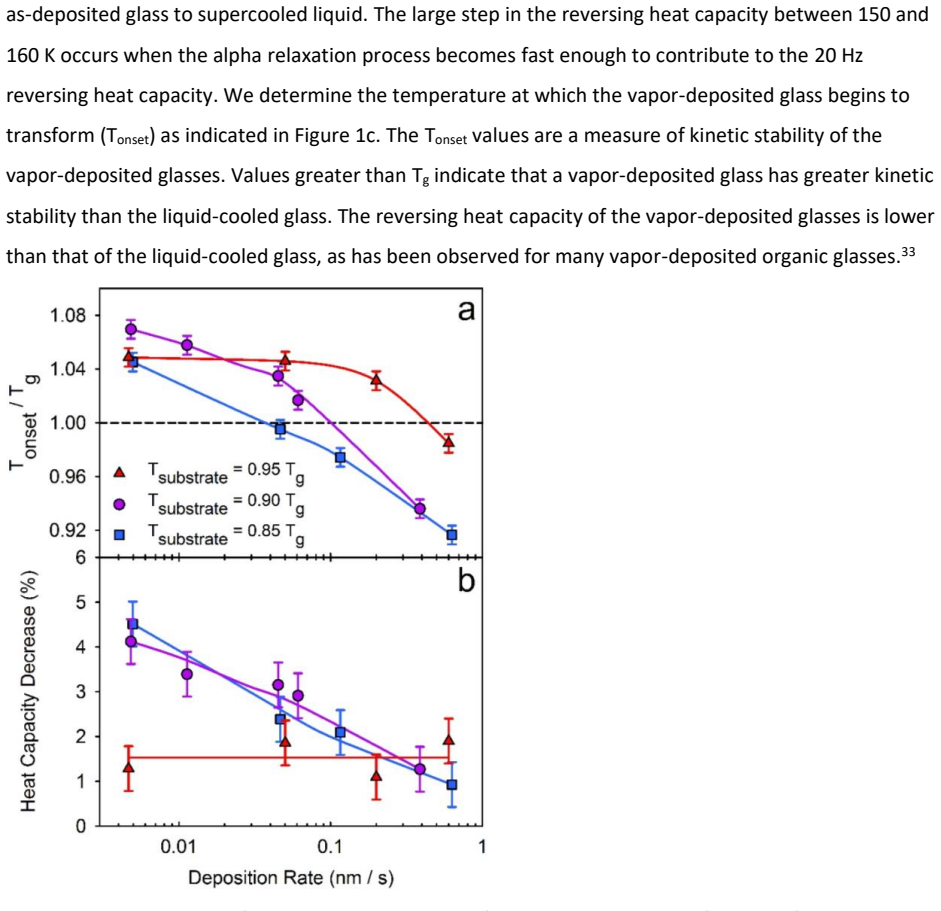
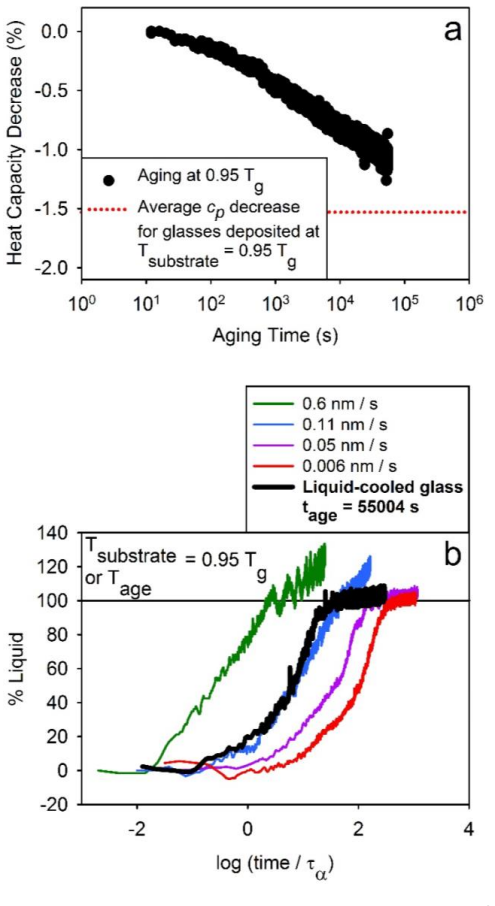
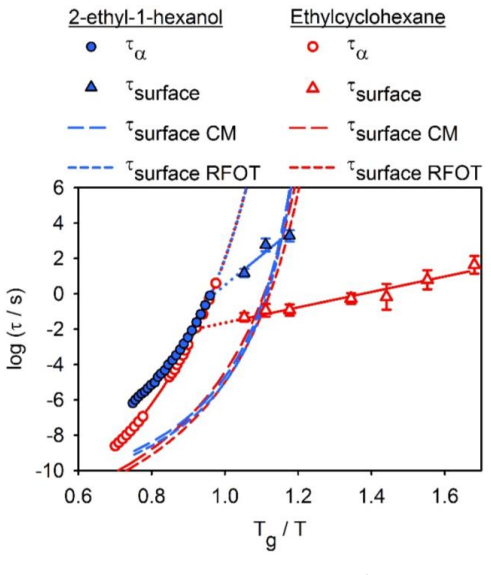
The kinetic stability of 2-ethyl-1-hexanol glasses increases by three orders of magnitude when the deposition rate is lowered at 0.90 Tg, and a vapor-deposited glass is far more stable than an aged liquid-cooled glass prepared in the same time; direct comparison shows the surface mobility of 2-ethyl-1-hexanol is more than four orders of magnitude lower than that of ethylcyclohexane at 0.85 Tg, supporting the hypothesis that limited surface mobility inhibits formation of highly stable glasses.
What carries the argument
Deposition-rate dependence of isothermal transformation times, used to quantify and compare surface mobility against ethylcyclohexane.
Load-bearing premise
That differences in stable glass formation between 2-ethyl-1-hexanol and ethylcyclohexane arise solely from their difference in surface mobility rather than from other molecular-structure or bulk-property distinctions.
What would settle it
A direct measurement of surface diffusion coefficients for both molecules at 0.85 Tg that finds the mobility ratio is not larger than four orders of magnitude.
Figures
read the original abstract
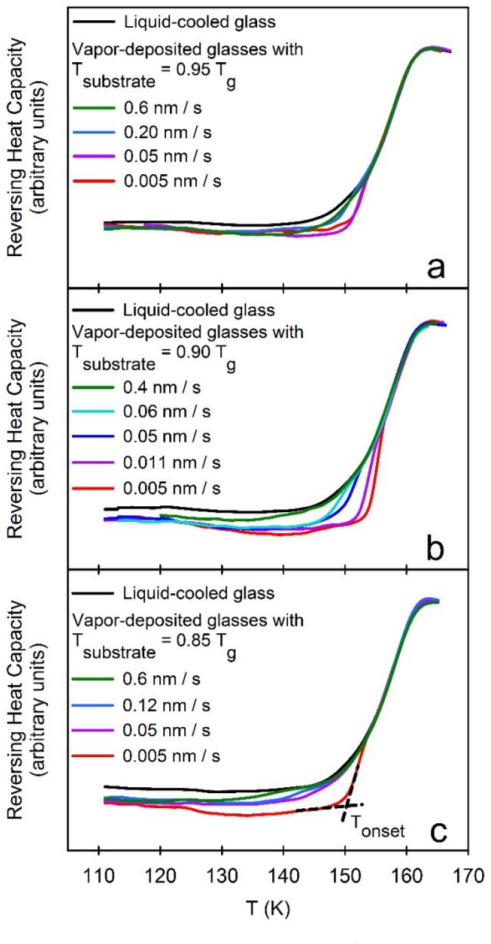
Previous work has shown that vapor-deposition can prepare organic glasses with extremely high kinetic stabilities and other properties that would be expected from liquid-cooled glasses only after aging for thousands of years or more. However, recent reports have shown that some molecules form vapor-deposited glasses with only limited kinetic stability when prepared using conditions expected to yield a stable glass. In this work, we vapor deposit glasses of 2-ethyl-1-hexanol over a wide range of deposition rates and test several hypotheses for why this molecule does not form highly stable glasses under normal deposition conditions. The kinetic stability of 2-ethyl-1-hexanol glasses is found to be highly dependent on the deposition rate. For deposition at Tsubstrate = 0.90 Tg, the kinetic stability increases by 3 orders of magnitude (as measured by isothermal transformation times) when the deposition rate is decreased from 0.2 nm/s to 0.005 nm/s. We also find that, for the same preparation time, a vapor-deposited glass has much more kinetic stability than an aged liquid-cooled glass. Our results support the hypothesis that the formation of highly stable 2-ethyl-1-hexanol glasses is inhibited by limited surface mobility. We compare our deposition rate experiments to similar ones performed with ethylcyclohexane (which readily forms glasses of high kinetic stability); we estimate that the surface mobility of 2-ethyl-1-hexanol is more than 4 orders of magnitude less than that of ethylcyclohexane at 0.85 Tg.
Editorial analysis
A structured set of objections, weighed in public.
Referee Report
Summary. The manuscript reports vapor-deposition experiments on 2-ethyl-1-hexanol, demonstrating that the kinetic stability of the resulting glasses (quantified via isothermal transformation times) increases by three orders of magnitude when the deposition rate is lowered from 0.2 nm/s to 0.005 nm/s at T_substrate = 0.90 T_g. The authors test multiple hypotheses for the limited stability observed under standard conditions and conclude that limited surface mobility is the inhibiting factor. This conclusion rests on a direct comparison to ethylcyclohexane (which forms highly stable glasses), from which they estimate that the surface mobility of 2-ethyl-1-hexanol is more than four orders of magnitude lower at 0.85 T_g. They additionally show that, for equivalent preparation times, vapor-deposited glasses exhibit greater kinetic stability than aged liquid-cooled glasses.
Significance. If the central claim holds, the work identifies surface mobility as a key constraint on stable glass formation for hydrogen-bonding molecules and provides a concrete experimental example where rate-dependent deposition fails to produce high-stability glasses. The clear demonstration of strong rate dependence and the explicit comparison to a contrasting molecule constitute strengths; the manuscript also supplies falsifiable predictions about mobility differences that can be tested with independent diffusion measurements.
major comments (1)
- [abstract, final paragraph] Abstract, final paragraph: the claim that surface mobility of 2-ethyl-1-hexanol is >4 orders of magnitude lower than that of ethylcyclohexane at 0.85 T_g is load-bearing for the central hypothesis, yet the comparison does not demonstrate that bulk properties (fragility index, self-diffusion coefficients, or relaxation mechanisms) have been matched or corrected between the hydrogen-bonding alcohol and the non-polar hydrocarbon. Without such controls, differences in the mapping from deposition rate to stability cannot be attributed solely to surface mobility.
minor comments (2)
- The abstract states that several hypotheses were tested but does not enumerate them or report the outcome for each; a brief summary in the abstract or a dedicated section would improve clarity.
- Error analysis, uncertainties on transformation times, and full data tables for the rate series are not referenced; inclusion of these would strengthen the reported three-order-of-magnitude effect.
Simulated Author's Rebuttal
We thank the referee for their careful review and for raising this important point about our comparison between 2-ethyl-1-hexanol and ethylcyclohexane. We address the comment below and have revised the manuscript to qualify the surface-mobility estimate and to discuss potential confounding bulk-property differences.
read point-by-point responses
-
Referee: [abstract, final paragraph] Abstract, final paragraph: the claim that surface mobility of 2-ethyl-1-hexanol is >4 orders of magnitude lower than that of ethylcyclohexane at 0.85 T_g is load-bearing for the central hypothesis, yet the comparison does not demonstrate that bulk properties (fragility index, self-diffusion coefficients, or relaxation mechanisms) have been matched or corrected between the hydrogen-bonding alcohol and the non-polar hydrocarbon. Without such controls, differences in the mapping from deposition rate to stability cannot be attributed solely to surface mobility.
Authors: We agree that the original manuscript does not demonstrate explicit matching or correction for bulk properties such as fragility index, self-diffusion coefficients, or relaxation mechanisms between the two molecules. The >4-order-of-magnitude estimate is an inference based on the deposition rates needed to reach comparable kinetic stabilities at the same reduced temperature (0.85 Tg). We have revised the abstract and added a dedicated paragraph in the discussion to state this limitation explicitly, to note the known differences in bulk dynamics between hydrogen-bonding and non-polar glass-formers, and to emphasize that independent surface-diffusion measurements would be required for a definitive separation of surface versus bulk contributions. The strong rate dependence observed for 2-ethyl-1-hexanol nevertheless remains the primary experimental evidence supporting limited surface mobility as the inhibiting factor. revision: yes
Circularity Check
No circularity; experimental comparison stands on independent measurements
full rationale
The paper reports direct measurements of isothermal transformation times versus deposition rate for 2-ethyl-1-hexanol, then compares those rates to published ethylcyclohexane data to infer a surface-mobility difference. No equation defines surface mobility from the stability result and then re-uses that definition as a prediction; the central claim is an inference from two independent data sets rather than a self-referential fit or self-citation chain. The derivation chain therefore remains self-contained against external benchmarks.
Axiom & Free-Parameter Ledger
Reference graph
Works this paper leans on
-
[1]
The third hypothesis, that stable glass formation in 2-ethyl-1-hexanol is inhibited by limited surface mobility, is consistent with our experimental results as we discuss below
These observations in combination with the reasonably high kinetic stability achieved at the lowest deposition rates allow us to reject the second hypothesis. The third hypothesis, that stable glass formation in 2-ethyl-1-hexanol is inhibited by limited surface mobility, is consistent with our experimental results as we discuss below. For the rest of the ...
-
[2]
Yu, Surface mobility of molecular glasses and its importance in physical stability, Adv
L. Yu, Surface mobility of molecular glasses and its importance in physical stability, Adv. Drug Deliv. Rev. 100 3–9. (2016).; DOI:10.1016/j.addr.2016.01.005
-
[3]
M. D. Ediger and J. A. Forrest, Dynamics near Free Surfaces and the Glass Transition in Thin Polymer Films: A View to the Future, Macromolecules 47 471–478. (2014).; DOI:10.1021/ma4017696
-
[4]
C. B. Roth and J. R. Dutcher, Glass transition and chain mobility in thin polymer films, J. Electroanal. Chem. 584 13–22. (2005).; DOI:10.1016/j.jelechem.2004.03.003
-
[5]
X. Li and G. B. McKenna, Ultrathin Polymer Films: Rubbery Stiffening, Fragility, and Tg Reduction, Macromolecules 48 6329–6336. (2015).; DOI:10.1021/acs.macromol.5b01263
-
[6]
E. C. Glor, R. J. Composto and Z. Fakhraai, Glass Transition Dynamics and Fragility of Ultrathin Miscible Polymer Blend Films, Macromolecules 48 6682–6689. (2015).; DOI:10.1021/acs.macromol.5b00979
-
[7]
J. L. Keddie, R. A. L. Jones and R. A. Cory, Size-Dependent Depression of the Glass Transition Temperature in Polymer Films, Europhys. Lett. 27 59–64. (1994).; DOI:10.1209/0295- 24 5075/27/1/011
-
[8]
Reiter, Mobility of Polymers in Films Thinner than Their Unperturbed Size, Europhys
G. Reiter, Mobility of Polymers in Films Thinner than Their Unperturbed Size, Europhys. Lett. 23 579–584. (1993).; DOI:10.1209/0295-5075/23/8/007
-
[9]
J. A. Forrest, K. Dalnoki-Veress and J. R. Dutcher, Interface and chain confinement effects on the glass transition temperature of thin polymer films, Phys. Rev. E 56 5705–5716. (1997).; DOI:10.1103/PhysRevE.56.5705
-
[10]
D. Qi, M. Ilton and J. A. Forrest, Measuring surface and bulk relaxation in glassy polymers, Eur. Phys. J. E 34 56. (2011).; DOI:10.1140/epje/i2011-11056-1
-
[11]
C. W. Brian and L. Yu, Surface self-diffusion of organic glasses, J. Phys. Chem. A 117 13303–13309. (2013).; DOI:10.1021/jp404944s
-
[12]
M. Hasebe, D. Musumeci and L. Yu, Fast Surface Crystallization of Molecular Glasses: Creation of Depletion Zones by Surface Diffusion and Crystallization Flux, J. Phys. Chem. B 119 3304–3311. (2015).; DOI:10.1021/jp512400c
-
[13]
W. Zhang, C. Brian and L. Yu, Fast Surface Diffusion of Amorphous ortho-Terphenyl and its Competition with Viscous Flow in Surface Evolution, J. Phys. Chem. B 119 5071–5078. (2015).; DOI:10.1021/jp5127464
-
[14]
S. Ruan, W. Zhang, Y. Sun, M. D. Ediger and L. Yu, Surface Diffusion and Surface Crystal Growth of tris-Napthyl Benzene Glasses, J. Chem. Phys. 145 64503. (2016).; DOI:10.1063/1.4960301
-
[15]
S. F. Swallen, K. L. Kearns, M. K. Mapes, Y. S. Kim, R. J. McMahon, M. D. Ediger, T. Wu, L. Yu and S. Satija, Organic glasses with exceptional thermodynamic and kinetic stability, Science 315 353–
-
[16]
(2007).; DOI:10.1126/science.1135795
-
[17]
K. Ishii and H. Nakayama, Structural relaxation of vapor-deposited molecular glasses and supercooled liquids., Phys. Chem. Chem. Phys. 16 12073–12092. (2014).; DOI:10.1039/c4cp00458b
-
[18]
K. L. Kearns, S. F. Swallen, M. D. Ediger, T. Wu, Y. Sun and L. Yu, Hiking down the energy landscape: progress toward the Kauzmann temperature via vapor deposition, J. Phys. Chem. B 112 4934–4942. (2008).; DOI:10.1021/jp7113384
-
[19]
Molecular orientation in small-mol ecule organic light-emitting diodes
D. Yokoyama, Molecular orientation in small-molecule organic light-emitting diodes, J. Mater. 25 Chem. 21 19187. (2011).; DOI:10.1039/c1jm13417e
-
[20]
S. S. Dalal, D. M. Walters, I. Lyubimov, J. J. de Pablo and M. D. Ediger, Tunable molecular orientation and elevated thermal stability of vapor-deposited organic semiconductors, Proc. Natl. Acad. Sci. 112 4227–4232. (2015).; DOI:10.1073/pnas.1421042112
-
[21]
Z. Shi, P. G. Debenedetti and F. H. Stillinger, Properties of model atomic free-standing thin films, J. Chem. Phys. 134 114524. (2011).; DOI:10.1063/1.3565480
-
[22]
R. Malshe, M. D. Ediger, L. Yu and J. J. de Pablo, Evolution of glassy gratings with variable aspect ratios under surface diffusion., J. Chem. Phys. 134 194704. (2011).; DOI:10.1063/1.3573903
-
[23]
J. A. Torres, P. F. Nealey and J. J. De Pablo, Molecular Simulation of Ultrathin Polymeric Films near the Glass Transition, Phys. Rev. Lett. 85 3221–3224. (2000).; DOI:10.1103/PhysRevLett.85.3221
-
[24]
A. Shavit and R. A. Riggleman, Physical Aging, the Local Dynamics of Glass-Forming Polymers under Nanoscale Confinement, J. Phys. Chem. B 118 9096–9103. (2014).; DOI:10.1021/jp502952n
-
[25]
P. Z. Hanakata, J. F. Douglas and F. W. Starr, Local variation of fragility and glass transition temperature of ultra-thin supported polymer films, J. Chem. Phys. 137 244901. (2012).; DOI:10.1063/1.4772402
-
[26]
Peter, H
S. Peter, H. Meyer and J. Baschnagel, Thickness-dependent reduction of the glass-transition temperature in thin polymer films with a free surface, J. Polym. Sci. Part B Polym. Phys. 44 2951–
-
[27]
(2006).; DOI:10.1002/polb.20924
-
[28]
P. Scheidler, W. Kob, K. Binder and G. Parisi, Growing length scales in a supercooled liquid close to an interface, Philos. Mag. Part B 82 283–290. (2002).; DOI:10.1080/13642810208221307
-
[29]
J.-L. Barrat, J. Baschnagel and A. Lyulin, Molecular dynamics simulations of glassy polymers, Soft Matter 6 3430–3446. (2010).; DOI:10.1039/b927044b
-
[30]
J. H. Mangalara, M. D. Marvin and D. S. Simmons, Three-Layer Model for the Emergence of Ultrastable Glasses from the Surfaces of Supercooled Liquids, J. Phys. Chem. B 120 4861–4865. (2016).; DOI:10.1021/acs.jpcb.6b04736
-
[32]
S. Mirigian and K. S. Schweizer, Theory of activated glassy relaxation, mobility gradients, surface diffusion, and vitrification in free standing thin films, J. Chem. Phys. 143 244705. (2015).; DOI:10.1063/1.4937953
-
[34]
R. P. White, C. C. Price and J. E. G. Lipson, Effect of Interfaces on the Glass Transition of Supported and Freestanding Polymer Thin Films, Macromolecules 48 4132–4141. (2015).; DOI:10.1021/acs.macromol.5b00510
-
[35]
K. Dawson, L. A. Kopff, L. Zhu, R. J. McMahon, L. Yu, R. Richert and M. D. Ediger, Molecular packing in highly stable glasses of vapor-deposited tris-naphthylbenzene isomers, J. Chem. Phys. 136 94505. (2012).; DOI:10.1063/1.3686801
-
[36]
K. R. Whitaker, M. Tylinski, M. Ahrenberg, C. Schick and M. D. Ediger, Kinetic stability and heat capacity of vapor-deposited glasses of o-terphenyl, J. Chem. Phys. 143 84511. (2015).; DOI:10.1063/1.4929511
-
[37]
M. Tylinski, Y. Z. Chua, M. S. Beasley, C. Schick and M. D. Ediger, Vapor-deposited alcohol glasses reveal a wide range of kinetic stability, J. Chem. Phys. 145 174506. (2016).; DOI:10.1063/1.4966582
-
[38]
S. S. Dalal, Z. Fakhraai and M. D. Ediger, High-throughput ellipsometric characterization of vapor- deposited indomethacin glasses, J. Phys. Chem. B 117 15415–25. (2013).; DOI:10.1021/jp405005n
-
[39]
H. Nakayama, K. Omori, K. Ino-u-e and K. Ishii, Molar volumes of ethylcyclohexane and butyronitrile glasses resulting from vapor deposition: dependence on deposition temperature and comparison to alkylbenzenes., J. Phys. Chem. B 117 10311–9. (2013).; DOI:10.1021/jp404256r
-
[40]
T. Liu, K. Cheng, E. Salami-Ranjbaran, F. Gao, C. Li, X. Tong, Y.-C. Lin, Y. Zhang, W. Zhang, L. Klinge, P. J. Walsh and Z. Fakhraai, The effect of chemical structure on the stability of physical vapor deposited glasses of 1,3,5-triarylbenzene, J. Chem. Phys. 143 84506. (2015).; DOI:10.1063/1.4928521
-
[41]
E. Leon-Gutierrez, A. Sepúlveda, G. Garcia, M. T. Clavaguera-Mora and J. Rodríguez-Viejo, 27 Stability of thin film glasses of toluene and ethylbenzene formed by vapor deposition: an in situ nanocalorimetric study., Phys. Chem. Chem. Phys. 12 14693–14698. (2010).; DOI:10.1039/c0cp00208a
-
[42]
S. L. L. M. Ramos, A. K. Chigira and M. Oguni, Devitrification properties of vapor-deposited ethylcyclohexane glasses and interpretation of the molecular mechanism for formation of vapor- deposited glasses, J. Phys. Chem. B 119 4076–4083. (2015).; DOI:10.1021/jp5109174
-
[44]
S. Singh and J. J. de Pablo, A molecular view of vapor deposited glasses, J. Chem. Phys. 134 194903. (2011).; DOI:10.1063/1.3586805
-
[45]
J. Helfferich, I. Lyubimov, D. Reid and J. J. de Pablo, Inherent structure energy is a good indicator of molecular mobility in glasses, Soft Matter 12 5898–5904. (2016).; DOI:10.1039/C6SM00810K
-
[46]
E. A. Di Marzio and A. J. M. Yang, Configurational Entropy Approach to the Kinetics of Glasses, J. Res. Natl. Inst. Stand. Technol. 102 135–157. (1997).; DOI:10.6028/jres.102.011
-
[47]
P. A. O’Connell and G. B. McKenna, Arrhenius-type temperature dependence of the segmental relaxation below Tg, J. Chem. Phys. 110 11054. (1999).; DOI:10.1063/1.479046
-
[48]
J. P. Garrahan and D. Chandler, Coarse-grained microscopic model of glass formers., Proc. Natl. Acad. Sci. U. S. A. 100 9710–9714. (2003).; DOI:10.1073/pnas.1233719100
-
[49]
J. Zhao, S. L. Simon and G. B. McKenna, Using 20-million-year-old amber to test the super- Arrhenius behaviour of glass-forming systems, Nat. Commun. 4 1783. (2013).; DOI:10.1038/ncomms2809
-
[50]
I. Lyubimov, L. Antony, D. M. Walters, D. Rodney, M. D. Ediger and J. J. de Pablo, Orientational anisotropy in simulated vapor-deposited molecular glasses, J. Chem. Phys. 143 94502. (2015).; DOI:10.1063/1.4928523
-
[51]
Y. Chen, W. Zhang and L. Yu, Hydrogen Bonding Slows Down Surface Diffusion of Molecular Glasses, J. Phys. Chem. B 120 8007–8015. (2016).; DOI:10.1021/acs.jpcb.6b05658
-
[52]
M. Ahrenberg, Y. Z. Chua, K. R. Whitaker, H. Huth, M. D. Ediger and C. Schick, In situ investigation 28 of vapor-deposited glasses of toluene and ethylbenzene via alternating current chip- nanocalorimetry, J. Chem. Phys. 138 24501. (2013).; DOI:10.1063/1.4773354
-
[53]
D. Bhattacharya and V. Sadtchenko, Enthalpy and high temperature relaxation kinetics of stable vapor-deposited glasses of toluene, J. Chem. Phys. 141 94502. (2014).; DOI:10.1063/1.4893716
-
[58]
M. Ahrenberg, E. Shoifet, K. R. Whitaker, H. Huth, M. D. Ediger and C. Schick, Differential alternating current chip calorimeter for in situ investigation of vapor-deposited thin films, Rev. Sci. Instrum. 83 33902. (2012).; DOI:10.1063/1.3692742
-
[59]
M. Tylinski, A. Sepúlveda, D. M. Walters, Y. Z. Chua, C. Schick and M. D. Ediger, Vapor-deposited glasses of methyl-m-toluate: How uniform is stable glass transformation?, J. Chem. Phys. 143 244509. (2015).; DOI:10.1063/1.4938420
-
[60]
A. Sepúlveda, S. F. Swallen, L. A. Kopff, R. J. McMahon and M. D. Ediger, Stable glasses of indomethacin and α,α,β-tris-naphthylbenzene transform into ordinary supercooled liquids, J. Chem. Phys. 137 204508. (2012).; DOI:10.1063/1.4768168
-
[61]
C. Rodríguez-Tinoco, M. Gonzalez-Silveira, J. Ràfols-Ribé, A. F. Lopeandía, M. T. Clavaguera-Mora and J. Rodríguez-Viejo, Evaluation of growth front velocity in ultrastable glasses of indomethacin over a wide temperature interval, J. Phys. Chem. B 118 10795–10801. (2014).; DOI:10.1021/jp506782d
-
[62]
A. Sepúlveda, S. F. Swallen and M. D. Ediger, Manipulating the properties of stable organic 29 glasses using kinetic facilitation, J. Chem. Phys. 138 12A517. (2013).; DOI:10.1063/1.4772594
-
[63]
R. C. Bell, H. Wang, M. J. Iedema and J. P. Cowin, Nanometer-Resolved Interfacial Fluidity, J. Am. Chem. Soc. 125 5176–5185. (2003).; DOI:10.1021/ja0291437
-
[64]
L. Zhu, C. W. Brian, S. F. Swallen, P. T. Straus, M. D. Ediger and L. Yu, Surface Self-Diffusion of an Organic Glass, Phys. Rev. Lett. 106 256103. (2011).; DOI:10.1103/PhysRevLett.106.256103
-
[65]
D. Fragiadakis, C. M. Roland and R. Casalini, Insights on the origin of the Debye process in monoalcohols from dielectric spectroscopy under extreme pressure conditions, J. Chem. Phys. 132 144505. (2010).; DOI:10.1063/1.3374820
-
[66]
Z. Fakhraai and J. A. Forrest, Probing Slow Dynamics in Supported Thin Polymer Films, Phys. Rev. Lett. 95 25701. (2005).; DOI:10.1103/PhysRevLett.95.025701
-
[67]
Y. Zhang, E. C. Glor, M. Li, T. Liu, K. Wahid, W. Zhang, R. A. Riggleman and Z. Fakhraai, Long-range correlated dynamics in ultra-thin molecular glass films, J. Chem. Phys. 145 114502. (2016).; DOI:10.1063/1.4962734
-
[68]
K. Paeng, S. F. Swallen and M. D. Ediger, Direct Measurement of Molecular Motion in Freestanding Polystyrene Thin Films, J. Am. Chem. Soc. 133 8444–8447. (2011).; DOI:10.1021/ja2022834
-
[69]
E. C. Glor and Z. Fakhraai, Facilitation of interfacial dynamics in entangled polymer films, J. Chem. Phys. 141 194505. (2014).; DOI:10.1063/1.4901512
-
[70]
L. Berthier, G. Biroli, J.-P. Bouchaud, L. Cipelletti, D. El Masri, D. L’Hôte, F. Ladieu and M. Pierno, Direct Experimental Evidence of a Growing Length Scale Accompanying the Glass Transition, Science 310 1797–1800. (2005).; DOI:10.1126/science.1120714
-
[71]
C. Dalle-Ferrier, C. Thibierge, C. Alba-Simionesco, L. Berthier, G. Biroli, J.-P. Bouchaud, F. Ladieu, D. L’Hôte and G. Tarjus, Spatial correlations in the dynamics of glassforming liquids: Experimental determination of their temperature dependence, Phys. Rev. E 76 41510. (2007).; DOI:10.1103/PhysRevE.76.041510
-
[72]
Cavagna, Supercooled liquids for pedestrians, Phys
A. Cavagna, Supercooled liquids for pedestrians, Phys. Rep. 476 51–124. (2009).; DOI:10.1016/j.physrep.2009.03.003
-
[73]
Richert, Supercooled Liquid Dynamics: Advances and Challenges, Struct
R. Richert, Supercooled Liquid Dynamics: Advances and Challenges, Struct. Glas. Supercooled Liq. 30 1–30. (2012), Hoboken, NJ, USA: John Wiley & Sons, Inc.; DOI:10.1002/9781118202470.ch1 Supplemental Material for: Limited surface mobility inhibits stable glass formation for 2-ethyl-1-hexanol M. TylinskiA, M. S. BeasleyA, Y. Z. ChuaB, C. SchickB, M. D. Edi...
-
[74]
S. Capaccioli, K. L. Ngai, M. Paluch and D. Prevosto, Mechanism of fast surface self-diffusion of an organic glass, Phys. Rev. E 86 51503. (2012).; DOI:10.1103/PhysRevE.86.051503
-
[75]
Y. Z. Chua, M. Ahrenberg, M. Tylinski, M. D. Ediger and C. Schick, How much time is needed to form a kinetically stable glass? AC calorimetric study of vapor-deposited glasses of ethylcyclohexane, J. Chem. Phys. 142 54506. (2015).; DOI:10.1063/1.4906806
-
[76]
H. Huth, L.-M. Wang, C. Schick and R. Richert, Comparing calorimetric and dielectric polarization modes in viscous 2-ethyl-1-hexanol, J. Chem. Phys. 126 104503. (2007).; DOI:10.1063/1.2539105
-
[77]
A. Mandanici, W. Huang, M. Cutroni and R. Richert, Dynamics of glass-forming liquids. XII. Dielectric study of primary and secondary relaxations in ethylcyclohexane., J. Chem. Phys. 128 124505. (2008).; DOI:10.1063/1.2844797
-
[78]
A. Mandanici, W. Huang, M. Cutroni and R. Richert, On the features of the dielectric response of supercooled ethylcyclohexane, Philos. Mag. 88 3961–3971. (2008).; DOI:10.1080/14786430802537753
-
[79]
M. R. Carpenter, D. B. Davies and A. J. Matheson, Measurement of the Glass-Transition Temperature of Simple Liquids, J. Chem. Phys. 46 2451. (1967).; DOI:10.1063/1.1841068
-
[80]
J. D. Stevenson and P. G. Wolynes, On the surface of glasses, J. Chem. Phys. 129 234514. (2008).; DOI:10.1063/1.3041651
discussion (0)
Sign in with ORCID, Apple, or X to comment. Anyone can read and Pith papers without signing in.