REVIEW 2 major objections 73 references
From Meta Idea to Advanced Mathematical Discovery -- Human-AI Co-Discovery of Sign-Embedding Quantum Algorithms
T0 review · 2 major / 0 minor · reviewed 2026-06-27 · grok-4.3
Pith's one-line read Human judgment gates AI expansion of a rational-approximation intuition into sign-embedding quantum algorithms.
desk verdict A self-reported narrative of using AI for early-stage quantum algorithm ideation that provides no logs or artifacts to verify the claimed AI contributions. read the letter →
The pith
A machine-rendered reading of the paper's core claim, the machinery that carries it, and where it could break.
The reading
What carries the argument
sign embedding, the framework that uses the sign function to connect a known matrix-sign identity to wider classes of matrix equations and matrix functions.
What would settle it
A complete record of all AI-human exchanges during the project that shows either the AI never expanded the candidate routes or that the human rejected the invalid Cayley-trapezoidal route before any AI input would falsify the described benefit of the co-discovery workflow.
Extended reading notes
Core claim
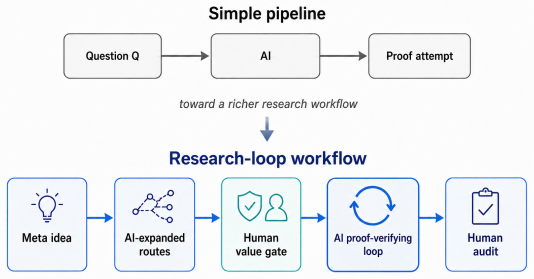
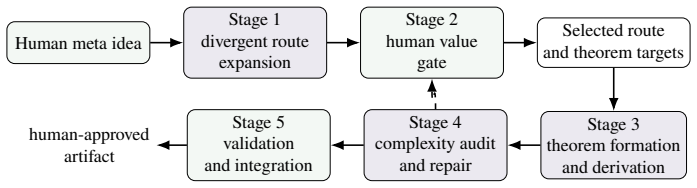
The central claim is that human-AI co-discovery workflows are most valuable not as standalone theorem provers but as research partners for problem formation, connection discovery, derivation, and skeptical review inside a human-gated research loop, as shown by the development of sign-embedding quantum algorithms from an initial intuition about rational approximation for the sign function.
Load-bearing premise
The paper's narrative of which contributions came from the AI and which remained with human judgment accurately reflects the actual sequence of interactions.
Editorial analysis
A structured set of objections, weighed in public.
Referee Report
Summary. The paper claims that human-AI co-discovery workflows using systems such as AIM are most valuable for problem formation, connection discovery, derivation, and skeptical review inside a human-gated research loop, as illustrated by a case study in which a human intuition about rational approximations for the sign function was expanded into the sign-embedding framework for quantum algorithms on matrix equations and matrix functions.
Significance. If the attributions in the narrative hold, the work would provide a concrete example of AI assistance at the pre-theorem stage of research and credit the human role in route selection and validation. The absence of any independent verification of the AI interactions, however, prevents assessment of whether the claimed division of labor is accurate.
major comments (2)
- [Abstract] Abstract: The central claim that AIM 'helped connect a known matrix-sign identity to wider classes... and drafted proof and complexity calculations' rests entirely on the authors' self-reported narrative with no referenced interaction logs, prompt histories, or AIM output artifacts, so the effectiveness of the co-discovery process cannot be externally verified.
- [Abstract] Abstract: The argument that human judgments alone selected routes and rejected the Cayley-trapezoidal approximation is defined in terms of the same internal sequence the authors recount, creating a circularity that prevents separation of the process claim from the outcome.
Simulated Author's Rebuttal
We thank the referee for the constructive feedback on verifiability and potential circularity in the case-study narrative. We respond to each major comment below. The manuscript is a reflective report on a human-gated workflow rather than a controlled experiment, which limits the forms of external verification that can be supplied.
read point-by-point responses
-
Referee: [Abstract] Abstract: The central claim that AIM 'helped connect a known matrix-sign identity to wider classes... and drafted proof and complexity calculations' rests entirely on the authors' self-reported narrative with no referenced interaction logs, prompt histories, or AIM output artifacts, so the effectiveness of the co-discovery process cannot be externally verified.
Authors: We agree that the paper presents a narrative case study rather than timestamped logs or artifacts. The mathematical contributions (sign-embedding algorithms for matrix equations and functions) are stated in full and can be checked independently of the discovery story. Because the interactions occurred over an extended period and were not archived in a machine-readable, shareable format at the time, we cannot retroactively supply the requested logs. We will revise the abstract and add a short methods paragraph clarifying that the account is based on participant recollection and working notes, while emphasizing that the final theorems stand on their own. revision: partial
-
Referee: [Abstract] Abstract: The argument that human judgments alone selected routes and rejected the Cayley-trapezoidal approximation is defined in terms of the same internal sequence the authors recount, creating a circularity that prevents separation of the process claim from the outcome.
Authors: The manuscript separates the verifiable mathematical outcome (the sign-embedding framework and its complexity bounds) from the process description. The rejection of the Cayley-trapezoidal route is justified inside the paper by the explicit discovery of a hidden validity condition that renders the approximation unusable for the target matrix classes; this is a mathematical observation, not merely an assertion of human preference. We will add one sentence to the abstract stating that the process narrative is offered as an illustration of human oversight within the loop, while the algorithmic results are presented for independent evaluation. revision: partial
- Absence of archived interaction logs, prompt histories, or AIM output artifacts from the original research sessions, which prevents any form of external verification of the specific attributions made to the AI system.
Circularity Check
No circularity detected; narrative case study lacks derivation chain or load-bearing reductions
full rationale
The paper is a descriptive narrative case study of a human-AI research process for developing sign-embedding quantum algorithms. It contains no mathematical derivations, equations, fitted parameters, predictions, uniqueness theorems, or ansatzes that could reduce to inputs by construction. The enumerated circularity patterns (self-definitional, fitted_input_called_prediction, self_citation_load_bearing, etc.) do not apply, as there are no such elements to inspect. The central claim about workflow value is supported by the recounted sequence itself, but this is a process report rather than a theorem whose result is forced by definition or self-citation. Per rules, this warrants score 0 as an honest non-finding for a self-contained narrative without the specified reductions.
Assumptions & free parameters
invented entities (1)
-
sign-embedding framework
Cite this review
Pith. "Pith review of From Meta Idea to Advanced Mathematical Discovery -- Human-AI Co-Discovery of Sign-Embedding Quantum Algorithms." pith.science (2026). https://pith.science/paper/WWI2VPQB
@misc{pith2026260624899,
  author       = {Pith},
  title        = {Pith review of: From Meta Idea to Advanced Mathematical Discovery -- Human-AI Co-Discovery of Sign-Embedding Quantum Algorithms},
  year         = {2026},
  howpublished = {\url{https://pith.science/paper/WWI2VPQB}},
  note         = {Machine review of arXiv:2606.24899}
}
read the original abstract
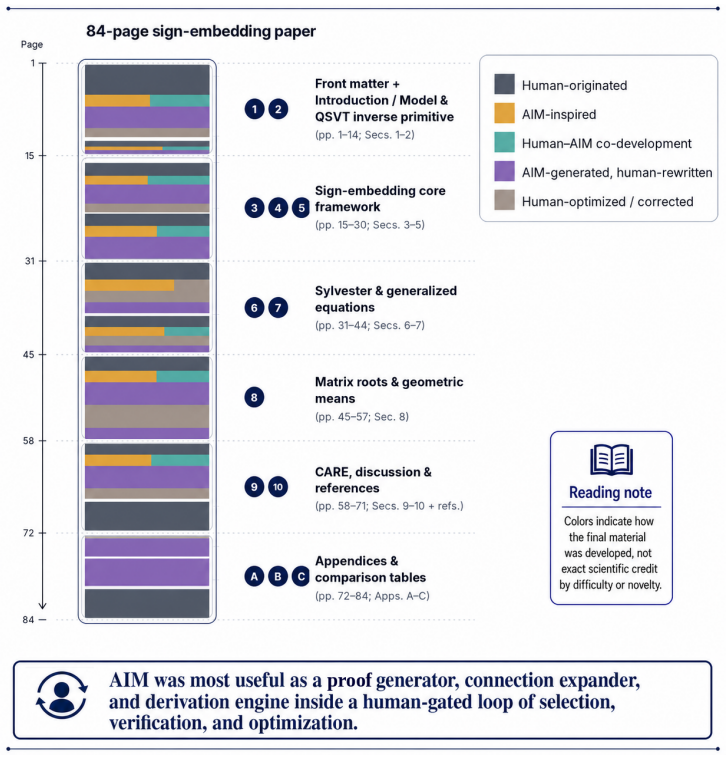
AI-assisted mathematics is often evaluated on solving predefined problems. In practice, however, many important advances begin earlier, when a vague research intuition is transformed into a concrete problem, a promising route, and a theorem family worth proving. This report studies that stage through a case study that led to sign-embedding quantum algorithms for matrix equations and matrix functions, foundational primitives in quantum linear algebra and operator-output quantum algorithms. The project began with a human-originated intuition that rational approximation is especially effective for jump-type functions such as the sign function, and might therefore serve as a design principle for quantum algorithms. Rather than merely assisting after the problem was fixed, AI-assisted exploration, including workflows later integrated into the agentic AI-mathematician system AIM, played a key role in expanding this intuition into a route map, comparing candidate formulations, and converging toward sign embedding as the central framework. AIM then helped connect a known matrix-sign identity to wider classes of matrix equations and matrix functions, and drafted proof and complexity calculations. The decisive scientific judgments remained human: selecting which human-AI-expanded routes were worth pursuing, rejecting a Cayley-trapezoidal approximation when its validity required a hidden condition, and refining the Sylvester implementation from a coarse quadratic-gap query route to the final factorized and scaled analysis. The report argues that human-AI co-discovery workflows, with systems such as AIM as important components, are most valuable not as standalone theorem provers, but as research partners for problem formation, connection discovery, derivation, and skeptical review inside a human-gated research loop.
Figures
Reference graph
Works this paper leans on
-
[1]
BernardinoRomera-Paredes,MohammadaminBarekatain,AlexanderNovikov,MatejBalog,M.PawanKumar, Emilien Dupont, Francisco J. R. Ruiz, Jordan S. Ellenberg, Pengming Wang, Omar Fawzi, Pushmeet Kohli, and Alhussein Fawzi. Mathematical discoveries from program search with large language models.Nature, 625 (7995):468–475,2024. doi: 10.1038/s41586-023-06924-6. URLhtt...
-
[2]
Alhussein Fawzi, Matej Balog, Aja Huang, Thomas Hubert, Bernardino Romera-Paredes, Mohammadamin Barekatain, Alexander Novikov, Francisco J. R. Ruiz, Julian Schrittwieser, Grzegorz Swirszcz, David Silver, Demis Hassabis, and Pushmeet Kohli. Discovering faster matrix multiplication algorithms with reinforcement learning.Nature, 610:47–53, 2022. doi: 10.1038...
-
[3]
URL https://openai.com/index/model-disproves-discrete-geometry-conjecture/
OpenAI.AnOpenAImodelhasdisprovedacentralconjectureindiscretegeometry.OpenAIResearchMilestone, May 2026. URL https://openai.com/index/model-disproves-discrete-geometry-conjecture/. Published May 20, 2026
2026
-
[4]
Trieu H. Trinh, Yuhuai Wu, Quoc V. Le, He He, and Thang Luong. Solving olympiad geometry without human demonstrations.Nature, 625(7995):476–482, 2024. doi: 10.1038/s41586-023-06747-5. URL https://doi.org/10.1038/s41586-023-06747-5
-
[5]
doi:10.1038/s41586-025-09833-y , url =
Thomas Hubert, Rishi Mehta, Laurent Sartran, Miklós Z. Horváth, Goran Žužić, Eric Wieser, Aja Huang, Julian Schrittwieser, Yannick Schroecker, Hussain Masoom, et al. Olympiad-level formal mathematical reasoning with reinforcement learning.Nature, 651:607–613, 2026. doi: 10.1038/s41586-025-09833-y. URL https://doi.org/10.1038/s41586-025-09833-y. Published ...
-
[6]
Yuanhang Liu, Yanxing Huang, Yanqiao Wang, Peng Li, and Yang Liu. AI mathematician: Towards fully automated frontier mathematical research.arXiv preprint arXiv:2505.22451, 2025. URL https: //arxiv.org/abs/2505.22451
-
[7]
Yuanhang Liu, Beichen Wang, Peng Li, and Yang Liu. AI mathematician as a partner in advancing mathematical discovery—a case study in homogenization theory.arXiv preprint arXiv:2510.26380, 2025. URL https://arxiv.org/abs/2510.26380
-
[8]
Towards autonomous mathematics research.arXiv preprint arXiv:2602.10177, 2026
Tony Feng, Trieu H. Trinh, Garrett Bingham, Dawsen Hwang, Yuri Chervonyi, Junehyuk Jung, Joonkyung Lee, Carlo Pagano, Sang-hyun Kim, Federico Pasqualotto, Sergei Gukov, Jonathan N. Lee, Junsu Kim, 13 Kaiying Hou, Golnaz Ghiasi, Yi Tay, YaGuang Li, Chenkai Kuang, Yuan Liu, Hanzhao Lin, Evan Zheran Liu, Nigamaa Nayakanti, Xiaomeng Yang, Heng-Tze Cheng, Demi...
Show all 73 references
-
[9]
Sign embedding quantum algorithms for matrix equations and matrix functions.arXiv preprint arXiv:2604.25333, 2026
Yanqiao Wang and Jin-Peng Liu. Sign embedding quantum algorithms for matrix equations and matrix functions.arXiv preprint arXiv:2604.25333, 2026. URL https://arxiv.org/abs/2604.25333
2026 arXiv
-
[10]
Generative language modeling for automated theorem proving.arXiv preprint arXiv:2009.03393, 2020
Stanislas Polu and Ilya Sutskever. Generative language modeling for automated theorem proving.arXiv preprint arXiv:2009.03393, 2020. URL https://arxiv.org/abs/2009.03393
2009 arXiv
-
[11]
HyperTree proof search for neural theorem proving
Guillaume Lample, Timothée Lacroix, Marie-Anne Lachaux, Aurélien Rodriguez, Amaury Hayat, Thibaut Lavril, Gabriel Ebner, and Xavier Martinet. HyperTree proof search for neural theorem proving. InAdvances in Neural Information Processing Systems, volume 35, pages 26337–26349, 2...
2022
-
[12]
The Lean theorem prover (system description)
Leonardo de Moura, Soonho Kong, Jeremy Avigad, Floris van Doorn, and Jakob von Raumer. The Lean theorem prover (system description). InAutomated Deduction – CADE-25, volume 9195 ofLecture Notes in Computer Science, pages 378–388. Springer, 2015. doi: 10.1007/978-3-319-21401-6_26
2015 doi
-
[13]
Towards end-to-end automation of AI research.Nature, 651(8107):914–919, 2026
Chris Lu, Cong Lu, Robert Tjarko Lange, Yutaro Yamada, Shengran Hu, Jakob Foerster, David Ha, and Jeff Clune. Towards end-to-end automation of AI research.Nature, 651(8107):914–919, 2026. doi: 10.1038/s41586-026-10265-5. URL https://doi.org/10.1038/s41586-026-10265-5
2026 doi
-
[14]
Accelerating scientific discovery with co- scientist.Nature,2026
Juraj Gottweis, Wei-Hung Weng, Alexander Daryin, Tao Tu, Petar Sirkovic, Artiom Myaskovsky, Grzegorz Glowaty, Felix Weissenberger, Alessio Orlandi, Dan Popovici, et al. Accelerating scientific discovery with co- scientist.Nature,2026. doi: 10.1038/s41586-026-10644-y. URLhttps:...
2026 doi
-
[15]
Szostkiewicz, Dmytro Shved, Gavin J
Ali Essam Ghareeb, Benjamin Chang, Ludovico Mitchener, Angela Yiu, Caralyn J. Szostkiewicz, Dmytro Shved, Gavin J. Gyimesi, Jon M. Laurent, Samantha M. Wright, Muhammed T. Razzak, Andrew D. White, Silvia C. Finnemann, Michaela M. Hinks, and Samuel G. Rodriques. A multi-agent s...
2026 doi
-
[16]
Advancingmathematicalresearchviahuman-AI interactive theorem proving.arXiv preprint arXiv:2512.09443, 2025
ChenyiLi, ZhijianLai, DongAn, JiangHu, andZaiwenWen. Advancingmathematicalresearchviahuman-AI interactive theorem proving.arXiv preprint arXiv:2512.09443, 2025. URL https://arxiv.org/abs/2512.09443
2025
-
[17]
Daniel Zheng, Ingrid von Glehn, Yori Zwols, Iuliya Beloshapka, Lars Buesing, Daniel M. Roy, Martin Wattenberg, Bogdan Georgiev, Tatiana Schmidt, Andrew Cowie, Fernanda Viegas, Dimitri Kanevsky, Vineet Kahlon, Hartmut Maennel, Sophia Alj, George Holland, Alex Davies, and Pushme...
2026 arXiv
-
[18]
Harrow, Avinatan Hassidim, and Seth Lloyd
Aram W. Harrow, Avinatan Hassidim, and Seth Lloyd. Quantum algorithm for linear systems of equations. Physical Review Letters, 103(15):150502, 2009. doi: 10.1103/PhysRevLett.103.150502
2009 doi
-
[19]
Quantumalgorithmforsystemsoflinearequations with exponentially improved dependence on precision.SIAM Journal on Computing, 46(6):1920–1950, 2017
AndrewM.Childs,RobinKothari,andRolandoD.Somma. Quantumalgorithmforsystemsoflinearequations with exponentially improved dependence on precision.SIAM Journal on Computing, 46(6):1920–1950, 2017. doi: 10.1137/16M1087072
1920 doi
-
[20]
Berry, Andrew M
Dominic W. Berry, Andrew M. Childs, Richard Cleve, Robin Kothari, and Rolando D. Somma. Simulating hamiltonian dynamics with a truncated taylor series.Physical Review Letters, 114(9):090502, 2015. doi: 10.1103/PhysRevLett.114.090502
2015 doi
-
[21]
Optimalhamiltoniansimulationbyquantumsignalprocessing.Physical Review Letters, 118(1):010501, 2017
GuangHaoLowandIsaacL.Chuang. Optimalhamiltoniansimulationbyquantumsignalprocessing.Physical Review Letters, 118(1):010501, 2017. doi: 10.1103/PhysRevLett.118.010501
2017 doi
-
[22]
Guang Hao Low and Isaac L. Chuang. Hamiltonian simulation by qubitization.Quantum, 3:163, 2019. doi: 10.22331/q-2019-07-12-163. 14
2019 doi
-
[23]
Quantum singular value transformation and beyond: exponential improvements for quantum matrix arithmetics
András Gilyén, Yuan Su, Guang Hao Low, and Nathan Wiebe. Quantum singular value transformation and beyond: exponential improvements for quantum matrix arithmetics. InProceedings of the 51st Annual ACM SIGACT Symposium on Theory of Computing, pages 193–204. ACM, 2019. doi: 10.1...
2019 doi
-
[24]
Linear Combination of Hamiltonian Simulation for Nonunitary Dynamics with Optimal State Preparation Cost.Physical Review Letters, 131(15):150603, 2023
Dong An, Jin-Peng Liu, and Lin Lin. Linear Combination of Hamiltonian Simulation for Nonunitary Dynamics with Optimal State Preparation Cost.Physical Review Letters, 131(15):150603, 2023. doi: 10.1103/PhysRevLett.131.150603
2023 doi
-
[25]
Childs, and Lin Lin
Dong An, Andrew M. Childs, and Lin Lin. Quantum Algorithm for Linear Non-unitary Dynamics with Near-Optimal Dependence on All Parameters.Communications in Mathematical Physics, 407(1):19, 2026. doi: 10.1007/s00220-025-05509-w
2026 doi
-
[26]
Childs, Lin Lin, and Lexing Ying
Dong An, Andrew M. Childs, Lin Lin, and Lexing Ying. Laplace Transform–Based Quantum Eigenvalue Transformation via Linear Combination of Hamiltonian Simulation.SIAM Journal on Computing, 55(2): 376–409, 2026. doi: 10.1137/24M1720160
2026 doi
-
[27]
An Efficient Explicit Implementation of a Near-Optimal Quantum Algorithm for Simulating Linear Dissipative Differential Equations.arXiv preprint arXiv:2501.11146, 2025
Ivan Novikau and Ilon Joseph. An Efficient Explicit Implementation of a Near-Optimal Quantum Algorithm for Simulating Linear Dissipative Differential Equations.arXiv preprint arXiv:2501.11146, 2025. doi: 10.48550/arXiv.2501.11146. URL https://arxiv.org/abs/2501.11146
-
[28]
Arbitrary BoundaryConditionsandConstraintsinQuantumAlgorithmsforDifferentialEquationsviaPenaltyProjections
Philipp Schleich, Tyler Kharazi, Xiangyu Li, Jin-Peng Liu, Alán Aspuru-Guzik, and Nathan Wiebe. Arbitrary BoundaryConditionsandConstraintsinQuantumAlgorithmsforDifferentialEquationsviaPenaltyProjections. arXiv preprint arXiv:2506.21751, 2025. doi: 10.48550/arXiv.2506.21751. UR...
2025 doi
-
[29]
doi: 10.48550/arXiv.2508.19238
GuangHaoLowandRolandoD.Somma.OptimalQuantumSimulationofLinearNon-UnitaryDynamics.arXiv preprint arXiv:2508.19238, 2025. doi: 10.48550/arXiv.2508.19238. URL https://arxiv.org/abs/2508.19238
2025 doi
-
[30]
Fourier Transform-Based Linear Combination of Hamiltonian Simulation.arXiv preprint arXiv:2508.19596, 2025
Xi Huang and Dong An. Fourier Transform-Based Linear Combination of Hamiltonian Simulation.arXiv preprint arXiv:2508.19596, 2025. doi: 10.48550/arXiv.2508.19596. URL https://arxiv.org/abs/2508.19596
2025 doi
-
[31]
Circuit-Efficient Randomized Quantum Simulation of Non-Unitary Dynamics with Observable-Driven and Symmetry-Aware Designs.arXiv preprint arXiv:2509.08030, 2025
Songqinghao Yang and Jin-Peng Liu. Circuit-Efficient Randomized Quantum Simulation of Non-Unitary Dynamics with Observable-Driven and Symmetry-Aware Designs.arXiv preprint arXiv:2509.08030, 2025. doi: 10.48550/arXiv.2509.08030. URL https://arxiv.org/abs/2509.08030
2025 doi
-
[32]
Quantum algorithms based on the Block-Encoding framework for matrix functions by contour integrals.Quantum Information and Computation, 22(11–12):965–979, 2022
Souichi Takahira, Asuka Ohashi, Tomohiro Sogabe, and Tsuyoshi Sasaki Usuda. Quantum algorithms based on the Block-Encoding framework for matrix functions by contour integrals.Quantum Information and Computation, 22(11–12):965–979, 2022. doi: 10.26421/QIC22.11-12-4
2022 doi
-
[33]
Somma, Guang Hao Low, Dominic W
Rolando D. Somma, Guang Hao Low, Dominic W. Berry, and Ryan Babbush. Quantum algorithm for linear matrix equations, 2025. arXiv:2508.02822
2025
-
[34]
Wilde, and Zhicheng Zhang
Nana Liu, Qisheng Wang, Mark M. Wilde, and Zhicheng Zhang. Quantum algorithms for matrix geometric means.npj Quantum Information, 11:101, 2025. doi: 10.1038/s41534-025-00973-7
2025 doi
-
[35]
Higham.Functions of Matrices: Theory and Computation
Nicholas J. Higham.Functions of Matrices: Theory and Computation. SIAM, Philadelphia, PA, 2008. doi: 10.1137/1.9780898717778
2008 doi
-
[36]
Kenney and Alan J
Charles S. Kenney and Alan J. Laub. The matrix sign function.IEEE Transactions on Automatic Control, 40 (8):1330–1348, 1995. doi: 10.1109/9.402226
1995 doi
-
[37]
Oxford University Press, Oxford, 1995
Peter Lancaster and Leiba Rodman.Algebraic Riccati Equations. Oxford University Press, Oxford, 1995
1995
-
[38]
J. D. Roberts. Linear model reduction and solution of the algebraic riccati equation by use of the sign function. International Journal of Control, 32(4):677–687, 1980. doi: 10.1080/00207178008922881
1980 doi
-
[39]
Solving the algebraic riccati equation with the matrix sign function.Linear Algebra and Its Applications, 85:267–279, 1987
Ralph Byers. Solving the algebraic riccati equation with the matrix sign function.Linear Algebra and Its Applications, 85:267–279, 1987. doi: 10.1016/0024-3795(87)90222-9. 15 A Experimental Results This section records representative interaction traces between the human resear...
1987 doi
-
[40]
the classical analytic representation that might be useful, such as rational approximations, resolvent formulas, contour integrals, matrix sign functions, or spectral projectors
-
[41]
the target quantum output model
-
[42]
the likely quantum primitives needed
-
[43]
what would be genuinely new compared with standard HHL/QSVT/contour-integral approaches
-
[44]
Do not try to force a single answer
the main technical obstacles. Do not try to force a single answer. Give several candidate projects and rank them by conceptual unity, feasibility, and potential novelty. Assistant Entry (AIM’s Response) Below are candidate projects organized around the principle: Insteadofview...
-
[45]
Instead of implementing𝑓 by a high-degree QSVT polynomial, implement a linear combination of shifted inverses
Rational block-encodings of matrix functions via shifted resolvents Core idea Given a matrix function𝑓(𝐴), use a rational approximation 𝑓(𝐴) ≈𝑟(𝐴)=𝑐 0𝐼+ 𝑚∑︁ 𝑗=1 𝑐 𝑗 𝐴−𝑧 𝑗 𝐼 or, for Hermitian𝐴, 𝑓(𝐴) ≈𝑐 0𝐼+ 𝑚∑︁ 𝑗=1 𝑐 𝑗 (𝐴−𝑧 𝑗 𝐼) −1. Instead of implementing𝑓 by a high-degree QSVT...
-
[46]
For example, if𝐴is stable, 𝑋= ∫ ∞ 0 𝑒𝑡 𝐴𝑄𝑒 𝑡 𝐴† 𝑑𝑡
Quantum algorithms for Lyapunov and Sylvester equations using rational Krylov ideas Core idea Solve matrix equations such as 𝐴𝑋+𝑋 𝐵=𝐶, or the continuous Lyapunov equation 𝐴𝑋+𝑋 𝐴 † =−𝑄, 18 not by vectorizing and applying HHL to the huge linear system, but by using integral or r...
-
[47]
Rational block-encodings of𝑓(𝐴)
-
[48]
Rational approximations for fractional powers
-
[49]
Matrix logarithm and inverse square root
-
[50]
Compiler for rational approximations. Main deliverable: A theorem converting a rational approximation 𝑟(𝑥)=𝑐 0 + 𝑚∑︁ 𝑗=1 𝑐 𝑗 𝑥−𝑧 𝑗 into a block-encoding of𝑟(𝐴) , with complexity depending explicitly on pole locations, coefficient ℓ1-norm, shifted condition numbers, and target ...
-
[51]
Spectral projectors via rational filters
-
[52]
Matrix sign and stable subspaces
-
[53]
Quantum FEAST-style algorithms
-
[54]
Green’s function and spectral density operators. Main deliverable: A quantum rational-filter framework that outputs block-encodings of spectral projectors or approxi- mate projectors, with complexity competitive against polynomial QSVT in small-gap regimes. This cluster is con...
-
[55]
Lyapunov/Sylvester equations
-
[56]
ADI-inspired quantum algorithms
-
[57]
Bivariate separable rational approximations
-
[58]
Riccati equations. Main deliverable: Quantum algorithms for structured matrix equations that avoid black-box vectorization and instead exploit separable rational approximations of kernels such as 1 𝜆+𝜇 . This is probably the most novel cluster, but also technically harder. Clu...
-
[59]
Quantum rational preconditioners
-
[60]
Effective Hamiltonians
-
[61]
Main deliverable: Reusable block-encoded approximate inverses, Schur complements, or effective operators for downstream quantum algorithms
Domain decomposition. Main deliverable: Reusable block-encoded approximate inverses, Schur complements, or effective operators for downstream quantum algorithms. This is potentially very impactful if one can define a convincing reuse model. Most promising individual projects P...
-
[62]
What is the correct quantum cost model for rational approximants? Classically, one minimizes approximation error or number of poles. Quantumly, the cost should include: Cost(𝑟) ≈ ∑︁ 𝑗 |𝑐 𝑗 | ·Cost (𝐴−𝑧 𝑗 𝐼) −1 or, more accurately, an LCU-normalized version involving 𝛼𝑟 =|𝑐 0| ...
-
[63]
Quantumly, poles near the spectrum are expensive because shifted systems become ill-conditioned
Can pole locations be optimized for quantum implementation cost? Classical pole optimization focuses on uniform approximation. Quantumly, poles near the spectrum are expensive because shifted systems become ill-conditioned. So one wants to solve a constrained rational approxim...
-
[64]
Rational methods are compelling only if the savings in approximation order survive the cost of shifted inverses
When do rational methods beat polynomial QSVT? For Hermitian 𝐴, QSVT can implement many functions nearly optimally in polynomial degree. Rational methods are compelling only if the savings in approximation order survive the cost of shifted inverses. Promising regimes: •functio...
-
[65]
If𝐴is Hermitian, this can be reduced to real block systems such as 𝐴−𝑎𝐼 𝑏𝐼 −𝑏𝐼 𝐴−𝑎𝐼 −1
How should one handle complex shifts? For𝑧=𝑎+𝑖𝑏, one needs to implement (𝐴−𝑧𝐼) −1. If𝐴is Hermitian, this can be reduced to real block systems such as 𝐴−𝑎𝐼 𝑏𝐼 −𝑏𝐼 𝐴−𝑎𝐼 −1 . Alternatively, one can pair conjugate poles to maintain Hermiticity: 𝑐(𝐴−𝑧𝐼) −1 + 𝑐(𝐴− 𝑧𝐼) −1. A good pro...
-
[66]
rational approximation to block-encoding
What output model is most useful? Possible output models differ substantially: 1.Block-encodingof𝑓(𝐴): reusable and composable. 2.Stateproportional to𝑓(𝐴) |𝑏⟩: standard HHL-like model. 3.Density operatorproportional to𝑓(𝐴): useful when𝑓(𝐴) ⪰0. 4.Projector/reflection: useful fo...
-
[67]
the input access model, such as block-encodings of the coefficient matrices
-
[68]
the augmented matrix and the sign or projector identity
-
[69]
the rational or contour-integral approximation and its deterministic error
-
[70]
the quantum implementation of the shifted resolvents
-
[71]
the LCU normalization or block-encoding normalization
-
[72]
the total query complexity
-
[73]
explicitly implementable contractions with costs,
how deterministic approximation error and quantum implementation error are combined. Finally,comparethisframeworkwithexistingquantumalgorithmsforSylvesterequations,Lyapunovequations, matrix functions, and contour-integral-based matrix-function algorithms. Identify regimes wher...
Reviewed June 27, 2026 · model on record in the stance chip above.
Discussion (0). Sign in to comment.