REVIEW 38 references
No-shell FRW daughters matched to asymptotically flat regular black holes are bounded if closed and past-incomplete if flat or open; a regular core alone cannot yield a viable daughter cosmology.
Reviewed by Pith at T0; open to challenge. T0 means a machine referee read the full paper against a public rubric. the ladder, T0–T4 →
T0 review · deepseek-v4-flash
2026-08-04 01:47 UTC pith:PAVA3VNY
Obstructions to Minimal Regular Black Hole Cosmologies
The pith
A machine-rendered reading of the paper's core claim, the machinery that carries it, and where it could break.
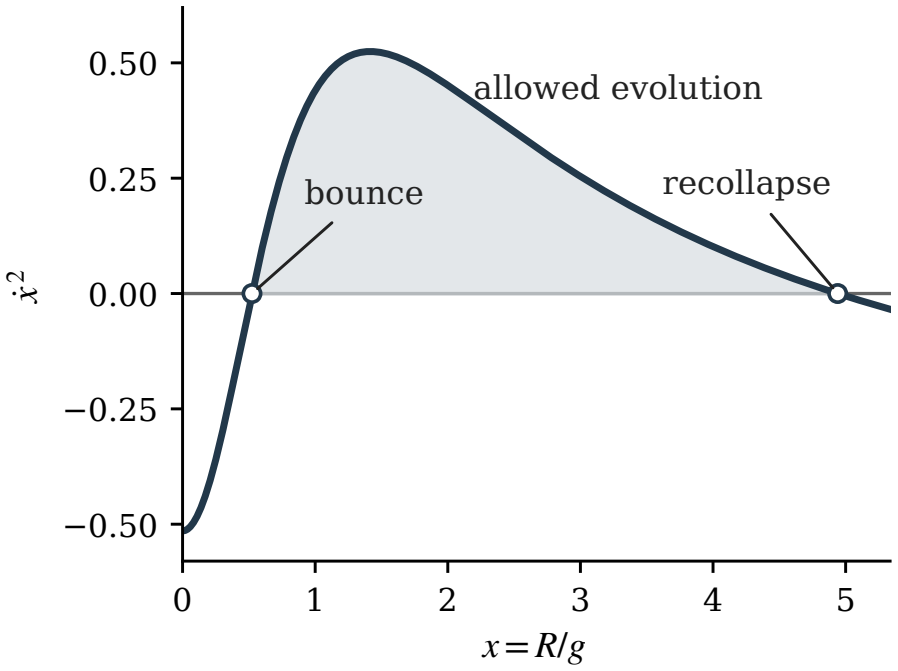
The gluing imposes a Friedmann equation on the daughter, controlled by the parent's Misner–Sharp mass: H² + k/A² = 2m(R_b)/R_b³, where R_b is the boundary radius. For a closed (spherical) daughter, k = +1. Asymptotic flatness and finite ADM mass make the mass term behave like dust, falling as A⁻³, while the curvature term falls as A⁻² and dominates at large scale factor. So the closed daughter is bounded: it expands from a bounce, turns around, and recollapses. Adding a redshift function to the parent does not rescue it. Flat and open daughters avoid the turnaround, but the paper applies a completeness theorem (from the author's companion papers) stating that non-static, curvature-regular flat/open FRW spacetimes with regular affine ends cannot be simultaneously null geodesically complete and ANEC-consistent. The Bardeen example is explicitly past-incomplete because its de Sitter-like beginning has finite past affine length. The paper also argues the Bardeen matter cannot supply late-time support.
The conclusion is a list of escape routes: shells, modified asymptotics, non-FRW daughters, or extra stress-energy. The paper does not claim a general no-go for all black-hole-universe constructions.
Core claim
Theorem 1 (Sec. V): 'Consider a static, spherically symmetric, asymptotically flat parent spacetime in the one-function class g_tt g_rr = −1, with finite ADM mass M > 0. Attach an FRW daughter across a nondegenerate comoving spherical Darmois boundary. Assume that the matching is no-shell... Then the closed daughter branch is bounded at finite scale factor... For flat and open daughters... a non-static curvature-regular FRW spacetime with k = 0 or k = −1 and regular affine ends cannot be both null geodesically complete and ANEC-consistent.' If correct, no minimal no-shell FRW daughter of an asymptotically flat regular black hole is simultaneously indefinitely expanding, curvature-regular, geodesically complete, and ANEC-consistent; the closed-branch part is the new content, enforced by m(R) → M through H² = −1/A² + 2M/(A³ sin³ψ_b) + o(A⁻³) (Eq. 55).
Load-bearing premise
The flat/open leg of Theorem 1 is carried by the 'flat/open FRW completeness theorem' of the author's companion papers [3,4], stated in Sec. V but not proven here, under the 'regular affine ends' caveat of footnote 3; if that theorem is false or inapplicable, the flat/open half collapses even though the closed-branch result (Sec. V.A, Prop. 2) stands on its own derivation. A second structural premise: completeness is assessed for the maximal FRW continuation of A(τ) rather than for the actual parent+daughter matched spacetime (Sec. V.C), leaving open whether radial null geodesics might leave the daughter through the junction before their affine parameter ends. The declared scope restriction g_tt g_rr = −1 (Sec. I) is also load-bearing for the flat/open dichotomy; only the closed branch is extended to redshifted parents (Sec. IVB).
Editorial analysis
A structured set of objections, weighed in public.
Axiom & Free-Parameter Ledger
axioms (5)
- domain assumption Flat/open FRW completeness theorem: a non-static curvature-regular FRW spacetime with k=0 or k=−1 and regular affine ends cannot be both null geodesically complete and ANEC-consistent (refs [3,4]).
- domain assumption ANEC along complete null geodesics is imposed as the minimal non-exoticity criterion.
- domain assumption Main dichotomies are restricted to the one-function static spherical class g_tt g_rr = −1.
- domain assumption Standard Darmois–Israel no-shell matching with a comoving boundary at fixed χ_b (or ψ_b); daughter evolution is fixed entirely by the parent metric profile.
- domain assumption Asymptotic flatness with F(R) = 1 − 2M/R + o(R⁻¹) and finite ADM mass M > 0.
Cite this review
Pith. "Pith review of Obstructions to Minimal Regular Black Hole Cosmologies." pith.science (2026). https://pith.science/paper/PAVA3VNY
@misc{pith2026260625023,
  author       = {Pith},
  title        = {Pith review of: Obstructions to Minimal Regular Black Hole Cosmologies},
  year         = {2026},
  howpublished = {\url{https://pith.science/paper/PAVA3VNY}},
  note         = {Machine review of arXiv:2606.25023}
}
read the original abstract
We derive an obstruction to Friedmann--Lema\^itre--Robertson--Walker (FLRW) daughter cosmologies from static, asymptotically flat regular black holes. The trapped region of such a parent is Kantowski--Sachs rather than FLRW, so the daughter must be introduced as a separate matched region. For closed daughters, the angular Darmois condition is controlled by the Misner--Sharp mass: asymptotic flatness and finite ADM mass force the induced density to decay as $A^{-3}$, while the $k=+1$ curvature term scales as $A^{-2}$. The minimal closed branch is therefore bounded rather than indefinitely expanding. Flat and open daughters avoid this boundedness mechanism. For their maximal homogeneous FLRW continuations, the regular-end affine-ANEC theorem excludes simultaneous non-staticity, curvature regularity, null geodesic completeness, and ANEC consistency. For Bardeen, the parent source does not naturally supply the late-time support needed for an unbounded closed daughter. Within these criteria, a viable FLRW daughter therefore requires additional structure, such as modified asymptotics, nonminimal matching, non-FLRW evolution, or an additional stress-energy component.
Figures
Reference graph
Works this paper leans on
-
[1]
Proving the Achronal Averaged Null Energy Condition from the Generalized Second Law,
A. C. Wall, “Proving the Achronal Averaged Null Energy Condition from the Generalized Second Law,” Phys. Rev. D81, 024038 (2010) doi:10.1103/PhysRevD.81.024038 [arXiv:0910.5751 [gr-qc]]. 21
Pith/arXiv arXiv 2010
-
[2]
A Primer on Energy Conditions,
E. Curiel, “A Primer on Energy Conditions,” Einstein Stud.13, 43–104 (2017) doi:10.1007/978- 1-4939-3210-8_3 [arXiv:1405.0403 [physics.hist-ph]]
Pith/arXiv arXiv 2017
-
[3]
Open case for a closed universe,
N. L. Burwig and D. A. Easson, “Open case for a closed universe,” Phys. Rev. D113, no.8, 083530 (2026) doi:10.1103/mn3v-myzc [arXiv:2510.13971 [hep-th]]
Pith/arXiv arXiv 2026
-
[4]
Affine ANEC selects the closed FRW branch for geodesically complete cosmology,
N. L. Burwig and D. A. Easson, “Affine ANEC selects the closed FRW branch for geodesically complete cosmology,” [arXiv:2605.18965 [gr-qc]]
-
[5]
The Universe as a Black Hole,
R. K. Pathria, “The Universe as a Black Hole,” Nature240, 298 (1972)
1972
-
[6]
Universe generation from black hole interiors,
D. A. Easson and R. H. Brandenberger, “Universe generation from black hole interiors,” JHEP 06, 024 (2001) doi:10.1088/1126-6708/2001/06/024 [arXiv:hep-th/0103019 [hep-th]]
Pith/arXiv arXiv 2001
-
[7]
The Dynamics of False Vacuum Bubbles,
S. K. Blau, E. I. Guendelman and A. H. Guth, “The Dynamics of False Vacuum Bubbles,” Phys. Rev. D35, 1747 (1987) doi:10.1103/PhysRevD.35.1747
-
[8]
Through a black hole into a new universe?
V. P. Frolov, M. A. Markov, and V. F. Mukhanov, “Through a black hole into a new universe?” Phys. Lett. B216, 272 (1989)
1989
-
[9]
Black holes as possible sources of closed and semiclosed worlds,
V. P. Frolov, M. A. Markov, and V. F. Mukhanov, “Black holes as possible sources of closed and semiclosed worlds,” Phys. Rev. D41, 383 (1990)
1990
-
[10]
Is it possible to create a universe in the laboratory by quantum tunneling?
E. Farhi, A. H. Guth, and J. Guven, “Is it possible to create a universe in the laboratory by quantum tunneling?” Nucl. Phys. B339, 417 (1990)
1990
-
[11]
A nonsingular two dimensional black hole,
M. Trodden, V. F. Mukhanov and R. H. Brandenberger, “A nonsingular two dimensional black hole,” Phys. Lett. B316, 483 (1993) [arXiv:hep-th/9305111]
Pith/arXiv arXiv 1993
-
[12]
Nonsingular Schwarzschild–de Sitter black hole,
D. A. Easson, “Nonsingular Schwarzschild–de Sitter black hole,” Class. Quant. Grav.35, no.23, 235005 (2018) doi:10.1088/1361-6382/aae85f [arXiv:1712.09455 [hep-th]]
Pith/arXiv arXiv 2018
-
[13]
Two-dimensional black holes in the limiting curvature theory of gravity,
V. P. Frolov and A. Zelnikov, “Two-dimensional black holes in the limiting curvature theory of gravity,” JHEP08, 154 (2021) doi:10.1007/JHEP08(2021)154 [arXiv:2105.12808 [hep-th]]
Pith/arXiv arXiv 2021
-
[14]
Universes inside aΛblack hole,
I. G. Dymnikova, A. Dobosz, M. L. Fil’chenkov, and A. Gromov, “Universes inside aΛblack hole,” Phys. Lett. B506, 351 (2001) [arXiv:gr-qc/0102032]
Pith/arXiv arXiv 2001
-
[15]
Universes Inside a Black Hole with the de Sitter Interior,
I. Dymnikova, “Universes Inside a Black Hole with the de Sitter Interior,” Universe5, 111 (2019)
2019
-
[16]
Non-singular general-relativistic gravitational collapse,
J. M. Bardeen, “Non-singular general-relativistic gravitational collapse,” inProceedings of the International Conference GR5, Tbilisi, U.S.S.R. (1968)
1968
-
[17]
The Bardeen model as a nonlinear magnetic monopole,
E. Ayón-Beato and A. García, “The Bardeen model as a nonlinear magnetic monopole,” Phys. Lett. B493, 149 (2000) [arXiv:gr-qc/0009077]. 22
Pith/arXiv arXiv 2000
-
[18]
Formation and evaporation of regular black holes,
S. A. Hayward, “Formation and evaporation of regular black holes,” Phys. Rev. Lett.96, 031103 (2006) [arXiv:gr-qc/0506126]
Pith/arXiv arXiv 2006
-
[19]
S. Ansoldi, “Spherical black holes with regular center: A review of existing models including a recent realization with Gaussian sources,” [arXiv:0802.0330 [gr-qc]]
-
[20]
Regular black hole metrics and the weak energy condition,
L. Balart and E. C. Vagenas, “Regular black hole metrics and the weak energy condition,” Phys. Lett. B730, 14 (2014) [arXiv:1401.2136 [gr-qc]]
Pith/arXiv arXiv 2014
-
[21]
Construction of regular black holes in general relativity,
Z.-Y. Fan and X. Wang, “Construction of regular black holes in general relativity,” Phys. Rev. D94, no.12, 124027 (2016) doi:10.1103/PhysRevD.94.124027 [arXiv:1610.02636 [gr-qc]]
Pith/arXiv arXiv 2016
-
[22]
Eternal inflation and the initial singularity,
A. Borde and A. Vilenkin, “Eternal inflation and the initial singularity,” Phys. Rev. Lett.72, 3305 (1994) doi:10.1103/PhysRevLett.72.3305 [arXiv:gr-qc/9312022]
Pith/arXiv arXiv 1994
-
[23]
Inflationary spacetimes are incomplete in past directions,
A. Borde, A. H. Guth and A. Vilenkin, “Inflationary spacetimes are incomplete in past directions,” Phys. Rev. Lett.90, 151301 (2003) doi:10.1103/PhysRevLett.90.151301 [arXiv:gr- qc/0110012]
arXiv 2003
-
[24]
On the past-completeness of inflationary spacetimes,
J. E. Lesnefsky, D. A. Easson, and P. C. W. Davies, “On the past-completeness of inflationary spacetimes,” Phys. Rev. D107, 044024 (2023) [arXiv:2207.00955 [gr-qc]]
Pith/arXiv arXiv 2023
-
[25]
Inflationary resolution of the initial singularity,
D. A. Easson and J. E. Lesnefsky, “Inflationary resolution of the initial singularity,” Phys. Lett. B875, 140370 (2026) doi:10.1016/j.physletb.2026.140370 [arXiv:2402.13031 [hep-th]]
arXiv 2026
-
[26]
D. A. Easson and J. E. Lesnefsky, “Eternal universes,” Phys. Rev. D112, no.6, 063545 (2025) doi:10.1103/5mhz-m8bg [arXiv:2404.03016 [hep-th]]
Pith/arXiv arXiv 2025
-
[27]
Geodesically Complete Curvature-Bounce Inflation,
D. A. Easson, “Geodesically Complete Curvature-Bounce Inflation,” [arXiv:2604.27103 [astro- ph.CO]]
-
[28]
On Continued Gravitational Contraction,
J. R. Oppenheimer and H. Snyder, “On Continued Gravitational Contraction,” Phys. Rev.56, 455 (1939)
1939
-
[29]
Singular hypersurfaces and thin shells in general relativity,
W. Israel, “Singular hypersurfaces and thin shells in general relativity,” Nuovo Cim. B44, 1 (1966)
1966
-
[30]
Relativistic equations for adiabatic, spherically symmetric gravitational collapse,
C. W. Misner and D. H. Sharp, “Relativistic equations for adiabatic, spherically symmetric gravitational collapse,” Phys. Rev.136, B571 (1964)
1964
-
[31]
Generalized Oppenheimer-Snyder Gravitational Collapse into Regular Black holes,
F. Shojai, A. Sadeghi, and R. Hassannejad, “Generalized Oppenheimer-Snyder Gravitational Collapse into Regular Black holes,” Class. Quantum Grav.39, 085003 (2022) [arXiv:2202.14024 [gr-qc]]
Pith/arXiv arXiv 2022
-
[32]
Cosmic inflation prevents singularity formation in collapse into a Hayward black 23 hole,
M. Bobula, “Cosmic inflation prevents singularity formation in collapse into a Hayward black 23 hole,” Class. Quantum Grav.42, 065027 (2025) [arXiv:2404.12243 [gr-qc]]
Pith/arXiv arXiv 2025
-
[33]
Regular black holes from Oppenheimer-Snyder collapse,
P. Bueno, P. A. Cano, R. A. Hennigar, Á. J. Murcia and A. Vicente-Cano, “Regular black holes from Oppenheimer-Snyder collapse,” Phys. Rev. D112, no.6, 064039 (2025) doi:10.1103/qrbb- mdvm [arXiv:2505.09680 [gr-qc]]
Pith/arXiv arXiv 2025
-
[34]
Non-singular cosmologies matching regular black holes,
S. Li, J.-P. Wu, and X.-H. Ge, “Non-singular cosmologies matching regular black holes,” [arXiv:2512.00926 [gr-qc]]
-
[35]
Quantum gravitational stellar evolution beyond shell-crossing sin- gularities,
M. Bobula and F. Fazzini, “Quantum gravitational stellar evolution beyond shell-crossing sin- gularities,” Phys. Rev. D113, no.10, 106016 (2026) doi:10.1103/165q-lwmd [arXiv:2601.18618 [gr-qc]]
Pith/arXiv arXiv 2026
-
[36]
Timelike convergence condition in regular black-hole spacetimes with (anti-)de Sitter core,
J. Borissova, S. Liberati and M. Visser, “Timelike convergence condition in regular black-hole spacetimes with (anti-)de Sitter core,” Phys. Rev. D112, no.10, 104072 (2025) doi:10.1103/rrc9- g1sv [arXiv:2509.08590 [gr-qc]]
Pith/arXiv arXiv 2025
-
[37]
Classical double copy of nonsingular black holes,
D. A. Easson, C. Keeler and T. Manton, “Classical double copy of nonsingular black holes,” Phys. Rev. D102, no.8, 086015 (2020) doi:10.1103/PhysRevD.102.086015 [arXiv:2007.16186 [gr-qc]]
Pith/arXiv arXiv 2020
-
[38]
Black Hole Interiors as a Laboratory for Time-Dependent Classical Double Copy,
D. A. Easson and T. Manton, “Black Hole Interiors as a Laboratory for Time-Dependent Classical Double Copy,” [arXiv:2604.19920 [hep-th]]. 24
discussion (0)
Sign in with ORCID, Apple, or X to comment. Anyone can read and Pith papers without signing in.