A Look at Eight Outbursts of Comet 7P/Pons-Winnecke
Pith reviewed 2026-06-25 21:46 UTC · model grok-4.3
The pith
Comet 7P/Pons-Winnecke produced eight mini-outbursts in summer 2021 whose surface-area normalized rate matches several Jupiter-family comets but is ten times higher than for 49P/Arend-Rigaux.
A machine-rendered reading of the paper's core claim, the machinery that carries it, and where it could break.
Core claim
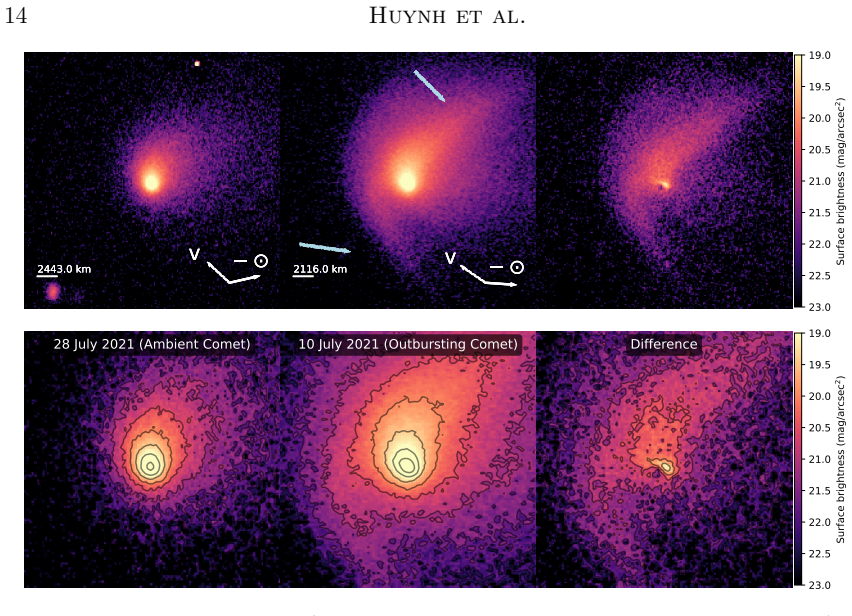
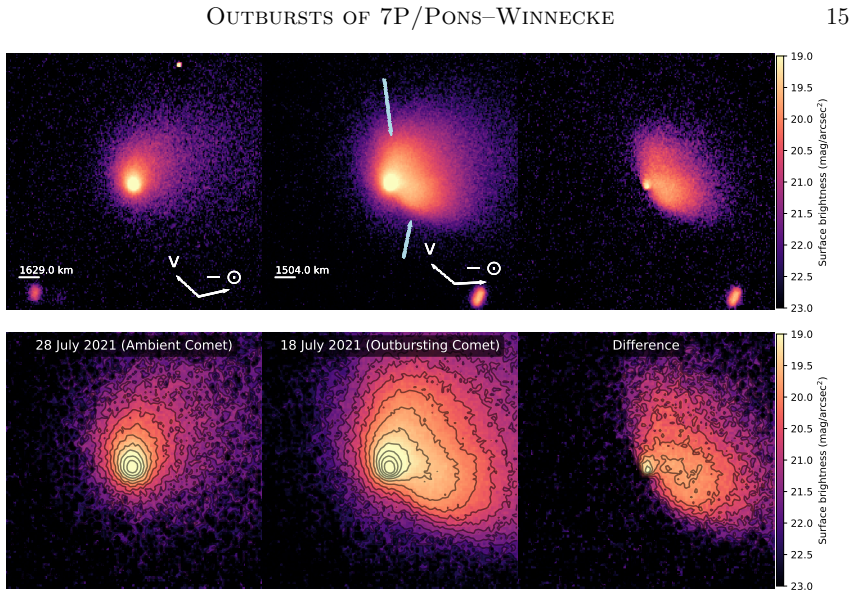
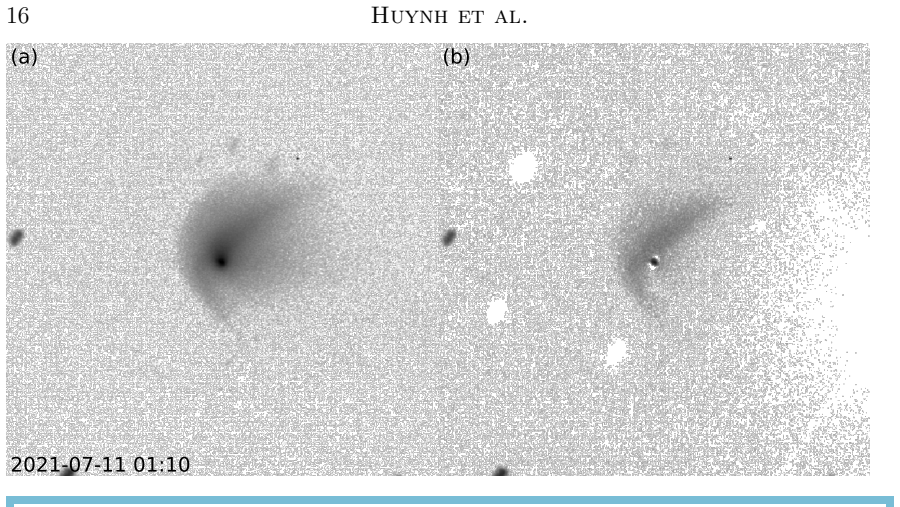
We studied eight outbursts of comet 7P/Pons-Winnecke identified between 2021 June 3 and 2021 August 31 using optical images and photometry from the Las Cumbres Observatory network. The outburst strengths relative to the ambient coma ranged from -0.2 to -1.1 mag, with ejecta apparent brightnesses from 17.4 to 13.3 mag and morphologies suggesting origins from different nucleus sources. An order-of-magnitude estimation gives ejecta masses of 10^5 to 10^6 kg. The surface-area normalized outburst rate is similar to that of comets 41P/Tuttle-Giacobini-Kresák, 9P/Tempel 1 and 46P/Wirtanen, but 10 times larger than observed at 49P/Arend-Rigaux; comparison with the mini-outburst rate of 67P/Churyumov
What carries the argument
Surface-area normalized outburst rate derived from photometric detection of eight discrete brightness increases in the coma, used to enable direct comparison of mini-outburst frequency across comets observed with different instruments.
If this is right
- Outburst rates normalized by surface area allow quantitative comparison across Jupiter-family comets despite differing observation methods.
- Ground-based photometry and spacecraft in-situ data can yield inconsistent mini-outburst frequencies for the same class of comet.
- Varying ejecta morphologies imply multiple active source regions on the nucleus of 7P.
- Historical 19th-century activity levels of 7P may or may not be required to match 20th-century meteor shower observations.
- Mini-outburst ejecta masses in the 10^5-10^6 kg range appear common across several short-period comets.
Where Pith is reading between the lines
- If the rate discrepancy with 67P holds, it suggests that spacecraft data capture a different population of events or that ground-based detection completeness varies strongly with comet distance and activity level.
- Similar normalized rates across 7P, 41P, 9P, and 46P imply that the underlying trigger mechanism for mini-outbursts is shared among many Jupiter-family comets rather than being unique to individual objects.
- The investigation into meteor showers opens the possibility that outburst statistics from one apparition can be extrapolated backward to explain stream activity decades earlier.
Load-bearing premise
The eight identified brightness increases are genuine nucleus-sourced outbursts rather than observational artifacts or natural variations in the ambient coma.
What would settle it
A spacecraft flyby or orbiter measurement of 7P showing either zero mini-outbursts or a surface-area normalized rate differing by more than a factor of a few from the ground-based estimate during a comparable activity period.
Figures
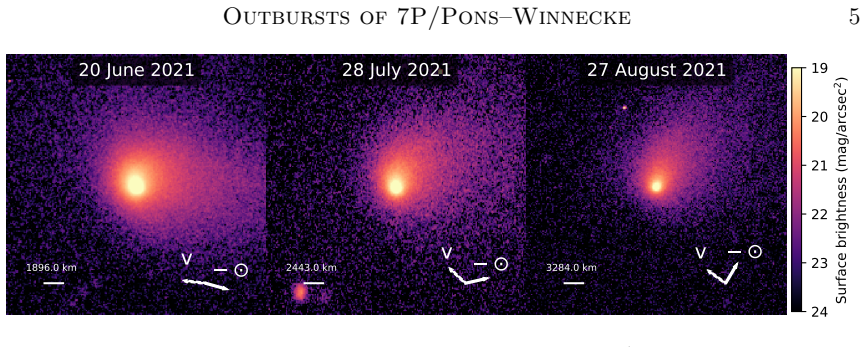
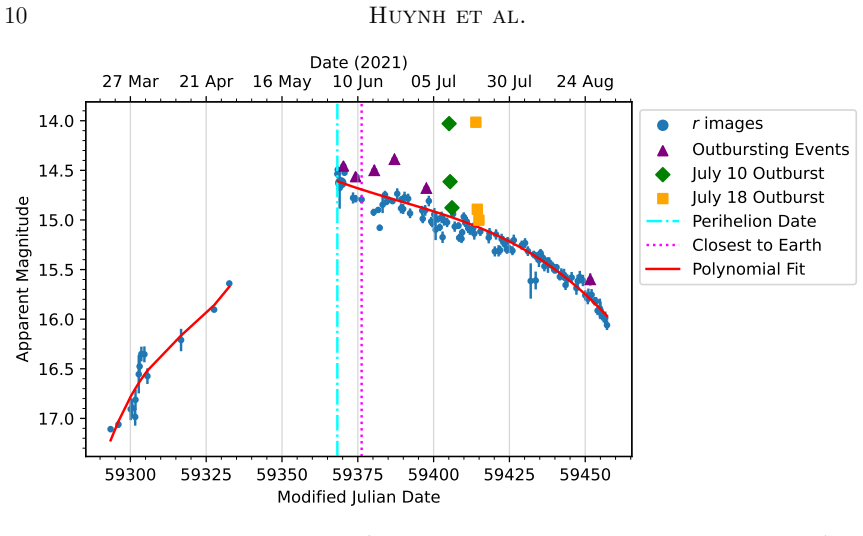
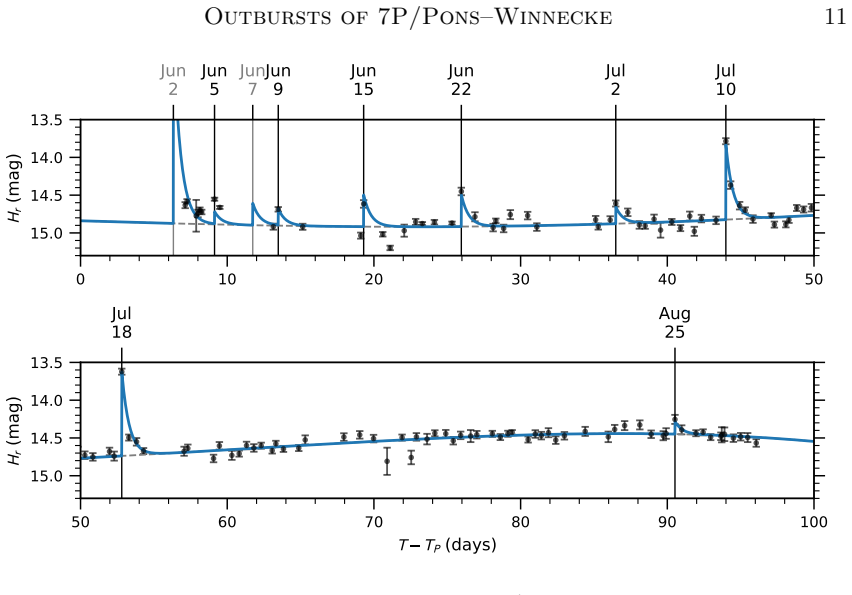
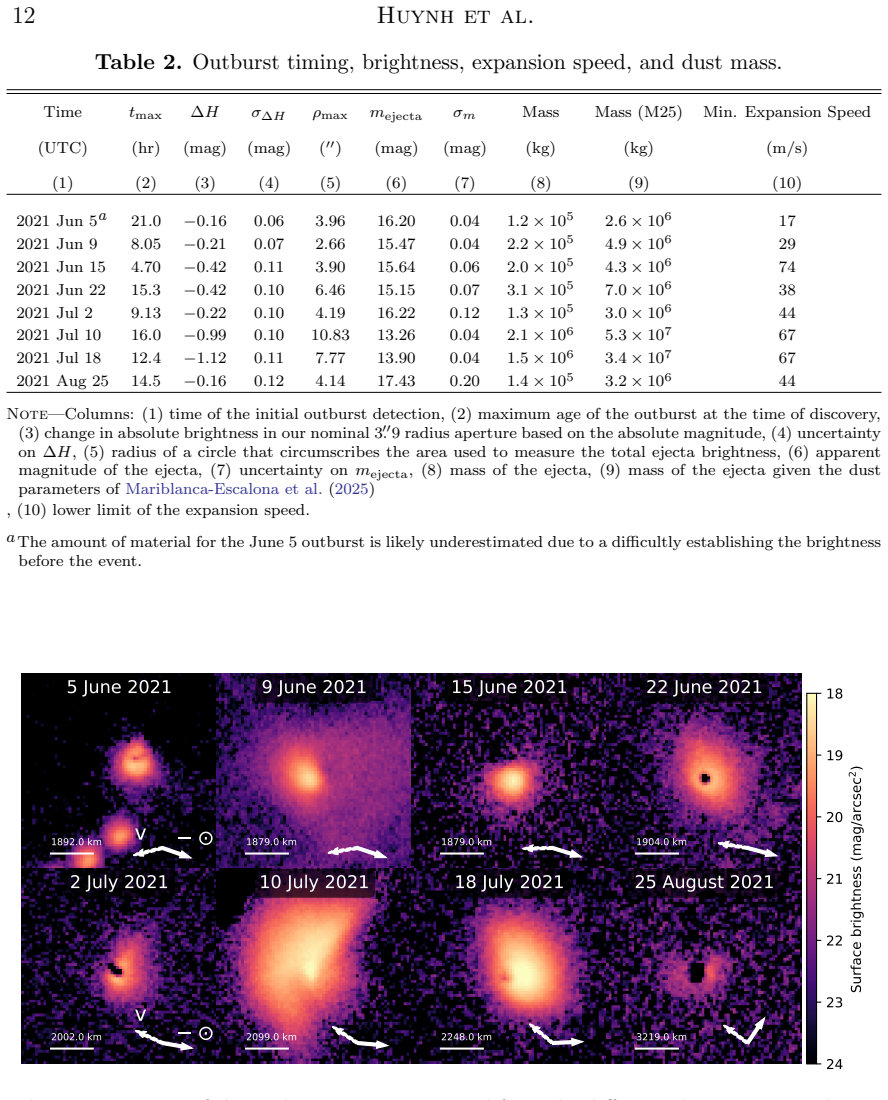
read the original abstract
Cometary outbursts may be used as a means to infer the physical processes occurring on cometary nuclei. To that end, we studied eight outbursts of comet 7P/Pons-Winnecke identified between 2021 June 3 and 2021 August 31. The data analyzed consisted of optical images and derived photometry of the comet from the Las Cumbres Observatory network of telescopes. The outburst strengths relative to the ambient coma ranged from -0.2 to -1.1 mag, and the ejecta themselves had apparent brightnesses ranging from 17.4 to 13.3 mag. The morphologies of the ejecta varied, suggesting that the events may have originated from different sources across the nucleus. An order of magnitude estimation of the ejecta masses ranged from 10$^{5}$ - 10$^{6}$ kg, similar to other mini-outbursts of comets. The surface-area normalized outburst rate estimated during this time period is similar to comets 41P/Tuttle-Giacobini-Kres\'ak, 9P/Tempel 1 and 46P/Wirtanen, but 10 times larger than that observed at comet 49P/Arend-Rigaux. However, a comparison to the mini-outburst rate of comet 67P/Churyumov-Gerasimenko reveals significant discrepancies between Rosetta spacecraft results and those from ground-based telescopes. We also investigate whether or not cometary outbursts from 7P in the 19th century are needed to explain outbursts in meteor shower rates observed in the 20th century.
Editorial analysis
A structured set of objections, weighed in public.
Referee Report
Summary. The paper reports the identification and analysis of eight outbursts in comet 7P/Pons-Winnecke from optical photometry obtained with the Las Cumbres Observatory network between 2021 June 3 and August 31. Outburst amplitudes relative to the ambient coma range from -0.2 to -1.1 mag with ejecta apparent magnitudes 13.3–17.4; order-of-magnitude ejecta masses are estimated at 10^5–10^6 kg. The surface-area-normalized outburst rate is stated to be comparable to those of 41P, 9P and 46P but ~10× higher than 49P, while showing discrepancies with the mini-outburst rate derived from Rosetta data on 67P. The work also examines whether 19th-century outbursts from 7P are required to explain 20th-century meteor-shower activity.
Significance. If the event identifications prove robust, the manuscript supplies a new set of well-sampled mini-outburst light curves and mass estimates for a Jupiter-family comet, together with a direct rate comparison that underscores possible systematic differences between ground-based and spacecraft-derived outburst statistics. Such data points are useful for constraining the frequency and energetics of cometary activity across the population.
major comments (2)
- [Abstract and §2] Abstract and §2 (Observations/Data Reduction): No quantitative criteria are given for outburst identification (e.g., minimum significance above photometric noise, light-curve fitting procedure, or ambient-coma subtraction method), nor are photometric error bars or completeness simulations reported. These omissions are load-bearing for the central claim that the eight brightness increases constitute genuine nucleus-sourced outbursts rather than artifacts or coma fluctuations.
- [§4] §4 (Rate Comparisons): The surface-area-normalized rate statements (similar to 41P/9P/46P, 10× higher than 49P, discrepant with 67P) rest on direct comparison without any assessment of detection efficiency, cadence differences, or sensitivity limits between LCO ground-based data and the Rosetta or other literature datasets. If completeness varies by more than a factor of a few, the factor-of-10 discrepancy and similarity claims do not follow.
minor comments (2)
- [Abstract and mass-estimate paragraph] The abstract states ejecta masses as an “order of magnitude estimation” but does not specify the adopted dust grain properties, ejection velocity, or albedo values used in the conversion from photometry to mass; these parameters should be stated explicitly in the text or a table.
- Figure captions and text should clarify whether the reported magnitudes are in a standard filter (e.g., r′) and whether any color-term or phase-angle corrections were applied.
Simulated Author's Rebuttal
We thank the referee for the detailed and constructive report. We address the two major comments point-by-point below and indicate the revisions we will make to the manuscript.
read point-by-point responses
-
Referee: [Abstract and §2] Abstract and §2 (Observations/Data Reduction): No quantitative criteria are given for outburst identification (e.g., minimum significance above photometric noise, light-curve fitting procedure, or ambient-coma subtraction method), nor are photometric error bars or completeness simulations reported. These omissions are load-bearing for the central claim that the eight brightness increases constitute genuine nucleus-sourced outbursts rather than artifacts or coma fluctuations.
Authors: We agree that the identification criteria must be stated quantitatively. In the revised manuscript we will expand §2 to specify the adopted threshold (brightness increase exceeding 3 times the local photometric scatter after ambient-coma subtraction), the exact subtraction method (linear interpolation between pre- and post-event photometry), and the light-curve inspection procedure. Photometric uncertainties will be plotted on all light-curve figures and tabulated. A brief discussion of sampling completeness given the LCO cadence will also be added. These additions directly address the referee’s concern without altering the reported events. revision: yes
-
Referee: [§4] §4 (Rate Comparisons): The surface-area-normalized rate statements (similar to 41P/9P/46P, 10× higher than 49P, discrepant with 67P) rest on direct comparison without any assessment of detection efficiency, cadence differences, or sensitivity limits between LCO ground-based data and the Rosetta or other literature datasets. If completeness varies by more than a factor of a few, the factor-of-10 discrepancy and similarity claims do not follow.
Authors: We accept that the rate comparisons require explicit caveats. The revised §4 will include a new paragraph comparing the LCO nightly cadence and typical 0.1-mag precision with the continuous Rosetta monitoring and the published cadences of the 41P/9P/46P/49P studies. We will note that the factor-of-10 difference with 67P could partly reflect detection-threshold differences and will qualify all statements as order-of-magnitude estimates. A full end-to-end completeness simulation across every dataset is not feasible with the information publicly available, but the added discussion will make the limitations transparent. revision: partial
Circularity Check
No circularity in observational photometry and external rate comparisons
full rationale
The paper reports new Las Cumbres Observatory photometry of eight brightness increases in 7P, derives order-of-magnitude ejecta masses directly from those data, and compares the resulting surface-area-normalized rate to independently published values for other comets. No equations reduce a claimed prediction to a fitted input by construction, no uniqueness theorems or ansatzes are imported via self-citation, and the central claims rest on external benchmarks rather than self-referential definitions. This is the expected outcome for a purely observational study.
Axiom & Free-Parameter Ledger
free parameters (1)
- dust grain properties and ejection velocity
axioms (2)
- domain assumption Observed brightness increases are due to dust ejection from the nucleus
- domain assumption Comet nucleus surface area is known accurately enough for normalization
Reference graph
Works this paper leans on
-
[1]
Agarwal , J., Della Corte , V., Feldman , P. D., et al. 2017, , 469, s606, 10.1093/mnras/stx2386
-
[2]
A'Hearn , M. F. 2008, , 138, 237, 10.1007/s11214-008-9350-3
-
[3]
A'Hearn , M. F., Millis , R. L., Schleicher , D. G., Osip , D. J., & Birch , P. V. 1995, Icar, 118, 223, 10.1006/icar.1995.1190
-
[4]
A'Hearn , M. F., Belton , M. J. S., Delamere , W. A., et al. 2005, Sci, 310, 258, 10.1126/science.1118923
-
[5]
2011, Sci, 332, 1396, 10.1126/science.1204054
---. 2011, Sci, 332, 1396, 10.1126/science.1204054
-
[6]
1999, in Proceedings of the International Meteor Conference, 17th IMC, Stara Lesna, Slovakia, 1998, 29--42
Arlt, R. 1999, in Proceedings of the International Meteor Conference, 17th IMC, Stara Lesna, Slovakia, 1998, 29--42
1999
-
[7]
Arlt , R., Rendtel , J., Brown , P., et al. 1999, , 308, 887, 10.1046/j.1365-8711.1999.02755.x
-
[8]
Astropy Collaboration , Robitaille , T. P., Tollerud , E. J., et al. 2013, , 558, A33, 10.1051/0004-6361/201322068
-
[9]
Astropy Collaboration , Price-Whelan , A. M., Sip o cz , B. M., et al. 2018, , 156, 123, 10.3847/1538-3881/aabc4f
-
[10]
The Astrophysical Journal , author =
Astropy Collaboration , Price-Whelan , A. M., Lim , P. L., et al. 2022, , 935, 167, 10.3847/1538-4357/ac7c74
work page internal anchor Pith review doi:10.3847/1538-4357/ac7c74 2022
-
[11]
Belton , M. J. S., Feldman , P. D., A'Hearn , M. F., & Carcich , B. 2008, Icar, 198, 189, 10.1016/j.icarus.2008.07.009
-
[12]
Bianco , F. B., Ivezi \'c , Z ., Jones , R. L., et al. 2022, , 258, 1, 10.3847/1538-4365/ac3e72
-
[13]
Bodewits , D., Farnham , T. L., Kelley , M. S. P., & Knight , M. M. 2018, , 553, 186, 10.1038/nature25150
-
[14]
U., Goudfrooij , P., et al
Boehnhardt , H., Kaeufl , H. U., Goudfrooij , P., et al. 1996, The Messenger, 84, 26
1996
-
[15]
2020, , 638, A8, 10.1051/0004-6361/202037663
Boehnhardt , H., Riffeser , A., Ries , C., Schmidt , M., & Hopp , U. 2020, , 638, A8, 10.1051/0004-6361/202037663
-
[16]
2002, , 387, 1107, 10.1051/0004-6361:20020494
Boehnhardt , H., Delahodde , C., Sekiguchi , T., et al. 2002, , 387, 1107, 10.1051/0004-6361:20020494
-
[17]
2022, astropy/photutils: , Zenodo, Zenodo, 10.5281/zenodo.596036
Bradley , L., Sip o cz , B., Robitaille , T., et al. 2022, astropy/photutils: , Zenodo, Zenodo, 10.5281/zenodo.596036
-
[18]
Brown , T. M., Baliber , N., Bianco , F. B., et al. 2013, , 125, 1031, 10.1086/673168
work page internal anchor Pith review doi:10.1086/673168 2013
-
[19]
Chambers , J. E. 1999, , 304, 793, 10.1046/j.1365-8711.1999.02379.x
-
[20]
2020, Planetary and Space Science, 185, 104895
Egal, A. 2020, Planetary and Space Science, 185, 104895
2020
-
[21]
Eisner , N., Knight , M. M., & Schleicher , D. G. 2017, , 154, 196, 10.3847/1538-3881/aa8b0b
-
[22]
Farnham , T. L., Knight , M. M., Schleicher , D. G., et al. 2021, , 2, 7, 10.3847/PSJ/abd091
-
[23]
Farnham , T. L., Wellnitz , D. D., Hampton , D. L., et al. 2007, Icar, 191, 146, 10.1016/j.icarus.2006.10.038
-
[24]
Fern \'a ndez , Y. R., Kelley , M. S., Lamy , P. L., et al. 2013, Icar, 226, 1138, 10.1016/j.icarus.2013.07.021
-
[25]
2022, , 517, 4305, 10.1093/mnras/stac2995
Gardener , D., Snodgrass , C., & Ligier , N. 2022, , 517, 4305, 10.1093/mnras/stac2995
-
[26]
Long-term outburst activity of comet 17P/Holmes and constraints on ejecta size distributions
Gritsevich , M., Weso owski , M., Trigo-Rodr \' guez , J. M., et al. in press, , arXiv:2603.17130, 10.48550/arXiv.2603.17130
work page internal anchor Pith review Pith/arXiv arXiv doi:10.48550/arxiv.2603.17130
-
[27]
Gronkowski , P., & Sacharczuk , Z. 2010, , 408, 1207, 10.1111/j.1365-2966.2010.17194.x
-
[28]
2023, , 4, 220, 10.3847/PSJ/ad083a
Guilbert-Lepoutre , A., Benseguane , S., Martinien , L., et al. 2023, , 4, 220, 10.3847/PSJ/ad083a
-
[29]
1998, WGN, Journal of the International Meteor Organization, vol
Hashimoto, T., & Osada, K. 1998, WGN, Journal of the International Meteor Organization, vol. 26, no. 6, p. 263-266, 26, 263
1998
-
[30]
Hughes , D. W. 1990, , 31, 69
1990
-
[31]
Hughes , D. W. 1991, in Astrophysics and Space Science Library, Vol. 167, IAU Colloq. 116: Comets in the post-Halley era, ed. R. L. Newburn , Jr., M. Neugebauer , & J. Rahe , 825--851
1991
-
[32]
Hunter, J. D. 2007, Computing in Science & Engineering, 9, 90, 10.1109/MCSE.2007.55
-
[33]
2016, , 152, 169, 10.3847/0004-6256/152/6/169
Ishiguro , M., Kuroda , D., Hanayama , H., et al. 2016, , 152, 169, 10.3847/0004-6256/152/6/169
-
[34]
LSST: From Science Drivers to Reference Design and Anticipated Data Products.Astrophys
Ivezi \'c , Z ., Kahn , S. M., Tyson , J. A., et al. 2019, , 873, 111, 10.3847/1538-4357/ab042c
-
[35]
2006, Meteor Showers and their Parent Comets
Jenniskens , P. 2006, Meteor Showers and their Parent Comets
2006
-
[36]
2016, Icar, 277, 257, 10.1016/j.icarus.2016.05.002
Jorda , L., Gaskell , R., Capanna , C., et al. 2016, Icar, 277, 257, 10.1016/j.icarus.2016.05.002
-
[37]
Kelley , M. S. P., Lin, Z.-Y., Sharma, K., et al. 2021 a , Cent. Bur. Electron. Telegrams, 4997
2021
-
[38]
Kelley , M. S. P., & Lister, T. 2019, calviacat: Calibrate star photometry by comparison to a catalog, 1.0.2, Zenodo, 10.5281/zenodo.2635841
-
[39]
Kelley , M. S. P., & Lister , T. 2021, ATel, 14486, 1
2021
-
[40]
Kelley , M. S. P., Ye , Q., Donaldson , A., et al. 2022, ATel, 15772, 1. http://www.astronomerstelegram.org/?read=15772
2022
-
[41]
Kelley , M. S. P., Farnham , T. L., Li , J.-Y., et al. 2021 b , , 2, 131, 10.3847/PSJ/abfe11
-
[42]
Kronk , G. W. 2003, Cometography: A Catalog of Comets, Volume 2: 1800-1899 (Cambridge, UK: Cambridge University Press)
2003
-
[43]
M., Boehnhardt , H., Gredel , R., et al
Lara , L. M., Boehnhardt , H., Gredel , R., et al. 2006, , 445, 1151, 10.1051/0004-6361:20053833
-
[44]
Li , J., Jewitt , D., Clover , J. M., & Jackson , B. V. 2011, , 728, 31, 10.1088/0004-637X/728/1/31
-
[45]
Lister , T., Kelley , M. S. P., Holt , C. E., et al. 2022, , 3, 173, 10.3847/PSJ/ac7a31
-
[46]
Marcus , J. N. 2007, Int. Comet Q., 29, 119
2007
-
[47]
M., Moreno , F., Guti \'e rrez , P
Mariblanca-Escalona , I., Lara , L. M., Moreno , F., Guti \'e rrez , P. J., & Evangelista-Santana , M. 2025, , 538, 1329, 10.1093/mnras/staf370
-
[48]
McCully , C., Volgenau , N. H., Harbeck , D.-R., et al. 2018, in Society of Photo-Optical Instrumentation Engineers (SPIE) Conference Series, Vol. 10707, Software and Cyberinfrastructure for Astronomy V, ed. J. C. Guzman & J. Ibsen , 107070K, 10.1117/12.2314340
-
[49]
J., Ageorges , N., A'Hearn , M
Meech , K. J., Ageorges , N., A'Hearn , M. F., et al. 2005, Sci, 310, 265, 10.1126/science.1118978
-
[50]
Meech , K. J., A'Hearn , M. F., Adams , J. A., et al. 2011, , 734, L1, 10.1088/2041-8205/734/1/L1
-
[51]
Millis , R. L., A'Hearn , M. F., & Campins , H. 1988, , 324, 1194, 10.1086/165974
-
[52]
Mommert , M., Kelley , M., de Val-Borro , M., et al. 2019, J. Open Source Softw., 4, 1426, 10.21105/joss.01426
-
[53]
Moretto , M. J., Feaga , L. M., & A'Hearn , M. F. 2017, Icar, 296, 28, 10.1016/j.icarus.2017.05.013
-
[54]
R., Altwegg , K., Berthelier , J.-J., et al
M \"u ller , D. R., Altwegg , K., Berthelier , J.-J., et al. 2024, , 529, 2763, 10.1093/mnras/stae622
-
[55]
2025, , 537, 2997, 10.1093/mnras/staf180
---. 2025, , 537, 2997, 10.1093/mnras/staf180
-
[56]
2020, in Society of Photo-Optical Instrumentation Engineers (SPIE) Conference Series, Vol
Narita , N., Fukui , A., Yamamuro , T., et al. 2020, in Society of Photo-Optical Instrumentation Engineers (SPIE) Conference Series, Vol. 11447, Society of Photo-Optical Instrumentation Engineers (SPIE) Conference Series, 114475K, 10.1117/12.2559947
-
[57]
Noonan , J. W., Rinaldi , G., Feldman , P. D., et al. 2021, , 162, 4, 10.3847/1538-3881/abf8b4
-
[58]
Novichonok , A. O., Shmal'ts , A. A., Nazarov , S. V., et al. 2024, Solar System Research, 58, 456, 10.1134/S003809462470028X
-
[59]
Pajola , M., H \"o fner , S., Vincent , J. B., et al. 2017, NatAs., 1, 0092, 10.1038/s41550-017-0092
-
[60]
Prialnik , D., & Jewitt , D. 2024, in Comets III, ed. K. J. Meech , M. R. Combi , D. Bockel \'e e-Morvan , S. N. Raymodn , & M. E. Zolensky (Tucson, AZ: Univ. Arizona Press ), 823--844, 10.2458/azu_uapress_9780816553631-ch025
-
[61]
Schleicher , D. G., Knight , M. M., Eisner , N. L., & Thirouin , A. 2019, , 157, 108, 10.3847/1538-3881/aafbab
-
[62]
Schleicher , D. G., Millis , R. L., & Birch , P. V. 1998, Icar, 132, 397, 10.1006/icar.1997.5902
-
[63]
Schwamb , M. E., Knight , M. M., Jones , G. H., et al. 2020, Res. Not. AAS, 4, 21, 10.3847/2515-5172/ab7300
-
[64]
Schwamb , M. E., Jones , R. L., Yoachim , P., et al. 2023, , 266, 22, 10.3847/1538-4365/acc173
-
[65]
2009, International Comet Quarterly, 31, 99
Sekanina , Z. 2009, International Comet Quarterly, 31, 99
2009
-
[66]
Sharma , K., Kelley , M. S. P., Joharle , S., et al. 2021 a , Res. Not. AAS, 5, 277, 10.3847/2515-5172/ac3ee4
-
[67]
Sharma , K., Kelley , M. S. P., Stanzin , J., et al. 2021 b , ATel, 14687, 1
2021
-
[68]
Snodgrass , C., Fitzsimmons , A., & Lowry , S. C. 2005, , 444, 287, 10.1051/0004-6361:20053237
-
[69]
K., Graves , K., Hirabayashi , M., Melosh , H
Steckloff , J. K., Graves , K., Hirabayashi , M., Melosh , H. J., & Richardson , J. E. 2016, Icar, 272, 60, 10.1016/j.icarus.2016.02.026
-
[70]
Sykes , M. V., & Walker , R. G. 1992, Icar, 95, 180, 10.1016/0019-1035(92)90037-8
-
[71]
2002, Earth, Moon, Planets, 88, 27, 10.1023/A:1013807101680
Tanigawa , T., & Hashimoto , T. 2002, Earth, Moon, Planets, 88, 27, 10.1023/A:1013807101680
-
[72]
Thomas , P., A'Hearn , M., Belton , M. J. S., et al. 2013 a , Icar, 222, 453, 10.1016/j.icarus.2012.02.037
-
[73]
Thomas , P. C., A'Hearn , M. F., Veverka , J., et al. 2013 b , Icar, 222, 550, 10.1016/j.icarus.2012.05.034
-
[74]
L., Denneau , L., Flewelling , H., et al
Tonry , J. L., Denneau , L., Flewelling , H., et al. 2018, , 867, 105, 10.3847/1538-4357/aae386
-
[75]
Trigo-Rodr \' guez , J. M., & Blum , J. 2022, , 512, 2277, 10.1093/mnras/stab2827
-
[76]
Trigo-Rodr \' guez , J. M., Garc \' a-Hern \'a ndez , D. A., S \'a nchez , A., et al. 2010, , 409, 1682, 10.1111/j.1365-2966.2010.17425.x
-
[77]
2015, , 573, A62, 10.1051/0004-6361/201424735
Tubiana , C., Snodgrass , C., Bertini , I., et al. 2015, , 573, A62, 10.1051/0004-6361/201424735
-
[78]
2021, Central Bureau Electronic Telegrams, 4997, 1
van Buitenen , G. 2021, Central Bureau Electronic Telegrams, 4997, 1
2021
-
[79]
, year = 2005, month = apr, volume =
Vaubaillon , J., Arlt , R., Shanov , S., Dubrovski , S., & Sato , M. 2005, , 362, 1463, 10.1111/j.1365-2966.2005.09421.x
-
[80]
Vincent , J.-B., A'Hearn , M. F., Lin , Z.-Y., et al. 2016, , 462, S184, 10.1093/mnras/stw2409
discussion (0)
Sign in with ORCID, Apple, or X to comment. Anyone can read and Pith papers without signing in.