Solarsystem: A Validated Lightweight Python Package for Planetary Positions and Solar-Lunar Event Calculations
Pith reviewed 2026-06-26 03:04 UTC · model grok-4.3
The pith
A lightweight Python package delivers planetary positions and solar-lunar events through analytical models without external ephemeris files.
A machine-rendered reading of the paper's core claim, the machinery that carries it, and where it could break.
Core claim
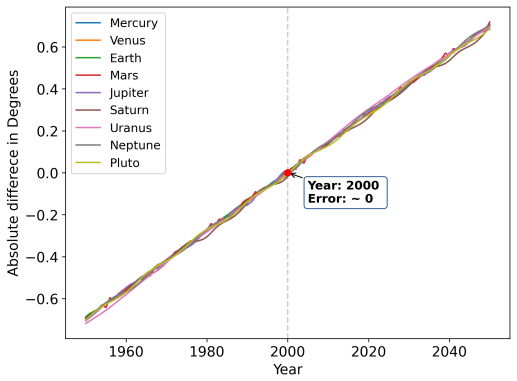
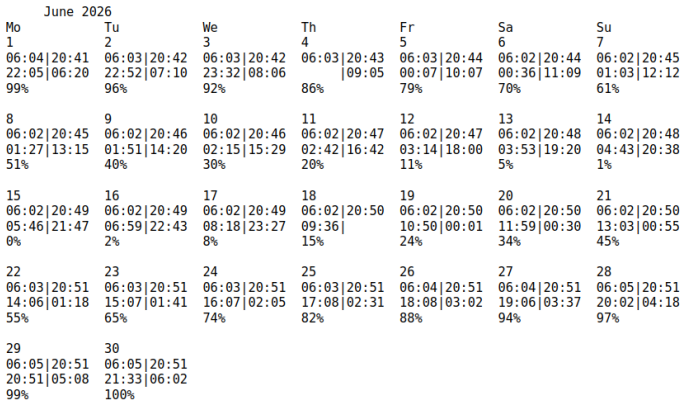
The implemented analytical models produce heliocentric and geocentric positions for the major planets, selected dwarf planets, the Centaur Chiron, and the Moon, together with solar and lunar event calculations, while supporting coordinate transformations and an optional precession correction; when tested against JPL DE440 using Skyfield, these yield mean planetary longitude and latitude deviations of approximately 0.44 and 0.16 arcminutes over extended intervals, with solar-lunar timing differences of only a few minutes and lunar illumination differences of approximately 0.2 percent.
What carries the argument
Analytical models for planetary positions and solar-lunar events that avoid external ephemeris datasets, with optional precession correction to switch between reference frames.
If this is right
- Users can run planetary calculations on any machine without downloading large ephemeris files.
- Solar and lunar event times remain usable for planning within a few minutes of reference solutions.
- Lunar illumination estimates support applications that tolerate 0.2 percent error.
- Coordinate transformations and precession options allow flexible reference-frame choices in one library.
Where Pith is reading between the lines
- The same analytical approach could support lightweight astronomy tools in resource-constrained environments such as embedded devices or educational software.
- Extending the models to additional minor bodies would broaden coverage while preserving the no-external-data property.
- Integration with visualization libraries could enable quick generation of sky charts for citizen-science projects.
Load-bearing premise
The chosen analytical models stay accurate enough over the tested time spans and bodies without needing external data or numerical integration.
What would settle it
Direct position comparison at an epoch well outside the validated interval, such as year 3000, that produces longitude or latitude deviations substantially larger than 1 arcminute.
Figures
read the original abstract
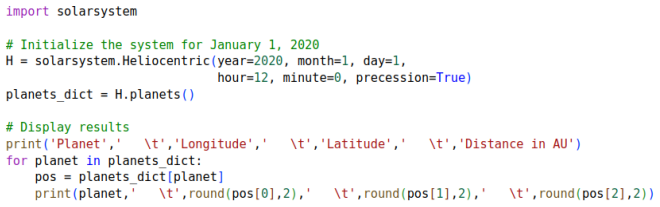
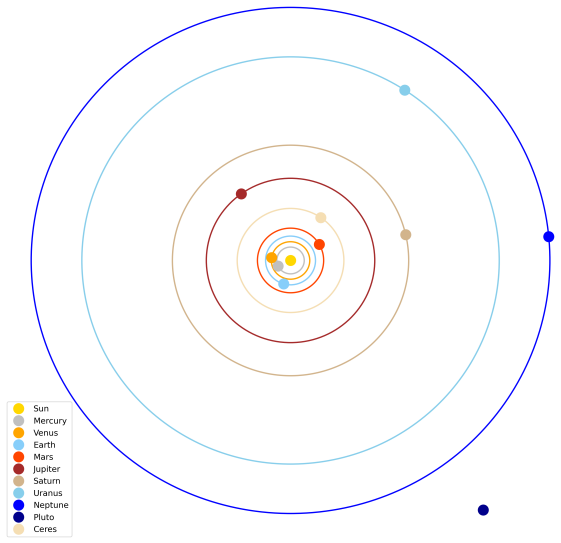
This paper presents solarsystem, a validated lightweight and dependency-free Python package for planetary positions and solar-lunar event calculations. The package provides heliocentric and geocentric positions for the major planets, selected dwarf planets, the Centaur Chiron, and the Moon, together with sunrise, sunset, moonrise, moonset, and lunar illumination calculations. Additional functionality includes coordinate transformations between commonly used astronomical reference systems. The implemented algorithms employ analytical models that avoid reliance on external ephemeris datasets, resulting in a portable and computationally efficient solution suitable for a broad range of astronomical applications. An optional precession correction model is included, enabling calculations either in a precession-corrected reference frame or in a fixed epoch framework, depending on user requirements. The numerical performance of solarsystem was evaluated against the JPL DE440 planetary ephemerides using the Skyfield framework as a reference. Validation experiments spanning multiple bodies and extended temporal intervals demonstrate good agreement with the reference ephemerides, with mean planetary longitude and latitude deviations of approximately 0.44 and 0.16 arcminutes, respectively. Additional validation of solar and lunar event calculations yielded timing differences of only a few minutes relative to the reference solutions, while lunar illumination estimates differed by approximately 0.2%. The package can be installed directly through PyPI while the source code, documentation, validation notebooks and example workflows are publicly available through the project repository in https://github.com/IoannisNasios/solarsystem.
Editorial analysis
A structured set of objections, weighed in public.
Referee Report
Summary. The manuscript presents solarsystem, a lightweight, dependency-free Python package implementing analytical models for heliocentric and geocentric positions of the major planets, selected dwarf planets, Chiron, and the Moon, plus solar-lunar event calculations (sunrise/sunset, moonrise/moonset, lunar illumination) and coordinate transformations. An optional precession correction is included. Validation against JPL DE440 via Skyfield reports mean planetary longitude and latitude deviations of ~0.44 and ~0.16 arcmin, solar/lunar event timing differences of a few minutes, and lunar illumination differences of ~0.2%. The package is available via PyPI with public code, documentation, and validation notebooks on GitHub.
Significance. If the reported agreement holds, the package provides a portable, computationally efficient alternative to full ephemeris libraries for applications where external datasets are impractical. Public release of validation notebooks and example workflows supports reproducibility. The use of independent reference ephemerides (DE440) for validation avoids circularity and directly tests the accuracy of the analytical models over the claimed domains.
minor comments (2)
- [Abstract] Abstract: The validation summary should specify the exact time intervals, number of bodies tested, and outlier handling to allow readers to evaluate the robustness of the mean deviation figures (0.44/0.16 arcmin).
- The manuscript would benefit from a table or figure breaking down deviations by individual body and time span rather than reporting only aggregate means.
Simulated Author's Rebuttal
We thank the referee for their positive evaluation of the manuscript and their recommendation to accept.
Circularity Check
No significant circularity
full rationale
The paper implements known analytical models for planetary positions and validates their output directly against the independent external reference JPL DE440 (via Skyfield). The reported mean deviations (0.44/0.16 arcmin) and event timing differences are empirical comparisons to this external benchmark, not reductions of the package's own fitted parameters or self-citations. No derivation chain, uniqueness theorem, or ansatz is load-bearing; the central claim is a straightforward accuracy test against an outside ephemeris and therefore self-contained.
Axiom & Free-Parameter Ledger
Reference graph
Works this paper leans on
-
[1]
Hope: A python just-in-time compiler for astrophysical computations
Akeret, J., Gamper, L., Amara, A., Refregier, A., 2015. Hope: A python just-in-time compiler for astrophysical computations. Astronomy and Computing 10, 1–8
2015
-
[2]
Spiceypy: a pythonic wrapper for the spice toolkit
Annex, A., et al., 2020. Spiceypy: a pythonic wrapper for the spice toolkit. doi:10. 5281/zenodo.3826081. Astropy Collaboration, 2013. Astropy: A community python package for astronomy. Astronomy & Astrophysics 558, A33
2020
-
[3]
Long-term variations of daily insolation and quaternary climatic changes
Berger, A., 1978. Long-term variations of daily insolation and quaternary climatic changes. Journal of Atmospheric Sciences 35, 2362–2367
1978
-
[4]
Practical astronomy with your calculator or spread- sheet
Duffett-Smith, P., Zwart, J., 2017. Practical astronomy with your calculator or spread- sheet. Cambridge University Press
2017
-
[5]
The planetary and lunar ephemerides de430 and de431
Folkner, W.M., Williams, J.G., Boggs, D.H., Park, R.S., Kuchynka, P., 2014. The planetary and lunar ephemerides de430 and de431. Interplanetary Network Progress Report 42-196, 1–81
2014
-
[6]
Fundamental astronomy
Karttunen, H., Kröger, P., Oja, H., Poutanen, M., Donner, K.J., 2007. Fundamental astronomy. Springer. KLUYVERª1, T., RAGAN-KELLEYb 1, B., Pérez, F., Granger, B., Bussonnier, M.,
2007
-
[7]
Frederic, J., Kelley, K., 2016. Jupyter notebooks-a publishing format for repro- ducible computational workflows, in: Positioning and power in academic publish- ing: players, agents and agendas: proceedings of the 20th International Conference on Electronic Publishing, IOS press. p. 87
2016
-
[8]
Simulations of triple mi- crolensing events i: detectability of a scaled sun–jupiter–saturn system
Kuang, R., Zang, W., Mao, S., Zhang, J., Jiang, H., 2023. Simulations of triple mi- crolensing events i: detectability of a scaled sun–jupiter–saturn system. Monthly Notices of the Royal Astronomical Society 520, 4540–4553
2023
-
[9]
Secular terms of classical planetary theories using the results of general theory
Laskar, J., 1986. Secular terms of classical planetary theories using the results of general theory. Astronomy and astrophysics 157, 59–70
1986
-
[10]
Astronomical algorithms
Meeus, J.H., 1991. Astronomical algorithms. Willmann-Bell, Incorporated
1991
-
[11]
Astronomy on the personal computer
Montenbruck, O., Pfleger, T., 2013. Astronomy on the personal computer. Springer
2013
-
[12]
The jpl planetary and lunar ephemerides de440 and de441
Park, R.S., Folkner, W.M., Williams, J.G., Boggs, D.H., 2021. The jpl planetary and lunar ephemerides de440 and de441. The Astronomical Journal 161, 105
2021
-
[13]
Skyfield: High precision research-grade positions for planets and earth satellites generator.https://rhodesmill.org/skyfield/
Rhodes, B., 2019. Skyfield: High precision research-grade positions for planets and earth satellites generator.https://rhodesmill.org/skyfield/. Rodríguez, J.L.C., et al., 2020. poliastro: Python library for interactive astrodynamics. Journal of Open Source Software 5, 2187. 17
2019
-
[14]
Galsim: The modular galaxy image simulation toolkit
Rowe, B.T., Jarvis, M., Mandelbaum, R., Bernstein, G.M., Bosch, J., Simet, M., Mey- ers, J.E., Kacprzak, T., Nakajima, R., Zuntz, J., et al., 2015. Galsim: The modular galaxy image simulation toolkit. Astronomy and Computing 10, 121–150
2015
-
[15]
Explanatory supplement to the astronomical almanac
Seidelmann, P.K., 1992. Explanatory supplement to the astronomical almanac. Uni- versity Science Books
1992
-
[16]
Numerical expressions for precession formulae and mean elements for the moon and the planets
Simon, J.L., Bretagnon, P., Chapront, J., Chapront-Touze, M., Francou, G., Laskar, J., 1994. Numerical expressions for precession formulae and mean elements for the moon and the planets. Astronomy and Astrophysics (ISSN 0004-6361), vol. 282, no. 2, p. 663-683 282, 663–683
1994
-
[17]
Best practices for scientific computing
Wilson, G., et al., 2014. Best practices for scientific computing. PLoS Biology 12, e1001745. 18
2014
discussion (0)
Sign in with ORCID, Apple, or X to comment. Anyone can read and Pith papers without signing in.