A Scalable Path to Astrometric Exomoon Discoveries with the Nautilus Space Observatory
Pith reviewed 2026-06-30 01:03 UTC · model grok-4.3
The pith
The scalable array architecture of the Nautilus Space Observatory enables staged astrometric detection of exomoons around the nearest imaged giant planets.
A machine-rendered reading of the paper's core claim, the machinery that carries it, and where it could break.
Core claim
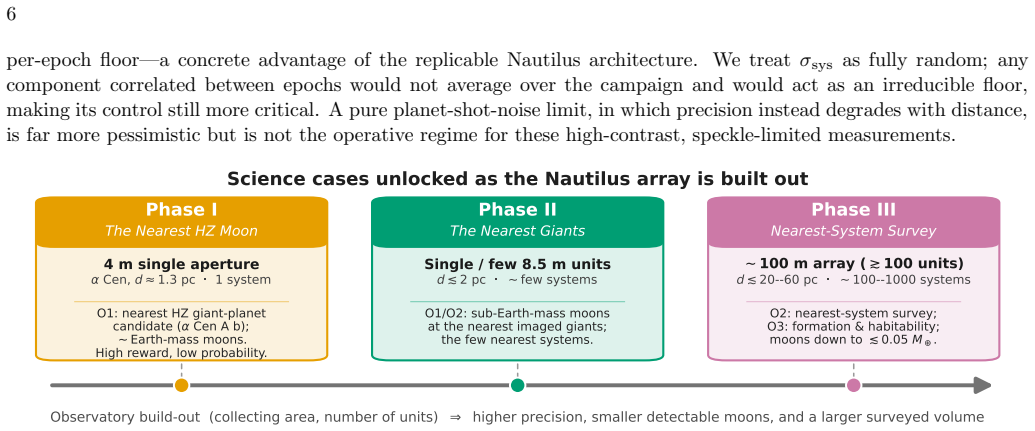
The scalable, replicable architecture of the Nautilus Space Observatory is uniquely suited to astrometric exomoon detection and supports a staged campaign that begins with one or a few small apertures targeting the nearest imaged giant planets and extends, as the array grows, to the nearest such systems around K and earlier stars.
What carries the argument
Astrometric time-series measurement of the planet's reflex motion induced by an orbiting moon, made possible by the observatory's growing array of small apertures that lowers the noise floor over successive phases.
If this is right
- An initial phase with one or a few apertures conducts a high-reward, low-probability search focused on the closest stars.
- As the array expands the astrometric noise floor decreases, extending the search to more systems among nearby K and earlier stars.
- The exomoon search runs in parallel with high-contrast imaging and spectral characterization of the same host planets.
- The campaign operates in synergy with a companion starshade concept for imaging Earth-like planets around the same nearby stars.
Where Pith is reading between the lines
- Success in the initial phase would supply the first concrete examples of exomoons and allow direct comparison of their occurrence rates with those of solar-system moons.
- The same long-baseline astrometric dataset could be reanalyzed for additional signals such as planet-planet interactions or unseen outer companions.
- If the array reaches the scale needed for systematic coverage, population-level statistics on exomoon masses and separations become feasible for the nearest stars.
Load-bearing premise
Recovering small moons requires continuous, long-baseline, high-precision monitoring that is only practical with a dedicated or nearly dedicated facility.
What would settle it
If the astrometric precision delivered by one or a few small apertures on the nearest imaged giant planets remains above the reflex-motion amplitude expected for an Earth-mass moon at realistic orbital separations, the proposed initial-phase detections would not occur.
Figures
read the original abstract
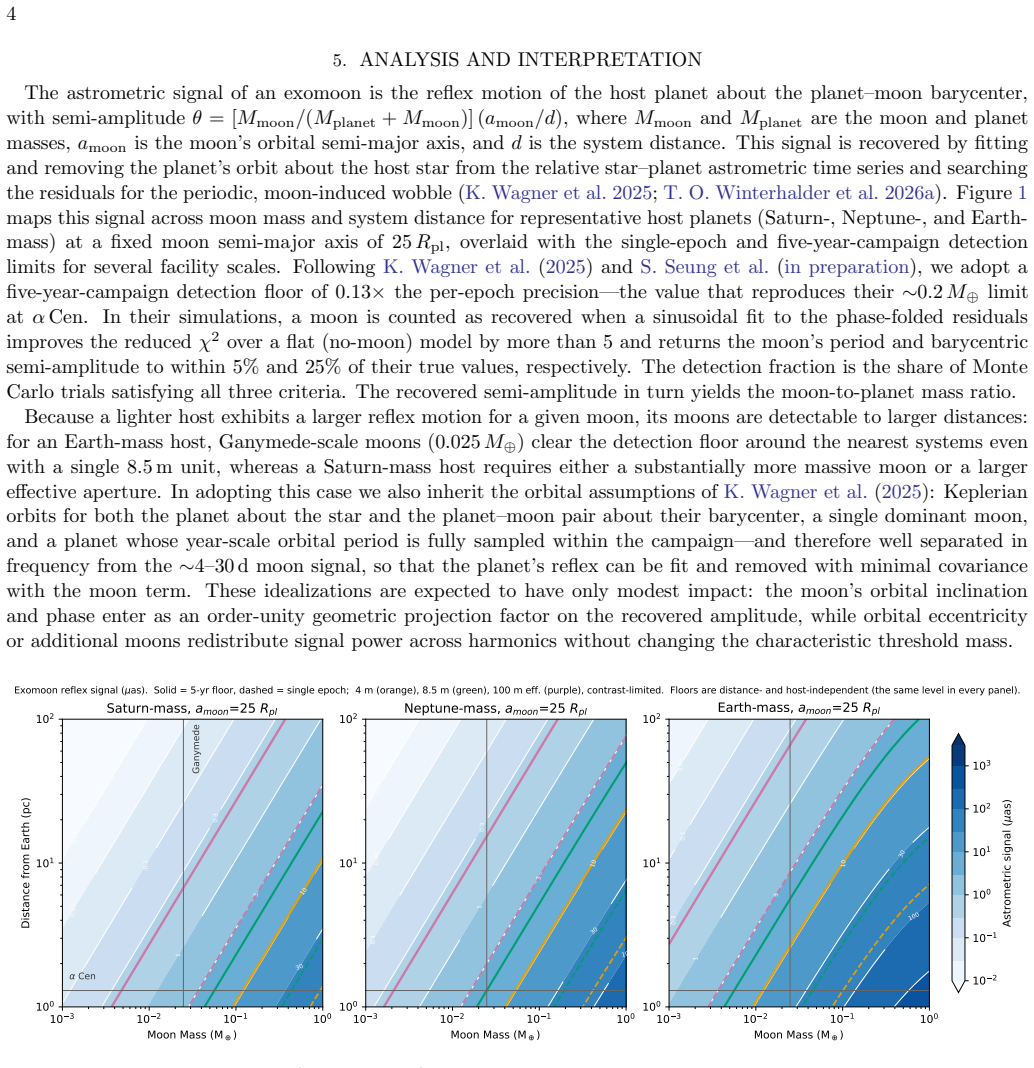
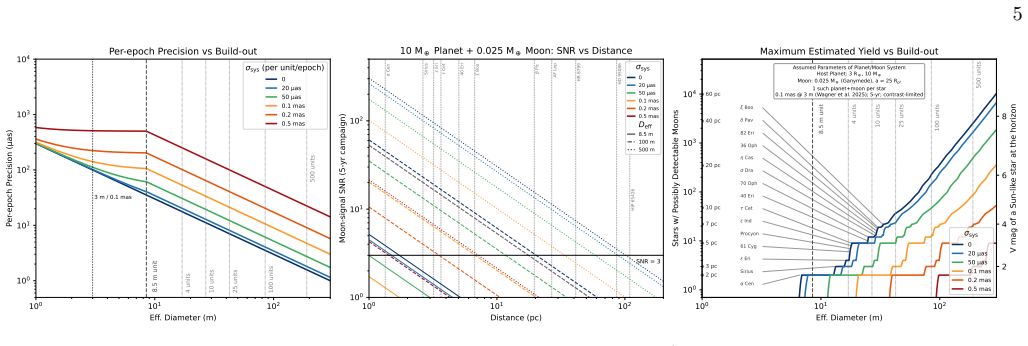
Moons orbiting exoplanets (exomoons) can be detected through the reflex motion they impart to their host planet, which is recoverable in relative star-planet astrometric time series. The signal grows with moon mass and orbital separation and decreases with distance, so the nearest and least massive imaged planets are the most favorable targets. Recovering small (<Earth-mass) moons requires continuous, long-baseline, high-precision monitoring that is only practical with a dedicated or nearly dedicated facility. Building on recent simulations of astrometric exomoon detection and of the resulting population yields, we argue that the scalable, replicable architecture of the Nautilus Space Observatory is uniquely suited to this problem, and we outline a staged campaign. In an initial phase, one or a few small apertures target the nearest imaged giant planets--a high-reward but low-probability search focused on the closest stars. As the array is built out, the astrometric noise floor decreases and the same technique extends the search to the nearest such systems among nearby stars of spectral type K and earlier. This would be performed in parallel with high-contrast imaging and spectral characterization of the host planets and in synergy with a companion starshade concept for imaging Earth-like planets around the same nearby stars. Nautilus thus provides a scalable path from the first detection of a nearby exomoon toward a systematic search for exomoons around the closest stars.
Editorial analysis
A structured set of objections, weighed in public.
Referee Report
Summary. The manuscript proposes that the scalable, replicable architecture of the Nautilus Space Observatory is uniquely suited for astrometric exomoon detection through reflex motion on host planets. It outlines a staged campaign beginning with one or a few small apertures targeting the nearest imaged giant planets, expanding to broader searches among nearby K and earlier stars as the array scales, performed in parallel with high-contrast imaging and in synergy with a starshade concept.
Significance. If the required astrometric precision for sub-Earth-mass moons is achievable with the proposed architecture as assumed from prior simulations, the staged approach could enable the first nearby exomoon detections and a systematic search, leveraging continuous long-baseline monitoring that dedicated facilities can provide. The proposal explicitly builds on existing yield simulations and highlights observational synergies.
major comments (2)
- [Abstract] Abstract: The central claim that the Nautilus architecture is 'uniquely suited' for recovering small (<Earth-mass) moons rests on the premise that such detections 'require continuous, long-baseline, high-precision monitoring that is only practical with a dedicated or nearly dedicated facility,' yet the manuscript provides no new quantitative validation, error analysis, or demonstration that the described apertures and array achieve the necessary precision; it references external simulations without internal verification.
- [Staged campaign description] Staged campaign section: The description of the initial phase (nearest imaged giants) and expansion to K-type stars lacks specific estimates of observation cadence, baseline length, or noise-floor reduction as a function of array size, making it impossible to assess whether the architecture meets the signal requirements for the targeted moon masses without relying entirely on the cited prior work.
minor comments (2)
- The manuscript would benefit from an explicit table or section comparing the astrometric requirements (precision, baseline, duty cycle) against the stated capabilities of Nautilus at each stage of array build-out.
- Notation for 'nearest imaged giant planets' and 'nearby stars of spectral type K and earlier' should be defined more precisely with example target lists or distance cuts to aid reproducibility.
Simulated Author's Rebuttal
We thank the referee for their constructive comments. This manuscript is a conceptual proposal outlining a staged observational strategy that builds directly on existing yield simulations; it does not introduce new quantitative validations or error analyses. We address each major comment below.
read point-by-point responses
-
Referee: [Abstract] Abstract: The central claim that the Nautilus architecture is 'uniquely suited' for recovering small (<Earth-mass) moons rests on the premise that such detections 'require continuous, long-baseline, high-precision monitoring that is only practical with a dedicated or nearly dedicated facility,' yet the manuscript provides no new quantitative validation, error analysis, or demonstration that the described apertures and array achieve the necessary precision; it references external simulations without internal verification.
Authors: The manuscript is explicitly framed as a high-level proposal for an observational campaign rather than a simulation or technical validation study. The 'uniquely suited' argument follows from the dedicated, scalable nature of the Nautilus architecture enabling the continuous long-baseline monitoring described in the text, with the required astrometric precision and resulting yields taken from the cited prior simulations. We do not perform new internal verification here, as that would duplicate the referenced work. We will revise the abstract and introduction to state more explicitly that all quantitative precision requirements and yield estimates are drawn from those external simulations. revision: partial
-
Referee: [Staged campaign description] Staged campaign section: The description of the initial phase (nearest imaged giants) and expansion to K-type stars lacks specific estimates of observation cadence, baseline length, or noise-floor reduction as a function of array size, making it impossible to assess whether the architecture meets the signal requirements for the targeted moon masses without relying entirely on the cited prior work.
Authors: The staged campaign is presented at a conceptual level to demonstrate scalability. Specific numerical estimates for cadence, baseline length, and noise-floor scaling with array size are contained in the cited prior simulation papers; repeating those calculations is outside the scope of this proposal manuscript. We will expand the staged-campaign section with additional direct citations to the relevant results, figures, and parameter assumptions from those works so that readers can more readily locate the quantitative details. revision: partial
Circularity Check
No significant circularity
full rationale
The paper is a conceptual feasibility proposal outlining a staged campaign for astrometric exomoon detection using the Nautilus Space Observatory. It explicitly builds on external simulations of detection yields and population statistics, and grounds its claims in the observatory's stated replicable architecture and the general requirement for dedicated long-baseline monitoring. No equations, fitted parameters, derivations, or self-citations appear in the text that reduce any prediction or uniqueness claim to an input by construction. The argument remains independent of its own outputs and is self-contained against external benchmarks.
Axiom & Free-Parameter Ledger
Reference graph
Works this paper leans on
-
[1]
Agnor, C. B., & Hamilton, D. P. 2006, Nature, 441, 192, doi: 10.1038/nature04792
-
[2]
2015, ApJ, 812, 5, doi: 10.1088/0004-637X/812/1/5
Agol, E., Jansen, T., Lacy, B., et al. 2015, ApJ, 812, 5, doi: 10.1088/0004-637X/812/1/5
-
[3]
Anche, R. M., Van Gorkom, K. J., Ashcraft, J. N., et al. 2024, in Proc. SPIE, Vol. 13092, 130926M, doi: 10.1117/12.3020630
-
[4]
Apai, D., Milster, T. D., Kim, D. W., et al. 2019, AJ, 158, 83, doi: 10.3847/1538-3881/ab2631
-
[5]
Apai, D., et al. 2022, in Proc. SPIE, Vol. 12221, 122210C, doi: 10.1117/12.2633184
-
[6]
Barr, A. C., & Bruck Syal, M. 2017, MNRAS, 475, 4868, doi: 10.1093/mnras/sty038
-
[7]
2025, ApJL, 989, L22, doi: 10.3847/2041-8213/adf53f
Beichman, C., et al. 2025, ApJL, 989, L22, doi: 10.3847/2041-8213/adf53f
-
[8]
Bennett, D. P., Batista, V., Bond, I. A., et al. 2014, ApJ, 785, 155, doi: 10.1088/0004-637X/785/2/155
-
[9]
Bond, H. E., Gilliland, R. L., Schaefer, G. H., et al. 2015, ApJ, 813, 106, doi: 10.1088/0004-637X/813/2/106
-
[10]
Canup, R. M., & Ward, W. R. 2006, Nature, 441, 834, doi: 10.1038/nature04860
-
[11]
2006, Nature, 442, 51, doi: 10.1038/nature04930 9
Cash, W. 2006, Nature, 442, 51, doi: 10.1038/nature04930 9
-
[12]
Cilibrasi, M., Szul´ agyi, J., Grimm, S. L., et al. 2021, MNRAS, 504, 5455, doi: 10.1093/mnras/stab1179
-
[13]
Astrometric exoplanet detection survives solar-like stellar contamination
Deagan, C., Montet, B. T., Tuthill, P., et al. 2026, arXiv e-prints. https://arxiv.org/abs/2605.18953
work page internal anchor Pith review Pith/arXiv arXiv 2026
-
[14]
Douglas, E. S., Aldering, G., Allan, G. W., et al. 2023, in Proc. SPIE, Vol. 12677, 126770D, doi: 10.1117/12.2677843
-
[15]
Feinberg, L., Ziemer, J., Ansdell, M., et al. 2024, in Proc. SPIE, doi: 10.1117/12.3018328
-
[16]
2019, MNRAS, 490, 5002
Feng, F., Anglada-Escud´ e, G., Tuomi, M., et al. 2019, MNRAS, 490, 5002
2019
-
[17]
Feng, F., Tuomi, M., Jones, H. R. A., et al. 2017, AJ, 154, 135 Gaia Collaboration, Smart, R. L., Sarro, L. M., et al. 2021, A&A, 649, A6, doi: 10.1051/0004-6361/202039498
-
[18]
Hand, K. P., Carlson, R. W., & Chyba, C. F. 2007, Astrobiology, 7, 1006, doi: 10.1089/ast.2007.0156
-
[19]
P., Cochran, W
Hatzes, A. P., Cochran, W. D., McArthur, B., et al. 2000, ApJL, 544, L145
2000
-
[20]
2024, Nature Astronomy, 8, 193, doi: 10.1038/s41550-023-02148-w
Heller, R., & Hippke, M. 2024, Nature Astronomy, 8, 193, doi: 10.1038/s41550-023-02148-w
-
[21]
2019, A&A, 624, A95, doi: 10.1051/0004-6361/201834913
Heller, R., Rodenbeck, K., & Bruno, G. 2019, A&A, 624, A95, doi: 10.1051/0004-6361/201834913
-
[22]
Kaplan-Lipkin, A., Macintosh, B., Madurowicz, A., et al. 2022, AJ, doi: 10.3847/1538-3881/ac56e0
-
[23]
An exomoon survey of 70 cool giant exoplanets and the new candidate
Kipping, D., Bryson, S., Burke, C., et al. 2022, Nature Astronomy, 6, 367, doi: 10.1038/s41550-021-01539-1
-
[24]
Kipping, D. M., Fossey, S. J., & Campanella, G. 2009, MNRAS, 400, 398, doi: 10.1111/j.1365-2966.2009.15472.x
- [25]
-
[26]
2019, ApJ, 877, L15, doi: 10.3847/2041-8213/ab20c8
Kreidberg, L., Luger, R., & Bedell, M. 2019, ApJ, 877, L15, doi: 10.3847/2041-8213/ab20c8
-
[27]
2022, MNRAS, 516, 391, doi: 10.1093/mnras/stac2081
Lazzoni, C., Desidera, S., Gratton, R., et al. 2022, MNRAS, 516, 391, doi: 10.1093/mnras/stac2081
-
[28]
Maire, A.-L., Langlois, M., Delorme, P., et al. 2021, Journal of Astronomical Telescopes, Instruments, and Systems, 7, 035004, doi: 10.1117/1.JATIS.7.3.035004
-
[29]
C., Carter, A
Matthews, E. C., Carter, A. L., Pathak, P., et al. 2024, Nature, 633, 789
2024
-
[30]
The National Academies Press, Washington, DC, 2023
Mawet, D., Hirsch, L., Lee, E. J., et al. 2019, AJ, 157, 33 National Academies of Sciences, Engineering, and Medicine. 2021, Pathways to Discovery in Astronomy and Astrophysics for the 2020s (The National Academies Press), doi: 10.17226/26141
-
[31]
Peters-Limbach, M. A., & Turner, E. L. 2013, ApJ, 769, 98, doi: 10.1088/0004-637X/769/2/98
-
[32]
Porco, C. C., et al. 2006, Science, 311, 1393, doi: 10.1126/science.1123013
-
[33]
P., Ottiger, M., Fontanet, E., et al
Quanz, S. P., et al. 2022, A&A, 664, A21, doi: 10.1051/0004-6361/202140366
-
[34]
Quarles, B., Eggl, S., Rosario-Franco, M., et al. 2021, AJ, 162, 58, doi: 10.3847/1538-3881/ac042a
-
[35]
Reynolds, R. T., McKay, C. P., & Kasting, J. F. 1987, Advances in Space Research, 7, 125, doi: 10.1016/0273-1177(87)90364-4
-
[36]
Rosario-Franco, M., Quarles, B., Musielak, Z. E., et al. 2020, AJ, 159, 260, doi: 10.3847/1538-3881/ab89a7
-
[37]
2025, ApJL, 989, doi: 10.3847/2041-8213/adf53e
Sanghi, A., et al. 2025, ApJL, 989, doi: 10.3847/2041-8213/adf53e
-
[38]
Scharf, C. A. 2006, ApJ, 648, 1196, doi: 10.1086/505256
-
[39]
9605, 96050W, doi: 10.1117/12.2190378
SPIE, Vol. 9605, 96050W, doi: 10.1117/12.2190378
-
[40]
Simon, A., Szatm´ ary, K., & Szab´ o, G. M. 2007, A&A, 470, 727, doi: 10.1051/0004-6361:20066560
-
[41]
Teachey, A., & Kipping, D. M. 2018, Science Advances, 4, eaav1784, doi: 10.1126/sciadv.aav1784
-
[42]
Tuomi, M., Jones, H. R. A., Jenkins, J. S., et al. 2013, A&A, 551, A79
2013
-
[43]
2018, in Proc
Tuthill, P., Bendek, E., Guyon, O., et al. 2018, in Proc
2018
-
[44]
10701, 107011J, doi: 10.1117/12.2313269
SPIE, Vol. 10701, 107011J, doi: 10.1117/12.2313269
-
[45]
2021, Nature Communications, 12, 922, doi: 10.1038/s41467-021-21176-6
Wagner, K., Boehle, A., Pathak, P., et al. 2021, Nature Communications, 12, 922, doi: 10.1038/s41467-021-21176-6
-
[46]
Wagner, K., Douglas, E., Ertel, S., et al. 2025, arXiv e-prints. https://arxiv.org/abs/2509.13513
-
[47]
2025, AJ, 169, 197, doi: 10.3847/1538-3881/adadf6
Weible, G., Wagner, K., Stone, J., et al. 2025, AJ, 169, 197, doi: 10.3847/1538-3881/adadf6
-
[48]
Williams, D. M., Kasting, J. F., & Wade, R. A. 1997, Nature, 385, 234, doi: 10.1038/385234a0
- [49]
-
[50]
Winterhalder, T. O., et al. 2026b, AJ, doi: 10.3847/1538-3881/ae421c
-
[51]
Zhao, L., Fischer, D. A., Brewer, J., et al. 2018, AJ, 155, 24, doi: 10.3847/1538-3881/aa9bea
discussion (0)
Sign in with ORCID, Apple, or X to comment. Anyone can read and Pith papers without signing in.