GOATS: The next generation software infrastructure for time-domain astronomy at Gemini/NOIRLab. Application to alerts from Vera C. Rubin Observatory's Legacy Survey of Space and Time
Pith reviewed 2026-06-30 00:22 UTC · model grok-4.3
The pith
GOATS integrates ANTARES, Gemini triggering, DRAGONS, and Astro Data Lab into one platform for real-time follow-up of Rubin LSST alerts.
A machine-rendered reading of the paper's core claim, the machinery that carries it, and where it could break.
Core claim
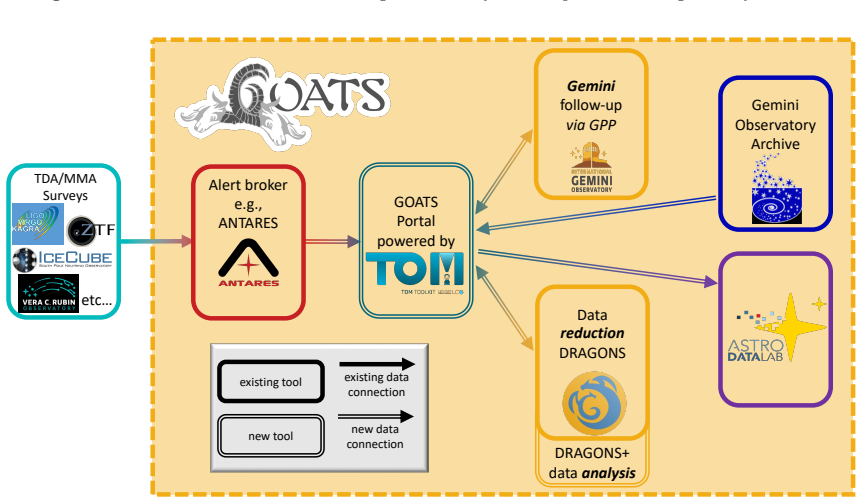
GOATS unifies the MMA/TDA follow-up workflow by integrating ANTARES alert broker, Gemini triggering, automated archive retrieval, DRAGONS reduction, and Astro Data Lab analysis into a single platform, demonstrated by real-time selection and classification of Rubin/LSST supernova alerts.
What carries the argument
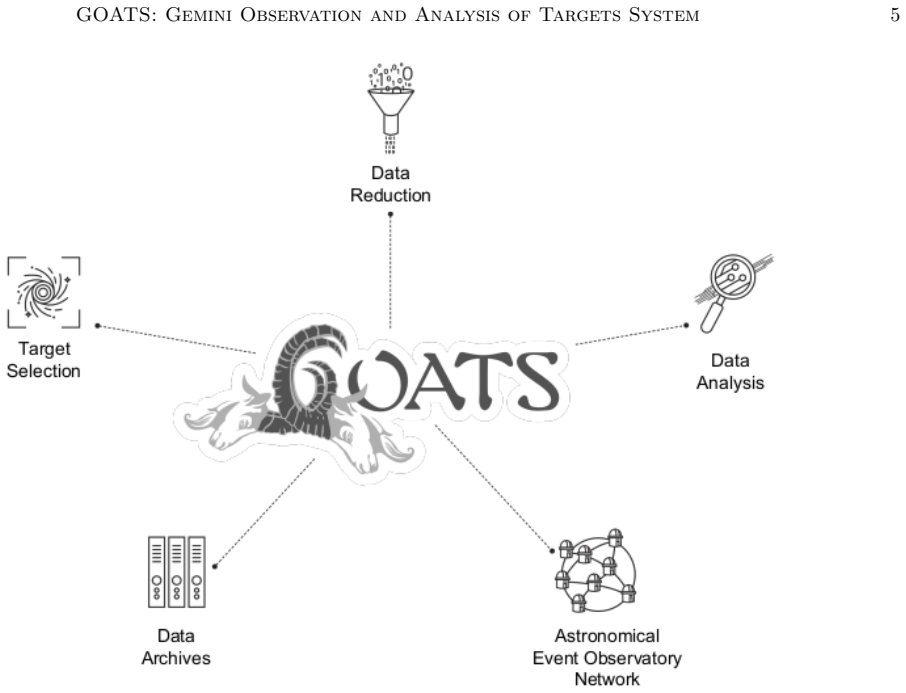
The GOATS platform, which serves as the single interface layer connecting alert streams, observatory triggering, archive access, data reduction, and science analysis services.
If this is right
- Observations can be triggered at Gemini within minutes of an LSST alert detection.
- Spectra of transients can be reduced and classified without switching between separate tools.
- Repetitive tasks are automated so effort shifts to scientific interpretation of results.
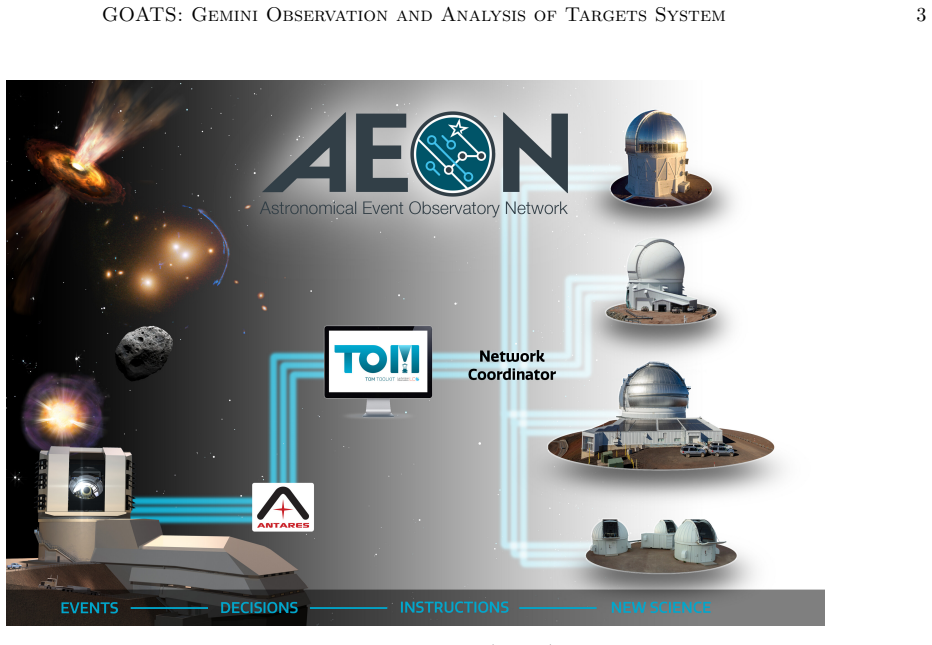
- The same interface supports triggering at other facilities in the Astronomical Event Observatory Network.
Where Pith is reading between the lines
- The same integration pattern could be replicated at additional observatories to widen access to rapid-response observations.
- Handling larger volumes of LSST alerts would test whether the real-time connections remain stable at scale.
- The platform may enable faster studies of short-lived events such as kilonovae by shortening the interval from detection to classification.
Load-bearing premise
The separate NOIRLab and Gemini services can be connected to run together reliably in real time without failures, data loss, or repeated manual intervention.
What would settle it
A live LSST alert that is selected in GOATS but produces a failed trigger, missing archive data, or broken reduction pipeline due to integration breakdown.
Figures
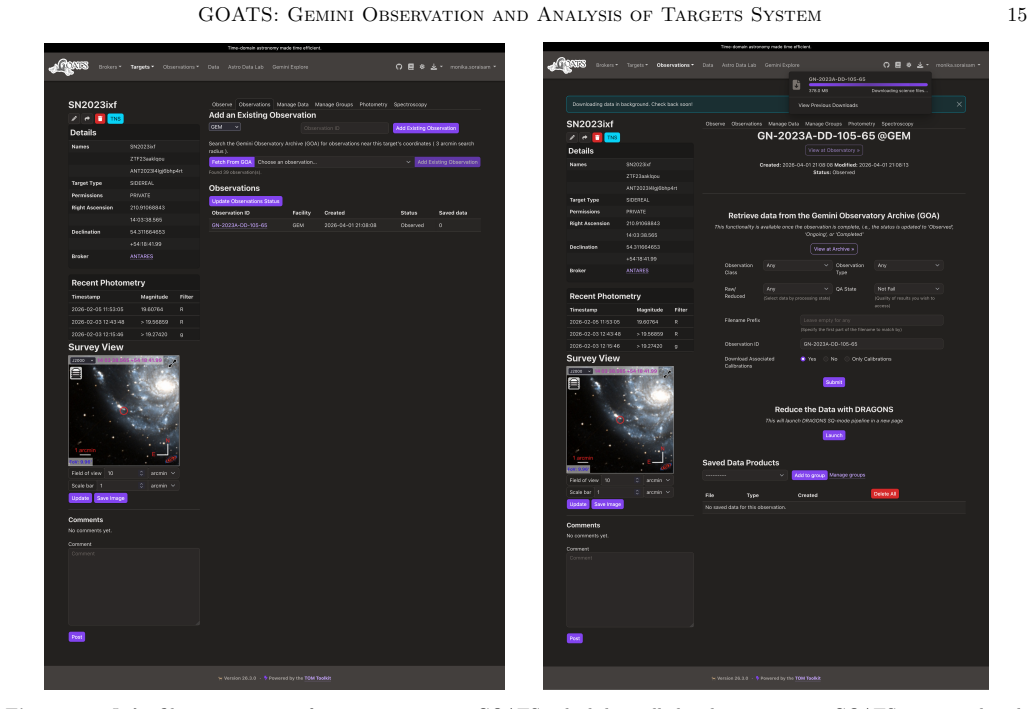
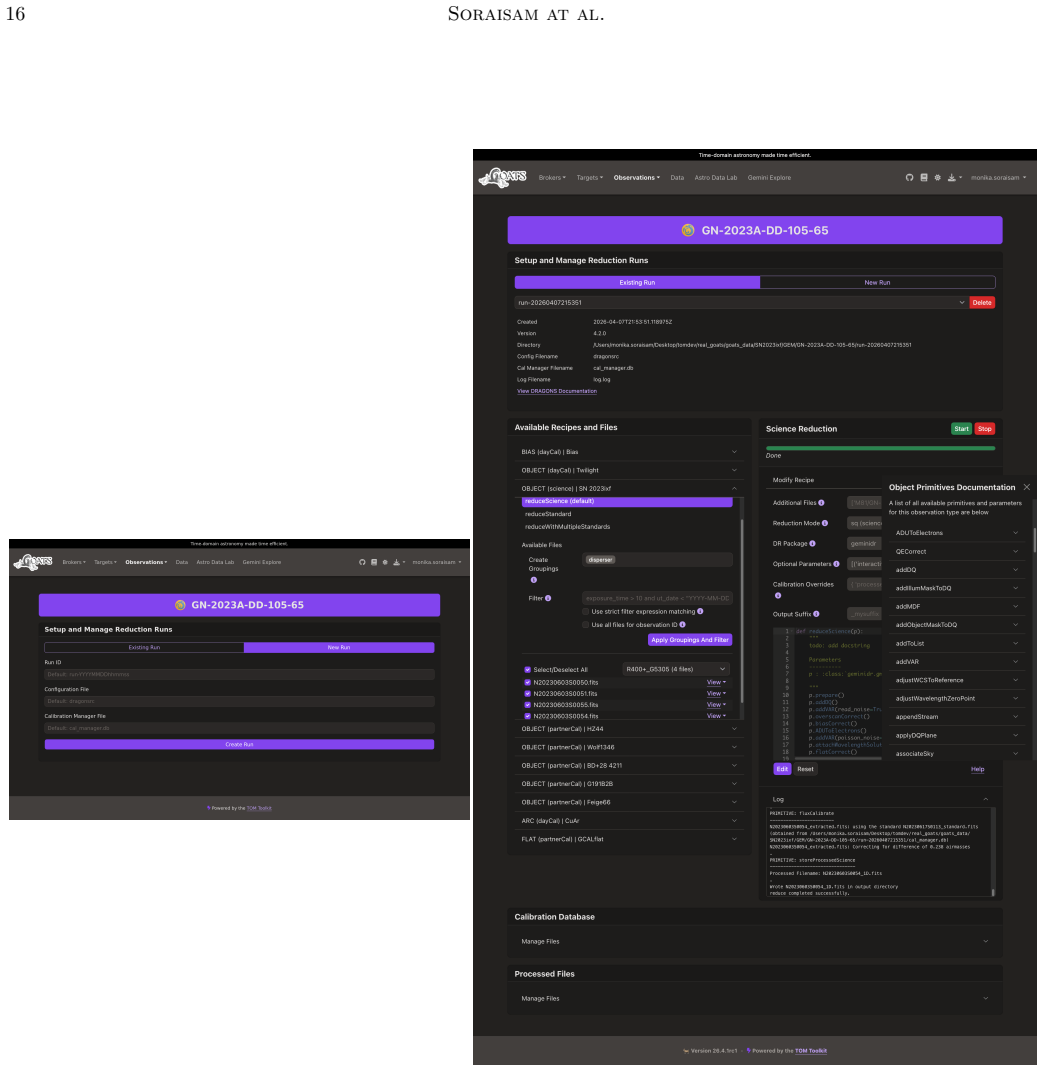
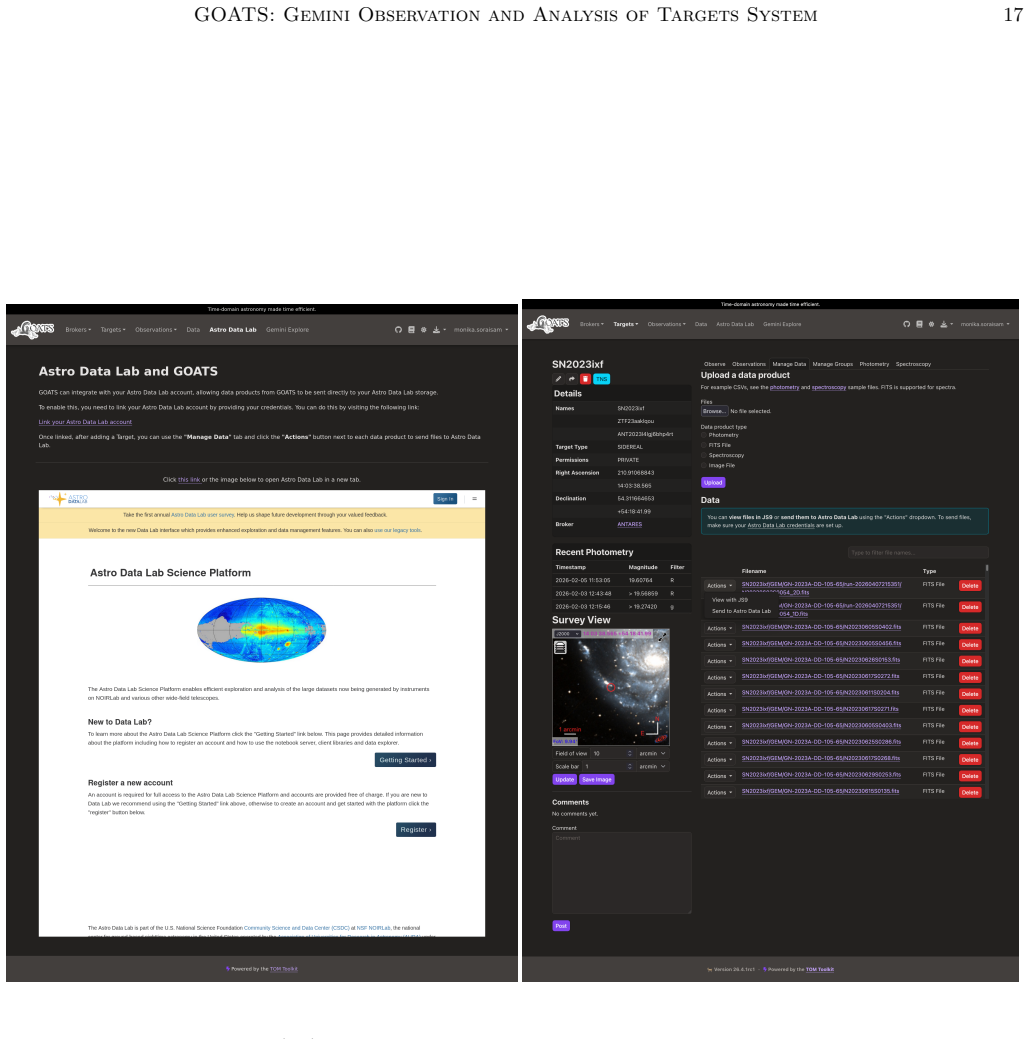
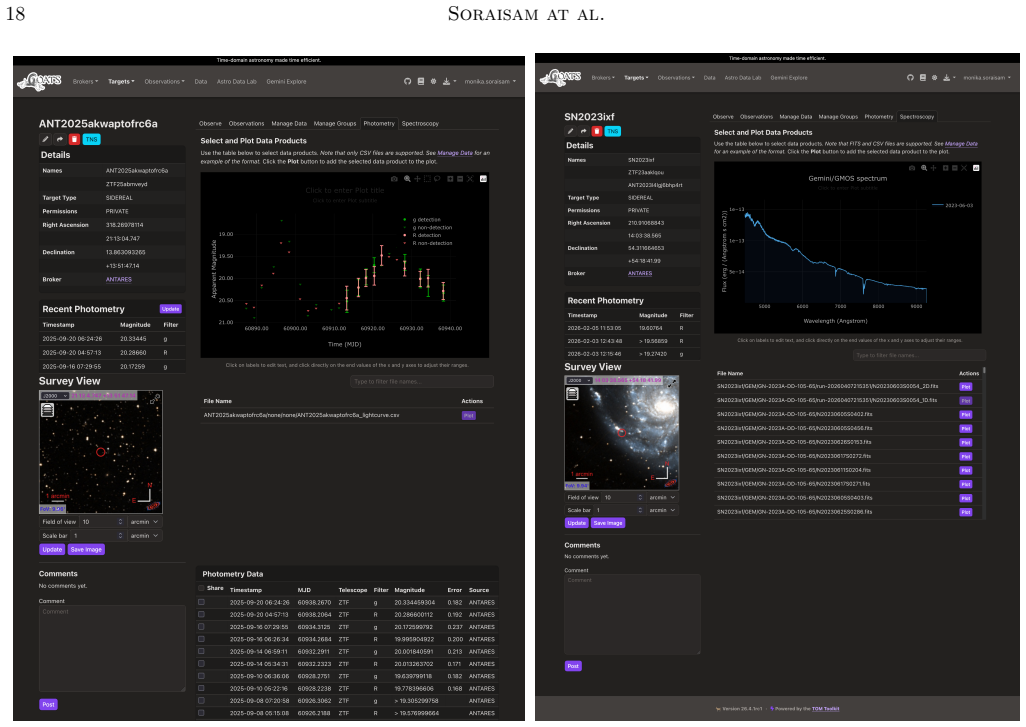
read the original abstract
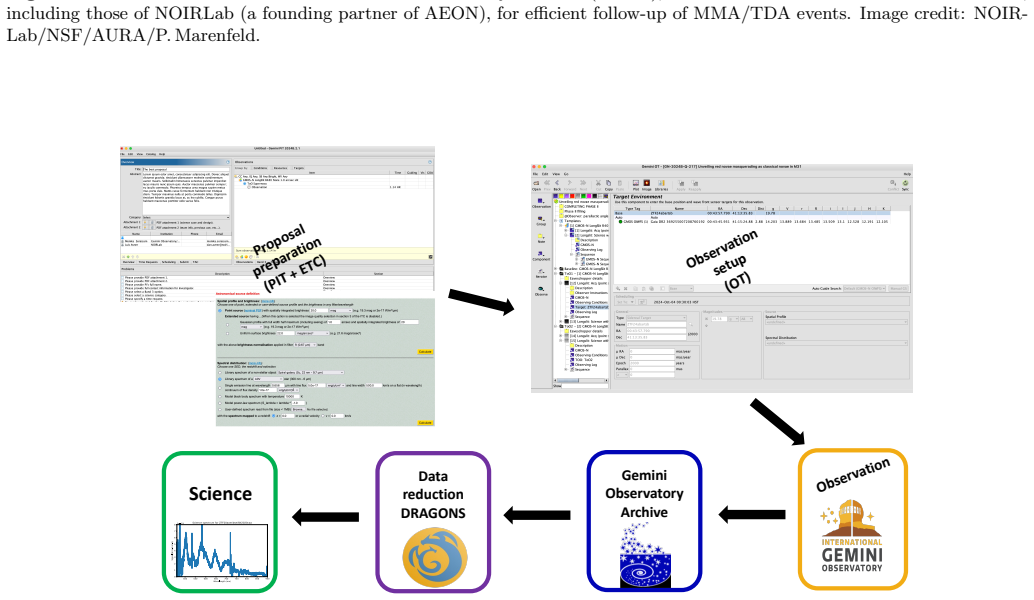
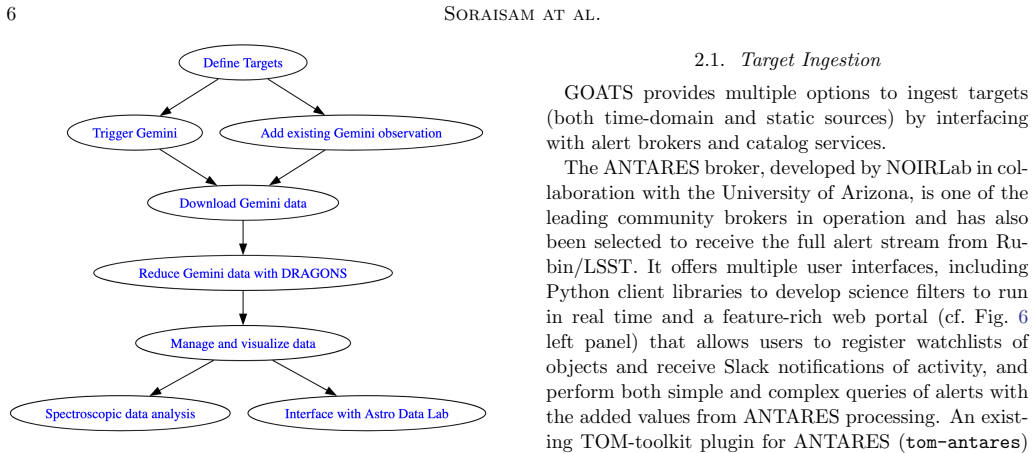
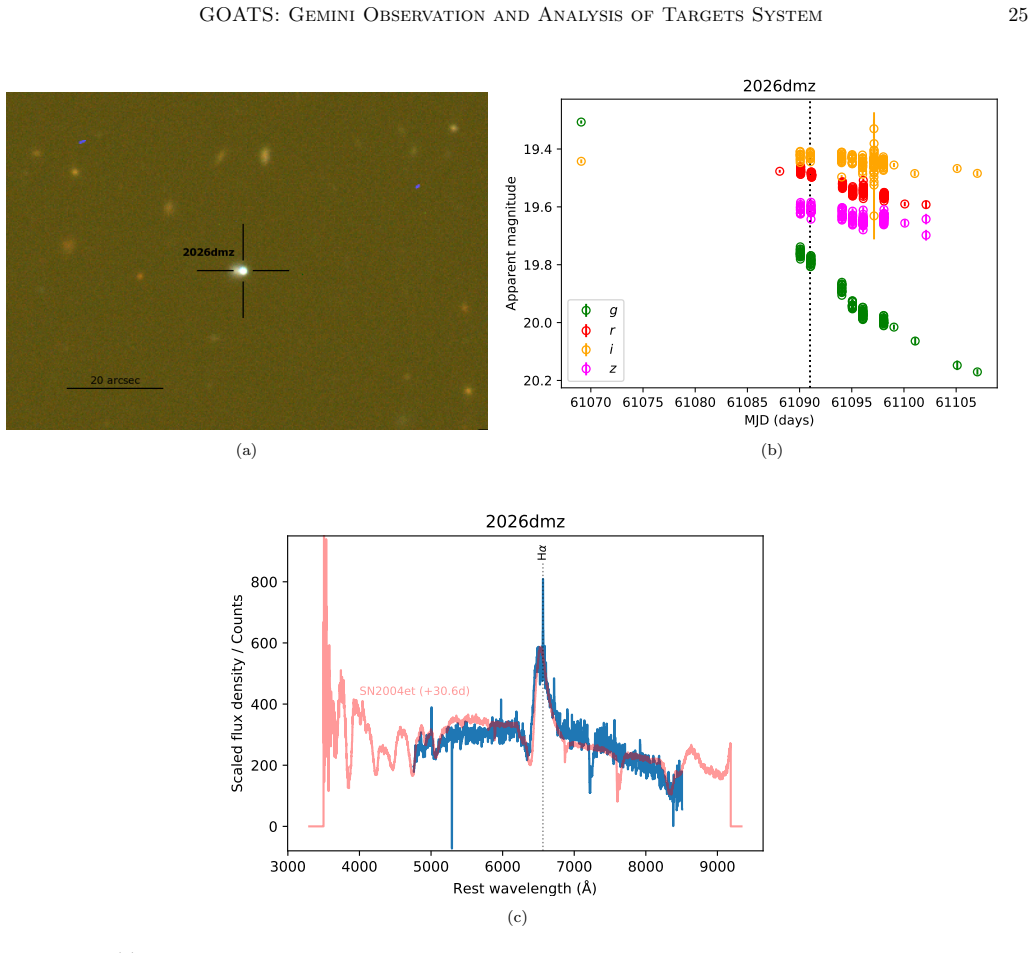
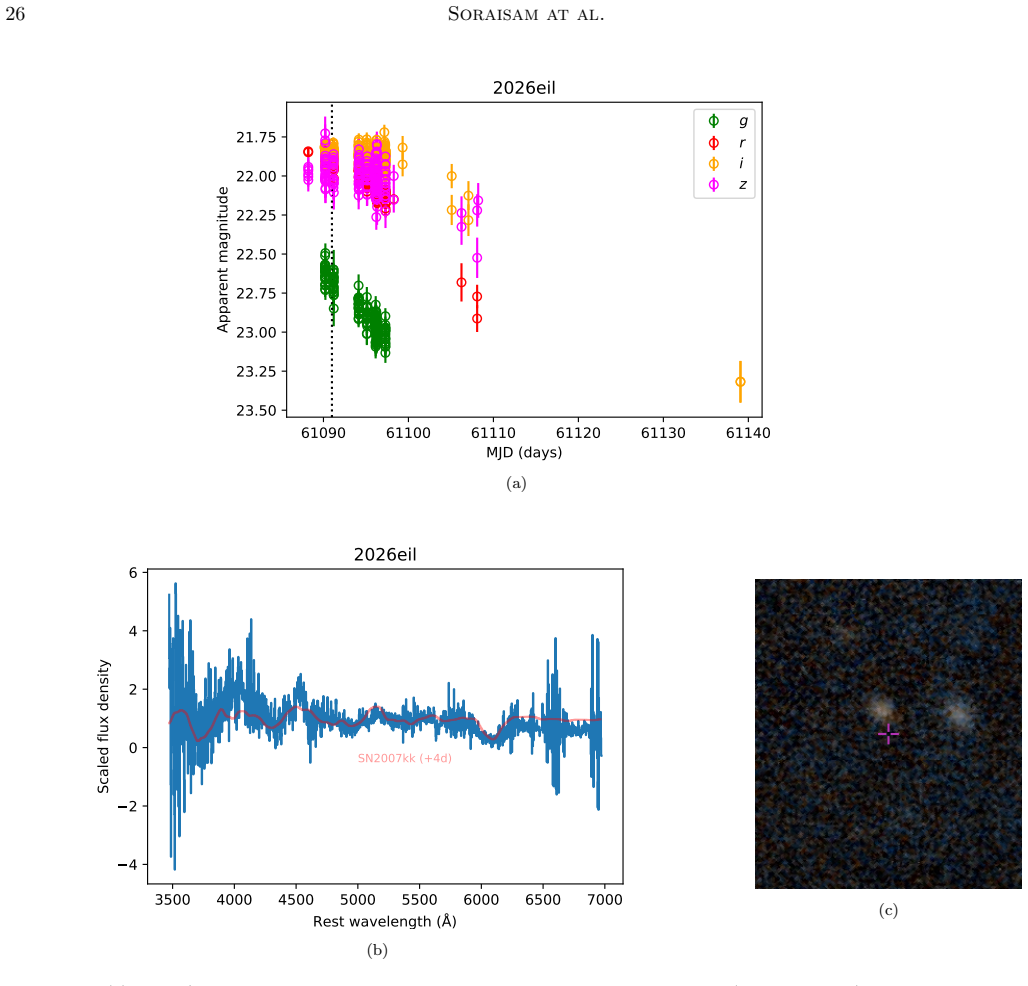
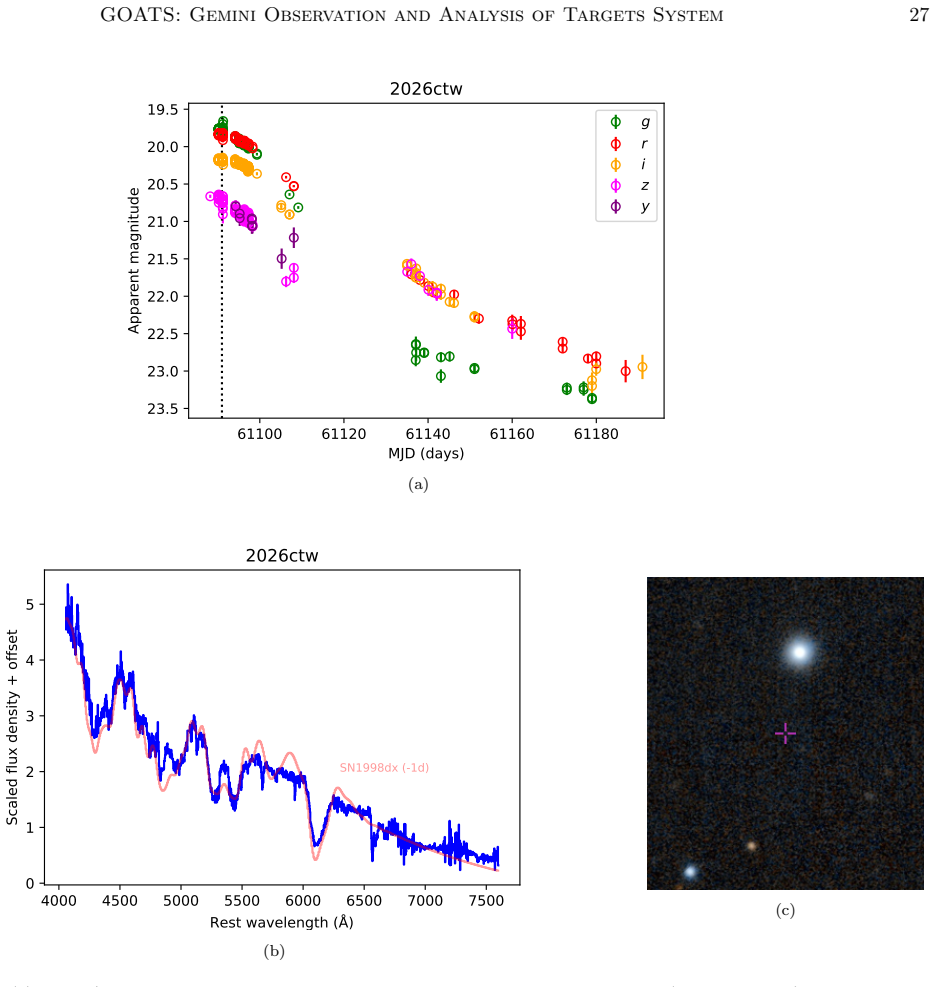
Time-domain and multimessenger astronomy (MMA/TDA) targets demand rapid-response follow-up observations. In many cases, it is the only way to make discoveries and advance our understanding of the astrophysical phenomena, for example, kilonovae accompanying gravitational waves from compact object mergers, shock breakout in supernovae, prompt emission from GRBs, etc. Presently the MMA/TDA follow-up workflow requires wrangling disparate software packages and user interfaces. We present an end-to-end software tool for the community, the Gemini Observation and Analysis of Targets System (GOATS), which unifies and simplifies the workflow, particularly for Gemini follow-up observations. GOATS achieves this by integrating services from Gemini Observatory and its parent organization, NSF NOIRLab. From a single platform, GOATS enables enhanced target selection via NOIRLab's ANTARES alert broker, triggering of Gemini (and other facilities within the Astronomical Event Observatory Network), automated data retrieval from the Gemini Observatory Archive, and interactive data reduction and analysis through Gemini's DRAGONS software and NOIRLab's Astro Data Lab science platform. GOATS was successfully deployed in an end-to-end demonstration of real-time follow-up of Rubin/LSST alerts with NOIRLab facilities. As part of this demonstration, we selected targets from the Rubin alert stream and triggered follow-up observations within minutes of the Rubin detections. We obtained spectra for several targets and classified them as supernova of various types (Ia, IIP, Ib/c) with redshifts ranging from 0.05 to 0.35. By eliminating the need to manually connect tools and automating repetitive tasks, GOATS lowers the entry barrier and allows users to focus on the scientific interpretation of the observation results.
Editorial analysis
A structured set of objections, weighed in public.
Referee Report
Summary. The manuscript presents the Gemini Observation and Analysis of Targets System (GOATS) as an integrated software platform that unifies ANTARES alert selection, Gemini (and AEN) triggering, automated archive retrieval, DRAGONS reduction, and Astro Data Lab analysis for rapid MMA/TDA follow-up. It claims a successful real-time end-to-end demonstration on Rubin/LSST alerts, with targets selected and observed within minutes, yielding spectra classified as supernovae (Ia, IIP, Ib/c) at redshifts 0.05–0.35.
Significance. If the claimed integration functions reliably and reproducibly, GOATS would meaningfully reduce the manual overhead of coordinating multiple NOIRLab/Gemini services, lowering the barrier for community follow-up of transients. The described demonstration outcomes indicate potential operational value for LSST-era response. However, the complete absence of any technical description or metrics in the manuscript prevents assessment of whether these benefits are realized.
major comments (3)
- [Abstract] Abstract: The manuscript asserts that GOATS 'was successfully deployed in an end-to-end demonstration of real-time follow-up' with specific outcomes (targets selected, observations triggered within minutes, spectra obtained and classified). No architecture, data-flow description, API connections, error-handling strategy, or validation steps are provided, making it impossible to evaluate the central claim that disparate services operated reliably without significant failures or manual intervention.
- [Abstract] Abstract: No quantitative metrics are reported for the demonstration, such as end-to-end latency distributions, fraction of steps completed automatically, failure rates, or instances requiring human intervention. This absence directly undermines assessment of the weakest assumption that the integrated services function reliably in real time.
- [Abstract] Abstract: The claim that GOATS 'eliminates the need to manually connect tools and automates repetitive tasks' is presented without any workflow examples, user-interface description, or evidence that the automation was tested end-to-end on the cited Rubin alerts.
Simulated Author's Rebuttal
We thank the referee for their review. We agree that the abstract is high-level and lacks sufficient technical detail and metrics to fully support its claims. We will revise the abstract to address these points while preserving its brevity; the full manuscript expands on the system in later sections.
read point-by-point responses
-
Referee: [Abstract] Abstract: The manuscript asserts that GOATS 'was successfully deployed in an end-to-end demonstration of real-time follow-up' with specific outcomes (targets selected, observations triggered within minutes, spectra obtained and classified). No architecture, data-flow description, API connections, error-handling strategy, or validation steps are provided, making it impossible to evaluate the central claim that disparate services operated reliably without significant failures or manual intervention.
Authors: We agree the abstract provides no such technical description. We will revise the abstract to include a concise statement on the integrated components (ANTARES, triggering, archive access, DRAGONS, Astro Data Lab) and note that end-to-end validation occurred via the reported Rubin alert demonstration. revision: yes
-
Referee: [Abstract] Abstract: No quantitative metrics are reported for the demonstration, such as end-to-end latency distributions, fraction of steps completed automatically, failure rates, or instances requiring human intervention. This absence directly undermines assessment of the weakest assumption that the integrated services function reliably in real time.
Authors: We agree that quantitative metrics are absent from the abstract. We will revise the abstract to report available demonstration metrics (e.g., triggering within minutes of detection, spectra obtained and classified for multiple targets at z=0.05–0.35) and indicate the level of automation achieved. revision: yes
-
Referee: [Abstract] Abstract: The claim that GOATS 'eliminates the need to manually connect tools and automates repetitive tasks' is presented without any workflow examples, user-interface description, or evidence that the automation was tested end-to-end on the cited Rubin alerts.
Authors: We agree the abstract offers no workflow examples or UI details to support the automation claim. We will revise the abstract to briefly reference the unified platform and cite the successful real-time Rubin alert follow-up as the end-to-end test evidence. revision: yes
Circularity Check
No circularity: descriptive software demonstration with no derivations or fitted quantities
full rationale
The paper presents a descriptive account of the GOATS software platform and its deployment in a real-time demonstration of Rubin/LSST alert follow-up. The abstract and available text contain no equations, predictions, fitted parameters, uniqueness theorems, or derivation chains of any kind. The central claim is an assertion of successful integration and automation, supported only by high-level outcomes (targets selected, observations triggered, spectra classified). No load-bearing step reduces to its own inputs by construction, self-citation, or renaming; the enumerated circularity patterns do not apply. This is a normal non-finding for a software/infrastructure paper.
Axiom & Free-Parameter Ledger
Reference graph
Works this paper leans on
-
[1]
G., Abbasi, R., Ackermann, M., et al
Aartsen, M. G., Abbasi, R., Ackermann, M., et al. 2021, Journal of Physics G Nuclear Physics, 48, 060501, doi: 10.1088/1361-6471/abbd48
-
[2]
, archivePrefix = "arXiv", eprint =
Abbott, B. P., Abbott, R., Abbott, T. D., et al. 2017, ApJL, 848, L12, doi: 10.3847/2041-8213/aa91c9
-
[3]
2023, Living Reviews in Relativity, 26, 2, doi: 10.1007/s41114-022-00041-y
Amaro-Seoane, P., Andrews, J., Arca Sedda, M., et al. 2023, Living Reviews in Relativity, 26, 2, doi: 10.1007/s41114-022-00041-y
-
[4]
Characterizing the V-band light-curves of hydrogen-rich type II supernovae
Anderson, J. P., Gonz´ alez-Gait´ an, S., Hamuy, M., et al. 2014, ApJ, 786, 67, doi: 10.1088/0004-637X/786/1/67 Astropy Collaboration, Robitaille, T. P., Tollerud, E. J., et al. 2013, A&A, 558, A33, doi: 10.1051/0004-6361/201322068 Astropy Collaboration, Price-Whelan, A. M., Sip˝ ocz, B. M., et al. 2018, AJ, 156, 123, doi: 10.3847/1538-3881/aabc4f Astropy...
-
[5]
Bellm, E. C., Kulkarni, S. R., Graham, M. J., et al. 2019, PASP, 131, 018002, doi: 10.1088/1538-3873/aaecbe
-
[6]
K., Berger, E., Fong, W., et al
Blanchard, P. K., Berger, E., Fong, W., et al. 2017, ApJL, 848, L22, doi: 10.3847/2041-8213/aa9055 28 https://lco.global/tomtoolkit/tom-team/
-
[7]
Blondin, S., & Tonry, J. L. 2007, ApJ, 666, 1024, doi: 10.1086/520494
-
[8]
CHIME/FRB Collaboration et al.ApJS, 257(2):59, December
Brazier, A. 2021, in American Astronomical Society Meeting Abstracts, Vol. 53, American Astronomical Society Meeting Abstracts, 146.03 CHIME Collaboration, Amiri, M., Bandura, K., et al. 2022, ApJS, 261, 29, doi: 10.3847/1538-4365/ac6fd9
-
[9]
2017, ApJL, 848, L19, doi: 10.3847/2041-8213/aa905c
Chornock, R., Berger, E., Kasen, D., et al. 2017, ApJL, 848, L19, doi: 10.3847/2041-8213/aa905c
-
[10]
2024, Frontiers in Astronomy and Space Sciences, 11, 1386748, doi: 10.3389/fspas.2024.1386748
Corsi, A., Barsotti, L., Berti, E., et al. 2024, Frontiers in Astronomy and Space Sciences, 11, 1386748, doi: 10.3389/fspas.2024.1386748
-
[11]
Coughlin, M. W., Bloom, J. S., Nir, G., et al. 2023, ApJS, 267, 31, doi: 10.3847/1538-4365/acdee1
-
[12]
2026, Jdaviz, v5.0.0 Zenodo, doi: 10.5281/zenodo.19599318
Developers, J., Averbukh, J., Bradley, L., et al. 2026, Jdaviz, v5.0.0 Zenodo, doi: 10.5281/zenodo.19599318
-
[13]
Science , archivePrefix = "arXiv", eprint =
Dilday, B., Howell, D. A., Cenko, S. B., et al. 2012, Science, 337, 942, doi: 10.1126/science.1219164
-
[14]
J., Olsen, K., Economou, F., et al
Fitzpatrick, M. J., Olsen, K., Economou, F., et al. 2014, in Society of Photo-Optical Instrumentation Engineers (SPIE) Conference Series, Vol. 9149, Observatory Operations: Strategies, Processes, and Systems V, ed. A. B. Peck, C. R. Benn, & R. L. Seaman, 91491T, doi: 10.1117/12.2057445
-
[15]
Fu, S., Matheson, T., Meisner, A., et al. 2024, AJ, 168, 186, doi: 10.3847/1538-3881/ad70b1 GOATS: Gemini Observation and Analysis of Targets System33
-
[16]
J., Bloemen, S., Vreeswijk, P., et al
Groot, P. J., Bloemen, S., Vreeswijk, P., et al. 2024, arXiv e-prints, arXiv:2405.18923, doi: 10.48550/arXiv.2405.18923
-
[17]
J., Hu, L., Palmese, A., et al
Hall, X. J., Hu, L., Palmese, A., et al. 2026, Transient Name Server Discovery Report, 2026-571, 1
2026
-
[18]
H., Pfahler, P., Pastorello, A., et al
Harutyunyan, A. H., Pfahler, P., Pastorello, A., et al. 2008, A&A, 488, 383, doi: 10.1051/0004-6361:20078859
-
[19]
2016, in Society of Photo-Optical Instrumentation Engineers (SPIE) Conference Series, Vol
Hirst, P., & Cardenes, R. 2016, in Society of Photo-Optical Instrumentation Engineers (SPIE) Conference Series, Vol. 9913, Software and Cyberinfrastructure for Astronomy IV, ed. G. Chiozzi & J. C. Guzman, 99131E, doi: 10.1117/12.2231833
-
[20]
Hosseinzadeh, G., Paterson, K., Rastinejad, J. C., et al. 2024, ApJ, 964, 35, doi: 10.3847/1538-4357/ad2170
-
[21]
Hunter, J. D. 2007, Computing in Science & Engineering, 9, 90, doi: 10.1109/MCSE.2007.55 Ivezi´ c,ˇZ., Kahn, S. M., Tyson, J. A., et al. 2019, ApJ, 873, 111, doi: 10.3847/1538-4357/ab042c
-
[22]
Jones, D. O., Foley, R. J., Narayan, G., et al. 2021, ApJ, 908, 143, doi: 10.3847/1538-4357/abd7f5
-
[23]
2023, Research Notes of the American Astronomical Society, 7, 214, doi: 10.3847/2515-5172/ad0044
Labrie, K., Simpson, C., Cardenes, R., et al. 2023, Research Notes of the American Astronomical Society, 7, 214, doi: 10.3847/2515-5172/ad0044
-
[24]
Law, C. J., Sharma, K., Ravi, V., et al. 2024, ApJ, 967, 29, doi: 10.3847/1538-4357/ad3736
-
[25]
Law, N. M., Corbett, H., Galliher, N. W., et al. 2022, PASP, 134, 035003, doi: 10.1088/1538-3873/ac4811
-
[26]
Matheson, T., Stubens, C., Wolf, N., et al. 2021, AJ, 161, 107, doi: 10.3847/1538-3881/abd703
-
[27]
McCully, C., Daily, M., Brandt, G. M., et al. 2022, in Society of Photo-Optical Instrumentation Engineers (SPIE) Conference Series, Vol. 12189, Software and Cyberinfrastructure for Astronomy VII, 1218914, doi: 10.1117/12.2630667
-
[28]
2021, The NOIRLab Mirror, 2, 33
McManus, S., & Olsen, K. 2021, The NOIRLab Mirror, 2, 33
2021
-
[29]
Modjaz, M., Blondin, S., Kirshner, R. P., et al. 2014, AJ, 147, 99, doi: 10.1088/0004-6256/147/5/99
-
[30]
Murphey, C. T., Arunachalam, A., Nair, G., et al. 2026, Transient Name Server Discovery Report, 2026-783, 1 National Academies of Sciences, E., & Medicine. 2023, Pathways to Discovery in Astronomy and Astrophysics for the 2020s (Washington, DC: The National Academies Press), doi: 10.17226/26141
-
[31]
Nikutta, R., Fitzpatrick, M., Scott, A., & Weaver, B. A. 2020, Astronomy and Computing, 33, 100411, doi: 10.1016/j.ascom.2020.100411
-
[32]
O., Ben-Ami, S., Polishook, D., et al
Ofek, E. O., Ben-Ami, S., Polishook, D., et al. 2023, PASP, 135, 065001, doi: 10.1088/1538-3873/acd8f0 O’Mullane, W., Economou, F., Huang, F., et al. 2024, in Astronomical Society of the Pacific Conference Series, Vol. 535, Astronomical Data Analysis Software and Systems XXXI, ed. B. V. Hugo, R. Van Rooyen, & O. M. Smirnov, 227, doi: 10.48550/arXiv.2111.15030
-
[33]
2024, in American Astronomical Society Meeting Abstracts, Vol
Pellegrino, C. 2024, in American Astronomical Society Meeting Abstracts, Vol. 243, American Astronomical Society Meeting Abstracts, 211.06
2024
-
[34]
M., Arag´ on-Salamanca, A., Zaritsky, D., et al
Poggianti, B. M., Arag´ on-Salamanca, A., Zaritsky, D., et al. 2009, ApJ, 693, 112, doi: 10.1088/0004-637X/693/1/112
-
[35]
2026, Transient Name Server Classification Report, 2026-772, 1
Rose, S., Hinds, K., Fremling, C., et al. 2026, Transient Name Server Classification Report, 2026-772, 1
2026
-
[36]
Sahu, D. K., Anupama, G. C., Srividya, S., & Muneer, S. 2006, MNRAS, 372, 1315, doi: 10.1111/j.1365-2966.2006.10937.x
-
[37]
Shvartzvald, Y., Waxman, E., Gal-Yam, A., et al. 2024, ApJ, 964, 74, doi: 10.3847/1538-4357/ad2704
-
[38]
2026b, Transient Name Server Discovery Report, 2026-1328, 1
Soraisam, M., Miller, B., Adamson, A., et al. 2026b, Transient Name Server Discovery Report, 2026-1328, 1
2026
-
[39]
Wide-Field InfrarRed Survey Telescope-Astrophysics Focused Telescope Assets WFIRST-AFTA 2015 Report
Spergel, D., Gehrels, N., Baltay, C., et al. 2015, arXiv e-prints, arXiv:1503.03757, doi: 10.48550/arXiv.1503.03757
work page internal anchor Pith review Pith/arXiv arXiv doi:10.48550/arxiv.1503.03757 2015
-
[40]
Street, R. A., Bowman, M., Saunders, E. S., & Boroson, T. 2018, in Society of Photo-Optical Instrumentation Engineers (SPIE) Conference Series, Vol. 10707, Software and Cyberinfrastructure for Astronomy V, ed. J. C. Guzman & J. Ibsen, 1070711, doi: 10.1117/12.2312293
-
[41]
Taddia, F., Stritzinger, M. D., Bersten, M., et al. 2018, A&A, 609, A136, doi: 10.1051/0004-6361/201730844 The 2023 Windows on the Universe Workshop White Paper Working Group, Ahumada, T., Andrews, J. E., et al. 2024, arXiv e-prints, arXiv:2401.02063, doi: 10.48550/arXiv.2401.02063
-
[42]
2026, Transient Name Server Discovery Report, 2026-693, 1
Tonry, J., Denneau, L., Weiland, H., et al. 2026, Transient Name Server Discovery Report, 2026-693, 1
2026
-
[43]
ATLAS: A High-Cadence All-Sky Survey System
Tonry, J. L., Denneau, L., Heinze, A. N., et al. 2018, PASP, 130, 064505, doi: 10.1088/1538-3873/aabadf
work page internal anchor Pith review doi:10.1088/1538-3873/aabadf 2018
-
[44]
2020, in Astronomical Society of the Pacific Conference Series, Vol
Torres-Robledo, S., Brice˜ no, C., Quint, B., & Sanmartim, D. 2020, in Astronomical Society of the Pacific Conference Series, Vol. 522, Astronomical Data Analysis Software and Systems XXVII, ed. P. Ballester, J. Ibsen, M. Solar, & K. Shortridge, 533
2020
-
[45]
2014, in Astronomical Society of the Pacific Conference Series, Vol
Valdes, F., Gruendl, R., & DES Project. 2014, in Astronomical Society of the Pacific Conference Series, Vol. 485, Astronomical Data Analysis Software and Systems XXIII, ed. N. Manset & P. Forshay, 379
2014
-
[46]
Whitesides, L., Lunnan, R., Kasliwal, M. M., et al. 2017, ApJ, 851, 107, doi: 10.3847/1538-4357/aa99de 34Soraisam at al
-
[47]
D., Tohuvavohu, A., Arcavi, I., et al
Wyatt, S. D., Tohuvavohu, A., Arcavi, I., et al. 2020, ApJ, 894, 127, doi: 10.3847/1538-4357/ab855e
-
[48]
Wyrzykowski, L. 2024, in What Was That? - Planning ESO Follow up for Transients, Variables, and Solar System Objects in the Era of LSST, 4, doi: 10.5281/zenodo.10571539
discussion (0)
Sign in with ORCID, Apple, or X to comment. Anyone can read and Pith papers without signing in.