Self-force on a static scalar charge in traversable wormholes
Pith reviewed 2026-06-30 02:34 UTC · model grok-4.3
The pith
The self-force on a static scalar charge in traversable wormholes changes sign with distance from the throat and can have up to two zero crossings.
A machine-rendered reading of the paper's core claim, the machinery that carries it, and where it could break.
Core claim
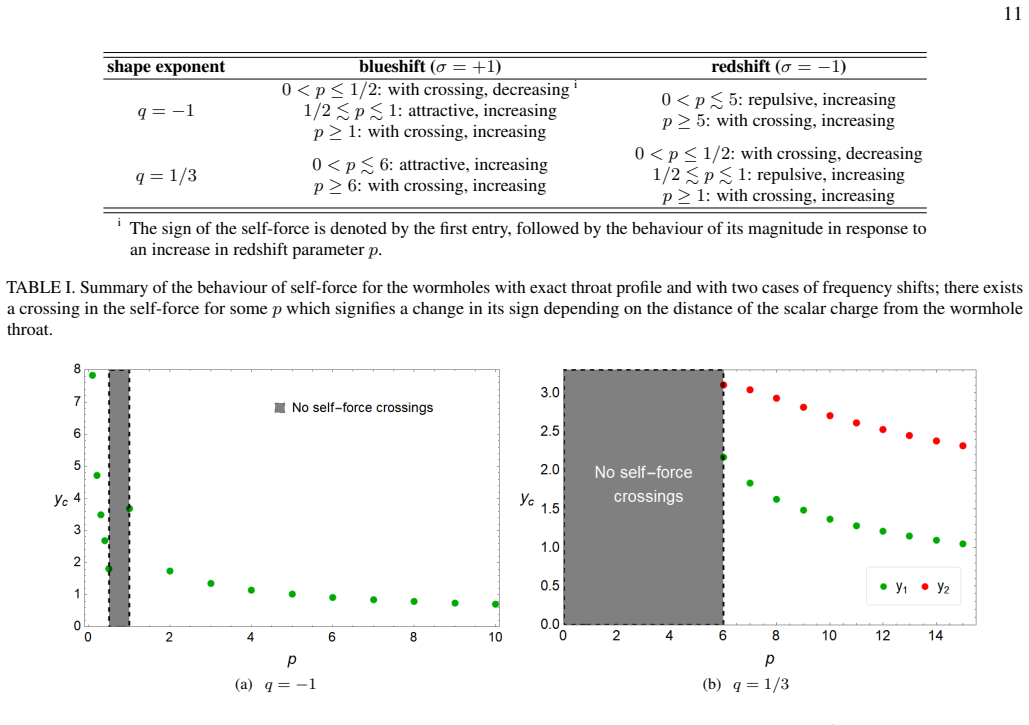
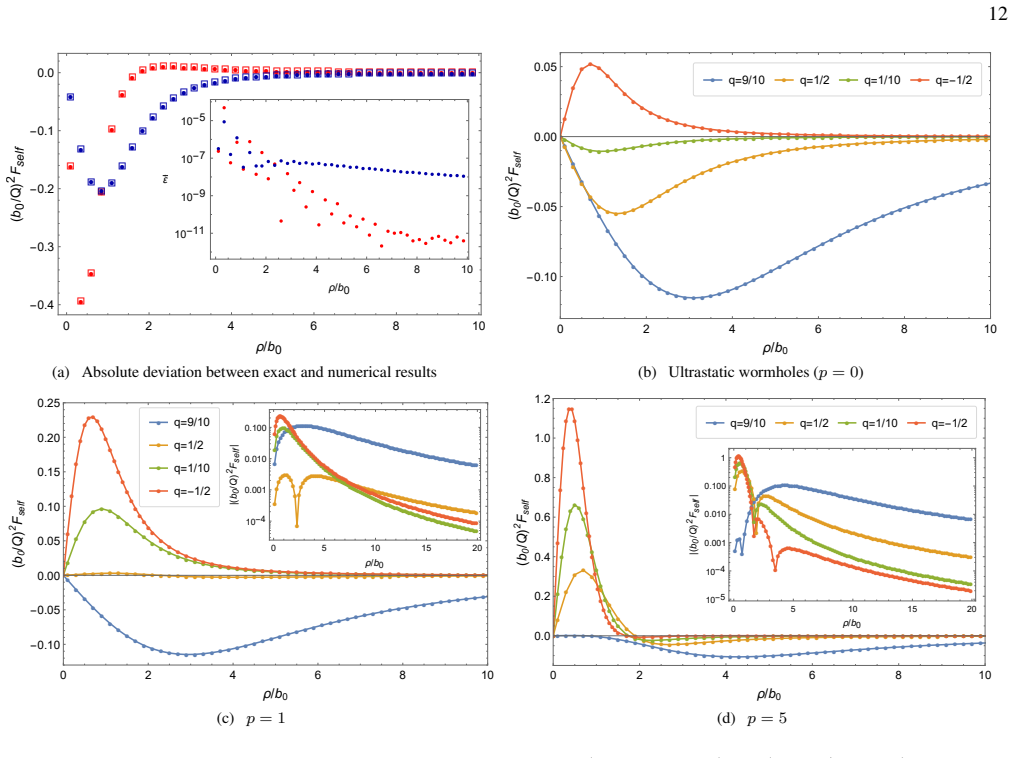
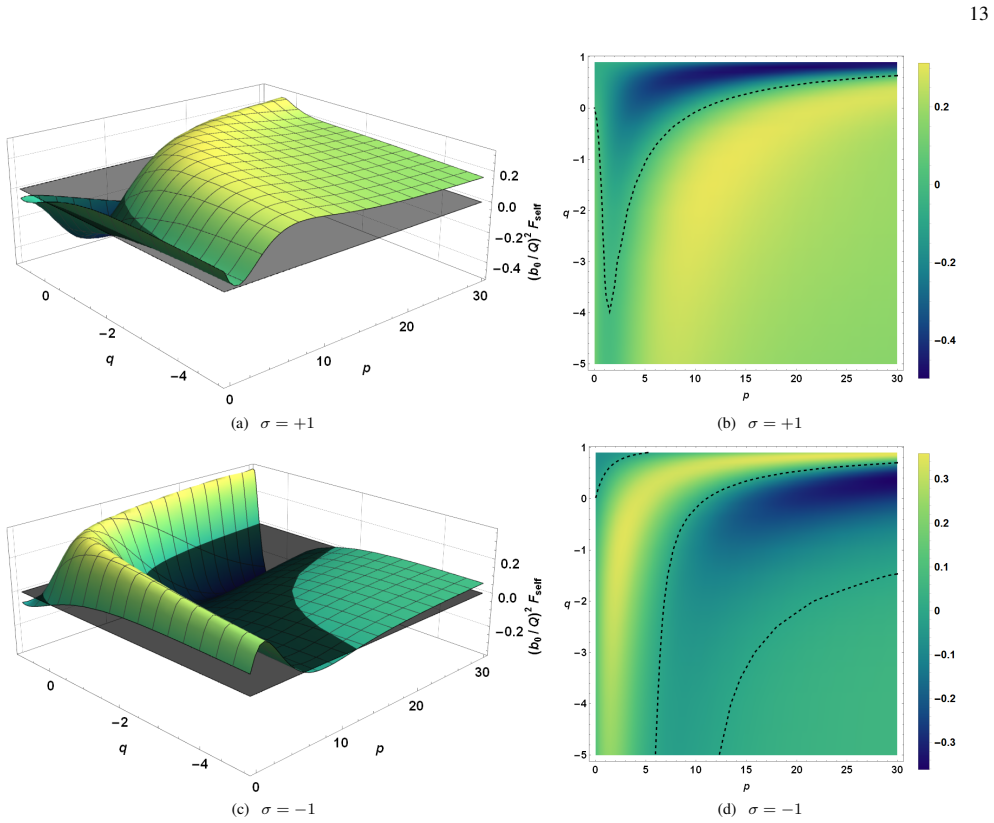
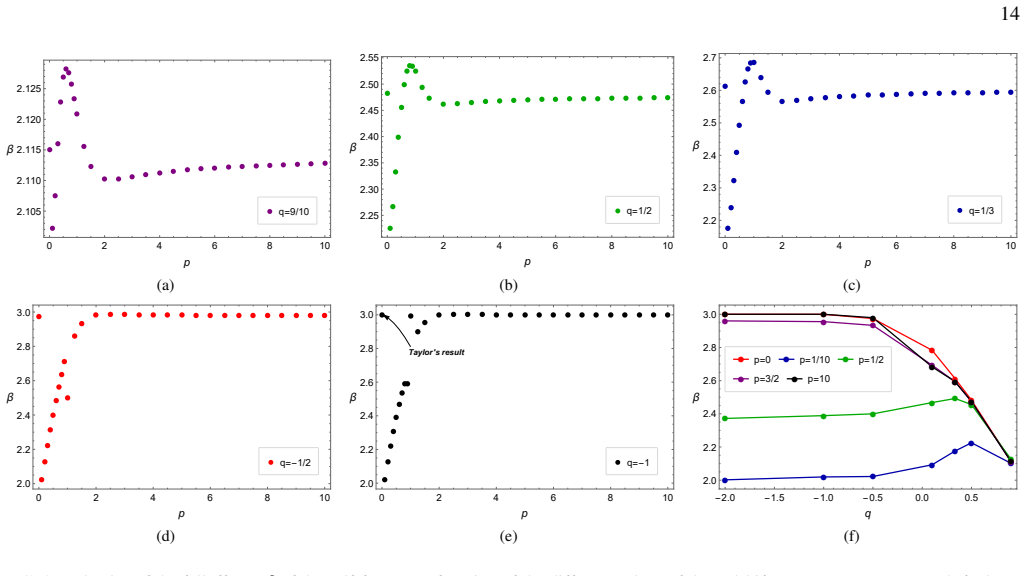
In these wormhole geometries the static scalar self-force is generally not unidirectional. It changes sign with radial distance from the throat, with up to two distinct zero crossings whose locations depend on the two metric parameters. Both the direction of the force and its asymptotic falloff rate are characterized as functions of those parameters, with slower-than-canonical decay when the redshift parameter is large and faster decay when the shape exponent is more negative. In the combined limit of infinite redshift parameter and shape exponent to negative infinity the falloff approaches the behavior found in a limiting case of the family.
What carries the argument
Mode-sum regularization applied to the scalar Green's function in the wormhole metric, which removes the divergent singular contribution to leave a finite self-force at each point.
If this is right
- The self-force direction at a given location depends on both radial position and the two metric parameters.
- For sufficiently large redshift parameter the force decays more slowly than the inverse-cube law typical of isolated systems.
- More negative values of the shape exponent produce faster large-distance decay.
- The number of zero crossings can be zero, one, or two according to the parameter pair.
Where Pith is reading between the lines
- The position-dependent sign changes imply that a charge placed near the throat could experience a net push or pull that differs from expectations in black-hole exteriors.
- Slower asymptotic decay for large redshift parameter means the wormhole structure continues to influence the force at greater distances than in standard spacetimes.
- Parameter-tuned reversals suggest that self-force measurements on test charges could in principle constrain the redshift and flaring properties of a wormhole.
Load-bearing premise
The mode-sum regularization procedure remains valid and yields a physically meaningful finite self-force throughout the exterior region of these wormhole spacetimes.
What would settle it
A direct numerical evaluation of the self-force at a radial coordinate where the calculation predicts a zero crossing, to check whether the force actually changes sign there.
Figures
read the original abstract
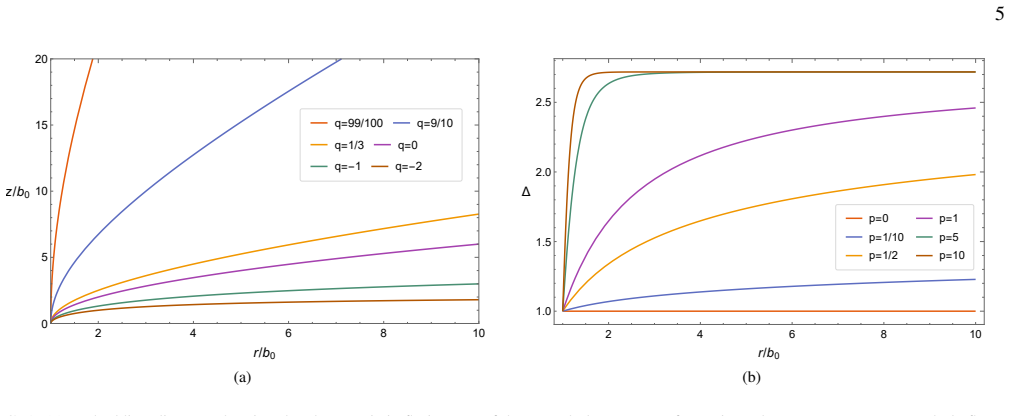
The self-force acting on a charged particle is sensitive to the global structure of curved spacetime and can serve as a probe of geometry beyond local curvature. We compute the static scalar self-force on a point charge in the two-parameter family of spherically symmetric wormholes introduced by Konoplya and Zhidenko, members of the broader Morris-Thorne class of traversable wormholes. Using mode-sum regularization, we analyze its dependence on the shape exponent $q$, which controls the throat geometry, and the redshift parameter $p$, which determines the redshift function and tidal strength. We find that the self-force is generally not unidirectional: it can change sign with radial distance from the throat, with up to two distinct zero crossings depending on $(p,q)$. We provide a systematic characterization of how both the direction and large-distance falloff depend on the wormhole parameters. For sufficiently large $p$, the force can decay at a slower rate than the canonical $\sim r^{-3}$ behavior typical of isolated-body spacetimes, with stronger flaring (more negative $q$) leading to more rapid decay. In the combined limit $p \to \infty$ and $q \to -\infty$, the asymptotic falloff approaches that of the static scalar self-force in the Ellis wormhole.
Editorial analysis
A structured set of objections, weighed in public.
Referee Report
Summary. The paper computes the static scalar self-force on a point charge in the two-parameter Konoplya-Zhidenko family of traversable wormholes using mode-sum regularization. It reports that the force is generally not unidirectional, exhibiting up to two zero crossings whose locations depend on the shape exponent q and redshift parameter p, and characterizes the direction and large-r falloff (which can be slower than r^{-3} for large p, or approach the Ellis-wormhole limit for p o∞ and q o- au).
Significance. If the regularization procedure is shown to be complete, the result would demonstrate that global topology can produce qualitatively new self-force phenomenology (sign changes and modified asymptotics) not present in isolated-body spacetimes, providing a concrete diagnostic for wormhole geometries.
major comments (2)
- [regularization procedure and numerical implementation] The central numerical claims rest on the mode-sum regularization yielding a finite, physically meaningful self-force throughout the exterior. The manuscript applies the standard procedure without explicit demonstration that the retarded Green's function contributions from paths crossing the throat are either absent or correctly incorporated; standard mode-sum derivations assume a single asymptotically flat exterior, and the two-sided Konoplya-Zhidenko metric requires verification that no additional transmission or image terms are needed (see the method description and the numerical results section).
- [numerical results] No error-bar estimates, convergence tests with respect to mode cutoff, or explicit checks that all divergent pieces are subtracted for every (p,q) pair are reported; such diagnostics are required to confirm that the reported sign changes and zero crossings are not artifacts of incomplete regularization.
minor comments (2)
- [abstract and §4] The abstract states the falloff can be slower than the canonical r^{-3}; the manuscript should clarify whether this refers to the leading 1/r^3 term or a slower power, and provide the explicit asymptotic expression.
- [introduction] Notation for the wormhole parameters p and q should be defined at first use with reference to the metric line element.
Simulated Author's Rebuttal
We thank the referee for their careful reading of the manuscript and for highlighting important points regarding the regularization procedure and numerical validation. We address each major comment below and will incorporate the suggested improvements in the revised version.
read point-by-point responses
-
Referee: [regularization procedure and numerical implementation] The central numerical claims rest on the mode-sum regularization yielding a finite, physically meaningful self-force throughout the exterior. The manuscript applies the standard procedure without explicit demonstration that the retarded Green's function contributions from paths crossing the throat are either absent or correctly incorporated; standard mode-sum derivations assume a single asymptotically flat exterior, and the two-sided Konoplya-Zhidenko metric requires verification that no additional transmission or image terms are needed (see the method description and the numerical results section).
Authors: We agree that an explicit verification is warranted given the two-sided nature of the geometry. In the revised manuscript we will expand the method section with a dedicated subsection demonstrating that the mode decomposition is performed over the full radial coordinate that spans both asymptotic regions. Because the metric is smooth and regular across the throat, the retarded Green's function is obtained by solving the wave equation globally with outgoing boundary conditions at both spatial infinities; no additional image or transmission terms arise beyond those already captured by the mode sum. We will include a short derivation confirming that the standard Detweiler-Whiting regularization coefficients remain valid in this setting and that throat-crossing contributions are automatically accounted for by the global solution. revision: yes
-
Referee: [numerical results] No error-bar estimates, convergence tests with respect to mode cutoff, or explicit checks that all divergent pieces are subtracted for every (p,q) pair are reported; such diagnostics are required to confirm that the reported sign changes and zero crossings are not artifacts of incomplete regularization.
Authors: We acknowledge that the current numerical results section lacks these diagnostics. In the revised manuscript we will add (i) error estimates derived from the tail of the mode sum, (ii) convergence plots versus mode cutoff for representative values of (p,q) including the cases exhibiting sign changes, and (iii) explicit verification that the regularization parameters A, B, and C have been correctly subtracted for every parameter pair shown. These additions will confirm that the reported zero crossings and modified asymptotic decay are robust against truncation and regularization artifacts. revision: yes
Circularity Check
No circularity: direct numerical evaluation on fixed background
full rationale
The paper computes the static scalar self-force via mode-sum regularization applied to the fixed Konoplya-Zhidenko wormhole metric. No parameters are fitted to the target self-force data, no self-referential definitions equate inputs to outputs, and no load-bearing steps reduce to self-citations or ansatze imported from the authors' prior work. The reported sign changes and falloff behaviors are direct outputs of the numerical procedure on the given spacetime, making the derivation self-contained against external benchmarks.
Axiom & Free-Parameter Ledger
axioms (1)
- domain assumption Mode-sum regularization subtracts all divergent contributions leaving a finite, physically meaningful self-force on the static charge.
Reference graph
Works this paper leans on
-
[1]
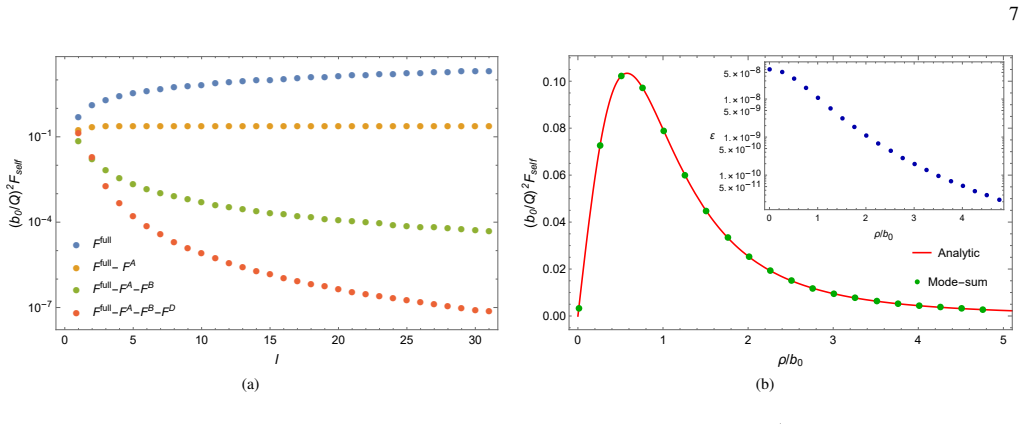
× 10-8 ρ/b0 ε 0 1 2 3 4 5 0.00 0.02 0.04 0.06 0.08 0.10 ρ/b0 (b0/Q)2Fself (b) FIG. 2. (a) Falloff behavior of the l-mode components of the self-force on the scalar charge located at ρ/b0 = 1 along with results of the subtraction of A, B and D regularization parameters; (b) comparison of the self-force obtained using Taylor’s exact expression, and by the m...
-
[2]
The self-force on a static scalar charge Q has an exact form that was obtained by Taylor [40]
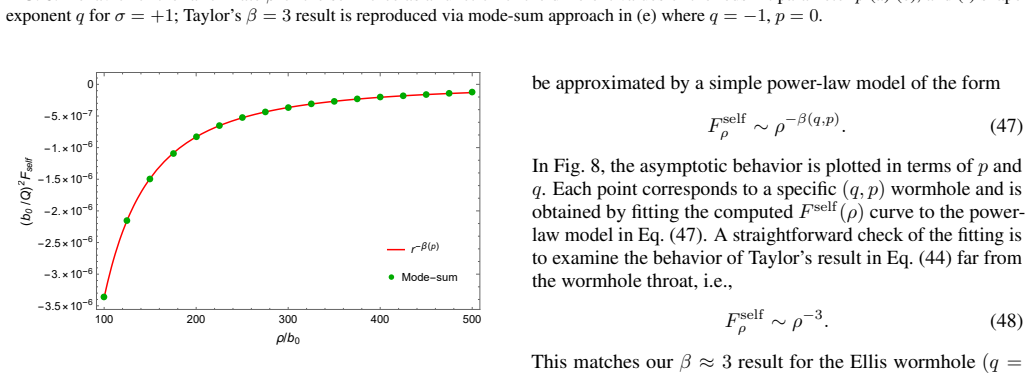
Ellis wormhole(p= 0, q=−1) The ultrastatic wormhole (Φ = 0) belonging to this class is the well-known Ellis wormhole. The self-force on a static scalar charge Q has an exact form that was obtained by Taylor [40]. For the case of a minimum coupling, the self-force is given by F Ellis ρ = Q2b0 ρ π(ρ 2 +b 2 0)2 = Q2 πb2 0 y (1 +y 2)2 ,(44) hence f(y;p= 0, q=...
-
[3]
damped oscillation
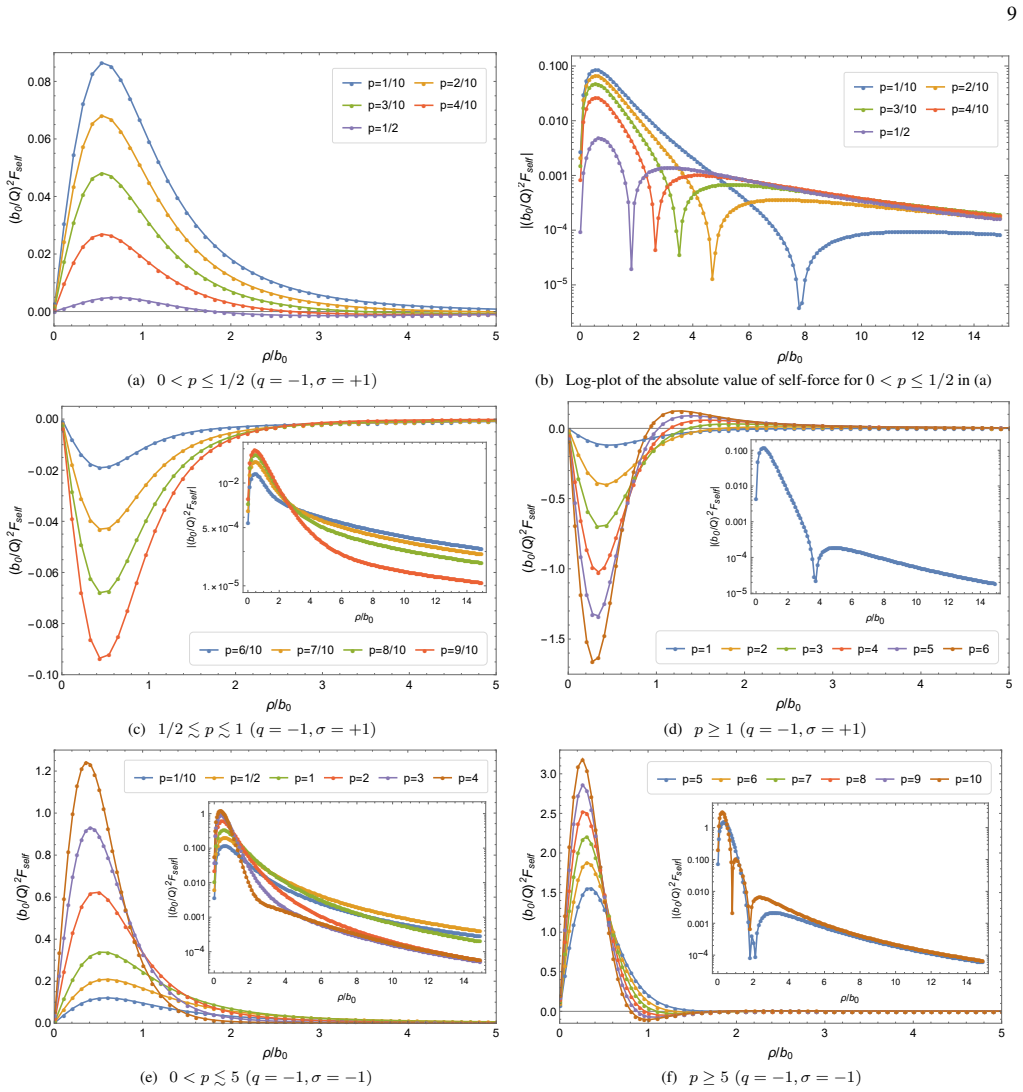
× 10-4 10-2 ρ/b0 |(b0 /Q)2 Fself | 0 1 2 3 4 5 -0.10 -0.08 -0.06 -0.04 -0.02 0.00 ρ/b0 (b0/Q)2Fself (c)1/2≲p≲1 (q=−1, σ= +1) ...
-
[4]
Given this, we speculate that no ultrastatic wormhole produces a self-force profile with crossings
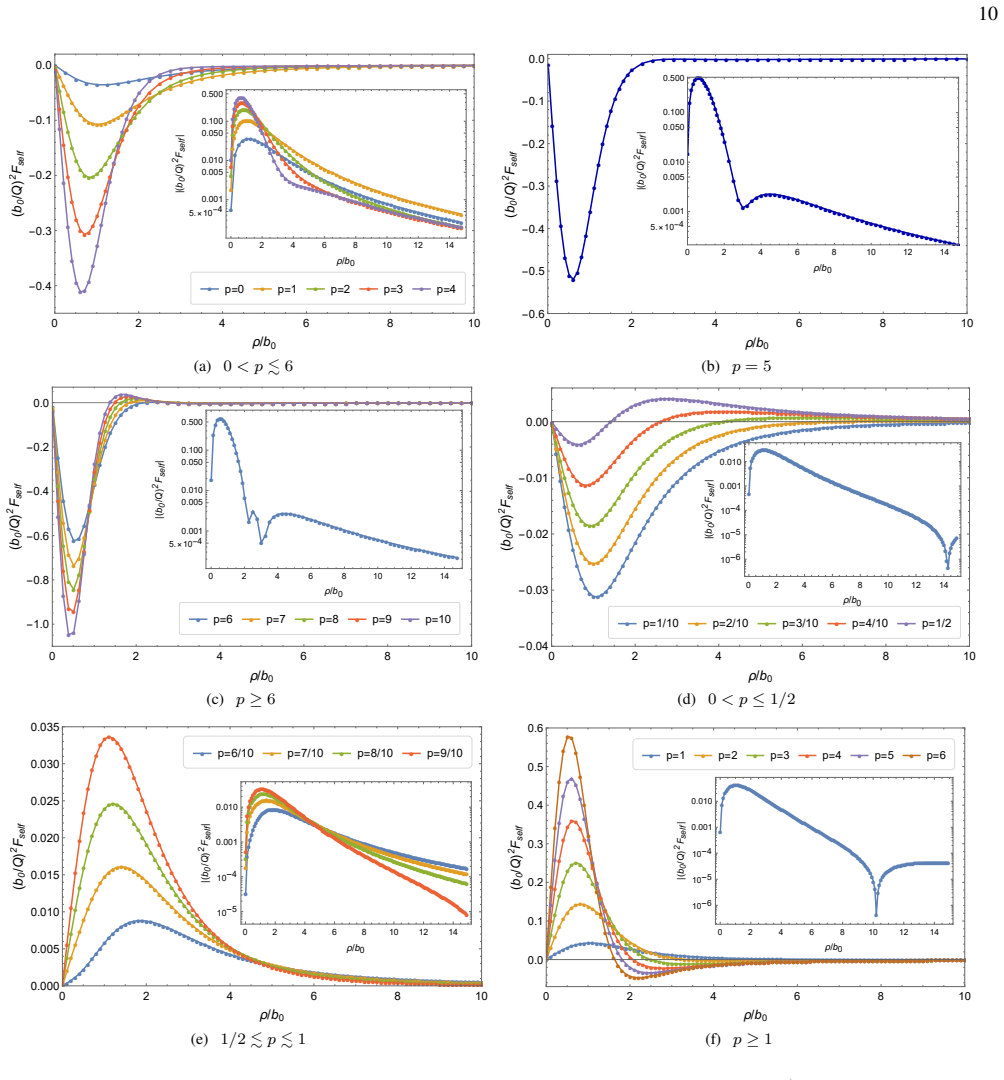
Ultrastatic wormholes In the previously considered cases of ultrastatic wormholes with shape exponent q=−1 and q= 1/3 , the self-force computed is found to be purely repulsive and attractive, respec- tively. Given this, we speculate that no ultrastatic wormhole produces a self-force profile with crossings. By examining other throat profiles, we verify tha...
-
[5]
6(c) for q= 1/2
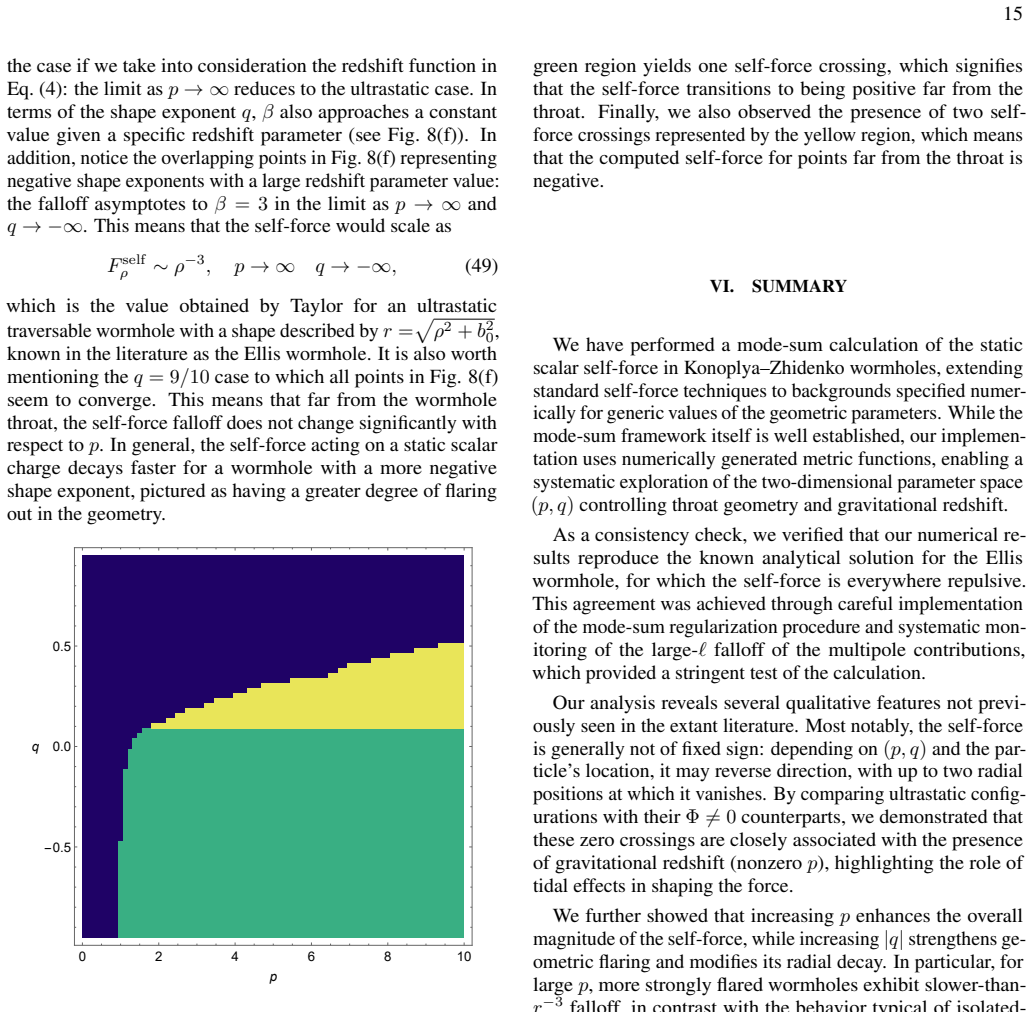
Generic(q, p)wormholes As p is increased to unity, self-force crossing starts to appear again in Fig. 6(c) for q= 1/2 . The self-force acting on the scalar charge in the vicinity of the throat is repulsive and be- comes attractive as the charge is placed farther away, while its magnitude increases with a more negative q value. In Fig. 6(d), for the case q...
2016
-
[6]
Flamm, Phys
L. Flamm, Phys. Rev48, 73 (1935)
1935
-
[7]
C. W. Misner and J. A. Wheeler, Ann. Phys2, 525 (1957)
1957
-
[8]
Gravanis and S
E. Gravanis and S. Willison, Physical Review D75, 084025 (2007)
2007
-
[9]
M. G. Richarte and C. Simeone, Physical Review D76, 087502 (2007)
2007
-
[10]
E. F. Eiroa, M. G. Richarte, and C. Simeone, Physics Letters A 373, 1 (2008)
2008
-
[11]
M. G. Richarte, arXiv preprint arXiv:1001.4034 (2010)
work page internal anchor Pith review Pith/arXiv arXiv 2010
-
[12]
Bambi, Physical Review D87, 107501 (2013)
C. Bambi, Physical Review D87, 107501 (2013)
2013
-
[13]
Bambi, Reviews of Modern Physics89, 025001 (2017)
C. Bambi, Reviews of Modern Physics89, 025001 (2017)
2017
-
[14]
Bambi and D
C. Bambi and D. Stojkovic, Universe7, 136 (2021)
2021
-
[15]
Almheiri, T
A. Almheiri, T. Hartman, J. Maldacena, E. Shaghoulian, and A. Tajdini, Journal of High Energy Physics2020, 1 (2020)
2020
-
[16]
Gonzalez and J
J. Gonzalez and J. Herrero, Nuclear physics B825, 426 (2010)
2010
-
[17]
P. C. Flores, D. A. Pablico, and E. Galapon, Physical Review A 110, 062223 (2024)
2024
-
[18]
N. L. Vu, N. Nishimura, T. Osburn, J. E. Thompson, L. E. Kidder, S. D. Upton, and B. Wardell, arXiv preprint arXiv:2606.04998 (2026)
work page internal anchor Pith review Pith/arXiv arXiv 2026
-
[19]
F. M. Blanco, E. E. Flanagan, and A. I. Harte, arXiv preprint arXiv:2605.14958 (2026)
work page internal anchor Pith review Pith/arXiv arXiv 2026
- [20]
-
[21]
Bini and G
D. Bini and G. Di Russo, Physical Review D113, 104069 (2026)
2026
-
[22]
A. Vaswani, L. Barack, O. Long, and R. P. Macedo, “Time- domain framework for the teukolsky equation with a particle source using comoving hyperboloidal coordinates,” (2026), arXiv:2606.26339 [gr-qc]
work page internal anchor Pith review Pith/arXiv arXiv 2026
-
[23]
Numerical self-force calculations for scalar particles, formulated in the lab frame
S. Vretinaris, E. Schnetter, and B. Krishnan, arXiv preprint arXiv:2606.06487 (2026)
work page internal anchor Pith review Pith/arXiv arXiv 2026
-
[24]
Blanchet, G
L. Blanchet, G. Faye, and D. Trestini, Classical and Quantum Gravity42, 065015 (2025)
2025
-
[25]
Trestini, Z
D. Trestini, Z. Nasipak, and A. Pound, Physical Review D113, 124049 (2026)
2026
-
[26]
Warburton, Physical Review D113, 084059 (2026)
N. Warburton, Physical Review D113, 084059 (2026)
2026
-
[27]
A. Roy, L. K¨uchler, A. Pound, and R. P. Macedo, arXiv preprint arXiv:2510.11793 (2025)
work page internal anchor Pith review Pith/arXiv arXiv 2025
-
[28]
H. Iglesias, L. Durkan, and D. Shoemaker, arXiv preprint arXiv:2510.11685 (2025)
-
[29]
Whittall, L
C. Whittall, L. Barack, and O. Long, Physical Review D112, 124045 (2025)
2025
-
[30]
S. D. Upton, B. Wardell, A. Pound, N. Warburton, and L. Barack, Physical Review D113, 064013 (2026)
2026
-
[31]
Lewis, T
J. Lewis, T. Kakehi, A. Pound, and T. Tanaka, Physical Review D113, 064046 (2026)
2026
-
[32]
K¨uchler, G
L. K¨uchler, G. Comp`ere, and A. Pound, Classical and Quantum Gravity43, 015018 (2026)
2026
-
[33]
Capozziello, N
S. Capozziello, N. Menadeo, and D. Usseglio, Classical and Quantum Gravity43, 065011 (2026)
2026
-
[34]
Leather, A
B. Leather, A. Buonanno, and M. van de Meent, Physical Re- view D112, 044012 (2025)
2025
-
[35]
Detweiler and B
S. Detweiler and B. F. Whiting, Physical Review D67 (2)(2003)
2003
-
[36]
Poisson, A
E. Poisson, A. Pound, and I. Vega, Living Reviews in Relativity 14, 7 (2011)
2011
-
[37]
Barack and A
L. Barack and A. Pound, Reports on Progress in Physics82, 016904 (2018). 19
2018
-
[38]
N. R. Khusnutdinov and I. V . Bakhmatov, Phys. Rev. D76 (12) (2007), 10.1103/PhysRevD.76.124015
-
[39]
N. R. Khusnutdinov, A. A. Popov, and L. N. Lipatova, Classical and Quantum Gravity27 (21)(2010)
2010
-
[40]
E. R. de Celis, O. Santillan, and C. Simeone, Physical Review D86 (12)(2012)
2012
-
[41]
E. R. de Celis and C. Simeone, The European Physical Journal C80, 1 (2020)
2020
-
[42]
E. R. de Celis, O. P. Santill´an, and C. Simeone, Physical Review D88 (12)(2013)
2013
- [43]
-
[44]
Bezerra and N
V . Bezerra and N. R. Khusnutdinov, Physical Review D79 (6) (2009)
2009
-
[45]
Taylor, Physical Review D87 (2)(2013)
P. Taylor, Physical Review D87 (2)(2013)
2013
-
[46]
Taylor, Physical Review D90, 024057 (2014)
P. Taylor, Physical Review D90, 024057 (2014)
2014
-
[47]
Taylor, Physical Review D95, 109904 (2017)
P. Taylor, Physical Review D95, 109904 (2017)
2017
-
[48]
Tomasini, E
C. Tomasini, E. R. de Celis, and C. Simeone, The European Physical Journal C79, 1 (2019)
2019
-
[49]
Tomasini, E
C. Tomasini, E. R. De Celis, and C. Simeone, The European Physical Journal C78, 1 (2018)
2018
-
[50]
A. A. Popov and O. Aslan, International Journal of Geometric Methods in Modern Physics15, 1850050 (2018)
2018
-
[51]
M. S. Morris and K. S. Thorne, Am. J. Phys56, 395 (1988)
1988
-
[52]
F. S. Lobo (Ed.),Wormholes, warp drives and energy conditions, V ol. 189 (Springer, 2017)
2017
-
[53]
Krasnikov, Physical Review D62 (8)(2000)
S. Krasnikov, Physical Review D62 (8)(2000)
2000
-
[54]
Garattini, Classical and Quantum Gravity22, 1105 (2005)
R. Garattini, Classical and Quantum Gravity22, 1105 (2005)
2005
-
[55]
Garattini and F
R. Garattini and F. S. Lobo, Physics Letters B671, 146 (2009)
2009
-
[56]
P. K. Kuhfittig, Physical Review D98 (6)(2018)
2018
-
[57]
Armendariz-Picon, Physical Review D65 (10)(2002)
C. Armendariz-Picon, Physical Review D65 (10)(2002)
2002
-
[58]
Sushkov, Physical Review D71 (4)(2005)
S. Sushkov, Physical Review D71 (4)(2005)
2005
-
[59]
F. S. Lobo, Physical Review D71 (8)(2005)
2005
-
[60]
F. S. Lobo, arXiv preprint arXiv:1008.1127 (2010)
work page internal anchor Pith review Pith/arXiv arXiv 2010
-
[61]
M. Visser and D. Hochberg, arXiv preprint gr-qc/9710001 (1997)
work page internal anchor Pith review Pith/arXiv arXiv 1997
-
[62]
DeBenedictis and A
A. DeBenedictis and A. Das, Classical and Quantum Gravity18, 1187 (2001)
2001
-
[63]
Rahaman, M
F. Rahaman, M. Kalam, M. Sarker, and K. Gayen, Physics Letters B633, 161 (2006)
2006
-
[64]
S. D. Forghani, S. H. Mazharimousavi, and M. Halilsoy, The European Physical Journal Plus133, 497 (2018)
2018
-
[65]
Harko, F
T. Harko, F. S. Lobo, M. Mak, and S. V . Sushkov, Physical Review D87, 067504 (2013)
2013
-
[66]
R. Konoplya and A. Zhidenko, Phys. Rev. D81 (12)(2010), 10.1103/PhysRevD.81.124036
-
[67]
H. G. Ellis, Journal of Mathematical Physics14, 104 (1973)
1973
-
[68]
Cataldo, L
M. Cataldo, L. Liempi, and P. Rodr ´ıguez, Physical Review D 91, 124039 (2015)
2015
-
[69]
Godani and G
N. Godani and G. C. Samanta, International Journal of Modern Physics D28, 1950039 (2019)
2019
-
[70]
Konoplya and A
R. Konoplya and A. Zhidenko, Journal of Cosmology and As- troparticle Physics2016, 043 (2016)
2016
-
[71]
Konoplya, Physics Letters B784, 43 (2018)
R. Konoplya, Physics Letters B784, 43 (2018)
2018
-
[72]
Kim, Journal of the Korean Physical Society63, 1887 (2013)
S.-W. Kim, Journal of the Korean Physical Society63, 1887 (2013)
2013
-
[73]
P. D. Roy, S. Aneesh, and S. Kar, The European Physical Journal C80, 1 (2020)
2020
-
[74]
B. Azad, F. Loran, and A. Mostafazadeh, The European Physical Journal C80, 1 (2020)
2020
-
[75]
Churilova, R
M. Churilova, R. Konoplya, and A. Zhidenko, Physics Letters B802, 135207 (2020)
2020
-
[76]
Casals, E
M. Casals, E. Poisson, and I. Vega, Physical Review D86 (6) (2012)
2012
-
[77]
I. Vega, B. Wardell, and P. Diener, Classical and Quantum Gravity28, 134010 (2011)
2011
-
[78]
Wardell, C
B. Wardell, C. R. Galley, A. Zengino˘glu, M. Casals, S. R. Dolan, and A. C. Ottewill, Physical Review D89, 084021 (2014)
2014
-
[79]
Barack and A
L. Barack and A. Ori, Physical Review D61, 061502 (2000)
2000
-
[80]
L. M. Burko, Classical and Quantum Gravity17, 227 (2000)
2000
discussion (0)
Sign in with ORCID, Apple, or X to comment. Anyone can read and Pith papers without signing in.