Conservative and dissipative sectors in a nonlinear scalar model for the gravitational self-force problem
Pith reviewed 2026-06-30 20:11 UTC · model grok-4.3
The pith
Requiring the conservative sector to be Hamiltonian yields multiple definitions of the second-order self-force in a nonlinear scalar model.
A machine-rendered reading of the paper's core claim, the machinery that carries it, and where it could break.
Core claim
Demanding that any reasonable conservative sector be Hamiltonian, we identify multiple possible definitions of the conservative second-order self-force. Motivations for these possibilities and their properties are discussed and relevant Hamiltonians are obtained. We assume the existence of a three-point function with certain properties that is a generalization of the Detweiler-Whiting two-point function. These results apply to the two-body problem but are restricted to unbound scattering trajectories, due to infrared divergences that arise for bound orbits.
What carries the argument
A three-point function that generalizes the Detweiler-Whiting two-point function and is used to define candidate conservative sectors that are required to be Hamiltonian.
If this is right
- Several distinct but Hamiltonian-consistent definitions of the conservative second-order self-force become available.
- Corresponding Hamiltonians can be derived for each of these definitions.
- The splitting criteria that agreed at first order produce inequivalent conservative sectors at second order.
- The results are restricted to unbound scattering trajectories in the two-body problem.
Where Pith is reading between the lines
- Different choices among the Hamiltonian definitions may correspond to distinct regularization schemes when the same logic is applied to the gravitational self-force.
- Numerical evolution of the nonlinear scalar model on scattering trajectories could test which of the candidate definitions best matches the full dynamics.
- If infrared divergences for bound orbits can be controlled, the same Hamiltonian requirement might yield conservative definitions for periodic or inspiraling motion.
Load-bearing premise
The existence of a three-point function with the required properties that generalizes the Detweiler-Whiting two-point function.
What would settle it
An explicit construction showing that no three-point function with the stated properties exists, or a direct calculation demonstrating that none of the proposed conservative sectors can be derived from a Hamiltonian.
Figures
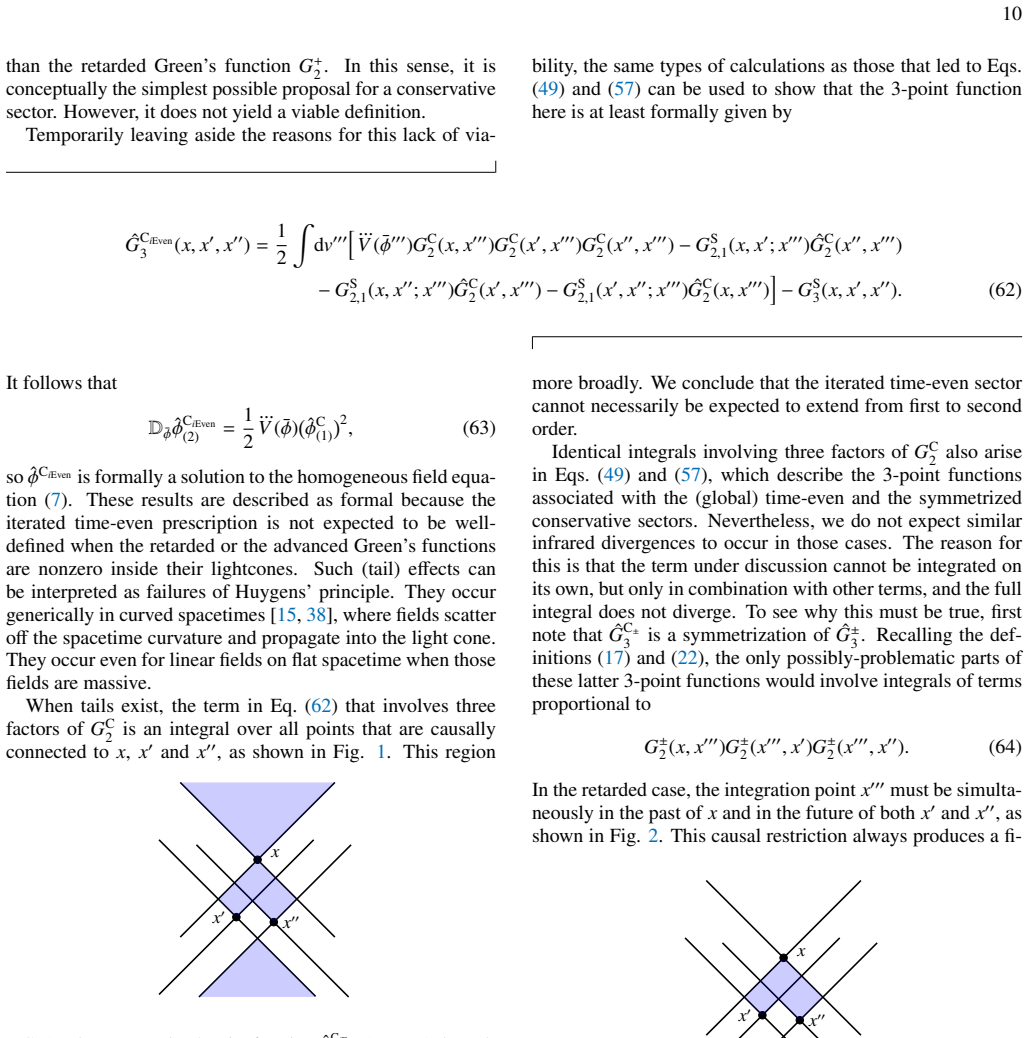
read the original abstract
When considering how self-interaction affects an object's motion, it can be convenient to decompose the self-force into conservative and dissipative pieces. As a toy model for understanding such decompositions of the gravitational self-force, we consider objects that do not affect the spacetime, but are instead coupled to a nonlinear scalar field. There is then a standard splitting of the first-order scalar self-force into conservative and dissipative components. Multiple criteria can be used to obtain this splitting, all of which imply the same result. However, the implications of these criteria generically differ at higher orders. Demanding that any reasonable conservative sector be Hamiltonian, we identify multiple possible definitions of the conservative second-order self-force. Motivations for these possibilities and their properties are discussed and relevant Hamiltonians are obtained. We assume the existence of a three-point function with certain properties that is a generalization of the Detweiler-Whiting two-point function. These results apply to the two-body problem but are restricted to unbound scattering trajectories, due to infrared divergences that arise for bound orbits.
Editorial analysis
A structured set of objections, weighed in public.
Referee Report
Summary. The manuscript investigates the splitting of the self-force into conservative and dissipative parts in a nonlinear scalar toy model intended to mimic aspects of the gravitational self-force problem. It shows that while different criteria agree on the first-order conservative sector, they lead to distinct possibilities at second order when requiring the conservative sector to be Hamiltonian. Multiple definitions are identified, with corresponding Hamiltonians derived, under the assumption of a suitable three-point function. The analysis is limited to unbound trajectories.
Significance. If valid, the result demonstrates an ambiguity in the conservative-dissipative decomposition at second order that is not present at first order. This has potential implications for higher-order self-force calculations in general relativity, particularly for scattering orbits. The toy model clarifies the role of the Hamiltonian condition. The explicit Hamiltonians and discussion of motivations are positive aspects of the work.
Simulated Author's Rebuttal
We thank the referee for their positive assessment of the manuscript and their recommendation to accept.
Circularity Check
No significant circularity identified
full rationale
The paper states upfront its assumption of a three-point function generalizing the Detweiler-Whiting two-point function and derives multiple possible conservative second-order self-force definitions from the independent Hamiltonian requirement on the conservative sector. No load-bearing step reduces a claimed prediction or definition to a fitted input, self-citation chain, or ansatz smuggled via prior work by the same authors; the derivation remains self-contained within the stated toy-model assumptions and restrictions to unbound trajectories.
Axiom & Free-Parameter Ledger
axioms (1)
- domain assumption Existence of a three-point function with certain properties that generalizes the Detweiler-Whiting two-point function
Forward citations
Cited by 1 Pith paper
-
Self-force on a static scalar charge in traversable wormholes
Mode-sum computation of static scalar self-force in Konoplya-Zhidenko wormholes shows parameter-dependent sign changes and slower-than-usual large-distance decay for large redshift parameter p.
Reference graph
Works this paper leans on
-
[1]
Select the piece of ˆG+ 2 which is obtained by symmetriz- ing under exchange of arguments
-
[2]
Select the piece of ˆG+ 2 which is invariant under time re- versal, meaning that it remains the same when retarded and advanced Green’s functions are exchanged
-
[3]
These prescriptions all give the same result at first order
Instead of finding an effective field for the retarded field and then isolating a particular component of that field, start by solving the field equations with time-symmetric boundary conditions and then find the effective field as- sociated with that solution. These prescriptions all give the same result at first order. How- ever, we show in the followin...
-
[4]
global time-even projection
The retarded Green’s function in turn depends on the physical boundary conditions. If we had used advanced boundary conditions in- stead,G + 2 would be replaced byG − 2 whileG S 2 andG S 3 would remain as is. With this in mind, we consider objects with the form gn(x1, . . . ,x n;G + 2 ,G − 2 ].(37) These aren-point functions on spacetime that depend func-...
-
[5]
B. P. Abbottet al.(LIGO Scientific, Virgo), Phys. Rev. Lett. 116, 061102 (2016), arXiv:1602.03837
work page internal anchor Pith review Pith/arXiv arXiv 2016
-
[6]
B. P. Abbottet al.(LIGO Scientific, Virgo), Phys. Rev. Lett. 116, 241103 (2016), arXiv:1606.04855
work page internal anchor Pith review Pith/arXiv arXiv 2016
-
[7]
B. P. Abbottet al.(LIGO Scientific, Virgo), Phys. Rev. X6, 041015 (2016), arXiv:1606.04856
work page internal anchor Pith review Pith/arXiv arXiv 2016
-
[8]
The NANOGrav 15-year Data Set: Evidence for a Gravitational-Wave Background
G. Agazieet al.(NANOGrav Collaboration), The Astrophysi- cal Journal Letters951, L8 (2023), arXiv:2306.16213
work page internal anchor Pith review Pith/arXiv arXiv 2023
-
[9]
G. Agazieet al.(NANOGrav Collaboration), The Astrophysi- cal Journal Letters951, L9 (2023), arXiv:2306.16217
-
[10]
Laser Interferometer Space Antenna
P. Amaro-Seoaneet al., (2017), arXiv:1702.00786
work page internal anchor Pith review Pith/arXiv arXiv 2017
-
[11]
Post-Newtonian Theory for Gravitational Waves
L. Blanchet, Living Rev. Rel.17, 2 (2014), arXiv:1310.1528
work page internal anchor Pith review Pith/arXiv arXiv 2014
-
[12]
Poisson and C
E. Poisson and C. M. Will,Gravity: Newtonian, post- Newtonian, relativistic(Cambridge University Press, 2014)
2014
- [13]
-
[14]
R. A. Porto, Phys. Rept.633, 1 (2016), arXiv:1601.04914
work page internal anchor Pith review Pith/arXiv arXiv 2016
-
[15]
Gravitational scattering, post-Minkowskian approximation and Effective One-Body theory
T. Damour, Phys. Rev. D94, 104015 (2016), arXiv:1609.00354
work page internal anchor Pith review Pith/arXiv arXiv 2016
-
[16]
Numerical Relativity and Astrophysics
L. Lehner and F. Pretorius, Ann. Rev. Astron. Astrophys.52, 661 (2014), arXiv:1405.4840
work page internal anchor Pith review Pith/arXiv arXiv 2014
-
[17]
The General Relativistic Two Body Problem and the Effective One Body Formalism
T. Damour, Fundam. Theor. Phys.177, 111 (2014), arXiv:1212.3169
work page internal anchor Pith review Pith/arXiv arXiv 2014
-
[18]
Effective-one-body model for black-hole binaries with generic mass ratios and spins
A. Taracchiniet al., Phys. Rev. D89, 061502 (2014), arXiv:1311.2544
work page internal anchor Pith review Pith/arXiv arXiv 2014
-
[19]
The motion of point particles in curved spacetime
E. Poisson, A. Pound, and I. Vega, Living Rev. Rel.14, 7 (2011), arXiv:1102.0529
work page internal anchor Pith review Pith/arXiv arXiv 2011
-
[20]
Self-force and radiation reaction in general relativity
L. Barack and A. Pound, Rept. Prog. Phys.82, 016904 (2019), arXiv:1805.10385
work page internal anchor Pith review Pith/arXiv arXiv 2019
- [21]
- [22]
-
[23]
Y . Mino, M. Sasaki, and T. Tanaka, Phys. Rev. D55, 3457 (1997), arXiv:gr-qc/9606018
work page internal anchor Pith review Pith/arXiv arXiv 1997
-
[24]
T. C. Quinn and R. M. Wald, Phys. Rev. D56, 3381 (1997), arXiv:gr-qc/9610053
work page internal anchor Pith review Pith/arXiv arXiv 1997
-
[25]
Second-order gravitational self-force
A. Pound, Phys. Rev. Lett.109, 051101 (2012), arXiv:1201.5089
work page internal anchor Pith review Pith/arXiv arXiv 2012
-
[26]
Nonlinear gravitational self-force. I. Field outside a small body
A. Pound, Phys. Rev. D86, 084019 (2012), arXiv:1206.6538
work page internal anchor Pith review Pith/arXiv arXiv 2012
-
[27]
S. E. Gralla, Phys. Rev. D85, 124011 (2012), arXiv:1203.3189
work page internal anchor Pith review Pith/arXiv arXiv 2012
-
[28]
A practical, covariant puncture for second-order self-force calculations
A. Pound and J. Miller, Phys. Rev. D89, 104020 (2014), arXiv:1403.1843
work page internal anchor Pith review Pith/arXiv arXiv 2014
-
[29]
Second-order perturbation theory: problems on large scales
A. Pound, Phys. Rev. D92, 104047 (2015), arXiv:1510.05172
work page internal anchor Pith review Pith/arXiv arXiv 2015
-
[30]
Second-order perturbation theory: the problem of infinite mode coupling
J. Miller, B. Wardell, and A. Pound, Phys. Rev. D94, 104018 (2016), arXiv:1608.06783
work page internal anchor Pith review Pith/arXiv arXiv 2016
-
[31]
G. Sch ¨afer and P. Jaranowski, Living Rev. Rel.21, 7 (2018), arXiv:1805.07240
-
[32]
Hamiltonians and canonical coordinates for spinning particles in curved space-time
V . Witzany, J. Steinhoff, and G. Lukes-Gerakopoulos, Class. Quantum Gravity36, 075003 (2019), arXiv:1808.06582
work page internal anchor Pith review Pith/arXiv arXiv 2019
- [33]
- [34]
- [35]
-
[36]
A. I. Harte, F. M. Blanco, and E. E. Flanagan, In preparation
-
[37]
A. I. Harte, Class. Quantum Gravity25, 235020 (2008), arXiv:0807.1150
work page internal anchor Pith review Pith/arXiv arXiv 2008
-
[38]
Mechanics of extended masses in general relativity
A. Harte, Class. Quantum Gravity29, 055012 (2012), arXiv:1103.0543
work page internal anchor Pith review Pith/arXiv arXiv 2012
- [39]
-
[40]
S. L. Detweiler and B. F. Whiting, Phys. Rev. D67, 024025 (2003), arXiv:gr-qc/0202086
work page internal anchor Pith review Pith/arXiv arXiv 2003
-
[41]
Geroch and J
R. Geroch and J. Traschen, Phys. Rev. D36, 1017 (1987)
1987
-
[42]
G ¨unther,Huygens’ principle and hyperbolic equations, Per- spectives in mathematics (Academic press, 1988)
P. G ¨unther,Huygens’ principle and hyperbolic equations, Per- spectives in mathematics (Academic press, 1988)
1988
-
[43]
Two timescale analysis of extreme mass ratio inspirals in Kerr. I. Orbital Motion
T. Hinderer and E. E. Flanagan, Phys. Rev. D78, 064028 (2008), arXiv:0805.3337
work page internal anchor Pith review Pith/arXiv arXiv 2008
- [44]
- [45]
- [46]
-
[47]
Nonlocal-in-time action for the fourth post-Newtonian conservative dynamics of two-body systems
T. Damour, P. Jaranowski, and G. Sch ¨afer, Phys. Rev. D89, 064058 (2014), arXiv:1401.4548
work page internal anchor Pith review Pith/arXiv arXiv 2014
-
[48]
Fourth post-Newtonian effective one-body dynamics
T. Damour, P. Jaranowski, and G. Sch ¨afer, Phys. Rev. D91, 084024 (2015), arXiv:1502.07245
work page internal anchor Pith review Pith/arXiv arXiv 2015
-
[49]
Hamiltonian Formulation of the Conservative Self-Force Dynamics in the Kerr Geometry
R. Fujita, S. Isoyama, A. Le Tiec, H. Nakano, N. Sago, and T. Tanaka, Class. Quant. Grav.34, 134001 (2017), arXiv:1612.02504
work page internal anchor Pith review Pith/arXiv arXiv 2017
- [50]
-
[51]
Z. Bern, J. Parra-Martinez, R. Roiban, M. S. Ruf, C.-H. Shen, M. P. Solon, and M. Zeng, PoSLL2022, 051 (2022)
2022
- [52]
- [53]
- [54]
- [55]
- [56]
-
[57]
M. Driesse, G. U. Jakobsen, G. Mogull, C. Nega, J. Plefka, B. Sauer, and J. Usovitsch, (2026), arXiv:2601.16256
-
[58]
Bini and T
D. Bini and T. Damour, Phys. Rev. D112, 044002 (2025)
2025
-
[59]
Schwinger, J
J. Schwinger, J. Math. Phys.2, 407 (1961)
1961
-
[60]
L. V . Keldysh, inSelected papers of Leonid V . Keldysh(World Scientific, 2023) pp. 47–55
2023
-
[61]
C. R. Galley, Phys. Rev. Lett.110, 174301 (2013), arXiv:1210.2745
work page internal anchor Pith review Pith/arXiv arXiv 2013
-
[62]
Llosa and J
J. Llosa and J. Vives, J. Math. Phys.35, 2856 (1994). Appendix A: Notation We consider a number of different scalar fields – typically denoted by a variant ofϕ– and alson-point functions, which are typically denoted by a variant ofG. This appendix ex- plains the various adornments we apply to those base sym- bols. First, superscripts applied to fields and...
1994
-
[63]
General class of nonlocal dynamical systems The equations of motion we consider are integro- differential equations, as opposed to the ordinary differential equations characteristic of simpler local-in-time systems. An example of such an integro-differential equation is ¨x(t)=f(x(t))+ Z ∞ −∞ dt′K(t,t ′)x(t ′).(B1) Here,f(x) is proportional to the local pi...
-
[64]
Because of this, solutions are generally not parametrized by initial data con- sisting of a single phase space pointQ
Local dynamical systems obtained by treating nonlocalities perturbatively Equation (B10) is an integro-differential system of equa- tions for the trajectoriesX s on phase space. Because of this, solutions are generally not parametrized by initial data con- sisting of a single phase space pointQ. In fact, the space of initial data required to determine sol...
-
[65]
In the second term on the right hand side of Eq
Local Hamiltonian description Although the perturbative expansion of subsection B 2 al- leviates the problem of nonlocality, the equations of motion (B12) are not manifestly Hamiltonian. In the second term on the right hand side of Eq. (B13), the derivative with respect to the first argument evaluated at coincidence is not necessarily of the form of a tot...
discussion (0)
Sign in with ORCID, Apple, or X to comment. Anyone can read and Pith papers without signing in.