General Relativistic Shock Wave Solutions with Black Hole Formation: The Singular Isothermal Sphere Case
Pith reviewed 2026-06-30 01:48 UTC · model grok-4.3
The pith
Shock waves during general-relativistic collapse of a singular isothermal sphere form black holes and release about 10 percent of the enclosed rest mass in energy.
A machine-rendered reading of the paper's core claim, the machinery that carries it, and where it could break.
Core claim
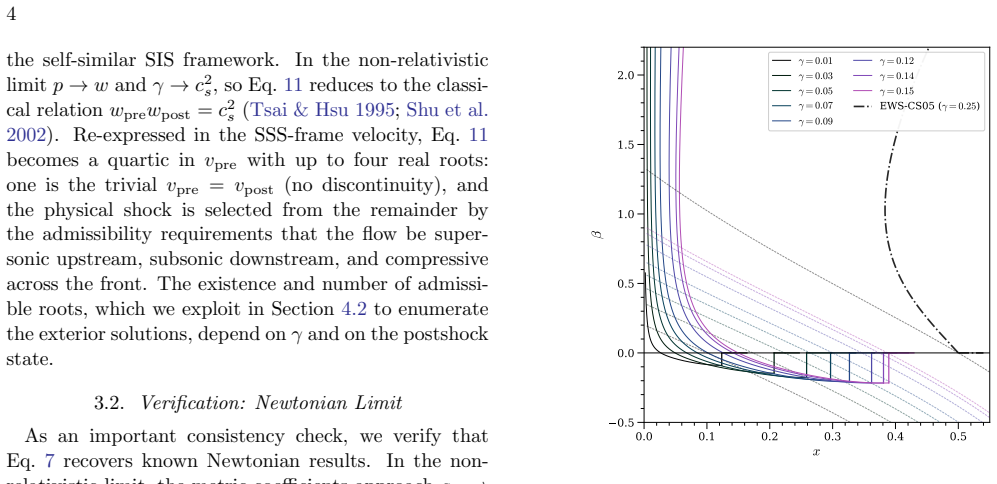
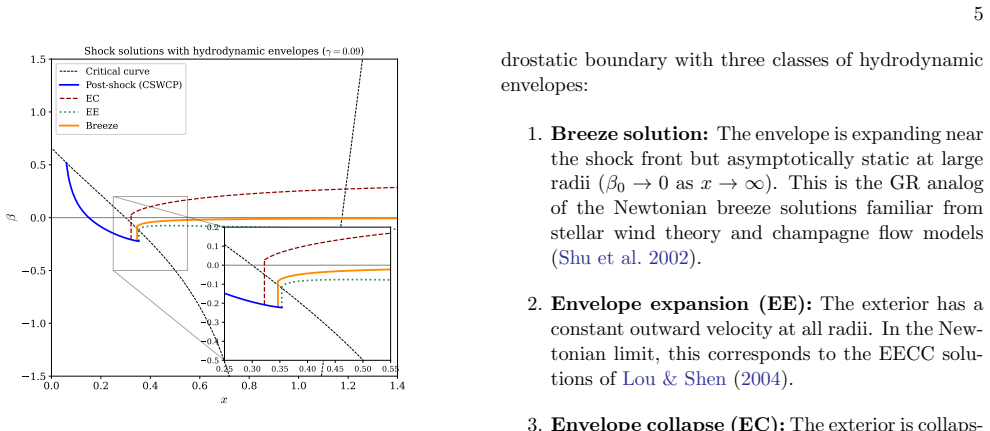
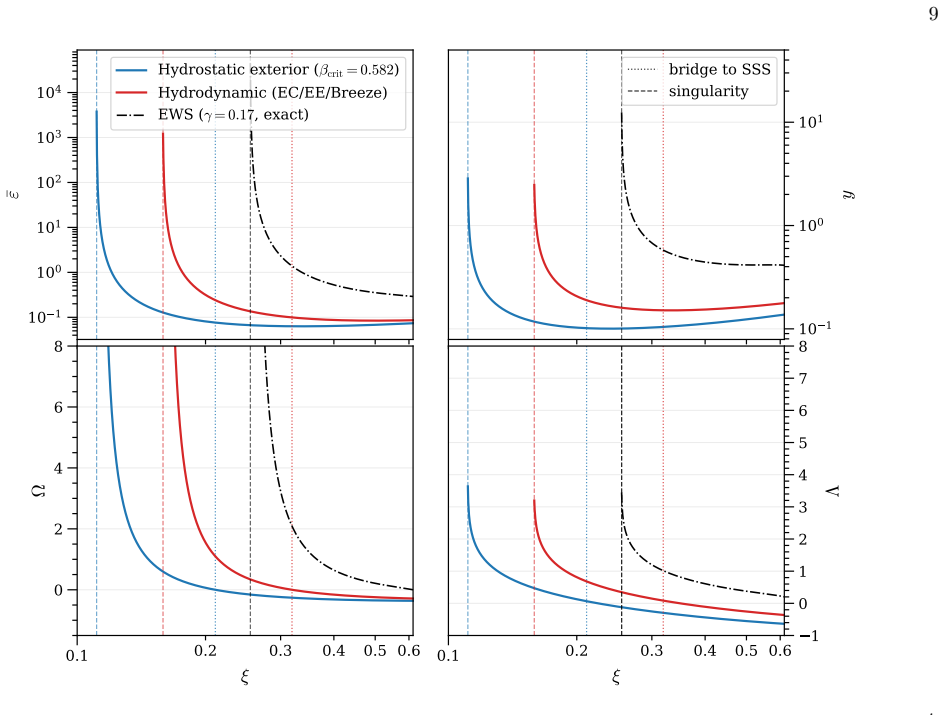
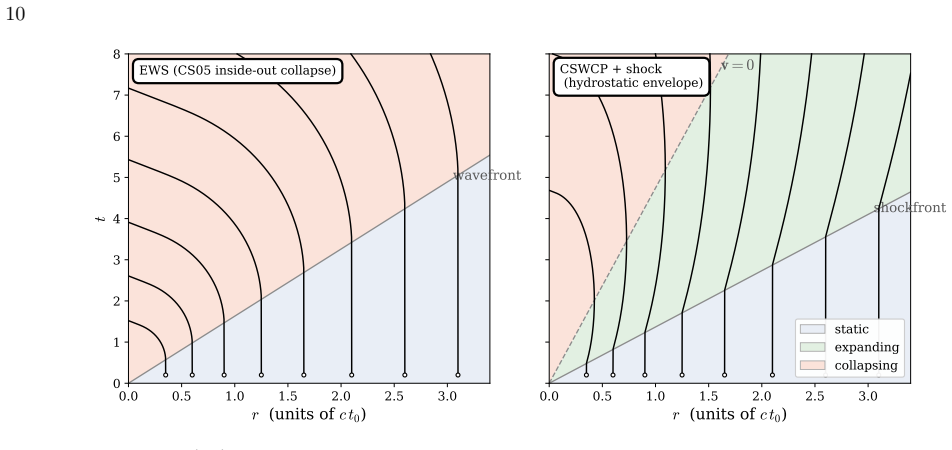
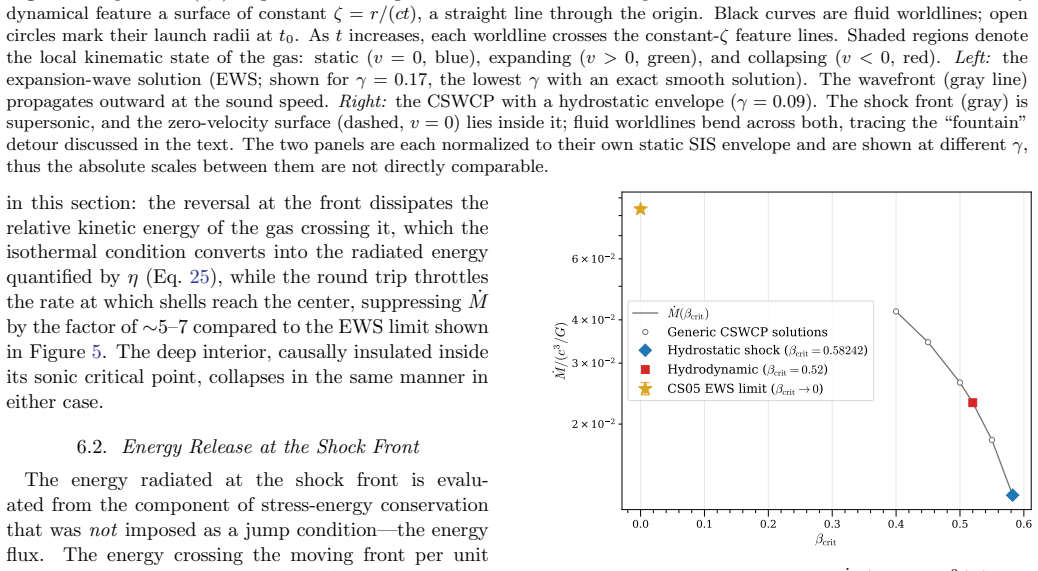
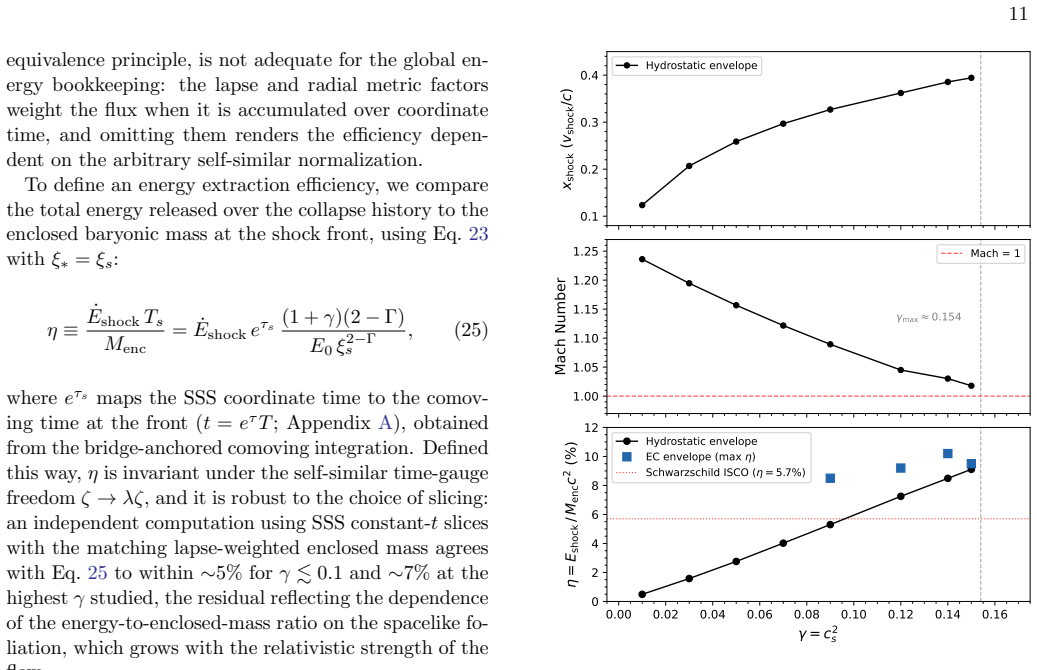
We obtain the general relativistic jump conditions for an isothermal fluid and show that they connect interior collapse solutions to exterior envelopes that may be static, expanding, or collapsing, yielding a rich family of shocks propagating at up to ∼40% the speed of light; the central accretion rate is set by the interior collapse alone and is suppressed by a factor of ∼5–7 relative to the smooth expansion-wave solution, while the energy released at the shock reaches ∼10% of the enclosed rest mass.
What carries the argument
The general relativistic jump conditions for an isothermal fluid together with a coordinate-matching technique at the zero-velocity surface that bridges the Schwarzschild and comoving self-similar descriptions.
If this is right
- The central accretion rate is set by the interior collapse alone.
- Shocks propagate at up to 40 percent the speed of light.
- The energy released at the shock reaches about 10 percent of the enclosed rest mass.
- The available exterior types narrow with increasing sound speed.
- The solutions provide an analytical energy budget for direct-collapse black hole formation.
Where Pith is reading between the lines
- The framework could be tested against numerical relativity simulations that relax the self-similar assumption.
- Similar shock structures might appear in other early-universe collapse scenarios beyond the isothermal sphere.
- The energy release at the shock could influence the surrounding medium in ways observable in high-redshift transients.
Load-bearing premise
The collapse solution remains self-similar after a discontinuous shock is introduced and the coordinate matching at the zero-velocity surface works correctly.
What would settle it
A high-resolution numerical simulation of the same initial conditions that produces a central accretion rate matching the smooth expansion-wave solution instead of being suppressed by a factor of 5-7.
Figures
read the original abstract
The rapid emergence at $z\gtrsim 6$ of ubiquitous populations of supermassive black holes (SMBHs) revealed by JWST and of quasars with estimated masses $M_\bullet > 10^{10} M_\odot$ demands efficient pathways for early growth. The smooth collapse of a singular isothermal sphere (SIS) has been solved analytically in full general relativity, but the shock waves that inevitably accompany such collapse have not. Here, we derive general-relativistic self-similar shock-wave solutions for the collapse of an SIS to a black hole, extending the framework of Cai \& Shu (2005) to discontinuous flows. We obtain the general relativistic jump conditions for an isothermal fluid and show that they connect interior collapse solutions to exterior envelopes that may be static, expanding, or collapsing, yielding a rich family of shocks propagating at up to $\sim$40\% the speed of light; the available exterior types narrow with increasing sound speed. A coordinate-matching technique that uses the zero-velocity surface uniquely bridges the Schwarzschild and comoving self-similar descriptions, completing the characterization of the growing black hole. The central accretion rate is set by the interior collapse alone and is suppressed by a factor of $\sim$5--7 relative to the smooth expansion-wave solution, while the energy released at the shock reaches $\sim$10\% of the enclosed rest mass -- nearly twice the 5.7\% radiative efficiency of Schwarzschild accretion. These results provide an analytical energy budget for direct-collapse black hole formation, with implications for SMBH seed assembly, the dense cocoons around nascent high-redshift black holes, the recently discovered JWST's Little Red Dots, and relativistic transients such as gamma-ray bursts.
Editorial analysis
A structured set of objections, weighed in public.
Referee Report
Summary. The paper derives general-relativistic self-similar shock-wave solutions for the collapse of a singular isothermal sphere (SIS) to a black hole, extending the Cai & Shu (2005) framework to discontinuous flows. It obtains GR jump conditions for an isothermal fluid that connect interior collapse solutions to exterior envelopes (static, expanding, or collapsing), yielding a family of shocks up to ~40% the speed of light. A coordinate-matching technique at the zero-velocity surface bridges Schwarzschild and comoving descriptions. The central accretion rate is set by the interior solution alone and is suppressed by a factor of ~5–7 relative to the smooth expansion-wave case, while the shock releases ~10% of the enclosed rest mass (nearly twice the Schwarzschild radiative efficiency).
Significance. If the derivations hold, the work supplies an analytical, parameter-free energy budget for direct-collapse black-hole formation. This is directly relevant to early SMBH seed assembly, the dense environments around high-redshift black holes, JWST Little Red Dots, and relativistic transients. The quantitative outputs (suppression factor, energy fraction, maximum shock speed) are falsifiable predictions that could be compared with numerical simulations.
major comments (1)
- [Abstract (and extension of Cai & Shu 2005 framework)] The central claims (family of solutions, factor-of-5–7 accretion suppression, ~10% energy release) rest on the self-similar ansatz remaining valid after the introduction of a discontinuous shock and on the coordinate-matching procedure at the zero-velocity surface correctly fixing the black-hole growth rate. The abstract supplies no derivation steps, error estimates, or independent validation of metric continuity across the matching surface; without these, it is impossible to confirm that the isothermal jump conditions are satisfied or that the matching does not introduce an implicit assumption about shock location or metric continuity. This is load-bearing for all reported quantitative factors.
Simulated Author's Rebuttal
We thank the referee for the positive summary of our work's significance and for the detailed reading. We address the major comment below, providing references to the relevant sections of the manuscript where the derivations and validations are presented in full.
read point-by-point responses
-
Referee: The central claims (family of solutions, factor-of-5–7 accretion suppression, ~10% energy release) rest on the self-similar ansatz remaining valid after the introduction of a discontinuous shock and on the coordinate-matching procedure at the zero-velocity surface correctly fixing the black-hole growth rate. The abstract supplies no derivation steps, error estimates, or independent validation of metric continuity across the matching surface; without these, it is impossible to confirm that the isothermal jump conditions are satisfied or that the matching does not introduce an implicit assumption about shock location or metric continuity. This is load-bearing for all reported quantitative factors.
Authors: The general-relativistic jump conditions for an isothermal fluid and the preservation of the self-similar ansatz across the discontinuity are derived explicitly in Section 3, where the Rankine-Hugoniot relations are solved in the GR metric to obtain the family of shock solutions with speeds up to ~0.4c. The coordinate-matching procedure at the zero-velocity surface, which bridges the Schwarzschild and comoving descriptions while enforcing metric continuity by construction, is presented in Section 5.2; this fixes the black-hole growth rate solely from the interior solution without additional assumptions on shock location. The solutions are exact within the self-similar framework, so separate error estimates are not required. Validation is provided by recovering the smooth Cai & Shu (2005) expansion-wave solution in the limit of vanishing shock strength. The abstract is intentionally concise and does not contain derivation steps; all supporting analysis appears in the body. We are happy to add a brief reference to Sections 3 and 5 in a revised abstract if that addresses the concern. revision: partial
Circularity Check
Minor self-citation to Cai & Shu 2005 for smooth baseline; new GR jump conditions and shock family are independent outputs
full rationale
The derivation begins from the smooth SIS collapse solution in Cai & Shu (2005) (one co-author) and extends it by deriving new general-relativistic jump conditions for an isothermal fluid. These conditions are then used to connect interior and exterior self-similar solutions, producing a family of shocks with reported propagation speeds, accretion suppression (~5-7), and energy release (~10% of enclosed rest mass). The abstract and claimed results present the suppression factor and energy fraction as computed outputs of the extended model rather than inputs or redefinitions. The coordinate-matching technique at the zero-velocity surface is described as a completing step for the growing black hole, not as a self-referential fit. No quoted equation reduces a reported prediction to a fitted parameter or prior self-citation by construction; the central claims retain independent content from the new jump conditions.
Axiom & Free-Parameter Ledger
axioms (2)
- domain assumption The collapse remains self-similar after introduction of a discontinuous shock
- domain assumption The fluid obeys an isothermal equation of state
Reference graph
Works this paper leans on
-
[1]
Abel, T., Bryan, G. L., & Norman, M. L. 2002, Science, 295, 93, doi: 10.1126/science.1063991
-
[2]
2001, Physics Reports, 349, 125, doi: 10.1016/S0370-1573(01)00019-9
Barkana, R., & Loeb, A. 2001, Physics Reports, 349, 125, doi: 10.1016/S0370-1573(01)00019-9
-
[3]
Begelman, M. C., & Dexter, J. 2026, ApJ, 996, 48, doi: 10.3847/1538-4357/ae274a
-
[4]
Begelman, M. C., Volonteri, M., & Rees, M. J. 2006, MNRAS, 370, 289, doi: 10.1111/j.1365-2966.2006.10467.x
-
[5]
Blandford, R. D., & Znajek, R. L. 1977, MNRAS, 179, 433, doi: 10.1093/mnras/179.3.433
-
[6]
Boekholt, T. C. N., Schleicher, D. R. G., Fellhauer, M., et al. 2018, MNRAS, 476, 366, doi: 10.1093/mnras/sty208 Bogd´ an,´A., et al. 2024, Nature Astronomy, 8, 126, doi: 10.1038/s41550-023-02111-9
-
[7]
2003, ApJ, 596, 34, doi: 10.1086/377529
Bromm, V., & Loeb, A. 2003, ApJ, 596, 34, doi: 10.1086/377529
-
[8]
2011, ARA&A, 49, 373, doi: 10.1146/annurev-astro-081710-102608
Bromm, V., & Yoshida, N. 2011, ARA&A, 49, 373, doi: 10.1146/annurev-astro-081710-102608
-
[9]
Cai, M. J., & Shu, F. H. 2005, ApJ, 618, 438, doi: 10.1086/425861 Di Matteo, T., Colberg, J., Springel, V., Hernquist, L., &
-
[10]
2008, ApJ, 676, 33, doi: 10.1086/524921
Sijacki, D. 2008, ApJ, 676, 33, doi: 10.1086/524921
-
[11]
Font, J. A. 2000, Living Reviews in Relativity, 3, 2, doi: 10.12942/lrr-2000-2
-
[12]
Gupta, A. R., Taylor, A., Curtis-Lake, E., et al. 2026, arXiv e-prints, arXiv:2605.30414, doi: 10.48550/arXiv.2605.30414
work page internal anchor Pith review Pith/arXiv arXiv doi:10.48550/arxiv.2605.30414 2026
-
[13]
2023, ApJS, 265, 5, doi: 10.3847/1538-4365/acaaa9
Harikane, Y., et al. 2023, ApJS, 265, 5, doi: 10.3847/1538-4365/acaaa9
-
[14]
Inayoshi, K., & Ho, L. C. 2025, arXiv e-prints, arXiv:2512.03130, doi: 10.48550/arXiv.2512.03130
-
[15]
2020, ARA&A, 58, 27, doi: 10.1146/annurev-astro-120419-014455
Inayoshi, K., Visbal, E., & Haiman, Z. 2020, ARA&A, 58, 27, doi: 10.1146/annurev-astro-120419-014455
-
[16]
2015, MNRAS, 453, 1692, doi: 10.1093/mnras/stv1654
Inayoshi, K., Visbal, E., & Kashiyama, K. 2015, MNRAS, 453, 1692, doi: 10.1093/mnras/stv1654
-
[17]
Katz, H., Sijacki, D., & Haehnelt, M. G. 2015, MNRAS, 451, 2352, doi: 10.1093/mnras/stv1048
-
[18]
D., Onoue, M., Inayoshi, K., et al
Kocevski, D. D., Onoue, M., Inayoshi, K., et al. 2023, ApJL, 954, L4, doi: 10.3847/2041-8213/ace5a0
-
[19]
Kocevski, D. D., Finkelstein, S. L., Barro, G., et al. 2025, ApJ, 986, 126, doi: 10.3847/1538-4357/adbc7d
-
[20]
Lai, S. T. H., et al. 2023, ApJL, 959, L5, doi: 10.3847/2041-8213/ad0e05
-
[21]
D., & Lifshitz, E
Landau, L. D., & Lifshitz, E. M. 1959, The Classical Theory of Fields, 2nd edn. (Pergamon Press)
1959
-
[22]
Latif, M. A., & Ferrara, A. 2016, Publications of the Astronomical Society of Australia, 33, e051, doi: 10.1017/pasa.2016.41
-
[23]
2014, MNRAS, 438, 1242, doi: 10.1093/mnras/stt2271
Lian, B., & Lou, Y.-Q. 2014, MNRAS, 438, 1242, doi: 10.1093/mnras/stt2271
-
[24]
Lodato, G., & Natarajan, P. 2006, MNRAS, 371, 1813, doi: 10.1111/j.1365-2966.2006.10801.x
-
[25]
Loeb, A., & Rasio, F. A. 1994, ApJ, 432, 52, doi: 10.1086/174548
-
[26]
Lou, Y.-Q., & Shen, Y. 2004, MNRAS, 348, 717, doi: 10.1111/j.1365-2966.2004.07400.x
-
[27]
MacFadyen, A. I., & Woosley, S. E. 1999, ApJ, 524, 262, doi: 10.1086/307790 16
work page internal anchor Pith review doi:10.1086/307790 1999
-
[28]
2024, MNRAS, 531, 3598
Maiolino, R., et al. 2024, MNRAS, 531, 3598
2024
-
[29]
Matthee, J., Naidu, R. P., Brammer, G., et al. 2024, ApJ, 963, 129, doi: 10.3847/1538-4357/ad2345
-
[30]
McKee, C. F., & Colgate, S. A. 1973, ApJ, 181, 903, doi: 10.1086/152101
-
[31]
Misner, C. W., & Sharp, D. H. 1964, Physical Review, 136, B571, doi: 10.1103/PhysRev.136.B571
-
[32]
W., Thorne, K
Misner, C. W., Thorne, K. S., & Wheeler, J. A. 1973, Gravitation (W. H. Freeman)
1973
-
[33]
A "Black Hole Star" Reveals the Remarkable Gas-Enshrouded Hearts of the Little Red Dots
Naidu, R. P., Matthee, J., Katz, H., et al. 2025, arXiv e-prints, arXiv:2503.16596, doi: 10.48550/arXiv.2503.16596
work page internal anchor Pith review Pith/arXiv arXiv doi:10.48550/arxiv.2503.16596 2025
-
[34]
Natarajan, P., et al. 2024, ApJL, 960, L1, doi: 10.3847/2041-8213/ad0e76
-
[35]
Oppenheimer, J. R., & Volkoff, G. M. 1939, Physical Review, 55, 374, doi: 10.1103/PhysRev.55.374
-
[36]
Pacucci, F., Ferrara, A., & Kocevski, D. D. 2026, arXiv e-prints, arXiv:2601.14368, doi: 10.48550/arXiv.2601.14368
-
[37]
2025, ApJ, 994, 40, doi: 10.3847/1538-4357/ae1619
Pacucci, F., Hernquist, L., & Fujii, M. 2025, ApJ, 994, 40, doi: 10.3847/1538-4357/ae1619
-
[38]
2024, ApJ, 976, 96, doi: 10.3847/1538-4357/ad84f7
Pacucci, F., & Narayan, R. 2024, ApJ, 976, 96, doi: 10.3847/1538-4357/ad84f7
-
[39]
2023, ApJL, 957, L3, doi: 10.3847/2041-8213/ad0158 Portegies Zwart, S
Pacucci, F., Nguyen, B., Carniani, S., Maiolino, R., & Fan, X. 2023, ApJL, 957, L3, doi: 10.3847/2041-8213/ad0158 Portegies Zwart, S. F., & McMillan, S. L. W. 2002, ApJ, 576, 899, doi: 10.1086/341798
-
[40]
Regan, J. A., Wise, J. H., Woods, T. E., et al. 2020, The Open Journal of Astrophysics, 3, 15, doi: 10.21105/astro.2008.08090
-
[41]
2013, Relativistic Hydrodynamics
Rezzolla, L., & Zanotti, O. 2013, Relativistic Hydrodynamics
2013
-
[42]
Rusakov, V., Watson, D., Nikopoulos, G. P., et al. 2026, Nature, 649, 574, doi: 10.1038/s41586-025-09900-4
-
[43]
Shapiro, S. L., & Teukolsky, S. A. 1983, Black Holes, White Dwarfs, and Neutron Stars: The Physics of Compact Objects (Wiley), doi: 10.1002/9783527617661
-
[44]
Shu, F. H. 1977, ApJ, 214, 488, doi: 10.1086/155274
-
[45]
H., Lizano, S., Galli, D., Cant´ o, J., & Laughlin, G
Shu, F. H., Lizano, S., Galli, D., Cant´ o, J., & Laughlin, G. 2002, ApJ, 580, 969, doi: 10.1086/343859
-
[46]
Tolman, R. C. 1939, Physical Review, 55, 364, doi: 10.1103/PhysRev.55.364
-
[47]
Tsai, J. C., & Hsu, J. J. L. 1995, ApJ, 448, 774, doi: 10.1086/176004
-
[48]
2021, Nature Reviews Physics, 3, 732, doi: 10.1038/s42254-021-00364-9
Volonteri, M., Habouzit, M., & Colpi, M. 2021, Nature Reviews Physics, 3, 732, doi: 10.1038/s42254-021-00364-9
-
[49]
E., Agarwal, B., Bromm, V., et al
Woods, T. E., Agarwal, B., Bromm, V., et al. 2019, PASA, 36, e027, doi: 10.1017/pasa.2019.14
-
[50]
Woosley, S. E. 1993, ApJ, 405, 273, doi: 10.1086/172359
discussion (0)
Sign in with ORCID, Apple, or X to comment. Anyone can read and Pith papers without signing in.