High-Redshift Signatures from the Cosmic Dawn and the Epoch of Reionization
Pith reviewed 2026-06-30 05:33 UTC · model grok-4.3
The pith
The 21-cm signal from the Cosmic Dawn and Epoch of Reionization carries both standard signatures from the first stars and galaxies and exotic ones from new physics that SKA-Low can detect.
A machine-rendered reading of the paper's core claim, the machinery that carries it, and where it could break.
Core claim
The chapter establishes that the 21-cm signal during Cosmic Dawn and the Epoch of Reionization is shaped by standard LambdaCDM sources including the first stars, galaxies and black holes as well as by exotic sources such as primordial black holes, modifications to the dark matter sector, non-standard primordial fluctuations or strongly emitting radio galaxies, and that both classes of signatures are potentially observable with SKA-Low.
What carries the argument
The 21-cm brightness temperature fluctuations from neutral hydrogen at high redshifts, modulated by heating, ionization and energy injection from the listed sources.
If this is right
- Detection of standard signatures will constrain the properties and timing of the first stars and galaxies.
- Detection of exotic signatures could indicate the existence of primordial black holes or non-standard dark matter.
- Observations will refine the history of reionization and the thermal evolution of the intergalactic medium.
- Absence of exotic signals will place upper limits on the abundance or strength of the new-physics sources considered.
Where Pith is reading between the lines
- Confirmation of the standard signals would extend the tested timeline of structure formation to redshifts currently inaccessible to direct galaxy observations.
- The 21-cm data could be combined with other high-redshift probes to reduce degeneracies between astrophysical and cosmological parameters.
- If exotic signals appear, follow-up observations at different frequencies could help isolate the responsible mechanism.
Load-bearing premise
The SKA-Low telescope will reach its projected sensitivity in the AA* and AA4 configurations and the cited theoretical models accurately represent the relevant physics.
What would settle it
SKA-Low measurements that show no 21-cm fluctuations at the amplitudes or spectral shapes predicted by any of the standard or exotic models would falsify the detectability claims.
Figures
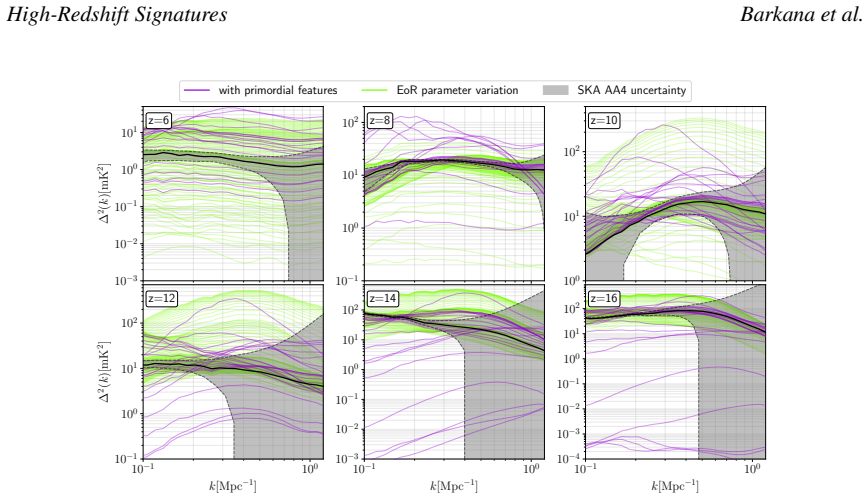
read the original abstract
In this chapter, we provide a comprehensive overview of the astrophysical and cosmological processes that shape the 21-cm signal during Cosmic Dawn and the Epoch of Reionization. We investigate both standard and exotic signatures potentially observable with SKA-Low. Standard signatures are those expected within the $\Lambda$CDM framework, including contributions from the first stars, galaxies, and black holes. Exotic signatures are more speculative indicating new physics, such as primordial black holes, modifications to the dark matter sector, non-standard primordial fluctuations, or strongly emitting radio galaxies. The effects of these different sources or scenarios are evaluated in the context of the expected sensitivity of SKA-Low, considering the AA* and AA4 configurations. The chapter aims to provide an overview of the theoretical landscape of 21-cm signatures and to highlight how the forthcoming SKA-Low observations will improve our understanding of astrophysical processes at early times and may open the door towards new physics beyond the $\Lambda$CDM framework.
Editorial analysis
A structured set of objections, weighed in public.
Referee Report
Summary. The manuscript is a review chapter providing a comprehensive overview of astrophysical and cosmological processes shaping the 21-cm signal during Cosmic Dawn and the Epoch of Reionization. It covers standard ΛCDM signatures from first stars, galaxies, and black holes, as well as exotic signatures from new physics (e.g., primordial black holes, modified dark matter, non-standard primordial fluctuations, or radio galaxies), and evaluates their detectability against SKA-Low sensitivity forecasts in the AA* and AA4 configurations.
Significance. If the literature summaries are accurate, the chapter offers a useful synthesis of the 21-cm theoretical landscape, highlighting how SKA-Low observations can constrain early-universe astrophysics and potentially test beyond-ΛCDM scenarios. It compiles existing models and sensitivity projections without introducing new derivations, which is appropriate for a review format.
Simulated Author's Rebuttal
We thank the referee for their positive review of the manuscript and for recommending acceptance. We are pleased that the chapter is regarded as a useful synthesis of the theoretical 21-cm landscape and its detectability with SKA-Low.
Circularity Check
Review chapter presents no new derivations or self-referential predictions
full rationale
This is a review chapter that compiles and summarizes existing literature on 21-cm signals during Cosmic Dawn and Reionization, including standard and exotic signatures in the context of SKA-Low sensitivity. No original derivations, fitted parameters, or quantitative predictions are introduced within the paper itself; all content is framed as overviews of prior published models. Consequently, there are no load-bearing steps that reduce by construction to inputs defined in the paper, satisfying the default expectation of no significant circularity.
Axiom & Free-Parameter Ledger
Reference graph
Works this paper leans on
-
[1]
On the properties of massive Population III stars and metal-free stellar populations
On the properties of massive Population III stars and metal-free stellar populations. , keywords =. doi:10.1051/0004-6361:20011619 , archivePrefix =. astro-ph/0110697 , primaryClass =
work page internal anchor Pith review Pith/arXiv arXiv doi:10.1051/0004-6361:20011619
-
[2]
Impact of cosmic rays on Population III star formation. , keywords =. doi:10.1111/j.1365-2966.2007.12247.x , archivePrefix =. 0705.3634 , primaryClass =
-
[3]
Possible interaction between baryons and dark-matter particles revealed by the first stars
Possible interaction between baryons and dark-matter particles revealed by the first stars. , keywords =. doi:10.1038/nature25791 , archivePrefix =. 1803.06698 , primaryClass =
work page internal anchor Pith review Pith/arXiv arXiv doi:10.1038/nature25791
-
[4]
Cosmic ray heating of intergalactic medium: patchy or uniform?. , keywords =. doi:10.1093/mnras/sty1481 , archivePrefix =. 1806.01295 , primaryClass =
-
[5]
Cosmic recombination history in light of EDGES measurements of the cosmic dawn 21-cm signal. , keywords =. doi:10.1103/PhysRevD.102.083502 , archivePrefix =. 2001.06497 , primaryClass =
-
[6]
Effect of primordial magnetic fields on the ionization history
Effect of primordial magnetic fields on the ionization history. , keywords =. doi:10.1093/mnras/stv1096 , archivePrefix =. 1503.04827 , primaryClass =
work page internal anchor Pith review Pith/arXiv arXiv doi:10.1093/mnras/stv1096
-
[7]
Simulating cosmic metal enrichment by the first galaxies
Simulating cosmic metal enrichment by the first galaxies. , keywords =. doi:10.1093/mnras/stu451 , archivePrefix =. 1403.1261 , primaryClass =
work page internal anchor Pith review Pith/arXiv arXiv doi:10.1093/mnras/stu451
-
[8]
Fluctuations in the high-redshift Lyman-Werner and Ly radiation backgrounds. , keywords =. doi:10.1111/j.1365-2966.2011.19752.x , archivePrefix =. 1105.5648 , primaryClass =
-
[9]
H_2 Cooling of Primordial Gas Triggered by UV Irradiation
H 2 Cooling of Primordial Gas Triggered by UV Irradiation. , keywords =. doi:10.1086/177628 , archivePrefix =. astro-ph/9511126 , primaryClass =
work page internal anchor Pith review Pith/arXiv arXiv doi:10.1086/177628
-
[10]
Magnetic fields limit the mass of Population III stars even before the onset of protostellar radiation feedback. , keywords =. doi:10.1093/mnrasl/slaf043 , archivePrefix =. 2501.12734 , primaryClass =
-
[11]
Population III star formation in the presence of turbulence, magnetic fields, and ionizing radiation feedback. , keywords =. doi:10.1093/mnras/staf803 , archivePrefix =. 2405.18265 , primaryClass =
-
[12]
Effective model for the 21-cm signal with population III stars. , keywords =. doi:10.1103/PhysRevD.111.083503 , archivePrefix =. 2407.18294 , primaryClass =
-
[13]
Ultraviolet photon production rates of the first stars: Impact on the He II λ 1640 A emission line from primordial star clusters and the 21-cm signal from cosmic dawn. arXiv e-prints , keywords =. doi:10.48550/arXiv.2507.21764 , archivePrefix =. 2507.21764 , primaryClass =
-
[14]
The Open Journal of Astrophysics , keywords =
Efficient semi-analytic modelling of Pop III star formation from Cosmic Dawn to Reionization. The Open Journal of Astrophysics , keywords =. doi:10.33232/001c.145070 , archivePrefix =. 2507.19581 , primaryClass =
-
[15]
Closing in on Pop-III stars: constraints and predictions across the spectrum. , keywords =. doi:10.1088/1475-7516/2025/10/047 , archivePrefix =. 2502.03525 , primaryClass =
-
[16]
Constraining First Star Formation with 21cm-Cosmology
Constraining First Star Formation with 21 cm Cosmology. , keywords =. doi:10.3847/2041-8213/ab1e51 , archivePrefix =. 1901.03344 , primaryClass =
work page internal anchor Pith review Pith/arXiv arXiv doi:10.3847/2041-8213/ab1e51 2041
-
[17]
III star formation and metallicity evolution II
Semi-analytical modelling of Pop. III star formation and metallicity evolution II. Impact on 21 cm power spectrum. , keywords =. doi:10.1093/mnras/staf699 , archivePrefix =. 2502.08971 , primaryClass =
-
[18]
Unique Signatures of Population III Stars in the Global 21-cm Signal
Unique signatures of Population III stars in the global 21-cm signal. , keywords =. doi:10.1093/mnras/sty1388 , archivePrefix =. 1710.02530 , primaryClass =
work page internal anchor Pith review Pith/arXiv arXiv doi:10.1093/mnras/sty1388
-
[19]
The effects of population III radiation backgrounds on the cosmological 21-cm signal. , keywords =. doi:10.1093/mnras/staa280 , archivePrefix =. 1910.10171 , primaryClass =
-
[20]
Formation of the first stars. Reports on Progress in Physics , keywords =. doi:10.1088/0034-4885/76/11/112901 , archivePrefix =. 1305.5178 , primaryClass =
work page internal anchor Pith review Pith/arXiv arXiv doi:10.1088/0034-4885/76/11/112901
-
[21]
Constraining the properties of Population III galaxies with multiwavelength observations. , keywords =. doi:10.1093/mnras/stae1185 , archivePrefix =. 2312.08095 , primaryClass =
-
[22]
Effects of chemically homogeneous evolution of the first stars on the 21-cm signal and reionization. , keywords =. doi:10.1093/mnras/staf1178 , archivePrefix =. 2504.00535 , primaryClass =
-
[23]
, year = 2007, volume =
Heating and Cooling of the Early Intergalactic Medium by Resonance Photons. , year = 2007, volume =
2007
-
[24]
2010, MNRAS, 402, 497, doi: 10.1111/j.1365-2966.2009.15898.x
Ly versus X-ray heating in the high-z intergalactic medium. , keywords =. doi:10.1111/j.1365-2966.2009.15843.x , archivePrefix =. 0910.1547 , primaryClass =
-
[25]
The Epoch of IGM heating by early sources of X-rays
The epoch of cosmic heating by early sources of X-rays. , keywords =. doi:10.1093/mnras/sty272 , archivePrefix =. 1801.09719 , primaryClass =
work page internal anchor Pith review Pith/arXiv arXiv doi:10.1093/mnras/sty272
-
[26]
X-ray background and its correlation with the 21 cm signal
X-ray background and its correlation with the 21 cm signal. , keywords =. doi:10.1093/mnras/sty1806 , archivePrefix =. 1807.01283 , primaryClass =
work page internal anchor Pith review Pith/arXiv arXiv doi:10.1093/mnras/sty1806
-
[27]
The X-ray spectra of the first galaxies: 21cm signatures
The X-ray spectra of the first galaxies: 21 cm signatures. , keywords =. doi:10.1093/mnras/stu1240 , archivePrefix =. 1403.6125 , primaryClass =
work page internal anchor Pith review Pith/arXiv arXiv doi:10.1093/mnras/stu1240
-
[28]
Journal of Physics G Nuclear Physics , year = 2005, month = may, volume =
TOPICAL REVIEW: Can diffusive shock acceleration in supernova remnants account for high-energy galactic cosmic rays?. Journal of Physics G Nuclear Physics , year = 2005, month = may, volume =. doi:10.1088/0954-3899/31/5/R02 , adsurl =
-
[29]
The Temperature of Intergalactic Gas. Sov. Astron. , year = 1966, month = apr, volume =
1966
-
[30]
Did Cosmic Rays Reionize the Intergalactic Medium?
Did cosmic rays reionize the intergalactic medium?. , keywords =. doi:10.1093/mnras/265.1.241 , archivePrefix =. astro-ph/9306001 , primaryClass =
work page internal anchor Pith review Pith/arXiv arXiv doi:10.1093/mnras/265.1.241
-
[31]
Cosmic Ray Astrophysics
-
[32]
Cosmic reionization by primordial cosmic rays
Cosmic reionization by primordial cosmic rays. , keywords =. doi:10.1051/0004-6361/201424666 , archivePrefix =. 1409.6225 , primaryClass =
work page internal anchor Pith review Pith/arXiv arXiv doi:10.1051/0004-6361/201424666
-
[33]
29th International Cosmic Ray Conference (ICRC29), Volume 9 , year = 2005, series =
Can Cosmic Rays Heat the Intergalactic Medium?. 29th International Cosmic Ray Conference (ICRC29), Volume 9 , year = 2005, series =
2005
-
[34]
Models of high redshift luminosity functions and galactic outflows: The dependence on halo mass function. New Astron. , keywords =. doi:10.1016/j.newast.2009.02.006 , archivePrefix =. 0902.3141 , primaryClass =
work page internal anchor Pith review Pith/arXiv arXiv doi:10.1016/j.newast.2009.02.006 2009
-
[35]
Efficient cold outflows driven by cosmic rays in high-redshift galaxies and their global effects on the IGM. , keywords =. doi:10.1093/mnras/sty287 , archivePrefix =. 1706.01890 , primaryClass =
work page internal anchor Pith review Pith/arXiv arXiv doi:10.1093/mnras/sty287
-
[36]
, year = 1969, month = may, volume =
The Effect of Wave-Particle Interactions on the Propagation of Cosmic Rays. , year = 1969, month = may, volume =. doi:10.1086/149981 , adsurl =
-
[37]
Plasma Physics for Astrophysics
-
[38]
Preheating of the Universe by cosmic rays from primordial supernovae at the beginning of cosmic reionization. , keywords =. doi:10.1093/mnras/stv2255 , archivePrefix =. 1509.08408 , primaryClass =
work page internal anchor Pith review Pith/arXiv arXiv doi:10.1093/mnras/stv2255
-
[39]
Simulations of Ion Acceleration at Non-relativistic Shocks. I. Acceleration Efficiency. , keywords =. doi:10.1088/0004-637X/783/2/91 , archivePrefix =. 1310.2943 , primaryClass =
work page internal anchor Pith review Pith/arXiv arXiv doi:10.1088/0004-637x/783/2/91
-
[40]
Radio background and IGM heating due to Pop III supernovae explosions
Radio background and IGM heating due to Pop III supernova explosions. , keywords =. doi:10.1093/mnras/sty3426 , archivePrefix =. 1812.07404 , primaryClass =
work page internal anchor Pith review Pith/arXiv arXiv doi:10.1093/mnras/sty3426
-
[41]
Do Cosmic Rays Heat the Early Intergalactic Medium?
Do cosmic rays heat the early intergalactic medium?. , keywords =. doi:10.1093/mnras/stx805 , archivePrefix =. 1703.09337 , primaryClass =
work page internal anchor Pith review Pith/arXiv arXiv doi:10.1093/mnras/stx805
-
[42]
European Physical Journal Web of Conferences , year = 2017, series =
Ultimate precision in cosmic-ray radio detection the SKA. European Physical Journal Web of Conferences , year = 2017, series =. doi:10.1051/epjconf/201713502003 , archivePrefix =. 1608.08869 , primaryClass =
-
[43]
Frank G. Schröder , keywords =. Radio detection of cosmic-ray air showers and high-energy neutrinos , journal =. 2017 , issn =. doi:https://doi.org/10.1016/j.ppnp.2016.12.002 , url =
-
[44]
Detecting cosmic rays with the LOFAR radio telescope
Detecting cosmic rays with the LOFAR radio telescope. , keywords =. doi:10.1051/0004-6361/201322683 , archivePrefix =. 1311.1399 , primaryClass =
work page internal anchor Pith review Pith/arXiv arXiv doi:10.1051/0004-6361/201322683
-
[45]
A large light-mass component of cosmic rays at 10^{17} - 10^{17.5} eV from radio observations
A large light-mass component of cosmic rays at 10 ^ 17 -10 ^ 17.5 electronvolts from radio observations. , keywords =. doi:10.1038/nature16976 , archivePrefix =. 1603.01594 , primaryClass =
work page internal anchor Pith review Pith/arXiv arXiv doi:10.1038/nature16976
-
[46]
Primordial magnetic fields during the cosmic dawn in light of EDGES 21-cm signal. , keywords =. doi:10.1093/mnras/staa1529 , archivePrefix =. 2005.14206 , primaryClass =
-
[47]
and Moodley, Kavilan and Skordis, Constantinos
Primordial magnetic fields in the post-recombination era and early reionization. , keywords =. doi:10.1111/j.1365-2966.2004.08520.x , archivePrefix =. astro-ph/0405413 , primaryClass =
-
[48]
Probing primordial magnetic fields with the 21-cm fluctuations. , keywords =. doi:10.1111/j.1365-2966.2006.10901.x , archivePrefix =. astro-ph/0607169 , primaryClass =
-
[49]
21 cm line signal from magnetic modes
21 cm line signal from magnetic modes. , keywords =. doi:10.1088/1475-7516/2019/01/033 , archivePrefix =. 1805.10943 , primaryClass =
work page internal anchor Pith review Pith/arXiv arXiv doi:10.1088/1475-7516/2019/01/033 2019
-
[50]
21-cm fluctuations from primordial magnetic fields. , keywords =. doi:10.1103/PhysRevD.109.023518 , archivePrefix =. 2308.04483 , primaryClass =
-
[51]
Revisiting primordial magnetic fields through 21-cm physics: bounds and forecasts. , keywords =. doi:10.1088/1475-7516/2025/01/089 , archivePrefix =. 2407.11923 , primaryClass =
-
[52]
Journal of Cosmology and Astroparticle Physics , volume=
Inverse Gertsenshtein effect as a probe of high-frequency gravitational waves , author=. Journal of Cosmology and Astroparticle Physics , volume=. 2024 , publisher=
2024
-
[53]
Physical review letters , volume=
Potential of radio telescopes as high-frequency gravitational wave detectors , author=. Physical review letters , volume=. 2021 , publisher=
2021
-
[54]
Journal of Cosmology and Astroparticle Physics , volume=
The future of primordial features with 21 cm tomography , author=. Journal of Cosmology and Astroparticle Physics , volume=. 2016 , publisher=
2016
-
[55]
Physical Review D , volume=
Primordial non-Gaussianity and non-Gaussian covariance , author=. Physical Review D , volume=. 2023 , publisher=
2023
-
[56]
Monthly Notices of the Royal Astronomical Society , volume=
On the constraints on superconducting cosmic strings from 21-cm cosmology , author=. Monthly Notices of the Royal Astronomical Society , volume=. 2024 , publisher=
2024
-
[57]
Signatures of cosmic ray heating in 21-cm observables. , keywords =. doi:10.1093/mnras/stad3014 , archivePrefix =. 2304.07201 , primaryClass =
-
[58]
, year = 2014, volume =
The observable signature of late heating of the Universe during cosmic reionization. , year = 2014, volume =
2014
-
[59]
, year = 2007, volume =
21-cm fluctuations from inhomogeneous X-ray heating before reionization. , year = 2007, volume =
2007
-
[60]
Simulating cosmic reionization at large scales - I. The geometry of reionization. , keywords =. doi:10.1111/j.1365-2966.2006.10502.x , archivePrefix =. astro-ph/0512187 , primaryClass =
-
[61]
ApJ , year = 1997, volume =
21 Centimeter Tomography of the Intergalactic Medium at High Redshift. ApJ , year = 1997, volume =
1997
-
[62]
Radio Power from a Direct-collapse Black Hole in CR7. , keywords =. doi:10.3847/2041-8213/ab9a30 , archivePrefix =. 2004.04167 , primaryClass =
-
[63]
Radiation Hydrodynamical Simulations of the First Quasars
Radiation Hydrodynamical Simulations of the First Quasars. , keywords =. doi:10.3847/1538-4357/aad7b8 , archivePrefix =. 1703.00449 , primaryClass =
work page internal anchor Pith review Pith/arXiv arXiv doi:10.3847/1538-4357/aad7b8
-
[64]
Radio signals from early direct collapse black holes. , keywords =. doi:10.1093/mnras/stab2121 , archivePrefix =. 2107.11307 , primaryClass =
-
[65]
Cosmic Reionization in the JWST Era: Back to AGNs?. , keywords =. doi:10.3847/1538-4357/ad5ce8 , archivePrefix =. 2406.18697 , primaryClass =
-
[66]
The impact of faint AGN discovered by JWST on reionization. arXiv e-prints , keywords =. doi:10.48550/arXiv.2409.15453 , archivePrefix =. 2409.15453 , primaryClass =
-
[67]
UNCOVERing the contribution of black holes to reionization. , keywords =. doi:10.1051/0004-6361/202449331 , archivePrefix =. 2401.11242 , primaryClass =
-
[68]
Impact of the Epoch of Reionization sources on the 21-cm bispectrum. , keywords =. doi:10.1088/1475-7516/2024/10/003 , archivePrefix =. 2406.03118 , primaryClass =
-
[69]
Detecting ionized bubbles around luminous sources during the reionization era using HI 21 cm signal. , keywords =. doi:10.1088/1475-7516/2025/02/055 , archivePrefix =. 2408.01681 , primaryClass =
-
[70]
Physics of Cosmic Reionization
Physics of Cosmic Reionization. arXiv e-prints , keywords =. doi:10.48550/arXiv.astro-ph/0603149 , archivePrefix =. astro-ph/0603149 , primaryClass =
work page internal anchor Pith review Pith/arXiv arXiv doi:10.48550/arxiv.astro-ph/0603149
-
[71]
Quasar HII regions during cosmic reionization. , keywords =. doi:10.1111/j.1745-3933.2007.00342.x , archivePrefix =. astro-ph/0703740 , primaryClass =
-
[72]
Improving constraints on the reionization parameters using 21-cm bispectrum. , keywords =. doi:10.1088/1475-7516/2022/04/045 , archivePrefix =. 2108.07279 , primaryClass =
-
[73]
Sensitivity for 21cm Bispectrum from Epoch of Reionization
Sensitivity for 21 cm bispectrum from Epoch of Reionization. , keywords =. doi:10.1093/mnras/stv855 , archivePrefix =. 1412.5279 , primaryClass =
work page internal anchor Pith review Pith/arXiv arXiv doi:10.1093/mnras/stv855
-
[75]
Probing non-Gaussian features in the HI distribution at the epoch of re-ionization. , keywords =. doi:10.1111/j.1365-2966.2005.08836.x , archivePrefix =. astro-ph/0410581 , primaryClass =
-
[76]
Glimmers in the Cosmic Dawn. II. A variability census of supermassive black holes across the Universe. arXiv e-prints , keywords =. doi:10.48550/arXiv.2501.17675 , archivePrefix =. 2501.17675 , primaryClass =
-
[77]
Formation of massive black holes in rapidly growing pre-galactic gas clouds
Formation of massive black holes in rapidly growing pre-galactic gas clouds. , keywords =. doi:10.1038/s41586-019-0873-4 , archivePrefix =. 1901.07563 , primaryClass =
work page internal anchor Pith review Pith/arXiv arXiv doi:10.1038/s41586-019-0873-4 1901
-
[78]
Cosmic Reionization on Computers: The Evolution of the Ionizing Background and Mean Free Path. , keywords =. doi:10.3847/1538-4357/ada1d3 , archivePrefix =. 2405.00100 , primaryClass =
-
[79]
The 21-cm signal during the end stages of reionization. , keywords =. doi:10.1093/mnras/stae1999 , archivePrefix =. 2403.04838 , primaryClass =
-
[80]
The forest at EndEoR: the effect of Lyman limit systems on the end of reionization. , keywords =. doi:10.1093/mnras/stae2788 , archivePrefix =. 2405.04273 , primaryClass =
-
[81]
The Effects of Lyman-Limit Systems on the Evolution and Observability of the Epoch of Reionization
The effects of Lyman-limit systems on the evolution and observability of the epoch of reionization. , keywords =. doi:10.1093/mnras/stw249 , archivePrefix =. 1602.01144 , primaryClass =
work page internal anchor Pith review Pith/arXiv arXiv doi:10.1093/mnras/stw249
discussion (0)
Sign in with ORCID, Apple, or X to comment. Anyone can read and Pith papers without signing in.