Multipolar Magnetic-Field Inference for PSR J0740+6620 with Neural-Network-Accelerated NICER Pulse-Profile Modeling
Pith reviewed 2026-07-01 01:31 UTC · model grok-4.3
The pith
An offset dipole-plus-quadrupole magnetic field reproduces the double-peaked NICER pulse profile of PSR J0740+6620 while a zero-offset version is disfavored.
A machine-rendered reading of the paper's core claim, the machinery that carries it, and where it could break.
Core claim
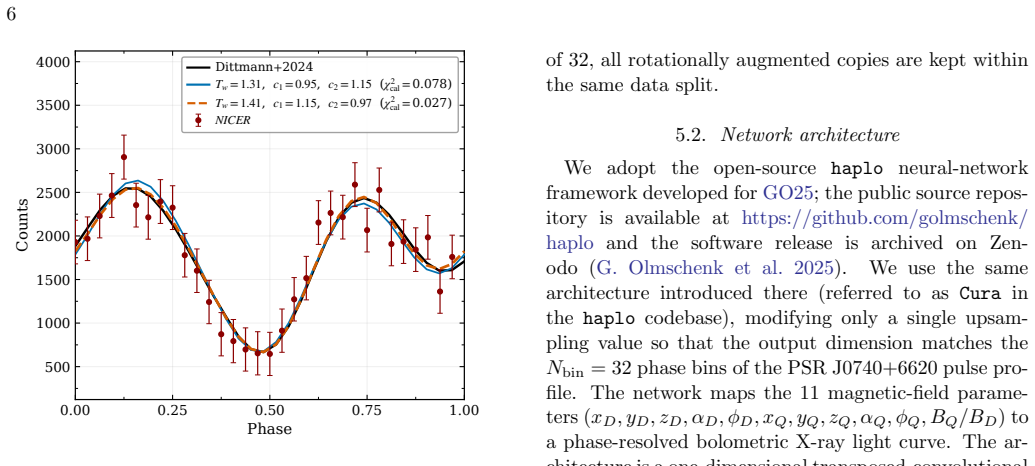
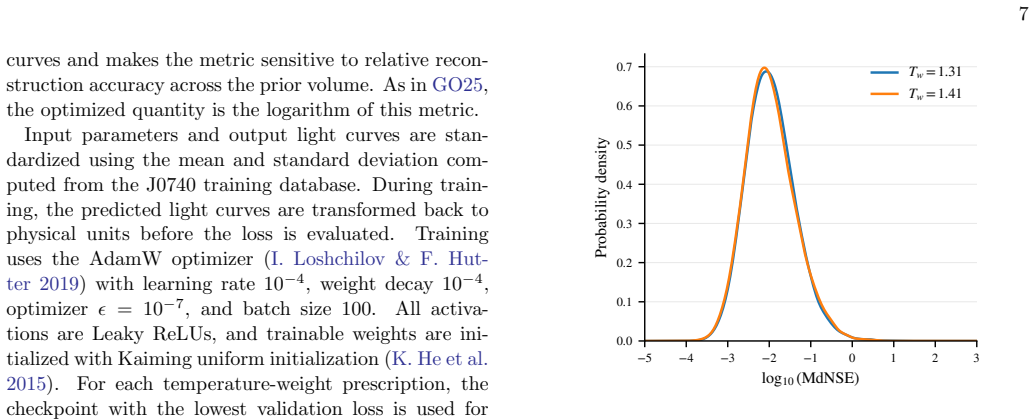
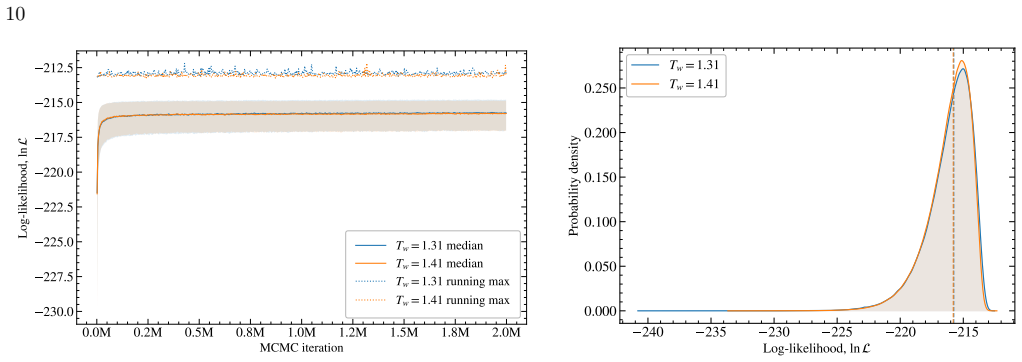
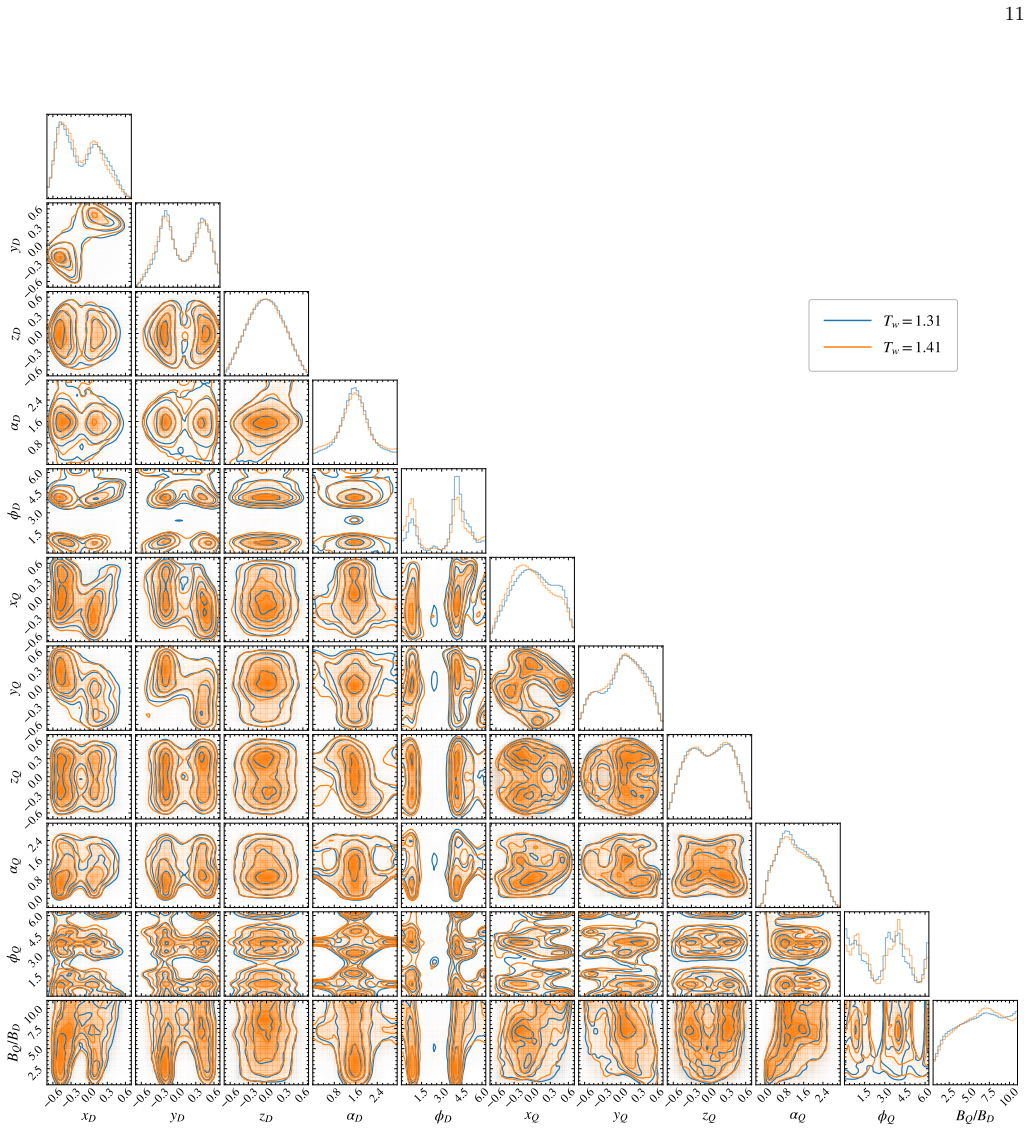
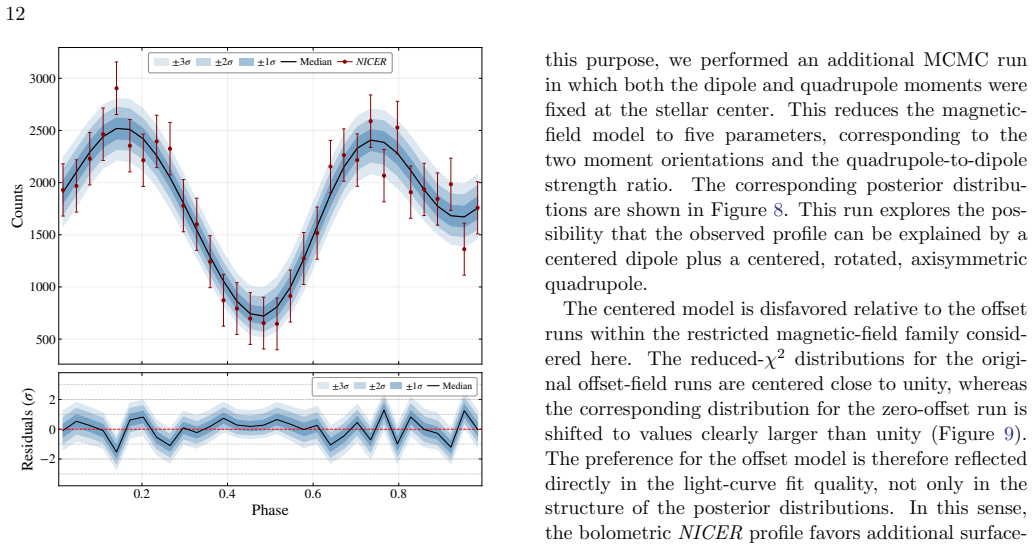
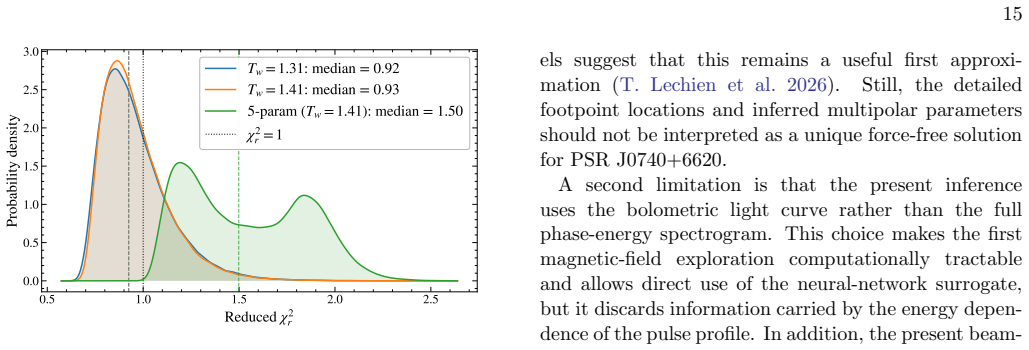
By representing the emitting regions as the open-field-line footpoints of a static vacuum multipolar field consisting of an offset dipole plus axisymmetric quadrupole, and by using convolutional neural-network surrogates to evaluate 5.12 times 10 to the 7 synthetic light curves, the analysis shows that this model reproduces the observed double-peaked bolometric NICER pulse profile. The posteriors are broad and multimodal, the maximum-likelihood values are similar for the two calibrated temperature weights, and a restricted zero-offset run is disfavored within the adopted parameterization.
What carries the argument
The offset dipole plus axisymmetric quadrupole static vacuum multipolar field, whose open-field-line footpoints define the locations and shapes of the emitting regions.
If this is right
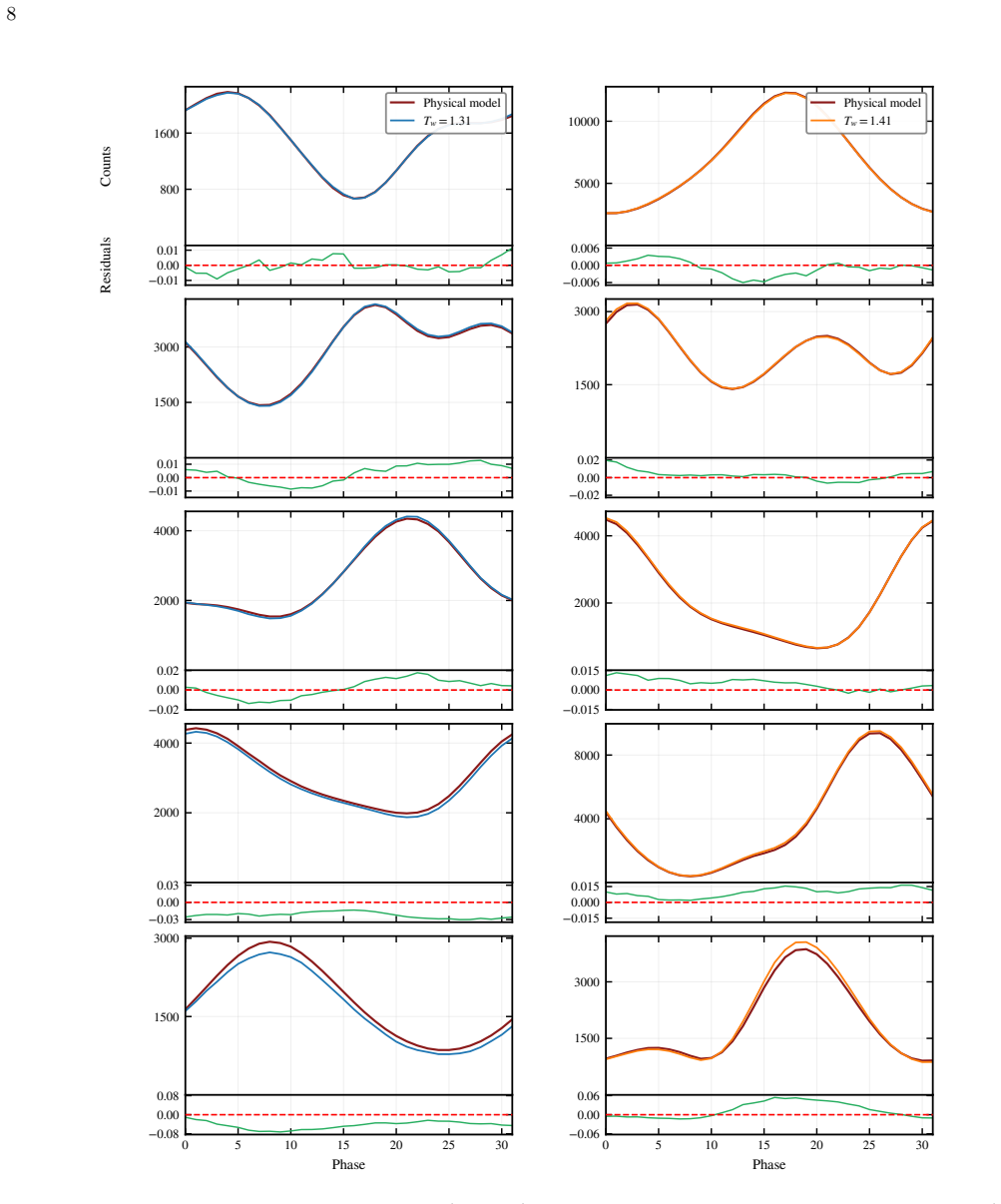
- The neural-network surrogates accelerate likelihood evaluations by a factor of at least 400, making an 11-dimensional magnetic-field inference computationally feasible on parallel CPU resources.
- The similarity of posteriors for the two temperature-weight prescriptions demonstrates weak sensitivity to that modeling choice.
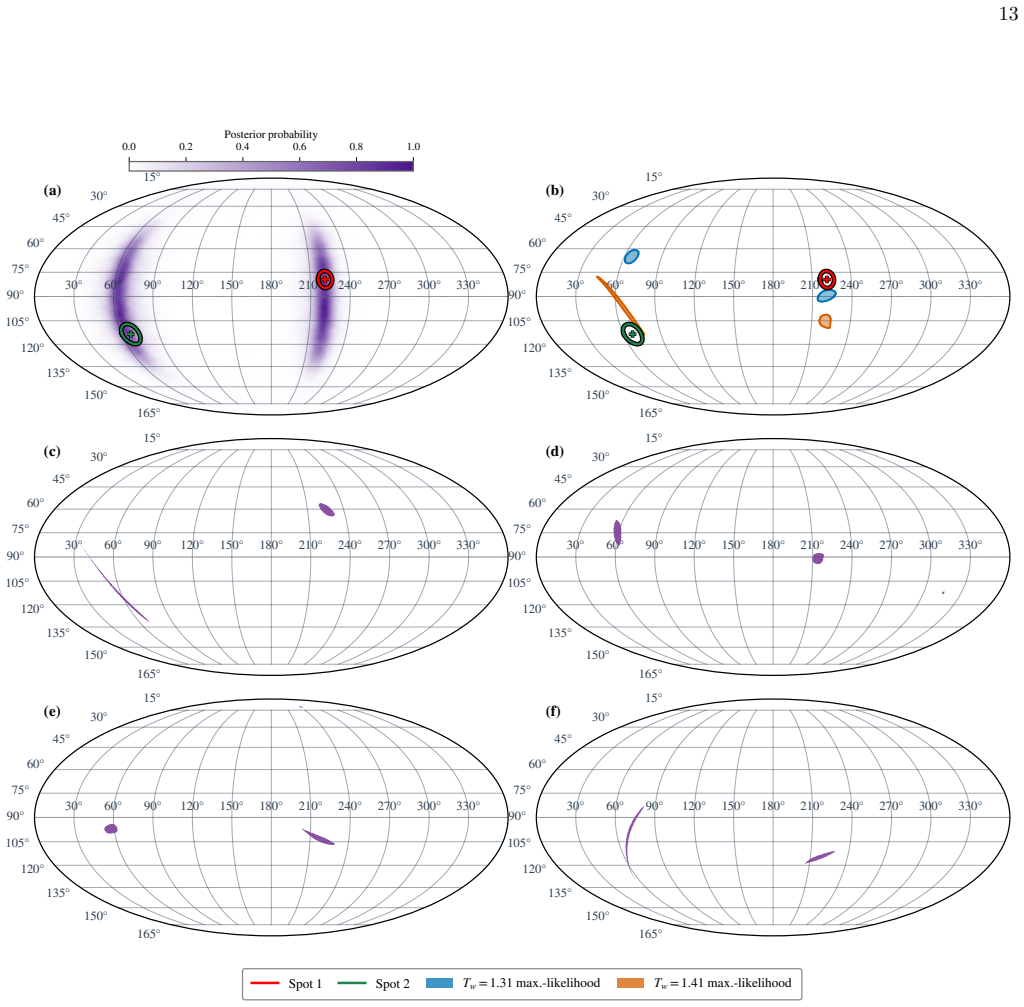
- Pulse phases constrain the approximate azimuthal placement of emission regions while latitude, surface extent, and morphology remain weakly constrained.
- The method extends neural-network-accelerated multipolar inference to PSR J0740+6620 and supports future energy-dependent and force-free extensions.
Where Pith is reading between the lines
- Jointly varying the fixed stellar and geometric parameters together with the magnetic-field parameters would likely expose additional degeneracies or tighten the constraints.
- Adding gamma-ray pulse-profile data to the X-ray likelihood could help resolve the broad multimodal posteriors in the multipolar coefficients.
- The same surrogate approach could be applied to other NICER-observed millisecond pulsars to test whether offset multipolar geometries are common.
Load-bearing premise
Stellar mass, radius, observer inclination, and hotspot temperature ratio are fixed to the Dittmann et al. (2024) maximum-likelihood values, and emitting regions coincide exactly with open-field-line footpoints of the static vacuum multipolar field.
What would settle it
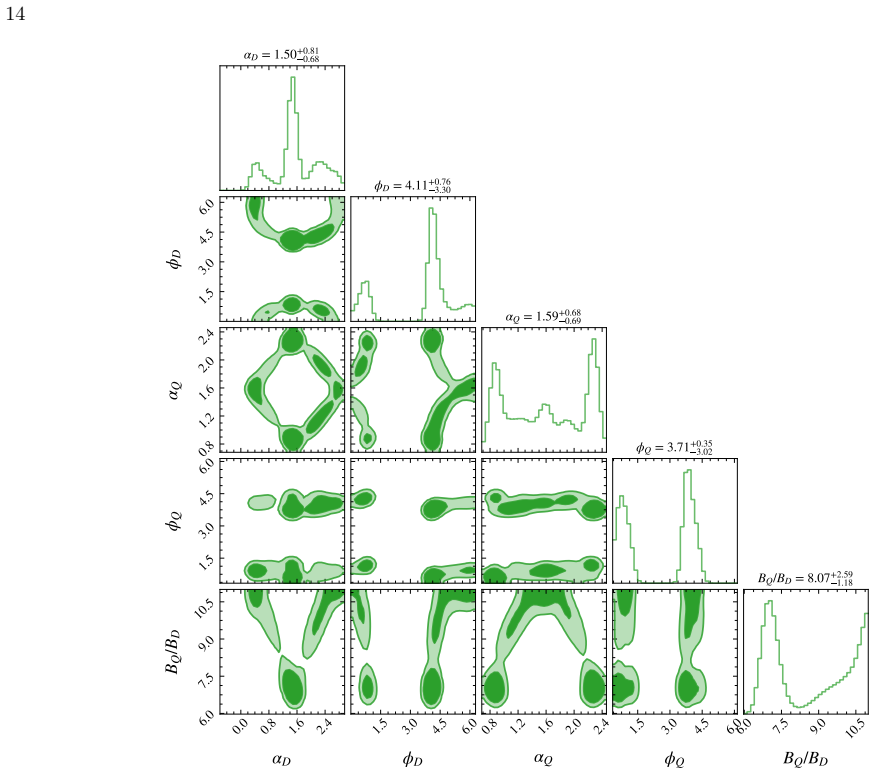
An MCMC exploration restricted to zero offset that produces a comparable or higher likelihood value for the 32-bin NICER profile would show that the offset is not required within the adopted field basis.
Figures
read the original abstract
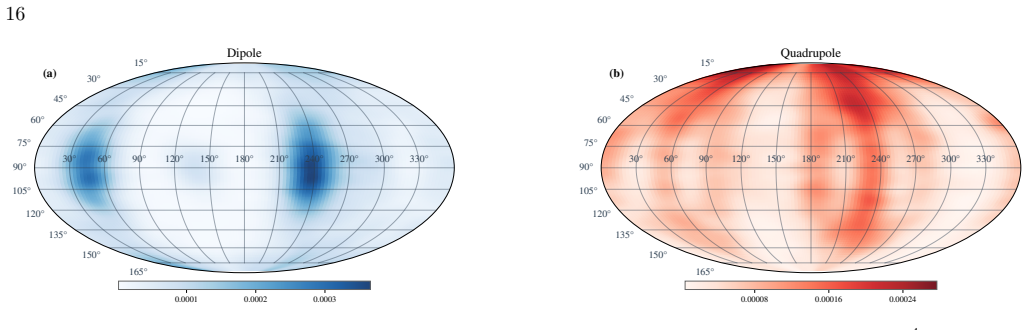
We investigate the multipolar surface magnetic-field structure of the high-mass millisecond pulsar PSR J0740+6620 using the 32-bin bolometric NICER pulse profile of Dittmann et al. (2024). Building on the neural-network surrogate framework of Olmschenk et al. (2025), we model the emitting regions as open-field-line footpoints of an offset dipole plus axisymmetric quadrupole static vacuum field, rather than as prescribed geometric hotspots. We fix the stellar mass, radius, observer inclination, and hotspot temperature ratio to the Dittmann et al. (2024) maximum-likelihood values and explore the resulting 11-dimensional magnetic-field space. To make this feasible, we train convolutional neural-network surrogates on $5.12\times10^7$ synthetic bolometric light curves and use them in a parallel ensemble Markov Chain Monte Carlo calculation on 4000 CPU cores, accelerating likelihood evaluations by a factor of $\gtrsim 400$. We perform independent inferences for two calibrated temperature-weight prescriptions, Tw=1.31 and Tw=1.41, encoding the relative bolometric weight associated with the hotspot temperature difference. The posteriors, posterior-predictive light curves, and maximum-likelihood values are very similar, indicating weak sensitivity to this choice. The offset model reproduces the observed double-peaked profile and yields broad, multimodal posteriors, reflecting both the background-dominated data and degeneracies of the multipolar parameterization. The hotspot-density map shows that pulse phases constrain the approximate azimuthal placement of the emission, while latitude, surface extent, and morphology remain weakly constrained. A restricted zero offset run is disfavored within the adopted field basis. This work extends neural-network-accelerated magnetic-field inference to PSR J0740+6620 and motivates future energy-dependent, force-free, and joint X-ray/$\gamma$-ray extensions.
Editorial analysis
A structured set of objections, weighed in public.
Referee Report
Summary. The manuscript performs an 11-dimensional Bayesian inference of the surface magnetic field of PSR J0740+6620 from its 32-bin NICER bolometric pulse profile, modeling emission regions as open-field-line footpoints of an offset dipole plus axisymmetric quadrupole vacuum field. Stellar mass, radius, observer inclination, and hotspot temperature ratio are fixed to the Dittmann et al. (2024) maximum-likelihood values; convolutional neural-network surrogates trained on 5.12×10^7 synthetic light curves accelerate likelihood evaluations by ≳400× to enable parallel ensemble MCMC. The offset model is reported to reproduce the observed double-peaked profile, with broad multimodal posteriors, while a restricted zero-offset run is disfavored; results are insensitive to the choice of two calibrated temperature-weight prescriptions.
Significance. If the results hold, the work demonstrates computational feasibility of neural-network-accelerated multipolar field inference on real high-mass MSP data, extending the Olmschenk et al. (2025) surrogate framework. The scale of the training set and parallel implementation on 4000 cores are notable strengths that enable exploration of an 11-dimensional parameter space.
major comments (2)
- [Abstract] Abstract: The claim that a restricted zero-offset run is disfavored is obtained after fixing stellar mass, radius, observer inclination, and hotspot temperature ratio to the Dittmann et al. (2024) maximum-likelihood point derived under a prescribed geometric hotspot model. Because these values are not re-optimized or marginalized under the open-field-line footpoint geometry, the apparent preference for nonzero offset may be an artifact of the conditioning rather than a robust comparison within the adopted field basis.
- [Abstract] Abstract / surrogate training description: No quantitative validation metrics (e.g., test-set mean absolute error, maximum surrogate prediction error, or posterior sensitivity to surrogate uncertainty) are reported for the convolutional neural-network surrogates, which are load-bearing for the reliability of the reported posteriors and the disfavoring statement.
minor comments (1)
- [Abstract] The abstract states that the posteriors are 'very similar' for Tw=1.31 and Tw=1.41 but does not quantify the level of agreement (e.g., via overlap integrals or parameter shifts) or provide the physical motivation for these specific calibrated values.
Simulated Author's Rebuttal
We thank the referee for their careful reading and constructive comments on our manuscript. We address each major comment below and indicate where revisions will be made to improve clarity and completeness.
read point-by-point responses
-
Referee: [Abstract] Abstract: The claim that a restricted zero-offset run is disfavored is obtained after fixing stellar mass, radius, observer inclination, and hotspot temperature ratio to the Dittmann et al. (2024) maximum-likelihood point derived under a prescribed geometric hotspot model. Because these values are not re-optimized or marginalized under the open-field-line footpoint geometry, the apparent preference for nonzero offset may be an artifact of the conditioning rather than a robust comparison within the adopted field basis.
Authors: We agree that the comparison is conditional on the fixed stellar mass, radius, observer inclination, and temperature ratio taken from the Dittmann et al. (2024) maximum-likelihood point, which was obtained under a different geometric hotspot prescription. Our statement that the zero-offset model is disfavored therefore holds only within this fixed-parameter setup and the adopted multipolar field basis; it is not a fully marginalized result. We will revise the abstract to explicitly note this conditioning and the limited scope of the model comparison, while retaining the reported finding that, under these choices, the zero-offset run is disfavored. revision: yes
-
Referee: [Abstract] Abstract / surrogate training description: No quantitative validation metrics (e.g., test-set mean absolute error, maximum surrogate prediction error, or posterior sensitivity to surrogate uncertainty) are reported for the convolutional neural-network surrogates, which are load-bearing for the reliability of the reported posteriors and the disfavoring statement.
Authors: We acknowledge that the current manuscript does not report quantitative validation metrics such as test-set mean absolute error, maximum prediction error, or an assessment of how surrogate uncertainty affects the posteriors. Although the training-set size and the resulting speed-up factor are stated, these additional diagnostics are needed to substantiate the reliability of the MCMC results. In the revised manuscript we will add an appendix or dedicated subsection presenting the held-out test-set errors, maximum deviations, and a brief sensitivity test of the posteriors to surrogate noise, thereby addressing the referee's concern directly. revision: yes
Circularity Check
Minor self-citation of surrogate framework; central inference remains independent of fitted inputs
full rationale
The paper performs Bayesian inference on an 11-dimensional magnetic field parameter space using neural network surrogates trained on 5.12e7 synthetic light curves generated from the adopted multipolar field model. Stellar parameters are fixed to values from an external reference (Dittmann et al. 2024), and the data are from NICER observations reported therein. The comparison between offset and zero-offset models is conducted within this fixed setup, but the posteriors and model preference do not reduce by construction to the input parameters or prior citations. The surrogate training and MCMC sampling provide independent content, making the analysis self-contained against external benchmarks with only minor reliance on prior framework papers.
Axiom & Free-Parameter Ledger
free parameters (1)
- 11-dimensional magnetic-field parameters
axioms (1)
- domain assumption Magnetic field is a static vacuum offset dipole plus axisymmetric quadrupole
Reference graph
Works this paper leans on
-
[1]
Alpar, M. A., Cheng, A. F., Ruderman, M. A., & Shaham, J. 1982, Nature, 300, 728, doi: 10.1038/300728a0
-
[2]
2010, ApJ, 715, 1282, doi: 10.1088/0004-637X/715/2/1282
Bai, X.-N., & Spitkovsky, A. 2010, ApJ, 715, 1282, doi: 10.1088/0004-637X/715/2/1282
-
[3]
Bhattacharya, D., & van den Heuvel, E. P. J. 1991, Phys. Rep., 203, 1, doi: 10.1016/0370-1573(91)90064-S
-
[4]
Bilous, A. V., Watts, A. L., Harding, A. K., et al. 2019, ApJL, 887, L23, doi: 10.3847/2041-8213/ab53e7
-
[5]
Bogdanov, S., Guillot, S., Ray, P. S., et al. 2019, ApJL, 887, L25, doi: 10.3847/2041-8213/ab53eb
-
[6]
Y., Yuan, Y., & Vasilopoulos, G
Chen, A. Y., Yuan, Y., & Vasilopoulos, G. 2020, ApJL, 893, L38, doi: 10.3847/2041-8213/ab85c5
-
[7]
1999, ApJ, 511, 351, doi: 10.1086/306652
Contopoulos, I., Kazanas, D., & Fendt, C. 1999, ApJ, 511, 351, doi: 10.1086/306652
-
[8]
Cromartie, H. T., Fonseca, E., Ransom, S. M., et al. 2020, Nat. Astron., 4, 72, doi: 10.1038/s41550-019-0880-2
-
[9]
Dittmann, A. J., Miller, M. C., Lamb, F. K., et al. 2024, ApJ, 974, 295, doi: 10.3847/1538-4357/ad5f1e
-
[10]
Fonseca, E., Cromartie, H. T., Pennucci, T. T., et al. 2021, ApJL, 915, L12, doi: 10.3847/2041-8213/ac03b8
-
[11]
C., Arzoumanian, Z., Adkins, P
Gendreau, K. C., Arzoumanian, Z., Adkins, P. W., et al. 2016, in Proc. SPIE, Vol. 9905, 99051H, doi: 10.1117/12.2231304
-
[12]
Goodman, J., & Weare, J. 2010, Communications in Applied Mathematics and Computational Science, 5, 65, doi: 10.2140/camcos.2010.5.65
-
[13]
Harding, A. K., & Muslimov, A. G. 2001, ApJ, 556, 987, doi: 10.1086/321589
-
[14]
Harding, A. K., & Muslimov, A. G. 2002, ApJ, 568, 862, doi: 10.1086/338985
-
[15]
He, K., Zhang, X., Ren, S., & Sun, J. 2015, in Proceedings of the IEEE International Conference on Computer Vision (ICCV), 1026–1034, doi: 10.1109/ICCV.2015.123
-
[16]
Deep Residual Learning for Image Recognition,
He, K., Zhang, X., Ren, S., & Sun, J. 2016, in Proceedings of the IEEE Conference on Computer Vision and Pattern Recognition (CVPR), 770–778, doi: 10.1109/CVPR.2016.90
-
[17]
Kalapotharakos, C., Harding, A. K., & Kazanas, D. 2014, ApJ, 793, 97, doi: 10.1088/0004-637X/793/2/97
-
[18]
2021, ApJ, 907, 63, doi: 10.3847/1538-4357/abcec0
Kazanas, D. 2021, ApJ, 907, 63, doi: 10.3847/1538-4357/abcec0
-
[19]
The swept-back multipolar magnetic field of neutron stars: Application to NICER MSP J0030+0451
Kundu, A., Kalapotharakos, C., Wadiasingh, Z., et al. 2026, arXiv e-prints. https://arxiv.org/abs/2604.19534
work page internal anchor Pith review Pith/arXiv arXiv 2026
-
[20]
2026, in preparation
Lechien, T., Olmschenk, G., Kalapotharakos, C., et al. 2026, in preparation
2026
-
[21]
2019, in International Conference on Learning Representations (ICLR)
Loshchilov, I., & Hutter, F. 2019, in International Conference on Learning Representations (ICLR). https://openreview.net/forum?id=Bkg6RiCqY7
2019
-
[22]
Miller, M. C., Lamb, F. K., Dittmann, A. J., et al. 2019, ApJL, 887, L24, doi: 10.3847/2041-8213/ab50c5
-
[23]
Miller, M. C., Lamb, F. K., Dittmann, A. J., et al. 2021, ApJL, 918, L28, doi: 10.3847/2041-8213/ac089b 18
-
[24]
2025, ApJ, 991, 169, doi: 10.3847/1538-4357/ae03c0
Olmschenk, G., Broadbent, E., Kalapotharakos, C., et al. 2025, ApJ, 991, 169, doi: 10.3847/1538-4357/ae03c0
-
[25]
Broadbent, E., & Wallace, W. F. 2025, haplo, Zenodo, doi: 10.5281/zenodo.14814679 P´ etri, J., Guillot, S., Guillemot, L., et al. 2023, A&A, 680, A93, doi: 10.1051/0004-6361/202346913
-
[26]
Raaijmakers, G., Greif, S. K., Hebeler, K., et al. 2021, ApJL, 918, L29, doi: 10.3847/2041-8213/ac089a
-
[27]
Riley, T. E., Watts, A. L., Bogdanov, S., et al. 2019, ApJL, 887, L21, doi: 10.3847/2041-8213/ab481c
-
[28]
Riley, T. E., Watts, A. L., Ray, P. S., et al. 2021, ApJL, 918, L27, doi: 10.3847/2041-8213/ac0a81
-
[29]
2024, ApJ, 974, 294, doi: 10.3847/1538-4357/ad5f1f
Salmi, T., Choudhury, D., Kini, Y., et al. 2024, ApJ, 974, 294, doi: 10.3847/1538-4357/ad5f1f
discussion (0)
Sign in with ORCID, Apple, or X to comment. Anyone can read and Pith papers without signing in.