Leveraging Multimodality for Real-Time Classification of Transients and Variables found by the Zwicky Transient Facility
Pith reviewed 2026-07-02 17:00 UTC · model grok-4.3
The pith
Adding metadata and images to light curves raises real-time transient classification accuracy by up to 40 percent on ZTF data.
A machine-rendered reading of the paper's core claim, the machinery that carries it, and where it could break.
Core claim
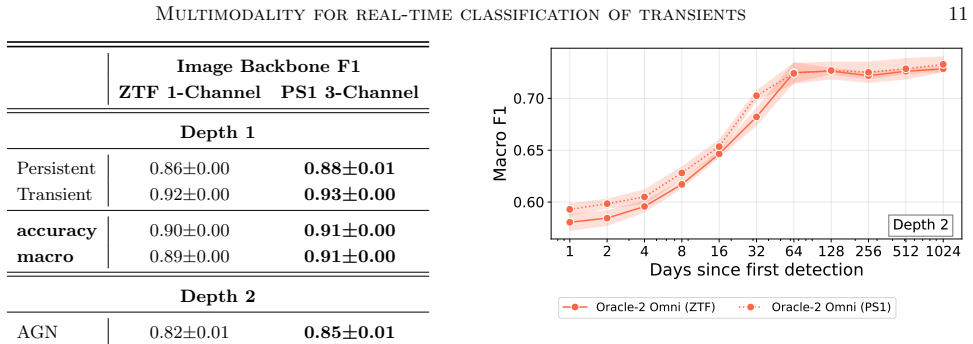
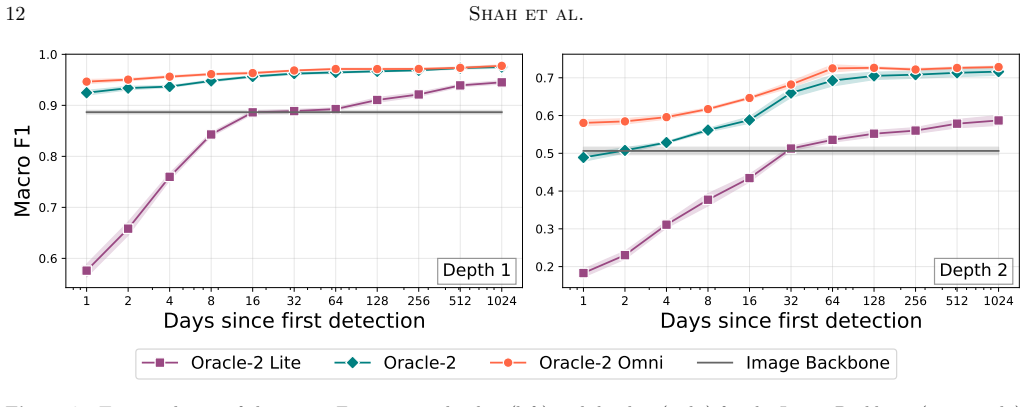
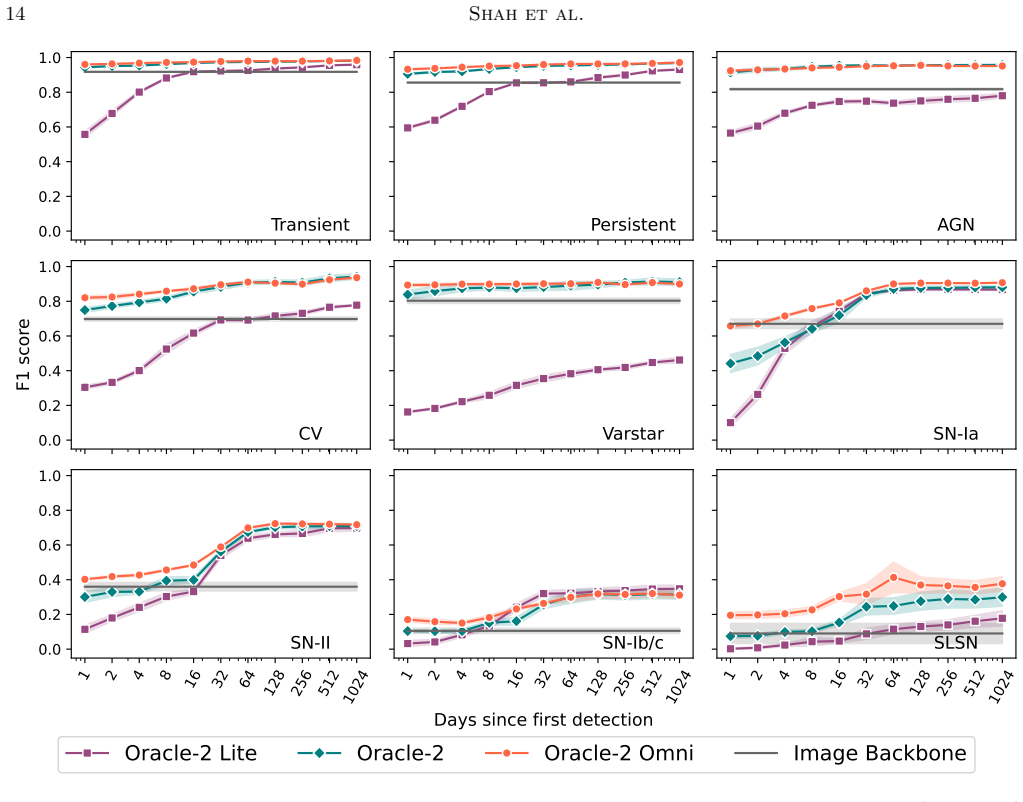
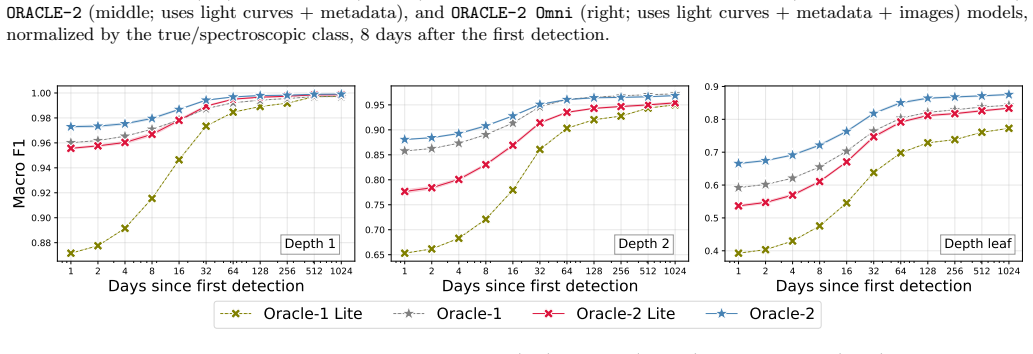
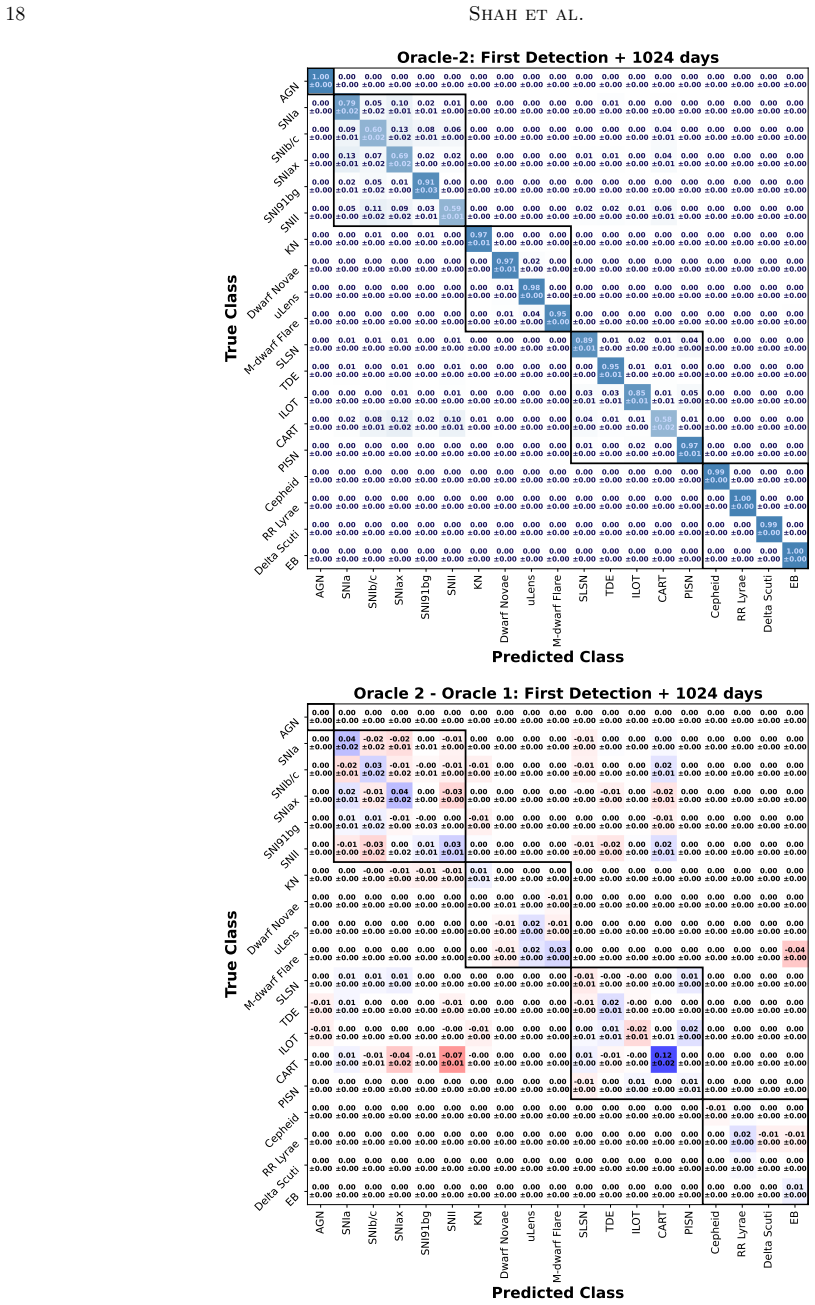
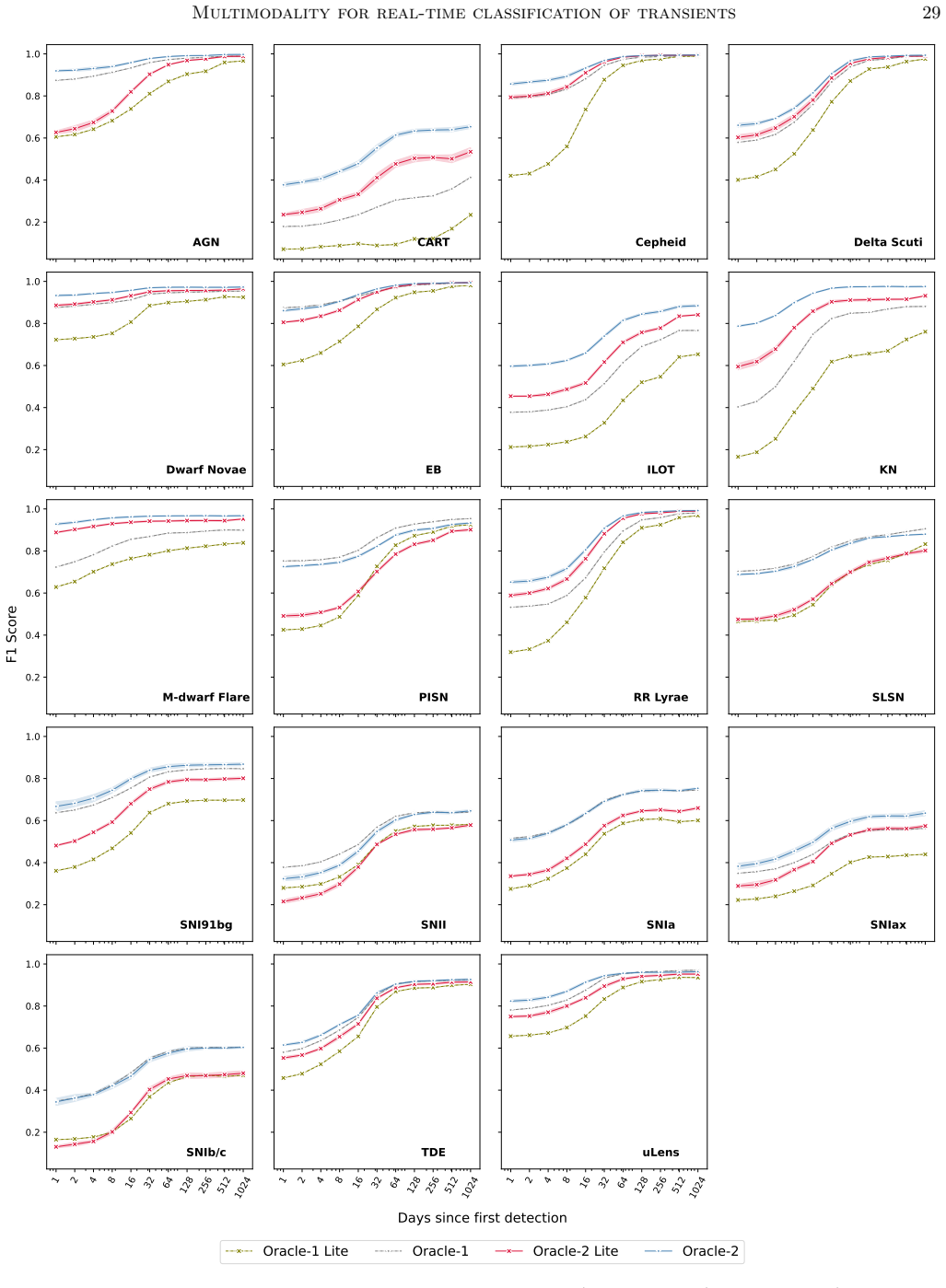
The central claim is that ORACLE-2 hierarchical classifiers that combine light-curve time series, metadata features, and image data deliver consistently higher macro F1 scores than unimodal light-curve models, with the largest improvements occurring at the earliest epochs when light curves remain sparse. On ZTF BTS data the full multimodal ORACLE-2 Omni model achieves 0.73 macro F1, an improvement of up to 11 percent over light-curve-plus-metadata and up to 40 percent over light-curve-only versions. A light-curve-plus-metadata model trained on the ELAsTiCC simulation reaches 0.88 macro F1, matching other state-of-the-art results while remaining deployable on the actual ZTF alert stream.
What carries the argument
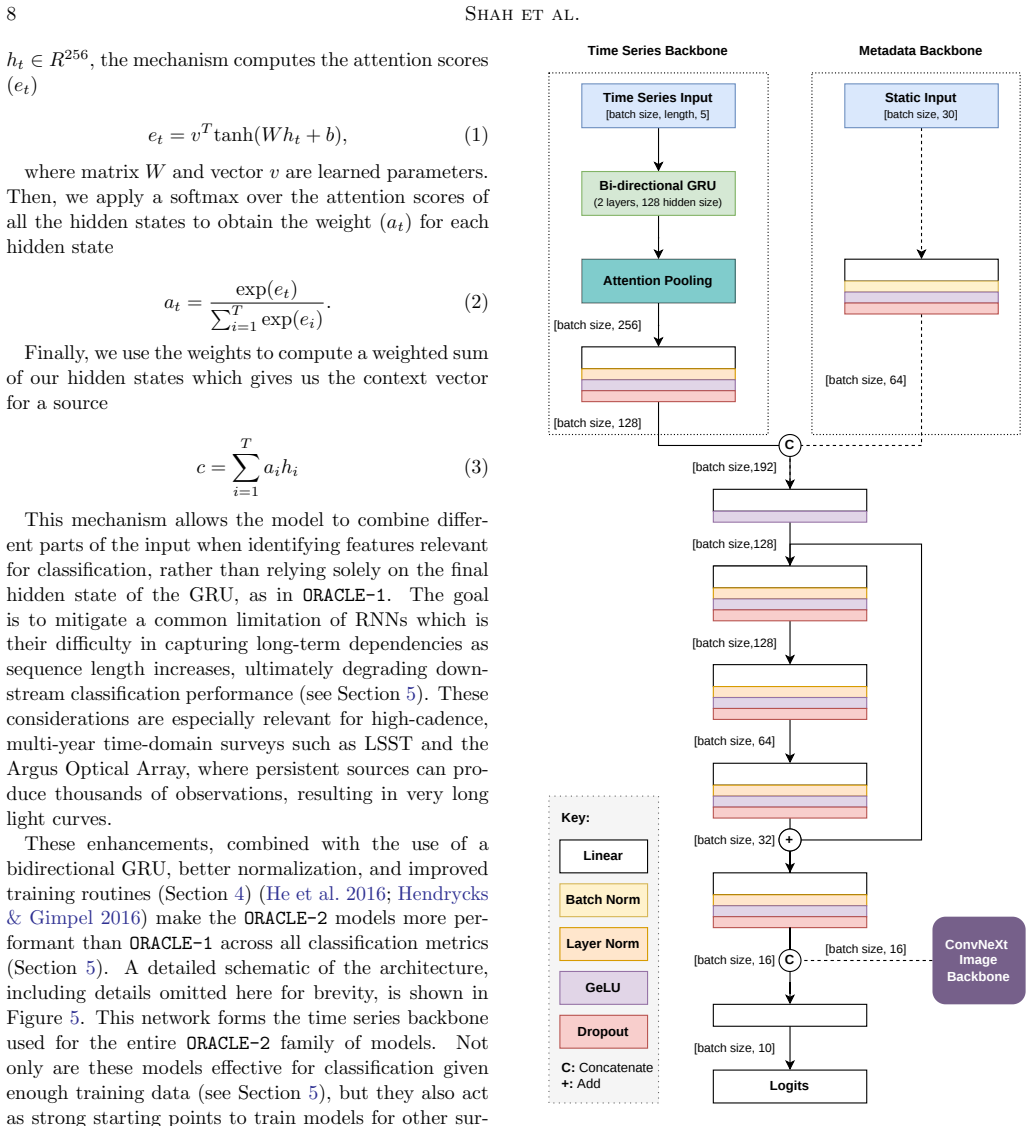
The ORACLE-2 models that perform hierarchical classification by fusing light-curve time series with metadata and image inputs to output real-time class probabilities.
Load-bearing premise
The training and test distributions from ZTF BTS and ELAsTiCC simulations are representative enough of future live alert streams that the reported F1 gains will hold under different class priors and alert rates.
What would settle it
A deployment test on new live ZTF alerts in which the multimodal model's macro F1 on a held-out sample of confirmed transients falls below the light-curve-only baseline.
Figures
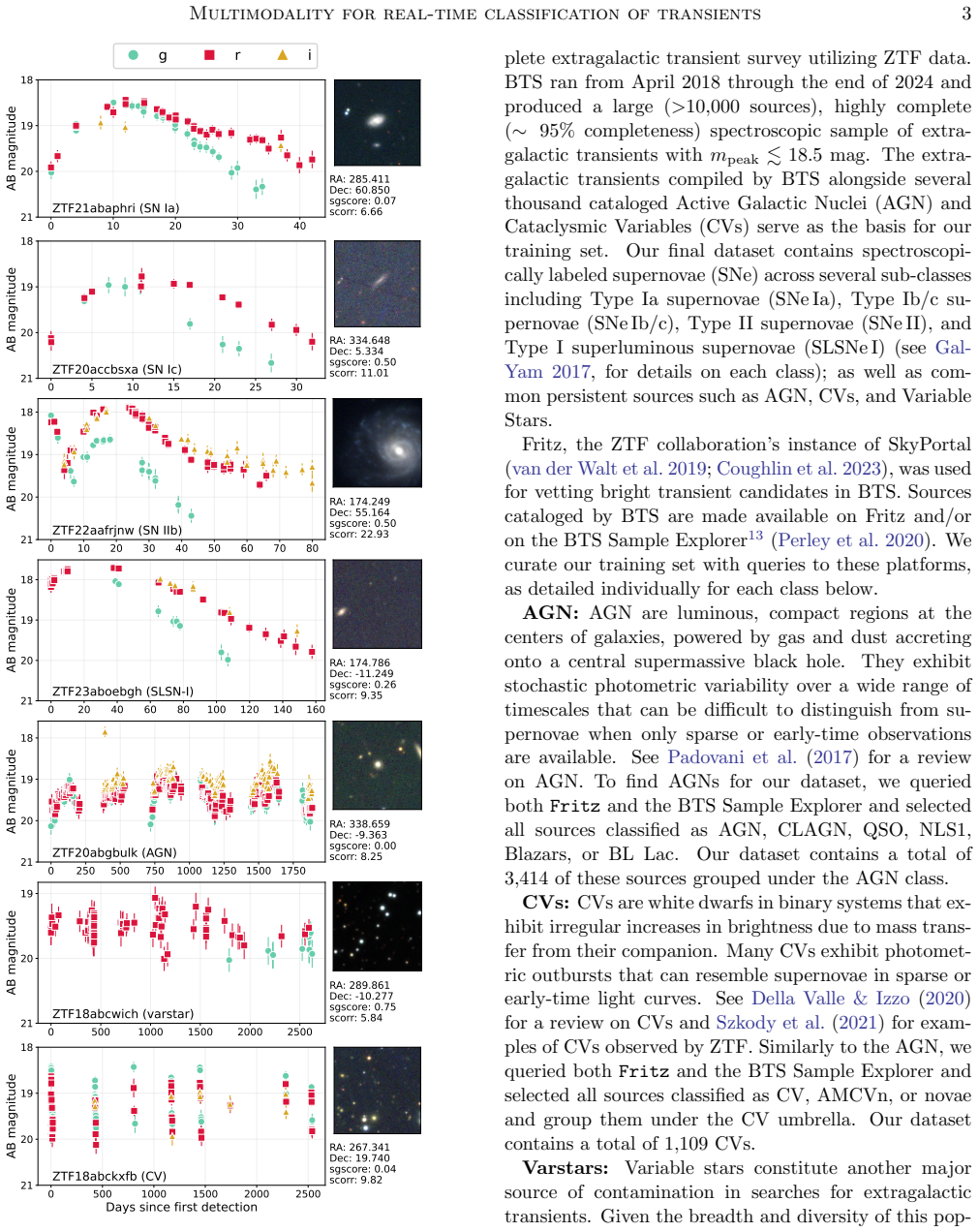
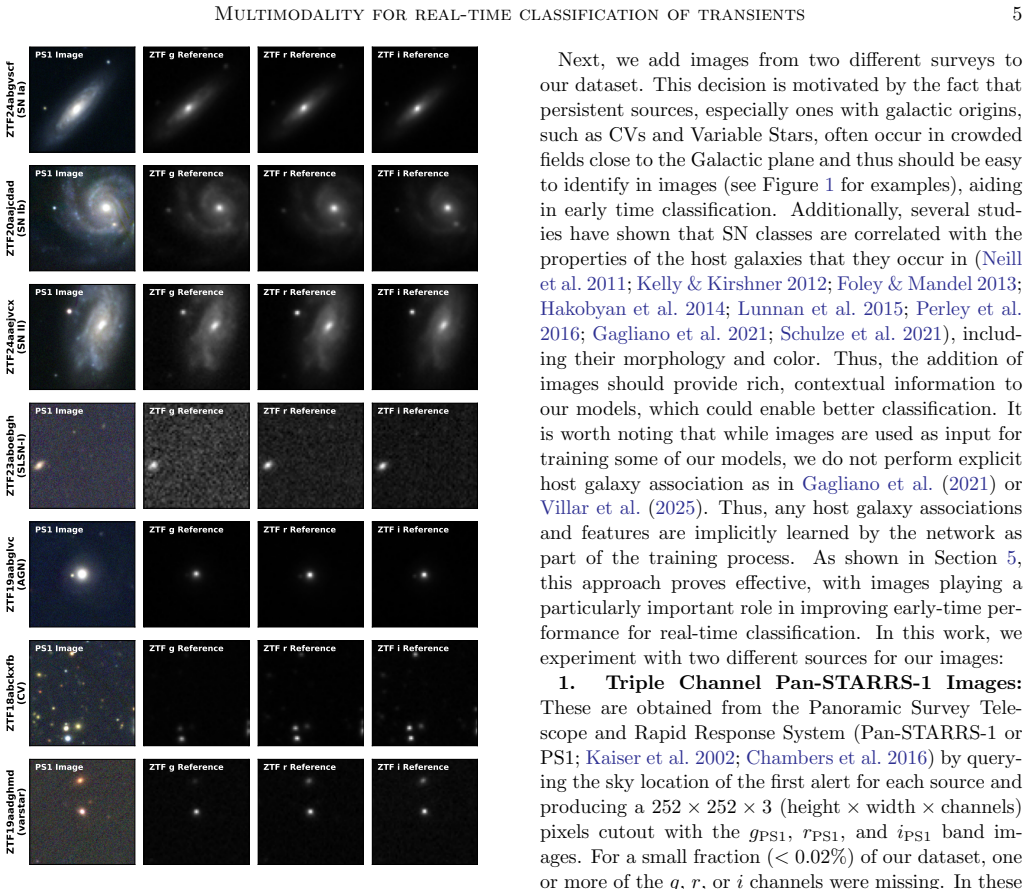
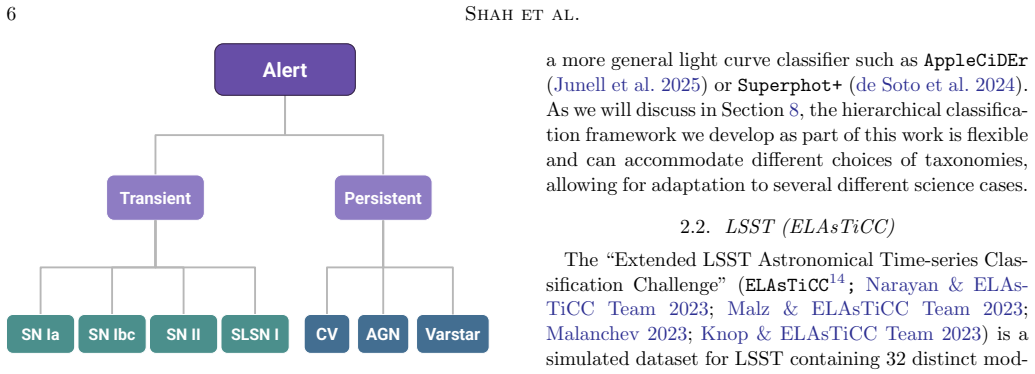
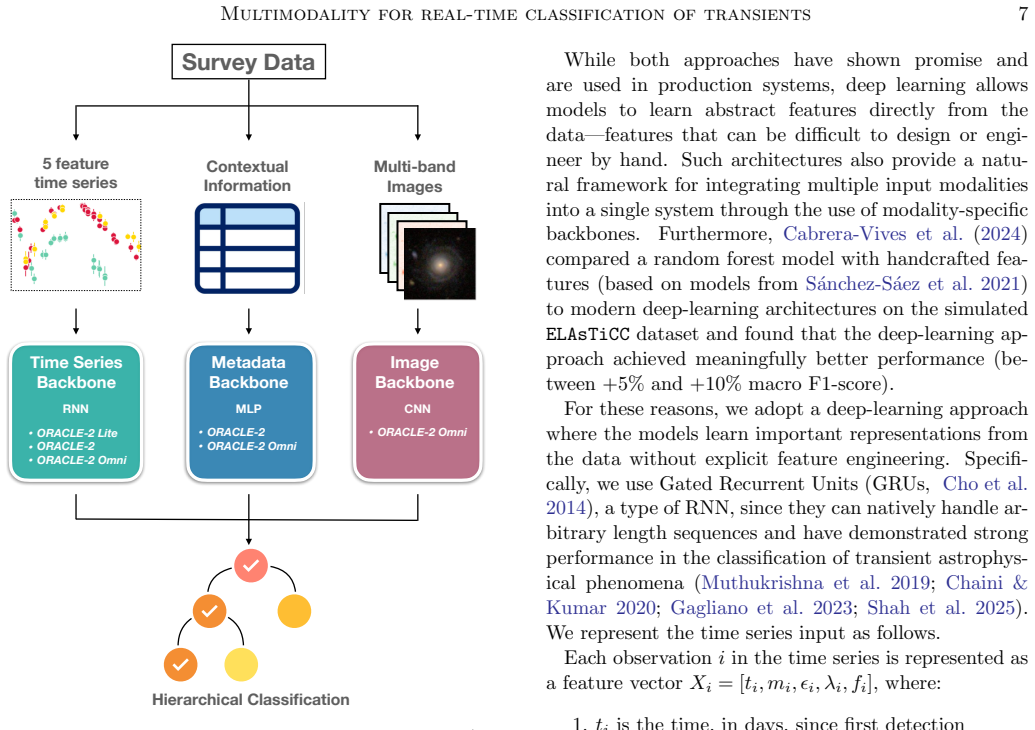
read the original abstract
Modern time-domain surveys such as the Zwicky Transient Facility (ZTF) generate hundreds of thousands of alerts each night, making real-time decisions for follow-up observations a central challenge in time-domain astronomy. Robust early classification is crucial for making informed decisions, but is hindered by sparse light curves and degeneracies between classes. In this work, we leverage multimodality to substantially improve real-time classification and demonstrate the practicality of our approach by deploying our model on the ZTF alert stream. Building on the Online Ranked Astrophysical CLass Estimator (ORACLE), we introduce the ORACLE-2 models, which combine light curves, metadata, and images for real-time hierarchical classification. Using both real and simulated datasets, we show that incorporating additional modalities consistently improves classification performance. On observations from ZTF's Bright Transient Survey, our best-performing model, ORACLE-2 Omni, achieves a macro F1 score of 0.73 -- an improvement of up to 11% over models using light curves and metadata alone, and up to 40% over light-curve-only models, with the strongest gains realized at early times. To demonstrate applicability to the Legacy Survey of Space and Time, which will increase alert volume by more than an order of magnitude, we train a light curve + metadata variant on the simulated ELAsTiCC dataset. This model achieves a macro F1 score of 0.88, an improvement of up to 13% over the light-curve-only variant, matching the performance of other state-of-the-art models. Finally, we quantify the trade-offs between performance and throughput, identifying regimes where multimodal approaches offer the greatest benefit. These results show that combining multiple modalities improves early-time classification, enabling more effective triage of high-volume alert streams for current and future time-domain surveys.
Editorial analysis
A structured set of objections, weighed in public.
Referee Report
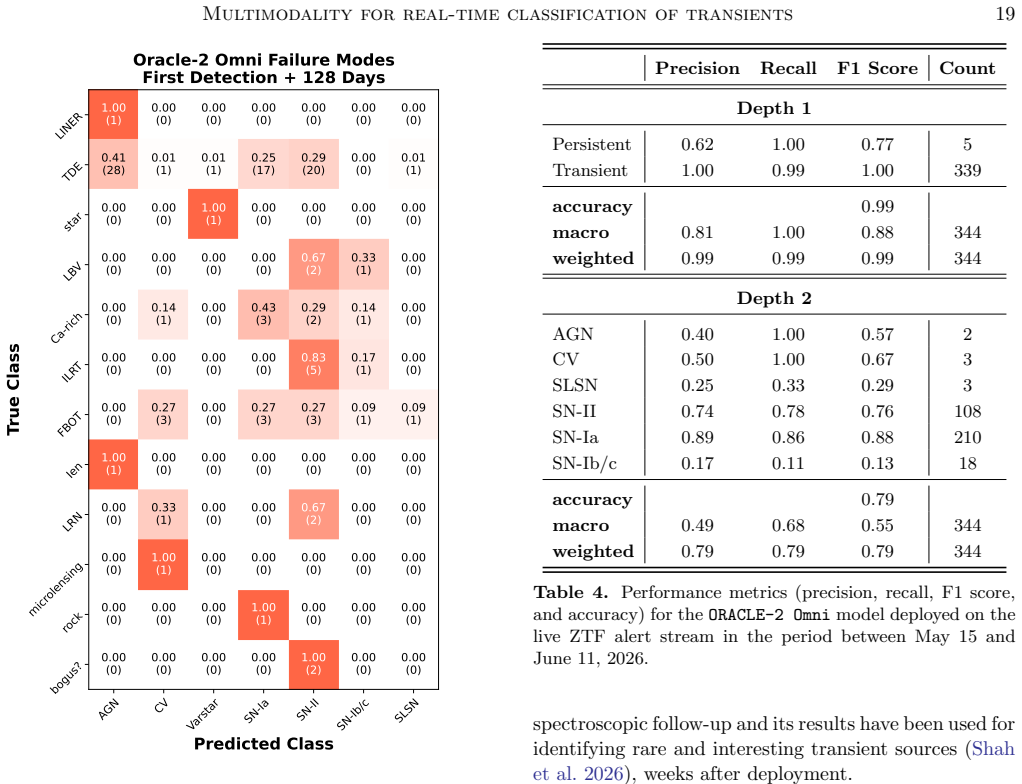
Summary. The manuscript introduces ORACLE-2, an extension of the ORACLE framework, for real-time hierarchical classification of transients and variables using multimodal inputs (light curves, metadata, and images) from ZTF alerts. It reports consistent macro F1 gains on real ZTF BTS data (0.73 for the Omni model, up to 40% over light-curve-only) and on simulated ELAsTiCC data (0.88 for the light-curve+metadata variant), with largest improvements at early times, quantifies performance-throughput trade-offs, and states that the model has been deployed on the live ZTF alert stream.
Significance. If the multimodal gains hold under operational conditions, the approach would offer a concrete, deployable method for improving early triage in high-volume alert streams, directly relevant to ZTF operations and scalable to LSST; the empirical results on both real and simulated data plus the throughput analysis are strengths that would support adoption if distribution-shift concerns are addressed.
major comments (2)
- [Abstract] Abstract and deployment description: the central claim that the reported F1 gains (0.73 on BTS, 0.88 on ELAsTiCC) will translate to live ZTF operations rests on the untested assumption that BTS/ELAsTiCC class priors, alert cadence, magnitude limits, and host-galaxy properties match the operational stream; no quantitative comparison or re-evaluation on a held-out live segment is supplied.
- [Abstract] Abstract: the statement that ORACLE-2 Omni achieves up to 40% improvement over light-curve-only models is presented without accompanying error bars, class-wise breakdown, or analysis of whether post-hoc class-imbalance handling or validation-split choices affect the macro F1 numbers.
minor comments (1)
- The methods section should explicitly state the exact input preprocessing steps for images and metadata and the hierarchical decision thresholds used at inference time.
Simulated Author's Rebuttal
We thank the referee for their constructive comments on our manuscript. We address each of the major comments below and propose revisions where appropriate to strengthen the presentation of our results.
read point-by-point responses
-
Referee: [Abstract] Abstract and deployment description: the central claim that the reported F1 gains (0.73 on BTS, 0.88 on ELAsTiCC) will translate to live ZTF operations rests on the untested assumption that BTS/ELAsTiCC class priors, alert cadence, magnitude limits, and host-galaxy properties match the operational stream; no quantitative comparison or re-evaluation on a held-out live segment is supplied.
Authors: We acknowledge that the BTS dataset, while consisting of real ZTF observations, represents a specific bright transient sample and may not fully capture the diversity of the entire live ZTF alert stream. Similarly, ELAsTiCC is a simulation. Our live deployment demonstrates that the model can run in real time on the ZTF stream, but we agree that without a held-out live evaluation with labels, direct translation of the F1 scores cannot be quantitatively verified. We will revise the abstract to clarify that the performance metrics are reported on BTS and ELAsTiCC, and that the deployment serves to show operational feasibility rather than to claim identical performance on the full stream. We will also add a section discussing potential distribution shifts. revision: yes
-
Referee: [Abstract] Abstract: the statement that ORACLE-2 Omni achieves up to 40% improvement over light-curve-only models is presented without accompanying error bars, class-wise breakdown, or analysis of whether post-hoc class-imbalance handling or validation-split choices affect the macro F1 numbers.
Authors: The 'up to 40%' figure refers to the maximum relative improvement observed across different time bins or configurations on the BTS dataset. To address this, we will include error bars on the macro F1 scores in the abstract and figures, expand the results section with a class-wise performance breakdown, and add an appendix or subsection analyzing the sensitivity to class-imbalance handling methods and different validation splits to confirm the robustness of the reported improvements. revision: yes
Circularity Check
No circularity: all claims are empirical measurements on held-out data
full rationale
The paper reports macro F1 scores from training and evaluating hierarchical classifiers on fixed train/test splits of ZTF BTS and ELAsTiCC data. No equations, first-principles derivations, fitted parameters renamed as predictions, or load-bearing self-citations appear in the chain. The ORACLE base model is cited as prior work, but the multimodal gains (0.73 and 0.88 F1) are direct empirical outcomes on independent test sets, not reductions to inputs by construction.
Axiom & Free-Parameter Ledger
axioms (2)
- domain assumption Training and test data are drawn from distributions representative of future operational alert streams
- standard math Standard neural-network training assumptions (i.i.d. samples, fixed class taxonomy)
Reference graph
Works this paper leans on
-
[1]
The Wide Field Infrared Survey Telescope: 100 Hubbles for the 2020s
Akeson, R., Armus, L., Bachelet, E., et al. 2019, arXiv e-prints, arXiv:1902.05569, doi: 10.48550/arXiv.1902.05569
work page internal anchor Pith review Pith/arXiv arXiv doi:10.48550/arxiv.1902.05569 2019
-
[2]
J., Stern, D., Noirot, G., et al
Assef, R. J., Stern, D., Noirot, G., et al. 2018, The Astrophysical Journal Supplemental Series, 234, 23, doi: 10.3847/1538-4365/aaa00a Astropy Collaboration, Robitaille, T. P., Tollerud, E. J., et al. 2013, A&A, 558, A33, doi: 10.1051/0004-6361/201322068 Astropy Collaboration, Price-Whelan, A. M., Sip˝ ocz, B. M., et al. 2018, ApJ, 156, 123, doi: 10.3847...
-
[3]
Neural Machine Translation by Jointly Learning to Align and Translate
Bahdanau, D., Cho, K., & Bengio, Y. 2014, arXiv e-prints, arXiv:1409.0473, doi: 10.48550/arXiv.1409.0473
work page internal anchor Pith review Pith/arXiv arXiv doi:10.48550/arxiv.1409.0473 2014
-
[4]
Bellm, E. C., Kulkarni, S. R., Graham, M. J., et al. 2019, PASP, 131, 018002, doi: 10.1088/1538-3873/aaecbe
-
[5]
Lord, N. A. 2019, arXiv e-prints, arXiv:1912.09393, doi: 10.48550/arXiv.1912.09393
-
[6]
2020, Experiment Tracking with Weights and Biases
Biewald, L. 2020, Experiment Tracking with Weights and Biases. https://www.wandb.com/
2020
-
[7]
Blagorodnova, N., Neill, J. D., Walters, R., et al. 2018, PASP, 130, 035003, doi: 10.1088/1538-3873/aaa53f
-
[8]
2019, AJ, 158, 257, doi: 10.3847/1538-3881/ab5182 —
Boone, K. 2019, AJ, 158, 257, doi: 10.3847/1538-3881/ab5182 —. 2021, AJ, 162, 275, doi: 10.3847/1538-3881/ac2a2d
-
[9]
Cabrera-Vives, G., Moreno-Cartagena, D., Astorga, N., et al. 2024, A&A, 689, A289, doi: 10.1051/0004-6361/202449475 C´ adiz-Leyton, M., Cabrera-Vives, G., Protopapas, P.,
-
[10]
2025, arXiv e-prints, arXiv:2507.12611, doi: 10.48550/arXiv.2507.12611
Moreno-Cartagena, D., & Becker, I. 2025, arXiv e-prints, arXiv:2507.12611, doi: 10.48550/arXiv.2507.12611
-
[11]
Chaini, S., & Kumar, S. S. 2020, arXiv e-prints, arXiv:2006.12333, doi: 10.48550/arXiv.2006.12333
-
[12]
Chambers, K. C., Magnier, E. A., Metcalfe, N., et al. 2016, arXiv e-prints, arXiv:1612.05560, doi: 10.48550/arXiv.1612.05560
work page internal anchor Pith review Pith/arXiv arXiv doi:10.48550/arxiv.1612.05560 2016
-
[13]
2020, The Astrophysical Journal Supplement Series, 249, 18, doi: 10.3847/1538-4365/ab9cae
Chen, X., Wang, S., Deng, L., et al. 2020, The Astrophysical Journal Supplement Series, 249, 18, doi: 10.3847/1538-4365/ab9cae
-
[14]
H., Yan, L., Kangas, T., et al
Chen, Z. H., Yan, L., Kangas, T., et al. 2023, ApJ, 943, 41, doi: 10.3847/1538-4357/aca161
-
[15]
On the Properties of Neural Machine Translation: Encoder-Decoder Approaches
Cho, K., van Merrienboer, B., Bahdanau, D., & Bengio, Y. 2014, arXiv e-prints, arXiv:1409.1259, doi: 10.48550/arXiv.1409.1259
work page internal anchor Pith review Pith/arXiv arXiv doi:10.48550/arxiv.1409.1259 2014
-
[16]
Coughlin, M. W., Bloom, J. S., Nir, G., et al. 2023, ApJS, 267, 31, doi: 10.3847/1538-4365/acdee1
-
[17]
Cutri, R. M., Wright, E. L., Conrow, T., et al. 2021, VizieR Online Data Catalog: AllWISE Data Release (Cutri+ 2013), VizieR On-line Data Catalog: II/328. Originally published in: IPAC/Caltech (2013) de Soto, K. M., Villar, V. A., Berger, E., et al. 2024, ApJ, 974, 169, doi: 10.3847/1538-4357/ad6a4f
-
[18]
Dekany, R., Smith, R. M., Riddle, R., et al. 2020, PASP, 132, 038001, doi: 10.1088/1538-3873/ab4ca2 Della Valle, M., & Izzo, L. 2020, A&A Rv, 28, 3, doi: 10.1007/s00159-020-0124-6
-
[19]
Deng, J., Dong, W., Socher, R., et al. 2009, in 2009 IEEE Conference on Computer Vision and Pattern Recognition, 248–255, doi: 10.1109/CVPR.2009.5206848 DES Collaboration, Abbott, T. M. C., Acevedo, M., et al. 2025, The Dark Energy Survey: Cosmology Results With 1500 New High-redshift Type Ia Supernovae Using The Full 5-year Dataset. https://arxiv.org/abs...
-
[20]
Duev, D. A., Mahabal, A., Masci, F. J., et al. 2019, MNRAS, 489, 3582, doi: 10.1093/mnras/stz2357
-
[21]
Foley, R. J., & Mandel, K. 2013, ApJ, 778, 167, doi: 10.1088/0004-637X/778/2/167
-
[22]
Fremling, C., Miller, A. A., Sharma, Y., et al. 2020, ApJ, 895, 32, doi: 10.3847/1538-4357/ab8943
-
[23]
Fremling, C., Hall, X. J., Coughlin, M. W., et al. 2021, ApJL, 917, L2, doi: 10.3847/2041-8213/ac116f
-
[24]
2025, ApJ, 992, 158, doi: 10.3847/1538-4357/adff4e
Frohmaier, C., Vincenzi, M., Sullivan, M., et al. 2025, ApJ, 992, 158, doi: 10.3847/1538-4357/adff4e
-
[25]
Gagliano, A., Contardo, G., Foreman-Mackey, D., Malz, A. I., & Aleo, P. D. 2023, ApJ, 954, 6, doi: 10.3847/1538-4357/ace326
-
[26]
2021, ApJ, 908, 170, doi: 10.3847/1538-4357/abd02b
Gagliano, A., Narayan, G., Engel, A., Carrasco Kind, M., & LSST Dark Energy Science Collaboration. 2021, ApJ, 908, 170, doi: 10.3847/1538-4357/abd02b
-
[27]
Gagliano, A. T., Shen, Y., & Villar, V. A. 2025, arXiv e-prints, arXiv:2512.04145, doi: 10.48550/arXiv.2512.04145
-
[28]
2017, in Handbook of Supernovae, ed
Gal-Yam, A. 2017, in Handbook of Supernovae, ed. A. W. Alsabti & P. Murdin, 195, doi: 10.1007/978-3-319-21846-5 35
-
[29]
Gal-Yam, A. 2019, Annual Review of Astronomy and Astrophysics, 57, 305–333, doi: 10.1146/annurev-astro-081817-051819
-
[30]
Gomez, S., Berger, E., Blanchard, P. K., et al. 2020, ApJ, 904, 74, doi: 10.3847/1538-4357/abbf49
-
[31]
2024, MNRAS, 535, 471, doi: 10.1093/mnras/stae2270
Gomez, S., Nicholl, M., Berger, E., et al. 2024, MNRAS, 535, 471, doi: 10.1093/mnras/stae2270
-
[32]
Graham, M. J., Kulkarni, S. R., Bellm, E. C., et al. 2019, PASP, 131, 078001, doi: 10.1088/1538-3873/ab006c Multimodality for real-time classification of transients23
-
[33]
2025, MNRAS, 542, L132, doi: 10.1093/mnrasl/slaf074
Gupta, R., Muthukrishna, D., Rehemtulla, N., & Shah, V. 2025, MNRAS, 542, L132, doi: 10.1093/mnrasl/slaf074
-
[34]
2008, Exploring network structure, dynamics, and function using
Hagberg, A., Swart, P., & S Chult, D. 2008, Exploring network structure, dynamics, and function using
2008
-
[35]
Hakobyan, A. A., Nazaryan, T. A., Adibekyan, V. Z., et al. 2014, MNRAS, 444, 2428, doi: 10.1093/mnras/stu1598
-
[36]
doi:10.1038/s41586-020-2649-2 , keywords =
Harris, C. R., Millman, K. J., van der Walt, S. J., et al. 2020, Nature, 585, 357, doi: 10.1038/s41586-020-2649-2
-
[37]
Deep residual learning for image recognition,
He, K., Zhang, X., Ren, S., & Sun, J. 2016, in 2016 IEEE Conference on Computer Vision and Pattern Recognition (CVPR), 1, doi: 10.1109/CVPR.2016.90
-
[38]
Gaussian Error Linear Units (GELUs)
Hendrycks, D., & Gimpel, K. 2016, arXiv e-prints, arXiv:1606.08415, doi: 10.48550/arXiv.1606.08415
work page internal anchor Pith review Pith/arXiv arXiv doi:10.48550/arxiv.1606.08415 2016
-
[39]
Hinds, K.-R., Perley, D. A., Sollerman, J., et al. 2025, MNRAS, 541, 135, doi: 10.1093/mnras/staf888
-
[40]
Distilling the Knowledge in a Neural Network
Hinton, G. E., Vinyals, O., & Dean, J. 2015, ArXiv, abs/1503.02531. https://api.semanticscholar.org/CorpusID:7200347
work page internal anchor Pith review Pith/arXiv arXiv 2015
-
[41]
Howell, D. A. 2011, Nature Communications, 2, doi: 10.1038/ncomms1344
-
[42]
Hunter, J. D. 2007, Computing In Science & Engineering, 9, 90 Inc., P. T. 2015, Collaborative data science, Montreal, QC: Plotly Technologies Inc. https://plot.ly Ivezi´ c,ˇZ., Kahn, S. M., Tyson, J. A., et al. 2019, ApJ, 873, 111, doi: 10.3847/1538-4357/ab042c Jegou du Laz, T., Coughlin, M. W., Bachant, P., et al. 2025, arXiv e-prints, arXiv:2511.00164, ...
work page internal anchor Pith review Pith/arXiv arXiv doi:10.3847/1538-4357/ab042c 2007
-
[43]
2025, arXiv e-prints, arXiv:2507.16088, doi: 10.48550/arXiv.2507.16088
Junell, A., Sasli, A., Fontinele Nunes, F., et al. 2025, arXiv e-prints, arXiv:2507.16088, doi: 10.48550/arXiv.2507.16088
-
[44]
Kaiser, N., Aussel, H., Burke, B. E., et al. 2002, in Society of Photo-Optical Instrumentation Engineers (SPIE) Conference Series, Vol. 4836, Survey and Other Telescope Technologies and Discoveries, ed. J. A. Tyson & S. Wolff, 154–164, doi: 10.1117/12.457365
-
[45]
M., Bellm, E., & Graham, M
Kasliwal, M. M., Bellm, E., & Graham, M. 2025, Transient Name Server AstroNote, 238, 1
2025
-
[46]
Kelly, P. L., & Kirshner, R. P. 2012, ApJ, 759, 107, doi: 10.1088/0004-637X/759/2/107
-
[47]
Kim, Y.-L., Rigault, M., Neill, J. D., et al. 2022, PASP, 134, 024505, doi: 10.1088/1538-3873/ac50a0
-
[48]
Adam: A Method for Stochastic Optimization
Kingma, D. P., & Ba, J. 2014, CoRR, abs/1412.6980. https://api.semanticscholar.org/CorpusID:6628106
work page internal anchor Pith review Pith/arXiv arXiv 2014
-
[49]
2023, in American Astronomical Society Meeting Abstracts, Vol
Knop, R., & ELAsTiCC Team. 2023, in American Astronomical Society Meeting Abstracts, Vol. 241, American Astronomical Society Meeting Abstracts #241, 117.02
2023
- [50]
-
[51]
Law, N. M., Corbett, H., Galliher, N. W., et al. 2022, PASP, 134, 035003, doi: 10.1088/1538-3873/ac4811
-
[52]
1989, in Advances in Neural Information Processing Systems, ed
LeCun, Y., Boser, B., Denker, J., et al. 1989, in Advances in Neural Information Processing Systems, ed. D. Touretzky, Vol. 2 (Morgan-Kaufmann). https://proceedings.neurips.cc/paper files/paper/1989/ file/53c3bce66e43be4f209556518c2fcb54-Paper.pdf
1989
-
[53]
2025, arXiv e-prints, arXiv:2510.06200, doi: 10.48550/arXiv.2510.06200
Li, W., Chen, H.-Y., Rehemtulla, N., et al. 2025, arXiv e-prints, arXiv:2510.06200, doi: 10.48550/arXiv.2510.06200
-
[54]
Lintott, C., Schawinski, K., Bamford, S., et al. 2011, MNRAS, 410, 166, doi: 10.1111/j.1365-2966.2010.17432.x
-
[55]
doi:10.1111/j.1365-2966.2008.13689.x , keywords =
Lintott, C. J., Schawinski, K., Slosar, A., et al. 2008, MNRAS, 389, 1179, doi: 10.1111/j.1365-2966.2008.13689.x
-
[56]
Liu, Z., Mao, H., Wu, C.-Y., et al. 2022, arXiv e-prints, arXiv:2201.03545, doi: 10.48550/arXiv.2201.03545 LSST Dark Energy Science Collaboration, Aubourg, E.,
-
[57]
2026, arXiv e-prints, arXiv:2601.14235, doi: 10.48550/arXiv.2601.14235
Avestruz, C., et al. 2026, arXiv e-prints, arXiv:2601.14235, doi: 10.48550/arXiv.2601.14235
-
[58]
2015, ApJ, 804, 90, doi: 10.1088/0004-637X/804/2/90
Lunnan, R., Chornock, R., Berger, E., et al. 2015, ApJ, 804, 90, doi: 10.1088/0004-637X/804/2/90
-
[59]
2023, in American Astronomical Society Meeting Abstracts, Vol
Malanchev, K. 2023, in American Astronomical Society Meeting Abstracts, Vol. 241, American Astronomical Society Meeting Abstracts #241, 117.03
2023
-
[60]
I., & ELAsTiCC Team
Malz, A. I., & ELAsTiCC Team. 2023, in American Astronomical Society Meeting Abstracts, Vol. 241, American Astronomical Society Meeting Abstracts #241, 117.04
2023
-
[61]
Masci, F. J., Laher, R. R., Rusholme, B., et al. 2019, PASP, 131, 018003, doi: 10.1088/1538-3873/aae8ac
work page internal anchor Pith review doi:10.1088/1538-3873/aae8ac 2019
-
[62]
UMAP: Uniform Manifold Approximation and Projection for Dimension Reduction
McInnes, L., Healy, J., & Melville, J. 2018, arXiv e-prints, arXiv:1802.03426, doi: 10.48550/arXiv.1802.03426
work page internal anchor Pith review Pith/arXiv arXiv doi:10.48550/arxiv.1802.03426 2018
-
[63]
Miller, A. A., Abrams, N. S., Aldering, G., et al. 2025, PASP, 137, 094204, doi: 10.1088/1538-3873/ae02c5 M¨ oller, A., & de Boissi` ere, T. 2020, MNRAS, 491, 4277, doi: 10.1093/mnras/stz3312
-
[64]
2025, A&A, 703, A41, doi: 10.1051/0004-6361/202554289
Moreno-Cartagena, D., Protopapas, P., Cabrera-Vives, G., et al. 2025, A&A, 703, A41, doi: 10.1051/0004-6361/202554289
-
[65]
Muthukrishna, D., Narayan, G., Mandel, K. S., Biswas, R., & Hloˇ zek, R. 2019, PASP, 131, 118002, doi: 10.1088/1538-3873/ab1609 24Shah et al
-
[66]
2023, in American Astronomical Society Meeting Abstracts, Vol
Narayan, G., & ELAsTiCC Team. 2023, in American Astronomical Society Meeting Abstracts, Vol. 241, American Astronomical Society Meeting Abstracts #241, 117.01
2023
-
[67]
D., Sullivan, M., Gal-Yam, A., et al
Neill, J. D., Sullivan, M., Gal-Yam, A., et al. 2011, ApJ, 727, 15, doi: 10.1088/0004-637X/727/1/15
-
[68]
Padovani, P., Alexander, D. M., Assef, R. J., et al. 2017, The Astronomy and Astrophysics Review, 25, doi: 10.1007/s00159-017-0102-9
-
[69]
AION-1: Omnimodal Foundation Model for Astronomical Sciences
Parker, L., Lanusse, F., Shen, J., et al. 2025, arXiv e-prints, arXiv:2510.17960, doi: 10.48550/arXiv.2510.17960
-
[70]
PyTorch: An Imperative Style, High-Performance Deep Learning Library
Paszke, A., Gross, S., Massa, F., et al. 2019, arXiv e-prints, arXiv:1912.01703, doi: 10.48550/arXiv.1912.01703
work page internal anchor Pith review Pith/arXiv arXiv doi:10.48550/arxiv.1912.01703 2019
-
[71]
2011, Journal of Machine Learning Research, 12, 2825
Pedregosa, F., Varoquaux, G., Gramfort, A., et al. 2011, Journal of Machine Learning Research, 12, 2825
2011
-
[72]
Perley, D. A., Quimby, R. M., Yan, L., et al. 2016, ApJ, 830, 13, doi: 10.3847/0004-637X/830/1/13
-
[73]
A., Fremling, C., Sollerman, J., et al
Perley, D. A., Fremling, C., Sollerman, J., et al. 2020, ApJ, 904, 35, doi: 10.3847/1538-4357/abbd98
-
[74]
Prentice, S. J., Ashall, C., James, P. A., et al. 2019, MNRAS, 485, 1559, doi: 10.1093/mnras/sty3399
-
[75]
2021, AJ, 162, 67, doi: 10.3847/1538-3881/ac0824
Qu, H., Sako, M., M¨ oller, A., & Doux, C. 2021, AJ, 162, 67, doi: 10.3847/1538-3881/ac0824
-
[76]
Rehemtulla, N., Coughlin, M. W., Miller, A. A., & du Laz, T. J. 2025a, Nature Astronomy, 9, 1764, doi: 10.1038/s41550-025-02720-6
-
[77]
Rehemtulla, N., Miller, A. A., Jegou Du Laz, T., et al. 2024, ApJ, 972, 7, doi: 10.3847/1538-4357/ad5666
-
[78]
Rehemtulla, N., Jacobson-Gal´ an, W. V., Singh, A., et al. 2025b, ApJ, 985, 241, doi: 10.3847/1538-4357/adcf1e
-
[79]
Rehemtulla, N., Miller, A. A., Walmsley, M., et al. 2026, PASP, 138, 034503, doi: 10.1088/1538-3873/ae50bc
-
[80]
Rigault, M., Neill, J. D., Blagorodnova, N., et al. 2019, A&A, 627, A115, doi: 10.1051/0004-6361/201935344
discussion (0)
Sign in with ORCID, Apple, or X to comment. Anyone can read and Pith papers without signing in.