Generative AI and Federated Learning for Intrusion Detection Systems: A Survey
Pith reviewed 2026-07-03 20:16 UTC · model grok-4.3
The pith
Generative models and federated learning address data scarcity and privacy limits in intrusion detection systems.
A machine-rendered reading of the paper's core claim, the machinery that carries it, and where it could break.
Core claim
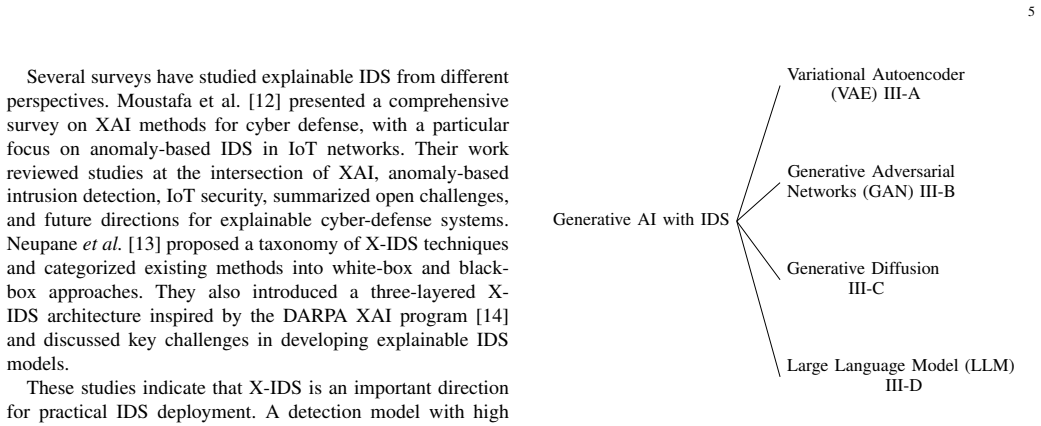
This survey first outlines IDS research directions including adversarial machine learning, anomaly detection, IoT-specific systems, explainable models, and benchmark datasets. It then groups generative AI applications by model families and task goals, covering autoencoder-based models for imputation and reconstruction, GANs for adversarial and synthetic traffic generation, diffusion models for high-fidelity samples, and LLMs for alert explanation. Finally it reviews studies that merge generative AI with federated IDS training and lists remaining challenges around data quality, communication efficiency, and domain-specific models.
What carries the argument
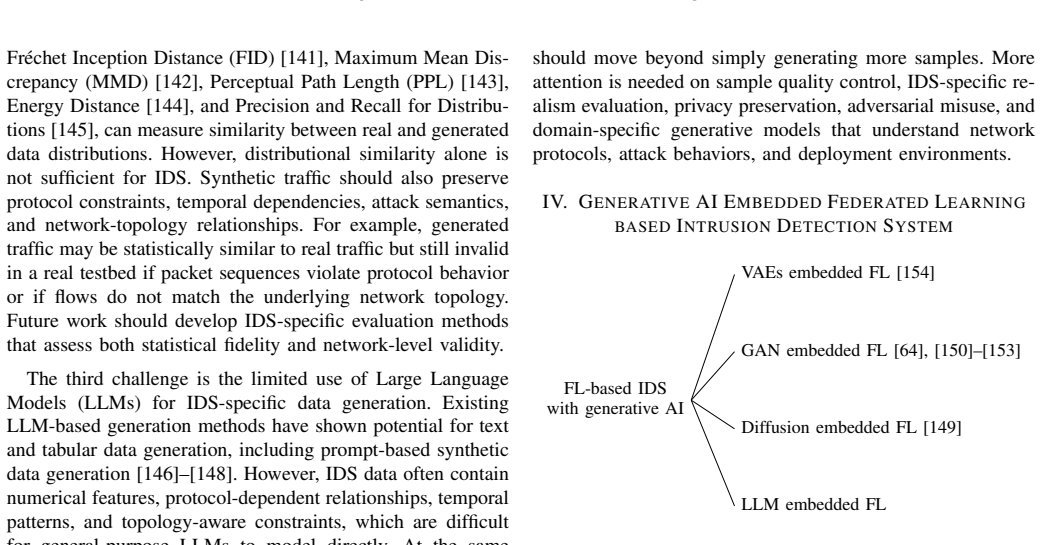
Categorization of generative AI by model families (autoencoders, GANs, diffusion models, LLMs) and task objectives, extended to their integration with federated learning for distributed IDS training.
If this is right
- Generative models can produce synthetic traffic to augment imbalanced or incomplete attack datasets for more robust training.
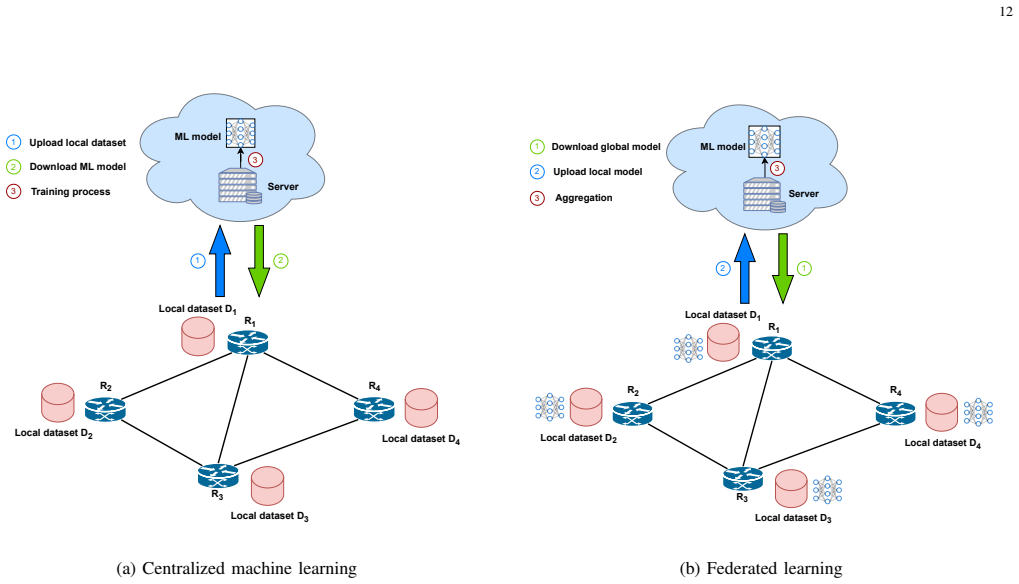
- Federated learning enables collaborative IDS model updates across organizations without exposing local network records.
- Combined generative and federated approaches can support anomaly detection and alert explanation while respecting privacy constraints.
- Open challenges remain in ensuring synthetic data matches real traffic distributions and handling non-IID data across federated clients.
Where Pith is reading between the lines
- Testing the surveyed techniques on live, large-scale production networks would reveal whether synthetic data improves detection rates under actual traffic conditions.
- The framework could extend to other privacy-sensitive monitoring tasks such as fraud detection in financial systems.
- Development of standardized federated IDS benchmarks would allow direct comparison of different generative augmentation strategies.
Load-bearing premise
The papers chosen for review and their grouping by model families and tasks form a representative sample of the field without major gaps or selection bias.
What would settle it
Identification of a sizable body of generative-AI or federated-IDS research that falls outside the surveyed model-family and task-objective categories.
Figures
read the original abstract
Intrusion Detection Systems (IDSs) are essential for monitoring network traffic and identifying malicious activities in modern cyber-physical, Internet of Things (IoT), enterprise, and distributed network environments. However, developing reliable IDS models remains challenging because attack behaviors evolve over time, realistic datasets are difficult to obtain, traffic records may be incomplete, attack classes are often imbalanced, and privacy constraints limit centralized data collection. Recent advances in generative artificial intelligence (AI) and Federated Learning (FL) provide new opportunities to address these limitations. Generative models can support anomaly detection, synthetic traffic generation, data augmentation, data imputation, adversarial traffic generation, and IDS alert explanation. FL enables distributed IDS training without directly sharing local network traffic, making it suitable for privacy-sensitive and geographically distributed environments. This survey provides a structured review of generative AI and FL techniques for IDS. We first summarize representative IDS research directions, including adversarial machine learning, anomaly-based detection, IoT-oriented IDS, explainable IDS, and benchmark datasets. We then categorize generative AI applications in IDS according to model families and task objectives, covering autoencoder-based models, Generative Adversarial Networks (GANs), diffusion models, and Large Language Models (LLMs). Finally, we review emerging studies that integrate generative AI with FL-based IDS and discuss open challenges, including synthetic data quality, realistic traffic generation, dual-use adversarial risks, non-IID client distributions, communication-efficient model sharing, federated IDS benchmarking, and domain-specific LLMs for network security.
Editorial analysis
A structured set of objections, weighed in public.
Referee Report
Summary. The paper is a literature survey on generative AI and federated learning (FL) for intrusion detection systems (IDS). It summarizes IDS challenges and research directions (adversarial ML, anomaly detection, IoT IDS, explainable IDS, benchmarks), categorizes generative models (autoencoders, GANs, diffusion models, LLMs) by families and task objectives (anomaly detection, synthetic traffic generation, data augmentation, imputation, adversarial generation, alert explanation), reviews their integration with FL-based IDS, and discusses open challenges such as synthetic data quality, non-IID distributions, and dual-use risks.
Significance. If the categorization proves representative, the survey would be a useful organizing resource for the intersection of generative models and privacy-preserving distributed IDS training. It supplies an explicit structure that maps model families to concrete IDS tasks and flags actionable open problems, which can help researchers locate relevant work on data scarcity and privacy constraints.
major comments (1)
- [Introduction and review-structure section] The central claim is that the survey supplies a 'structured review' and 'categorize[s] generative AI applications in IDS according to model families and task objectives.' However, the manuscript provides no description of the literature search protocol, databases, keywords, time window, or inclusion criteria (Introduction and the section outlining the review structure). Without these, the representativeness of the selected papers cannot be evaluated and selection bias remains unaddressed, which is load-bearing for any survey's reliability.
minor comments (2)
- [Generative AI categorization section] The abstract lists six generative-AI task objectives but the corresponding categorization section would benefit from an explicit mapping table that links each reviewed paper to both its model family and primary task objective.
- Ensure that every acronym (e.g., GAN, LLM, non-IID) is defined at first use in the main text even if already expanded in the abstract.
Simulated Author's Rebuttal
We thank the referee for the detailed and constructive review. The single major comment identifies a clear gap in the current manuscript regarding the literature search methodology. We agree this is essential for a reliable survey and will address it directly in revision.
read point-by-point responses
-
Referee: [Introduction and review-structure section] The central claim is that the survey supplies a 'structured review' and 'categorize[s] generative AI applications in IDS according to model families and task objectives.' However, the manuscript provides no description of the literature search protocol, databases, keywords, time window, or inclusion criteria (Introduction and the section outlining the review structure). Without these, the representativeness of the selected papers cannot be evaluated and selection bias remains unaddressed, which is load-bearing for any survey's reliability.
Authors: We fully agree that a transparent description of the literature search protocol is required to substantiate the survey's claims of structure and categorization. In the revised manuscript we will insert a dedicated subsection (provisionally titled 'Literature Search and Selection Methodology') immediately after the review-structure outline. This subsection will specify: (1) databases queried (IEEE Xplore, ACM Digital Library, Scopus, arXiv, and Google Scholar); (2) search strings and Boolean combinations (e.g., ('generative adversarial network' OR 'diffusion model' OR 'large language model' OR 'autoencoder') AND ('intrusion detection' OR 'anomaly detection') AND ('federated learning')); (3) time window (2018–2024, with earlier seminal works included when foundational); (4) inclusion criteria (peer-reviewed journal or top-tier conference papers, explicit focus on generative models or FL for IDS tasks, English language); and (5) exclusion criteria (non-peer-reviewed preprints without subsequent publication, purely theoretical works without IDS application, duplicate entries). We will also report the number of papers initially retrieved and finally retained after screening. This addition will allow readers to evaluate coverage and selection bias. revision: yes
Circularity Check
No circularity: pure literature survey with no derivations
full rationale
The paper is a survey that summarizes external literature on IDS, generative models, and FL without presenting any original derivations, equations, fitted parameters, or predictions. Its structure consists of categorizing prior work by model families and tasks, plus listing open challenges; none of these steps reduce to self-definition, fitted-input renaming, or self-citation chains that bear the central claim. The representativeness of coverage is an external risk, not an internal circularity. No load-bearing step matches any of the six enumerated patterns.
Axiom & Free-Parameter Ledger
Reference graph
Works this paper leans on
-
[1]
Computer security threat monitoring and surveil- lance
James P Anderson. Computer security threat monitoring and surveil- lance. Technical Report, James P . Anderson Company, 1980
1980
-
[2]
Dorothy E. Denning. An intrusion-detection model. IEEE Trans. Software Eng., 13(2):222–232, 1987
1987
-
[3]
Communication-efficient learning of deep networks from decentralized data
Brendan McMahan, Eider Moore, Daniel Ramage, Seth Hampson, and Blaise Ag ¨uera y Arcas. Communication-efficient learning of deep networks from decentralized data. In Aarti Singh and Xiaojin (Jerry) Zhu, editors, Proceedings of the 20th International Conference on Artificial Intelligence and Statistics, AISTATS 2017, 20-22 April 2017, Fort Lauderdale, FL, ...
2017
-
[4]
Adversarial machine learn- ing for network intrusion detection: A comparative study
Houda Jmila and Mohamed Ibn Khedher. Adversarial machine learn- ing for network intrusion detection: A comparative study. Comput. Networks, 214:109073, 2022
2022
-
[5]
A detailed analysis of the kdd cup 99 data set
Mahbod Tavallaee, Ebrahim Bagheri, Wei Lu, and Ali A Ghorbani. A detailed analysis of the kdd cup 99 data set. In 2009 IEEE symposium on computational intelligence for security and defense applications , pages 1–6. Ieee, 2009
2009
-
[6]
Unsw-nb15: a comprehensive data set for network intrusion detection systems (unsw-nb15 network data set)
Nour Moustafa and Jill Slay. Unsw-nb15: a comprehensive data set for network intrusion detection systems (unsw-nb15 network data set). In 2015 military communications and information systems conference (MilCIS), pages 1–6. IEEE, 2015
2015
-
[7]
Afnan Alotaibi and Murad A. Rassam. Adversarial machine learning attacks against intrusion detection systems: A survey on strategies and defense. Future Internet, 15(2), 2023
2023
-
[8]
A systematic literature review of methods and datasets for anomaly-based network intrusion detection
Zhen Yang, Xiaodong Liu, Tong Li, Di Wu, Jinjiang Wang, Yunwei Zhao, and Han Han. A systematic literature review of methods and datasets for anomaly-based network intrusion detection. Comput. Secur., 116:102675, 2022
2022
-
[9]
Anomaly-based intrusion detection systems: The requirements, methods, measurements, and datasets
Suzan Hajj, Rayane El Sibai, Jacques Bou Abdo, Jacques Demerjian, Abdallah Makhoul, and Christophe Guyeux. Anomaly-based intrusion detection systems: The requirements, methods, measurements, and datasets. Transactions on Emerging Telecommunications Technologies, 32(4):e4240, 2021
2021
-
[10]
A comprehensive survey on machine learning-based intrusion detection systems for secure communication in internet of things
SVN Santhosh Kumar, M Selvi, and A Kannan. A comprehensive survey on machine learning-based intrusion detection systems for secure communication in internet of things. Computational Intelligence and Neuroscience: CIN , 2023, 2023
2023
-
[11]
Machine and deep learning solutions for intrusion detection and prevention in iots: A survey
PLS Jayalaxmi, Rahul Saha, Gulshan Kumar, Mauro Conti, and Tai- Hoon Kim. Machine and deep learning solutions for intrusion detection and prevention in iots: A survey. IEEE Access , 10:121173–121192, 2022
2022
-
[12]
Zomaya, and Zahir Tari
Nour Moustafa, Nickolaos Koroniotis, Marwa Keshk, Albert Y . Zomaya, and Zahir Tari. Explainable intrusion detection for cyber defences in the internet of things: Opportunities and solutions. IEEE Communications Surveys & Tutorials , 25(3):1775–1807, 2023
2023
-
[13]
Explainable intrusion detection systems (X-IDS): A survey of current methods, challenges, and opportunities
Subash Neupane, Jesse Ables, William Anderson, Sudip Mittal, Shahram Rahimi, Ioana Banicescu, and Maria Seale. Explainable intrusion detection systems (X-IDS): A survey of current methods, challenges, and opportunities. IEEE Access, 10:112392–112415, 2022
2022
-
[14]
Darpa’s explainable artificial intelli- gence (xai) program
David Gunning and David Aha. Darpa’s explainable artificial intelli- gence (xai) program. AI magazine, 40(2):44–58, 2019. 17
2019
-
[15]
Benchmarking datasets for anomaly-based network intrusion detection: Kdd cup 99 alternatives
Abhishek Divekar, Meet Parekh, Vaibhav Savla, Rudra Mishra, and Mahesh Shirole. Benchmarking datasets for anomaly-based network intrusion detection: Kdd cup 99 alternatives. In 2018 IEEE 3rd International Conference on Computing, Communication and Security (ICCCS), pages 1–8. IEEE, 2018
2018
-
[16]
Toward generating a new intrusion detection dataset and intrusion traffic characterization
Iman Sharafaldin, Arash Habibi Lashkari, and Ali A Ghorbani. Toward generating a new intrusion detection dataset and intrusion traffic characterization. ICISSp, 1:108–116, 2018
2018
-
[17]
Developing realistic distributed denial of service (ddos) at- tack dataset and taxonomy
Iman Sharafaldin, Arash Habibi Lashkari, Saqib Hakak, and Ali A Ghorbani. Developing realistic distributed denial of service (ddos) at- tack dataset and taxonomy. In 2019 International Carnahan Conference on Security Technology (ICCST) , pages 1–8. IEEE, 2019
2019
-
[18]
Car hacking: Attack & defense challenge 2020 dataset, 2021
Hyunjae Kang, Byung Il Kwak, Young Hun Lee, Haneol Lee, Hwejae Lee, and Huy Kang Kim. Car hacking: Attack & defense challenge 2020 dataset, 2021
2020
-
[19]
Flnet2023: Realistic network intrusion detection dataset for federated learning
Pratyay Kumar, Jiefei Liu, Abu Saleh Md Tayeen, Satyajayant Misra, Huiping Cao, Jayashree Harikumar, and Oscar Perez. Flnet2023: Realistic network intrusion detection dataset for federated learning. In MILCOM 2023-2023 IEEE Military Communications Conference (MILCOM), pages 345–350. IEEE, 2023
2023
-
[20]
Ciciot2023: A real- time dataset and benchmark for large-scale attacks in iot environment
Euclides Carlos Pinto Neto, Sajjad Dadkhah, Raphael Ferreira, Alireza Zohourian, Rongxing Lu, and Ali A Ghorbani. Ciciot2023: A real- time dataset and benchmark for large-scale attacks in iot environment. Sensors, 23(13):5941, 2023
2023
-
[21]
Ci- ciov2024: Advancing realistic ids approaches against dos and spoofing attack in iov can bus
Euclides Carlos Pinto Neto, Hamideh Taslimasa, Sajjad Dadkhah, Shahrear Iqbal, Pulei Xiong, Taufiq Rahman, and Ali A Ghorbani. Ci- ciov2024: Advancing realistic ids approaches against dos and spoofing attack in iov can bus. Internet of Things , 26:101209, 2024
2024
-
[22]
X-canids: Signal-aware explainable intrusion detection system for controller area network-based in-vehicle network
Seonghoon Jeong, Sangho Lee, Hwejae Lee, and Huy Kang Kim. X-canids: Signal-aware explainable intrusion detection system for controller area network-based in-vehicle network. IEEE Transactions on Vehicular Technology, 73(3):3230–3246, 2024
2024
-
[23]
A survey of network-based intrusion detection data sets
Markus Ring, Sarah Wunderlich, Deniz Scheuring, Dieter Landes, and Andreas Hotho. A survey of network-based intrusion detection data sets. Computers & Security , 86:147–167, 2019
2019
-
[24]
Survey of intrusion detection systems: techniques, datasets and challenges
Ansam Khraisat, Iqbal Gondal, Peter Vamplew, and Joarder Kamruz- zaman. Survey of intrusion detection systems: techniques, datasets and challenges. Cybersecurity, 2(1):1–22, 2019
2019
-
[25]
Kingma and Max Welling
Diederik P. Kingma and Max Welling. Auto-encoding variational bayes. In Yoshua Bengio and Yann LeCun, editors, 2nd Interna- tional Conference on Learning Representations, ICLR 2014, Banff, AB, Canada, April 14-16, 2014, Conference Track Proceedings , 2014
2014
-
[26]
A novel deep clustering variational auto-encoder for anomaly- based network intrusion detection
Van Quan Nguyen, Viet Hung Nguyen, Tuan Hao Hoang, and Nathan Shone. A novel deep clustering variational auto-encoder for anomaly- based network intrusion detection. In Nguyen Ba Hung, Le Sy Vinh, Nguyen Le Minh, Ha Minh Hoang, Bui Thu Lam, Phan Xuan Hieu, Nguyen Trung Lap, V o Dinh Hieu, and Van Huu Quang Nhat, editors, 14th International Conference on K...
2022
-
[27]
Anomaly based resilient network intrusion detection using inferential autoencoders
Abdul Hannan, Christian Gruhl, and Bernhard Sick. Anomaly based resilient network intrusion detection using inferential autoencoders. In IEEE International Conference on Cyber Security and Resilience, CSR 2021, Rhodes, Greece, July 26-28, 2021 , pages 1–7. IEEE, 2021
2021
-
[28]
Intrusion detection results analysis based on variational auto- encoder
Haocheng Xie, Aiping Li, Rong Jiang, Yan Jia, Li Huang, and Weihong Han. Intrusion detection results analysis based on variational auto- encoder. In Fourth IEEE International Conference on Data Science in Cyberspace, DSC 2019, Hangzhou, China, June 23-25, 2019 , pages 516–521. IEEE, 2019
2019
-
[29]
Shuhana Azmin and A. B. M. Alim Al Islam. Network intrusion detection system based on conditional variational laplace autoencoder. In 7th NSysS 2020: 7th International Conference on Networking, Systems and Security, Dhaka, Bangladesh, 22-24 December, 2020 , pages 82–88. ACM, 2020
2020
-
[30]
Anomaly detection for power system forecasting under data corruption based on variational auto-encoder
Ruicheng Zheng and Jie Gu. Anomaly detection for power system forecasting under data corruption based on variational auto-encoder. In 8th Renewable Power Generation Conference (RPG 2019) , pages 1–6. IET, 2019
2019
-
[31]
Variational auto-encoder-based detection of electricity stealth cyber-attacks in AMI networks
Abdulrahman Takiddin, Muhammad Ismail, Usman Zafar, and Erchin Serpedin. Variational auto-encoder-based detection of electricity stealth cyber-attacks in AMI networks. In 28th European Signal Processing Conference, EUSIPCO 2020, Amsterdam, Netherlands, January 18-21, 2021, pages 1590–1594. IEEE, 2020
2020
-
[32]
Insider threat detection using deep autoencoder and variational autoencoder neural networks
Efthimios Pantelidis, Gueltoum Bendiab, Stavros Shiaeles, and Nicholas Kolokotronis. Insider threat detection using deep autoencoder and variational autoencoder neural networks. In IEEE International Conference on Cyber Security and Resilience, CSR 2021, Rhodes, Greece, July 26-28, 2021 , pages 129–134. IEEE, 2021
2021
-
[33]
GEE: A gradient-based explainable variational autoencoder for network anomaly detection
Quoc Phong Nguyen, Kar Wai Lim, Dinil Mon Divakaran, Kian Hsiang Low, and Mun Choon Chan. GEE: A gradient-based explainable variational autoencoder for network anomaly detection. In 7th IEEE Conference on Communications and Network Security, CNS 2019, Washington, DC, USA, June 10-12, 2019 , pages 91–99. IEEE, 2019
2019
-
[34]
Towards an effective intrusion detection model using focal loss variational autoencoder for internet of things (iot)
Shapla Khanam, Ismail Ahmedy, Mohd Yamani Idna Bin Idris, and Mohamed Hisham Jaward. Towards an effective intrusion detection model using focal loss variational autoencoder for internet of things (iot). Sensors, 22(15):5822, 2022
2022
-
[35]
Un- supervised learning approach for network intrusion detection system using autoencoders
Hyunseung Choi, Mintae Kim, Gyubok Lee, and Wooju Kim. Un- supervised learning approach for network intrusion detection system using autoencoders. J. Supercomput., 75(9):5597–5621, 2019
2019
-
[36]
Network intrusion detection based on semi-supervised variational auto-encoder
Genki Osada, Kazumasa Omote, and Takashi Nishide. Network intrusion detection based on semi-supervised variational auto-encoder. In Simon N. Foley, Dieter Gollmann, and Einar Snekkenes, editors, Computer Security - ESORICS 2017 - 22nd European Symposium on Research in Computer Security, Oslo, Norway, September 11-15, 2017, Proceedings, Part II , volume 10...
2017
-
[37]
Toward effective intrusion detection using log-cosh conditional variational autoencoder
Xing Xu, Jie Li, Yang Yang, and Fumin Shen. Toward effective intrusion detection using log-cosh conditional variational autoencoder. IEEE Internet Things J. , 8(8):6187–6196, 2021
2021
-
[38]
Anomaly-based intrusion detection from network flow features using variational autoencoder.IEEE Access, 8:108346–108358, 2020
Sultan Zavrak and Murat Iskefiyeli. Anomaly-based intrusion detection from network flow features using variational autoencoder.IEEE Access, 8:108346–108358, 2020
2020
-
[39]
Time series anomaly detection with variational autoencoder using mahalanobis distance
Laze Gjorgiev and Sonja Gievska. Time series anomaly detection with variational autoencoder using mahalanobis distance. In Vesna Dimitrova and Ivica Dimitrovski, editors, ICT Innovations 2020. Ma- chine Learning and Applications - 12th International Conference, ICT Innovations 2020, Skopje, North Macedonia, September 24-26, 2020, Proceedings, volume 1316 ...
2020
-
[40]
Anomaly detection using lstm-based variational autoencoder in unsupervised data in power grid
Dibyajyoti Guha, Rajdeep Chatterjee, and Biplab Sikdar. Anomaly detection using lstm-based variational autoencoder in unsupervised data in power grid. IEEE Syst. J. , 17(3):4313–4323, 2023
2023
-
[41]
B-V AE: a new dataset balancing approach using batched variational autoencoders to enhance network intrusion detection
Po-Jen Chuang and Pang-Yu Huang. B-V AE: a new dataset balancing approach using batched variational autoencoders to enhance network intrusion detection. J. Supercomput., 79(12):13262–13286, 2023
2023
-
[42]
Network intrusion detection based on supervised adversarial variational auto-encoder with regularization
Yanqing Yang, Kangfeng Zheng, Bin Wu, Yixian Yang, and Xiujuan Wang. Network intrusion detection based on supervised adversarial variational auto-encoder with regularization. IEEE access , 8:42169– 42184, 2020
2020
-
[43]
Nguyen, Son Pham Bao, and Eryk Dutkiewicz
Phai Vu Dinh, Quang Uy Nguyen, Dinh Thai Hoang, Diep N. Nguyen, Son Pham Bao, and Eryk Dutkiewicz. Constrained twin variational auto-encoder for intrusion detection in iot systems. IEEE Internet Things J., 11(8):14789–14803, 2024
2024
-
[44]
Improving the classification effectiveness of intrusion detection by using improved conditional variational autoencoder and deep neural network
Yanqing Yang, Kangfeng Zheng, Chunhua Wu, and Yixian Yang. Improving the classification effectiveness of intrusion detection by using improved conditional variational autoencoder and deep neural network. Sensors, 19(11):2528, 2019
2019
-
[45]
A lightweight unsupervised intrusion detection model based on variational auto-encoder
Yi Ren, Kanghui Feng, Fei Hu, Liangyin Chen, and Yanru Chen. A lightweight unsupervised intrusion detection model based on variational auto-encoder. Sensors, 23(20):8407, 2023
2023
-
[46]
Machine learning with variational autoencoder for imbalanced datasets in intrusion detection
Ying-Dar Lin, Zi-Qiang Liu, Ren-Hung Hwang, Van-Linh Nguyen, Po- Ching Lin, and Yuan-Cheng Lai. Machine learning with variational autoencoder for imbalanced datasets in intrusion detection. IEEE Access, 10:15247–15260, 2022
2022
-
[47]
Variational data generative model for intrusion detection
Manuel L ´opez Mart´ın, Bel´en Carro, and Antonio S ´anchez-Esguevillas. Variational data generative model for intrusion detection. Knowl. Inf. Syst., 60(1):569–590, 2019
2019
-
[48]
Conditional variational autoencoder for prediction and feature recovery applied to intrusion detection in iot
Manuel L ´opez Mart ´ın, Bel ´en Carro, Antonio S ´anchez-Esguevillas, and Jaime Lloret. Conditional variational autoencoder for prediction and feature recovery applied to intrusion detection in iot. Sensors, 17(9):1967, 2017
1967
-
[49]
Improving intrusion detection system using improved variational autoencoder
Kh Shaikh Ahmed and Li Yue. Improving intrusion detection system using improved variational autoencoder. In 2023 8th International Conference on Intelligent Computing and Signal Processing (ICSP) , pages 215–219, 2023
2023
-
[50]
Applying deep learning to balancing network intrusion detection datasets
Po-Jen Chuang and Dong-Ye Wu. Applying deep learning to balancing network intrusion detection datasets. In 11th IEEE International Conference on Advanced Infocomm Technology, ICAIT 2019, Jinan, China, October 18-20, 2019 , pages 213–217. IEEE, 2019
2019
-
[51]
A comparative evaluation of intrusion detection systems: Icvae vs
Vipasha Thakur, Dhandapani Vaithiyanathan, Preeti Verma, and Baljit Kaur. A comparative evaluation of intrusion detection systems: Icvae vs. cvae. In 2024 International Conference on Advances in Modern Age 18 Technologies for Health and Engineering Science (AMATHE) , pages 1–6, 2024
2024
-
[52]
Intrusion detection system after data augmentation schemes based on the V AE and CV AE
Chang Liu, Ruslan Antypenko, Iryna Sushko, and Oksana Za- kharchenko. Intrusion detection system after data augmentation schemes based on the V AE and CV AE. IEEE Trans. Reliab. , 71(2):1000–1010, 2022
2022
-
[53]
Two-stage ddos mitigation with variational auto-encoder and cyclic queuing
Ryo Yaegashi, Erina Takeshita, and Yu Nakayama. Two-stage ddos mitigation with variational auto-encoder and cyclic queuing. In IEEE International Conference on Communications, ICC 2022, Seoul, Korea, May 16-20, 2022 , pages 5421–5426. IEEE, 2022
2022
-
[54]
Conditional variational auto-encoder and extreme value theory aided two-stage learning approach for intelligent fine-grained known/unknown intrusion detection
Jian Yang, Xiang Chen, Shuangwu Chen, Xiaofeng Jiang, and Xi- aobin Tan. Conditional variational auto-encoder and extreme value theory aided two-stage learning approach for intelligent fine-grained known/unknown intrusion detection. IEEE Trans. Inf. Forensics Secur., 16:3538–3553, 2021
2021
-
[55]
CV AE-AN: atypical attack flow detection using incremental adversarial learning
Ulya Sabeel, Shahram Shah-Heydari, Khalid Elgazzar, and Khalil El- Khatib. CV AE-AN: atypical attack flow detection using incremental adversarial learning. In IEEE Global Communications Conference, GLOBECOM 2021, Madrid, Spain, December 7-11, 2021 , pages 1–
2021
-
[56]
Comparative evaluation of vaes, vae-gans and aaes for anomaly detection in network intrusion data
Mahmoud Mohamed. Comparative evaluation of vaes, vae-gans and aaes for anomaly detection in network intrusion data. EMITTER International Journal of Engineering Technology, 11(2):160–173, 2023
2023
-
[57]
Data synthesis based on generative adversarial networks
Noseong Park, Mahmoud Mohammadi, Kshitij Gorde, Sushil Jajodia, Hongkyu Park, and Youngmin Kim. Data synthesis based on generative adversarial networks. Proc. VLDB Endow., 11(10):1071–1083, 2018
2018
-
[58]
Modeling tabular data using conditional gan
Lei Xu, Maria Skoularidou, Alfredo Cuesta-Infante, and Kalyan Veera- machaneni. Modeling tabular data using conditional gan. In Advances in Neural Information Processing Systems , 2019
2019
-
[59]
A survey of miss- ing data imputation using generative adversarial networks
Jaeyoon Kim, Donghyun Tae, and Junhee Seok. A survey of miss- ing data imputation using generative adversarial networks. In 2020 International Conference on Artificial Intelligence in Information and Communication, ICAIIC 2020, Fukuoka, Japan, February 19-21, 2020, pages 454–456. IEEE, 2020
2020
-
[60]
Generative adversarial networks assist missing data imputation: A comprehensive survey and evaluation
Reza Shahbazian and Sergio Greco. Generative adversarial networks assist missing data imputation: A comprehensive survey and evaluation. IEEE Access, 11:88908–88928, 2023
2023
-
[61]
An enhanced ai-based network intrusion detection system using generative adversarial networks
Cheolhee Park, Jonghoon Lee, Youngsoo Kim, Jong-Geun Park, Hyun- jin Kim, and Dowon Hong. An enhanced ai-based network intrusion detection system using generative adversarial networks. IEEE Internet of Things Journal , 10(3):2330–2345, 2022
2022
-
[62]
Igan-ids: An imbalanced generative adversarial network towards intrusion detection system in ad-hoc networks
Shuokang Huang and Kai Lei. Igan-ids: An imbalanced generative adversarial network towards intrusion detection system in ad-hoc networks. Ad Hoc Networks , 105:102177, 2020
2020
-
[63]
Unsupervised gan-based intrusion detection system using temporal convolutional networks and self-attention
Paulo Freitas de Araujo-Filho, Mohamed Naili, Georges Kaddoum, Emmanuel Thepie Fapi, and Zhongwen Zhu. Unsupervised gan-based intrusion detection system using temporal convolutional networks and self-attention. IEEE Transactions on Network and Service Manage- ment, 2023
2023
-
[64]
SGAN-IDS: self-attention-based generative adversarial network against intrusion detection systems
Sahar Aldhaheri and Abeer Alhuzali. SGAN-IDS: self-attention-based generative adversarial network against intrusion detection systems. Sensors, 23(18):7796, 2023
2023
-
[65]
Generative adversarial attacks against intrusion detection systems using active learning
Dule Shu, Nandi O Leslie, Charles A Kamhoua, and Conrad S Tucker. Generative adversarial attacks against intrusion detection systems using active learning. In Proceedings of the 2nd ACM workshop on wireless security and machine learning , pages 1–6, 2020
2020
-
[66]
Enhancing network intrusion detection performance using generative adversarial networks
Xinxing Zhao, Kar Wai Fok, and Vrizlynn LL Thing. Enhancing network intrusion detection performance using generative adversarial networks. arXiv preprint arXiv:2404.07464 , 2024
-
[67]
Pre-trained language model-enhanced conditional generative adversarial networks for intrusion detection
Fang Li, Hang Shen, Jieai Mai, Tianjing Wang, Yuanfei Dai, and Xiaodong Miao. Pre-trained language model-enhanced conditional generative adversarial networks for intrusion detection. Peer Peer Netw. Appl., 17(1):227–245, 2024
2024
-
[68]
Generative adversarial nets
Ian Goodfellow, Jean Pouget-Abadie, Mehdi Mirza, Bing Xu, David Warde-Farley, Sherjil Ozair, Aaron Courville, and Yoshua Bengio. Generative adversarial nets. Advances in neural information processing systems, 27, 2014
2014
-
[69]
Improved training of wasserstein gans
Ishaan Gulrajani, Faruk Ahmed, Martin Arjovsky, Vincent Dumoulin, and Aaron C Courville. Improved training of wasserstein gans. Advances in neural information processing systems , 30, 2017
2017
-
[70]
Mart ´ın Arjovsky, Soumith Chintala, and L ´eon Bottou. Wasserstein GAN. CoRR, abs/1701.07875, 2017
work page internal anchor Pith review Pith/arXiv arXiv 2017
-
[71]
Generative adversarial networks for face generation: A survey
Amina Kammoun, Rim Slama, Hedi Tabia, Tarek Ouni, and Mohamed Abid. Generative adversarial networks for face generation: A survey. ACM Comput. Surv., 55(5):94:1–94:37, 2023
2023
-
[72]
A survey on generative adversarial networks and their variants methods
Fatma Ben Aissa, Mahmoud Mejdoub, and Mourad Zaied. A survey on generative adversarial networks and their variants methods. In Wolfgang Osten and Dmitry P. Nikolaev, editors, Twelfth International Conference on Machine Vision, ICMV 2019, Amsterdam, The Nether- lands, 16-18 November 2019, volume 11433 of SPIE Proceedings, page 114333N. SPIE, 2019
2019
-
[73]
Gustavo Henrique de Rosa and Jo ˜ao P. Papa. A survey on text generation using generative adversarial networks. Pattern Recognit., 119:108098, 2021
2021
-
[74]
Khoshgoftaar
Rick Sauber-Cole and Taghi M. Khoshgoftaar. The use of generative adversarial networks to alleviate class imbalance in tabular data: a survey. J. Big Data , 9(1):98, 2022
2022
-
[75]
A survey on generative adversarial networks for imbalance problems in computer vision tasks
Vignesh Sampath, I ˜naki Maurtua, Juan Jos ´e Aguilar Mart´ın, and Aitor Gutierrez. A survey on generative adversarial networks for imbalance problems in computer vision tasks. J. Big Data , 8(1):27, 2021
2021
-
[76]
Diffusion models in text generation: a survey
Qiuhua Yi, Xiangfan Chen, Chenwei Zhang, Zehai Zhou, Linan Zhu, and Xiangjie Kong. Diffusion models in text generation: a survey. PeerJ Comput. Sci., 10:e1905, 2024
2024
-
[77]
Diffusion models for non-autoregressive text generation: A survey
Yifan Li, Kun Zhou, Wayne Xin Zhao, and Ji-Rong Wen. Diffusion models for non-autoregressive text generation: A survey. In Proceed- ings of the Thirty-Second International Joint Conference on Artificial Intelligence, IJCAI 2023, 19th-25th August 2023, Macao, SAR, China , pages 6692–6701. ijcai.org, 2023
2023
-
[78]
A survey on generative diffusion models
Hanqun Cao, Cheng Tan, Zhangyang Gao, Yilun Xu, Guangyong Chen, Pheng-Ann Heng, and Stan Z Li. A survey on generative diffusion models. IEEE Transactions on Knowledge and Data Engineering , 2024
2024
-
[79]
Weiss, Niru Maheswaranathan, and Surya Ganguli
Jascha Sohl-Dickstein, Eric A. Weiss, Niru Maheswaranathan, and Surya Ganguli. Deep unsupervised learning using nonequilibrium thermodynamics. In Francis R. Bach and David M. Blei, editors, Proceedings of the 32nd International Conference on Machine Learn- ing, ICML 2015, Lille, France, 6-11 July 2015 , volume 37 of JMLR Workshop and Conference Proceeding...
2015
-
[80]
Denoising diffusion probabilistic models
Jonathan Ho, Ajay Jain, and Pieter Abbeel. Denoising diffusion probabilistic models. Advances in neural information processing systems, 33:6840–6851, 2020
2020
discussion (0)
Sign in with ORCID, Apple, or X to comment. Anyone can read and Pith papers without signing in.