Correlation and entanglement dynamics of free fermions in disguise
Pith reviewed 2026-07-03 03:50 UTC · model grok-4.3
The pith
Spin chains mapped to free fermions in disguise allow analytic computation of generalized Gibbs ensembles and require a modified quasi-particle formula for entanglement growth due to energy degeneracy.
A machine-rendered reading of the paper's core claim, the machinery that carries it, and where it could break.
Core claim
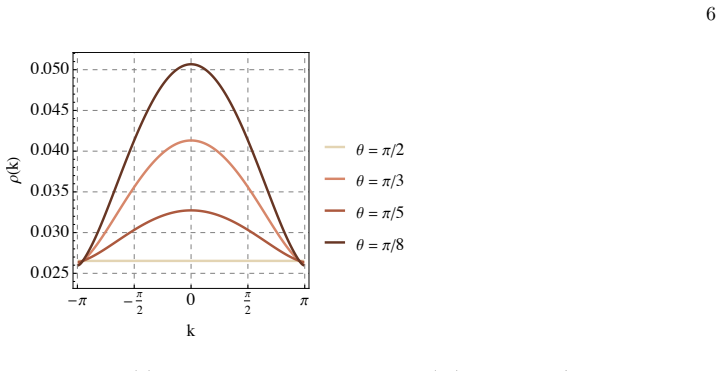
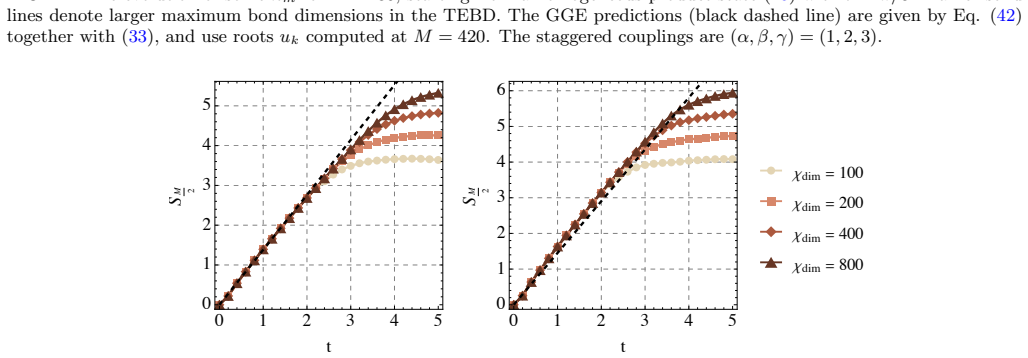
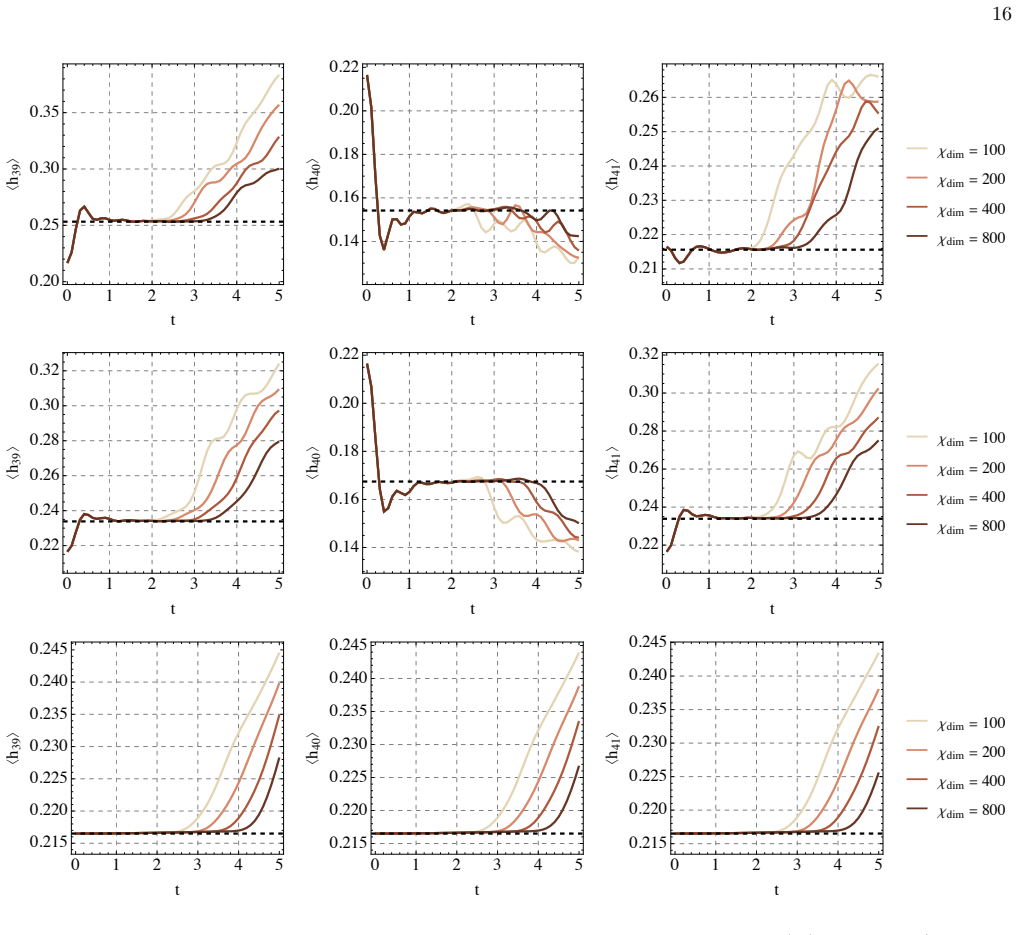
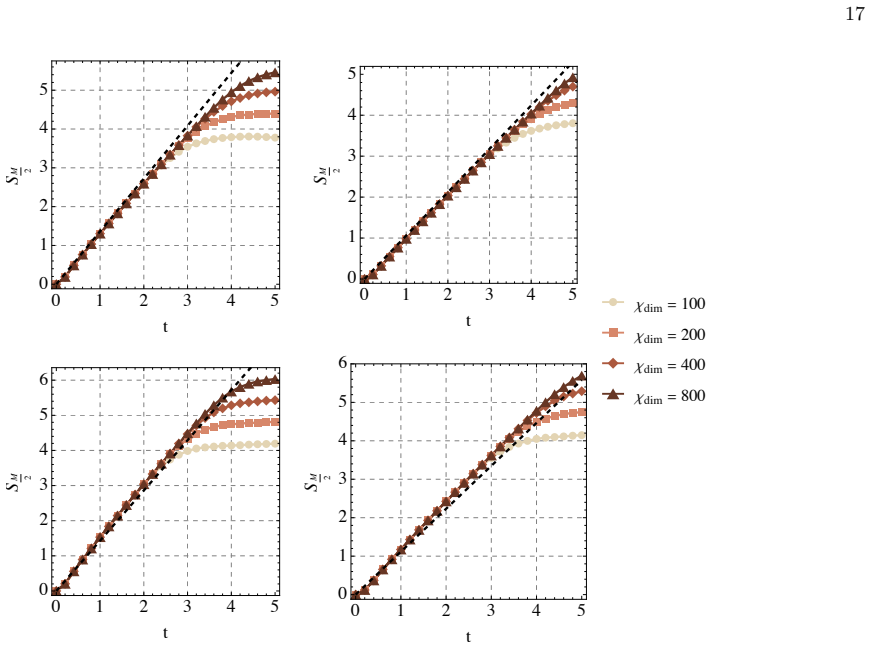
We develop an analytic method to compute the quasi-momentum distribution function characterizing the generalized Gibbs ensemble, and derive an analytic formula to compute the corresponding expectation values for special observables. We conjecture a modification of the standard formula for the entanglement growth based on the quasi-particle picture, taking into account that each fermion in disguise carries an additional amount of entropy due to the exponential degeneracy of the energy eigenvalues.
What carries the argument
Mapping to free fermions in disguise, which introduces exponential degeneracy of energy eigenvalues and requires an additive entropy correction in the quasi-particle picture.
If this is right
- The quasi-momentum distribution function characterizing the generalized Gibbs ensemble admits an analytic computation.
- Expectation values of special observables follow from an analytic formula based on that distribution.
- Entanglement growth follows a modified quasi-particle formula that adds extra entropy per fermion from eigenvalue degeneracy.
- Numerical tests confirm excellent agreement for local observables across initial states and Hamiltonian parameters.
Where Pith is reading between the lines
- Similar degeneracy corrections may apply to other integrable models with high spectral degeneracy, suggesting a general extension of the framework.
- The observed small deviations in entanglement dynamics point to possible additional refinements needed in the quasi-particle description.
- These methods could be tested on constrained spin models or lattice systems where exponential degeneracy appears naturally.
Load-bearing premise
The mapping to free fermions in disguise preserves the structure of the generalized Gibbs ensemble and quasi-particle picture enough that only an additive per-fermion entropy correction is needed rather than a full reformulation.
What would settle it
A tensor-network computation of entanglement entropy growth after a quench that deviates significantly in rate or functional form from the conjectured modified quasi-particle formula would falsify the conjecture.
Figures
read the original abstract
We study the nonequilibrium dynamics following a quantum quench in spin chains that can be solved via a mapping to free fermions in disguise. These models feature an exponential degeneracy of all energy eigenvalues, raising the question of the validity of the established framework describing the properties of integrable systems out of equilibrium. We present two main results. First, we develop an analytic method to compute the quasi-momentum distribution function characterizing the generalized Gibbs ensemble, and derive an analytic formula to compute the corresponding expectation values for special observables. Second, we conjecture a modification of the standard formula for the entanglement growth based on the quasi-particle picture, taking into account that each fermion in disguise carries an additional amount of entropy due to the exponential degeneracy of the energy eigenvalues. We test our theoretical predictions against numerical tensor-network computations for different initial states and Hamiltonian parameters. For the local observables, we find excellent agreement. For the entanglement dynamics, we find small deviations suggesting that our conjecture is only approximately correct. Our results represent a first step towards the extension of the established framework of integrable systems out of equilibrium to models hosting free fermions in disguise.
Editorial analysis
A structured set of objections, weighed in public.
Referee Report
Summary. The manuscript studies nonequilibrium dynamics after quantum quenches in spin chains solvable by mapping to free fermions in disguise, which feature exponential degeneracy of energy eigenvalues. The authors develop an analytic method to compute the quasi-momentum distribution function of the generalized Gibbs ensemble and derive closed-form expressions for expectation values of special observables. They conjecture a modification of the standard quasi-particle formula for entanglement growth that adds an extra entropy contribution per fermion arising from the degeneracy. Tensor-network numerics are used to test the predictions, yielding excellent agreement for local observables but only approximate agreement for entanglement dynamics, with small persistent deviations.
Significance. If the analytic results hold, the work provides a first extension of the established integrable-systems-out-of-equilibrium framework to models hosting free fermions in disguise. Credit is due for the parameter-free analytic derivations obtained directly from the mapping and standard GGE construction, together with independent validation against tensor-network data rather than tautological checks.
major comments (2)
- [Abstract and introduction] Abstract and introduction: the central conjecture that the mapping preserves the quasi-particle picture and GGE structure up to a single additive per-fermion entropy term is load-bearing for the second main result, yet the reported small deviations in entanglement dynamics across multiple initial states and parameters indicate that additional effects (e.g., modified velocities or subspace counting) may be present.
- [Numerical comparison section] Numerical comparison section: the entanglement data exhibit visible, systematic small deviations from the conjectured formula that are not explained by the additive correction alone; this weakens the claim that the standard framework requires only this modification rather than a more substantial reformulation.
minor comments (1)
- [Abstract] The abstract should explicitly delimit the domain of validity of the mapping to free fermions in disguise.
Simulated Author's Rebuttal
We thank the referee for the careful reading of our manuscript and the constructive comments. We appreciate the positive assessment of the analytic GGE results and the independent numerical validation. We address the major comments below, noting that the manuscript already qualifies the entanglement conjecture as approximate due to the observed deviations.
read point-by-point responses
-
Referee: [Abstract and introduction] Abstract and introduction: the central conjecture that the mapping preserves the quasi-particle picture and GGE structure up to a single additive per-fermion entropy term is load-bearing for the second main result, yet the reported small deviations in entanglement dynamics across multiple initial states and parameters indicate that additional effects (e.g., modified velocities or subspace counting) may be present.
Authors: We agree that the small deviations indicate our conjecture is approximate rather than exact, and the manuscript already states this explicitly in the abstract ('we find small deviations suggesting that our conjecture is only approximately correct') and conclusion. The central analytic result on the quasi-momentum distribution and GGE expectation values for local observables stands independently and shows excellent agreement. While additional effects such as modified velocities cannot be ruled out, the mapping to free fermions in disguise and standard GGE construction directly motivate the proposed additive entropy term as the leading correction. In revision we will expand the introduction to discuss possible origins of the discrepancies more explicitly while preserving the presentation of the conjecture as a first step. revision: partial
-
Referee: [Numerical comparison section] Numerical comparison section: the entanglement data exhibit visible, systematic small deviations from the conjectured formula that are not explained by the additive correction alone; this weakens the claim that the standard framework requires only this modification rather than a more substantial reformulation.
Authors: The manuscript already reports these systematic small deviations and draws the conclusion that the conjecture is only approximately correct, so the claim is already qualified rather than overstated. The primary result remains the parameter-free analytic GGE construction, which matches local observables to high accuracy. The entanglement formula is presented as a conjecture motivated by the degeneracy, tested numerically with the observed limitations noted. We will revise the numerical section to quantify the deviations more precisely and add a brief discussion of why a more substantial reformulation is not yet required by the data, while acknowledging that further work may be needed. revision: partial
Circularity Check
No circularity: analytic derivations from mapping are independent; conjecture tested against external tensor-network data
full rationale
The paper derives the quasi-momentum distribution and observable formulas directly from the free-fermion-in-disguise mapping and standard GGE construction (abstract). The entanglement conjecture is explicitly labeled as such and evaluated against independent numerical tensor-network simulations for multiple initial states and parameters, with the paper itself noting small deviations rather than claiming exact agreement. No fitted parameters are renamed as predictions, no self-citation chain is load-bearing for the central claims, and no ansatz or uniqueness result reduces the output to the input by construction. The derivation chain remains self-contained against external benchmarks.
Axiom & Free-Parameter Ledger
axioms (2)
- domain assumption The spin-chain Hamiltonians admit an exact mapping to free fermions whose single-particle spectrum is known and whose many-body spectrum is exponentially degenerate.
- domain assumption The generalized Gibbs ensemble constructed from the conserved charges of the mapped fermions correctly describes the steady state after a quench.
Reference graph
Works this paper leans on
-
[1]
We are computing ⟨O(t)⟩=⟨φ t|O|φt⟩(B1) where |φt⟩=e −iHt |φ0⟩.(B2) andOis some local observable
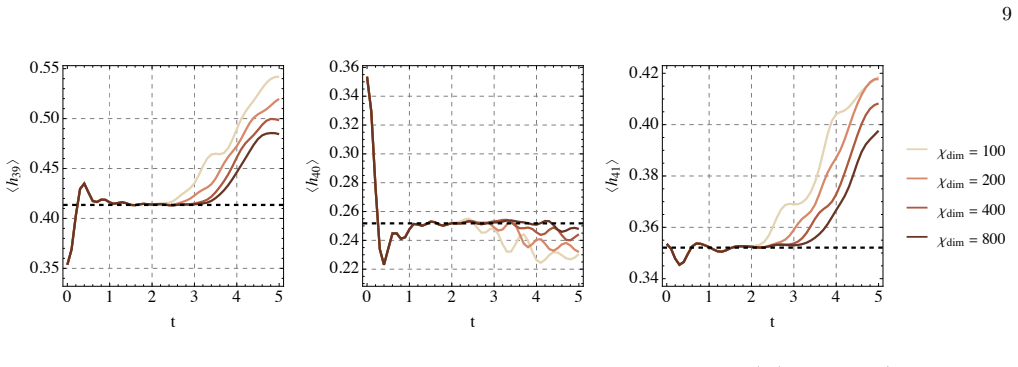
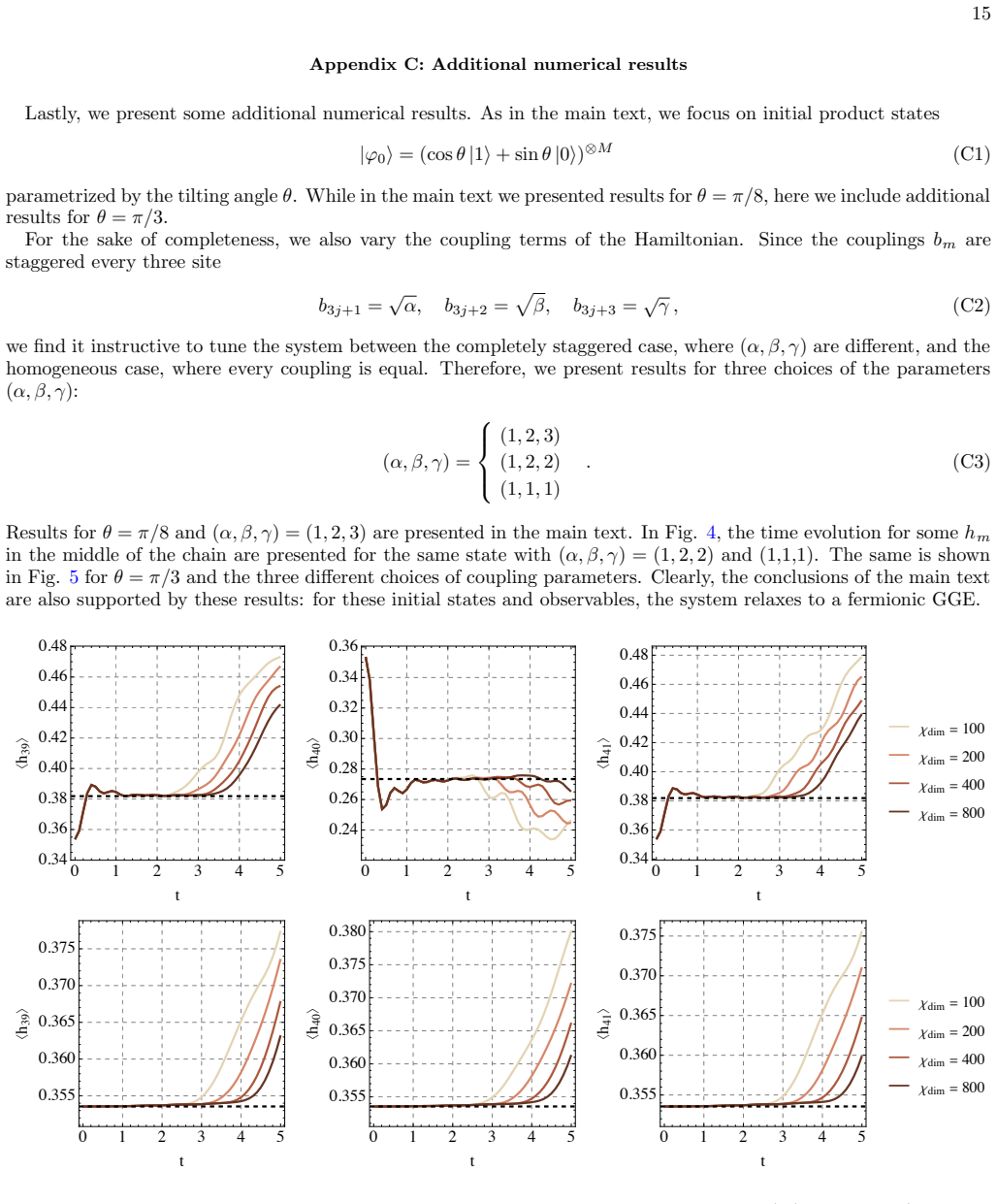
Time evolution of the system Here we present some details of the implementation of the numerical simulations. We are computing ⟨O(t)⟩=⟨φ t|O|φt⟩(B1) where |φt⟩=e −iHt |φ0⟩.(B2) andOis some local observable. We are employing tensor-network methods, namely the time-evolving block decimation (TEBD). In the TEBD, the initial state|ϕ0⟩is represented as a matri...
-
[2]
(B4) is defined in a finite volumeM
The GGE expectation values ofh m To compute the GGE expectation values ⟨hm⟩GGE = SX k=1 ˜nkϵ2 k (∂P) M(1/ϵk) P ′ M(1/ϵk) ,(B4) it is necessary to evaluate the polynomials (∂P) M defined by the following recursion relations (∂P) j = 0j < m(B5) (∂P) m =−2u 2bmPm−3(u) (B6) (∂P) j(u) = (∂P) j−1(u)−u 2b2 j(∂P) j−3(u), j > m .(B7) Although the Gibbs ensemble{N ...
-
[3]
Calabrese, F
P. Calabrese, F. H. Essler, and G. Mussardo, J. Stat. Mech.2016, 064001 (2016)
2016
-
[4]
V. Alba, B. Bertini, M. Fagotti, L. Piroli, and P. Ruggiero, J. Stat. Mech.2021, 114004 (2021)
2021
-
[5]
F. H. Essler and M. Fagotti, J. Stat. Mech.2016, 064002 (2016)
2016
-
[6]
J.-S. Caux, J. Stat. Mech.2016, 064006 (2016)
2016
-
[7]
Vidmar and M
L. Vidmar and M. Rigol, J. Stat. Mech.2016, 064007 (2016)
2016
-
[8]
D’Alessio, Y
L. D’Alessio, Y. Kafri, A. Polkovnikov, and M. Rigol, Adv. Phys.65, 239 (2016)
2016
-
[9]
Rigol, V
M. Rigol, V. Dunjko, V. Yurovsky, and M. Olshanii, Phys. Rev. Lett.98, 050405 (2007)
2007
-
[10]
Caux and F
J.-S. Caux and F. H. L. Essler, Phys. Rev. Lett.110, 257203 (2013)
2013
-
[11]
Bertini, D
B. Bertini, D. Schuricht, and F. H. Essler, J. Stat. Mech.2014, P10035 (2014)
2014
-
[12]
De Nardis, B
J. De Nardis, B. Wouters, M. Brockmann, and J.-S. Caux, Phys. Rev. A89, 033601 (2014)
2014
-
[13]
Wouters, J
B. Wouters, J. De Nardis, M. Brockmann, D. Fioretto, M. Rigol, and J.-S. Caux, Phys. Rev. Lett.113, 117202 (2014)
2014
-
[14]
Pozsgay, M
B. Pozsgay, M. Mesty´ an, M. A. Werner, M. Kormos, G. Zar´ and, and G. Tak´ acs, Phys. Rev. Lett.113, 117203 (2014)
2014
-
[15]
Mesty´ an, B
M. Mesty´ an, B. Pozsgay, G. Tak´ acs, and M. Werner, J. Stat. Mech.2015, P04001 (2015)
2015
-
[16]
Piroli, P
L. Piroli, P. Calabrese, and F. H. L. Essler, Phys. Rev. Lett.116, 070408 (2016)
2016
-
[17]
Piroli, E
L. Piroli, E. Vernier, and P. Calabrese, Phys. Rev. B94, 054313 (2016)
2016
-
[18]
Bertini, L
B. Bertini, L. Piroli, and P. Calabrese, J. Stat. Mech.2016, 063102 (2016)
2016
-
[19]
Piroli, P
L. Piroli, P. Calabrese, and F. H. L. Essler, SciPost Phys.1, 001 (2016)
2016
-
[20]
Piroli, E
L. Piroli, E. Vernier, P. Calabrese, and B. Pozsgay, J. Stat. Mech.2019, 063103 (2019)
2019
-
[21]
Piroli, E
L. Piroli, E. Vernier, P. Calabrese, and B. Pozsgay, J. Stat. Mech.2019, 063104 (2019)
2019
-
[22]
Kinoshita, T
T. Kinoshita, T. Wenger, and D. S. Weiss, Nature440, 900 (2006)
2006
-
[23]
Langen, S
T. Langen, S. Erne, R. Geiger, B. Rauer, T. Schweigler, M. Kuhnert, W. Rohringer, I. E. Mazets, T. Gasenzer, and J. Schmiedmayer, Science348, 207 (2015)
2015
-
[24]
Bertini, M
B. Bertini, M. Collura, J. De Nardis, and M. Fagotti, Phys. Rev. Lett.117, 207201 (2016)
2016
-
[25]
O. A. Castro-Alvaredo, B. Doyon, and T. Yoshimura, Phys. Rev. X6, 041065 (2016)
2016
-
[26]
Malvania, Y
N. Malvania, Y. Zhang, Y. Le, J. Dubail, M. Rigol, and D. S. Weiss, Science373, 1129 (2021)
2021
-
[27]
Schemmer, I
M. Schemmer, I. Bouchoule, B. Doyon, and J. Dubail, Phys. Rev. Lett.122, 090601 (2019)
2019
-
[28]
Møller, C
F. Møller, C. Li, I. Mazets, H.-P. Stimming, T. Zhou, Z. Zhu, X. Chen, and J. Schmiedmayer, Phys. Rev. Lett.126, 090602 (2021)
2021
-
[29]
Bouchoule and J
I. Bouchoule and J. Dubail, J. Stat. Mech.2022, 014003 (2022)
2022
-
[30]
Dubois, G
L. Dubois, G. Th´ em` eze, F. Nogrette, J. Dubail, and I. Bouchoule, Phys. Rev. Lett.133, 113402 (2024)
2024
-
[31]
Dubois, G
L. Dubois, G. Th´ em` eze, J. Dubail, and I. Bouchoule, SciPost Phys.20, 008 (2026)
2026
-
[32]
Calabrese, F
P. Calabrese, F. H. L. Essler, and M. Fagotti, Phys. Rev. Lett.106, 227203 (2011)
2011
-
[33]
Fagotti and F
M. Fagotti and F. H. L. Essler, Phys. Rev. B87, 245107 (2013)
2013
-
[34]
Calabrese, F
P. Calabrese, F. H. Essler, and M. Fagotti, J. Stat. Mech.2012, P07016 (2012)
2012
-
[35]
Calabrese, F
P. Calabrese, F. H. Essler, and M. Fagotti, J. Stat. Mech.2012, P07022 (2012)
2012
-
[36]
Fagotti and P
M. Fagotti and P. Calabrese, Phys. Rev. A78, 010306 (2008)
2008
-
[37]
Calabrese and J
P. Calabrese and J. Cardy, Phys. Rev. Lett.96, 136801 (2006)
2006
-
[38]
Calabrese and J
P. Calabrese and J. Cardy, J. Stat. Mech.2016, 064003 (2016)
2016
-
[39]
Alba and P
V. Alba and P. Calabrese, PNAS114, 7947 (2017)
2017
-
[40]
Fagotti, M
M. Fagotti, M. Collura, F. H. L. Essler, and P. Calabrese, Phys. Rev. B89, 125101 (2014)
2014
-
[41]
Ilievski, J
E. Ilievski, J. De Nardis, B. Wouters, J.-S. Caux, F. H. L. Essler, and T. Prosen, Phys. Rev. Lett.115, 157201 (2015)
2015
-
[42]
Piroli, E
L. Piroli, E. Vernier, P. Calabrese, and M. Rigol, Phys. Rev. B95, 054308 (2017)
2017
-
[43]
Pozsgay, J
B. Pozsgay, J. Phys. A: Math. Theor.50, 074006 (2017)
2017
-
[44]
Modak, L
R. Modak, L. Piroli, and P. Calabrese, J. Stat. Mech.2019, 093106 (2019)
2019
-
[45]
Fendley, J
P. Fendley, J. Phys. A: Math. Theor.52, 335002 (2019)
2019
-
[46]
S. J. Elman, A. Chapman, and S. T. Flammia, Comm. Math. Phys.388, 969 (2021)
2021
-
[47]
Fendley and K
P. Fendley and K. Schoutens, J. Stat. Mech.2007, P02017 (2007)
2007
-
[48]
De Gier, G
J. De Gier, G. Z. Feher, B. Nienhuis, and M. Rusaczonek, J. Stat. Mech.2016, 023104 (2016)
2016
-
[49]
G. Z. Feher, A. Garbali, J. d. Gier, and K. Schoutens, in2017 MATRIX Annals(Springer, 2019) pp. 167–184
2019
-
[50]
F. C. Alcaraz and R. A. Pimenta, Phys. Rev. B102, 121101 (2020)
2020
-
[51]
F. C. Alcaraz and R. A. Pimenta, Phys. Rev. B102, 235170 (2020)
2020
- [52]
-
[53]
Fendley and B
P. Fendley and B. Pozsgay, SciPost Phys.16, 102 (2024)
2024
-
[54]
Fukai and B
K. Fukai and B. Pozsgay, J. Phys. A: Math. Theor.58, 175202 (2025)
2025
- [55]
-
[56]
Hidden Ising models from the generalized Yang-Baxter equation
A. Sinha, S. Maity, P. Padmanabhan, and V. Korepin, arXiv:2605.30007 (2026)
work page internal anchor Pith review Pith/arXiv arXiv 2026
-
[57]
Solving models with generalized free fermions II: Path-product expansion and conserved charges
K. Fukai, B. Pozsgay, and I. Vona, arXiv:2605.31453 (2026)
work page internal anchor Pith review Pith/arXiv arXiv 2026
-
[58]
I. Vona, M. Mesty´ an, and B. Pozsgay, Phys. Rev. B111, 144306 (2025)
2025
-
[59]
Sz´ asz-Schagrin, D
D. Sz´ asz-Schagrin, D. Cristani, L. Piroli, and E. Vernier, Quantum Science Techn.11, 015044 (2026)
2026
- [60]
- [61]
-
[62]
Free fermions in disguise without exponential degeneracies
B. Pozsgay, arXiv:2606.09462 (2026)
work page internal anchor Pith review Pith/arXiv arXiv 2026
-
[63]
Lagrangian representation for fermionic linear optics
S. Bravyi, arXiv quant-ph/0404180 (2004)
work page internal anchor Pith review Pith/arXiv arXiv 2004
-
[64]
Surace and L
J. Surace and L. Tagliacozzo, SciPost Phys. Lect. Notes , 54 (2022)
2022
-
[65]
Piroli and P
L. Piroli and P. Calabrese, J. Phys. A: Math. Theor.47, 385003 (2014)
2014
-
[66]
Brockmann, J
M. Brockmann, J. De Nardis, B. Wouters, and J.-S. Caux, J. Phys. A: Math. Theor.47, 345003 (2014)
2014
-
[67]
Brockmann, J
M. Brockmann, J. Stat. Mech.2014, P05006 (2014)
2014
-
[68]
Foda and K
O. Foda and K. Zarembo, J. Stat. Mech.2016, 023107 (2016)
2016
-
[69]
Piroli, B
L. Piroli, B. Pozsgay, and E. Vernier, Nucl. Phys. B925, 362 (2017)
2017
-
[70]
Gombor and Z
T. Gombor and Z. Bajnok, JHEP2020(10), 123
-
[71]
Gombor and B
T. Gombor and B. Pozsgay, Nucl. Phys. B967, 115390 (2021)
2021
-
[72]
Gombor, Nucl
T. Gombor, Nucl. Phys. B983, 115909 (2022)
2022
-
[73]
Calabrese and J
P. Calabrese and J. Cardy, J. Stat. Mech.2005, P04010 (2005)
2005
-
[74]
Alba and P
V. Alba and P. Calabrese, SciPost Phys. , 017 (2018)
2018
-
[75]
Bertini, M
B. Bertini, M. Fagotti, L. Piroli, and P. Calabrese, J. Phys. A: Math. Theor.51, 39LT01 (2018)
2018
-
[76]
Bastianello and P
A. Bastianello and P. Calabrese, SciPost Phys. , 033 (2018)
2018
-
[77]
V. Alba, B. Bertini, and M. Fagotti, SciPost Phys.7, 5 (2019)
2019
-
[78]
Bastianello and M
A. Bastianello and M. Collura, SciPost Phys.8, 045 (2020)
2020
-
[79]
Klobas and B
K. Klobas and B. Bertini, SciPost Phys.11, 107 (2021)
2021
-
[80]
Lagnese, P
G. Lagnese, P. Calabrese, and L. Piroli, J. Phys. A: Math. Theor.55, 214003 (2022)
2022
discussion (0)
Sign in with ORCID, Apple, or X to comment. Anyone can read and Pith papers without signing in.