Hidden Ising models from the generalized Yang-Baxter equation
Pith reviewed 2026-06-29 00:31 UTC · model grok-4.3
The pith
A multi-site spin-1/2 chain has a free-fermionic spectrum with extra degeneracy from local conserved quantities that act like classical background fields.
A machine-rendered reading of the paper's core claim, the machinery that carries it, and where it could break.
Core claim
The introduced Hamiltonian has an algebra of densities that matches the transverse field Ising model, making its spectrum free-fermionic with huge degeneracy from local conserved quantities acting as classical background fields. It is obtained via the quantum inverse scattering method with a generalized Yang-Baxter equation using R-matrices from extraspecial 2-groups.
What carries the argument
The algebra of the Hamiltonian densities, which resembles that of the transverse-field Ising model and thereby permits a free-fermion mapping while preserving extra local charges.
If this is right
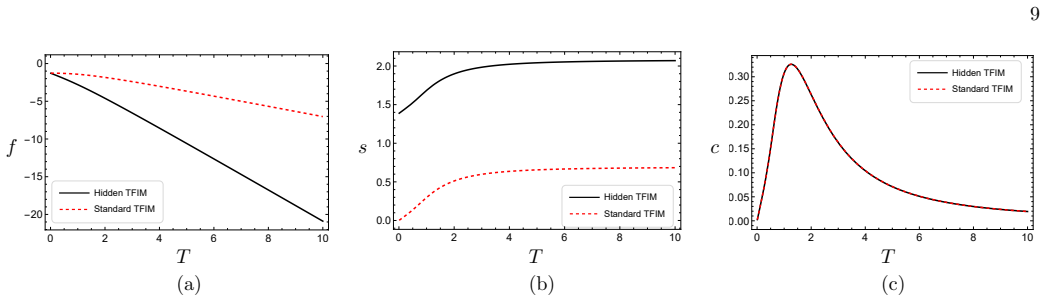
- The thermodynamics differs from the ordinary Ising chain because of the extra degeneracy at each level.
- At gapless points the model is recovered from the quantum inverse scattering method applied to the multi-site Yang-Baxter equation.
- All conserved charges follow directly from the R-matrix built with extraspecial 2-group generators.
- The same construction supplies a systematic way to produce other multi-site spin systems that are transverse-field Ising models underneath.
- Fendley's free-fermion-in-disguise models can be recovered inside the same formalism.
Where Pith is reading between the lines
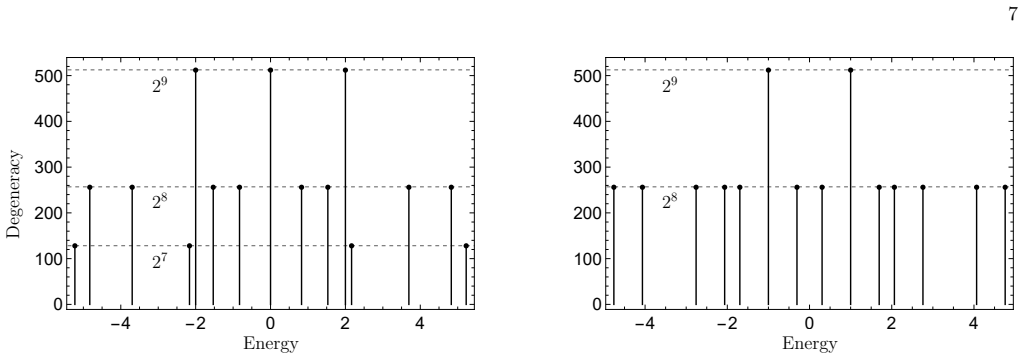
- Numerical spectra of small chains should display a degeneracy pattern that factors into the Ising contribution times the dimension of the classical background configurations.
- The extraspecial-group construction may extend to other root-of-unity or higher-rank cases, yielding families of hidden free-fermion models.
- Physical realizations with engineered multi-spin couplings could exhibit unexpectedly flat bands or enhanced susceptibilities traceable to the hidden charges.
- The method offers a route to classify integrable multi-site chains by the algebraic resemblance of their densities to known solvable models.
Load-bearing premise
The algebra satisfied by the Hamiltonian densities is assumed to be close enough to the transverse-field Ising model algebra that the spectrum remains free-fermionic.
What would settle it
Exact diagonalization of the Hamiltonian on chains of length 8-12, checking whether the eigenvalues follow the free-fermion dispersion and whether the observed multiplicities match the number of independent local conserved quantities.
Figures
read the original abstract
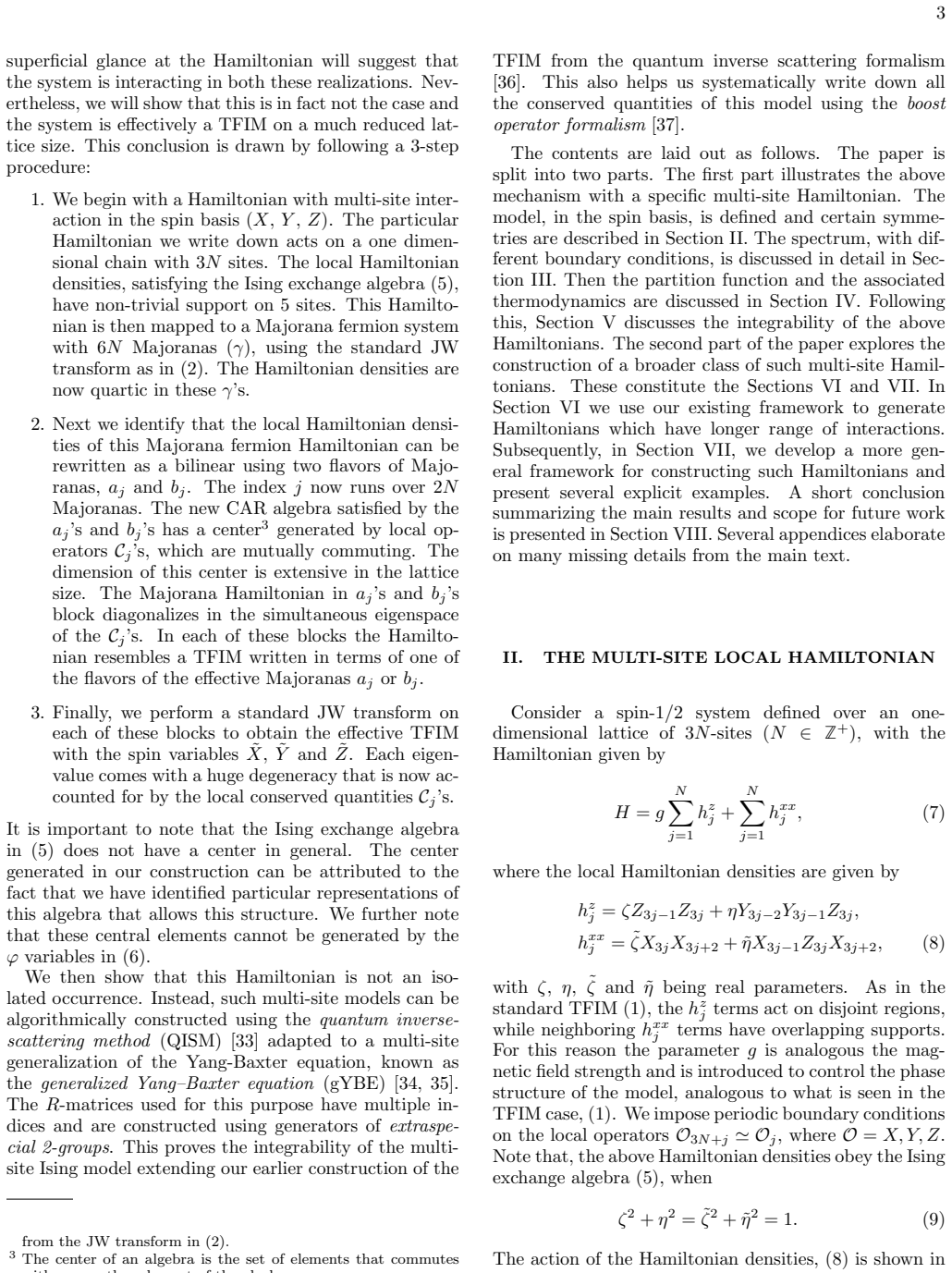
We introduce a one dimensional spin $\frac{1}{2}$ Hamiltonian with multi-site interactions, but still local. The algebra of its Hamiltonian densities resembles that of the transverse field Ising model. Using this fact we show that its spectrum is free-fermionic but with a huge degeneracy for each level. The source of the degeneracy is a set of local conserved quantities that act like a classical background field for the quantum system. The thermodynamics of this system is contrasted with the standard Ising model. At the gapless points in the energy spectrum, we show that this system can be derived from the quantum inverse scattering method adapted to a multi-site generalization of the Yang-Baxter equation as introduced by E. Rowell and Z. Wang. The $R$-matrix is constructed using generators of extraspecial 2-groups. This helps us extract all the conserved charges and lay the framework for a general mechanism to generate such multi-site interaction spin systems that are transverse field Ising models under the hood. A remark on how to obtain P. Fendley's free-fermion in disguise models in this formalism is also included.
Editorial analysis
A structured set of objections, weighed in public.
Referee Report
Summary. The manuscript introduces a one-dimensional spin-1/2 Hamiltonian with local multi-site interactions. It asserts that the algebra of the Hamiltonian densities resembles that of the transverse-field Ising model (TFIM), from which it concludes that the spectrum is free-fermionic with extensive degeneracy generated by a set of local conserved quantities that behave as a classical background field. The model is obtained from the quantum inverse scattering method applied to a multi-site generalization of the Yang-Baxter equation, with the R-matrix constructed from generators of extraspecial 2-groups; thermodynamics are contrasted with the ordinary Ising chain, and a remark on recovering Fendley-type models is included.
Significance. If the central algebraic claim is rigorously established, the construction supplies an explicit mechanism for generating families of integrable spin chains whose free-fermion character is hidden behind additional local integrals of motion. The link to the generalized Yang-Baxter equation and extraspecial 2-groups offers a potential route to systematic classification of such models beyond nearest-neighbor interactions.
major comments (2)
- [Abstract / Hamiltonian definition] Abstract and the paragraph following the definition of the Hamiltonian: the assertion that algebraic resemblance to the TFIM implies a free-fermionic spectrum is load-bearing for the central claim, yet the multi-site interaction terms are not shown to map under Jordan-Wigner to purely bilinear fermionic operators. An explicit verification that no quartic or higher fermionic terms survive is required; the TFIM case works because its nearest-neighbor terms become quadratic, but this does not automatically extend to the multi-site case without further proof.
- [Conserved quantities paragraph] Section on conserved quantities (the paragraph introducing the local charges that act as background fields): the degeneracy is attributed to these charges, but it is not demonstrated that they commute with the Hamiltonian while remaining independent of the fermionic degrees of freedom that diagonalize the quadratic part. An explicit commutation relation or counting argument establishing that the degeneracy is independent of system size and of the particular choice of R-matrix parameters would strengthen the claim.
minor comments (1)
- [Abstract] The abstract states that the R-matrix is constructed using generators of extraspecial 2-groups; a brief reminder of the defining relations of these groups (or a reference to the precise representation used) would aid readers unfamiliar with the construction.
Simulated Author's Rebuttal
We thank the referee for the careful reading and constructive comments on our manuscript. We respond to each major point below, agreeing that additional explicit verifications will strengthen the presentation, and will incorporate them in the revised version.
read point-by-point responses
-
Referee: [Abstract / Hamiltonian definition] Abstract and the paragraph following the definition of the Hamiltonian: the assertion that algebraic resemblance to the TFIM implies a free-fermionic spectrum is load-bearing for the central claim, yet the multi-site interaction terms are not shown to map under Jordan-Wigner to purely bilinear fermionic operators. An explicit verification that no quartic or higher fermionic terms survive is required; the TFIM case works because its nearest-neighbor terms become quadratic, but this does not automatically extend to the multi-site case without further proof.
Authors: We agree that an explicit Jordan-Wigner transformation for the multi-site terms would clarify the free-fermionic character. Although the algebraic structure mirroring the TFIM is used to establish the spectrum, the revised manuscript will include a direct computation showing that the multi-site densities, built from the extraspecial 2-group generators, map to purely bilinear fermionic operators with no surviving quartic or higher terms, owing to the specific relations enforced by the generalized Yang-Baxter construction. revision: yes
-
Referee: [Conserved quantities paragraph] Section on conserved quantities (the paragraph introducing the local charges that act as background fields): the degeneracy is attributed to these charges, but it is not demonstrated that they commute with the Hamiltonian while remaining independent of the fermionic degrees of freedom that diagonalize the quadratic part. An explicit commutation relation or counting argument establishing that the degeneracy is independent of system size and of the particular choice of R-matrix parameters would strengthen the claim.
Authors: We will add explicit commutation relations confirming that the local charges commute with the Hamiltonian and are independent of the fermionic modes. A counting argument will also be included demonstrating that the degeneracy is extensive, independent of system size, and holds uniformly across the family of R-matrices obtained from extraspecial 2-groups. revision: yes
Circularity Check
No circularity: construction from generalized YBE and group generators is independent of the claimed spectrum
full rationale
The paper derives the multi-site Hamiltonian explicitly from the R-matrix built from extraspecial 2-group generators and the generalized Yang-Baxter equation (citing Rowell-Wang), then separately notes algebraic resemblance to TFIM densities to infer free-fermion solvability and degeneracy from local conserved charges. No equation or claim reduces the spectrum, degeneracy, or thermodynamics to a quantity defined by the result itself, nor does any load-bearing step rely on a self-citation chain or fitted parameter renamed as prediction. The derivation chain remains self-contained against external algebraic inputs.
Axiom & Free-Parameter Ledger
axioms (1)
- domain assumption The algebra of its Hamiltonian densities resembles that of the transverse field Ising model
invented entities (1)
-
R-matrix constructed using generators of extraspecial 2-groups
no independent evidence
Forward citations
Cited by 1 Pith paper
-
Symmetries of the Generalized Yang--Baxter Equations
Symmetries of generalized multi-site Yang-Baxter equations depend on site count and frequently outnumber those of the standard equation, heavily constraining inequivalent integrable models.
Reference graph
Works this paper leans on
-
[1]
However, it turns out that both H± share the same spectrum
Closed chain Consider the fermionic Hamiltonians H± = i 2N−1X j=1 ajbj+1 ±ia 2N b1,(35) where±denote periodic and antiperiodic boundary con- ditions, respectively. However, it turns out that both H± share the same spectrum. To see this, consider the operatorγ ε defined as γε = 3X k=1 εkγk, 3X k=1 εkωk = 0, γεaj =−a jγε, γ εbj =−(−1) δj,1bjγε,(36) withj= 1...
-
[2]
The split
Open chain We now briefly talk about the open boundary condi- tion, for which the Hamiltonian becomes Ho = i 2N−1X j=1 ajbj+1 = i 2N−1X j=1 bj ˆCjbj+1.(47) In this case, the degeneracy is enhanced further and be- comes twice as large as only a single sector admits non- trivial spectrum. The boundary modesb 2N , b1, along with the operatorsU kl, suffice to...
-
[3]
Crystal statistics. i. a two-dimensional model with an order-disorder transition,
L. Onsager, “Crystal statistics. i. a two-dimensional model with an order-disorder transition,”Phys. Rev., vol. 65, pp. 117–149, Feb 1944
1944
-
[4]
Crystal statistics. ii. partition function 12 Another mapping of such systems to free-fermions can be found in [32]. evaluated by spinor analysis,
B. Kaufman, “Crystal statistics. ii. partition function 12 Another mapping of such systems to free-fermions can be found in [32]. evaluated by spinor analysis,”Phys. Rev., vol. 76, pp. 1232–1243, Oct 1949
1949
-
[5]
Two- dimensional ising model as a soluble problem of many fermions,
T. D. Schultz, D. C. Mattis, and E. H. Lieb, “Two- dimensional ising model as a soluble problem of many fermions,”Rev. Mod. Phys., vol. 36, pp. 856–871, Jul 1964
1964
-
[6]
The one-dimensional ising model with a transverse field,
P. Pfeuty, “The one-dimensional ising model with a transverse field,”Annals of Physics, vol. 57, no. 1, pp. 79– 90, 1970. 20
1970
-
[7]
Two soluble mod- els of an antiferromagnetic chain,
E. Lieb, T. Schultz, and D. Mattis, “Two soluble mod- els of an antiferromagnetic chain,”Annals of Physics, vol. 16, no. 3, pp. 407–466, 1961
1961
-
[8]
A one-way quantum computer,
R. Raussendorf and H. J. Briegel, “A one-way quantum computer,”Phys. Rev. Lett., vol. 86, pp. 5188–5191, May 2001
2001
-
[9]
Quantum phase transition between clus- ter and antiferromagnetic states,
W. Son, L. Amico, R. Fazio, A. Hamma, S. Pascazio, and V. Vedral, “Quantum phase transition between clus- ter and antiferromagnetic states,”EPL (Europhysics Let- ters), vol. 95, no. 5, p. 50001, 2011
2011
-
[10]
¨Uber das paulische ¨ aquivalenzverbot,
P. Jordan and E. Wigner, “ ¨Uber das paulische ¨ aquivalenzverbot,”Zeitschrift f¨ ur Physik, vol. 47, no. 9, pp. 631–651, 1928
1928
-
[11]
Free fermions in disguise,
P. Fendley, “Free fermions in disguise,”Journal of Physics A: Mathematical and Theoretical, vol. 52, no. 33, p. 335002, 2019
2019
-
[12]
Free fermionic and parafermionic quantum spin chains with multispin inter- actions,
F. C. Alcaraz and R. A. Pimenta, “Free fermionic and parafermionic quantum spin chains with multispin inter- actions,”Phys. Rev. B, vol. 102, p. 121101(R), Sep 2020
2020
-
[13]
Integrable quantum spin chains with free fermionic and parafermionic spec- trum,
F. C. Alcaraz and R. A. Pimenta, “Integrable quantum spin chains with free fermionic and parafermionic spec- trum,”Phys. Rev. B, vol. 102, p. 235170, Dec 2020
2020
-
[14]
Integrable spin chains and cellular automata with medium-range interaction,
T. Gombor and B. Pozsgay, “Integrable spin chains and cellular automata with medium-range interaction,”Phys. Rev. E, vol. 104, p. 054123, Nov 2021
2021
-
[15]
Generalised Onsager Algebra in Quantum Lat- tice Models,
Y. Miao, “Generalised Onsager Algebra in Quantum Lat- tice Models,”SciPost Phys., vol. 13, p. 070, 2022
2022
-
[16]
Dissipative free fermions in disguise,
K. Fukai, H. Yoshida, and H. Katsura, “Dissipative free fermions in disguise,”ariv:2603.22163 [cond-mat.stat- mech], 2026
arXiv 2026
-
[17]
Free fermions behind the disguise,
S. J. Elman, A. Chapman, and S. T. Flammia, “Free fermions behind the disguise,”Communications in Math- ematical Physics, vol. 388, no. 2, pp. 969–1003, 2021
2021
-
[18]
Characterization of solvable spin models via graph invariants,
A. Chapman and S. T. Flammia, “Characterization of solvable spin models via graph invariants,”Quantum, vol. 4, p. 278, 2020
2020
-
[19]
Geometric criterion for solvability of lattice spin systems,
M. Ogura, Y. Imamura, N. Kameyama, K. Minami, and M. Sato, “Geometric criterion for solvability of lattice spin systems,”Physical Review B, vol. 102, Dec. 2020
2020
-
[20]
Exact real time dynamics with free fermions in disguise,
I. Vona, M. Mesty´ an, and B. Pozsgay, “Exact real time dynamics with free fermions in disguise,” 2025
2025
-
[21]
Construction and simulability of quantum circuits with free fermions in disguise,
D. Sz´ asz-Schagrin, D. Cristani, L. Piroli, and E. Vernier, “Construction and simulability of quantum circuits with free fermions in disguise,”Quantum Science and Tech- nology, vol. 11, p. 015044, Jan. 2026
2026
-
[22]
Classical simula- tion of noninteracting-fermion quantum circuits,
B. M. Terhal and D. P. DiVincenzo, “Classical simula- tion of noninteracting-fermion quantum circuits,”Physi- cal Review A, vol. 65, Mar. 2002
2002
-
[23]
Matchgates and classical sim- ulation of quantum circuits,
R. Jozsa and A. Miyake, “Matchgates and classical sim- ulation of quantum circuits,”Proceedings of the Royal Society A: Mathematical, Physical and Engineering Sci- ences, vol. 464, no. 2100, p. 3089–3106, 2008
2008
-
[24]
Jordan-wigner transformation for quantum- spin systems in two dimensions and fractional statistics,
E. Fradkin, “Jordan-wigner transformation for quantum- spin systems in two dimensions and fractional statistics,” Phys. Rev. Lett., vol. 63, pp. 322–325, Jul 1989
1989
-
[25]
Ground state of the two-dimensional an- tiferromagnetic heisenberg model studied using an ex- tended wigner-jordon transformation,
Y. R. Wang, “Ground state of the two-dimensional an- tiferromagnetic heisenberg model studied using an ex- tended wigner-jordon transformation,”Phys. Rev. B, vol. 43, pp. 3786(R)–3789(R), Feb 1991
1991
-
[26]
Bose-fermi transformation in three-dimensional space,
L. Huerta and J. Zanelli, “Bose-fermi transformation in three-dimensional space,”Phys. Rev. Lett., vol. 71, pp. 3622–3624, Nov 1993
1993
-
[27]
Generalized jordan-wigner transformations,
C. D. Batista and G. Ortiz, “Generalized jordan-wigner transformations,”Phys. Rev. Lett., vol. 86, pp. 1082– 1085, Feb 2001
2001
-
[28]
Arbitrary di- mensional majorana dualities and architectures for topo- logical matter,
Z. Nussinov, G. Ortiz, and E. Cobanera, “Arbitrary di- mensional majorana dualities and architectures for topo- logical matter,”Phys. Rev. B, vol. 86, p. 085415, Aug 2012
2012
-
[29]
Jordan– wigner transformations for tree structures,
S. Backens, A. Shnirman, and Y. Makhlin, “Jordan– wigner transformations for tree structures,”Scientific Reports, vol. 9, no. 1, p. 2598, 2019
2019
-
[30]
Mapping local hamiltoni- ans of fermions to local hamiltonians of spins,
F. Verstraete and J. I. Cirac, “Mapping local hamiltoni- ans of fermions to local hamiltonians of spins,”Journal of Statistical Mechanics: Theory and Experiment, vol. 2005, p. P09012, sep 2005
2005
-
[31]
Exact bosonization in two spatial dimensions and a new class of lattice gauge theories,
Y.-A. Chen, A. Kapustin, and D. Radicevi´ c, “Exact bosonization in two spatial dimensions and a new class of lattice gauge theories,”Annals of Physics, vol. 393, pp. 234–253, 2018
2018
-
[32]
Jordan-wigner dualities for translation-invariant hamiltonians in any dimension: Emergent fermions in fracton topological order,
N. Tantivasadakarn, “Jordan-wigner dualities for translation-invariant hamiltonians in any dimension: Emergent fermions in fracton topological order,” Physical Review Research, vol. 2, no. 2, 2020
2020
-
[33]
Bonsai algorithm: Grow your own fermion-to-qubit mappings,
A. Miller, Z. Zimbor´ as, S. Knecht, S. Maniscalco, and G. Garc´ ıa-P´ erez, “Bonsai algorithm: Grow your own fermion-to-qubit mappings,”PRX Quantum, vol. 4, p. 030314, Aug 2023
2023
-
[34]
Solvable hamiltonians and fermionization transformations obtained from operators satisfying spe- cific commutation relations,
K. Minami, “Solvable hamiltonians and fermionization transformations obtained from operators satisfying spe- cific commutation relations,”Journal of the Physical So- ciety of Japan, vol. 85, no. 2, p. 024003, 2016
2016
-
[35]
Quantum Inverse Scattering Method and Correlation Functions,
V. E. Korepin, N. M. Bogoliubov, and A. G. Izergin, “Quantum Inverse Scattering Method and Correlation Functions,” Cambridge university press, 1993
1993
-
[36]
Ex- traspecial two-groups, generalized yang-baxter equations and braiding quantum gates,
E. C. Rowell, Y. Zhang, Y.-S. Wu, and M.-L. Ge, “Ex- traspecial two-groups, generalized yang-baxter equations and braiding quantum gates,” 2010
2010
-
[37]
Quan- tum entanglement, supersymmetry, and the generalized yang-baxter equation.,
P. Padmanabhan, F. Sugino, and D. Trancanelli, “Quan- tum entanglement, supersymmetry, and the generalized yang-baxter equation.,”Quantum Information and Com- putation, 2019
2019
-
[38]
The Yang–Baxter integrability of the critical Ising chain,
A. Sinha, T. Justin, P. Padmanabhan, and V. Kore- pin, “The Yang–Baxter integrability of the critical Ising chain,”J. Stat. Mech., vol. 2025, no. 10, p. 103102, 2025
2025
-
[39]
Lectures on yangian symmetry,
F. Loebbert, “Lectures on yangian symmetry,”Jour- nal of Physics A: Mathematical and Theoretical, vol. 49, no. 32, p. 323002, 2016
2016
-
[40]
Ising model with four-spin interactions,
F. W. Wu, “Ising model with four-spin interactions,” Phys. Rev. B, vol. 4, pp. 2312–2314, Oct 1971
1971
-
[41]
Duality in generalized ising models,
F. J. Wegner, “Duality in generalized ising models,” arXiv:1411.5815 [hep-lat], 2014
Pith/arXiv arXiv 2014
-
[42]
Duality in generalized ising models and phase transitions without local order parameters,
F. J. Wegner, “Duality in generalized ising models and phase transitions without local order parameters,”Jour- nal of Mathematical Physics, vol. 12, pp. 2259–2272, 10 1971
1971
-
[43]
Ising analogs of quantum spin chains with multispin interac- tions,
F. C. Alcaraz, R. A. Pimenta, and J. Sirker, “Ising analogs of quantum spin chains with multispin interac- tions,”Physical Review B, vol. 107, no. 23, 2023
2023
-
[44]
Extraspe- cial 2-groups and images of braid group representations,
J. M. Franko, E. C. Rowell, and Z. Wang, “Extraspe- cial 2-groups and images of braid group representations,” Journal of Knot Theory and Its Ramifications, vol. 15, no. 04, pp. 413–427, 2006
2006
-
[45]
Anyons in an exactly solved model and be- yond,
A. Kitaev, “Anyons in an exactly solved model and be- yond,”Annals of Physics, vol. 321, no. 1, pp. 2–111, 2006. January Special Issue
2006
-
[46]
The hilbert-space structure of 21 free fermions in disguise,
E. Vernier and L. Piroli, “The hilbert-space structure of 21 free fermions in disguise,”Journal of Statistical Mechan- ics: Theory and Experiment, vol. 2026, no. 1, p. 013101, 2026
2026
-
[47]
Takahashi,Thermodynamics of One-Dimensional Solvable Models
M. Takahashi,Thermodynamics of One-Dimensional Solvable Models. Cambridge University Press, 1999
1999
-
[48]
Statistical mechanics of the x y model. ii. spin-correlation functions,
E. Barouch and B. M. McCoy, “Statistical mechanics of the x y model. ii. spin-correlation functions,”Physical Review A, vol. 3, pp. 786–804, 1971
1971
-
[49]
Time- dependent correlation functions of the transverse ising chain at the critical magnetic field,
B. M. McCoy, J. H. Perk, and R. E. Shrock, “Time- dependent correlation functions of the transverse ising chain at the critical magnetic field,”Nuclear Physics B, vol. 220, no. 1, pp. 35–47, 1983
1983
-
[50]
Lattice models in statistical mechanics and soliton equations,
B. M. McCoy, “Lattice models in statistical mechanics and soliton equations,” 1993
1993
-
[51]
Lieb-robinson correlation function for the quantum transverse-field ising model,
B. J. Mahoney and C. S. Lent, “Lieb-robinson correlation function for the quantum transverse-field ising model,” Physical Review Research, vol. 6, no. 2, 2024
2024
-
[52]
New results for the correlation functions of the ising model and the trans- verse ising chain,
J. H. H. Perk and H. Au-Yang, “New results for the correlation functions of the ising model and the trans- verse ising chain,”Journal of Statistical Physics, vol. 135, p. 599–619, May 2009
2009
-
[53]
Quench dynamics and relaxation in isolated integrable quantum spin chains,
F. H. L. Essler and M. Fagotti, “Quench dynamics and relaxation in isolated integrable quantum spin chains,” Journal of Statistical Mechanics: Theory and Experi- ment, vol. 2016, no. 6, p. 064002, 2016
2016
-
[54]
Temperature correlations of quantum spins,
A. R. Its, A. G. Izergin, V. E. Korepin, and N. A. Slavnov, “Temperature correlations of quantum spins,” Physical Review Letters, vol. 70, p. 1704–1706, Mar. 1993
1993
-
[55]
On the equivalence of the discrete non- linear schr¨ odinger equation and the discrete isotropic heisenberg magnet,
T. Hoffmann, “On the equivalence of the discrete non- linear schr¨ odinger equation and the discrete isotropic heisenberg magnet,”Physics Letters A, vol. 265, p. 62–67, Jan. 2000
2000
-
[56]
Differential Equations for Quantum Cor- relation Functions,
A. R. Its, A. G. Izergin, V. E. Korepin, and N. A. Slavnov, “Differential Equations for Quantum Cor- relation Functions,”International Journal of Modern Physics B, vol. 4, pp. 1003–1037, Jan. 1990
1990
-
[57]
Algebraic classification of hietarinta’s solutions of yang- baxter equations: invertible 4×4 operators,
S. Maity, V. K. Singh, P. Padmanabhan, and V. Korepin, “Algebraic classification of hietarinta’s solutions of yang- baxter equations: invertible 4×4 operators,”Journal of High Energy Physics, vol. 2024, no. 12, p. 67, 2024
2024
-
[58]
Integrability of a family of clean syk models from the critical ising chain,
K. Fukai and H. Katsura, “Integrability of a family of clean syk models from the critical ising chain,”Phys. Rev. B, vol. 113, p. 115107, Mar 2026
2026
-
[59]
Boost operator and its applica- tion to quantum gelfand-levitan equation for heisenberg- ising chain with spin one-half,
K. Sogo and M. Wadati, “Boost operator and its applica- tion to quantum gelfand-levitan equation for heisenberg- ising chain with spin one-half,”Progress of Theoretical Physics, vol. 69, no. 2, pp. 431–450, 1983
1983
-
[60]
Infinite set of conserved charges in the ising model,
M. Grady, “Infinite set of conserved charges in the ising model,”Physical Review D, vol. 25, no. 4, p. 1103, 1982
1982
-
[61]
Conserved charges of series of solvable lat- tice models,
K. Minami, “Conserved charges of series of solvable lat- tice models,”Nuclear Physics B, vol. 1012, p. 116844, 2025
2025
-
[62]
Statistics of the two-dimensional ferromagnet. part i,
H. A. Kramers and G. H. Wannier, “Statistics of the two-dimensional ferromagnet. part i,”Phys. Rev., vol. 60, pp. 252–262, Aug 1941
1941
-
[63]
Statistics of the two- dimensional ferromagnet. part ii,
H. A. Kramers and G. H. Wannier, “Statistics of the two- dimensional ferromagnet. part ii,”Phys. Rev., vol. 60, pp. 263–276, Aug 1941
1941
-
[64]
Topological defects on the lattice: I. the ising model,
D. Aasen, R. S. Mong, and P. Fendley, “Topological defects on the lattice: I. the ising model,”Journal of Physics A: Mathematical and Theoretical, vol. 49, no. 35, p. 354001, 2016
2016
-
[65]
Topological de- fects on the lattice: dualities and degeneracies,
D. Aasen, P. Fendley, and R. S. Mong, “Topological de- fects on the lattice: dualities and degeneracies,”arXiv preprint arXiv:2008.08598, 2020
arXiv 2008
-
[66]
Majorana chain and ising model-(non-invertible) translations, anomalies, and em- anant symmetries,
N. Seiberg and S.-H. Shao, “Majorana chain and ising model-(non-invertible) translations, anomalies, and em- anant symmetries,”SciPost Physics, vol. 16, no. 3, p. 064, 2024
2024
-
[67]
Non- invertible Kramers-Wannier duality-symmetry in the trotterized critical Ising chain,
A. Sinha, P. Padmanabhan, and V. Korepin, “Non- invertible Kramers-Wannier duality-symmetry in the trotterized critical Ising chain,” 11 2025
2025
-
[68]
Braid- ing quantum gates from partition algebras,
P. Padmanabhan, F. Sugino, and D. Trancanelli, “Braid- ing quantum gates from partition algebras,”Quantum, vol. 4, p. 311, Aug. 2020
2020
-
[69]
Gen- erating w states with braiding operators,
P. Padmanabhan, F. Sugino, and D. Trancanelli, “Gen- erating w states with braiding operators,”arXiv preprint arXiv:2007.05660, 2020
arXiv 2007
-
[70]
Topological aspects of quantum entanglement,
L. H. Kauffman and E. Mehrotra, “Topological aspects of quantum entanglement,”arXiv:1611.08047[math.GT], 2018
Pith/arXiv arXiv 2018
-
[71]
Braiding operators are universal quantum gates,
L. H. Kauffman and S. J. Lomonaco, “Braiding operators are universal quantum gates,”New Journal of Physics, vol. 6, p. 134–134, Oct. 2004
2004
-
[72]
Generalized yang-baxter equations and braid- ing quantum gates,
R. Chen, “Generalized yang-baxter equations and braid- ing quantum gates,”arXiv:1108.5215[math.QA], 2011
Pith/arXiv arXiv 2011
-
[73]
Yang–baxter operators need quantum entanglement to distinguish knots,
G. Alagic, M. Jarret, and S. P. Jordan, “Yang–baxter operators need quantum entanglement to distinguish knots,”Journal of Physics A: Mathematical and Theo- retical, vol. 49, p. 075203, Jan. 2016
2016
-
[74]
Qubit rep- resentations of the braid groups from generalized yang- baxter matrices,
J. F. Vasquez, Z. Wang, and H. M. Wong, “Qubit rep- resentations of the braid groups from generalized yang- baxter matrices,”arXiv:1602.08536[math.QA], 2016. Appendix A: Review of the(d, l, m)-gYBE We denote the generalizedR-matrix withlindices as, R1···l({u})≡R j1···jl({u}) ;{u}= (u 1,· · ·, u l)∈C.(A1) In this notation, the (d, l, m)-gYBE reads, R1···l(...
Pith/arXiv arXiv 2016
discussion (0)
Sign in with ORCID, Apple, or X to comment. Anyone can read and Pith papers without signing in.