REVIEW 2 major objections 5 minor 80 references
In-plane oxygen vacancies flip the Hall sign in bilayer nickelate films by selectively killing the d_x2-y2 transport channel.
Reviewed by Pith at T0; open to challenge. T0 means a machine referee read the full paper against a public rubric. the ladder, T0–T4 →
T0 review · grok-4.5
2026-07-11 21:31 UTC pith:NKJN6UIM
load-bearing objection Solid microscopic account of the nickelate Hall sign flip: in-plane vacancies, not rigid-band doping, select the d_x2-y2 channel; scalar RTA is the softest step but does not sink the claim. the 2 major comments →
Hall Coefficient Sign Reversal Driven by Orbital-Selective Oxygen-Vacancy Scattering in Nickelate Films
The pith
A machine-rendered reading of the paper's core claim, the machinery that carries it, and where it could break.
Core claim
Multiband compensation is not enough: in-plane oxygen vacancies selectively suppress the transport channel dominated by the d_x2-y2 orbital and thereby drive the Hall coefficient through zero, whereas inner-apical vacancies make the Hall coefficient more negative. Pocket-resolved and orbital-selective oxygen-vacancy scattering is therefore the microscopic origin of the observed Hall sign reversal.
What carries the argument
A DFT+CDMFT quasiparticle Hamiltonian for the four Ni orbitals, combined with a first-principles T-matrix for the local vacancy potential and Ong’s geometric formula for the weak-field Hall conductivity (signed area swept by the mean-free-path contour). The machinery converts orbital-selective scattering rates into pocket-resolved Hall contributions that can cancel.
Load-bearing premise
The calculation assumes that a simple, band- and momentum-dependent transport lifetime obtained from Matthiessen’s rule with a single hand-chosen clean-limit lifetime is enough to set the relative weights of the pocket Hall areas.
What would settle it
Measure Hall coefficient versus controlled oxygen-vacancy concentration on films whose vacancy site preference (in-plane versus inner-apical) has been independently fixed by diffraction or spectroscopy; a pure in-plane series should reverse sign while a pure apical series should not.
Editorial analysis
A structured set of objections, weighed in public.
Referee Report
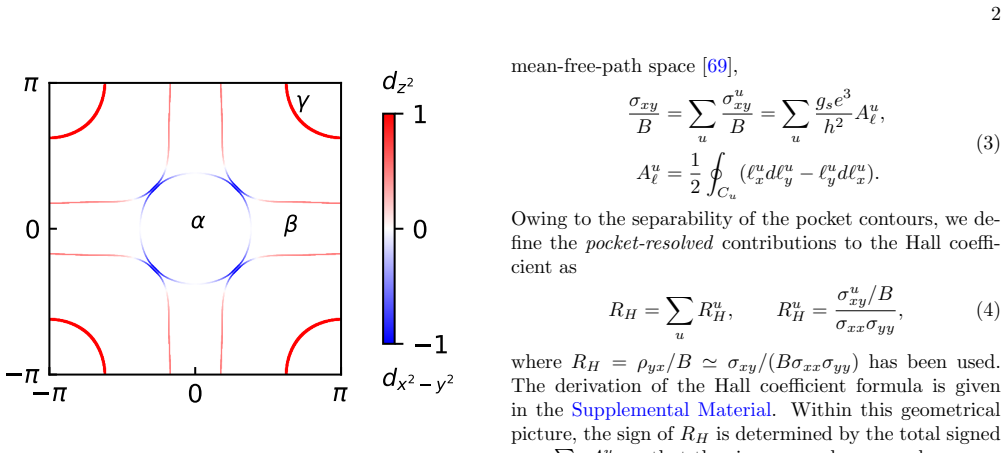
Summary. The manuscript argues that Hall-coefficient sign reversals observed in superconducting bilayer nickelate films cannot be explained by rigid-band electron doping from oxygen vacancies alone. Starting from a DFT+CDMFT quasiparticle Hamiltonian that reproduces the ARPES Fermiology (three pockets α, β, γ with distinct d_x2−y2 / d_z2 weights), the authors evaluate the weak-field Hall coefficient via Ong’s geometric formula in a semiclassical Boltzmann framework. They construct microscopic single-vacancy scattering potentials from DFT for inner-apical and in-plane oxygen sites, compute band- and momentum-dependent transport rates with a T-matrix, and mix them with a vacancy-free background via Matthiessen’s rule. Rigid-band doping makes R_H less negative but never flips its sign; in-plane vacancies selectively suppress the α / d_x2−y2 channel and drive R_H through zero, while inner-apical vacancies make R_H more negative. The claimed microscopic origin is therefore pocket-resolved, orbital-selective oxygen-vacancy scattering.
Significance. If correct, the work supplies a concrete, falsifiable microscopic mechanism for the oxygen-stoichiometry dependence of R_H in ambient-pressure bilayer nickelate films, and it cleanly separates doping from scattering—something that has been missing in the experimental literature. Strengths include: (i) a first-principles vacancy potential (Supplemental Material D, Tables VII–VIII) rather than phenomenological impurity parameters; (ii) an explicit demonstration that rigid-band doping alone never produces a sign change (Fig. 2, Table II); (iii) pocket- and orbital-resolved decompositions (Tables I–II, Fig. 4, Table IX); and (iv) documented robustness of the qualitative trend to τ0 over 10–500 fs and to small Δαβ and η (Supplemental Material C, F). These elements make the paper a useful framework for interpreting Hall data together with structural probes of oxygen defects.
major comments (2)
- Main text Eqs. (7)–(8) and Supplemental Material E, Eqs. (E.20) vs (E.24): the sign reversal is obtained only after collapsing the T-matrix scattering probability into a scalar transport time τ_mk via the projection (1−v̂·v̂′) and then mixing channels with Matthiessen’s rule and a hand-inflated vacancy-free τ0 = 50 fs (nominal resistivity calibration ~5.8 fs). Because each Ong area A_ℓ^u scales with products of τ, residual momentum/orbital anisotropy or inter-pocket vertex structure retained in the full vector mean-free-path equation (E.20) could reweight α versus β and move or eliminate the zero crossing. Supplemental Material F shows only that n*_vac shifts with τ0 while the qualitative trend survives; it does not test the scalar approximation itself. A limited numerical check of (E.20) for at least one vacancy type, or a sharper argument that the orbital selectivity already present in
- Main text discussion of the half-dome experiment [67] and Fig. 3: the paper asserts that in-plane vacancies drive the experimentally observed sign reversal, and cites evidence that vacancies preferentially occupy in-plane sites [7]. It does not, however, report a quantitative comparison of the predicted n*_vac (and its dependence on the a%/b% distribution) with the oxygen-vacancy concentrations at which R_H crosses zero in Ref. [67], nor does it estimate how sensitive that crossing is to residual inelastic/incoherent scattering beyond the inflated τ0. Without that comparison, the claim that the calculated mechanism is the microscopic origin of the measured sign reversal remains only semi-quantitative.
minor comments (5)
- Fig. 1 caption and main text: the relative orbital weight is defined as P_x = 1−2W_x in the figure caption but as P^x_mk = 1−2W^x_mk with W^x = |ϕ_{x+}|^2+|ϕ_{x−}|^2 in the text; the factor of 2 is nonstandard and should be clarified so that the color scale is unambiguous.
- Table I vs Table IX and Supplemental Material C: units and the out-of-plane lattice constant c enter the absolute conductivities; a brief statement that R_H is independent of the overall scale of τ0 in the vacancy-free limit (already used) but that absolute σ_xx is used only for the τ0 calibration would help readers who recompute the tables.
- Supplemental Material A: the ad-hoc inter-pocket coupling Δαβ = 15 meV is introduced to separate α and β; Tables V–VI show weak sensitivity of vacancy-free R_H, but a one-sentence remark in the main text that the Hall results are insensitive to this gap would reassure readers who notice the half-unit-cell starting point.
- References and experimental context: several very recent film-transport and oxygen-defect papers are cited; a short explicit mapping of which samples are oxygen-rich / stoichiometric / deficient relative to the five distributions in Fig. 3 would improve readability for experimental groups.
- Notation: the same symbol n_vac is used for concentration in the rigid-band plot (Fig. 2) and in the scattering calculation; stating once that the rigid-band n_vac is only a doping proxy (two electrons per vacancy) would avoid confusion.
Circularity Check
No construction-level circularity: Hall sign reversal is a computed consequence of independent DFT vacancy potentials and multiband Boltzmann transport, not forced by the τ0 calibration or self-cited Fermiology.
specific steps
-
self citation load bearing
[Quasiparticle model section; Eq. (1); Ref. [68]]
"We start from the correlated multi-orbital model of the bilayer nickelate film obtained from DFT+CDMFT [68], which reproduces the ARPES Fermiology of superconducting nickelate heterostructures [16]."
The three-pocket Fermiology and orbital weights that supply the competing Hall channels are imported from the authors’ own prior DFT+CDMFT paper. This is a standard electronic-structure input (also checked against ARPES), not a uniqueness claim or a definition of RH, so it is only a minor self-citation, not a construction that forces the vacancy-driven sign reversal.
full rationale
The derivation chain is self-contained as a first-principles-plus-Boltzmann calculation. The quasiparticle Hamiltonian is taken from the authors’ prior DFT+CDMFT work and is further anchored to ARPES Fermiology; that is ordinary use of an electronic-structure input, not a uniqueness theorem or a result defined in terms of RH. Vacancy-free RH is independent of the constant τ0 and is only a consistency check against stoichiometric-film data. Rigid-band doping is shown not to flip the sign. The load-bearing mechanism—in-plane versus inner-apical orbital-selective T-matrix scattering—comes from DFT-derived local vacancy potentials (Δεx, Δεz, hoppings) that are not fitted to Hall data. τ0 is calibrated to longitudinal resistivity and then inflated, but RH(nvac) trends (in-plane drives through zero; apical does not) are reported across a wide τ0 window (10–500 fs), so the sign-reversal claim is not statistically forced by that single number. Scalar RTA/Matthiessen is a soft approximation, not a circular reduction. Score 1 only for the minor, non-load-bearing self-citation of the QP model as the starting FS.
Axiom & Free-Parameter Ledger
free parameters (4)
- vacancy-free transport time τ0
- inter-pocket coupling Δαβ
- Dirac-delta broadening η
- vacancy distribution fractions a%/b%
axioms (6)
- domain assumption Low-energy transport is described by the DFT+CDMFT quasiparticle Hamiltonian H_QP with diagonal Z and ReΣ(0) in the bonding basis.
- domain assumption Weak-field Hall response follows semiclassical Boltzmann transport and Ong’s geometric mean-free-path area formula.
- domain assumption Oxygen-vacancy scattering is elastic, dilute, and independent; total rate follows Matthiessen’s rule with scalar transport times.
- domain assumption Doping from oxygen removal can be modeled separately by rigid-band chemical-potential shifts.
- domain assumption Single-vacancy DFT-Wannier parameter changes in a 4×4 supercell define the microscopic T-matrix potential.
- standard math Standard linear-response and Fermi golden-rule identities for elastic impurity scattering.
read the original abstract
Hall measurements in superconducting bilayer nickelate films show sign reversals that cannot be explained by rigid-band electron doping alone. We combine a DFT+CDMFT-derived correlated multi-orbital quasiparticle model with a $T$-matrix treatment of oxygen-vacancy scattering in a semiclassical Boltzmann transport framework. We find that multiband compensation is insufficient by itself: in-plane vacancies selectively suppress the transport channel dominated by the $d_{x^2-y^2}$ orbital and drive $R_H$ through zero, whereas inner-apical vacancies make $R_H$ more negative. These results identify pocket-resolved and orbital-selective oxygen-vacancy scattering as the microscopic origin of the Hall coefficient sign reversal and provide a framework for oxygen-stoichiometry-dependent transport in nickelate films.
Figures


Reference graph
Works this paper leans on
-
[1]
D. Li, K. Lee, B. Y. Wang, M. Osada, S. Crossley, H. R. Lee, Y. Cui, Y. Hikita, and H. Y. Hwang, Supercon- ductivity in an infinite-layer nickelate, Nature572, 624 (2019)
2019
-
[2]
H. Sun, M. Huo, X. Hu, J. Li, Z. Liu, Y. Han, L. Tang, Z. Mao, P. Yang, B. Wang, J. Cheng, D.-X. Yao, G.-M. Zhang, and M. Wang, Signatures of superconductivity near 80 K in a nickelate under high pressure, Nature621, 493 (2023)
2023
-
[3]
E. K. Ko, Y. Yu, Y. Liu, L. Bhatt, J. Li, V. Thampy, C.-T. Kuo, B. Y. Wang, Y. Lee, K. Lee, J.-S. Lee, B. H. Goodge, D. A. Muller, and H. Y. Hwang, Signa- tures of ambient pressure superconductivity in thin film La3Ni2O7, Nature638, 935 (2025)
2025
-
[4]
G. Zhou, W. Lv, H. Wang, Z. Nie, Y. Chen, Y. Li, H. Huang, W.-Q. Chen, Y.-J. Sun, Q.-K. Xue, and Z. Chen, Ambient-pressure superconductivity onset above 40 K in (La,Pr) 3Ni2O7 films, Nature640, 641 (2025)
2025
-
[5]
N. Wang, G. Wang, X. Shen, J. Hou, J. Luo, X. Ma, H. Yang, L. Shi, J. Dou, J. Feng, J. Yang, Y. Shi, Z. Ren, H. Ma, P. Yang, Z. Liu, Y. Liu, H. Zhang, X. Dong, Y. Wang, K. Jiang, J. Hu, S. Nagasaki, K. Kitagawa, S. Calder, J. Yan, J. Sun, B. Wang, R. Zhou, Y. Uwa- toko, and J. Cheng, Bulk high-temperature superconduc- tivity in pressurized tetragonal la 2...
2024
-
[6]
Zhang, D
Y. Zhang, D. Su, Y. Huang, Z. Shan, H. Sun, M. Huo, K. Ye, J. Zhang, Z. Yang, Y. Xu, Y. Su, R. Li, M. Smid- man, M. Wang, L. Jiao, and H. Yuan, High-temperature superconductivity with zero resistance and strange-metal behaviour in la3ni2o7−δ, Nature Physics20, 1269 (2024)
2024
-
[7]
B. Hao, M. Wang, W. Sun, Y. Yang, Z. Mao, S. Yan, H. Sun, H. Zhang, L. Han, Z. Gu, J. Zhou, D. Ji, and Y. Nie, Superconductivity in sr-doped La 3Ni2O7 thin films, Nature Materials24, 1756 (2025)
2025
-
[8]
Y. Liu, E. K. Ko, Y. Tarn, L. Bhatt, J. Li, V. Thampy, B. H. Goodge, D. A. Muller, S. Raghu, Y. Yu, and H. Y. Hwang, Superconductivity and normal-state transport in compressively strained La 2PrNi2O7 thin films, Nature Materials24, 1221 (2025)
2025
-
[9]
M. Wang, H. Sun, M. Huo, X. Hu, J. Li, Z. Liu, Y. Han, L. Tang, Z. Mao, P. Yang, J. Cheng, D.-X. Yao, and G.-M. Zhang, Superconducting dome in la 3−xsrxni2o7−δ thin films, Physical Review Letters136, 066002 (2026)
2026
-
[10]
Q. Li, J. Sun, S. Boetzel, M. Ou, Z.-N. Xiang, F. Lecher- mann, B. Wang, Y. Wang, Y.-J. Zhang, J. Cheng, I. M. Eremin, and H.-H. Wen, Enhanced superconductivity in the compressively strained bilayer nickelate thin films by pressure, Nature Communications17, 3276 (2026)
2026
-
[11]
Z. Nie, Y. Li, W. Lv, L. Xu, Z. Jiang, P. Fu, G. Zhou, W. Song, Y. Chen, H. Wang, H. Huang, J. Lin, J.-F. Jia, D. Shen, P. Li, Q.-K. Xue, and Z. Chen, Supercon- ductivity and electronic structures of nickelate thin film superstructures, Nature652, 628 (2026)
2026
-
[12]
Z. Dong, M. Huo, J. Li, J. Li, P. Li, H. Sun, Y. Lu, M. Wang, Y. Wang, and Z. Chen, Visualization of oxy- gen vacancies and self-doped ligand holes in la 3ni2o7−δ, Nature630, 847 (2024)
2024
-
[13]
Z. Dong, G. Wang, N. Wang, W.-H. Dong, L. Gu, Y. Xu, J. Cheng, Z. Chen, and Y. Wang, Interstitial oxy- gen order and its competition with superconductivity in la2prni2o7+δ, Nature Materials24, 1927 (2025)
1927
-
[14]
M. Shi, D. Peng, Y. Li, S. Yang, Z. Xing, Y. Wang, K. Fan, H. Li, R. Wu, B. Ge, Z. Zeng, Q. Zeng, J. Ying, T. Wu, and X. Chen, Spin density wave rather than tetragonal structure is prerequisite for superconductivity in la3ni2o7−δ, Nature Communications16, 9141 (2025)
2025
-
[15]
J. Yang, H. Sun, X. Hu, Y. Xie, T. Miao, H. Luo, H. Chen, B. Liang, W. Zhu, G. Qu, C.-Q. Chen, M. Huo, Y. Huang, S. Zhang, F. Zhang, F. Yang, Z. Wang, Q. Peng, H. Mao, G. Liu, Z. Xu, T. Qian, D.-X. Yao, M. Wang, L. Zhao, and X. J. Zhou, Orbital-dependent electron correlation in double-layer nickelate la 3ni2o7, Nature Communications15, 4373 (2024)
2024
-
[16]
P. Li, G. Zhou, W. Lv, Y. Li, C. Yue, H. Huang, L. Xu, J. Shen, Y. Miao, W. Song, Z. Nie, Y. Chen, H. Wang, W. Chen, Y. Huang, Z.-H. Chen, T. Qian, J. Lin, J. He, Y.-J. Sun, Z. Chen, and Q.-K. Xue, Angle-resolved photoemission spectroscopy of supercon- ducting (La,Pr) 3Ni2O7/SrLaAlO4 heterostructures, Na- tional Science Review12, nwaf205 (2025)
2025
-
[17]
Y. Li, L. Xu, W. Lv, Z. Nie, Z. Wang, Y. Miao, J. Shen, G. Zhou, W. Song, H. Wang, H. Huang, J. He, J.-F. Jia, P. Li, Q.-K. Xue, and Z. Chen, Three-dimensional elec- tronic structures in superconducting ruddlesden–popper bilayer nickelate films, arXiv (2026), 2604.08430
Pith/arXiv arXiv 2026
-
[18]
S. Fan, M. Ou, M. Scholten, Q. Li, Z. Shang, Y. Wang, and H. H. Wen, Single-particle tunneling spectrum with a robust superconducting gap in La 2PrNi2O7 thin films at ambient pressure, Science Advances12, eaeg2429 (2026)
2026
-
[19]
X. Wang, Y. Chen, C. Ding, L. Xu, J.-J. Miao, G. Zhou, Z. Chen, Y.-J. Sun, J.-F. Jia, and Q.-K. Xue, Atomically resolved intrinsic superconducting gap in (La, Pr)3Ni2O7 films, arXiv (2026), 2605.14806
Pith/arXiv arXiv 2026
-
[20]
X. Chen, J. Choi, Z. Jiang, J. Mei, K. Jiang, J. Li, S. Agrestini, M. Garcia-Fernandez, X. Huang, H. Sun, D. Shen, M. Wang, J. Hu, Y. Lu, K.-J. Zhou, and D. Feng, Electronic and magnetic excitations in la3ni2o7, Nature Communications15, 9597 (2024)
2024
-
[21]
Y. Meng, Y. Yang, H. Sun, S. Zhang, J. Luo, L. Chen, X. Ma, M. Wang, F. Hong, X. Wang, and X. Yu, Density- wave-like gap evolution in la 3ni2o7 under high pressure revealed by ultrafast optical spectroscopy, Nature Com- munications15, 10408 (2024)
2024
-
[22]
D. Zhao, Y. Zhou, M. Huo, Y. Wang, L. Nie, M. Wang, T. Wu, and X. Chen, Pressure-enhanced spin-density- wave transition in double-layer nickelate la3ni2o7−δ, Sci- ence Bulletin70, 1239 (2025)
2025
-
[23]
J. Luo, J. Feng, G. Wang, N. Wang, J. Dou, A. Fang, J. Yang, J. Cheng, G. Zheng, and R. Zhou, Microscopic evidence of charge- and spin-density waves in la 3ni2o7−δ revealed by 139la-nqr, Chinese Physics Letters42, 067402 (2025)
2025
-
[24]
Yashima, N
M. Yashima, N. Seto, Y. Oshita, M. Kakoi, H. Saku- rai, Y. Takano, and H. Mukuda, Microscopic evidence for spin–spinless stripe order with reduced ni moments within theabplane for bilayer nickelate la 3ni2o7 probed by 139la-nqr, Journal of the Physical Society of Japan94, 054704 (2025)
2025
-
[25]
K. Chen, X. Liu, J. Jiao, M. Zou, C. Jiang, X. Li, Y. Luo, Q. Wu, N. Zhang, Y. Guo, and L. Shu, Evidence of 7 spin density waves in la 3ni2o7−δ, Physical Review Let- ters132, 256503 (2024)
2024
-
[26]
Khasanov, T
R. Khasanov, T. J. Hicken, D. J. Gawryluk, V. Saz- gari, I. Plokhikh, L. P. Sorel, M. Bartkowiak, S. B¨ otzel, F. Lechermann, I. M. Eremin, H. Luetkens, and Z. Guguchia, Pressure-enhanced splitting of density wave transitions in la3ni2o7−δ, Nature Physics21, 430 (2025)
2025
-
[27]
I. Plokhikh, T. J. Hicken, L. Keller, V. Pomjakushin, S. H. Moody, P. Foury-Leylekian, J. J. Krieger, H. Luetkens, Z. Guguchia, R. Khasanov, and D. J. Gawryluk, Unraveling spin density wave order in layered nickelates la3ni2o7 and la2prni2o7 via neutron diffraction, arXiv (2025), 2503.05287
Pith/arXiv arXiv 2025
-
[28]
L. Chen, E. Zhang, Y. Hao, Y. Zhu, B. Cui, D. L. Abernathy, T. J. Williams, Y. Ikeda, H. Zhang, F. Liu, W. Wang, Q. Wang, and J. Zhao, Nature of magnetism in bilayer nickelate la3ni2o7 single crystals, arXiv (2026), 2605.03448
Pith/arXiv arXiv 2026
-
[29]
Lechermann, J
F. Lechermann, J. Gondolf, S. B¨ otzel, and I. M. Eremin, Electronic correlations and superconducting instability in la3ni2o7 under high pressure, Physical Review B108, L201121 (2023)
2023
-
[30]
Fan, J.-F
Z. Fan, J.-F. Zhang, B. Zhan, D. Lv, X.-Y. Jiang, B. Nor- mand, and T. Xiang, Superconductivity in nickelate and cuprate superconductors with strong bilayer coupling, Physical Review B110, 024514 (2024)
2024
-
[31]
Cao and Y.-f
Y. Cao and Y.-f. Yang, Flat bands promoted by hund’s rule coupling in the candidate double-layer high- temperature superconductor la 3ni2o7 under high pres- sure, Physical Review B109, L081105 (2024)
2024
-
[32]
Y. H. Gu, C. C. Le, Z. S. Yang, X. X. Wu, and J. P. Hu, Effective model and pairing tendency in bilayer ni-based superconductor la3ni2o7, Physical Review B111, 174506 (2025)
2025
-
[33]
Zhang, L.-F
Y. Zhang, L.-F. Lin, A. Moreo, T. A. Maier, and E. Dagotto, Structural phase transition,s ±-wave pair- ing, and magnetic stripe order in bilayered superconduc- tor la3ni2o7 under pressure, Nature Communications15, 2470 (2024)
2024
-
[34]
Sakakibara, N
H. Sakakibara, N. Kitamine, M. Ochi, and K. Kuroki, Physical Review Letters132, 106002 (2024)
2024
-
[35]
Heier, K
G. Heier, K. Park, and S. Y. Savrasov, Competingd xy ands ± pairing symmetries in superconducting la 3ni2o7: Lda+flex calculations, Physical Review B109, 104508 (2024)
2024
-
[36]
K. Y. Jiang, Y. H. Cao, Q. G. Yang, H. Y. Lu, and Q. H. Wang, Theory of pressure dependence of superconductiv- ity in bilayer nickelate la3ni2o7, Physical Review Letters 134, 076001 (2025)
2025
-
[37]
C. Xia, H. Liu, S. Zhou, and H. Chen, Magnetic and elec- tronic instabilities in pressurized la 3ni2o7, Nature Com- munications16, 1054 (2025)
2025
-
[38]
Xi, S.-L
W. Xi, S.-L. Yu, and J.-X. Li, Transition froms±-wave to dx2−y2-wave superconductivity driven by interlayer inter- action in the bilayer two-orbital model of la 3ni2o7, Phys- ical Review B111, 104505 (2025)
2025
-
[39]
C. Lu, Z. Pan, F. Yang, and C. Wu, Interlayer-coupling- driven high-temperature superconductivity in la 3ni2o7 under pressure, Physical Review Letters132, 146002 (2024)
2024
-
[40]
H. Yang, H. Oh, and Y.-H. Zhang, Strong pairing from a small fermi surface beyond weak coupling: Application to la3ni2o7, Physical Review B110, 104517 (2024)
2024
-
[41]
Jiang, Z
K. Jiang, Z. Wang, and F.-C. Zhang, High temperature superconductivity in la 3ni2o7, Chinese Physics Letters 41, 017402 (2024)
2024
-
[42]
Jiang, J
R. Jiang, J. Hou, Z. Fan, Z.-J. Lang, and W. Ku, Pressure driven fractionalization of ionic spins results in cuprate- like high-t c superconductivity in la 3ni2o7, Physical Re- view Letters132, 126503 (2024)
2024
-
[43]
Z. Luo, B. Lv, M. Wang, W. Wu, and D.-X. Yao, High-tc superconductivity in la 3ni2o7 based on the bilayer two- orbitalt-jmodel, npj Quantum Materials9, 61 (2024)
2024
-
[44]
J. X. Zhang, H. K. Zhang, Y. Z. You, and Z. Y. Weng, Strong pairing originated from an emergentz 2 berry phase in la 3ni2o7, Physical Review Letters133, 126501 (2024)
2024
-
[45]
Schl¨ omer, U
H. Schl¨ omer, U. Schollw¨ ock, F. Grusdt, and A. Bohrdt, Superconductivity in the pressurized nickelate la 3ni2o7 in the vicinity of a bec-bcs crossover, Communications Physics7, 366 (2024)
2024
-
[46]
Z. Wang, H. J. Zhang, K. Jiang, and F. C. Zhang, Self-doped molecular mott insulator for bilayer high- temperature superconducting la 3ni2o7, National Science Review12, nwaf353 (2025)
2025
-
[47]
Lange, L
H. Lange, L. Homeier, E. Demler, U. Schollw¨ ock, A. Bohrdt, and F. Grusdt, Feshbach resonance in a strongly repulsive ladder of mixed dimensionality: A pos- sible scenario for bilayer nickelate superconductors, Phys- ical Review B109, 045127 (2024)
2024
-
[48]
Qu, D.-W
X.-Z. Qu, D.-W. Qu, J. Chen, C. Wu, F. Yang, W. Li, and G. Su, Bilayert-j-j ⊥ model and magnetically medi- ated pairing in the pressurized nickelate la 3ni2o7, Physi- cal Review Letters132, 036502 (2024)
2024
-
[49]
Z. Wang, K. Jiang, F.-C. Zhang, and H.-K. Jin, Orbital- selectived-wave superconductivity in the two-bandt- jmodel for superconducting bilayer nickelates, arXiv 10.48550/arXiv.2604.08319 (2026), 2604.08319
-
[50]
Nomura and R
Y. Nomura and R. Arita, Superconductivity in infinite- layer nickelates, Reports on Progress in Physics85, 052501 (2022)
2022
-
[51]
Wang, H.-H
M. Wang, H.-H. Wen, T. Wu, D.-X. Yao, and T. Xiang, Normal and superconducting properties of la 3ni2o7, Chi- nese Physics Letters41, 077402 (2024)
2024
-
[52]
Puphal, T
P. Puphal, T. Sch¨ afer, B. Keimer, and M. Hepting, Su- perconductivity in infinite-layer and ruddlesden–popper nickelates, Nature Reviews Physics , 1 (2025)
2025
-
[53]
Y. Wang, K. Jiang, J. Ying, T. Wu, J. Cheng, J. Hu, and X. Chen, Recent progress in nickelate superconductors, National Science Review12, nwaf373 (2025)
2025
-
[54]
Miao and W
J. Miao and W. Chen, Weak coupling theory of nickel- based 327 superconductors, Acta Physica Sinica75, 070701 (2026)
2026
-
[55]
N. P. Ong, Z. Z. Wang, S. J. Hagen, T. W. Jing, J. A. Clayhold, and J. Horvath, Hall effect of La 2−xSrxCuO4: Implications for the electronic structure in the normal state, Physical Review B35, 8807 (1987)
1987
-
[56]
H. Y. Hwang, B. Batlogg, H. Takagi, H. L. Kao, J. Kwo, R. J. Cava, J. J. Krajewski, and W. F. Peck, Scaling of the temperature dependent hall effect in La2−xSrxCuO4, Physical Review Letters72, 2636 (1994)
1994
-
[57]
Y. Ando, K. Segawa, S. Komiya, and A. N. Lavrov, Evo- lution of the hall coefficient and the peculiar electronic structure of the cuprate superconductors, Physical Re- view Letters92, 197001 (2004)
2004
-
[58]
F. F. Balakirev, J. B. Betts, A. Migliori, S. Ono, Y. Ando, and G. S. Boebinger, Signature of optimal doping in hall- effect measurements on a high-temperature superconduc- 8 tor, Nature424, 912 (2003)
2003
-
[59]
Badoux, W
S. Badoux, W. Tabis, F. Lalibert´ e, G. Grissonnanche, B. Vignolle, D. Vignolles, J. B´ eard, D. A. Bonn, W. N. Hardy, R. Liang, N. Doiron-Leyraud, L. Taillefer, and C. Proust, Change of carrier density at the pseudogap critical point of a cuprate superconductor, Nature531, 210 (2016)
2016
-
[60]
Doiron-Leyraud, C
N. Doiron-Leyraud, C. Proust, D. LeBoeuf, J. Levallois, J.-B. Bonnemaison, R. Liang, D. A. Bonn, W. N. Hardy, and L. Taillefer, Quantum oscillations and the fermi sur- face in an underdoped high-t c superconductor, Nature 447, 565 (2007)
2007
-
[61]
LeBoeuf, N
D. LeBoeuf, N. Doiron-Leyraud, J. Levallois, R. Daou, J.-B. Bonnemaison, N. E. Hussey, L. Balicas, B. J. Ramshaw, R. Liang, D. A. Bonn, W. N. Hardy, S. Adachi, C. Proust, and L. Taillefer, Electron pockets in the fermi surface of hole-doped high-t c superconductors, Nature450, 533 (2007)
2007
-
[62]
Lalibert´ e, J
F. Lalibert´ e, J. Chang, N. Doiron-Leyraud, E. Hassinger, R. Daou, M. Rondeau, B. J. Ramshaw, R. Liang, D. A. Bonn, W. N. Hardy, S. Pyon, T. Takayama, H. Tak- agi, I. Sheikin, L. Malone, C. Proust, K. Behnia, and L. Taillefer, Fermi-surface reconstruction by stripe order in cuprate superconductors, Nature Communications2, 432 (2011)
2011
-
[63]
T. R. Chien, Z. Z. Wang, and N. P. Ong, Effect of Zn impurities on the normal-state hall angle in single-crystal YBa2Cu3−xZnxO7−δ, Physical Review Letters67, 2088 (1991)
2088
-
[64]
P. W. Anderson, Hall effect in the two-dimensional Lut- tinger liquid, Physical Review Letters67, 2092 (1991)
2092
-
[65]
J. M. Harris, Y. F. Yan, P. Matl, N. P. Ong, P. W. Anderson, T. Kimura, and K. Kitazawa, Violation of Kohler’s rule in the normal-state magnetoresistance of YBa2Cu3O7−δ and La2−xSrxCuO4, Physical Review Let- ters75, 1391 (1995)
1995
-
[66]
Y. Shi, C. Song, Y. Jia, Y. Wang, Q. Li, Y. Chen, Y. Yang, J. Fu, M. Qin, D. Song, Z. Chen, H. Yuan, Y. Xie, and M. Zhang, Critical thickness and long-term ambient stability in superconducting LaPr 2Ni2O7 films, Advanced Materials38, e10394 (2025)
2025
-
[67]
Y. Liu, B. Y. Wang, J. Li, Y. Tarn, L. Bhatt, M. Colletta, Y.-M. Wu, C.-T. Kuo, J.-S. Lee, B. H. Goodge, D. A. Muller, Z.-X. Shen, S. Raghu, H. Y. Hwang, and Y. Yu, A superconducting half-dome in bilayer nickelates, arXiv (2026), 2603.12196
arXiv 2026
-
[68]
Yue, J.-J
C. Yue, J.-J. Miao, H. Huang, Y. Hua, P. Li, Y. Li, G. Zhou, W. Lv, Q. Yang, H. Sun, Y.-J. Sun, J. Lin, Q.- K. Xue, Z. Chen, and W.-Q. Chen, Correlated electronic structures and unconventional superconductivity in bi- layer nickelate heterostructures, National Science Review 12, nwaf253 (2025)
2025
-
[69]
N. P. Ong, Geometric interpretation of the weak-field hall conductivity in two-dimensional metals with arbi- trary fermi surface, Physical Review B43, 193 (1991)
1991
-
[70]
C. M. Varma and E. Abrahams, Effective lorentz force due to small-angle impurity scattering: Magnetotrans- port in high-tc superconductors, Physical Review Letters 86, 4652 (2001)
2001
-
[71]
Abrahams and C
E. Abrahams and C. M. Varma, Hall effect in the marginal fermi liquid regime of high-t c superconductors, Physical Review B68, 094502 (2003)
2003
-
[72]
L. B. Ioffe, V. Kalmeyer, and P. B. Wiegmann, Hall coef- ficient of the doped mott insulator: A signature of parity violation, Physical Review B43, 1219 (1991)
1991
-
[73]
Veberiˇ c and P
D. Veberiˇ c and P. Prelovˇ sek, Temperature dependence of hall response in doped antiferromagnets, Physical Review B66, 020408 (2002)
2002
-
[74]
Chakravarty, C
S. Chakravarty, C. Nayak, S. Tewari, and X. Yang, Sharp signature of ad-density wave quantum critical point in the hall coefficient of the cuprates, Physical Review Let- ters89, 277003 (2002)
2002
-
[75]
Lin and A
J. Lin and A. J. Millis, Theory of low-temperature hall effect in electron-doped cuprates, Physical Review B72, 214506 (2005)
2005
-
[76]
A. J. Millis and M. R. Norman, Antiphase stripe order as the origin of electron pockets observed in 1/8-hole-doped cuprates, Physical Review B76, 220503 (2007)
2007
-
[77]
Eberlein, W
A. Eberlein, W. Metzner, S. Sachdev, and H. Yamase, Fermi surface reconstruction and drop of the hall num- ber due to spiral antiferromagnetism in high-t c cuprates, Physical Review Letters117, 187001 (2016)
2016
-
[78]
K. Kanki and H. Kontani, Theory of hall effect and elec- trical transport in high-t c cuprates: Effects of antiferro- magnetic spin fluctuations, Journal of the Physical Soci- ety of Japan68, 1614 (1999), arXiv:cond-mat/9905428
Pith/arXiv arXiv 1999
-
[79]
Kontani, K
H. Kontani, K. Kanki, and K. Ueda, Hall effect and re- sistivity in high-t c superconductors: The conserving ap- proximation, Physical Review B59, 14723 (1999)
1999
-
[80]
Y. Miao, R. Luan, Y. Chen, Z. Ou, G. Zhou, J. Shen, H. Wang, H. Huang, X. Wu, H. Sun, Z. Feng, X. Yong, Y. Li, P. Li, L. Xu, W. Lv, Z. Nie, C. Yue, Y.-J. Sun, W. Chen, H. Yuan, J.-F. Jia, Q.-K. Xue, Z. Chen, and J. He, Electronic structures across superconductor- insulator transition in ruddlesden-popper bilayer nick- elate films, arXiv 10.48550/arXiv.250...
discussion (0)
Sign in with ORCID, Apple, or X to comment. Anyone can read and Pith papers without signing in.