REVIEW 3 major objections 5 minor 3 cited by
Search Beyond What Can Be Taught: Evolving the Knowledge Boundary in Agentic Visual Generation
T0 review · 3 major / 5 minor · reviewed 2026-08-02 · deepseek-v4-flash
Pith's one-line read The paper claims that every image generator has a discoverable, generator-specific knowledge boundary, and that co-training the generator with a search reasoner expands what the generator can internalize while teaching the reasoner when to
desk verdict Useful benchmark and a plausible co-training recipe, but the central 'boundary discovery' evidence doesn't actually measure the boundary. read the letter →
The pith
A machine-rendered reading of the paper's core claim, the machinery that carries it, and where it could break.
The reading
What carries the argument
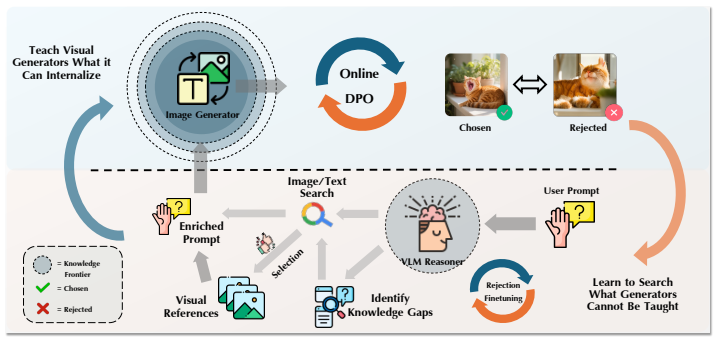
The load-bearing object is the knowledge boundary (Definition 1), a generator-specific partition of world-knowledge units into internalizable and contextual sets, defined through the expected quality gain from search. The argument is carried by a three-stage gate–filter–integrate agentic reasoner (decide when to search, select noise-free references, integrate through grounded language rather than raw pixels) and a two-phase co-training loop: online iterative Diffusion-DPO to teach the generator what it can absorb, then rejection-sampling finetuning of the reasoner to the shifted boundary. The boundary is also the unit of evaluation: rightward shifts in the no-search quality CDF directly show
What would settle it
Re-score the 751-prompt test set and the DPO preference pairs with human raters using the same checklists and rubrics, then check whether the Phase 0 to Phase 1 to Phase 2 monotonic progression and the rightward CDF shift survive at comparable magnitude; a significant shrink or reversal would indicate the knowledge boundary is an artifact of the automated judge.
Extended reading notes
Core claim
The paper's central claim is that knowledge required for faithful visual generation splits along a structural axis: some units (a character's canonical appearance, a flag's geometry) can migrate into generator parameters once seen, while others (post-cutoff events, long-tail cultural specifics, per-instance compositions) resist parameterization and must stay in external context. This split, formalized as the knowledge boundary, is generator-specific and evolves as the generator improves. The paper further claims that the boundary need not be known in advance; it can be discovered by co-training: first use online iterative DPO on search-augmented samples to push the generator's boundary outwa
Load-bearing premise
The load-bearing premise is that the score produced by the automated judge (with its checklist, rubric, and reference-fidelity components) measures world-knowledge fidelity faithfully; if the judge can be gamed or is biased, the discovered boundary and the monotonic gains are artifacts of optimizing that judge.
Editorial extensions
If this is right
- Open-weight generators lose up to 40 points on search-intensive world-knowledge prompts, a gap invisible to standard composition benchmarks; SearchGen-Bench makes it measurable.
- Search must be selective: blind retrieval corrupts prompts the generator already handles, so the decision to search is a first-class design variable.
- Co-training yields monotonic improvement at every difficulty tier for two architecturally distinct generators, so the benefits are not tied to one conditioning mechanism.
- A generator-calibrated 8B reasoner matches or slightly exceeds a frontier oracle reasoner on the same 4B generator at a fraction of compute, indicating generator-specific calibration substitutes for scale.
- The released pre-executed search corpus allows offline replay of the full pipeline, so search-augmented visual generation research no longer requires live search APIs.
Reading between the lines
- The knowledge-boundary formulation is a general tool-invocation principle: the same gate–filter–integrate and teach-then-search loop should apply to image editing, render-as-code, and 3D retrieval, not just web search.
- If the automated judge is biased or exploitable, the monotonic gains are an artifact of optimizing the judge, not of expanding knowledge; a human re-evaluation of Phase 1 versus Phase 2 outputs would settle this.
- The rightward CDF shift of no-search quality could be used as a stopping criterion for recursive co-training: when DPO stops shifting the boundary, further teach cycles should yield diminishing returns and the reasoner should take over.
- With 93% of entities appearing in a single prompt, purely parametric scaling cannot close the gap; any path to frontier visual generation must pair large generators with external grounding, making the boundary a permanent architectural feature.
Signed reviews
Editorial analysis
A structured set of objections, weighed in public.
Referee Report
Summary. The paper introduces SEARCHGEN-20K/SEARCHGEN-BENCH, a long-tailed, bilingual benchmark of world-knowledge-intensive text-to-image prompts with fine-grained checklists and rubrics, together with a pre-executed multimodal search corpus (SEARCHGEN-CORPUS-1M) enabling offline, replayable evaluation. The authors show that frontier open generators collapse to 21–28/100 on search-intensive prompts, that naive search can degrade performance, and propose a two-phase co-training recipe (Phase 1: online DPO on the generator; Phase 2: rejection-sampling finetuning of an 8B reasoner) to discover a generator-specific 'knowledge boundary' and improve search-augmented generation. The central claim is that a minimal co-training recipe yields monotonic improvement and that an 8B reasoner calibrated by this procedure can match or slightly exceed a frontier oracle on a 4B generator.
Significance. If the central claims hold, the paper makes a useful contribution: it identifies a real evaluation gap, provides a substantial and reproducible infrastructure (prompts, reasoning traces, cached search sessions), and proposes a concrete, low-compute co-training loop for agentic visual generation. The offline replay harness is a particularly valuable resource for the community. The paper is also commendably explicit about limitations (single-iteration recipe, VLM judge noise, commercial-API interpretation caveats). The 'knowledge boundary' concept is intuitively appealing and connects to selective-retrieval literature, but its empirical demonstration is currently not tight enough to support the strongest statements in the abstract and §4.1.
major comments (3)
- [§3.2, §4.1, Fig. 9b] Definition 1 defines the knowledge boundary through the per-prompt quality gap ΔQ = Q(Gθ,p,SEARCH(k)) − Q(Gθ,p,∅) and the tolerance ε (Eq. 1). The evidence in Figure 9b, however, plots the CDF of no-search quality Q(Gθ,p,∅) before and after Phase 1 DPO. A rightward shift in this CDF does not imply that ΔQ shrank; it is consistent with DPO improving general rendering or instruction-following, or with search-augmented quality improving by an equal or larger amount. The text in §4.1 ('CDF of per-prompt no-search quality') is accurate, but §3.2 explicitly claims that 'Figure 9b makes this concrete: we measure the per-prompt quality gap with and without search,' which the figure does not do. Without the joint distribution of Q(SEARCH) and Q(∅) — or a per-prompt migration table across the ε threshold — the shaded 'newly internalized knowledge' region is unsupported. This is the load-bearing ev
- [§4.1, Table 6] The main quantitative claim is monotonic improvement across co-training phases, but all numbers in Table 6 are single-run point estimates with no error bars, confidence intervals, or significance tests. The monotonicity claim is already internally contradicted by the NoSearch column: Klein-4B drops from 54.6 (Phase 0) to 54.0 (Phase 1), and Bagel drops from 52.6 to 52.4. While the Search/Overall columns improve monotonically, the NoSearch regression is small and could easily be within run-to-run noise. Since the paper's prediction is explicitly 'without regressing on any stratum,' these two regressions require at least a paired analysis across prompts, multiple seeds, or a statement of variance. The absence of statistical support also affects the matched-compute comparison (RFT-8B + Klein-4B-DPO: 31.8 vs. ORACLE: 31.2), which is a one-point difference on a single run.
- [§2.3, §3.3, Algorithm 1, Appendix D.2/E.2] The same VLM-judge protocol supplies the DPO reward (Phase 1: 'Score(p,x_j)' in Algorithm 1, line 8; described as Qwen3-VL-8B in Appendix E.2), the RFT reward (Algorithm 1, line 17), and the final evaluation scores (Gemini-3-Flash judge in §4). Even if the judge is not literally the same model, both are VLM judges using the same scoring rubrics. This creates a circularity risk: the 'knowledge boundary shift' in Figure 9b and the gains in Table 6 may partly reflect optimization of the judge's preferences rather than genuine world-knowledge grounding. The reported human correlation (Spearman ρ=0.87 on 500 pairs) is reassuring but does not show that the co-trained models improve on human judgment relative to the baselines, nor that the ΔQ change is human-visible. I recommend evaluating the co-trained outputs on a held-out human-rated subset and/or with an independent judge family (e.g., a d
minor comments (5)
- [Abstract, §2.2, §6] The dataset size is stated inconsistently: 20,839 prompts (Abstract), 20,939 prompt records (§6), and 20,188 training rows with 751 test prompts in §2.2. Please reconcile these numbers and clarify whether 20,839/20,939 includes the test and validation splits.
- [§4, Fig. 9b] The caption says the CDF is computed on the '647-prompt eval set,' while §4 says all evaluation is on the 751-prompt test set. If the boundary analysis uses a subset (e.g., search-intensive only), state this explicitly and justify why the full test set is not used.
- [§2.3, Table 3] §2.3 states the evaluation has four knowledge-sensitive components, but Table 3 lists five (Checklist, Rubric, Prompt Faithfulness, Visual Reference Fidelity, Textual Knowledge Fidelity). Please align the count and describe which components are included in the overall mean.
- [§3.3, Appendix E.1] The Phase 0 SFT data size is given as '~10,000 expert-annotated trajectories' in §3.3 but '∼20K SFT trajectories' in Appendix E.1 and '~20,000' in the Appendix overview. Please correct the inconsistency.
- [§2.2] The 'answer-first' synthesis strategy means prompts carry knowledge-gap references and checklists by construction. This is efficient but risks making the benchmark somewhat circular for the knowledge-gap detection task. Please provide a human validation of the checklists (e.g., a sample where annotators confirm each checklist item is answerable and non-trivial for a knowledgeable human).
Circularity Check
No significant circularity found; the main evidence gap (Fig. 9b plots no-search quality, not the defined ΔQ) is a validity issue, not a definitional self-reduction.
full rationale
Definition 1 is a formalization rather than a derivation: it partitions K by the sign of E[Q(SEARCH)−Q(∅)]−ε, so the 'internalizable/contextual' split is true by definition. The paper's substantive claim is that co-training discovers this boundary, and that claim is tested empirically: DPO/RFT rewards come from a Qwen3-VL-8B judge using the SEARCHGEN-20K protocol, while the reported Table 6 and Figure 9b results use the held-out 751-prompt test set scored by Gemini-3-Flash, which is independently validated against human labels (Spearman ρ=0.87). No load-bearing premise is imported from the authors' own prior work; citations to Mallen et al. and the selective-RAG literature are contextual and not used to force the conclusion. The one genuine weakness is evidentiary, not circular: §3.2 states 'Figure 9b makes this concrete: we measure the per-prompt quality gap with and without search and show that its distribution shifts under co-training,' and §4.1 labels the shaded region as 'concepts whose per-prompt quality gap formerly exceeded ε and now fall below it,' yet Figure 9b actually plots the CDF of per-prompt no-search quality Q(∅). A rightward shift in Q(∅) does not by itself establish a decrease in ΔQ=Q(SEARCH)−Q(∅), so the 'newly internalized knowledge' region is not identified by the Definition-1 quantity. This is a missing measurement/validity gap, not a case where a predicted quantity is equivalent by construction to an input: the figure is not the ΔQ curve, and the claimed result would not follow tautologically even if the figure were correct. Therefore the circularity score is 0.
Assumptions & free parameters
free parameters (3)
- ε (boundary tolerance) =
not reported
- DPO temperature β =
100
- Gate severity threshold =
critical/important trigger search
assumptions (4)
- domain assumption User requests are unbounded, evolving, and long-tailed while generator training corpora are fixed, so a structural world-knowledge bottleneck exists.
- domain assumption Gemini-3-Flash judge scores faithfully measure world-knowledge fidelity across checklist, rubric, reference, and plausibility components.
- domain assumption Search results always inject noise into the generator's conditioning, and open generators treat conditioning as authoritative.
- ad hoc to paper The knowledge boundary is discoverable via co-training rather than specifiable a priori.
invented entities (1)
-
Generator-specific knowledge boundary (K_int/K_ctx partition)
Cite this review
Pith. "Pith review of Search Beyond What Can Be Taught: Evolving the Knowledge Boundary in Agentic Visual Generation." pith.science (2026). https://pith.science/paper/DYO6ZH7I
@misc{pith2026260705382,
  author       = {Pith},
  title        = {Pith review of: Search Beyond What Can Be Taught: Evolving the Knowledge Boundary in Agentic Visual Generation},
  year         = {2026},
  howpublished = {\url{https://pith.science/paper/DYO6ZH7I}},
  note         = {Machine review of arXiv:2607.05382}
}
read the original abstract
Visual generators excel at rendering, but they confidently fabricate what they do not know. User requests are unbounded, evolving, and deeply long-tailed: new characters, trending entities, post-cutoff events, and more. This world-knowledge bottleneck is structural: generators are trained on fixed corpora, but the visual world is open-ended. We construct SearchGen-20K and SearchGen-Bench, with 20,839 prompts spanning twelve failure categories and twenty-two domains, paired with a pre-executed multimodal SearchGen-Corpus-1M to support offline, reproducible research. On SearchGen-Bench, frontier open generators score only 21 to 28 out of 100, a 40-point collapse invisible to existing benchmarks. The natural remedy is to employ search tools, enabling agentic visual generation. However, we find that naive search fails: it retrieves indiscriminately, injecting noise into prompts the generator already handles. We trace the root cause to a generator-specific, evolving knowledge boundary: the divide between what a generator can internalize through training and what must remain in external context. Although this boundary is hard to specify in advance, we show that it is discoverable through a teach-then-search co-training framework. Even a minimal version of this co-training recipe produces monotonic improvement, laying the foundation for recursive self-improvement in visual generation that can meet world-knowledge-grounded requests. We release the full dataset, co-training corpus, and search corpus as a replayable harness for tool-augmented, world-knowledge-grounded visual generation.
Figures


Figures from the paper (21 more)




Forward citations
Cited by 3 Pith papers
-
SpecPath: Testing Coding Agents Across Contract-Equivalent Specification Histories
A coding agent's success on a consolidated specification does not guarantee the same tested behavior when the identical contract is reached through a different revision history.
-
ToolArtist: Tool-Using Unified Multimodal Models for Agentic Image Generation
ToolArtist trains a unified multimodal model to reason, search the web, and generate images as one policy, improving scores on WISE and WorldGenBench-Humanities.
-
Rethinking Classifier-Free Guidance in On-Policy Diffusion Distillation
CFG-composed on-policy distillation is branch-underidentified; privileged negative conditioning causes Negative Branch Asymmetry, which Positive–Direction Matching fixes.
Reference graph
Works this paper leans on
-
[1]
arXiv preprint arXiv:2603.28767 , year=
Gen-searcher: Reinforcing agentic search for image generation , author=. arXiv preprint arXiv:2603.28767 , year=
-
[2]
Proceedings of the 41st International Conference on Machine Learning , year =
Scaling Rectified Flow Transformers for High-Resolution Image Synthesis , author =. Proceedings of the 41st International Conference on Machine Learning , year =
-
[3]
2024 , url =
Li, Baiqi and Lin, Zhiqiu and Pathak, Deepak and Li, Jiayao and Fei, Yixin and Wu, Kewen and Ling, Tiffany and Xia, Xide and Zhang, Pengchuan and Neubig, Graham and Ramanan, Deva , journal =. 2024 , url =
2024
-
[4]
Retrieval-Augmented Generation for Knowledge-Intensive
Lewis, Patrick and Perez, Ethan and Piktus, Aleksandra and Petroni, Fabio and Karpukhin, Vladimir and Goyal, Naman and K. Retrieval-Augmented Generation for Knowledge-Intensive. Advances in Neural Information Processing Systems , volume =
-
[5]
2020 , publisher =
Guu, Kelvin and Lee, Kenton and Tung, Zora and Pasupat, Panupong and Chang, Mingwei , booktitle =. 2020 , publisher =
2020
-
[6]
, booktitle =
Chen, Wenhu and Hu, Hexiang and Saharia, Chitwan and Cohen, William W. , booktitle =. Re-. 2023 , url =
2023
-
[7]
2023 , url =
Ashual, Oron and Wolf, Lior , booktitle =. 2023 , url =
2023
-
[8]
2023 , url =
Ye, Hu and Zhang, Jun and Liu, Sibo and Han, Xiao and Yang, Wei , journal =. 2023 , url =
2023
Show all 58 references
-
[9]
Advances in Neural Information Processing Systems , volume =
Retrieval-Augmented Diffusion Models , author =. Advances in Neural Information Processing Systems , volume =
-
[10]
2024 , url =
Asai, Akari and Wu, Zeqiu and Wang, Yizhong and Sil, Avirup and Hajishirzi, Hannaneh , booktitle =. 2024 , url =
2024
-
[11]
Proceedings of the 2023 Conference on Empirical Methods in Natural Language Processing , pages =
Active Retrieval Augmented Generation , author =. Proceedings of the 2023 Conference on Empirical Methods in Natural Language Processing , pages =. 2023 , publisher =
2023
-
[12]
Advances in Neural Information Processing Systems , volume =
Toolformer: Language Models Can Teach Themselves to Use Tools , author =. Advances in Neural Information Processing Systems , volume =
-
[13]
2601.18543 , archivePrefix =
Jiang, Kaixun and Wang, Yuzheng and Zhou, Junjie and Li, Pandeng and Liu, Zhihang and Xie, Chen-Wei and Chen, Zhaoyu and Zheng, Yun and Zhang, Wenqiang , year =. 2601.18543 , archivePrefix =
-
[14]
Mastering Text-to-Image Diffusion: Recaptioning, Planning, and Generating with Multimodal
Yang, Ling and Yu, Zhaochen and Meng, Chenlin and Xu, Minkai and Ermon, Stefano and Cui, Bin , booktitle =. Mastering Text-to-Image Diffusion: Recaptioning, Planning, and Generating with Multimodal. 2024 , series =
2024
-
[15]
Hu, Hexiang and Chan, Kelvin C. K. and Su, Yu-Chuan and Chen, Wenhu and Li, Yandong and Sohn, Kihyuk and Zhao, Yang and Ben, Xue and Gong, Boqing and Cohen, William W. and Chang, Ming-Wei and Jia, Xuhui , booktitle =. Instruct-
-
[16]
Huang, Kaiyi and Sun, Kaiyue and Xie, Enze and Li, Zhenguo and Liu, Xihui , booktitle =
-
[17]
Cho, Jaemin and Zala, Abhay and Bansal, Mohit , booktitle =
-
[18]
2508.02324 , archivePrefix =
Wu, Chenfei and Li, Jiahao and Zhou, Jingren and Lin, Junyang and Gao, Kaiyuan and Yan, Kun and Yin, Sheng-ming and Bai, Shuai and Xu, Xiao and Chen, Yilei and Chen, Yuxiang and Tang, Zecheng and Zhang, Zekai and Wang, Zhengyi and Yang, An and Yu, Bowen and Cheng, Chen and Liu...
-
[19]
2025 , url =
Bai, Shuai and Chen, Keqin and Liu, Xuejing and Wang, Jialin and Ge, Wenbin and Song, Sibo and Dang, Kai and Wang, Peng and Wang, Shijie and Tang, Jun and others , journal =. 2025 , url =
2025
-
[20]
arXiv preprint arXiv:2604.11626 , year=
RationalRewards: Reasoning Rewards Scale Visual Generation Both Training and Test Time , author=. arXiv preprint arXiv:2604.11626 , year=
-
[21]
Bad Seeing or Bad Thinking? Rewarding Perception for Multimodal Reasoning , author=
-
[22]
Advances in Neural Information Processing Systems (NeurIPS) , note=
VL-Rethinker: Incentivizing Self-Reflection of Vision-Language Models with Reinforcement Learning , author=. Advances in Neural Information Processing Systems (NeurIPS) , note=
-
[23]
International Conference on Learning Representations (ICLR) , year=
Emergent Hierarchical Reasoning in LLMs through Reinforcement Learning , author=. International Conference on Learning Representations (ICLR) , year=
-
[24]
Findings of the Association for Computational Linguistics: ACL 2025 , pages=
To code or not to code? adaptive tool integration for math language models via expectation-maximization , author=. Findings of the Association for Computational Linguistics: ACL 2025 , pages=
2025
-
[25]
International Conference on Learning Representations (ICLR) , year=
Reverse-Engineered Reasoning for Open-Ended Generation , author=. International Conference on Learning Representations (ICLR) , year=
-
[26]
Advances in Neural Information Processing Systems (NeurIPS) , year=
Pixel Reasoner: Incentivizing Pixel-Space Reasoning with Curiosity-Driven Reinforcement Learning , author=. Advances in Neural Information Processing Systems (NeurIPS) , year=
-
[27]
Advances in Neural Information Processing Systems , volume =
Direct Preference Optimization: Your Language Model is Secretly a Reward Model , author =. Advances in Neural Information Processing Systems , volume =
-
[28]
2026 , url =
Wang, Haozhe and Wei, Cong and Ren, Weiming and Liu, Jiaming and Lin, Fangzhen and Chen, Wenhu , journal =. 2026 , url =
2026
-
[29]
Hu, Yushi and Liu, Baolin and Kasai, Jungo and Wang, Yizhong and Ostendorf, Mari and Krishna, Ranjay and Hajishirzi, Hannaneh , booktitle =
-
[30]
Advances in Neural Information Processing Systems , volume =
Holistic Evaluation of Text-to-Image Models , author =. Advances in Neural Information Processing Systems , volume =
-
[31]
Proceedings of the 61st Annual Meeting of the Association for Computational Linguistics (Volume 1: Long Papers) , pages =
When Not to Trust Language Models: Investigating Effectiveness of Parametric and Non-Parametric Memories , author =. Proceedings of the 61st Annual Meeting of the Association for Computational Linguistics (Volume 1: Long Papers) , pages =
-
[32]
Proceedings of the
Diffusion Model Alignment Using Direct Preference Optimization , author =. Proceedings of the
-
[33]
2023 , howpublished =
Improving Image Generation with Better Captions , author =. 2023 , howpublished =
2023
-
[34]
2024 , howpublished =
Baldridge, Jason and Brooks, Tim and Darrell, Trevor and Dean, Jeff and Esser, Patrick and Ganguli, Deep and Ghiasi, Amir and Henighan, Tom and Ho, Daniel and H. 2024 , howpublished =
2024
-
[35]
Yan, Shiqi and Gu, Jiachen and Zhu, Yun and Ling, Zhenhua , journal =
-
[36]
Jeong, Soyeong and Baek, Jinheon and Cho, Sukmin and Hwang, Sung Ju and Park, Jong , journal =
-
[37]
Ruiz, Nataniel and Li, Yuanzhen and Jampani, Varun and Pritch, Yael and Rubinstein, Michael and Aberman, Kfir , booktitle =. Dream
-
[38]
The Eleventh International Conference on Learning Representations , year =
An Image is Worth One Word: Personalizing Text-to-Image Generation using Textual Inversion , author =. The Eleventh International Conference on Learning Representations , year =
-
[39]
Advances in Neural Information Processing Systems , volume =
Subject-driven Text-to-Image Generation via Apprenticeship Learning , author =. Advances in Neural Information Processing Systems , volume =
-
[40]
and Li, Jiayuan , booktitle =
Lian, Long and Li, Boyi and Anandkumar, Anima and Xing, Eric P. and Li, Jiayuan , booktitle =
-
[41]
Zhang, Xinchen and Yang, Ling and Li, Guohao and Cai, Yaqi and Xie, Jiake and Tang, Yong and Yang, Yujiu and Wang, Mengdi and Cui, Bin , journal =
-
[42]
Proceedings of the
Using Human Feedback to Fine-tune Diffusion Models without Any Reward Model , author =. Proceedings of the
-
[43]
Li, Dongxu and Li, Junnan and Hoi, Steven C. H. , booktitle =
-
[44]
Revisiting Text-to-Image Evaluation with
Wiles, Olivia and Zhang, Chuhan and Albuquerque, Isabela and Kajic, Ivana and Wang, Su and Bugliarello, Emanuele and Onoe, Yasumasa and Knutsen, Chris and Rashtchian, Cyrus and Pont-Tuset, Jordi and Nematzadeh, Aida , journal =. Revisiting Text-to-Image Evaluation with
-
[45]
Proceedings of the
Benchmarking Large Language Models in Retrieval-Augmented Generation , author =. Proceedings of the
-
[46]
2025 , eprint =
Emerging Properties in Unified Multimodal Pretraining , author =. 2025 , eprint =
2025
-
[47]
2026 , howpublished =
2026
-
[48]
2025 , howpublished =
2025
-
[49]
2025 , howpublished =
Jimeng. 2025 , howpublished =
2025
-
[50]
Journal of Machine Learning Research , volume =
Atlas: Few-shot Learning with Retrieval Augmented Language Models , author =. Journal of Machine Learning Research , volume =
-
[51]
Shi, Weijia and Min, Sewon and Yasunaga, Michihiro and Seo, Minjoon and James, Rich and Lewis, Mike and Zettlemoyer, Luke and Yih, Wen-tau , journal =
-
[52]
Proceedings of the 40th International Conference on Machine Learning , series =
Large Language Models Struggle to Learn Long-Tail Knowledge , author =. Proceedings of the 40th International Conference on Machine Learning , series =. 2023 , publisher =
2023
-
[53]
arXiv preprint arXiv:2401.10020 , year =
Self-Rewarding Language Models , author =. arXiv preprint arXiv:2401.10020 , year =
-
[54]
arXiv preprint arXiv:2401.01335 , year =
Self-Play Fine-Tuning Converts Weak Language Models to Strong Language Models , author =. arXiv preprint arXiv:2401.01335 , year =
-
[55]
arXiv preprint arXiv:2312.09390 , year =
Weak-to-Strong Generalization: Eliciting Strong Capabilities with Weak Supervision , author =. arXiv preprint arXiv:2312.09390 , year =
-
[56]
arXiv preprint arXiv:1810.08575 , year =
Supervising Strong Learners by Amplifying Weak Experts , author =. arXiv preprint arXiv:1810.08575 , year =
-
[57]
Proceedings of the 37th Allerton Conference on Communication, Control, and Computing , year =
The Information Bottleneck Method , author =. Proceedings of the 37th Allerton Conference on Communication, Control, and Computing , year =
-
[58]
Communications of the ACM , volume =
A Theory of the Learnable , author =. Communications of the ACM , volume =
Reviewed August 2, 2026 · model on record in the stance chip above.
Discussion (0). Continue with ORCID to comment.