REVIEW 1 major objections 5 minor 58 references
Color-name tone curves make learned image enhancement both better and editable by hand.
Reviewed by Pith at T0; open to challenge. T0 means a machine referee read the full paper against a public rubric. the ladder, T0–T4 →
NamedCurves+ conditions Bezier tone curves on color-naming probability maps and fuses them with a transposed-attention transformer, yielding SOTA interpretable enhancement on MIT-5K, PPR10K, MSEC and SICE.
T0 review reviewed 2026-07-10 challenge →
load-bearing objection Solid systems extension of the authors’ own NamedCurves work: real SOTA gains on three tasks plus genuine interactivity, with no load-bearing flaws. the 1 major comments →
Leveraging Color Naming for Image Enhancement
The pith
A machine-rendered reading of the paper's core claim, the machinery that carries it, and where it could break.
The reading
Core claim
Conditioning learned Bezier tone curves on a fixed, perceptually grounded color-naming decomposition, then fusing the resulting globally adjusted images with a transposed-attention transformer, yields state-of-the-art enhancement while remaining fully interpretable and user-editable.
What carries the argument
NamedCurves+: a pipeline that maps an input through a standardization backbone, six color-name probability maps, per-name Bezier tone curves, and a single multi-head transposed-attention fusion block.
Load-bearing premise
The fixed color-naming model (and the authors' grouping of eleven names into six) must produce stable probability maps even under unusual cameras and lighting, or the later curves and fusion will mis-edit the image.
What would settle it
Replace the color-naming stage with random RGB partitions or pure intensity curves on the same training data; if the quantitative gains and the absence of boundary halos disappear, the color-naming claim fails.
Editorial analysis
A structured set of objections, weighed in public.
Referee Report
Summary. NamedCurves+ is a supervised image-enhancement framework that first standardizes an input with a UNet-like backbone, decomposes the result into six color-name probability maps (Van de Weijer et al. with an ad-hoc grouping of the classic 11 terms), estimates a set of Bezier-parametrized global tone curves conditioned on each map, and fuses the six globally adjusted images with a transposed-attention transformer block. The design is intended to be both competitive with SOTA and interactive: users can edit the learned control points of individual color-name curves at inference time without retraining. The method is evaluated on image retouching (MIT-Adobe-5K, PPR10K), tone mapping (MIT-Adobe-5K XYZ o sRGB), and exposure correction (MSEC, SICE), with systematic ablations of backbone, naming scheme, fusion module, control-point count and loss weight α, plus a small 2AFC user study.
Significance. If the reported gains hold, the paper supplies a practical middle ground between black-box image-to-image networks and classical parametric editors: competitive quantitative performance on four standard benchmarks together with an explicit, user-editable representation (per-color-name Bezier curves) that matches the color-naming vocabulary already used in commercial software. The extension from the conference NamedCurves paper—transformer fusion that reduces halo artifacts, multi-task evaluation, and clearer interactivity demos—is incremental but useful. Strengths that should be credited include the breadth of the experimental suite (Tables I–IV), the module and naming ablations (Tables V–VII), the controlled 2AFC study, and the explicit Limitations section that already flags boundary leakage of the fixed color-naming prior.
major comments (1)
- The central empirical claim is adequately supported; no load-bearing technical error was found. The only material caveat is reproducibility: source code and models are promised (Abstract) but not yet released, so independent verification of the reported numbers and of the interactive editing interface is currently impossible. This should be remedied before final acceptance.
minor comments (5)
- Tables I–IV report point estimates only; even a single-run standard deviation or a note that results are from one seed would strengthen confidence.
- Inference-time figures (Table I, Table VIII) are given for a single hardware pair; a short note on batch size and whether the color-naming step is included would help readers compare fairly with LUT-based methods.
- Section III-B and Figure 5 motivate the 11 o6 grouping by intensity-dependent hue overlap; a one-sentence quantitative check (e.g., average probability mass retained after grouping) would make the design choice more transparent.
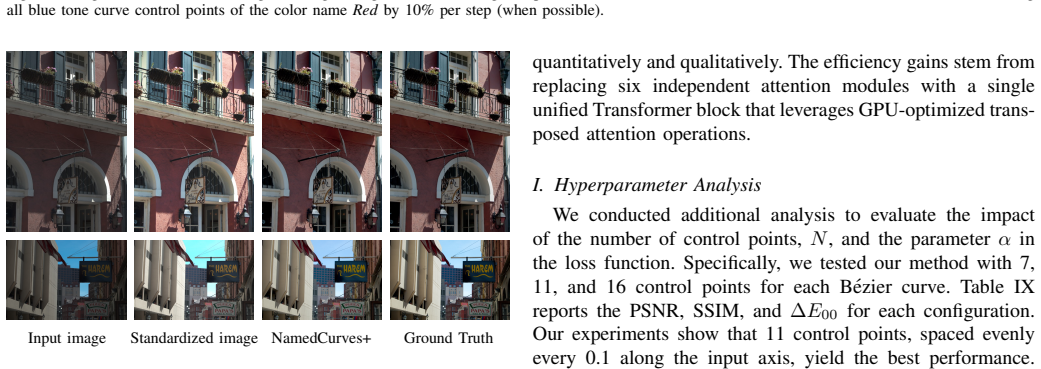
- Figure 2 caption and the surrounding text correctly highlight halo reduction, but the visual difference is subtle; a zoomed inset or residual map would make the improvement clearer.
- A few typographical issues remain (e.g., “F orum” in the references, inconsistent spacing around “ΔE”). A final proof-reading pass is recommended.
Circularity Check
No significant circularity: supervised empirical pipeline against external expert ground truth; color-naming prior is off-the-shelf, not defined by the enhancement objective.
full rationale
NamedCurves+ is a standard supervised learning architecture (backbone standardization + fixed Van de Weijer color-naming maps grouped into six channels + Bezier curve estimation + transformer fusion) trained end-to-end against external expert-retouched targets on public datasets (MIT-Adobe-5K, PPR10K, MSEC, SICE). The loss (Eq. 5) is ordinary L2 + SSIM fidelity to those targets; the Bezier control points are free parameters estimated by the network, not fitted constants later re-presented as predictions. Color naming is taken from an independent prior (Van de Weijer et al. 2009) and is ablated against alternatives (Table VII); the grouping of 11 names into 6 is an engineering choice justified by intensity-range coverage, not a uniqueness theorem or self-citation chain. No equation reduces by construction to its own input, no fitted parameter is renamed a prediction, and the self-citation to the authors’ prior conference paper is merely the baseline being improved upon. The central performance claims rest on external benchmarks and ablations, not on circular derivation.
Axiom & Free-Parameter Ledger
free parameters (4)
- loss weight α =
0.5
- number of Bezier control points N =
11
- transformer channel dimension C =
18
- learning-rate schedule =
1e-4 / 50-epoch half
axioms (4)
- domain assumption Van de Weijer et al. (2009) 11-class color-naming probabilities are a faithful perceptual decomposition of sRGB pixels.
- ad hoc to paper Grouping orange-brown-yellow, pink-purple and white-grey-black into three composite maps preserves all intensity-dependent hue information needed for tone curves.
- domain assumption Expert-retouched images (Expert C of MIT-5K, three experts of PPR10K, etc.) constitute the correct target distribution for ‘visually appealing’ enhancement.
- domain assumption Monotonic Bezier curves with fixed input abscissae and normalized positive increments are sufficiently expressive for global color-name edits.
invented entities (1)
-
NamedCurves+ end-to-end architecture (backbone + 6 color-name Bezier heads + transposed-attention fusion)
no independent evidence
Cite this review
Pith. "Pith review of Leveraging Color Naming for Image Enhancement." pith.science (2026). https://pith.science/paper/AOFLICN7
@misc{pith2026260708185,
  author       = {Pith},
  title        = {Pith review of: Leveraging Color Naming for Image Enhancement},
  year         = {2026},
  howpublished = {\url{https://pith.science/paper/AOFLICN7}},
  note         = {Machine review of arXiv:2607.08185}
}
read the original abstract
Enhancing images to make them visually appealing is a persistent challenge in computer vision. Many deep-learning methods train models on paired datasets to replicate expert editing styles. However, these approaches struggle with two key issues: (1) interpretability and (2) a parametrization suitable for user adjustments. To address these challenges, we present NamedCurves+, an approach inspired by the concept of Color Naming, a universal set of familiar colors widely used in software tools for intuitive editing. Our method integrates color names into a learning-based framework, enabling global adjustments for each named color through tone curves. To address local image variations, we incorporate a transformer block that captures spatial dependencies, enabling context-aware edits across the image. NamedCurves+ enhances the retouching process's interpretability and supports user interaction, allowing flexible modifications of individual tone curves to refine the retouched image according to personal preferences. Extensive experiments on tasks such as image retouching, tone mapping, and exposure correction demonstrate that NamedCurves+ outperforms state-of-the-art methods. Notably, our approach is both explainable, as the tone curves explicitly represent how each color name contributes to the enhancement, and interactive, allowing users to customize the retouching process and achieve results tailored to their liking.
Figures



Reference graph
Works this paper leans on
-
[1]
Learning image-adaptive 3d lookup tables for high performance photo enhancement in real- time,
H. Zeng, J. Cai, L. Li, Z. Cao, and L. Zhang, “Learning image-adaptive 3d lookup tables for high performance photo enhancement in real- time,”IEEE Transactions on Pattern Analysis and Machine Intelligence, vol. 44, no. 4, pp. 2058–2073, 2020
work page 2058
-
[2]
Adaint: Learning adaptive intervals for 3d lookup tables on real-time image enhancement,
C. Yang, M. Jin, X. Jia, Y . Xu, and Y . Chen, “Adaint: Learning adaptive intervals for 3d lookup tables on real-time image enhancement,” in Proceedings of the IEEE/CVF Conference on Computer Vision and Pattern Recognition, 2022, pp. 17 522–17 531
work page 2022
-
[3]
Seplut: Sep- arable image-adaptive lookup tables for real-time image enhancement,
C. Yang, M. Jin, Y . Xu, R. Zhang, Y . Chen, and H. Liu, “Seplut: Sep- arable image-adaptive lookup tables for real-time image enhancement,” inEuropean Conference on Computer Vision. Springer, 2022, pp. 201– 217
work page 2022
-
[4]
Image-adaptive 3d lookup tables for real-time image enhancement with bilateral grids,
W. Kim and N. I. Cho, “Image-adaptive 3d lookup tables for real-time image enhancement with bilateral grids,” inEuropean Conference on Computer Vision. Springer, 2025, pp. 91–108
work page 2025
-
[5]
Deep photo enhancer: Unpaired learning for image enhancement from photographs with gans,
Y .-S. Chen, Y .-C. Wang, M.-H. Kao, and Y .-Y . Chuang, “Deep photo enhancer: Unpaired learning for image enhancement from photographs with gans,” inProceedings of the IEEE Conference on Computer Vision and Pattern Recognition, 2018
work page 2018
-
[6]
Towards unsupervised deep image enhancement with generative adversarial network,
Z. Ni, W. Yang, S. Wang, L. Ma, and S. Kwong, “Towards unsupervised deep image enhancement with generative adversarial network,”IEEE Transactions on Image Processing, vol. 29, pp. 9140–9151, 2020
work page 2020
-
[7]
Enlightengan: Deep light enhancement without paired supervision,
Y . Jiang, X. Gong, D. Liu, Y . Cheng, C. Fang, X. Shen, J. Yang, P. Zhou, and Z. Wang, “Enlightengan: Deep light enhancement without paired supervision,”IEEE Transactions on Image Processing, vol. 30, pp. 2340–2349, 2021
work page 2021
-
[8]
Adobe Systems, “Adobe photoshop,” Computer software. [Online]. Available: photoshop.adobe.com
-
[9]
B. Berlin and P. Kay,Basic color terms: Their universality and evolution. Univ of California Press, 1991
work page 1991
-
[10]
Learning photo- graphic global tonal adjustment with a database of input/output image pairs,
V . Bychkovsky, S. Paris, E. Chan, and F. Durand, “Learning photo- graphic global tonal adjustment with a database of input/output image pairs,” inProceedings of the IEEE/CVF Conference on Computer Vision and Pattern Recognition, 2011, pp. 97–104
work page 2011
-
[11]
J. Liang, H. Zeng, M. Cui, X. Xie, and L. Zhang, “Ppr10k: A large- scale portrait photo retouching dataset with human-region mask and group-level consistency,” inProceedings of the IEEE/CVF Conference on Computer Vision and Pattern Recognition, 2021, pp. 653–661
work page 2021
-
[12]
Learning multi-scale photo exposure correction,
M. Afifi, K. G. Derpanis, B. Ommer, and M. S. Brown, “Learning multi-scale photo exposure correction,” inProceedings of the IEEE/CVF Conference on Computer Vision and Pattern Recognition, 2021, pp. 9157–9167
work page 2021
-
[13]
Learning a deep single image contrast enhancer from multi-exposure images,
J. Cai, S. Gu, and L. Zhang, “Learning a deep single image contrast enhancer from multi-exposure images,”IEEE Transactions on Image Processing, vol. 27, no. 4, pp. 2049–2062, 2018
work page 2049
-
[14]
Namedcurves: Learned image enhancement via color naming,
D. Serrano-Lozano, L. Herranz, M. S. Brown, and J. Vazquez-Corral, “Namedcurves: Learned image enhancement via color naming,” in European Conference on Computer Vision, 2025, pp. 92–108
work page 2025
-
[15]
Integrating high-level features for consistent palette-based multi-image recoloring,
D. Xue, J. V . Corral, L. Herranz, Y . Zhang, and M. S. Brown, “Integrating high-level features for consistent palette-based multi-image recoloring,” inComputer Graphics F orum, vol. 42, no. 7. Wiley Online Library, 2023, p. e14964
work page 2023
-
[16]
Palette-based color harmonization via color naming,
D. Xue, J. Vazquez-Corral, L. Herranz, Y . Zhang, and M. S. Brown, “Palette-based color harmonization via color naming,”IEEE Signal Processing Letters, vol. 31, pp. 1474–1478, 2024
work page 2024
-
[17]
Color naming reflects optimal partitions of color space,
T. Regier, P. Kay, and N. Khetarpal, “Color naming reflects optimal partitions of color space,”Proceedings of the National Academy of Sciences, vol. 104, no. 4, pp. 1436–1441, 2007
work page 2007
-
[18]
Modeling color difference for visualization design,
D. A. Szafir, “Modeling color difference for visualization design,”IEEE Transactions on Visualization and Computer Graphics, vol. 24, no. 1, pp. 392–401, 2017
work page 2017
-
[19]
Coloring with words: Guiding image colorization through text-based palette generation,
H. Bahng, S. Yoo, W. Cho, D. K. Park, Z. Wu, X. Ma, and J. Choo, “Coloring with words: Guiding image colorization through text-based palette generation,” inEuropean Conference on Computer Vision, 2018, pp. 431–447
work page 2018
-
[20]
Learning color names for real-world applications,
J. Van De Weijer, C. Schmid, J. Verbeek, and D. Larlus, “Learning color names for real-world applications,”IEEE Transactions on Image Processing, vol. 18, no. 7, pp. 1512–1523, 2009
work page 2009
-
[21]
Parametric fuzzy sets for automatic color naming,
R. Benavente, M. Vanrell, and R. Baldrich, “Parametric fuzzy sets for automatic color naming,”Journal of the Optical Society of America A, vol. 25, no. 10, pp. 2582–2593, 2008
work page 2008
-
[22]
Weakly supervised domain- specific color naming based on attention,
L. Yu, Y . Cheng, and J. van de Weijer, “Weakly supervised domain- specific color naming based on attention,” inInternational Conference on Pattern Recognition. IEEE, 2018. JOURNAL OF LATEX CLASS FILES, VOL. 14, NO. 8, AUGUST 2021 13
work page 2018
-
[23]
Nice: A computational solution to close the gap from colour perception to colour categorization,
C. A. Parraga and A. Akbarinia, “Nice: A computational solution to close the gap from colour perception to colour categorization,”PloS one, vol. 11, no. 3, p. e0149538, 2016
work page 2016
-
[24]
Adaptive image contrast enhancement using generalizations of histogram equalization,
J. A. Stark, “Adaptive image contrast enhancement using generalizations of histogram equalization,”IEEE Transactions on Image Processing, vol. 9, no. 5, pp. 889–896, 2000
work page 2000
-
[25]
A. M. Reza, “Realization of the contrast limited adaptive histogram equalization (clahe) for real-time image enhancement,”Journal of VLSI Signal Processing-Systems for Signal, Image, and Video Technology, vol. 38, pp. 35–44, 2004
work page 2004
-
[26]
Fast local laplacian filters: Theory and applications,
M. Aubry, S. Paris, S. W. Hasinoff, J. Kautz, and F. Durand, “Fast local laplacian filters: Theory and applications,”ACM Transactions on Graphics, vol. 33, no. 5, pp. 1–14, 2014
work page 2014
-
[27]
Fast bilateral filtering for the display of high-dynamic-range images,
F. Durand and J. Dorsey, “Fast bilateral filtering for the display of high-dynamic-range images,” inConference on Computer Graphics and Interactive Techniques, 2002
work page 2002
-
[28]
J. Van De Weijer, T. Gevers, and A. Gijsenij, “Edge-based color constancy,”IEEE Transactions on Image Processing, vol. 16, no. 9, pp. 2207–2214, 2007
work page 2007
-
[29]
Real- time image enhancer via learnable spatial-aware 3d lookup tables,
T. Wang, Y . Li, J. Peng, Y . Ma, X. Wang, F. Song, and Y . Yan, “Real- time image enhancer via learnable spatial-aware 3d lookup tables,” in Proceedings of the IEEE/CVF International Conference on Computer Vision, 2021
work page 2021
-
[30]
Deeplpf: Deep local parametric filters for image enhancement,
S. Moran, P. Marza, S. McDonagh, S. Parisot, and G. Slabaugh, “Deeplpf: Deep local parametric filters for image enhancement,” in Proceedings of the IEEE/CVF Conference on Computer Vision and Pattern Recognition, 2020, pp. 12 826–12 835
work page 2020
-
[31]
Rsfnet: A white-box image retouching approach using region-specific color filters,
W. Ouyang, Y . Dong, X. Kang, P. Ren, X. Xu, and X. Xie, “Rsfnet: A white-box image retouching approach using region-specific color filters,” inICCV, 2023
work page 2023
-
[32]
Zero- reference deep curve estimation for low-light image enhancement,
C. Guo, C. Li, J. Guo, C. C. Loy, J. Hou, S. Kwong, and R. Cong, “Zero- reference deep curve estimation for low-light image enhancement,” in Proceedings of the IEEE Conference on Computer Vision and Pattern Recognition, 2020, pp. 1780–1789
work page 2020
-
[33]
Curl: Neural curve layers for global image enhancement,
S. Moran, S. McDonagh, and G. Slabaugh, “Curl: Neural curve layers for global image enhancement,” inInternational Conference on Pattern Recognition, 2021, pp. 9796–9803
work page 2021
-
[34]
Flexicurve: Flex- ible piecewise curves estimation for photo retouching,
C. Li, C. Guo, S. Zhou, Q. Ai, R. Feng, and C. C. Loy, “Flexicurve: Flex- ible piecewise curves estimation for photo retouching,” inProceedings of the IEEE/CVF Conference on Computer Vision and Pattern Recognition, 2023, pp. 1092–1101
work page 2023
-
[35]
Personalized image enhancement using neural spline color transforms,
S. Bianco, C. Cusano, F. Piccoli, and R. Schettini, “Personalized image enhancement using neural spline color transforms,”IEEE Transactions on Image Processing, vol. 29, pp. 6223–6236, 2020
work page 2020
-
[36]
Learning tone curves for local image enhancement,
L. Zhao, A. Abdelhamed, and M. S. Brown, “Learning tone curves for local image enhancement,”IEEE Access, vol. 10, pp. 60 099–60 113, 2022
work page 2022
-
[37]
Learning exposure correction via consistency modeling,
N. E. Nsampi, Z. Hu, and Q. Wang, “Learning exposure correction via consistency modeling,” inBritish Machine Vision Conference, 2021, p. 12
work page 2021
-
[38]
Deep fourier-based exposure correction network with spatial- frequency interaction,
J. Huang, Y . Liu, F. Zhao, K. Yan, J. Zhang, Y . Huang, M. Zhou, and Z. Xiong, “Deep fourier-based exposure correction network with spatial- frequency interaction,” inEuropean Conference on Computer Vision. Springer, 2022, pp. 163–180
work page 2022
-
[39]
Per- ceptual image enhancement for smartphone real-time applications,
M. V . Conde, F. Vasluianu, J. Vazquez-Corral, and R. Timofte, “Per- ceptual image enhancement for smartphone real-time applications,” in Proceedings of the IEEE/CVF Winter Conference on Applications of Computer Vision, 2023, pp. 1848–1858
work page 2023
-
[40]
MobileNets: Efficient Convolutional Neural Networks for Mobile Vision Applications
A. G. Howard, M. Zhu, B. Chen, D. Kalenichenko, W. Wang, T. Weyand, M. Andreetto, and H. Adam, “Mobilenets: Efficient convo- lutional neural networks for mobile vision applications,”arXiv preprint arXiv:1704.04861, 2017
work page internal anchor Pith review Pith/arXiv arXiv 2017
-
[41]
Cbam: Convolutional block attention module,
S. Woo, J. Park, J.-Y . Lee, and I. S. Kweon, “Cbam: Convolutional block attention module,” inEuropean Conference on Computer Vision, 2018, pp. 3–19
work page 2018
-
[42]
D. Marnerides, T. Bashford-Rogers, J. Hatchett, and K. Debattista, “Ex- pandnet: A deep convolutional neural network for high dynamic range expansion from low dynamic range content,” inComputer Graphics F orum, vol. 37, no. 2. Wiley Online Library, 2018, pp. 37–49
work page 2018
-
[43]
Deep bilateral learning for real-time image enhancement,
M. Gharbi, J. Chen, J. T. Barron, S. W. Hasinoff, and F. Durand, “Deep bilateral learning for real-time image enhancement,”ACM Transactions on Graphics, vol. 36, no. 4, pp. 1–12, 2017
work page 2017
-
[44]
Influences of psychological factors on image color preferences evaluation,
G. Shing-Sheng and H. Po-Sung, “Influences of psychological factors on image color preferences evaluation,”Color Research & Application, vol. 35, no. 3, pp. 213–232, 2010
work page 2010
-
[45]
The quantitative aspects of color rendering for memory colors,
K. Topfer and R. Cookingham, “The quantitative aspects of color rendering for memory colors,” inIS&T’s PICS, 2000
work page 2000
-
[46]
Simplifying tone curves for image enhancement,
J. Bennett and G. D. Finlayson, “Simplifying tone curves for image enhancement,”Color and Imaging Conference, vol. 31, no. 1, pp. 108– 108, 2023
work page 2023
-
[47]
Restormer: Efficient transformer for high-resolution image restoration,
S. W. Zamir, A. Arora, S. Khan, M. Hayat, F. S. Khan, and M.-H. Yang, “Restormer: Efficient transformer for high-resolution image restoration,” inProceedings of the IEEE/CVF Conference on Computer Vision and Pattern Recognition, 2022, pp. 5728–5739
work page 2022
-
[48]
Retinex- former: One-stage retinex-based transformer for low-light image en- hancement,
Y . Cai, H. Bian, J. Lin, H. Wang, R. Timofte, and Y . Zhang, “Retinex- former: One-stage retinex-based transformer for low-light image en- hancement,” inICCV, 2023
work page 2023
-
[49]
A comparative study of image restoration networks for general backbone network design,
X. Chen, Z. Li, Y . Pu, Y . Liu, J. Zhou, Y . Qiao, and C. Dong, “A comparative study of image restoration networks for general backbone network design,” inECCV, 2024
work page 2024
-
[50]
Revisiting image fusion for multi-illuminant white-balance correction,
D. Serrano-Lozano, A. Arora, L. Herranz, K. G. Derpanis, M. S. Brown, and J. Vazquez-Corral, “Revisiting image fusion for multi-illuminant white-balance correction,” inICCV, 2025
work page 2025
-
[51]
Self-attention generative adversarial networks,
H. Zhang, I. Goodfellow, D. Metaxas, and A. Odena, “Self-attention generative adversarial networks,” inInternational Conference on Ma- chine Learning. PMLR, 2019, pp. 7354–7363
work page 2019
-
[52]
Adam: A method for stochastic optimization,
D. P. Kingma and J. Ba, “Adam: A method for stochastic optimization,” inInternational Conference on Learning Representations, 2015
work page 2015
-
[53]
Underexposed photo enhancement using deep illumination estimation,
R. Wang, Q. Zhang, C.-W. Fu, X. Shen, W.-S. Zheng, and J. Jia, “Underexposed photo enhancement using deep illumination estimation,” inProceedings of the IEEE/CVF Conference on Computer Vision and Pattern Recognition, 2019
work page 2019
-
[54]
Hdrnet: Single-image-based hdr reconstruction using channel attention cnn,
J. Li and P. Fang, “Hdrnet: Single-image-based hdr reconstruction using channel attention cnn,” inInternational Conference on Multimedia Systems and Signal Processing, 2019, pp. 119–124
work page 2019
-
[55]
Adaptive histogram equalization and its variations,
S. M. Pizer, E. P. Amburn, J. D. Austin, R. Cromartie, A. Geselowitz, T. Greer, B. ter Haar Romeny, J. B. Zimmerman, and K. Zuiderveld, “Adaptive histogram equalization and its variations,”Computer Vision, Graphics, and Image Processing, vol. 39, no. 3, pp. 355–368, 1987
work page 1987
-
[56]
Deep retinex decomposition for low-light enhancement,
C. Wei, W. Wang, W. Yang, and J. Liu, “Deep retinex decomposition for low-light enhancement,” inBritish Machine Vision Conference, 2018, p. 155
work page 2018
-
[57]
Exposure normalization and compensation for multiple-exposure cor- rection,
J. Huang, Y . Liu, X. Fu, M. Zhou, Y . Wang, F. Zhao, and Z. Xiong, “Exposure normalization and compensation for multiple-exposure cor- rection,” inProceedings of the IEEE/CVF Conference on Computer Vision and Pattern Recognition, 2022, pp. 6043–6052. VII. ACKNOWLEDGEMENTS This work was supported by Grant PID2021- 128178OB-I00, , PID2024-162555OB-I00 fund...
work page 2022
-
[58]
He has worked at the Computer Vision Center (Barcelona), the Institute of Computing Technology (Chinese Academy of Sciences), and Mitsubishi Electric Research and Development. His research interests include deep learning applied to various topics in computer vision and multimedia. Michael S. Brownis a Professor and a Canada Research Chair of Computer Visi...
work page 2011
This paper was first reviewed by grok-4.5 on July 10, 2026.
discussion (0)
Sign in with ORCID, Apple, or X to comment. Anyone can read and Pith papers without signing in.