REVIEW 2 major objections 6 minor 68 references
Water's heat-capacity anomaly comes from LDL/HDL-like structure swaps, not mainly quantum vibrations.
Reviewed by Pith at T0; open to challenge. T0 means a machine referee read the full paper against a public rubric. the ladder, T0–T4 →
T0 review · grok-4.5
2026-07-13 05:30 UTC pith:QRVUNAUN
load-bearing objection Solid separation of NQE magnitude from SSSI-tracked anomaly; the ~3–4 kJ/mol scale is effective and partly fitted, not an independent prediction. the 2 major comments →
Structural Origin of Water Heat Capacity Anomaly from Classical and Quantum Simulations
The pith
A machine-rendered reading of the paper's core claim, the machinery that carries it, and where it could break.
Core claim
Nuclear quantum effects primarily reduce the absolute magnitude of water's isobaric heat capacity by suppressing high-frequency vibrational contributions, while the anomalous temperature dependence—from the supercooled maximum near 230 K through the excess value at ambient temperature—originates from structural interconversion between LDL-like and HDL-like local environments, quantified by the solvation-shell-averaged second-solvation-shell-intruder order parameter SSSI(3) and corresponding to an effective enthalpy scale of about 3–4 kJ mol−1 in a two-state mapping.
What carries the argument
The SSSI(3) order parameter (second-solvation-shell intruders averaged over three successive solvation shells) together with its two-state mapping onto an HDL fraction λ(T) and a single fitted enthalpy of interconversion ΔH_L/H; the temperature derivative of the mean order parameter, and the structural piece of the enthalpy H_SSSI = ΔH_L/H · λ(T), carry the anomalous part of CP.
Load-bearing premise
The continuous structural change can be represented by a two-state fraction whose low- and high-density endpoints are simply the average order-parameter values at the coldest and hottest simulated temperatures, with one constant enthalpy difference fitted to the enthalpy curve.
What would settle it
Measure or compute whether the temperature derivative of an independent, well-validated structural order parameter for LDL/HDL-like environments still tracks CP when the two-state endpoints are fixed from independent thermodynamic or spectroscopic criteria rather than from the simulation extremes used in the fit.
Editorial analysis
A structured set of objections, weighed in public.
Referee Report
Summary. The manuscript uses classical MD and path-integral MD with two neuroevolution machine-learning potentials (trained on MB-pol and revPBE0-D3) to separate vibrational and structural contributions to water’s isobaric heat capacity. Nuclear quantum effects are shown to lower the absolute magnitude of CP mainly by suppressing high-frequency modes (PIMD and a vDOS-based quantum correction both reduce classical CP by ~4–5 R near ambient T), while the anomalous temperature dependence—from a maximum near ~230 K through excess CP at ambient conditions—is tracked by the temperature derivative of the solvation-shell-averaged second-solvation-shell intruder order parameter SSSI(3). Mapping ⟨SSSI(3)⟩ onto an effective two-state LDL/HDL-like fraction λ(T) and decomposing H(T) into a constrained baseline plus ΔH_L/H·λ(T) yields an effective interconversion enthalpy of roughly 3–4 kJ mol⁻¹ and a structural CP contribution that accounts for the supercooled peak and residual excess at higher T. Supporting analyses include SSSI variance, enthalpy–SSSI correlation, and near-linear high-T hydrogen-bond loss used to justify a temperature-independent CP,conf.
Significance. If the structural interpretation holds, the work supplies a concrete microscopic link between local network topology (SSSI) and water’s CP anomaly across supercooled and ambient regimes, consistent with the LLPT/Widom-line picture and with an effective energy scale of order half the ice-melting enthalpy. Strengths include: (i) dual independent ML potentials giving the same qualitative separation of quantum baseline vs structural anomaly; (ii) consistency among direct enthalpy derivatives, PIMD, and classical vDOS quantum corrections; (iii) block-error propagation and explicit sensitivity tests on LDL/HDL endpoints (SI S7); and (iv) an auxiliary H-bond analysis that grounds the constant-CP,conf assumption. These elements make the result useful beyond a single model and falsifiable against other order parameters or potentials.
major comments (2)
- Eqs. (4)–(5) and Fig. 4: λ(T) is defined by linear interpolation of ⟨SSSI(3)⟩ between fixed endpoints (simulation extremes 210 K and 360 K), and a single temperature-independent ΔH_L/H (plus CP,conf) is fitted so that H_base + ΔH_L/H·λ reproduces H(T). Consequently CP,SSSI ≈ ΔH_L/H·dλ/dT largely recovers the anomalous shape by construction of the fit rather than as an independent prediction. The independent evidence is the correlation of d⟨SSSI(3)⟩/dT with CP (Fig. 2 top) and the enhanced Var[SSSI] and ρ_H,SSSI near 230 K (SI S5). The manuscript already calls ΔH_L/H “effective,” but the abstract and closing claim of a “microscopic link” and of a structural contribution that “accounts for” the anomaly should be rewritten to state explicitly that the two-state decomposition is a post-hoc mapping that converts the observed d⟨SSSI⟩/dT correlation into an energy scale, not a first-principles
- S3 (simulation protocol): classical production runs are 10 ns while PIMD production is only 1 ns (32 beads) down to 210 K. Enthalpy derivatives and SSSI fluctuations that define T_max and the two-state endpoints are most sensitive precisely in the deeply supercooled window. The manuscript should either (a) demonstrate that 1 ns PIMD block averages for H and ⟨SSSI(3)⟩ are converged to within the reported error bars at 210–240 K (e.g., split-half or longer runs at a few key T), or (b) qualify that the quantum structural results near T_max carry larger sampling uncertainty than the classical ones, and that the ±5 K T_max uncertainty already reflects the 10 K grid.
minor comments (6)
- Abstract vs body: abstract states “about 4 kJ/mol” while the main text and SI report classical 2.8–3.3 and PIMD 3.6–3.9 kJ mol⁻¹ (and “≈3−4”). Align the abstract with the range actually obtained.
- Eq. (6) and S6: CP,vib is stated as exactly 9R classically; for the quantum case the text should state more clearly whether CP,vib is taken from the BE-weighted vDOS integral or left as a free part of the baseline fit, so that the classical/quantum comparison of CP,conf (Tables S2 vs S7) is unambiguous.
- Fig. 1 and Fig. 4: experimental symbols are cited to [8, 61, 62]; a short note on which data set is used below ~250 K (confined vs bulk estimates) would help readers judge the comparison of the supercooled maximum.
- Notation: SSSI(n) is introduced with n as the number of averaging shells, then used as SSSI(3); a single consistent definition early in the main text (or a pointer only to S1) would reduce confusion with the unaveraged SSSI(i).
- Typographical: “SUPPLEMENT AL MA TERIAL”, “DA T A A V AILABILITY”, and similar spaced headings; “Cpin” (missing subscript) in the paragraph introducing the two-state model; “second-solvent-shell” in the abstract vs “second solvation shell” elsewhere.
- S8 (revPBE0-D3): the main text asserts “same qualitative trends”; a one-sentence quantitative comparison of ΔH_L/H and T_max between the two potentials in the main text would strengthen the robustness claim without forcing readers into the SI.
Circularity Check
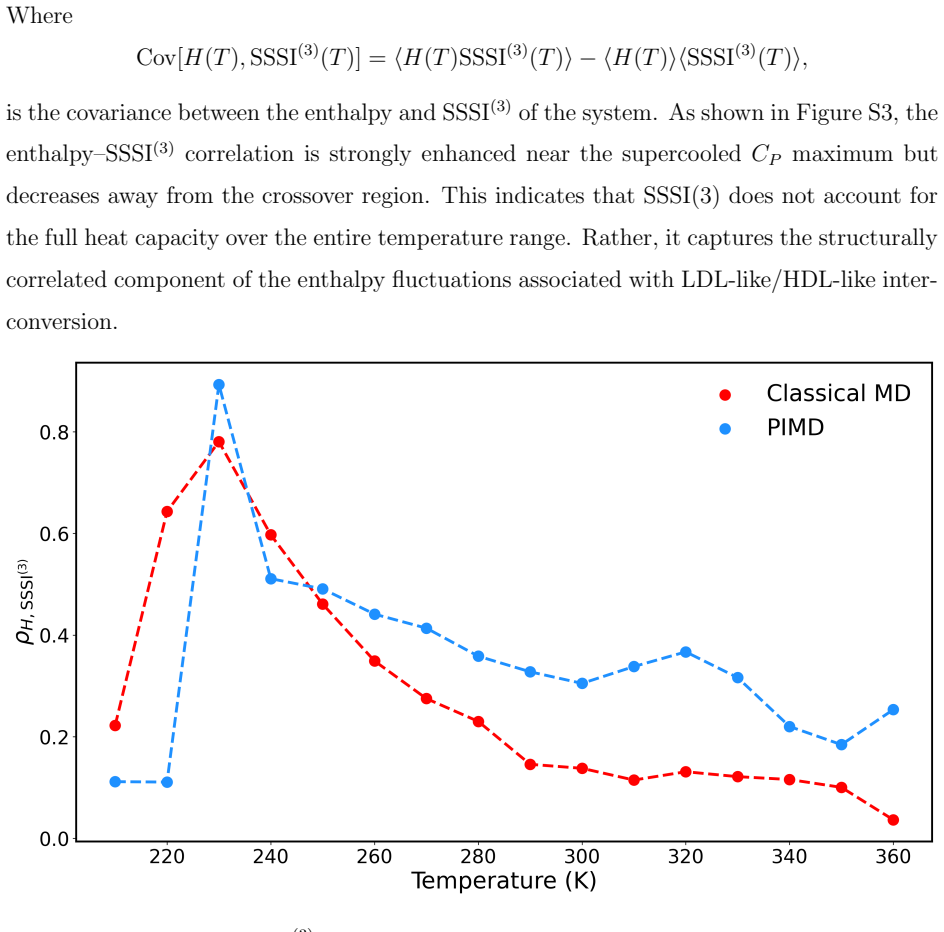
Two-state ΔH is fitted to H(T) so that CP,SSSI = ΔH·dλ/dT recovers the anomaly by construction of the decomposition; independent d⟨SSSI⟩/dT correlation remains non-circular.
specific steps
-
fitted input called prediction
[Eqs. 4–5 and Fig. 4; SI S7]
"⟨SSSI(3)⟩(T)=λ(T)SSSI(3)HDLL+[1−λ(T)]SSSI(3)LDLL … H(T)=Hbase(T)+HSSSI(T)=H0+∫TTrefCP,base(T′)dT′+ΔHL/H·λ(T). … H(T) was fitted to Equation 5 … and CP was determined through Equation 1. As shown in Figure 4, … the shape of the SSSI-based structural contribution (CP,SSSI) reproduces the maximum at ∼230 K."
λ is defined by linear interpolation of the identical ⟨SSSI(3)⟩ series between fixed simulation extremes (210 K / 360 K). A single temperature-independent ΔH is then fitted so that Hbase + ΔH·λ reproduces the simulated enthalpy. Differentiation therefore yields CP,SSSI = ΔH·dλ/dT by algebraic construction of the fit, not as an independent prediction of the heat-capacity anomaly. SI S7 shows the numerical value of ΔH changes with the arbitrary endpoint choice, confirming the scale is fit-dependent.
-
self definitional
[Eq. 4 and text after Fig. 2]
"SSSI(3)LDLL and SSSI(3)HDLL are defined as ⟨SSSI(3)⟩(T=210 K) and ⟨SSSI(3)⟩(T=360 K), respectively. … λ(T) increases most sharply at the transition temperature … reflecting the most rapid crossover between LDL-like and HDL-like environments."
The two-state fraction λ is not an independent structural observable; it is defined by rescaling the same order-parameter average whose temperature derivative already tracks CP. Consequently any claim that “population changes” of LDL/HDL structures produce the excess heat capacity is definitionally equivalent to the earlier d⟨SSSI⟩/dT correlation once the linear map is imposed.
full rationale
The direct CP from ∂H/∂T (Eq. 1, Fig. 1) and the independent observation that d⟨SSSI(3)⟩/dT tracks CP (Fig. 2) plus enhanced variance/correlation near 230 K (SI S5) are non-circular correlative results. Nuclear-quantum suppression of high-frequency modes is likewise independent (vDOS reweighting and PIMD). Circularity appears only in the subsequent two-state mapping used for the quantitative “microscopic link” and the 3–4 kJ mol⁻¹ scale: λ(T) is a linear rescaling of the same ⟨SSSI(3)⟩ series between simulation endpoints (Eq. 4), H_SSSI ≡ ΔH·λ is inserted into a fit of simulated H(T) (Eq. 5), and CP,SSSI is recovered by differentiation. The fit therefore reproduces the original CP curve by construction (Fig. 4). SI S7 confirms ΔH varies 2.8–3.9 kJ mol⁻¹ with endpoint choice, underscoring that the scale is effective and fit-dependent rather than an independent prediction. The SSSI definition itself is taken from overlapping-author prior work, but that citation is not load-bearing for the heat-capacity claim. Overall partial circularity of the fitted decomposition, score 5.
Axiom & Free-Parameter Ledger
free parameters (5)
- ΔH_L/H (effective LDL/HDL-like enthalpy difference) =
~2.8–3.9 kJ mol−1 (classical/PIMD, endpoint-dependent)
- CP,conf (residual configurational baseline heat capacity) =
~4.0–4.3 R
- SSSI LDL/HDL endpoints =
⟨SSSI(3)⟩(210 or 220 K) and ⟨SSSI(3)⟩(350 or 360 K)
- SSSI averaging depth n=3 =
n=3
- Polynomial split for H(T) and ⟨SSSI⟩ fits =
two third-order polynomials (low/high T)
axioms (7)
- standard math Isobaric heat capacity equals (∂H/∂T)_P and can be obtained from polynomial fits to simulated enthalpy.
- domain assumption NEP3@MB-pol and NEP3@revPBE0-D3 faithfully represent the thermodynamics and local structure of the underlying MB-pol and revPBE0-D3 water models over 210–360 K.
- domain assumption 32-bead PIMD is sufficient for converged structural and thermodynamic properties of water above 210 K.
- domain assumption Local environments can be usefully partitioned into LDL-like and HDL-like motifs whose populations control anomalous thermodynamics (LLPT/two-state scenario).
- domain assumption SSSI(3) is a valid order parameter that distinguishes LDL-like from HDL-like local structure and correlates with mobility and the LLPT.
- ad hoc to paper Residual CP,conf is approximately temperature-independent for T ≳ 250 K because ⟨N_HB⟩ decreases nearly linearly there.
- domain assumption vDOS quantum correction with CV ≈ CP is an adequate estimate of NQE impact on isobaric heat capacity.
invented entities (1)
-
Effective two-state SSSI mapping (λ, ΔH_L/H) for continuous liquid water structure
no independent evidence
read the original abstract
Water isobaric heat capacity is anomalously large under ambient conditions and exhibits a sharp maximum upon supercooling. Using classical and path-integral molecular dynamics with accurate machine-learning interatomic potentials, we show that nuclear quantum effects primarily act by suppressing high-frequency vibrations, while the anomalous temperature dependence of the isobaric heat capacity originates from structural fluctuations, quantified by the second-solvent-shell intruder order parameter. A simple two-state mapping reveals an effective enthalpy scale of about 4 kJ/mol associated with the interconversion of low- and high-density-like local structures, providing a microscopic link between their population changes and the excess heat capacity from supercooled to ambient conditions.
Figures




Reference graph
Works this paper leans on
-
[1]
G. K. Vallis,Climate and the Oceans:(Princeton University Press, 2011)
2011
-
[2]
Gallo, K
P. Gallo, K. Amann-Winkel, C. A. Angell, M. A. Anisimov, F. Caupin, C. Chakravarty, E. Lascaris, T. Loerting, A. Z. Panagiotopoulos, J. Russo, J. A. Sellberg, H. E. Stanley, H. Tanaka, C. Vega, L. Xu, and L. G. M. Pettersson, Water: A Tale of Two Liquids, Chem. Rev.116, 7463 (2016)
2016
-
[3]
Bagchi,Water in Biological and Chemical Processes: From Structure and Dynamics to Function, Cambridge Molecular Science (Cambridge University Press, 2013)
B. Bagchi,Water in Biological and Chemical Processes: From Structure and Dynamics to Function, Cambridge Molecular Science (Cambridge University Press, 2013)
2013
-
[4]
R. Naef, Calculation of the Isobaric Heat Capacities of the Liquid and Solid Phase of Organic Compounds at and around 298.15 K Based on Their “True” Molecular Volume, Molecules24, 1626 (2019)
2019
-
[5]
E. S. Domalski and E. D. Hearing, Condensed phase heat capacity data, inNIST Chemistry WebBook, NIST Standard Reference Database Number 69, edited by P. J. Linstrom and W. G. Mallard (National Institute of Standards and Technology, Gaithersburg, MD) retrieved June 9, 2026
2026
-
[6]
P. H. Poole, F. Sciortino, U. Essmann, and H. E. Stanley, Phase behaviour of metastable water, Nature360, 324 (1992)
1992
-
[7]
L. Xu, P. Kumar, S. V. Buldyrev, S.-H. Chen, P. H. Poole, F. Sciortino, and H. E. Stanley, Relation between the Widom line and the dynamic crossover in systems with a liquid–liquid phase transition, Proc. Natl. Acad. Sci. U.S.A.102, 16558 (2005)
2005
-
[8]
Pathak, A
H. Pathak, A. Sp¨ ah, N. Esmaeildoost, J. A. Sellberg, K. H. Kim, F. Perakis, K. Amann-Winkel, M. Ladd-Parada, J. Koliyadu, T. J. Lane, C. Yang, H. T. Lemke, A. R. Oggenfuss, P. J. M. Johnson, Y. Deng, S. Zerdane, R. Mankowsky, P. Beaud, and A. Nilsson, Enhancement and maximum in the isobaric specific-heat capacity measurements of deeply supercooled water...
2021
-
[9]
K. H. Kim, A. Sp¨ ah, H. Pathak, F. Perakis, D. Mariedahl, K. Amann-Winkel, J. A. Sellberg, J. H. Lee, S. Kim, J. Park, K. H. Nam, T. Katayama, and A. Nilsson, Maxima in the thermo- dynamic response and correlation functions of deeply supercooled water, Science358, 1589 (2017). 34
2017
-
[10]
Pathak, A
H. Pathak, A. Sp¨ ah, K. Amann-Winkel, F. Perakis, K. K. H. Kim, and A. Nilsson, Temper- ature dependent anomalous fluctuations in water: shift of≈1 kbar between experiment and classical force field simulations, Mol. Phys.117, 3232 (2019)
2019
-
[11]
Y. Yun, R. Z. Khaliullin, and Y. Jung, Correlated Local Fluctuations in the Hydrogen Bond Network of Liquid Water, J. Am. Chem. Soc.144, 13127 (2022)
2022
-
[12]
A. V. Muthachikavil, G. Sun, B. Peng, H. Tanaka, G. M. Kontogeorgis, and X. Liang, Un- raveling thermodynamic anomalies of water: A molecular simulation approach to probe the two-state theory with atomistic and coarse-grained water models, J. Chem. Phys.160, 154505 (2024)
2024
-
[13]
Eltareb, G
A. Eltareb, G. E. Lopez, and N. Giovambattista, Nuclear quantum effects on the thermo- dynamic, structural, and dynamical properties of water, Phys. Chem. Chem. Phys.23, 6914 (2021)
2021
-
[14]
Eltareb, G
A. Eltareb, G. E. Lopez, and N. Giovambattista, Evidence of a liquid–liquid phase transition in h2o and d2o from path-integral molecular dynamics simulations, Sci. Rep.12, 6004 (2022)
2022
-
[15]
Z. Chen, M. L. Berrens, K.-T. Chan, Z. Fan, and D. Donadio, Thermodynamics of Water and Ice from a Fast and Scalable First-Principles Neuroevolution Potential, J. Chem. Eng. Data 69, 128 (2024)
2024
-
[16]
Eltareb, G
A. Eltareb, G. E. Lopez, and N. Giovambattista, Isotope-Substitution Effects on the Thermo- dynamic, Dynamic, and Structural Properties of Water: H 2O, HDO, D2O, and T2O, J. Phys. Chem. B129, 6886 (2025)
2025
-
[17]
Savoia, E
E. Savoia, E. Oyarzua, B. D. Todd, and R. J. Sadus, Influence of quantum corrections on the predicted isobaric heat capacity of polarizable water models, J. Chem. Phys.162, 144503 (2025)
2025
-
[18]
H. W. Horn, W. C. Swope, J. W. Pitera, J. D. Madura, T. J. Dick, G. L. Hura, and T. Head- Gordon, Development of an improved four-site water model for biomolecular simulations: TIP4P-Ew, J. Chem. Phys.120, 9665 (2004)
2004
-
[19]
C. Vega, M. M. Conde, C. McBride, J. L. F. Abascal, E. G. Noya, R. Ramirez, and L. M. Ses´ e, Heat capacity of water: A signature of nuclear quantum effects, J. Chem. Phys.132, 046101 (2010)
2010
-
[20]
S. K. Reddy, S. C. Straight, P. Bajaj, C. Huy Pham, M. Riera, D. R. Moberg, M. A. Morales, C. Knight, A. W. G¨ otz, and F. Paesani, On the accuracy of the MB-pol many-body potential 35 for water: Interaction energies, vibrational frequencies, and classical thermodynamic and dynamical properties from clusters to liquid water and ice, J. Chem. Phys.145, 194...
2016
-
[21]
Ceriotti, W
M. Ceriotti, W. Fang, P. G. Kusalik, R. H. McKenzie, A. Michaelides, M. A. Morales, and T. E. Markland, Nuclear Quantum Effects in Water and Aqueous Systems: Experiment, Theory, and Current Challenges, Chem. Rev.116, 7529 (2016)
2016
-
[22]
K. Xu, T. Liang, N. Xu, P. Ying, S. Chen, N. Wei, J. Xu, and Z. Fan, NEP-MB-pol: a unified machine-learned framework for fast and accurate prediction of water’s thermodynamic and transport properties, Npj Comput. Mater.11, 279 (2025)
2025
-
[23]
CHAU and A
P.-L. CHAU and A. J. HARDWICK, A new order parameter for tetrahedral configurations, Mol. Phys.93, 511 (1998)
1998
-
[24]
J. R. Errington and P. G. Debenedetti, Relationship between structural order and the anoma- lies of liquid water, Nature409, 318 (2001)
2001
-
[25]
P. G. Debenedetti and H. E. Stanley, Supercooled and Glassy Water, Phys. Today56, 40 (2003)
2003
-
[26]
Holten and M
V. Holten and M. A. Anisimov, Entropy-driven liquid–liquid separation in supercooled water, Sci. Rep.2, 713 (2012)
2012
-
[27]
Russo and H
J. Russo and H. Tanaka, Understanding water’s anomalies with locally favoured structures, Nat. Commun.5, 3556 (2014)
2014
-
[28]
Shi and H
R. Shi and H. Tanaka, The anomalies and criticality of liquid water, Proc. Natl. Acad. Sci. U.S.A.117, 26591 (2020)
2020
-
[29]
Y. Song, R. Liu, C. Zhang, Y. Li, B. Santra, M. Chen, M. L. Klein, and X. Wu, Understanding the density maximum of water with machine-learned potentials, Sci. Adv.12, eaec6748 (2026)
2026
-
[30]
L.-P. Wang, M. L. Berrens, and D. Donadio, Direct observation of liquid–liquid phase coexis- tence in deeply supercooled water using an accurate polarizable multipole model, Proc. Natl. Acad. Sci. U.S.A.123, e2526573123 (2026)
2026
-
[31]
Widom, Some Topics in the Theory of Fluids, J
B. Widom, Some Topics in the Theory of Fluids, J. Chem. Phys.39, 2808 (1963)
1963
-
[32]
Franzese and H
G. Franzese and H. E. Stanley, The Widom line of supercooled water, J. Phys.: Condens. Matter19, 205126 (2007)
2007
-
[33]
J. L. F. Abascal and C. Vega, Widom line and the liquid–liquid critical point for the TIP4P/2005 water model, J. Chem. Phys.133, 234502 (2010). 36
2005
-
[34]
Z. Fan, Z. Zeng, C. Zhang, Y. Wang, K. Song, H. Dong, Y. Chen, and T. Ala-Nissila, Neu- roevolution machine learning potentials: Combining high accuracy and low cost in atomistic simulations and application to heat transport, Phys. Rev. B104, 104309 (2021)
2021
-
[35]
Z. Fan, Y. Wang, P. Ying, K. Song, J. Wang, Y. Wang, Z. Zeng, K. Xu, E. Lindgren, J. M. Rahm, A. J. Gabourie, J. Liu, H. Dong, J. Wu, Y. Chen, Z. Zhong, J. Sun, P. Erhart, Y. Su, and T. Ala-Nissila, GPUMD: A package for constructing accurate machine-learned potentials and performing highly efficient atomistic simulations, J. Chem. Phys.157, 114801 (2022)
2022
-
[36]
J. P. Perdew, K. Burke, and M. Ernzerhof, Generalized Gradient Approximation Made Simple, Phys. Rev. Lett.77, 3865 (1996)
1996
-
[37]
Generalized Gradient Approximation Made Simple
Y. Zhang and W. Yang, Comment on “Generalized Gradient Approximation Made Simple”, Phys. Rev. Lett.80, 890 (1998)
1998
-
[38]
Adamo and V
C. Adamo and V. Barone, Toward reliable density functional methods without adjustable parameters: The PBE0 model, J. Chem. Phys.110, 6158 (1999)
1999
-
[39]
Grimme, J
S. Grimme, J. Antony, S. Ehrlich, and H. Krieg, A consistent and accurateab initio parametrization of density functional dispersion correction (DFT-D) for the 94 elements H-Pu, J. Chem. Phys.132, 154104 (2010)
2010
-
[40]
First Principles
V. Babin, C. Leforestier, and F. Paesani, Development of a “First Principles” Water Potential with Flexible Monomers: Dimer Potential Energy Surface, VRT Spectrum, and Second Virial Coefficient, J. Chem. Theory Comput.9, 5395 (2013)
2013
-
[41]
First Principles
V. Babin, G. R. Medders, and F. Paesani, Development of a “First Principles” Water Potential with Flexible Monomers. II: Trimer Potential Energy Surface, Third Virial Coefficient, and Small Clusters, J. Chem. Theory Comput.10, 1599 (2014)
2014
-
[42]
First-Principles
G. R. Medders, V. Babin, and F. Paesani, Development of a “First-Principles” Water Potential with Flexible Monomers. III. Liquid Phase Properties, J. Chem. Theory Comput.10, 2906 (2014)
2014
-
[43]
See Supplemental Material at [URL will be inserted by publisher] for training details for the NEP3@MB-pol and NEP3@revPBE0-D3 potentials, classical MD and PIMD simulation details, and results from the NEP3@revPBE0-D3 model
-
[44]
Schran, K
C. Schran, K. Brezina, and O. Marsalek, Committee neural network potentials control gener- alization errors and enable active learning, J. Chem. Phys.153, 104105 (2020). 37
2020
-
[45]
J. L. F. Abascal, E. Sanz, R. Garc´ ıa Fern´ andez, and C. Vega, A potential model for the study of ices and amorphous water: TIP4P/Ice, J. Chem. Phys.122, 234511 (2005)
2005
-
[46]
M. L. Berrens, A. Kundu, M. F. Calegari Andrade, T. A. Pham, G. Galli, and D. Donadio, Nuclear Quantum Effects on the Electronic Structure of Water and Ice, J. Phys. Chem. Lett. , 6818 (2024)
2024
-
[47]
T. D. K¨ uhne, M. Iannuzzi, M. Del Ben, V. V. Rybkin, P. Seewald, F. Stein, T. Laino, R. Z. Khaliullin, O. Sch¨ utt, F. Schiffmann, D. Golze, J. Wilhelm, S. Chulkov, M. H. Bani- Hashemian, V. Weber, U. Borˇ stnik, M. Taillefumier, A. S. Jakobovits, A. Lazzaro, H. Pabst, T. M¨ uller, R. Schade, M. Guidon, S. Andermatt, N. Holmberg, G. K. Schenter, A. Hehn,...
2020
-
[48]
Marsalek and T
O. Marsalek and T. E. Markland, Quantum Dynamics and Spectroscopy of Ab Initio Liquid Water: The Interplay of Nuclear and Electronic Quantum Effects, J. Phys. Chem. Lett.8, 1545 (2017)
2017
-
[49]
VandeVondele and J
J. VandeVondele and J. Hutter, Gaussian basis sets for accurate calculations on molecular systems in gas and condensed phases, J. Chem. Phys.127, 114105 (2007)
2007
-
[50]
Guidon, J
M. Guidon, J. Hutter, and J. VandeVondele, Auxiliary Density Matrix Methods for Hartree−Fock Exchange Calculations, J. Chem. Theory Comput.6, 2348 (2010)
2010
-
[51]
Goedecker, M
S. Goedecker, M. Teter, and J. Hutter, Separable dual-space Gaussian pseudopotentials, Phys. Rev. B54, 1703 (1996)
1996
-
[52]
Riera, C
M. Riera, C. Knight, E. F. Bull-Vulpe, X. Zhu, H. Agnew, D. G. A. Smith, A. C. Simmonett, and F. Paesani, MBX: A many-body energy and force calculator for data-driven many-body simulations, J. Chem. Phys.159, 054802 (2023)
2023
-
[53]
Morawietz, A
T. Morawietz, A. Singraber, C. Dellago, and J. Behler, How van der waals interactions deter- mine the unique properties of water, Proceedings of the National Academy of Sciences113, 8368 (2016)
2016
-
[54]
Omranpour, P
A. Omranpour, P. Montero De Hijes, J. Behler, and C. Dellago, Perspective: Atomistic simula- tions of water and aqueous systems with machine learning potentials, The Journal of Chemical Physics160(2024). 38
2024
-
[55]
Bussi, D
G. Bussi, D. Donadio, and M. Parrinello, Canonical sampling through velocity rescaling, J. Chem. Phys.126, 014101 (2007)
2007
-
[56]
Bernetti and G
M. Bernetti and G. Bussi, Pressure control using stochastic cell rescaling, J. Chem. Phys.153, 114107 (2020)
2020
-
[57]
Bussi and M
G. Bussi and M. Parrinello, Accurate sampling using Langevin dynamics, Phys. Rev. E75, 056707 (2007)
2007
-
[58]
H. J. C. Berendsen, J. P. M. Postma, W. F. van Gunsteren, A. DiNola, and J. R. Haak, Molecular dynamics with coupling to an external bath, J. Chem. Phys.81, 3684 (1984)
1984
-
[59]
Ceriotti, M
M. Ceriotti, M. Parrinello, T. E. Markland, and D. E. Manolopoulos, Efficient stochastic thermostatting of path integral molecular dynamics, J. Chem. Phys.133, 124104 (2010)
2010
-
[60]
Luzar and D
A. Luzar and D. Chandler, Hydrogen-bond kinetics in liquid water, Nature379, 55 (1996)
1996
-
[61]
D. G. Archer and R. W. Carter, Thermodynamic Properties of the NaCl + H2O System. 4. Heat Capacities of H2O and NaCl(aq) in Cold-Stable and Supercooled States, J. Phys. Chem. B104, 8563 (2000)
2000
-
[62]
Wagner and A
W. Wagner and A. Pruß, The IAPWS Formulation 1995 for the Thermodynamic Properties of Ordinary Water Substance for General and Scientific Use, J. Phys. Chem. Ref. Data31, 387 (2002)
1995
-
[63]
P. H. Berens, D. H. J. Mackay, G. M. White, and K. R. Wilson, Thermodynamics and quantum corrections from molecular dynamics for liquid water, J. Chem. Phys.79, 2375 (1983)
1983
-
[64]
Stolte, J
N. Stolte, J. Daru, H. Forbert, J. Behler, and D. Marx, Nuclear Quantum Effects in Liquid Water Are Marginal for Its Average Structure but Significant for Dynamics, J. Phys. Chem. Lett. , 12144 (2024)
2024
-
[65]
Chiang, J
K.-Y. Chiang, J. Hunger, M. Bonn, and Y. Nagata, Experimental quantification of nuclear quantum effects on the hydrogen bond of liquid water, Sci. Adv.11, eadv7218 (2025)
2025
-
[66]
F. Pabst and A. Hassanali, Glassy arrest behind the apparent second liquid in water (2026), arXiv:2604.00794
arXiv 2026
-
[67]
VandeVondele, M
J. VandeVondele, M. Krack, F. Mohamed, M. Parrinello, T. Chassaing, and J. Hutter, Quick- step: Fast and accurate density functional calculations using a mixed Gaussian and plane waves approach, Comput. Phys. Commun.167, 103 (2005)
2005
-
[68]
M. L. Berrens, F. C. Bononi, and D. Donadio, Effect of sodium chloride adsorption on the surface premelting of ice, Phys. Chem. Chem. Phys.24, 20932 (2022). 39
2022
discussion (0)
Sign in with ORCID, Apple, or X to comment. Anyone can read and Pith papers without signing in.