REVIEW 2 major objections 3 minor 212 references
Discrete Diffusion Models: A Unified Framework from Tokenization to Generation
T0 review · 2 major / 3 minor · reviewed 2026-08-02 · deepseek-v4-flash
Pith's one-line read This survey claims that every discrete diffusion model—transition-matrix, masking, or score/ratio—instantiates the same four-component structure and that tokenization is the primary design axis.
desk verdict Useful map of discrete diffusion, but the 'every model fits four components' claim is narrower than its own scope allows. read the letter →
The pith
A machine-rendered reading of the paper's core claim, the machinery that carries it, and where it could break.
The reading
What carries the argument
The load-bearing object is the four-component decomposition: (1) corruption operator (transition matrix or rate matrix defining the forward noising), (2) denoiser parameterization (what the network predicts: clean-token distribution, logits, or probability ratios), (3) training objective (ELBO, simplified denoising, or score/ratio matching), and (4) sampler (ancestral, remasking, blockwise, guided, accelerated). The paper pairs this with a tokenization lens: the discrete state space—subword vocabularies, quantized codebooks, or natural scientific alphabets—determines the corruption topology and denoising difficulty. The decomposition does the work of making different formulations interconver
What would settle it
Find any model that is widely accepted as discrete diffusion but cannot be placed in the four components without forcing—for example, a forward process that is not a per-position categorical Markov chain, or an objective that is neither variational, denoising, nor score/ratio matching. A more empirical probe: train the paper's predicted-valid 'off-diagonal' pairings (e.g., absorbing corruption with a score-entropy objective) and show they fail to produce competitive likelihoods or samples at scale, which would falsify the claim that components are independently selectable.
Extended reading notes
Core claim
The paper's central claim is that the apparent diversity of discrete diffusion models conceals a common design space. It decomposes every model into four components: (1) a corruption operator (a transition matrix or rate matrix that specifies how clean tokens become noisy), (2) a denoiser parameterization (predicting the clean token, logits, or probability ratios), (3) a training objective (variational, simplified denoising, or score/ratio matching), and (4) a sampler (ancestral, confidence-based remasking, blockwise, guided, or accelerated). Major formulation families—general transition-matrix models, absorbing/masking diffusion, continuous-time Markov chains, and score/ratio-based methods—
Load-bearing premise
The load-bearing premise is that the sample of papers surveyed, gathered by following citations from a handful of foundational discrete-diffusion formulations, fairly represents the whole field; under-representing one branch, such as embed-then-diffuse or non-Markovian corruptions, could make the shared structure look more universal than it is.
Editorial extensions
If this is right
- Model families that look different (masking, substitution, score/ratio) differ mainly in corruption and parameterization; their training objectives and samplers can often be swapped.
- Masking vs. substitution vs. structured corruption is orthogonal to predict-x0 vs. predict-ratio parameterization, so combinations not yet tried are legitimate candidates for new models.
- Tokenization is a primary design axis: vocabulary granularity, codebook topology, and natural alphabets shape denoising difficulty, controllability, and cost, so tokenizer choice should be reported alongside model choice.
- Masked diffusion's ELBO collapses to a reweighted masked-language-modeling objective, which explains why large-scale diffusion language models train like BERT-style models and why time conditioning is partly redundant.
- Likelihood-based training and simplified denoising objectives occupy different points on a compute-vs-bound trade-off; the field has not settled on one as universally best.
Reading between the lines
- If tokenization is the primary axis, then pushing tokenizer development (e.g., semantic alignment of codebooks) may yield larger quality gains per unit effort than pushing denoiser architecture—a hypothesis that could be tested by ablating tokenizer changes with a fixed denoiser.
- The off-diagonal cells the paper highlights suggest a concrete research program: systematically crossing absorbing corruption with ratio/score parameterization, or structured substitution with predict-x0, and measuring which pairings scale; the survey does not run these experiments.
- The 'common design space' is built from a particular citation graph; if proteins, graphs, or media tokenization had been represented differently, the centrality of tokenization as an axis might be less pronounced—so the framework's strongest test is whether it survives application to a model family outside the sampled graph.
- Framing inference as a policy layer implies that speedups are often sampler-side gains, but the survey's own caveats suggest reported 'fewer steps' results only matter if they translate into wall-clock latency; a fair comparison should standardize hardware and batch.
Editorial analysis
A structured set of objections, weighed in public.
Referee Report
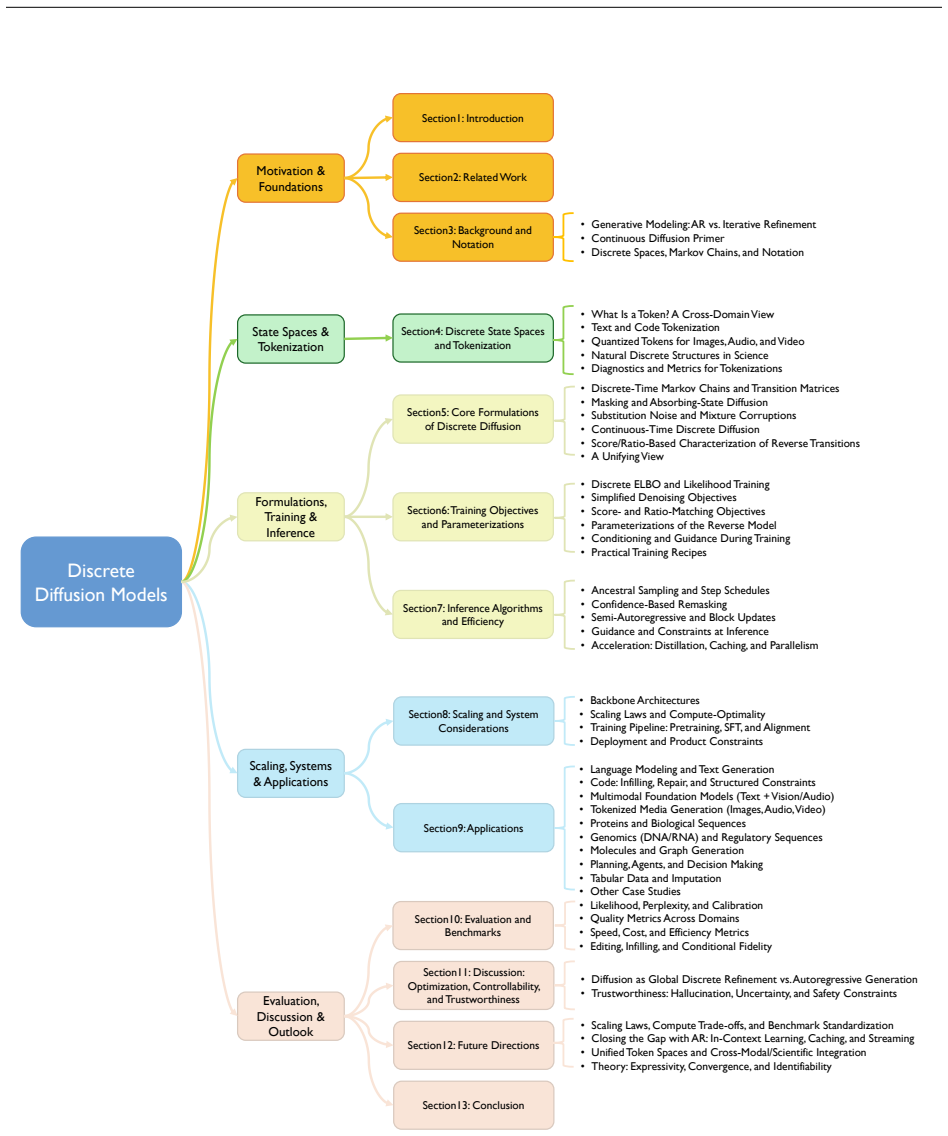
Summary. This paper is a narrative survey of discrete denoising diffusion models (DDMs), organized around the thesis that the construction of the discrete state space—'tokenization'—is the primary design axis. It proposes a four-component decomposition (corruption operator, denoiser parameterization, training objective, sampler) and argues that transition-matrix, masking/absorbing, score/ratio, and flow-matching formulations are instantiations of this common structure. The paper covers tokenization across text, code, quantized media, and scientific alphabets; systematizes training and inference; and discusses scaling, systems, applications, and evaluation. It also introduces several proposed tokenizer diagnostics and releases a companion repository.
Significance. If the unification claim is accepted, the paper provides a useful shared vocabulary and design checklist for a rapidly growing field. Its strengths include unusually explicit honesty about evidence quality: it flags that LLaDA's scale competitiveness is 'self-reported... not independently audited' (§8.2), that Mercury's throughput is 'reported by the originating work rather than independently reproduced' (§8.4), and that the proposed diagnostics in §4.5 are 'synthesized / not standardized' and not validated with new experiments. The cross-domain coverage—text, code, media, proteins, genomics, molecules, planning—is broad, and Table 5 is a practical mapping. The companion repository is a valuable resource. The main weakness is that the paper's most general claim ('every discrete diffusion model...') exceeds the evidence base it explicitly describes.
major comments (2)
- [§5.6; §2] The paper's central claim, stated in §5.6 as 'every discrete diffusion model instantiates the same four-component structure,' is stronger than the evidence assembled in §2. The 'Scope and selection' paragraph describes a narrative snowball sample around five roots, notes 'we do not claim exhaustive coverage,' and uses inclusion criterion (i) already expressed in the corruption/parameterization/objective/sampler vocabulary. The corpus therefore cannot support a universal quantifier. Boundary cases sharpen the problem: embed-then-diffuse methods are explicitly excluded in §1, and non-Markov forward processes (e.g., Discrete Non-Markov Diffusion Models in §7.1) are not shown to be representable as a Q_t/R_t corruption operator. I recommend narrowing the claim to 'all surveyed formulations' throughout, or adding a systematic independent census and a treatment of non-Markov processes.
- [§6.1, Eq. (16)] The sign convention in Eq. (16) is internally inconsistent as written. The text states that the weight α'_t/(1−α_t) is negative and that 'L∞ itself [is] negative (it is an expected log-likelihood).' But since α'_t<0 and the expectation of δ_{xt,m} x0^⊤ log μθ(xt,t) is ≤0, the integrand is nonnegative, making L∞ nonnegative. The subsequent claim that 'the ELBO reduces to −L∞' adds to the confusion about which quantity is minimized/maximized. Please reconcile Eq. (16) with the convention in Shi et al. (2024b) and state explicitly whether L∞ is the negative ELBO or the ELBO itself.
minor comments (3)
- [§4.5] The tokenizer diagnostics (reconstruction–generation gap, denoising loss curve, schedule sensitivity) are listed in the contributions as introduced diagnostics, but the section honestly labels them 'synthesized / not standardized' and 'we have not validated the proposed diagnostics with new experiments.' This caveat should also appear in the abstract or contributions to avoid overclaiming.
- [§6.6; §8.4] There are several missing spaces in citations, e.g., 'SeveriRissanen(2023)' and 'MercuryKhanna et al.' Please run a formatting pass over inline citations.
- [§5.2] The statement that the cosine schedule is 'Fisher-Rao optimal for masked discrete diffusion' is strong and relies on a single reference. A one-sentence explanation of the optimality criterion and its assumptions would help readers assess the claim.
Circularity Check
No significant circularity: the survey’s four-component taxonomy is an organizing framework with independent analytic content; the main caveat is a scope/representativeness limitation in §2, not a circular derivation.
full rationale
This is a narrative survey rather than a derivation chain. The four-component decomposition (corruption operator, denoiser parameterization, training objective, sampler) is presented as an organizing taxonomy, and the mathematical equivalences it relies on are derived from stated assumptions rather than from the paper’s conclusions: §5.5 shows predict-x0 and ratio parameterizations are interconvertible via Eq. 7 and Eq. 11, and §6.1 derives the discrete ELBO from the forward Markov chain. There are no fitted parameters and no quantities called predictions that reduce to fitted values. The self-citations (e.g., Ye et al. 2025a,b,c,d; 2024a) are used as literature references for diffusion’s planning/refinement motivation and for Dream 7B scaling evidence; they are not load-bearing for the framework’s internal structure. The main caveat is §2’s “Scope and selection”: the survey was assembled by snowballing around five foundational formulations and explicitly “do[es] not claim exhaustive coverage,” and inclusion criterion (i) is already phrased in the four-component vocabulary (“distinct corruption/parameterization/objective/sampler choice”). This weakens the §5.6 universal quantifier (“every discrete diffusion model instantiates the same four-component structure”) as an empirical generalization, but it is a representativeness/scope limitation rather than a circular derivation: the framework’s analytic content, such as the interconvertibility argument, does not depend on the sample. The paper also flags its own limitations honestly (§4.5 diagnostics “not validated”; §8.2/§8.4 self-reported numbers “not independently audited”), which further supports the conclusion that no load-bearing step reduces to its own inputs. Accordingly, no specific circular step is established; the score reflects only the minor, non-load-bearing self-citation pattern.
Assumptions & free parameters
assumptions (4)
- domain assumption The four-component decomposition (corruption operator, denoiser parameterization, training objective, sampler) is a complete description of any discrete diffusion model.
- domain assumption The citation-graph selection around D3PM, multinomial diffusion, MDLM/MD4, SEDD, and discrete flow matching is representative of the field through early 2026.
- ad hoc to paper Tokenization is the primary causal axis shaping corruption, denoising difficulty, controllability, and cost of discrete diffusion.
- ad hoc to paper The Section 4.5 diagnostics (reconstruction–generation gap, denoising loss curve, schedule sensitivity, neighborhood consistency) are informative for tokenizer–diffusion co-design.
invented entities (1)
-
Diffusion-facing tokenizer diagnostics (reconstruction–generation gap, denoising loss curve, schedule sensitivity, neighborhood consistency)
Cite this review
Pith. "Pith review of Discrete Diffusion Models: A Unified Framework from Tokenization to Generation." pith.science (2026). https://pith.science/paper/TTRGROUM
@misc{pith2026260713431,
  author       = {Pith},
  title        = {Pith review of: Discrete Diffusion Models: A Unified Framework from Tokenization to Generation},
  year         = {2026},
  howpublished = {\url{https://pith.science/paper/TTRGROUM}},
  note         = {Machine review of arXiv:2607.13431}
}
read the original abstract
Discrete denoising diffusion models (DDMs) have recently emerged as a compelling alternative to autoregressive (AR) modeling for discrete data, offering parallel generation and iterative global refinement capabilities. Unlike continuous diffusion, where the state space is fixed, DDMs are fundamentally shaped by how the discrete state space is constructed: the tokenization scheme, the vocabulary topology, and domain-specific structural alphabets. This work introduces a unified conceptual framework that views discrete diffusion models through the construction of the underlying discrete state space. Within this framework, existing formulations, including transition-matrix, masking/absorbing-state, and score/ratio-based approaches, emerge as different instantiations of a common design space. The framework further exposes common design trade-offs across training objectives, inference algorithms, scaling behavior, systems optimization, and evaluation protocols, suggesting several promising directions for future research.
Figures


Figures from the paper (1 more)

Reference graph
Works this paper leans on
-
[1]
Sudhanshu Agrawal, Risheek Garrepalli, Raghavv Goel, Mingu Lee, Christopher Lott, and F. Porikli. Spiffy: Multiplying diffusion llm acceleration via lossless speculative decoding.ArXiv preprint, abs/2509.18085,
-
[3]
Multi- conditioned graph diffusion for neural architecture search.Trans
Rohan Asthana, Joschua Conrad, Youssef Dawoud, Maurits Ortmanns, and Vasileios Belagiannis. Multi- conditioned graph diffusion for neural architecture search.Trans. Mach. Learn. Res., 2024,
2024
-
[6]
Bo Bai. Forget bit, it is all about token: Towards semantic information theory for llms.ArXiv preprint, abs/2511.01202,
-
[7]
Enabling approximate joint sampling in diffusion lms.ArXiv preprint, abs/2509.22738,
Parikshit Bansal and Sujay Sanghavi. Enabling approximate joint sampling in diffusion lms.ArXiv preprint, abs/2509.22738,
-
[8]
Wenrui Bao, Zhiben Chen, Dan Xu, and Yuzhang Shang. Learning to parallel: Accelerating diffusion large language models via learnable parallel decoding, 2025a. Wenrui Bao, Zhiben Chen, Dan Xu, and Yuzhang Shang. Learning to parallel: Accelerating diffusion large language models via adaptive parallel decoding.ArXiv preprint, abs/2509.25188, 2025b. Ethan Bar...
-
[10]
Simple and critical iterative denoising: A recasting of discrete diffusion in graph generatio
64 Yoann Boget. Simple and critical iterative denoising: A recasting of discrete diffusion in graph generatio. In Forty-second International Conference on Machine Learning, ICML 2025, Vancouver, BC, Canada, July 13-19, 2025, volume 267 ofProceedings of Machine Learning Research,
2025
-
[11]
Discrete graph auto-encoder.ArXiv preprint, abs/2306.07735,
Yoann Boget, Magda Gregorová, and Alexandros Kalousis. Discrete graph auto-encoder.ArXiv preprint, abs/2306.07735,
-
[12]
Montgomery Bohde, Mrunali Manjrekar, Runzhong Wang, Shuiwang Ji, and Connor W. Coley. Diffms: Diffusion generation of molecules conditioned on mass spectra. InForty-second International Conference on Machine Learning, ICML 2025, Vancouver, BC, Canada, July 13-19, 2025, volume 267 ofProceedings of Machine Learning Research,
2025
Show all 212 references
-
[13]
ScanDL: A diffusion model for generating synthetic scanpaths on texts
Lena Bolliger, David Reich, Patrick Haller, Deborah Jakobi, Paul Prasse, and Lena Jäger. ScanDL: A diffusion model for generating synthetic scanpaths on texts. InProceedings of the 2023 Conference on Empirical Methods in Natural Language Processing, pp. 15513–15538, Singapore,
2023
-
[14]
Breckon, and Chris G
Sam Bond-Taylor, Peter Hessey, Hiroshi Sasaki, Toby P. Breckon, and Chris G. Willcocks. Unleashing transformers: Parallel token prediction with discrete absorbing diffusion for fast high-resolution image generation from vector-quantized codes. InComputer Vision – ECCV 2022, pp...
2022
-
[15]
Preference-based alignment of discrete diffusion models.ArXiv preprint, abs/2503.08295,
Umberto Borso, Davide Paglieri, Jude Wells, and Tim Rocktäschel. Preference-based alignment of discrete diffusion models.ArXiv preprint, abs/2503.08295,
-
[17]
Jaakkola
Andrew Campbell, Jason Yim, Regina Barzilay, Tom Rainforth, and Tommi S. Jaakkola. Generative flows on discrete state-spaces: Enabling multimodal flows with applications to protein co-design. InForty-first International Conference on Machine Learning, ICML 2024, Vienna, Austri...
2024
-
[18]
Self-speculative masked diffusions
Andrew Campbell, Valentin De Bortoli, Jiaxin Shi, and Arnaud Doucet. Self-speculative masked diffusions. ArXiv preprint, abs/2510.03929,
-
[19]
Generating directed graphs with dual attention and asymmetric encoding.ArXiv preprint, abs/2506.16404,
Alba Carballo-Castro, Manuel Madeira, Yiming Qin, Dorina Thanou, and Pascal Frossard. Generating directed graphs with dual attention and asymmetric encoding.ArXiv preprint, abs/2506.16404,
-
[20]
Huiwen Chang, Han Zhang, Lu Jiang, Ce Liu, and William T. Freeman. Maskgit: Masked generative image transformer. InIEEE/CVF Conference on Computer Vision and Pattern Recognition, CVPR 2022, New Orleans, LA, USA, June 18-24, 2022, pp. 11305–11315,
2022
-
[21]
Freeman, Michael Rubinstein, Yuanzhen Li, and Dilip Krishnan
Huiwen Chang, Han Zhang, Jarred Barber, Aaron Maschinot, José Lezama, Lu Jiang, Ming-Hsuan Yang, Kevin Patrick Murphy, William T. Freeman, Michael Rubinstein, Yuanzhen Li, and Dilip Krishnan. Muse: Text-to-image generation via masked generative transformers. InInternational Co...
2023
-
[22]
Dtom: Decider-guided dynamic token merging for accelerating diffusion mllms.ArXiv preprint, abs/2511.12280,
Shuochen Chang, Xiaofeng Zhang, Qingyang Liu, and Li Niu. Dtom: Decider-guided dynamic token merging for accelerating diffusion mllms.ArXiv preprint, abs/2511.12280,
-
[23]
Krishnan
65 Chen-Hao Chao, Wei-Fang Sun, Hanwen Liang, Chun-Yi Lee, and Rahul G. Krishnan. Beyond masked and unmasked: Discrete diffusion models via partial masking.ArXiv preprint, abs/2505.18495,
-
[24]
Aligning visual foundation encoders to tokenizers for diffusion models.ArXiv preprint, abs/2509.25162, 2025a
Bowei Chen, Sai Bi, Hao Tan, He Zhang, Tianyuan Zhang, Zhengqi Li, Yuanjun Xiong, Jianming Zhang, and Kai Zhang. Aligning visual foundation encoders to tokenizers for diffusion models.ArXiv preprint, abs/2509.25162, 2025a. Chuangtao Chen, Qinglin Zhao, MengChu Zhou, Dusit Niya...
-
[26]
Controllable conversation generation with conversation structures via diffusion models
Jiaao Chen and Diyi Yang. Controllable conversation generation with conversation structures via diffusion models. InFindings of the Association for Computational Linguistics: ACL 2023, pp. 7238–7251, Toronto, Canada,
2023
-
[27]
A cheaper and better diffusion language model with soft-masked noise
Jiaao Chen, Aston Zhang, Mu Li, Alex Smola, and Diyi Yang. A cheaper and better diffusion language model with soft-masked noise. InProceedings of the 2023 Conference on Empirical Methods in Natural Language Processing, pp. 4765–4775, Singapore, 2023a. Jialin Chen, Shirley Wu, ...
2023
-
[29]
Sdar-vl: Stable and efficient block-wise diffusion for vision-language understanding.ArXiv preprint, abs/2512.14068, 2025a
Shuang Cheng, Yuhua Jiang, Zineng Zhou, Dawei Liu, Wang Tao, Linfeng Zhang, Biqing Qi, and Bowen Zhou. Sdar-vl: Stable and efficient block-wise diffusion for vision-language understanding.ArXiv preprint, abs/2512.14068, 2025a. Zicong Cheng, Guo-Wei Yang, Jia Li, Zhijie Deng, M...
2025
-
[30]
M2d2m: Multi-motion generation from text with discrete diffusion models
Seunggeun Chi, Hyung-gun Chi, Hengbo Ma, Nakul Agarwal, Faizan Siddiqui, Karthik Ramani, and Kwon- joon Lee. M2d2m: Multi-motion generation from text with discrete diffusion models. InComputer Vision – ECCV 2024, pp. 18–36,
2024
-
[31]
Speculative diffusion decoding: Accelerating language generation through diffusion
67 JacobKChristopher, BrianR.Bartoldson, TalBen-Nun, MichaelCardei, BhavyaKailkhura, andFerdinando Fioretto. Speculative diffusion decoding: Accelerating language generation through diffusion. InProceed- ings of the 2025 Conference of the Nations of the Americas Chapter of the...
2025
-
[32]
Split gibbs discrete diffusion posterior sampling.ArXiv preprint, abs/2503.01161,
Wenda Chu, Yang Song, and Yisong Yue. Split gibbs discrete diffusion posterior sampling.ArXiv preprint, abs/2503.01161,
-
[33]
Gaus, Toby P
Abril Corona-Figueroa, Sam Bond-Taylor, Neelanjan Bhowmik, Yona Falinie A. Gaus, Toby P. Breckon, Hubert P. H. Shum, and Chris G. Willcocks. Unaligned 2d to 3d translation with conditional vector- quantized code diffusion using transformers. InIEEE/CVF International Conference...
2023
-
[34]
Vilad: A large vision language diffusion framework for end-to-end autonomous driving.ArXiv preprint, abs/2508.12603,
Can Cui, Yupeng Zhou, Juntong Peng, Sung-Yeon Park, Zichong Yang, Prashanth Sankaranarayanan, Jiaru Zhang, Ruqi Zhang, and Ziran Wang. Vilad: A large vision language diffusion framework for end-to-end autonomous driving.ArXiv preprint, abs/2508.12603,
-
[35]
Differ: Cate- gorical diffusion for chemical retrosynthesis.ArXiv preprint, abs/2505.23721,
Sean Current, Ziqi Chen, Daniel Adu-Ampratwum, Xia Ning, and Srinivasan Parthasarathy. Differ: Cate- gorical diffusion for chemical retrosynthesis.ArXiv preprint, abs/2505.23721,
-
[36]
Periodic materials generation using text-guided joint diffusion model
Kishalay Das, Subhojyoti Khastagir, Pawan Goyal, Seung-Cheol Lee, Satadeep Bhattacharjee, and Niloy Ganguly. Periodic materials generation using text-guided joint diffusion model. InThe Thirteenth Inter- national Conference on Learning Representations, ICLR 2025, Singapore, Ap...
2025
-
[37]
Discrete diffusion language model for efficient text summarization
Do Huu Dat, Duc Anh Do, Anh Tuan Luu, and Wray Buntine. Discrete diffusion language model for efficient text summarization. InFindings of the Association for Computational Linguistics: NAACL 2025, pp. 6278–6290, Albuquerque, New Mexico,
2025
-
[38]
Alexandre Défossez, Jade Copet, Gabriel Synnaeve, and Yossi Adi
doi: 10.1126/science.add2187. Alexandre Défossez, Jade Copet, Gabriel Synnaeve, and Yossi Adi. High Fidelity Neural Audio Compression, October
-
[39]
Uniform discrete diffusion with metric path for video generation.ArXiv preprint, abs/2510.24717,
Haoge Deng, Ting Pan, Fan Zhang, Yang Liu, Zhuoyan Luo, Yufeng Cui, Wenxuan Wang, Chunhua Shen, Shiguang Shan, Zhaoxiang Zhang, and Xinlong Wang. Uniform discrete diffusion with metric path for video generation.ArXiv preprint, abs/2510.24717,
-
[40]
Llada-medv: Exploring large language diffusion models for biomedical image understanding.ArXiv preprint, abs/2508.01617, 2025a
Xuanzhao Dong, Wenhui Zhu, Xiwen Chen, Zhipeng Wang, Peijie Qiu, Shao Tang, Xin Li, and Yalin Wang. Llada-medv: Exploring large language diffusion models for biomedical image understanding.ArXiv preprint, abs/2508.01617, 2025a. Yihong Dong, Zhaoyu Ma, Xue Jiang, Zhiyuan Fan, J...
-
[41]
Planning with diffusion models for target-oriented dialogue systems
Hanwen Du, Bo Peng, and Xia Ning. Planning with diffusion models for target-oriented dialogue systems. InProceedings of the 63rd Annual Meeting of the Association for Computational Linguistics (Volume 1: Long Papers), pp. 20307–20329, Vienna, Austria, 2025a. 68 Yongkun Du, Mia...
-
[42]
Vector quantized diffusion model based speech bandwidth extension
Yuan Fang, Jinglin Bai, Jiajie Wang, and Xueliang Zhang. Vector quantized diffusion model based speech bandwidth extension. InICASSP 2025 - 2025 IEEE International Conference on Acoustics, Speech and Signal Processing (ICASSP), pp. 1–5,
2025
-
[43]
Alessandro Favero, Antonio Sclocchi, and M. Wyart. Bigger isn’t always memorizing: Early stopping over- parameterized diffusion models.ArXiv preprint, abs/2505.16959,
-
[44]
Masked diffusion captioning for visual feature learning
Chao Feng, Zihao Wei, and Andrew Owens. Masked diffusion captioning for visual feature learning. In Findings of the Association for Computational Linguistics: EMNLP 2025, pp. 25247–25263,
2025
-
[45]
Learnable sampler distillation for discrete diffusion models
Feiyang Fu, Tongxian Guo, and Zhaoqiang Liu. Learnable sampler distillation for discrete diffusion models. ArXiv preprint, abs/2509.19962, 2025a. Hengyu Fu, Baihe Huang, Virginia Adams, Charles Wang, Venkat Srinivasan, and Jiantao Jiao. From bits to rounds: Parallel decoding w...
-
[46]
Diffu- COMET: Contextual commonsense knowledge diffusion
Silin Gao, Mete Ismayilzada, Mengjie Zhao, Hiromi Wakaki, Yuki Mitsufuji, and Antoine Bosselut. Diffu- COMET: Contextual commonsense knowledge diffusion. InProceedings of the 62nd Annual Meeting of the Association for Computational Linguistics (Volume 1: Long Papers), pp. 4809...
-
[47]
Zhangyang Gao, Cheng Tan, Jue Wang, Yufei Huang, Lirong Wu, and Stan Z. Li. Foldtoken: Learning protein language via vector quantization and beyond.arXiv preprint arXiv:2403.09673, 2024b. H. F. García, Prem Seetharaman, Rithesh Kumar, and Bryan Pardo. Vampnet: Music generation...
-
[48]
Itai Gat, Tal Remez, Neta Shaul, Felix Kreuk, Ricky T. Q. Chen, Gabriel Synnaeve, Yossi Adi, and Yaron Lipman. Discrete flow matching. InAdvances in Neural Information Processing Systems 38: Annual Conference on Neural Information Processing Systems 2024, NeurIPS 2024, Vancouv...
2024
-
[49]
Mask-predict: Parallel decoding of conditional masked language models
Marjan Ghazvininejad, Omer Levy, Yinhan Liu, and Luke Zettlemoyer. Mask-predict: Parallel decoding of conditional masked language models. InProceedings of the 2019 Conference on Empirical Methods in Natural Language Processing and the 9th International Joint Conference on Natu...
2019
-
[50]
Thibaud Gloaguen, Robin Staab, Nikola Jovanovic, and Martin T. Vechev. Watermarking diffusion language models.ArXiv preprint, abs/2509.24368,
-
[51]
Text-guidedmoleculegenerationwithdiffusionlanguage model
HaisongGong, QiangLiu, ShuWu, andLiangWang. Text-guidedmoleculegenerationwithdiffusionlanguage model. InThirty-Eighth AAAI Conference on Artificial Intelligence, AAAI 2024, Thirty-Sixth Conference on Innovative Applications of Artificial Intelligence, IAAI 2024, Fourteenth Sym...
2024
-
[52]
Diffuseq: Sequence to sequence text generation with diffusion models
Shansan Gong, Mukai Li, Jiangtao Feng, Zhiyong Wu, and Lingpeng Kong. Diffuseq: Sequence to sequence text generation with diffusion models. InThe Eleventh International Conference on Learning Represen- tations, ICLR 2023, Kigali, Rwanda, May 1-5, 2023, 2023a. Shansan Gong, Muk...
2023 arXiv
-
[53]
Frey, Tim G
Nate Gruver, Samuel Stanton, Nathan C. Frey, Tim G. J. Rudner, Isidro Hötzel, Julien Lafrance-Vanasse, Arvind Rajpal, Kyunghyun Cho, and Andrew Gordon Wilson. Protein design with guided discrete diffu- sion. InAdvances in Neural Information Processing Systems 36: Annual Confer...
2023
-
[54]
Vector quantized diffusion model for text-to-image synthesis
Shuyang Gu, Dong Chen, Jianmin Bao, Fang Wen, Bo Zhang, Dongdong Chen, Lu Yuan, and Baining Guo. Vector quantized diffusion model for text-to-image synthesis. InIEEE/CVF Conference on Computer Vision and Pattern Recognition, CVPR 2022, New Orleans, LA, USA, June 18-24, 2022, p...
2022
-
[55]
Powers, Weili Nie, Tomas Geffner, Karsten Kreis, Jure Leskovec, Arash Vahdat, and Stefano Ermon
Siyi Gu, Minkai Xu, Alexander S. Powers, Weili Nie, Tomas Geffner, Karsten Kreis, Jure Leskovec, Arash Vahdat, and Stefano Ermon. Aligning target-aware molecule diffusion models with exact energy optimiza- tion. InAdvances in Neural Information Processing Systems 38: Annual Co...
2024
-
[56]
Hashimoto
70 Ishaan Gulrajani and Tatsunori B. Hashimoto. Likelihood-based diffusion language models. InAdvances in Neural Information Processing Systems 36: Annual Conference on Neural Information Processing Systems 2023, NeurIPS 2023, New Orleans, LA, USA, December 10 - 16, 2023,
2023
-
[57]
Revivingany-subsetautoregressivemodelswithprincipledparallelsampling and speculative decoding.ArXiv preprint, abs/2504.20456,
GabrielGuoandStefanoErmon. Revivingany-subsetautoregressivemodelswithprincipledparallelsampling and speculative decoding.ArXiv preprint, abs/2504.20456,
-
[58]
Training-free guidance beyond differentiability: Scalable path steering with tree search in diffusion and flow models.ArXiv preprint, abs/2502.11420,
Yingqing Guo, Yukang Yang, Hui Yuan, and Mengdi Wang. Training-free guidance beyond differentiability: Scalable path steering with tree search in diffusion and flow models.ArXiv preprint, abs/2502.11420,
-
[59]
Reward-weighted sampling: Enhancing non-autoregressive characteristics in masked diffusion llms
Daehoon Gwak, Minseo Jung, Junwoo Park, Minho Park, ChaeHun Park, Junha Hyung, and Jaegul Choo. Reward-weighted sampling: Enhancing non-autoregressive characteristics in masked diffusion llms. InPro- ceedings of the 2025 Conference on Empirical Methods in Natural Language Proc...
2025
-
[60]
Wattenhofer
Kilian Haefeli, Karolis Martinkus, Nathanael Perraudin, and R. Wattenhofer. Diffusion models for graphs benefit from discrete state spaces.ArXiv preprint, abs/2210.01549,
-
[61]
Discrete diffusion trajectory alignment via stepwise decomposition.ArXiv preprint, abs/2507.04832, 2025a
Jiaqi Han, Austin Wang, Minkai Xu, Wenda Chu, Meihua Dang, Yisong Yue, and Stefano Ermon. Discrete diffusion trajectory alignment via stepwise decomposition.ArXiv preprint, abs/2507.04832, 2025a. Jun Han, Zixiang Chen, Yongqian Li, Yiwen Kou, Eran Halperin, Robert E. Tillman, ...
2025
-
[62]
Discovering mathemat- ical equations with diffusion language model.ArXiv preprint, abs/2509.13136, 2025c
Xiaoxu Han, Chengzhen Ning, Jinghui Zhong, Fubiao Yang, Yu Wang, and Xin Mu. Discovering mathemat- ical equations with diffusion language model.ArXiv preprint, abs/2509.13136, 2025c. Zhitao Han and Wenhui Huang. Prostate mri super-resolution using discrete residual diffusion m...
2023
-
[63]
Efficient perplexity bound and ratio matching in discrete diffusion language models
Etrit Haxholli, Yeti Ziya Gurbuz, Ogul Can, and Eli Waxman. Efficient perplexity bound and ratio matching in discrete diffusion language models. InThe Thirteenth International Conference on Learning Represen- tations, ICLR 2025, Singapore, April 24-28, 2025,
2025
-
[64]
Distillation of discrete diffusion through dimensional correlations
Satoshi Hayakawa, Yuhta Takida, Masaaki Imaizumi, Hiromi Wakaki, and Yuki Mitsufuji. Distillation of discrete diffusion through dimensional correlations. InForty-second International Conference on Machine Learning, ICML 2025, Vancouver, BC, Canada, July 13-19, 2025, volume 267...
2025
-
[65]
Ultrallada: Scaling the context length to 128k for diffusion large language models.ArXiv preprint, abs/2510.10481, 2025a
Guangxin He, Shen Nie, Fengqi Zhu, Yuankang Zhao, Tianyi Bai, Ran Yan, Jie Fu, Chongxuan Li, and Binhang Yuan. Ultrallada: Scaling the context length to 128k for diffusion large language models.ArXiv preprint, abs/2510.10481, 2025a. Guojun He, Shengyu Zhang, and Tao Jiang. Res...
-
[66]
What exactly does guidance do in masked discrete diffusion models
Ye He, Kevin Rojas, and Molei Tao. What exactly does guidance do in masked discrete diffusion models. ArXiv preprint, abs/2506.10971, 2025d. Yi He, Ailun Wang, Zhi Wang, Yu Liu, Xingyuan Xu, and Wen Yan. Generative molecule evolution using 3d pharmacophore for efficient struct...
-
[67]
Shao, Chaofan Gan, Shijie Li, Zuxuan Wu, and Weiyao Lin
Zhihao He, Tieyuan Chen, Kangyu Wang, Ziran Qin, Y. Shao, Chaofan Gan, Shijie Li, Zuxuan Wu, and Weiyao Lin. Vidlada: Bidirectional diffusion large language models for efficient video understanding. ArXiv preprint, abs/2601.17868, 2026b. Michael Hersche, Samuel Moor-Smith, Tho...
-
[69]
Unsu- pervised training of diffusion models for feasible solution generation in neural combinatorial optimization, 2024a
Seong-Hyun Hong, Hyun sung Kim, Zian Jang, Deunsol Yoon, Hyungseok Song, and Byung-Jun Lee. Unsu- pervised training of diffusion models for feasible solution generation in neural combinatorial optimization, 2024a. Shibo Hong, Xuhong Zhang, Tianyu Du, Sheng Cheng, Xun Wang, and...
2021
-
[70]
Gritsenko, Jasmijn Bastings, Ben Poole, Rianne van den Berg, and Tim Salimans
Emiel Hoogeboom, Alexey A. Gritsenko, Jasmijn Bastings, Ben Poole, Rianne van den Berg, and Tim Salimans. Autoregressive diffusion models. InThe Tenth International Conference on Learning Represen- tations, ICLR 2022, Virtual Event, April 25-29, 2022,
2022
-
[71]
Bad: Bidirectional auto-regressive diffusion for text-to-motion generation
72 Seyed Rohollah Hosseyni, Ali Ahmad Rahmani, Seyed Jamal Seyedmohammadi, Sanaz Seyedin, and Arash Mohammadi. Bad: Bidirectional auto-regressive diffusion for text-to-motion generation. InICASSP 2025 - 2025 IEEE International Conference on Acoustics, Speech and Signal Process...
2025
-
[72]
Suganthan
Minghui Hu, Yujie Wang, Tat-Jen Cham, Jianfei Yang, and Ponnuthurai N. Suganthan. Global context with discrete diffusion in vector quantised modelling for image generation. InIEEE/CVF Conference on Computer Vision and Pattern Recognition, CVPR 2022, New Orleans, LA, USA, June ...
2022
-
[73]
Suganthan
Minghui Hu, Chuanxia Zheng, Zuopeng Yang, Tat-Jen Cham, Heliang Zheng, Chaoyue Wang, Dacheng Tao, and Ponnuthurai N. Suganthan. Unified discrete diffusion for simultaneous vision-language generation. In The Eleventh International Conference on Learning Representations, ICLR 20...
2023
-
[74]
Mixed diffusion for 3d indoor scene synthesis.ArXiv preprint, abs/2405.21066,
Siyi Hu, Diego Martín Arroyo, Stephanie Debats, Fabian Manhardt, Luca Carlone, and Federico Tombari. Mixed diffusion for 3d indoor scene synthesis.ArXiv preprint, abs/2405.21066,
-
[75]
Abdelfattah, Jae sun Seo, Zhiru Zhang, and Udit Gupta
Zhanqiu Hu, Jian Meng, Yash Akhauri, Mohamed S. Abdelfattah, Jae sun Seo, Zhiru Zhang, and Udit Gupta. Flashdlm: Accelerating diffusion language model inference via efficient kv caching and guided diffusion.ArXiv preprint, abs/2505.21467,
-
[76]
Tuning the implicit regularizer of masked diffusion language models: Enhancing generalization via insights from -parity.ArXiv preprint, abs/2601.22450,
Jianhao Huang and Baharan Mirzasoleiman. Tuning the implicit regularizer of masked diffusion language models: Enhancing generalization via insights from -parity.ArXiv preprint, abs/2601.22450,
-
[77]
Jiaxing Huang, Kaiwen Cui, Dayan Guan, Aoran Xiao, Fangneng Zhan, Shijian Lu, Shengcai Liao, and Eric P. Xing. Masked generative adversarial networks are data-efficient generation learners. InAdvances in Neural Information Processing Systems 35: Annual Conference on Neural Inf...
2022
-
[78]
Diffged: Computing graph edit distance via diffusion-based graph matching.ArXiv preprint, abs/2503.18245, 2025a
Wei Huang, Hanchen Wang, Dong Wen, Wenjie Zhang, Ying Zhang, and Xuemin Lin. Diffged: Computing graph edit distance via diffusion-based graph matching.ArXiv preprint, abs/2503.18245, 2025a. Yiming Huang and Tolga Birdal. Hog-diff: Higher-order guided diffusion for graph genera...
-
[79]
Reinforcing the diffusion chain of lateral thought with diffusion language models.ArXiv preprint, abs/2505.10446, 2025b
Zemin Huang, Zhiyang Chen, Zijun Wang, Tiancheng Li, and Guo-Jun Qi. Reinforcing the diffusion chain of lateral thought with diffusion language models.ArXiv preprint, abs/2505.10446, 2025b. Zemin Huang, Yuhang Wang, Zhiyang Chen, and Guo-Jun Qi. Don’t settle too early: Self-re...
2024
-
[80]
Layoutdm: Discrete diffusion model for controllable layout generation
Naoto Inoue, Kotaro Kikuchi, Edgar Simo-Serra, Mayu Otani, and Kota Yamaguchi. Layoutdm: Discrete diffusion model for controllable layout generation. InIEEE/CVF Conference on Computer Vision and Pattern Recognition, CVPR 2023, Vancouver, BC, Canada, June 17-24, 2023, pp. 10167–10176,
2023
-
[81]
Cheng, Guy Van den Broeck, Aditya Grover, Suvinay Subramanian, and Michael Carbin
Daniel Israel, Tian Jin, Ellie Y. Cheng, Guy Van den Broeck, Aditya Grover, Suvinay Subramanian, and Michael Carbin. Planned diffusion.ArXiv preprint, abs/2510.18087,
-
[82]
Layout-corrector: Alleviating layout sticking phenomenon in discrete diffusion model
Shoma Iwai, Atsuki Osanai, Shunsuke Kitada, and Shinichiro Omachi. Layout-corrector: Alleviating layout sticking phenomenon in discrete diffusion model. InComputer Vision – ECCV 2024, pp. 92–110,
2024
-
[83]
Olausson, Louis Béthune, Pierre Ablin, Michael Kirchhof, João Monteiro, Victor Turrisi, Jason Ramapuram, and Marco Cuturi
Metod Jazbec, Theo X. Olausson, Louis Béthune, Pierre Ablin, Michael Kirchhof, João Monteiro, Victor Turrisi, Jason Ramapuram, and Marco Cuturi. Learning unmasking policies for diffusion language models. ArXiv preprint, abs/2512.09106,
-
[84]
A2d: Any-order, any-step safety alignment for diffusion language models.ArXiv preprint, abs/2509.23286,
Wonje Jeung, Sangyeon Yoon, Yoonjun Cho, Dongjae Jeon, Sangwoo Shin, Hyesoo Hong, and Albert No. A2d: Any-order, any-step safety alignment for diffusion language models.ArXiv preprint, abs/2509.23286,
-
[85]
From denoising to refining: A corrective framework for vision-language diffusion model.ArXiv preprint, abs/2510.19871,
Yatai Ji, Teng Wang, Yuying Ge, Zhiheng Liu, Sidi Yang, Ying Shan, and Ping Luo. From denoising to refining: A corrective framework for vision-language diffusion model.ArXiv preprint, abs/2510.19871,
-
[86]
Bringing stability to diffusion: Decomposing and reducing variance of training masked diffusion models.ArXiv preprint, abs/2511.18159,
Mengni Jia, Mengyu Zhou, Yihao Liu, Xiaoxi Jiang, and Guanjun Jiang. Bringing stability to diffusion: Decomposing and reducing variance of training masked diffusion models.ArXiv preprint, abs/2511.18159,
-
[87]
Diffusion language models are provably optimal parallel samplers.ArXiv preprint, abs/2512.25014, 2025a
Haozhe Jiang, Nika Haghtalab, and Lijie Chen. Diffusion language models are provably optimal parallel samplers.ArXiv preprint, abs/2512.25014, 2025a. Yuchu Jiang, Yue Cai, Xiangzhong Luo, Jiale Fu, Jiarui Wang, Chonghan Liu, and Xu Yang. dcache: Accelerating diffusion-based ll...
2024
-
[88]
Loopholing discrete diffu- sion: Deterministic bypass of the sampling wall.ArXiv preprint, abs/2510.19304,
Mingyu Jo, Jaesik Yoon, Justin Deschenaux, Caglar Gulcehre, and Sungjin Ahn. Loopholing discrete diffu- sion: Deterministic bypass of the sampling wall.ArXiv preprint, abs/2510.19304,
-
[89]
Parallelbench: Understanding the trade-offs of parallel decoding in diffusion llms.ArXiv preprint, abs/2510.04767,
Wonjun Kang, Kevin Galim, Seunghyuk Oh, Minjae Lee, Yuchen Zeng, Shuibai Zhang, Coleman Hooper, Yuezhou Hu, Hyung Il Koo, Nam Ik Cho, and Kangwook Lee. Parallelbench: Understanding the trade-offs of parallel decoding in diffusion llms.ArXiv preprint, abs/2510.04767,
-
[90]
Discriminator guidance for autoregressive diffusion models
74 Filip Ekström Kelvinius and Fredrik Lindsten. Discriminator guidance for autoregressive diffusion models. InInternational Conference on Artificial Intelligence and Statistics, 2-4 May 2024, Palau de Congressos, Valencia, Spain, volume 238 ofProceedings of Machine Learning R...
2024
-
[91]
Andersson, Abhijith S
Filip Ekström Kelvinius, Oskar B. Andersson, Abhijith S. Parackal, Dong Qian, Rickard Armiento, and Fredrik Lindsten. Wyckoffdiff – a generative diffusion model for crystal symmetry. InForty-second In- ternational Conference on Machine Learning, ICML 2025, Vancouver, BC, Canad...
2025
-
[92]
Kerby and Kevin R
Thomas J. Kerby and Kevin R. Moon. Training-free guidance for discrete diffusion models for molecular generation.ArXiv preprint, abs/2409.07359,
-
[93]
Mercury: Ultra-fast language models based on diffusion.ArXiv preprint, abs/2506.17298,
Samar Khanna, Siddhant Kharbanda, Shufan Li, Harshit Varma, Eric Wang, Sawyer Birnbaum, Ziyang Luo, Yanis Miraoui, Akash Palrecha, Stefano Ermon, Aditya Grover, and Volodymyr Kuleshov. Mercury: Ultra-fast language models based on diffusion.ArXiv preprint, abs/2506.17298,
-
[94]
Fréchet Audio Distance: A Reference-Free Metric for Evaluating Music Enhancement Algorithms
Kevin Kilgour, Mauricio Zuluaga, Dominik Roblek, and Matthew Sharifi. Fréchet Audio Distance: A Reference-Free Metric for Evaluating Music Enhancement Algorithms. InInterspeech 2019, pp. 2350– 2354,
2019
-
[95]
Rainbow padding: Mitigating early termination in instruction-tuned diffusion llms.ArXiv preprint, abs/2510.03680, 2025a
Bumjun Kim, Dongjae Jeon, Dueun Kim, Wonje Jeung, and Albert No. Rainbow padding: Mitigating early termination in instruction-tuned diffusion llms.ArXiv preprint, abs/2510.03680, 2025a. Jaehyeon Kim, Taehong Moon, Keon Lee, and Jaewoong Cho. Efficient generative modeling with ...
2025
-
[96]
Leo Klarner, Tim G. J. Rudner, Garrett M. Morris, Charlotte M. Deane, and Yee Whye Teh. Context-guided diffusion for out-of-distribution molecular and protein design. InForty-first International Conference on Machine Learning, ICML 2024, Vienna, Austria, July 21-27, 2024,
2024
-
[97]
Conditional [mask] discrete diffusionlanguagemodel
75 Hyukhun Koh, Minha Jhang, Dohyung Kim, Sangmook Lee, and Kyomin Jung. Conditional [mask] discrete diffusionlanguagemodel. InProceedings of the 2025 Conference on Empirical Methods in Natural Language Processing, pp. 8910–8934,
2025
-
[98]
Victoria, and Guorui Zhou
Fanheng Kong, Jingyuan Zhang, Yahui Liu, Zirui Wu, Yu Tian, W. Victoria, and Guorui Zhou. Accelerating diffusion llm inference via local determinism propagation.ArXiv preprint, abs/2510.07081,
-
[99]
Aditya Prakash, and Chao Zhang
Lingkai Kong, Jiaming Cui, Haotian Sun, Yuchen Zhuang, B. Aditya Prakash, and Chao Zhang. Autore- gressive diffusion model for graph generation. InInternational Conference on Machine Learning, ICML 2023, 23-29 July 2023, Honolulu, Hawaii, USA, volume 202 ofProceedings of Machi...
2023
-
[100]
Fairwire: Fair graph generation
Oyku Deniz Kose and Yanning Shen. Fairwire: Fair graph generation. InAdvances in Neural Information Processing Systems 38: Annual Conference on Neural Information Processing Systems 2024, NeurIPS 2024, Vancouver, BC, Canada, December 10 - 15, 2024,
2024
-
[101]
Tabddpm: Modelling tabular data with diffusion models
Akim Kotelnikov, Dmitry Baranchuk, Ivan Rubachev, and Artem Babenko. Tabddpm: Modelling tabular data with diffusion models. InInternational Conference on Machine Learning, ICML 2023, 23-29 July 2023, Honolulu, Hawaii, USA, volume 202 ofProceedings of Machine Learning Research,...
2023
-
[102]
Feedback guidance of diffusion models.ArXiv preprint, abs/2506.06085,
Felix Koulischer, Florian Handke, Johannes Deleu, Thomas Demeester, and Luca Ambrogioni. Feedback guidance of diffusion models.ArXiv preprint, abs/2506.06085,
-
[103]
Grigoriy Ksenofontov and A. Korotin. Categorical Schrödinger Bridge Matching.ArXiv preprint, abs/2502.01416,
-
[104]
Lad: Lora-adapted diffusion
Ruurd Jan Anthonius Kuiper, Lars de Groot, Bram van Es, Maarten van Smeden, and Ayoub Bagheri. Lad: Lora-adapted diffusion. InProceedings of the 2025 Conference on Empirical Methods in Natural Language Processing: System Demonstrations, pp. 97–110,
2025
-
[105]
EdiText: Controllable coarse-to-fine text editing with diffusion language models
Che Hyun Lee, Heeseung Kim, Jiheum Yeom, and Sungroh Yoon. EdiText: Controllable coarse-to-fine text editing with diffusion language models. InProceedings of the 63rd Annual Meeting of the Association for Computational Linguistics (Volume 1: Long Papers), pp. 22798–22815, Vien...
2023
-
[106]
Fragfm: Efficient fragment-based molecular generation via discrete flow matching.ArXiv preprint, abs/2502.15805, 2025b
Joongwon Lee, Seonghwan Kim, and Wou Youn Kim. Fragfm: Efficient fragment-based molecular generation via discrete flow matching.ArXiv preprint, abs/2502.15805, 2025b. Joongwon Lee, Wonho Zhung, Jisu Seo, and Woo Youn Kim. Bind: Bond and interaction-generating diffusion model f...
2025
-
[107]
DLT: conditioned layout generation with joint discrete-continuous diffusion layout transformer
76 Elad Levi, Eli Brosh, Mykola Mykhailych, and Meir Perez. DLT: conditioned layout generation with joint discrete-continuous diffusion layout transformer. InIEEE/CVF International Conference on Computer Vision, ICCV 2023, Paris, France, October 1-6, 2023, pp. 2106–2115,
2023
-
[108]
Improved masked image generation with token-critic
José Lezama, Huiwen Chang, Lu Jiang, and Irfan Essa. Improved masked image generation with token-critic. InComputer Vision – ECCV 2022, pp. 70–86,
2022
-
[109]
Discrete predictor- corrector diffusion models for image synthesis
José Lezama, Tim Salimans, Lu Jiang, Huiwen Chang, Jonathan Ho, and Irfan Essa. Discrete predictor- corrector diffusion models for image synthesis. InThe Eleventh International Conference on Learning Representations, ICLR 2023, Kigali, Rwanda, May 1-5, 2023,
2023
-
[110]
Few-shottemporal pruning accelerates diffusion models for text generation
BochengLi, ZhujinGao, YongxinZhu, KunYin, HaoyuCao, DeqiangJiang, andLinliXu. Few-shottemporal pruning accelerates diffusion models for text generation. InProceedings of the 2024 Joint International Conference on Computational Linguistics, Language Resources and Evaluation (LR...
2024
-
[111]
Derivative-free guidance in continuous and discrete diffusion models with soft value-based decoding.ArXiv preprint, abs/2408.08252, 2024c
Xiner Li, Yulai Zhao, Chenyu Wang, Gabriele Scalia, Gökcen Eraslan, Surag Nair, Tommaso Biancalani, Aviv Regev, Sergey Levine, and Masatoshi Uehara. Derivative-free guidance in continuous and discrete diffusion models with soft value-based decoding.ArXiv preprint, abs/2408.082...
2023 arXiv
-
[112]
A survey on diffusion models for recommender systems.ArXiv preprint, abs/2409.05033, 2024a
Jianghao Lin, Jiaqi Liu, Jiachen Zhu, Yunjia Xi, Chengkai Liu, Yangtian Zhang, Yong Yu, and Weinan Zhang. A survey on diffusion models for recommender systems.ArXiv preprint, abs/2409.05033, 2024a. 78 Xiao Lin, Xiaokai Chen, Chenyang Wang, Hantao Shu, Linfeng Song, Biao Li, an...
2024 arXiv
-
[113]
Continuous-time discrete-space diffusion model for recommendation.ArXiv preprint, abs/2511.12114, 2025a
Chengyi Liu, Xiao Chen, Shijie Wang, Wenqi Fan, and Qing Li. Continuous-time discrete-space diffusion model for recommendation.ArXiv preprint, abs/2511.12114, 2025a. Enshu Liu, Xuefei Ning, Yu Wang, and Zinan Lin. Ni sampling: Accelerating discrete diffusion sampling by token ...
2024
-
[114]
Efficient inference for large reasoning models: A survey.ArXiv preprint, abs/2503.23077, 2025i
Yue Liu, Jiaying Wu, Yufei He, Hongcheng Gao, Hongyu Chen, Baolong Bi, Jiaheng Zhang, Zhiqi Huang, and Bryan Hooi. Efficient inference for large reasoning models: A survey.ArXiv preprint, abs/2503.23077, 2025i. Yuhan Liu, Shangbin Feng, Xiaochuang Han, Vidhisha Balachandran, C...
2024 arXiv
-
[115]
Beyond gemm-centric npus: Enabling efficient diffusion llm sampling.ArXiv preprint, abs/2601.20706,
Binglei Lou, Haoran Wu, Yao Lai, Jiayi Nie, Can Xiao, Xuan Guo, Rika Antonova, Robert Mullins, and Aaron Zhao. Beyond gemm-centric npus: Enabling efficient diffusion llm sampling.ArXiv preprint, abs/2601.20706,
-
[116]
Diversemotion: Towards diverse human motion generation via discrete diffusion.ArXiv preprint, abs/2309.01372,
Yu Lou, Linchao Zhu, Yaxiong Wang, Xiaohan Wang, and Yezhou Yang. Diversemotion: Towards diverse human motion generation via discrete diffusion.ArXiv preprint, abs/2309.01372,
-
[117]
Diffusion guided language modeling
Justin Lovelace, Varsha Kishore, Yiwei Chen, and Kilian Weinberger. Diffusion guided language modeling. InFindings of the Association for Computational Linguistics: ACL 2024, pp. 14936–14952, Bangkok, Thailand,
2024
-
[118]
Chen, Yuto Karashima, Zhican Wang, Daichi Fujiki, and Hongxiang Fan
Guanxi Lu, H. Chen, Yuto Karashima, Zhican Wang, Daichi Fujiki, and Hongxiang Fan. Adablock-dllm: Semantic-aware diffusion llm inference via adaptive block size.ArXiv preprint, abs/2509.26432, 2025a. Haoyu Lu, Guoxing Yang, Nanyi Fei, Yuqi Huo, Zhiwu Lu, Ping Luo, and Mingyu D...
2024
-
[119]
Structure language models for protein conformation generation
Jiarui Lu, Xiaoyin Chen, Stephen Zhewen Lu, Chence Shi, Hongyu Guo, Yoshua Bengio, and Jian Tang. Structure language models for protein conformation generation. InThe Thirteenth International Confer- ence on Learning Representations, ICLR 2025, Singapore, April 24-28, 2025, 20...
2025 arXiv
-
[120]
Antigen-specific antibody design and optimization with diffusion-based generative models for protein structures
Shitong Luo, Yufeng Su, Xingang Peng, Sheng Wang, Jian Peng, and Jianzhu Ma. Antigen-specific antibody design and optimization with diffusion-based generative models for protein structures. InAdvances in Neural Information Processing Systems 35: Annual Conference on Neural Inf...
2022
-
[121]
Permuter, and Eliya Nachmani
Omer Luxembourg, H. Permuter, and Eliya Nachmani. Plan for speed: Dilated scheduling for masked diffusion language models.ArXiv preprint, abs/2506.19037,
-
[122]
Reinforcement learning with discrete diffusion policies for combinatorial action spaces.ArXiv preprint, abs/2509.22963, 2025a
Haitong Ma, Ofir Nabati, Aviv Rosenberg, Bo Dai, Oran Lang, Idan Szpektor, Craig Boutilier, Na Li, Shie Mannor, Lior Shani, and Guy Tennenholtz. Reinforcement learning with discrete diffusion policies for combinatorial action spaces.ArXiv preprint, abs/2509.22963, 2025a. Xinyi...
-
[123]
Unmasking trees for tabular data.Trans
Calvin McCarter. Unmasking trees for tabular data.Trans. Mach. Learn. Res., 2025,
2025
-
[124]
Concrete score matching: Generalized score matching for discrete data
Chenlin Meng, Kristy Choi, Jiaming Song, and Stefano Ermon. Concrete score matching: Generalized score matching for discrete data. InAdvances in Neural Information Processing Systems 35: Annual Conference on Neural Information Processing Systems 2022, NeurIPS 2022, New Orleans...
2022
-
[125]
Decoding large language diffusion models with foreseeing movement.ArXiv preprint, abs/2512.04135,
Yichuan Mo, Quan Chen, Mingjie Li, Zeming Wei, and Yisen Wang. Decoding large language diffusion models with foreseeing movement.ArXiv preprint, abs/2512.04135,
-
[126]
Ruffolo, Aadyot Bhatnagar, and Ali Madani
Alex Morehead, Jeffrey A. Ruffolo, Aadyot Bhatnagar, and Ali Madani. Towards joint sequence- structure generation of nucleic acid and protein complexes with se(3)-discrete diffusion.ArXiv preprint, abs/2401.06151,
-
[127]
Niels Mündler, Jasper Dekoninck, and Martin T. Vechev. Constrained decoding of diffusion llms with context-free grammars.ArXiv preprint, abs/2508.10111,
-
[128]
G2d2: Gradient-guided discrete diffusion for inverse problem solving.Trans
Naoki Murata, Chieh-Hsin Lai, Yuhta Takida, Toshimitsu Uesaka, Bac Nguyen, Stefano Ermon, and Yuki Mitsufuji. G2d2: Gradient-guided discrete diffusion for inverse problem solving.Trans. Mach. Learn. Res., 2025,
2025
-
[129]
Efficient object-centric representation learning using masked generative modeling.Trans
Akihiro Nakano, Masahiro Suzuki, and Yutaka Matsuo. Efficient object-centric representation learning using masked generative modeling.Trans. Mach. Learn. Res., 2025,
2025
-
[130]
Drax: Speech recognition with discrete flow matching.ArXiv preprint, abs/2510.04162,
Aviv Navon, Aviv Shamsian, Neta Glazer, Yael Segal-Feldman, Gil Hetz, Joseph Keshet, and Ethan Fetaya. Drax: Speech recognition with discrete flow matching.ArXiv preprint, abs/2510.04162,
-
[131]
Lang2Mol-diff: A diffusion-based generative model for language-to-molecule translation leveraging SELFIES representa- tion
Nguyen Nguyen, Nhat Truong Pham, Duong Tran, and Balachandran Manavalan. Lang2Mol-diff: A diffusion-based generative model for language-to-molecule translation leveraging SELFIES representa- tion. InProceedings of the 1st Workshop on Language + Molecules (L+M 2024), pp. 128–13...
2024
-
[132]
Attention is all you need for kv cache in diffusion llms.ArXiv preprint, abs/2510.14973,
Quan Nguyen-Tri, Mukul Ranjan, and Zhiqiang Shen. Attention is all you need for kv cache in diffusion llms.ArXiv preprint, abs/2510.14973,
-
[133]
Scaling up masked diffusion models on text
Shen Nie, Fengqi Zhu, Chao Du, Tianyu Pang, Qian Liu, Guangtao Zeng, Min Lin, and Chongxuan Li. Scaling up masked diffusion models on text. InThe Thirteenth International Conference on Learning Representations, ICLR 2025, Singapore, April 24-28, 2025, 2025a. Shen Nie, Fengqi Z...
2025 arXiv
-
[134]
Your absorbing discrete diffusion secretly models the conditional distributions of clean data
Jingyang Ou, Shen Nie, Kaiwen Xue, Fengqi Zhu, Jiacheng Sun, Zhenguo Li, and Chongxuan Li. Your absorbing discrete diffusion secretly models the conditional distributions of clean data. InThe Thirteenth International Conference on Learning Representations, ICLR 2025, Singapore...
2025
-
[135]
d-treerpo: Towards more reliable policy optimization for diffusion language models.ArXiv preprint, abs/2512.09675, 2025a
Leyi Pan, Shuchang Tao, Yunpeng Zhai, Zheyu Fu, Liancheng Fang, Minghua He, Lingzhe Zhang, Zhaoyang Liu, Bolin Ding, Aiwei Liu, and Lijie Wen. d-treerpo: Towards more reliable policy optimization for diffusion language models.ArXiv preprint, abs/2512.09675, 2025a. Rui Pan, Zhu...
2025 arXiv
-
[136]
Jump your steps: Optimizing sampling schedule of discrete diffusion models.ArXiv preprint, abs/2410.07761,
82 Yonghyun Park, Chieh-Hsin Lai, Satoshi Hayakawa, Yuhta Takida, and Yuki Mitsufuji. Jump your steps: Optimizing sampling schedule of discrete diffusion models.ArXiv preprint, abs/2410.07761,
-
[137]
Leaf: Largelanguagediffusionmodelfortimeseriesforecasting
Yuhang Pei, Tao Ren, Yifan Wang, Zhipeng Sun, Wei Ju, Chong Chen, Xian-Sheng Hua, and Xiao Luo. Leaf: Largelanguagediffusionmodelfortimeseriesforecasting. InFindings of the Association for Computational Linguistics: EMNLP 2025, pp. 1076–1091,
2025
-
[138]
Pathplanningformaskeddiffusionmodelswithapplicationstobiologicalsequence generation, 2025a
Fred Zhangzhi Peng, Zachary Bezemek, Sawan Patel, Jarrid Rector-Brooks, Sherwood Yao, Alexander Tong, andPranamChatterjee. Pathplanningformaskeddiffusionmodelswithapplicationstobiologicalsequence generation, 2025a. Fred Zhangzhi Peng, Zachary Bezemek, Jarrid Rector-Brooks, Shu...
2023
-
[139]
Pham, Tri Ton, and Chang D
Trung X. Pham, Tri Ton, and Chang D. Yoo. Mdsgen: Fast and efficient masked diffusion temporal-aware transformers for open-domain sound generation. InThe Thirteenth International Conference on Learning Representations, ICLR 2025, Singapore, April 24-28, 2025,
2025
-
[140]
Discrete diffusion probabilistic models for symbolic music generation
Matthias Plasser, Silvan Peter, and Gerhard Widmer. Discrete diffusion probabilistic models for symbolic music generation. InProceedings of the Thirty-Second International Joint Conference on Artificial Intel- ligence, IJCAI 2023, 19th-25th August 2023, Macao, SAR, China, pp. ...
2023
-
[141]
Diffusion glancing transformer for parallel sequence- to-sequence learning
Lihua Qian, Mingxuan Wang, Yang Liu, and Hao Zhou. Diffusion glancing transformer for parallel sequence- to-sequence learning. InProceedings of the 2024 Conference of the North American Chapter of the As- sociation for Computational Linguistics: Human Language Technologies (Vo...
2024
-
[142]
d3llm: Ultra-fast diffusion llm using pseudo-trajectory distillation.ArXiv preprint, abs/2601.07568,
Yulei Qian, Junda Su, Lanxiang Hu, Peiyuan Zhang, Zhijie Deng, Peng Zhao, and Hao Zhang. d3llm: Ultra-fast diffusion llm using pseudo-trajectory distillation.ArXiv preprint, abs/2601.07568,
-
[143]
Composable score-based graph diffusion model for multi-conditional molecular generation.ArXiv preprint, abs/2509.09451, 2025a
Anjie Qiao, Zhen Wang, Chuan Chen, Defu Lian, and Enhong Chen. Composable score-based graph diffusion model for multi-conditional molecular generation.ArXiv preprint, abs/2509.09451, 2025a. 83 Anjie Qiao, Zhen Wang, Jiahua Rao, Yuedong Yang, and Zhewei Wei. Advancing retrosynt...
-
[144]
Sparse training of discrete diffusion models for graph generation.ArXiv preprint, abs/2311.02142,
Yiming Qin, Clément Vignac, and Pascal Frossard. Sparse training of discrete diffusion models for graph generation.ArXiv preprint, abs/2311.02142,
-
[145]
Sparsediff: Sparse discrete diffusion for scalable graph generation.Trans
Yiming Qin, Clément Vignac, and Pascal Frossard. Sparsediff: Sparse discrete diffusion for scalable graph generation.Trans. Mach. Learn. Res., 2025,
2025
-
[146]
Lr-dwm: Efficient watermarking for diffusion language models
Ofek Raban, Ethan Fetaya, and Gal Chechik. Lr-dwm: Efficient watermarking for diffusion language models. ArXiv preprint, abs/2601.12376,
-
[147]
Rotskoff, Molei Tao, and Lexing Ying
Yinuo Ren, Haoxuan Chen, Yuchen Zhu, Wei Guo, Yongxin Chen, Grant M. Rotskoff, Molei Tao, and Lexing Ying. Fast solvers for discrete diffusion models: Theory and applications of high-order algorithms.ArXiv preprint, abs/2502.00234,
-
[148]
Caramanis, Sanjay Shakkottai, and Ira Kemelmacher-Shlizerman
Litu Rout, Andreas Lugmayr, Yasamin Jafarian, Srivatsan Varadharajan, C. Caramanis, Sanjay Shakkottai, and Ira Kemelmacher-Shlizerman. Test-time anchoring for discrete diffusion posterior sampling.ArXiv preprint, abs/2510.02291,
-
[149]
Sahoo, Marianne Arriola, Yair Schiff, Aaron Gokaslan, Edgar Marroquin, Justin T
Subham S. Sahoo, Marianne Arriola, Yair Schiff, Aaron Gokaslan, Edgar Marroquin, Justin T. Chiu, Alexan- derRush, andVolodymyrKuleshov. Simpleandeffectivemaskeddiffusionlanguagemodels. InAdvances in Neural Information Processing Systems 38: Annual Conference on Neural Informat...
2024
-
[151]
Scalable discrete diffusion samplers: Combinatorial optimization and statistical physics
Sebastian Sanokowski, Wilhelm Franz Berghammer, Haoyu Peter Wang, Martin Ennemoser, Sepp Hochre- iter, and Sebastian Lehner. Scalable discrete diffusion samplers: Combinatorial optimization and statistical physics. InThe Thirteenth International Conference on Learning Represen...
2025
-
[152]
de Almeida, Alexander M
YairSchiff, SubhamSekharSahoo, HaoPhung, GuanghanWang, SamBoshar, HugoDalla-torre, BernardoP. de Almeida, Alexander M. Rush, Thomas Pierrot, and Volodymyr Kuleshov. Simple guidance mechanisms for discrete diffusion models. InThe Thirteenth International Conference on Learning ...
2025
-
[153]
Fast and fluent diffusion language models via convolutional decoding and rejective fine-tuning.ArXiv preprint, abs/2509.15188,
Yeongbin Seo, Dongha Lee, Jaehyung Kim, and Jinyoung Yeo. Fast and fluent diffusion language models via convolutional decoding and rejective fine-tuning.ArXiv preprint, abs/2509.15188,
-
[154]
Diffuse, sample, project: Plug-and-play controllable graph generation
Kartik Sharma, Srijan Kumar, and Rakshit Trivedi. Diffuse, sample, project: Plug-and-play controllable graph generation. InForty-first International Conference on Machine Learning, ICML 2024, Vienna, Austria, July 21-27, 2024, 2024a. Nakul Sharma, Aditay Tripathi, Anirban Chak...
2024 arXiv
-
[155]
Graph-constrained diffusion for end-to-end path planning
Dingyuan Shi, Yongxin Tong, Zimu Zhou, Ke Xu, Zheng Wang, and Jieping Ye. Graph-constrained diffusion for end-to-end path planning. InThe Twelfth International Conference on Learning Representations, ICLR 2024, Vienna, Austria, May 7-11, 2024, 2024a. Jiaxin Shi and Michalis K....
2024
-
[156]
Jiaxin Shi, Kehang Han, Zhe Wang, Arnaud Doucet, and Michalis K. Titsias. Simplified and generalized masked diffusion for discrete data. InAdvances in Neural Information Processing Systems 38: Annual Conference on Neural Information Processing Systems 2024, NeurIPS 2024, Vanco...
2024 arXiv
-
[157]
Training and inference on any-order autoregressive models the right way
Andy Shih, Dorsa Sadigh, and Stefano Ermon. Training and inference on any-order autoregressive models the right way. InAdvances in Neural Information Processing Systems 35: Annual Conference on Neural Information Processing Systems 2022, NeurIPS 2022, New Orleans, LA, USA, Nov...
2022
-
[158]
Malliaros, and Christopher Morris
Antoine Siraudin, Fragkiskos D. Malliaros, and Christopher Morris. Cometh: A continuous-time discrete- state graph diffusion model.Trans. Mach. Learn. Res., 2025,
2025
-
[159]
Weiss, Niru Maheswaranathan, and Surya Ganguli
85 Jascha Sohl-Dickstein, Eric A. Weiss, Niru Maheswaranathan, and Surya Ganguli. Deep unsupervised learning using nonequilibrium thermodynamics. InProceedings of the 32nd International Conference on Machine Learning, ICML 2015, Lille, France, 6-11 July 2015, volume 37 ofJMLR ...
2015
-
[161]
Saprot: Protein language modeling with structure-aware vocabulary
Jin Su, Chenchen Han, Yuyang Zhou, Junjie Shan, Xibin Zhou, and Fajie Yuan. Saprot: Protein language modeling with structure-aware vocabulary. InInternational Conference on Learning Representations, 2024a. Maojiang Su, Mingcheng Lu, Jerry Yao-Chieh Hu, Shang Wu, Zhao Song, Ale...
-
[162]
Toward better generalization: Shape feature- enhanced fastener defect detection with diffusion model.IEEE Transactions on Instrumentation and Measurement, 73:1–13, 2024b
Shixiang Su, Songlin Du, Dezhou Wang, and Xiaobo Lu. Toward better generalization: Shape feature- enhanced fastener defect detection with diffusion model.IEEE Transactions on Instrumentation and Measurement, 73:1–13, 2024b. Bowen Sun, Yujun Cai, Mingchao Yang, and Yiwei Wang. ...
-
[163]
Score-based continuous-time discrete diffusion models
Haoran Sun, Lijun Yu, Bo Dai, Dale Schuurmans, and Hanjun Dai. Score-based continuous-time discrete diffusion models. InThe Eleventh International Conference on Learning Representations, ICLR 2023, Kigali, Rwanda, May 1-5, 2023,
2023
-
[164]
DIFUSCO: graph-based diffusion solvers for combinatorial optimization
Zhiqing Sun and Yiming Yang. DIFUSCO: graph-based diffusion solvers for combinatorial optimization. InAdvances in Neural Information Processing Systems 36: Annual Conference on Neural Information Processing Systems 2023, NeurIPS 2023, New Orleans, LA, USA, December 10 - 16, 2023,
2023
-
[165]
Dingo: Con- strained inference for diffusion llms.ArXiv preprint, abs/2505.23061,
Tarun Suresh, Debangshu Banerjee, Shubham Ugare, Sasa Misailovic, and Gagandeep Singh. Dingo: Con- strained inference for diffusion llms.ArXiv preprint, abs/2505.23061,
-
[166]
Onkar Susladkar, Gayatri S Deshmukh, Sparsh Mittal, and P. Shastri. D styler: Advancing arbitrary style transfer with discrete diffusion methods.ArXiv preprint, abs/2408.03558,
-
[167]
Unified multimodal discrete diffusion.ArXiv preprint, abs/2503.20853,
Alexander Swerdlow, Mihir Prabhudesai, Siddharth Gandhi, Deepak Pathak, and Katerina Fragkiadaki. Unified multimodal discrete diffusion.ArXiv preprint, abs/2503.20853,
-
[168]
Peptune: De novo generation of therapeutic pep- tides with multi-objective-guided discrete diffusion
Sophia Tang, Yinuo Zhang, and Pranam Chatterjee. Peptune: De novo generation of therapeutic pep- tides with multi-objective-guided discrete diffusion. InForty-second International Conference on Machine Learning, ICML 2025, Vancouver, BC, Canada, July 13-19, 2025, volume 267 of...
2025
-
[169]
Can you detect the difference?ArXiv preprint, abs/2507.10475,
Ismail Tarim and Aytug Onan. Can you detect the difference?ArXiv preprint, abs/2507.10475,
-
[170]
Entrgi: Entropy aware reward guidance for diffusion language models.ArXiv preprint, abs/2602.05000,
Atula Tejaswi, Litu Rout, Constantine Caramanis, Sanjay Shakkottai, and Sujay Sanghavi. Entrgi: Entropy aware reward guidance for diffusion language models.ArXiv preprint, abs/2602.05000,
-
[171]
Finish first, perfect later: Test-time token-level cross-validation for diffusion large language models.ArXiv preprint, abs/2510.05090, 2025a
Runchu Tian, Junxia Cui, Xueqiang Xu, Feng Yao, and Jingbo Shang. Finish first, perfect later: Test-time token-level cross-validation for diffusion large language models.ArXiv preprint, abs/2510.05090, 2025a. Wenjie Tian, Bingshen Mu, Guobin Ma, Xuelong Geng, Zhixian Zhao, and...
-
[172]
Towards accurate generative models of video: A new metric & challenges.CoRR, abs/1812.01717,
Thomas Unterthiner, Sjoerd van Steenkiste, Karol Kurach, Raphaël Marinier, Marcin Michalski, and Sylvain Gelly. Towards accurate generative models of video: A new metric & challenges.CoRR, abs/1812.01717,
-
[173]
Digress: Discrete denoising diffusion for graph generation
Clément Vignac, Igor Krawczuk, Antoine Siraudin, Bohan Wang, Volkan Cevher, and Pascal Frossard. Digress: Discrete denoising diffusion for graph generation. InThe Eleventh International Conference on Learning Representations, ICLR 2023, Kigali, Rwanda, May 1-5, 2023,
2023
-
[174]
Scaling behavior of discrete diffusion language models.ArXiv preprint, abs/2512.10858,
Dimitri von Rütte, Janis Fluri, Omead Pooladzandi, Bernhard Schölkopf, Thomas Hofmann, and Antonio Orvieto. Scaling behavior of discrete diffusion language models.ArXiv preprint, abs/2512.10858,
-
[175]
Error analysis of discrete flow with generator matching.ArXiv preprint, abs/2509.21906,
Zhengyan Wan, Yidong Ouyang, Qiang Yao, Liyan Xie, Fang Fang, Hongyuan Zha, and Guang Cheng. Error analysis of discrete flow with generator matching.ArXiv preprint, abs/2509.21906,
-
[176]
Jaakkola, Yuandong Tian, and Bo Liu
Chenyu Wang, Paria Rashidinejad, DiJia Su, Song Jiang, Sid Wang, Siyan Zhao, Cai Zhou, Shannon Zejiang Shen, Feiyu Chen, Tommi S. Jaakkola, Yuandong Tian, and Bo Liu. Spg: Sandwiched policy gradient for masked diffusion language models.ArXiv preprint, abs/2510.09541, 2025a. Gu...
2025 arXiv
-
[177]
Linye Wei, Wenjue Chen, Pingzhi Tang, Xiaotian Guo, Le Ye, Runsheng Wang, and Meng Li
doi: 10.1038/s41586-023-06415-8. Linye Wei, Wenjue Chen, Pingzhi Tang, Xiaotian Guo, Le Ye, Runsheng Wang, and Meng Li. Orchestrating dual-boundaries: An arithmetic intensity inspired acceleration framework for diffusion language models. ArXiv preprint, abs/2511.21759, 2025a. ...
2024
-
[178]
dvla: Diffusion vision-language-action model with multimodal chain-of-thought.ArXiv preprint, abs/2509.25681, 2025a
Junjie Wen, Minjie Zhu, Jiaming Liu, Zhiyuan Liu, Yicun Yang, Linfeng Zhang, Shanghang Zhang, Yichen Zhu, and Yi Xu. dvla: Diffusion vision-language-action model with multimodal chain-of-thought.ArXiv preprint, abs/2509.25681, 2025a. Lingfeng Wen, Xuan Tang, Mingjie Ouyang, Xi...
2024
-
[179]
Llada-vla: Vision language diffusion action models.ArXiv preprint, abs/2509.06932, 2025b
Yuqing Wen, Hebei Li, Kefan Gu, Yucheng Zhao, Tiancai Wang, and Xiaoyan Sun. Llada-vla: Vision language diffusion action models.ArXiv preprint, abs/2509.06932, 2025b. Zichen Wen, Jiashu Qu, Dongrui Liu, Zhiyuan Liu, Ruixi Wu, Yicun Yang, Xiangqi Jin, Haoyun Xu, Xuyang Liu, Wei...
2024 arXiv
-
[180]
Molchanov, Ping Luo, Song Han, and Enze Xie
Chengyue Wu, Hao Zhang, Shuchen Xue, Shizhe Diao, Yonggan Fu, Zhijian Liu, Pavlo O. Molchanov, Ping Luo, Song Han, and Enze Xie. Fast-dllm v2: Efficient block-diffusion llm.ArXiv preprint, abs/2509.26328, 2025a. Chengyue Wu, Hao Zhang, Shuchen Xue, Zhijian Liu, Shizhe Diao, Li...
-
[181]
Dmark: Order-agnostic watermarking for diffusion large language models.ArXiv preprint, abs/2510.02902, 2025c
Linyu Wu, Linhao Zhong, Wenjie Qu, Yuexin Li, Yue Liu, Shengfang Zhai, Chunhua Shen, and Jiaheng Zhang. Dmark: Order-agnostic watermarking for diffusion large language models.ArXiv preprint, abs/2510.02902, 2025c. Shutong Wu and Jiawei Zhang. Free draft-and-verification: Towar...
-
[182]
Dynamic-dllm: Dynamic cache-budget and adaptive parallel decoding for training-free acceleration of diffusion llm, 2026a
90 Tianyi Wu, Xiaoxi Sun, Yanhua Jiao, Yulin Li, Yixin Chen, Yun-Hao Cao, Yi-Qi Hu, and Zhuotao Tian. Dynamic-dllm: Dynamic cache-budget and adaptive parallel decoding for training-free acceleration of diffusion llm, 2026a. Xiaoxue Wu, Bingjie Gao, Yu Qiao, Yaohui Wang, and Xi...
-
[183]
Show-o: One single transformer to unify multimodal understanding and generation
Jinheng Xie, Weijia Mao, Zechen Bai, David Junhao Zhang, Weihao Wang, Kevin Qinghong Lin, Yuchao Gu, Zhijie Chen, Zhenheng Yang, and Mike Zheng Shou. Show-o: One single transformer to unify multimodal understanding and generation. InThe Thirteenth International Conference on L...
2025 arXiv
-
[184]
Wam-diff: A masked diffusion vla framework with moe and online reinforcement learning for autonomous driving.ArXiv preprint, abs/2512.11872, 2025a
Mingwang Xu, Jiahao Cui, Feipeng Cai, Hanlin Shang, Zhihao Zhu, Shan Luan, Yifang Xu, Neng Zhang, Yaoyi Li, Jia Cai, and Siyu Zhu. Wam-diff: A masked diffusion vla framework with moe and online reinforcement learning for autonomous driving.ArXiv preprint, abs/2512.11872, 2025a...
-
[185]
Wam-flow: Parallel coarse-to-fine motion planning via discrete flow matching for autonomous driving.ArXiv preprint, abs/2512.06112, 2025c
Yifang Xu, Jiahao Cui, Feipeng Cai, Zhihao Zhu, Hanlin Shang, Shan Luan, Mingwang Xu, Neng Zhang, Yaoyi Li, Jia Cai, and Siyu Zhu. Wam-flow: Parallel coarse-to-fine motion planning via discrete flow matching for autonomous driving.ArXiv preprint, abs/2512.06112, 2025c. Zhe Xu,...
2024
-
[186]
Any-order gpt as masked diffusion model: Decoupling formulation and architecture.ArXiv preprint, abs/2506.19935,
Shuchen Xue, Tianyu Xie, Tianyang Hu, Zijin Feng, Jiacheng Sun, Kenji Kawaguchi, Zhenguo Li, and Zhi- Ming Ma. Any-order gpt as masked diffusion model: Decoupling formulation and architecture.ArXiv preprint, abs/2506.19935,
-
[187]
Retro synflow: Discrete flow-matching for accurate and diverse single-step retrosynthesis.ArXiv preprint, abs/2506.04439,
Robin Yadav, Qi Yan, Guy Wolf, Avishek Joey Bose, and Renjie Liao. Retro synflow: Discrete flow-matching for accurate and diverse single-step retrosynthesis.ArXiv preprint, abs/2506.04439,
-
[188]
Toward safer diffusion language models: Discovery and mitigation of priming vulnerability.ArXiv preprint, abs/2510.00565,
Shojiro Yamabe and Jun Sakuma. Toward safer diffusion language models: Discovery and mitigation of priming vulnerability.ArXiv preprint, abs/2510.00565,
-
[189]
Diffsound: Discrete diffusion model for text-to-sound generation.IEEE/ACM Transactions on Audio, Speech, and Language Processing, 31:1720–1733, 2023a
Dongchao Yang, Jianwei Yu, Helin Wang, Wen Wang, Chao Weng, Yuexian Zou, and Dong Yu. Diffsound: Discrete diffusion model for text-to-sound generation.IEEE/ACM Transactions on Audio, Speech, and Language Processing, 31:1720–1733, 2023a. Haojin Yang, Rui Hu, Zequn Sun, Rui Zhou...
-
[190]
Diffutester: Accelerating unit test generation for diffusion llms via mining structural pattern, 2025c
Le Yang, Yuetong Liu, Yitong Zhang, and Jia Li. Diffutester: Accelerating unit test generation for diffusion llms via mining structural pattern, 2025c. Ling Yang, Zhilong Zhang, Yang Song, Shenda Hong, Runsheng Xu, Yue Zhao, Wentao Zhang, Bin Cui, and Ming-Hsuan Yang. Diffusio...
-
[191]
Diffusion of thought: Chain-of-thought reasoning in diffusion language models
Jiacheng Ye, Shansan Gong, Liheng Chen, Lin Zheng, Jiahui Gao, Han Shi, Chuan Wu, Xin Jiang, Zhenguo Li, Wei Bi, and Lingpeng Kong. Diffusion of thought: Chain-of-thought reasoning in diffusion language models. InAdvances in Neural Information Processing Systems 38: Annual Con...
2024
-
[192]
Emotional face-to-speech
Jiaxin Ye, Boyuan Cao, and Hongming Shan. Emotional face-to-speech. InForty-second International Conference on Machine Learning, ICML 2025, Vancouver, BC, Canada, July 13-19, 2025, volume 267 of Proceedings of Machine Learning Research, 2025e. Xiaotian Ye, Mengqi Zhang, and Sh...
2025 arXiv
-
[193]
Kai Yi, Kiarash Jamali, and Sjors H. W. Scheres. All-atom inverse protein folding through discrete flow matching. InForty-second International Conference on Machine Learning, ICML 2025, Vancouver, BC, Canada, July 13-19, 2025, volume 267 ofProceedings of Machine Learning Research,
2025
-
[194]
Cfp-gen: Combinatorial functional protein generation via diffusion language models
Junbo Yin, Chao Zha, Wenjia He, Chencheng Xu, and Xin Gao. Cfp-gen: Combinatorial functional protein generation via diffusion language models. InForty-second International Conference on Machine Learning, ICML 2025, Vancouver, BC, Canada, July 13-19, 2025, volume 267 ofProceedi...
2025
-
[195]
A prior-based discrete diffusion model for social graph generation
Shu Yin, Dongpeng Hou, Lianwei Wu, Xianghua Li, and Chao Gao. A prior-based discrete diffusion model for social graph generation. InProceedings of the Thirty-ThirdInternational Joint Conference on Artificial Intelligence, Ijcai-2024, pp. 3570–3578,
2024
-
[196]
Llada-v: Large language diffusion models with visual instruction tuning.ArXiv preprint, abs/2505.16933, 2025a
Zebin You, Shen Nie, Xiaolu Zhang, Jun Hu, Jun Zhou, Zhiwu Lu, Jirong Wen, and Chongxuan Li. Llada-v: Large language diffusion models with visual instruction tuning.ArXiv preprint, abs/2505.16933, 2025a. 93 Zebin You, Jingyang Ou, Xiaolu Zhang, Jun Hu, Jun Zhou, and Chongxuan ...
2023 arXiv
-
[197]
Discrete diffusion in large language and multimodal models: A survey.ArXiv preprint, abs/2506.13759,
Runpeng Yu, Qi Li, and Xinchao Wang. Discrete diffusion in large language and multimodal models: A survey.ArXiv preprint, abs/2506.13759,
-
[198]
Text diffusion model with encoder-decoder transformers for sequence-to-sequence generation
Hongyi Yuan, Zheng Yuan, Chuanqi Tan, Fei Huang, and Songfang Huang. Text diffusion model with encoder-decoder transformers for sequence-to-sequence generation. InProceedings of the 2024 Confer- ence of the North American Chapter of the Association for Computational Linguistic...
2024
-
[199]
Diffusion-based symbolic music generation with structured state space models.ArXiv preprint, abs/2507.20128, 2025a
Shenghua Yuan, Xing Tang, Jiatao Chen, Tianming Xie, Jing Wang, and Bing Shi. Diffusion-based symbolic music generation with structured state space models.ArXiv preprint, abs/2507.20128, 2025a. Xiaoyang Yuan et al. Protein structure tokenization: Benchmarking and new designs.a...
-
[200]
Fine-tuning discrete diffusion models with policy gradient methods
Oussama Zekri and Nicolas Boulle. Fine-tuning discrete diffusion models with policy gradient methods. ArXiv preprint, abs/2502.01384,
-
[201]
Graph diffusion for robust multi-agent coor- dination
Xianghua Zeng, Hang Su, Zhengyi Wang, and Zhiyuan Lin. Graph diffusion for robust multi-agent coor- dination. InForty-second International Conference on Machine Learning, ICML 2025, Vancouver, BC, Canada, July 13-19, 2025, volume 267 ofProceedings of Machine Learning Research,
2025
-
[202]
Mattergen: a generative model for inorganic materials design.ArXiv preprint, abs/2312.03687,
Claudio Zeni, Robert Pinsler, Daniel Zügner, Andrew Fowler, Matthew Horton, Xiang Fu, Sasha Shysheya, Jonathan Crabbe, Lixin Sun, Jake Smith, Ryota Tomioka, and Tian Xie. Mattergen: a generative model for inorganic materials design.ArXiv preprint, abs/2312.03687,
-
[203]
Flexible-length text infilling for discretediffusionmodels
Andrew Zhang, Anushka Sivakumar, Chia-Wei Tang, and Chris Thomas. Flexible-length text infilling for discretediffusionmodels. InProceedings of the 2025 Conference on Empirical Methods in Natural Language Processing, pp. 31332–31347, 2025a. HengruiZhang, LianchengFang, QitianWu...
2025
-
[204]
Yu, and Aiwei Liu
94 Lingzhe Zhang, Liancheng Fang, Chiming Duan, Minghua He, Leyi Pan, Pei Xiao, Shiyu Huang, Yunpeng Zhai, Xuming Hu, Philip S. Yu, and Aiwei Liu. A survey on parallel text generation: From parallel decoding to diffusion language models.ArXiv preprint, abs/2508.08712, 2025c. L...
2024
-
[205]
Masked diffusion models are secretly time-agnostic masked models and exploit inaccurate categorical sampling
Kaiwen Zheng, Yongxin Chen, Hanzi Mao, Ming-Yu Liu, Jun Zhu, and Qinsheng Zhang. Masked diffusion models are secretly time-agnostic masked models and exploit inaccurate categorical sampling. InThe Thirteenth International Conference on Learning Representations, ICLR 2025, Sing...
2025
-
[206]
A reparameterized discrete diffusion model for text generation.ArXiv preprint, abs/2302.05737,
Lin Zheng, Jianbo Yuan, Lei Yu, and Lingpeng Kong. A reparameterized discrete diffusion model for text generation.ArXiv preprint, abs/2302.05737,
-
[207]
Parallelism and generation order in masked diffusion language models: Limits today, potential tomorrow.ArXiv preprint, abs/2601.15593,
Yangyang Zhong, Yanmei Gu, Zhengqing Zang, Xiaomeng Li, Yuqi Ding, Xibei Jia, Yu-Hong Shen, Zhen- zhong Lan, Liwang Zhu, Weiping Liu, Junlin Zhou, Haisheng Liu, Zhongyi Yu, Pengxin Luo, Donglian Qi, Yunfeng Yan, and Junbo Zhao. Parallelism and generation order in masked diffus...
-
[208]
Co-grpo: Co-optimized group relative policy optimization for masked diffusion model.ArXiv preprint, abs/2512.22288, 2025a
Renping Zhou, Zanlin Ni, Tianyi Chen, Zeyu Liu, Yang Yue, Yulin Wang, Yuxuan Wang, Jingshu Liu, and Gao Huang. Co-grpo: Co-optimized group relative policy optimization for masked diffusion model.ArXiv preprint, abs/2512.22288, 2025a. Ying Zhou, Xinyao Wang, Yulei Niu, Yaojie S...
2025
-
[209]
Llada 1.5: Variance-reduced preference optimization for large language diffusion models.ArXiv preprint, abs/2505.19223, 2025a
Fengqi Zhu, Rongzheng Wang, Shen Nie, Xiaolu Zhang, Chunwei Wu, Jun Hu, Jun Zhou, Jianfei Chen, Yankai Lin, Jirong Wen, and Chongxuan Li. Llada 1.5: Variance-reduced preference optimization for large language diffusion models.ArXiv preprint, abs/2505.19223, 2025a. Huaisheng Zh...
2024 arXiv
-
[210]
Di[m]o: Distilling masked diffusion models into one-step generator.ArXiv preprint, abs/2503.15457, 2025d
Yuanzhi Zhu, Xi Wang, Stéphane Lathuilière, and Vicky Kalogeiton. Di[m]o: Distilling masked diffusion models into one-step generator.ArXiv preprint, abs/2503.15457, 2025d. Yuchen Zhu, Wei Guo, Jaemoo Choi, Guan-Horng Liu, Yongxin Chen, and Molei Tao. Mdns: Masked diffusion neu...
-
[211]
Exploring discrete diffusion models for image captioning.ArXiv preprint, abs/2211.11694,
ZixinZhu, YixuanWei, JianfengWang, ZheGan, ZhengZhang, LeWang, G.Hua, LijuanWang, ZichengLiu, and Han Hu. Exploring discrete diffusion models for image captioning.ArXiv preprint, abs/2211.11694,
-
[212]
Zafeiriou
Ronglai Zuo, Rolandos Alexandros Potamias, Qi Sun, Evangelos Ververas, Jiankang Deng, and S. Zafeiriou. Madis: Taming masked diffusion language models for sign language generation.ArXiv preprint, abs/2601.19577,
-
[2015]
Jaakkola
Hannes Stärk, Bowen Jing, Chenyu Wang, Gabriele Corso, Bonnie Berger, Regina Barzilay, and Tommi S. Jaakkola. Dirichlet flow matching with applications to DNA sequence design. InForty-first International Conference on Machine Learning, ICML 2024, Vienna, Austria, July 21-27, 2024,
2024
-
[2016]
Adiffusionmodelframeworkforunsupervised neural combinatorial optimization
SebastianSanokowski, SeppHochreiter, andSebastianLehner. Adiffusionmodelframeworkforunsupervised neural combinatorial optimization. InForty-first International Conference on Machine Learning, ICML 2024, Vienna, Austria, July 21-27, 2024,
2024
-
[2017]
Classifier-Free Diffusion Guidance
Jonathan Ho and Tim Salimans. Classifier-Free Diffusion Guidance. InNeurIPS 2021 Workshop on Deep Generative Models and Downstream Applications,
2021
-
[2019]
Dicache: Let diffusion model determine its own cache.ArXiv preprint, abs/2508.17356,
Jiazi Bu, Pengyang Ling, Yujie Zhou, Yibin Wang, Yuhang Zang, Tong Wu, Dahua Lin, and Jiaqi Wang. Dicache: Let diffusion model determine its own cache.ArXiv preprint, abs/2508.17356,
-
[2021]
DiffPO: Diffusion-styled preference optimization for inference time alignment of large language models
Ruizhe Chen, Wenhao Chai, Zhifei Yang, Xiaotian Zhang, Ziyang Wang, Tony Quek, Joey Tianyi Zhou, Soujanya Poria, and Zuozhu Liu. DiffPO: Diffusion-styled preference optimization for inference time alignment of large language models. InProceedings of the 63rd Annual Meeting of ...
2023
-
[2022]
Accelerated sampling from masked diffusion models via entropy bounded unmasking.ArXiv preprint, abs/2505.24857,
Heli Ben-Hamu, Itai Gat, Daniel Severo, Niklas Nolte, and Brian Karrer. Accelerated sampling from masked diffusion models via entropy bounded unmasking.ArXiv preprint, abs/2505.24857,
-
[2023]
Parallel sam- pling from masked diffusion models via conditional independence testing.ArXiv preprint, abs/2510.21961,
Iskander Azangulov, Teodora Pandeva, Niranjani Prasad, Javier Zazo, and Sushrut Karmalkar. Parallel sam- pling from masked diffusion models via conditional independence testing.ArXiv preprint, abs/2510.21961,
-
[2024]
Johnson, Jonathan Ho, Daniel Tarlow, and Rianne van den Berg
Jacob Austin, Daniel D. Johnson, Jonathan Ho, Daniel Tarlow, and Rianne van den Berg. Structured denoising diffusion models in discrete state-spaces. InAdvances in Neural Information Processing Systems 34: Annual Conference on Neural Information Processing Systems 2021, NeurIP...
2021
-
[2025]
Chiu, Zhihan Yang, Zhixuan Qi, Jiaqi Han, Subham Sekhar Sahoo, and Volodymyr Kuleshov
Marianne Arriola, Aaron Gokaslan, Justin T. Chiu, Zhihan Yang, Zhixuan Qi, Jiaqi Han, Subham Sekhar Sahoo, and Volodymyr Kuleshov. Block diffusion: Interpolating between autoregressive and diffusion language models. InThe Thirteenth International Conference on Learning Represe...
2025
-
[2026]
Pan, and Martin D
Guojin Chen, Zixiao Wang, Bei Yu, David Z. Pan, and Martin D. F. Wong. Ultrafast source mask opti- mization via conditional discrete diffusion.IEEE Transactions on Computer-Aided Design of Integrated Circuits and Systems, 43(7):2140–2150, 2024a. Haolin Chen, Shiyu Wang, Can Qi...
Reviewed August 2, 2026 · model on record in the stance chip above.
Discussion (0). Sign in to comment.