REVIEW 2 major objections 6 minor 75 references
Diffraction in gravitational lensing and beyond-eikonal wave corrections are the same physics, written two ways.
Reviewed by Pith at T0; open to challenge. T0 means a machine referee read the full paper against a public rubric. the ladder, T0–T4 →
T0 review · grok-4.5
2026-07-31 06:43 UTC pith:PNTM3TSA
load-bearing objection Clean Kirchhoff↔BE equivalence with a small new O(1/ω) term; solid math, modest phenomenology, scope limited to thin-lens scalar BE surface data. the 2 major comments →
Beyond-eikonal diffraction integral in gravitational lensing
The pith
A machine-rendered reading of the paper's core claim, the machinery that carries it, and where it could break.
Core claim
At linear order in the lens potential and for images that have not crossed a caustic, the improved Kirchhoff evaluation and the beyond-eikonal expansion of scalar wave propagation yield the same amplification factor after summing over geometric-optics images: F(ω,η)=Σ_j √μ_j (1 + i/ω Δ^st_j + i/ω Δ^new_j) e^{iω T_j}. The usual diffraction-integral correction is Δ^st; the new term Δ^new comes from amplitude gradients and projection effects. Diffraction and beyond-eikonal corrections are equivalent descriptions of the same physics.
What carries the argument
Local Kirchhoff integration around each geometric-optics trajectory, with surface data fixed by beyond-eikonal evolution of Newman–Penrose scalars from the source. Performing the Gaussian integrals recovers the geometric-optics sum plus 1/ω phase corrections, independent of where the integration plane sits after the lens.
Load-bearing premise
The field on the integration surface can be set by thin-lens, weak-field, scalar beyond-eikonal evolution from a monochromatic source, and only in the regime where frequency is high enough that the Fresnel scale is smaller than the lens scale and images have not crossed caustics.
What would settle it
Compute the 1/ω phase correction for a singular isothermal sphere (or any thin matter lens) two ways—full beyond-eikonal transport to the observer versus the improved local Kirchhoff integral on a plane after the lens—and check whether Δ^st + Δ^new and the claimed plane-independence match numerically at linear order in G away from caustics.
If this is right
- The standard diffraction integral remains an excellent approximation for most realistic lensing geometries because Δ^new is suppressed by (b/D_L)^2.
- Frequency-dependent time-delay corrections between images receive a calculable split into the known diffraction piece and a small new piece proportional to surface density.
- One may switch freely between beyond-eikonal ray transport and Kirchhoff surface integration after the lens; both give the same observer field when images are summed.
- Near caustics the Kirchhoff route fixes Morse phase unambiguously, while pure geometric-optics or beyond-eikonal transport alone cannot.
- Phenomenological lensing codes that use only the standard diffraction integral are a posteriori justified in the beyond-eikonal window ω ≳ ω_ref for distant lenses.
Where Pith is reading between the lines
- If the equivalence survives a spin-2 extension, gravitational-wave lensing templates could drop separate ‘diffraction’ and ‘beyond-eikonal’ modules in favor of one controlled expansion.
- The (b/D_L)^2 suppression suggests targeted searches for the new term only when the lens is unusually close to the observer or when surface density is large and ∇²Σ is not.
- Vacuum (Weyl-only) lenses, where the linear term vanishes, offer a clean numerical testbed for the quadratic Kirchhoff–beyond-eikonal match derived in the appendix.
- Ambiguity after caustic crossing implies that any pipeline mixing geometric-optics magnifications with ad hoc phase rules near folds or cusps should be replaced by a surface-integral evaluation.
Editorial analysis
A structured set of objections, weighed in public.
Referee Report
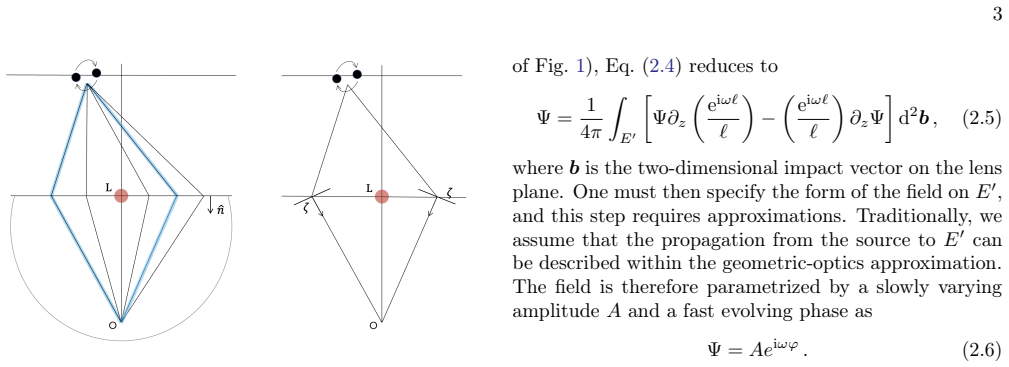
Summary. The paper re-derives the lensing diffraction integral as an approximation to the Kirchhoff integral, keeping track of all assumptions made in the standard treatment. The authors evaluate the Kirchhoff integral locally around each geometric-optics (GO) image, using the beyond-eikonal (BE) formalism of [51] to set the field and its normal derivative on a post-lens integration plane, and expand systematically in 1/omega and in the lens potential phi. They recover the standard diffraction integral as the leading term, plus a new correction Delta^new (Eqs. (1.3), (3.36)) arising from amplitude variation across the plane and projection effects, suppressed by (b/D_L)^2 relative to the standard Takahashi term Delta^st. The central claim is an equivalence: after summing over GO images, the improved Kirchhoff evaluation coincides with the BE propagation result of [51] at linear order in G (Eq. (5.27) = [51] Eq. (107)), so diffraction and BE corrections are equivalent descriptions of the same wave physics. Internal checks include exact cancellation for a flat-space spherical wave (V.B), a controlled amplitude-perturbation test (V.C), K-independence of the result, recovery of the GO magnification with Kirchhoff-fixed Morse phase (IV.C), the leading quadratic vacuum (Weyl) correction (App. D), and an SIS application (Sec. VI) with explicit validity condition (6.20).
Significance. If correct, this is a useful conceptual and technical contribution to GW lensing: it shows that diffraction and beyond-eikonal corrections are the same physics described in two formalisms, and it gives an a posteriori justification of the standard diffraction integral (2.19) that underlies a large phenomenology literature, with a controlled estimate of the first neglected term. Strengths worth naming: the derivation is parameter-free within stated approximations; it carries multiple independent internal cross-checks (flat-space spherical wave recovered exactly; amplitude-perturbation case matching the BE transport equation for A1; linear-order result (5.27) matching [51] Eq. (107) obtained by a different method; GO limit reproducing magnifications with the Morse phase fixed by the Kirchhoff side rather than by hand; the leading quadratic vacuum term in App. D matching the dominant Weyl result of [51]); and it makes a concrete, falsifiable quantitative prediction (Delta^new, Eq. (1.3)) with a stated suppression scaling (b/D_L)^2 and validity condition (6.20). The caustic phase-ambiguity discussion (III.C, IV.C) is handled honestly.
major comments (2)
- [§VI.A, Eq. (6.11)] Eq. (6.11) appears to be a factor of 2 too large. Projecting the SIS profile rho = sigma_v^2/(2 pi G r^2) along the line of sight gives Sigma(b) = sigma_v^2/(2 G b), consistent with the authors' Eq. (6.10). The 2D Laplacian of 1/b is 1/b^3 (for b>0), so nabla_perp^2 Sigma = sigma_v^2/(2 G b^3), not sigma_v^2/(G b^3). Since Eq. (6.11) feeds the standard-term contribution in Eqs. (6.16) and (6.18) and hence the quantitative content of Figs. 4 and 5, the authors should verify this normalization. The fix is local and does not affect the central equivalence result or the (D_L/b)^2 suppression hierarchy, but the application's numbers should be correct.
- [§V.D and §VII (equivalence claim)] The equivalence demonstrated here is conditional in a way that deserves sharper statement. The Kirchhoff surface data (Psi and its normal derivative on the post-lens plane) are themselves obtained from the perturbative BE evolution of [51] under the monochromatic scalar, thin-lens, linear-in-phi, non-caustic assumptions. The agreement of the two sides is therefore a nontrivial consistency proof of the Kirchhoff evaluation, but it cannot by construction detect O(1/omega) phase structure that the BE/thin-lens surface data themselves miss. The manuscript states this condition (footnote 2, Sec. IV), but the abstract and Sec. VII phrase the equivalence unconditionally. I ask that the regime qualifiers be carried into the abstract/conclusions, and that the authors comment on whether an independent test exists — e.g., comparison of Delta^new against an exact wave-optics solution for an axisymme
minor comments (6)
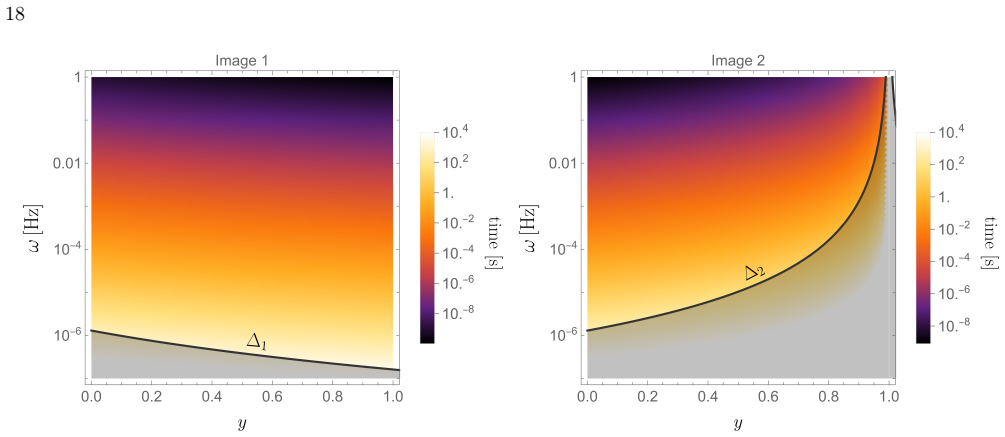
- [§III vs. Eq. (6.20)] omega_ref is defined as L/b^2 in Sec. III but as max{Delta_1, Delta_2} in Eq. (6.20). These are dimensionally consistent but numerically distinct quantities; for the SIS parameters used, Delta_j exceeds L/b^2, so (6.20) is the stronger condition. Please reconcile the notation and state explicitly that (6.20) supersedes the earlier definition.
- [§IV.C vs. §I, Eq. (1.1)] Sec. IV.C states that the improved Kirchhoff evaluation fixes the Morse phase 'without any ambiguity,' yet the main result (1.1) is restricted to images that have not crossed a caustic, because the BE surface data cannot supply the post-caustic phase. A sentence clarifying that the Kirchhoff side resolves the phase in principle, but that the present equivalence is limited to non-caustic images by the input data, would remove the apparent tension.
- [§V.E] Eq. (5.32): the authors note the axisymmetric (sigma=0) limitation, but the statement that the subdominant term 'does not fade away' for large magnification would benefit from an explicit validity window (distance from caustic, omega regime) since the perturbative condition (6.20) is precisely strained near caustics where sqrt(mu) is large.
- [§III.C, §IV.A, §VI.B] Several typos: 'the first equation is follows from Eq. (3.15)'; footnote 6 'of of order'; Sec. IV.A 'In this coordinates system'; Sec. VI.B 'beta is the source angular position of the source'.
- [Fig. 5] Fig. 5: the white band in the right panel and the grey exclusion region would be clearer if the caption stated which image sets the limiting frequency and why the divergence at y -> 1 is a profile-singularity artifact rather than a breakdown of the formalism per se.
- [§VI.B (notation)] The reuse of x, y as rescaled angular positions in Sec. VI after their use as transverse coordinates in Secs. IV–V is flagged by the authors, but an explicit sentence stating that the Gaussian-integral x, y do not appear in Sec. VI would help readers cross-referencing Eq. (6.16) with (5.27).
Circularity Check
No significant circularity: Kirchhoff–BE equivalence is a nontrivial consistency proof, not a result forced by definition or fit; mild self-citation of [51] supplies independent transport data.
specific steps
-
self citation load bearing
[Sec. III; Sec. IV procedure steps 1–2; Eqs. (5.25)–(5.27) vs [51] Eq. (107)]
"we propagate the field from the source to the integration plane ... using BE evolution, following the procedure of [51] ... The result (5.27) coincides with Eq. (107) of [51], also summarized in Sec. III, where it was obtained by solving the BE system of equations from the source to the observer. The equivalence between the two approaches is therefore established, as expected."
One side of the claimed equivalence (the field and NP scalars on the Kirchhoff surface, and the target BE phase Δ) is taken from the authors’ prior work [51]. That is a self-citation that supplies the boundary data for the Kirchhoff calculation. It is not circular in the strong sense: Kirchhoff integration and the cancellations that yield K-independence are derived here independently, and [51] is a separate solution of transport equations rather than a definition that forces the match. Flagged only as mild load-bearing self-citation for surface data.
full rationale
The paper’s central claim is that an improved local Kirchhoff evaluation, with surface data set by beyond-eikonal (BE) evolution, reproduces the BE observer field after summing geometric-optics images, and that the usual diffraction integral is the leading piece of that expansion plus a small new O(1/ω) term. The Kirchhoff side is derived from Green’s identity in a flat post-lens region (App. A) and from Newman–Penrose expansions of amplitude and phase on an arbitrary post-lens plane (Sec. IV); those steps do not assume the target equivalence. Matching to the BE phase corrections of [51] (Secs. V.B–V.D: flat-space cancellation, recovery of Takahashi’s Δ^st, K-independence, linear-in-ϕ matter result, and quadratic vacuum check in App. D) is an algebraic consistency result, not an input identity. Self-citation of Bruyère & Pitrou [51] is load-bearing only for the BE surface data and spin-scalar solutions used as Kirchhoff boundary values; those are independent transport equations solved in prior work, not a normalization or uniqueness theorem that forces F_Kirchhoff = F_BE by construction. There are no fitted parameters, no uniqueness theorem imported to forbid alternatives, and no renaming of an empirical pattern as a derivation. The physical limitations (thin lens, scalar monochromatic field, linear ϕ, ω ≳ ω_ref, caustic phase ambiguity) are assumptions about domain of validity, not circular reductions. Score 1 reflects only the mild, non-definitional self-citation of [51] for surface data.
Axiom & Free-Parameter Ledger
axioms (7)
- domain assumption Scalar monochromatic field obeys the Klein-Gordon equation; polarization is neglected.
- domain assumption Thin-lens approximation: potential confined so the Kirchhoff volume around the observer is flat (ϕ=0 in V).
- domain assumption Weak-field expansion linear in gravitational potential ϕ (G) for the main equivalence; metric ds²=-(1+2ϕ)dt²+(1-2ϕ)dx².
- domain assumption Beyond-eikonal inverse-frequency expansion with Fresnel-scale neighborhood a~√(λL) and validity ω>ω_ref=L/b².
- standard math Kirchhoff integral from Green’s identity on an arbitrary closed surface enclosing a flat region containing the observer.
- domain assumption Newman-Penrose optical scalars and transport equations for A0, A1 as developed in prior BE work.
- domain assumption Stationary spacetime allowing monochromatic separation Ψ̂=e^{-iωt}Ψ.
read the original abstract
We revisit the derivation of the diffraction integral, which is an approximate evaluation of the Kirchhoff integral, widely used in the literature for phenomenological applications in gravitational lensing. We propose a systematic approach to evaluate the Kirchhoff integral within a beyond-eikonal expansion, carefully tracking all approximations involved in its standard derivation. In this framework, we recover the usual diffraction integral as the leading contribution, together with a correction term that is typically small in realistic lensing scenarios. We further show that our evaluation of the Kirchhoff integral is equivalent to a beyond-eikonal expansion of wave propagation, after summing over all geometric-optics images. This result clarifies the physical origin of diffraction in gravitational lensing and demonstrates that diffraction effects and beyond-eikonal corrections are not distinct phenomena, but rather different but equivalent descriptions of the same underlying physics.
Figures


Reference graph
Works this paper leans on
-
[1]
we propagate the field from the source to the inte- gration plane (which is an arbitrary plane after the lens plane) using BE evolution, following the pro- cedure of [51] summarized in the previous section,
-
[2]
we evaluate locally the Kirchhoff integral in order to account for diffraction effects, choosing an in- tegrating plane orthogonal to the geometric-optics trajectory, at or after the lens plane,
-
[3]
spherical
finally, we sum the contributions associated with all geometric-optics trajectories. Crucially, wewillshowthatthefinalresultisindependent of the choice of the integration plane beyond the lens (see the end of Sec. VD). This allows us to switch at any stage between the BE expansion and the Kirchhoff integral to compute the field measured by the observer, t...
-
[4]
Peter Schneider, Jürgen Ehlers, and Emilio E. Falco. Gravitational Lenses. Astronomy and Astrophysics Li- brary. Springer, 1992
1992
-
[5]
Gravitational Lensing.Class
Matthias Bartelmann. Gravitational Lensing.Class. Quant. Grav., 27:233001, 2010
2010
-
[6]
Lectures on gravitational lensing
Ramesh Narayan and Matthias Bartelmann. Lectures on gravitational lensing. In13th Jerusalem Winter School in Theoretical Physics: Formation of Structure in the Uni- verse, 6 1996
1996
-
[7]
Sereno, A
M. Sereno, A. Sesana, A. Bleuler, Ph. Jetzer, M. Volon- teri, and M. C. Begelman. Strong lensing of gravitational waves as seen by LISA.Phys. Rev. Lett., 105:251101, 2010
2010
-
[8]
Gravitational- Wave Fringes at LIGO: Detecting Compact Dark Matter by Gravitational Lensing.Phys
Sunghoon Jung and Chang Sub Shin. Gravitational- Wave Fringes at LIGO: Detecting Compact Dark Matter by Gravitational Lensing.Phys. Rev. Lett., 122(4):041103, 2019
2019
-
[9]
Hannuksela, Antonio Herrera- Martín, Jose M
Kwun-Hang Lai, Otto A. Hannuksela, Antonio Herrera- Martín, Jose M. Diego, Tom Broadhurst, and Tjon- nie G. F. Li. Discovering intermediate-mass black hole lenses through gravitational wave lensing.Phys. Rev. D, 98(8):083005, 2018
2018
-
[10]
Effect of gravitational lensing on the distribution of gravitational waves from distant bi- nary black hole mergers.Mon
Masamune Oguri. Effect of gravitational lensing on the distribution of gravitational waves from distant bi- nary black hole mergers.Mon. Not. Roy. Astron. Soc., 480(3):3842–3855, 2018. 21
2018
-
[11]
Detecting Lensing-Induced Diffraction in Astrophysical Gravitational Waves.Phys
Liang Dai, Shun-Sheng Li, Barak Zackay, Shude Mao, and Youjun Lu. Detecting Lensing-Induced Diffraction in Astrophysical Gravitational Waves.Phys. Rev. D, 98(10):104029, 2018
2018
-
[12]
J. M. Diego, O. A. Hannuksela, P. L. Kelly, T. Broad- hurst, K. Kim, T. G. F. Li, G. F. Smoot, and G. Pagano. Observational signatures of microlensing in gravitational waves at LIGO/Virgo frequencies.Astron. Astrophys., 627:A130, 2019
2019
-
[13]
O. A. Hannuksela, K. Haris, K. K. Y. Ng, S. Kumar, A. K. Mehta, D. Keitel, T. G. F. Li, and P. Ajith. Search for gravitational lensing signatures in LIGO-Virgo binary black hole events.Astrophys. J. Lett., 874(1):L2, 2019
2019
-
[14]
Identifying strong gravitational-wave lensing during the second observing run of Advanced LIGO and Advanced Virgo.Astrophys
Xiaoshu Liu, Ignacio Magana Hernandez, and Jolien Creighton. Identifying strong gravitational-wave lensing during the second observing run of Advanced LIGO and Advanced Virgo.Astrophys. J., 908(1):97, 2021
2021
-
[15]
Lensing of gravita- tional waves as a probe of compact dark matter.Mon
Juan Urrutia and Ville Vaskonen. Lensing of gravita- tional waves as a probe of compact dark matter.Mon. Not. Roy. Astron. Soc., 509(1):1358–1365, 2021
2021
-
[16]
Abbott et al
R. Abbott et al. Search for Lensing Signatures in the Gravitational-Wave Observations from the First Half of LIGO–Virgo’s Third Observing Run.Astrophys. J., 923(1):14, 2021
2021
-
[17]
Abbott et al
R. Abbott et al. Search for Gravitational-lensing Signa- turesintheFullThirdObservingRunoftheLIGO–Virgo Network.Astrophys. J., 970(2):191, 2024
2024
-
[18]
Detectability of Single Spinless Stellar-Mass Black Holes through Gravitational Lensing of Gravitational Waves with Advanced LIGO
Chengjiang Yin and Jian-hua He. Detectability of Single Spinless Stellar-Mass Black Holes through Gravitational Lensing of Gravitational Waves with Advanced LIGO. Phys. Rev. Lett., 132(1):011401, 2024
2024
-
[19]
Characterization of lensing selection effects for LISA massive black hole bi- nary mergers.Mon
Giulia Cusin and Nicola Tamanini. Characterization of lensing selection effects for LISA massive black hole bi- nary mergers.Mon. Not. Roy. Astron. Soc., 504(3):3610– 3618, 2021
2021
-
[20]
Wave optics lensing of gravitational waves: Theory and phenomenology of triple systems in the LISA band.Phys
Martin Pijnenburg, Giulia Cusin, Cyril Pitrou, and Jean- Philippe Uzan. Wave optics lensing of gravitational waves: Theory and phenomenology of triple systems in the LISA band.Phys. Rev. D, 110(4):044054, 2024
2024
-
[21]
Lens- ing Magnification Seen by Gravitational Wave Detectors
Giulia Cusin, Ruth Durrer, and Irina Dvorkin. Lens- ing Magnification Seen by Gravitational Wave Detectors. Universe, 8(1):19, 2021
2021
-
[22]
Strong and weak lensing of Gravitational Waves: a semi- analytical approach
Giulia Cusin, Ruth Durrer, and Irina Dvorkin. Strong and weak lensing of Gravitational Waves: a semi- analytical approach. 12 2019
2019
-
[23]
Observing GW190521-like binary black holes and their environment with LISA.Phys
Laura Sberna et al. Observing GW190521-like binary black holes and their environment with LISA.Phys. Rev. D, 106(6):064056, 2022
2022
-
[24]
Detectable environmental ef- fects in GW190521-like black-hole binaries with LISA
Alexandre Toubiana et al. Detectable environmental ef- fects in GW190521-like black-hole binaries with LISA. Phys. Rev. Lett., 126(10):101105, 2021
2021
-
[25]
Rossi, Nicola Tamanini, and Giulia Cusin
Martina Toscani, Elena M. Rossi, Nicola Tamanini, and Giulia Cusin. Lensing of gravitational waves from tidal disruption events.Mon. Not. Roy. Astron. Soc., 523(3):3863–3873, 2023
2023
-
[26]
Irwin I. Shapiro. Fourth Test of General Relativity.Phys. Rev. Lett., 13(26):789–791, December 1964
1964
-
[27]
P. V. Bliokh and A. A. Minakov. Diffraction of Light and Lens Effect of the Stellar Gravitation Field.Astrophys. and Space Science, 34(2):L7–L9, May 1975
1975
-
[28]
Bontz and Mark P
Robert J. Bontz and Mark P. Haugan. A diffraction limit on the gravitational lens effect.Astrophys. Space Sci., 78(1):199–210, 1981
1981
-
[29]
Schneider and J
P. Schneider and J. Schmid-Burgk. Mutual coherence of gravitationally lensed images.Astron. Astrophys., 148(2):369–378, July 1985
1985
-
[30]
Shuji Deguchi and William D. Watson. Wave effects in gravitational lensing of electromagnetic radiation.Phys. Rev. D, 34:1708–1718, 1986
1986
-
[31]
Deguchi and W
S. Deguchi and W. D. Watson. Diffraction in Gravita- tional Lensing for Compact Objects of Low Mass.Ap. J., 307:30, August 1986
1986
-
[32]
Wave effects in gravitational lensing of gravitational waves from chirp- ing binaries.Astrophys
Ryuichi Takahashi and Takashi Nakamura. Wave effects in gravitational lensing of gravitational waves from chirp- ing binaries.Astrophys. J., 595:1039–1051, 2003
2003
-
[33]
Quasigeometrical optics approxi- mation in gravitational lensing.Astron
Ryuichi Takahashi. Quasigeometrical optics approxi- mation in gravitational lensing.Astron. Astrophys., 423:787–792, 2004
2004
-
[34]
Gravitational lensing of binary systems in wave optics
Job Feldbrugge and Neil Turok. Gravitational lensing of binary systems in wave optics. 8 2020
2020
-
[35]
Breaking the mass-sheet degeneracy with grav- itational wave interference in lensed events.Phys
Paolo Cremonese, Jose María Ezquiaga, and Vincenzo Salzano. Breaking the mass-sheet degeneracy with grav- itational wave interference in lensed events.Phys. Rev. D, 104(2):023503, 2021
2021
-
[36]
Observability of lensing of gravitational waves from massive black hole binaries with LISA.Phys
Mesut Çalışkan, Lingyuan Ji, Roberto Cotesta, Emanuele Berti, Marc Kamionkowski, and Sylvain Marsat. Observability of lensing of gravitational waves from massive black hole binaries with LISA.Phys. Rev. D, 107(4):043029, 2023
2023
-
[37]
Jow, Ue-Li Pen, and Job Feldbrugge
Dylan L. Jow, Ue-Li Pen, and Job Feldbrugge. Regimes in astrophysical lensing: refractive optics, diffractive op- tics, and the Fresnel scale.Mon. Not. Roy. Astron. Soc., 525(2):2107–2124, 2023
2023
-
[38]
Weakly lensed gravitational waves: Probing cosmic structures with wave-optics features.Phys
Stefano Savastano, Giovanni Tambalo, Hector Villarrubia-Rojo, and Miguel Zumalacarregui. Weakly lensed gravitational waves: Probing cosmic structures with wave-optics features.Phys. Rev. D, 108(10):103532, 2023
2023
-
[39]
Simon M. C. Yeung, Mark H. Y. Cheung, Miguel Zu- malacarregui, and Otto A. Hannuksela. wolensing: A Python package for computing the amplification factor for gravitational waves with wave-optics effects. 10 2024
2024
-
[40]
Gravitational lensing of waves: Novel methods for wave-optics phenomena.Phys
Hector Villarrubia-Rojo, Stefano Savastano, Miguel Zu- malacárregui, Lyla Choi, Srashti Goyal, Liang Dai, and Giovanni Tambalo. Gravitational lensing of waves: Novel methods for wave-optics phenomena.Phys. Rev. D, 111(10):103539, 2025
2025
-
[41]
Lens Stochastic Diffraction: A Signature of Compact Structures in Gravitational-Wave Data
Miguel Zumalacárregui. Lens Stochastic Diffraction: A Signature of Compact Structures in Gravitational-Wave Data. 4 2024
2024
-
[42]
Mark Ho-Yeuk Cheung, Ken K. Y. Ng, Miguel Zu- malacárregui, and Emanuele Berti. Probing minihalo lenses with diffracted gravitational waves.Phys. Rev. D, 109(12):124020, 2024
2024
-
[43]
Effective de- scription of lensed gravitational waves diffracted by stel- lar fields
Miguel Zumalacárregui and Xikai Shan. Effective de- scription of lensed gravitational waves diffracted by stel- lar fields. 6 2026
2026
-
[44]
Ezquiaga, Roberto Cotesta, Emanuele Berti, and Marc Kamionkowski
Mesut Çalışkan, Neha Anil Kumar, Lingyuan Ji, Jose M. Ezquiaga, Roberto Cotesta, Emanuele Berti, and Marc Kamionkowski. Probing wave-optics effects and low-mass dark matter halos with lensing of gravitational waves from massive black holes.Phys. Rev. D, 108(12):123543, 22 2023
2023
-
[45]
Invariance transformations in wave- optics lensing: Implications for gravitational-wave astro- physics and cosmology.Phys
Anson Chen, Paolo Cremonese, Jose María Ezquiaga, and David Keitel. Invariance transformations in wave- optics lensing: Implications for gravitational-wave astro- physics and cosmology.Phys. Rev. D, 110(12):123015, 2024
2024
-
[46]
Jose María Ezquiaga, Rico K. L. Lo, and Luka Vujeva. Diffraction around caustics in gravitational wave lensing. Phys. Rev. D, 112(4):043544, 2025
2025
-
[47]
Lensing of gravitational waves: Efficient wave-optics methods and validation with symmetric lenses.Phys
Giovanni Tambalo, Miguel Zumalacárregui, Liang Dai, and Mark Ho-Yeuk Cheung. Lensing of gravitational waves: Efficient wave-optics methods and validation with symmetric lenses.Phys. Rev. D, 108(4):043527, 2023
2023
-
[48]
Gravitational wave lensing as a probe of halo properties and dark matter.Phys
Giovanni Tambalo, Miguel Zumalacárregui, Liang Dai, and Mark Ho-Yeuk Cheung. Gravitational wave lensing as a probe of halo properties and dark matter.Phys. Rev. D, 108(10):103529, 2023
2023
-
[49]
Proper time path integrals for gravitational waves: an improved wave op- tics framework.JCAP, 11:031, 2024
Ginevra Braga, Alice Garoffolo, Angelo Ricciardone, Nicola Bartolo, and Sabino Matarrese. Proper time path integrals for gravitational waves: an improved wave op- tics framework.JCAP, 11:031, 2024
2024
-
[50]
Wave optics for rotating stars.Phys
Béatrice Bonga, Job Feldbrugge, and Ariadna Ribes Me- tidieri. Wave optics for rotating stars.Phys. Rev. D, 111(6):063061, 2025
2025
-
[51]
Dark Mat- ter Subhalos and Higher Order Catastrophes in Gravita- tional Wave Lensing
Luka Vujeva, Jose María Ezquiaga, Daniel Gilman, Srashti Goyal, and Miguel Zumalacárregui. Dark Mat- ter Subhalos and Higher Order Catastrophes in Gravita- tional Wave Lensing. 10 2025
2025
-
[52]
Luka Vujeva, Jose María Ezquiaga, Rico K. L. Lo, and Juno C. L. Chan. Effects of galaxy cluster structure on lensed gravitational waves.Phys. Rev. D, 112(6):063044, 2025
2025
-
[53]
Holz, Wayne Hu, Macarena Lagos, and Robert M
Jose María Ezquiaga, Daniel E. Holz, Wayne Hu, Macarena Lagos, and Robert M. Wald. Phase effects from strong gravitational lensing of gravitational waves. Phys. Rev. D, 103(6):064047, 2021
2021
-
[54]
Gravitational lensing beyond the eikonal approximation.Class
Emma Bruyère and Cyril Pitrou. Gravitational lensing beyond the eikonal approximation.Class. Quant. Grav., 43(8):085010, 2026
2026
-
[55]
Isaacson
Richard A. Isaacson. Gravitational Radiation in the Limit of High Frequency. I. The Linear Approximation and Geometrical Optics.Phys. Rev., 166:1263–1271, 1967
1967
-
[56]
Boosting gravitational waves: a review of kinematic effects on amplitude, po- larization, frequency and energy density.Class
Giulia Cusin, Cyril Pitrou, Camille Bonvin, Aurélien Barrau, and Killian Martineau. Boosting gravitational waves: a review of kinematic effects on amplitude, po- larization, frequency and energy density.Class. Quant. Grav., 41(22):225006, 2024
2024
-
[57]
Jow, Simon Foreman, Ue-Li Pen, and Wei Zhu
Dylan L. Jow, Simon Foreman, Ue-Li Pen, and Wei Zhu. Wave effects in the microlensing of pulsars and FRBs by point masses.Mon. Not. Roy. Astron. Soc., 497(4):4956– 4969, 2020
2020
-
[58]
An Approach to grav- itational radiation by a method of spin coefficients.J
Ezra Newman and Roger Penrose. An Approach to grav- itational radiation by a method of spin coefficients.J. Math. Phys., 3:566–578, 1962
1962
-
[59]
Misner, K.S
Charles W. Misner, K.S. Thorne, and J.A. Wheeler. Gravitation. Freeman, New York, 1973
1973
-
[60]
Sam R. Dolan. Geometrical optics for scalar, electromag- netic and gravitational waves on curved spacetime.Int. J. Mod. Phys. D, 27:1843010, 2017
2017
-
[61]
Sam R. Dolan. Higher-order geometrical optics for elec- tromagnetic waves on a curved spacetime. 1 2018
2018
-
[62]
Abraham I. Harte. Gravitational lensing beyond geomet- ricoptics: I.Formalismandobservables.Gen. Rel. Grav., 51(1):14, 2019
2019
-
[63]
Abraham I. Harte. Gravitational lensing beyond geo- metric optics: II. Metric independence.Gen. Rel. Grav., 51(12):160, 2019
2019
-
[64]
Gravitational wave propagation beyond geometric optics.Phys
Giulia Cusin and Macarena Lagos. Gravitational wave propagation beyond geometric optics.Phys. Rev. D, 101(4):044041, 2020
2020
-
[65]
Po- larization distortions of lensed gravitational waves.Phys
Charles Dalang, Giulia Cusin, and Macarena Lagos. Po- larization distortions of lensed gravitational waves.Phys. Rev. D, 105(2):024005, 2022
2022
-
[66]
Gravitational-wave dispersion over inho- mogeneous space-times: General relativity, screened the- ories of gravity and non-minimal dark energy
Nicola Menadeo, Serena Giardino, and Miguel Zu- malacárregui. Gravitational-wave dispersion over inho- mogeneous space-times: General relativity, screened the- ories of gravity and non-minimal dark energy. 11 2025
2025
-
[67]
Scatter- ing perspective on gravitational lensing.Phys
Mariana Carrillo Gonzalez, Valerio De Luca, Alice Garof- folo, Julio Parra-Martinez, and Mark Trodden. Scatter- ing perspective on gravitational lensing.Phys. Rev. D, 113(2):024024, 2026
2026
-
[68]
Cambridge University Press, 7th edition, 1999
Max Born and Emil Wolf.Principles of Optics: Elec- tromagnetic Theory of Propagation, Interference and Diffraction of Light (7th Edition). Cambridge University Press, 7th edition, 1999
1999
-
[69]
Calvin Leung, Dylan Jow, Prasenjit Saha, Liang Dai, Masamune Oguri, and Léon V. E. Koopmans. Wave Op- tics, Interference, and Decoherence in Strong Gravita- tional Lensing.Space Sci. Rev., 221(2):29, 2025
2025
-
[70]
Gravitational Lensing from a Spacetime Perspective.Living Reviews in Relativity, 12 2004
Volker Perlick. Gravitational Lensing from a Spacetime Perspective.Living Reviews in Relativity, 12 2004
2004
-
[71]
PhD thesis, Paris U., VI, IAP, 2015
Pierre Fleury.Light propagation in inhomogeneous and anisotropic cosmologies. PhD thesis, Paris U., VI, IAP, 2015
2015
-
[72]
Peter Schneider, Jürgen Ehlers, and Emilio E. Falco. Gravitational Lenses. Springer Verlag, 1992
1992
-
[73]
Richard C. Tolman. Static solutions of einstein’s field equations for spheres of fluid.Physical Review, 55(4):364–373, 1939
1939
-
[74]
Robert Oppenheimer and George M
J. Robert Oppenheimer and George M. Volkoff. On mas- sive neutron cores.Physical Review, 55(4):374–381, 1939
1939
-
[75]
Ferreira
Giulia Cusin, Ruth Durrer, and Pedro G. Ferreira. Po- larization of a stochastic gravitational wave background through diffusion by massive structures.Phys. Rev. D, 99(2):023534, 2019
2019
discussion (0)
Sign in with ORCID, Apple, or X to comment. Anyone can read and Pith papers without signing in.