Development and Application of Numerical Techniques for General-Relativistic Magnetohydrodynamics Simulations of Black Hole Accretion
Pith reviewed 2026-05-25 17:34 UTC · model grok-4.3
The pith
Advanced Riemann solvers and staggered-mesh constrained transport enable high-accuracy GRMHD simulations of black hole accretion.
A machine-rendered reading of the paper's core claim, the machinery that carries it, and where it could break.
Core claim
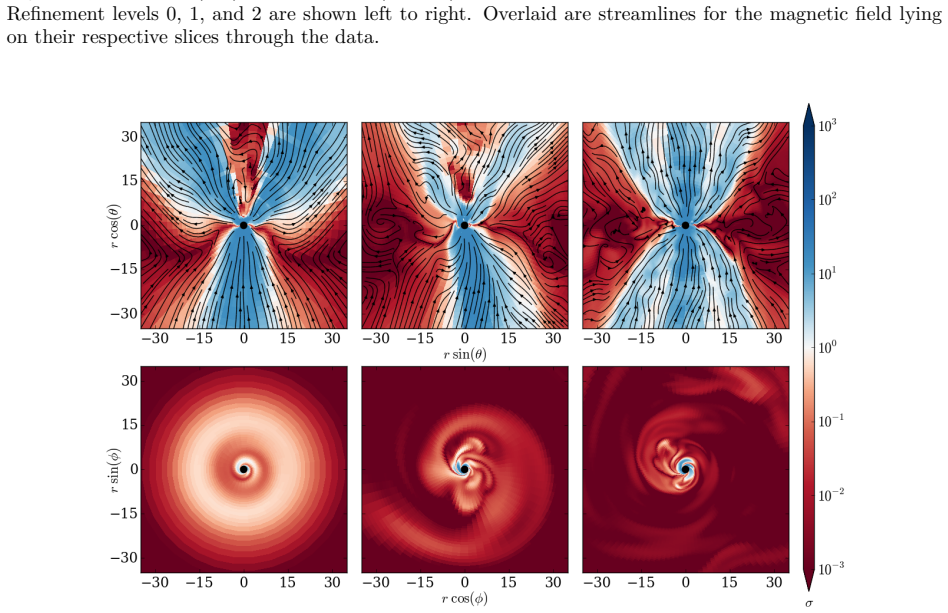
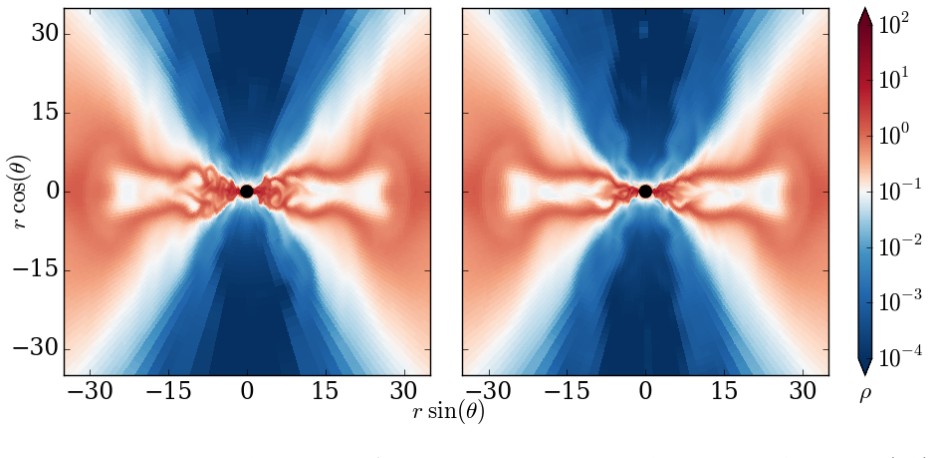
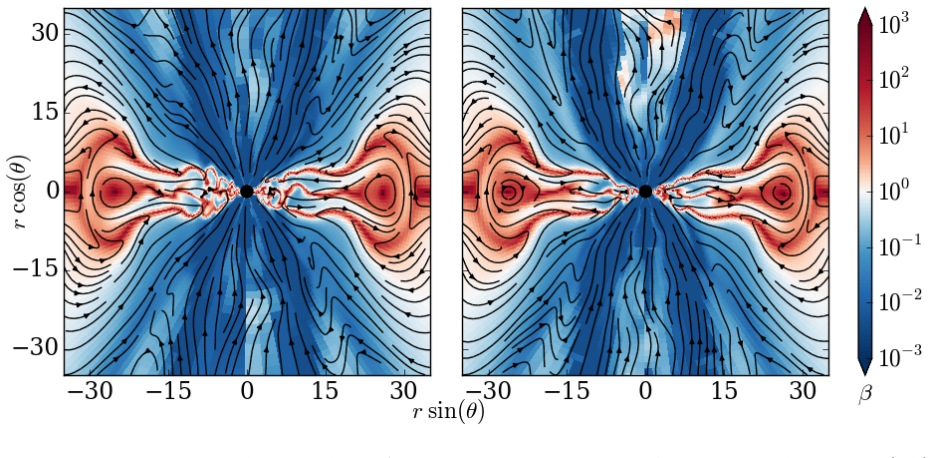
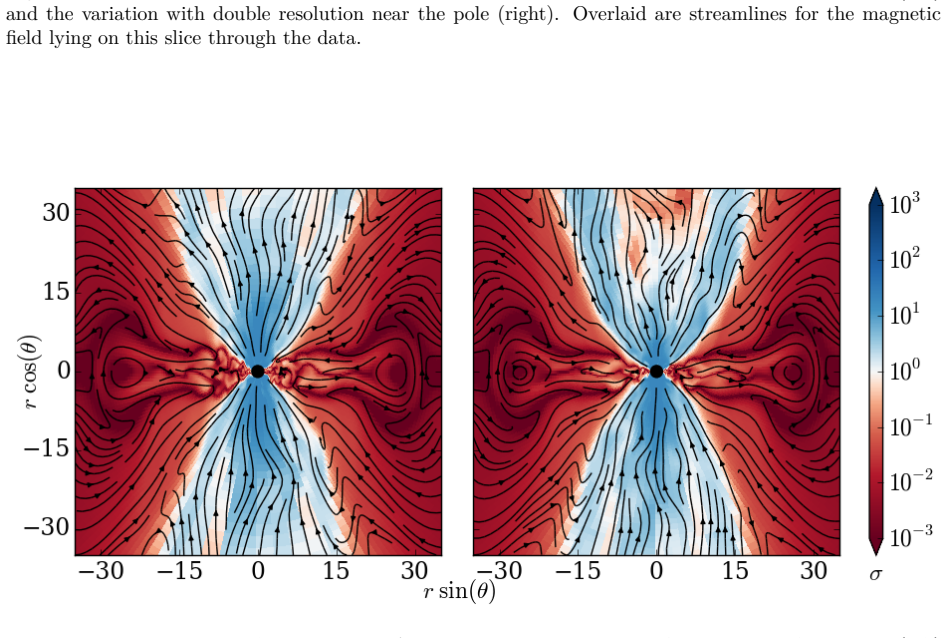
The central claim is that these numerical techniques permit investigation of black hole accretion flows with unprecedented accuracy, as shown through the exploration of magnetically arrested disks.
What carries the argument
The combination of advanced Riemann solvers and staggered-mesh constrained transport for general-relativistic magnetohydrodynamics.
If this is right
- Black hole accretion flows can be simulated with higher fidelity in strongly magnetized regions.
- Magnetically arrested disk configurations become accessible for detailed study.
- The methods support investigations that require both accuracy and computational efficiency.
- Parallel scalability allows running larger or longer simulations on modern computing systems.
Where Pith is reading between the lines
- These simulation capabilities could help clarify the role of magnetic fields in powering relativistic jets from black holes.
- Applying the methods to different initial conditions might reveal new stable accretion states.
- Further development could incorporate additional physics such as radiative transfer while maintaining numerical stability.
Load-bearing premise
The new numerical techniques do not suffer from significant discretization errors or instabilities when applied to strongly curved spacetime and highly magnetized flows.
What would settle it
A direct comparison between the code results and an exact analytic solution for a black hole accretion problem that shows substantial discrepancies would falsify the claim of unprecedented accuracy.
Figures

read the original abstract
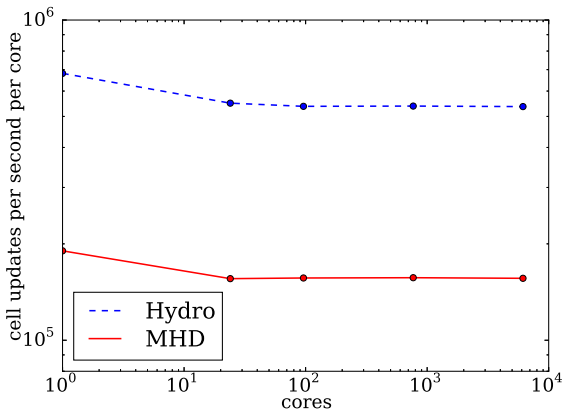
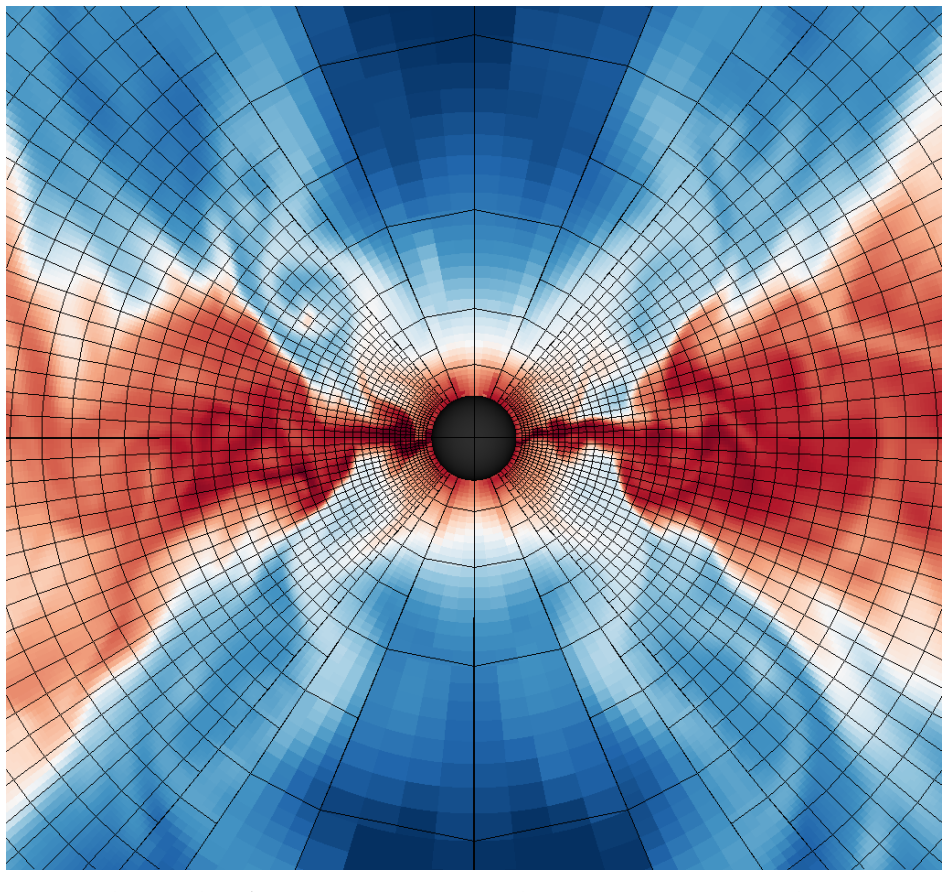
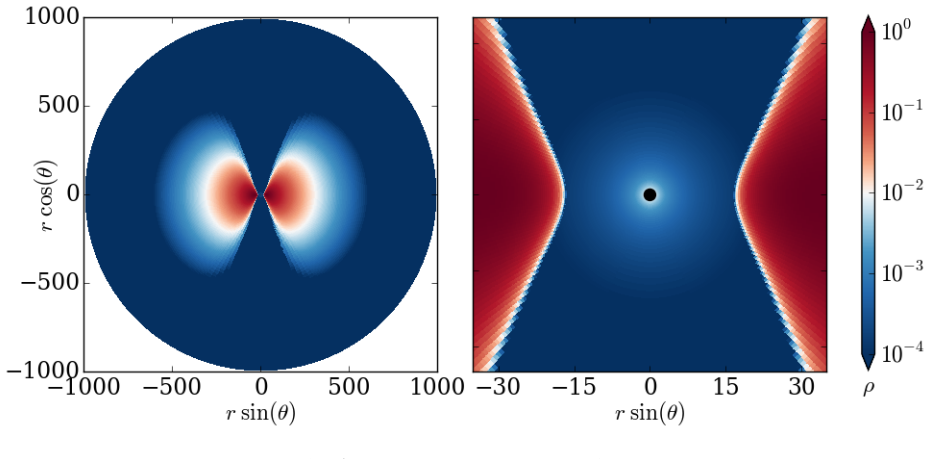
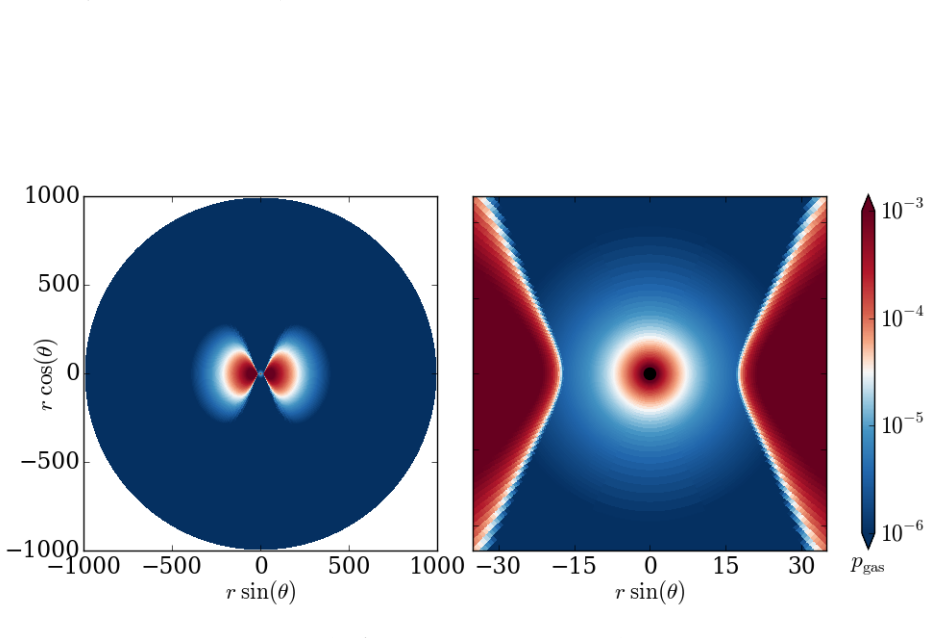
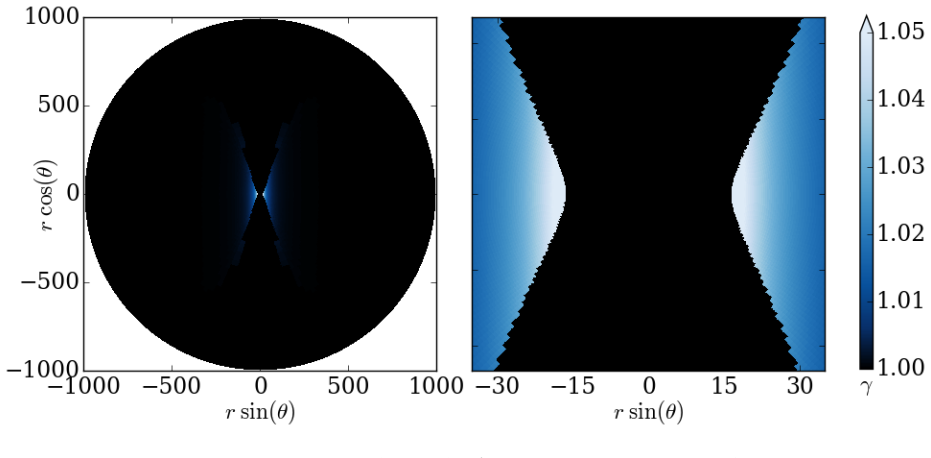
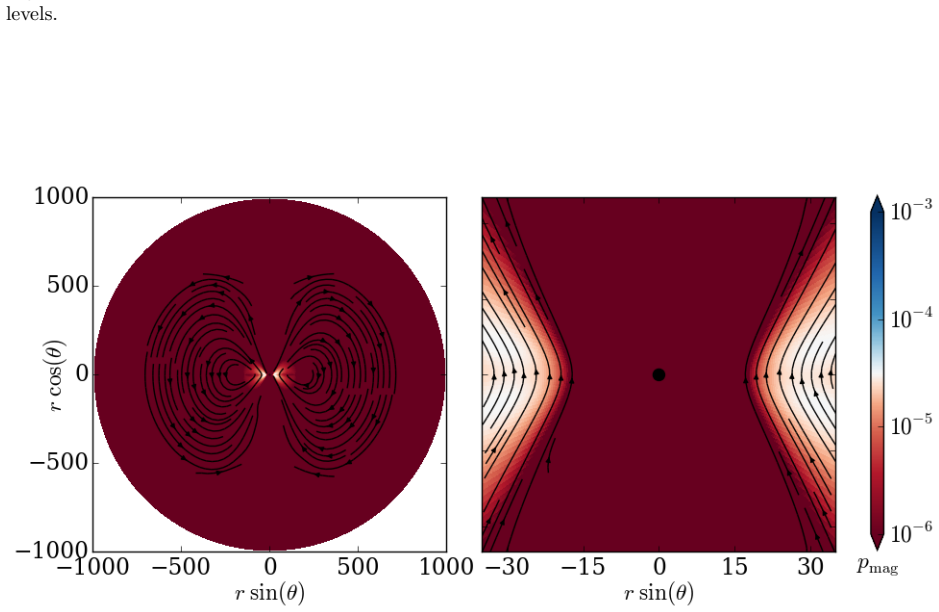
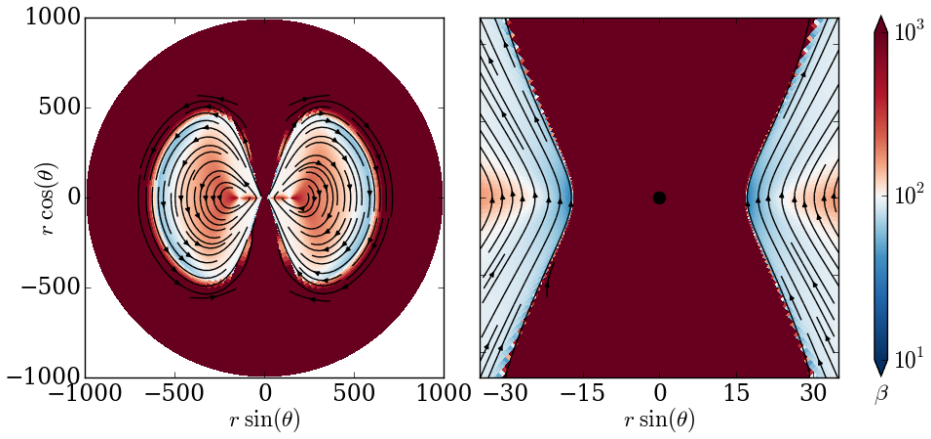
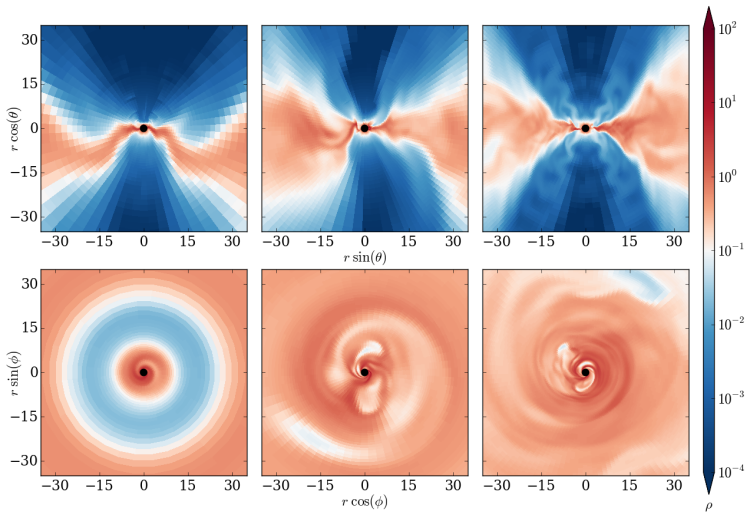
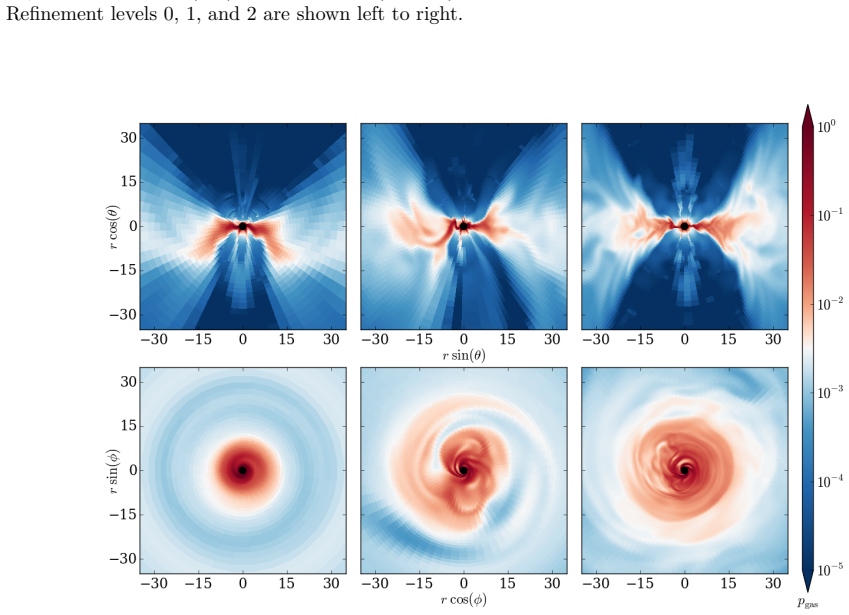
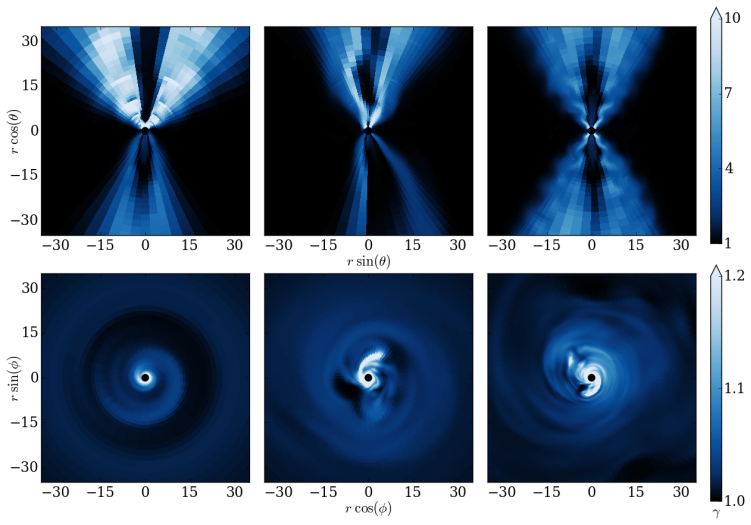
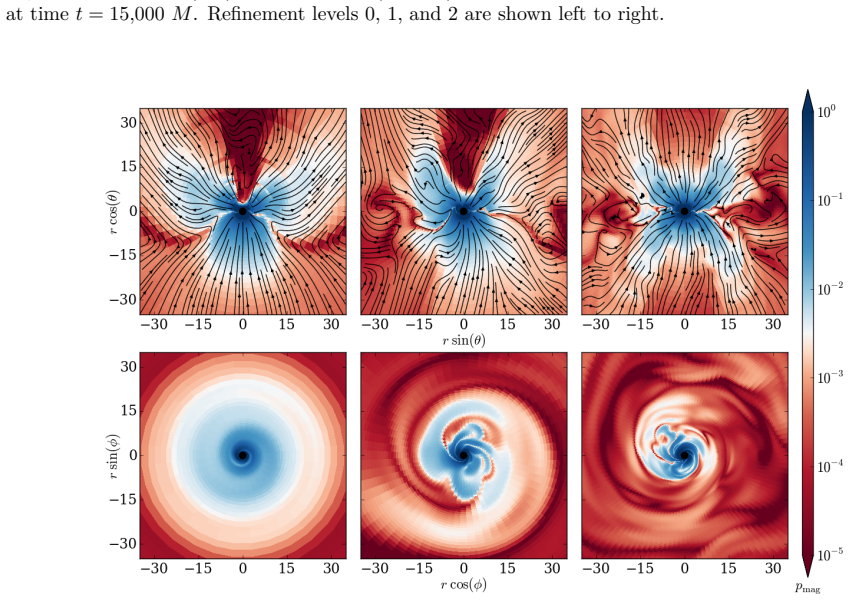
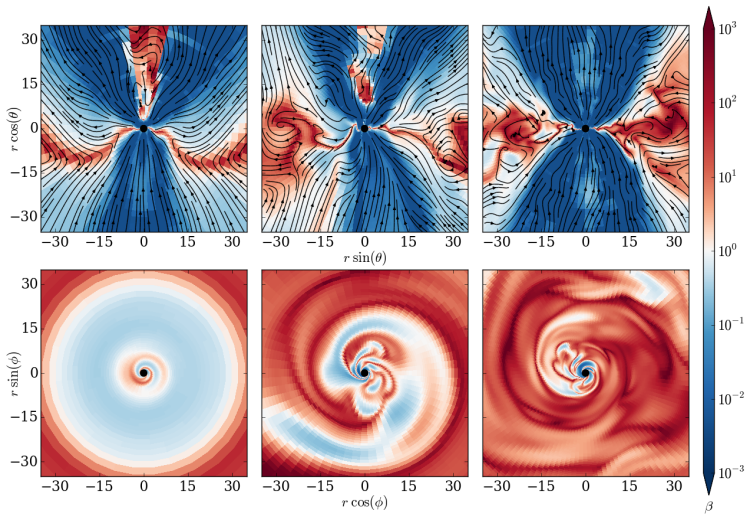
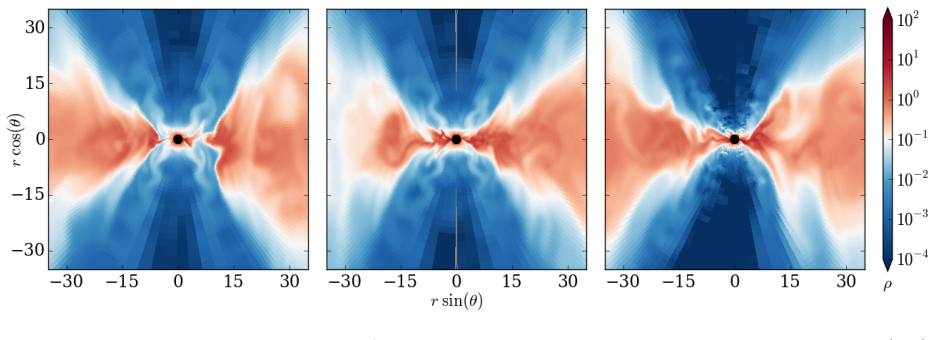
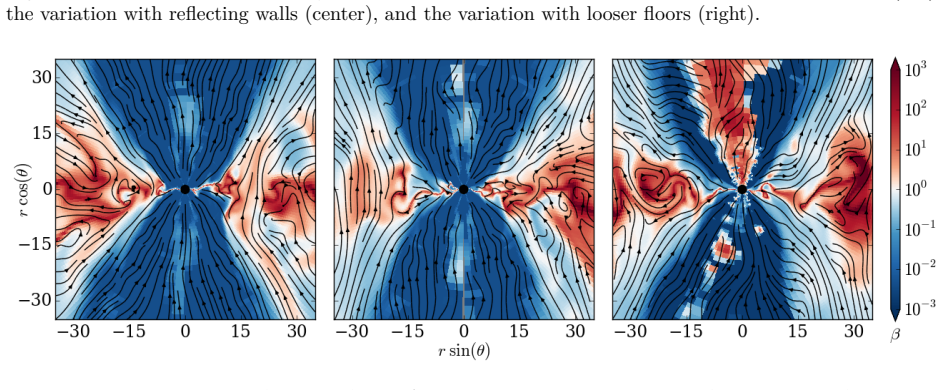
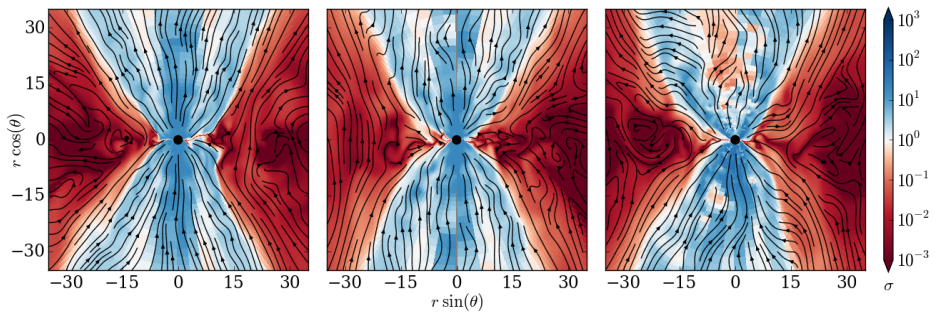
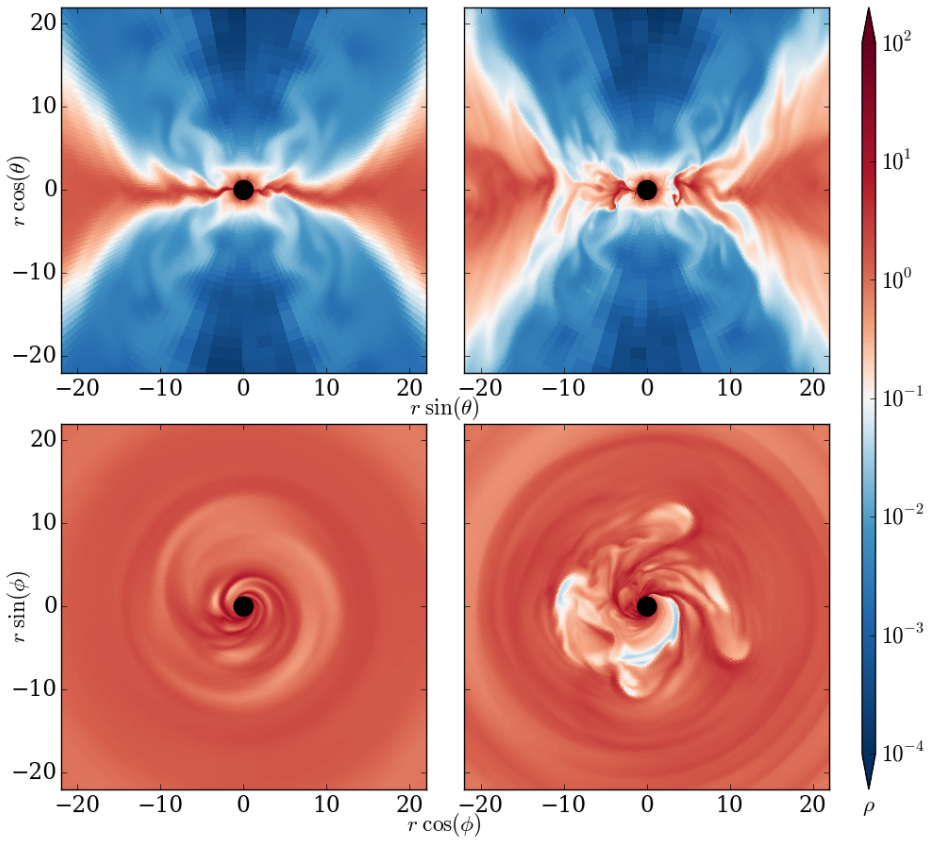
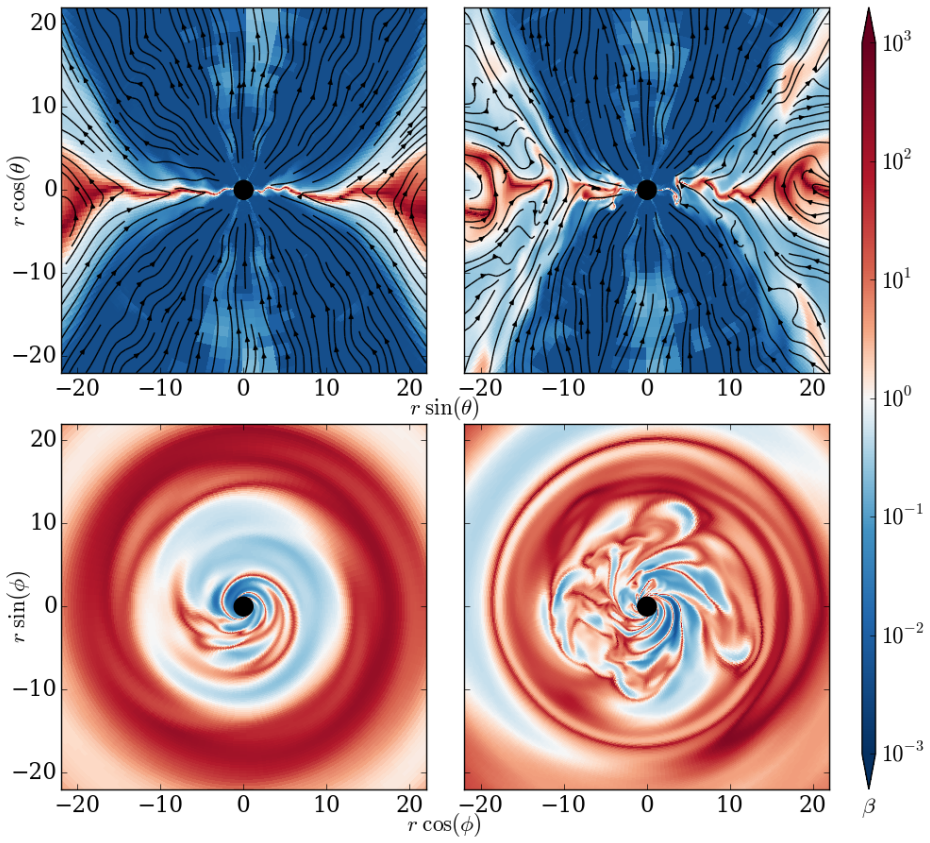
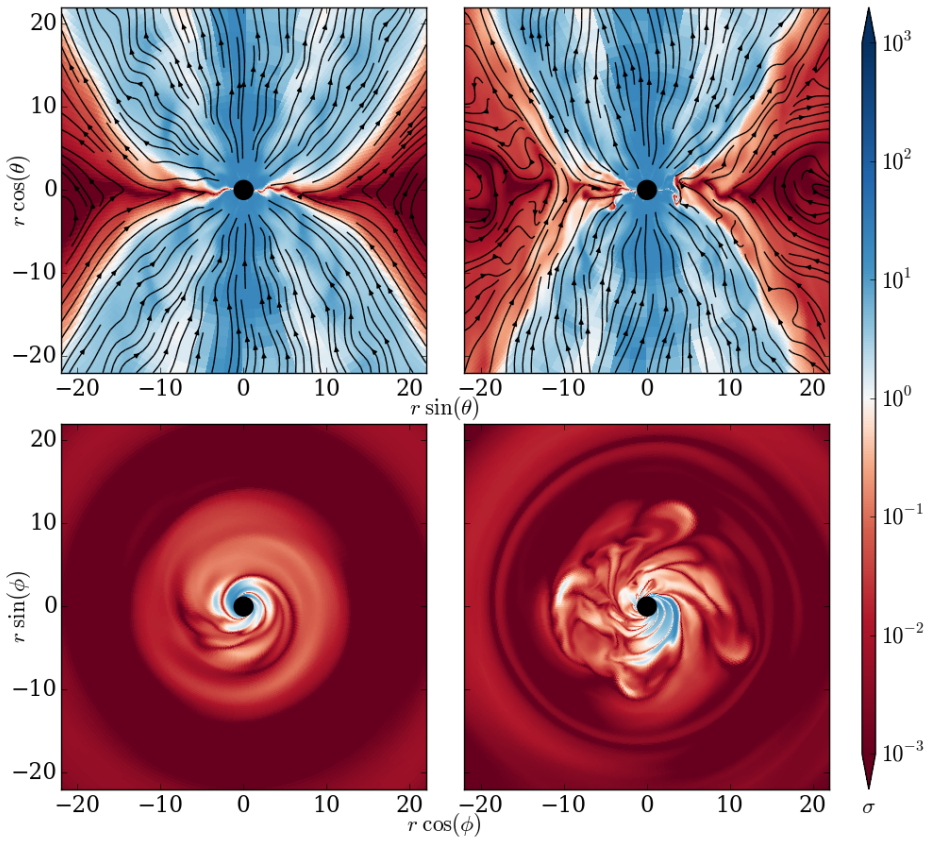
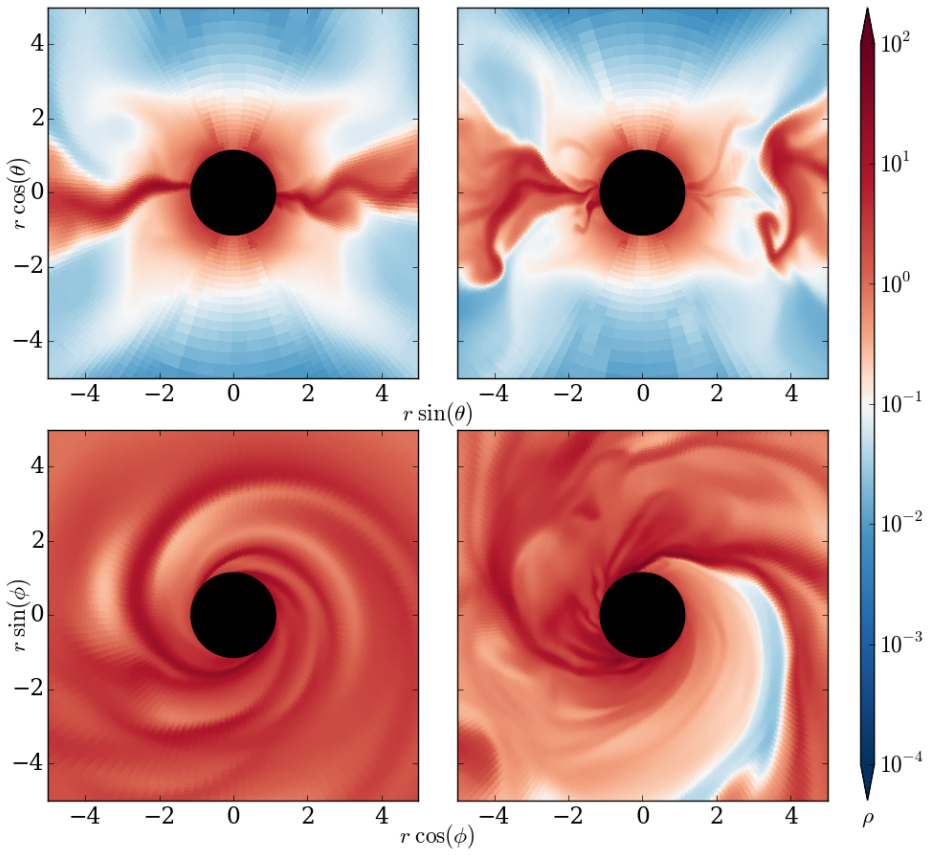
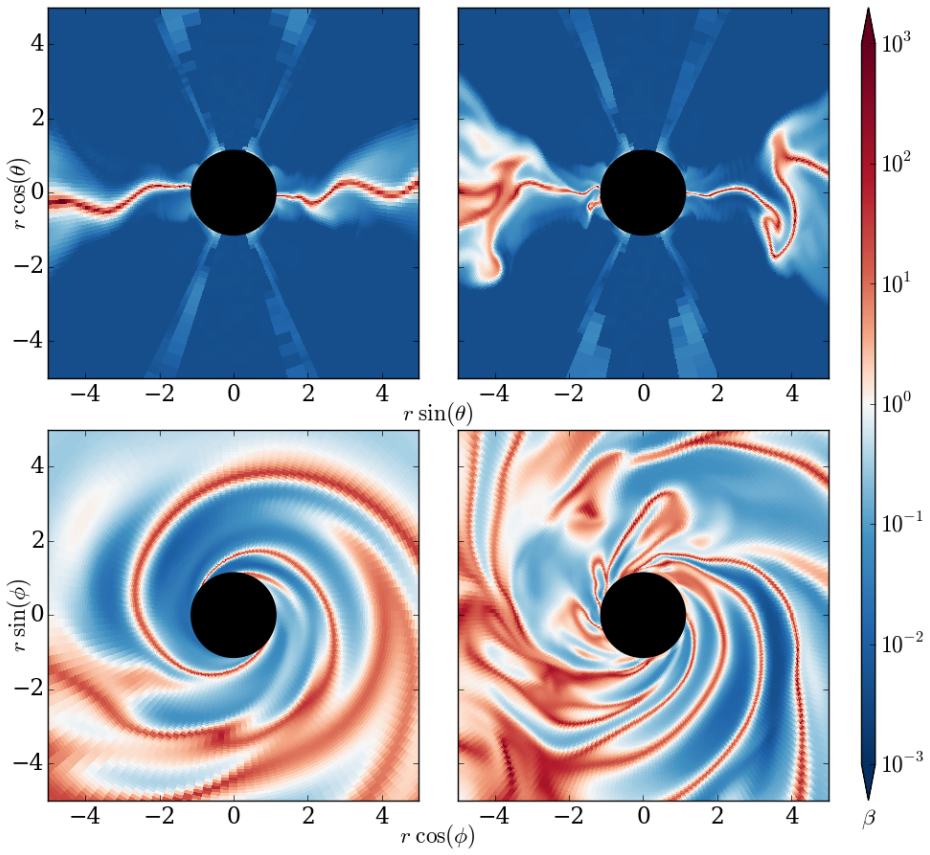
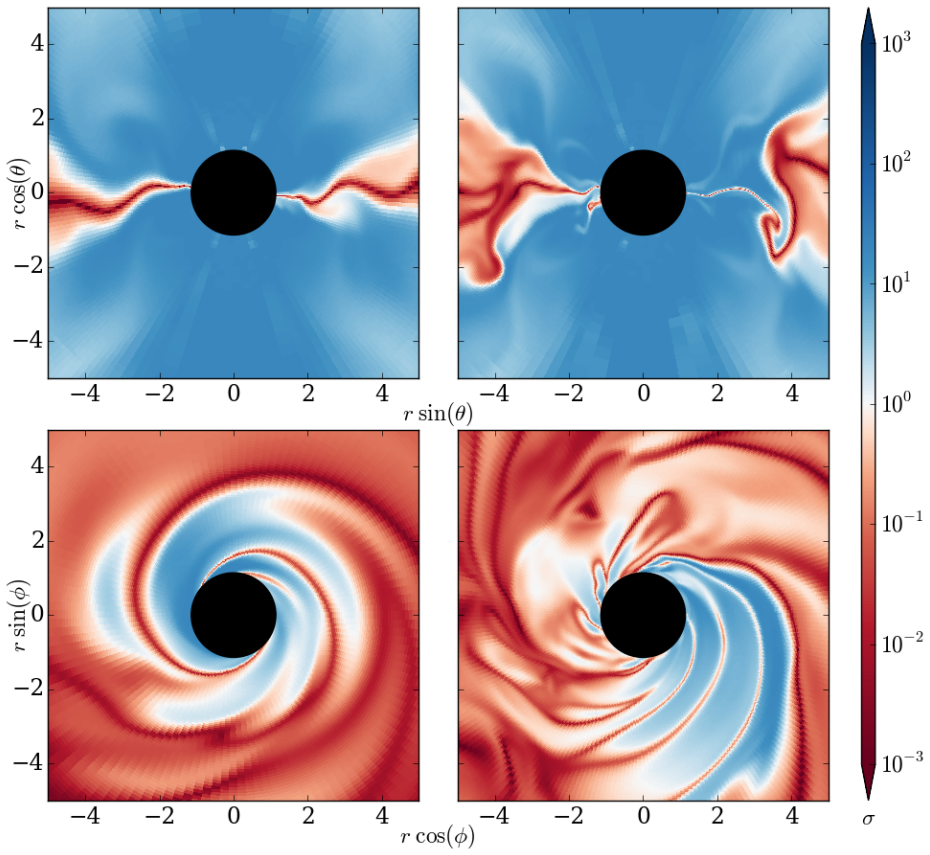
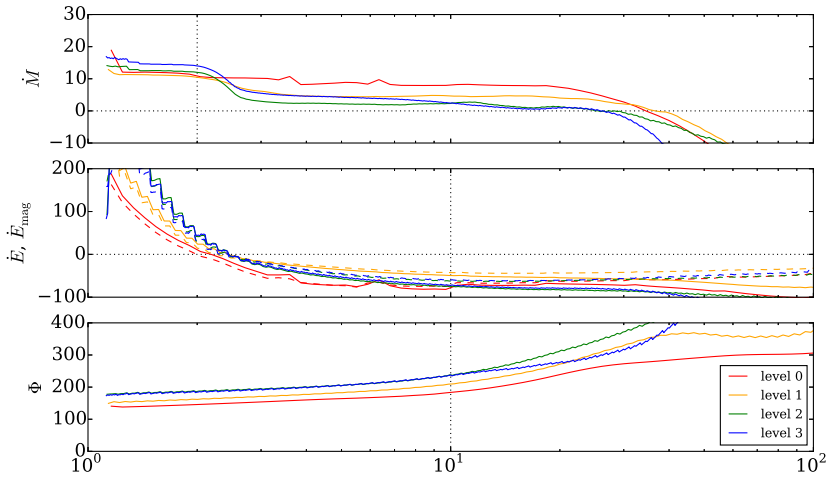
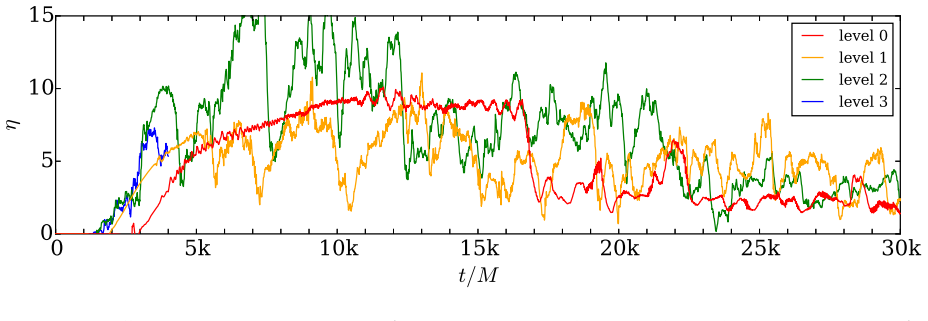
We describe the implementation of sophisticated numerical techniques for general-relativistic magnetohydrodynamics simulations in the Athena++ code framework. Improvements over many existing codes include the use of advanced Riemann solvers and of staggered-mesh constrained transport. Combined with considerations for computational performance and parallel scalability, these allow us to investigate black hole accretion flows with unprecedented accuracy. The capability of the code is demonstrated by exploring magnetically arrested disks.
Editorial analysis
A structured set of objections, weighed in public.
Referee Report
Summary. The manuscript describes the implementation of general-relativistic magnetohydrodynamics (GRMHD) in the Athena++ framework, incorporating advanced Riemann solvers and staggered-mesh constrained transport. These techniques, combined with attention to performance and scalability, are claimed to enable black hole accretion simulations with unprecedented accuracy, as demonstrated through explorations of magnetically arrested disks (MADs).
Significance. If the accuracy improvements are substantiated, the work would offer a valuable, scalable GRMHD tool for the astrophysics community studying black hole accretion. The focus on computational performance is a practical strength for large-scale applications.
major comments (2)
- [Abstract] Abstract: the assertion of 'unprecedented accuracy' is not supported by any quantitative comparisons, convergence tests, or error analysis.
- [Demonstration section] Demonstration of MAD simulations: no L1/L2 error norms, convergence rates, or direct comparisons against analytic solutions (e.g., magnetized Bondi flow) or other GRMHD codes are reported, leaving the central accuracy claim untested.
Simulated Author's Rebuttal
We thank the referee for the careful review and constructive feedback. We address each major comment below regarding the substantiation of accuracy claims.
read point-by-point responses
-
Referee: [Abstract] Abstract: the assertion of 'unprecedented accuracy' is not supported by any quantitative comparisons, convergence tests, or error analysis.
Authors: We agree that the abstract's phrasing of 'unprecedented accuracy' is not supported by quantitative evidence presented in the manuscript. This wording was intended to highlight the benefits of the advanced Riemann solvers and staggered constrained transport relative to more dissipative methods commonly used, but we acknowledge the claim requires qualification. We will revise the abstract to remove 'unprecedented' and instead describe the methods as enabling 'high-accuracy' simulations of black hole accretion. revision: yes
-
Referee: [Demonstration section] Demonstration of MAD simulations: no L1/L2 error norms, convergence rates, or direct comparisons against analytic solutions (e.g., magnetized Bondi flow) or other GRMHD codes are reported, leaving the central accuracy claim untested.
Authors: We agree that the demonstration section does not include L1/L2 norms, convergence studies, or code-to-code comparisons. The section's purpose is to illustrate the code's application to physically interesting MAD flows rather than to serve as a validation study. Validation tests for the Athena++ GRMHD module appear in separate references. We will revise the manuscript to explicitly reference those prior validation results and add a brief discussion of the expected benefits of the chosen numerical methods for the reported simulations. revision: yes
Circularity Check
No circularity; code implementation and demonstration paper with no derivation chain
full rationale
This is a methods paper describing the implementation of advanced Riemann solvers and staggered-mesh constrained transport in Athena++ for GRMHD. No physical predictions, fitted parameters, or first-principles derivations are claimed. The demonstration via MAD simulations does not reduce any result to its own inputs by construction, nor does it rely on self-citation load-bearing uniqueness theorems or ansatzes. The central claim of capability is supported by the code description itself and is independent of any circular reduction. This matches the default expectation of no significant circularity for implementation work.
Axiom & Free-Parameter Ledger
Lean theorems connected to this paper
-
IndisputableMonolith/Foundation/RealityFromDistinction.leanreality_from_one_distinction unclear?
unclearRelation between the paper passage and the cited Recognition theorem.
Improvements over many existing codes include the use of advanced Riemann solvers and of staggered-mesh constrained transport... demonstrated by exploring magnetically arrested disks.
-
IndisputableMonolith/Cost/FunctionalEquation.leanwashburn_uniqueness_aczel unclear?
unclearRelation between the paper passage and the cited Recognition theorem.
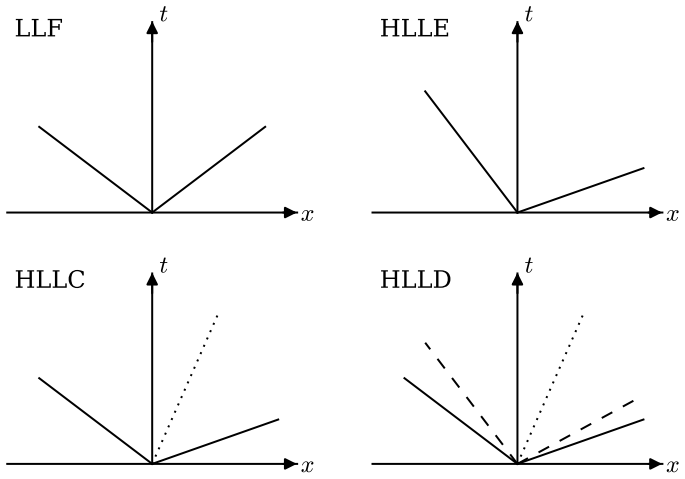
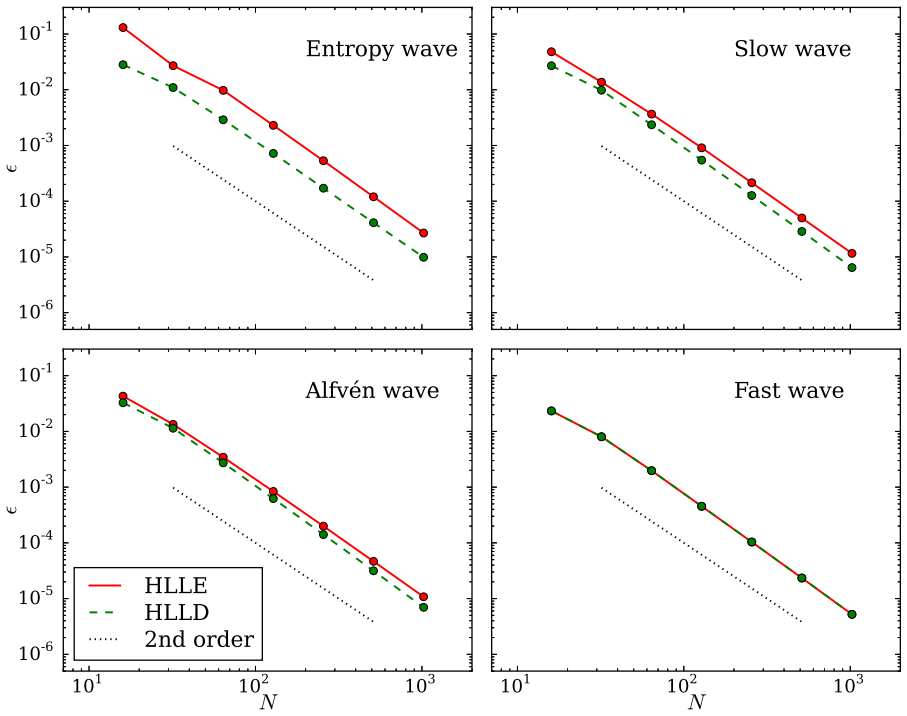
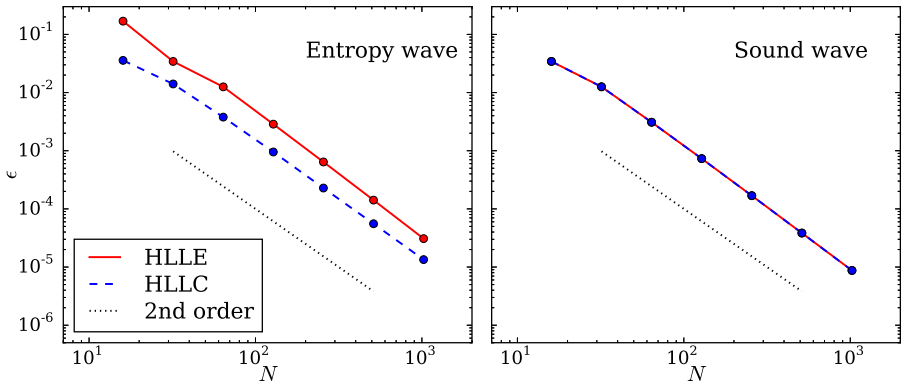
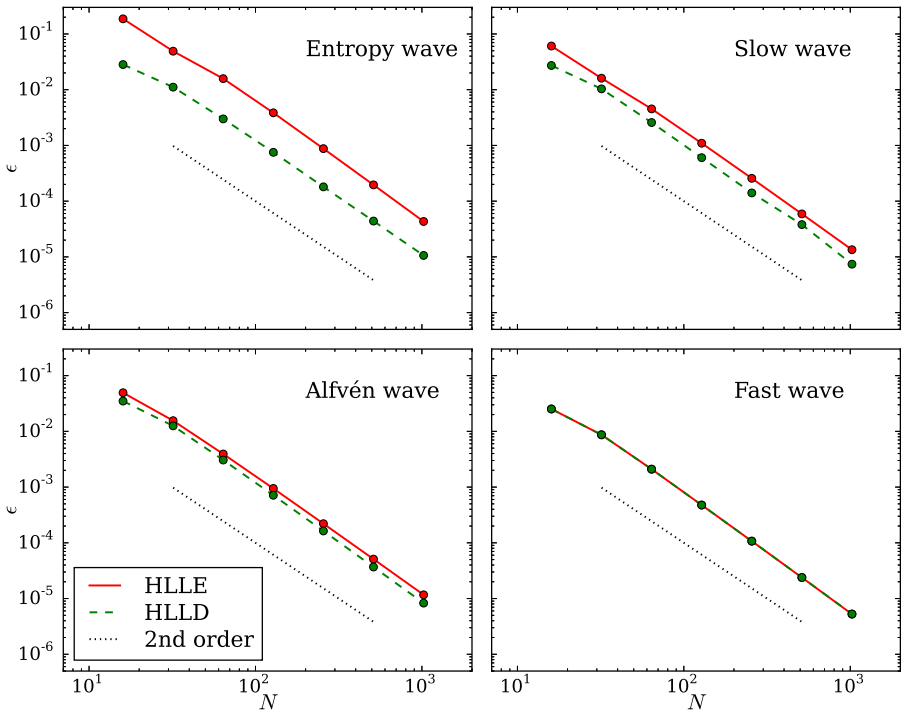
The accuracy of a simulation depends critically on the accuracy of the Riemann solver adopted... HLLD... resolves not only the contact but also the Alfvén waves.
What do these tags mean?
- matches
- The paper's claim is directly supported by a theorem in the formal canon.
- supports
- The theorem supports part of the paper's argument, but the paper may add assumptions or extra steps.
- extends
- The paper goes beyond the formal theorem; the theorem is a base layer rather than the whole result.
- uses
- The paper appears to rely on the theorem as machinery.
- contradicts
- The paper's claim conflicts with a theorem or certificate in the canon.
- unclear
- Pith found a possible connection, but the passage is too broad, indirect, or ambiguous to say the theorem truly supports the claim.
Reference graph
Works this paper leans on
-
[1]
Marek A. Abramowicz and P. Chris Fragile. Foundations of Black Hole Accretion Disk Theory . Living Reviews in Relativity, 16 0 (1), January 2013. doi:10.12942/lrr-2013-1
-
[2]
Relativistic MHD with adaptive mesh refinement
Matthew Anderson, Eric W Hirschmann, Steven L Liebling, and David Neilsen. Relativistic MHD with adaptive mesh refinement . Classical and Quantum Gravity, 23: 0 6503--6524, November 2006. doi:10.1088/0264-9381/23/22/025
-
[3]
Luis Ant \'o n, Olindo Zanotti, Juan A. Miralles, Jos \'e M. Mart \'i , Jos \'e M. Ib \'a \ n ez, Jos \'e A. Font, and Jos \'e A. Pons. Numerical 3+1 general relativistic magnetohydrodynamics:\ a local characteristic approach. The Astrophysical Journal, 637: 0 296--312, January 2006. doi:10.1086/498238
-
[4]
Miralles, Jos \'e M Mart \'i , Jos \'e M Ib \'a \ n ez, Miguel A
Luis Ant \'o n, Juan A. Miralles, Jos \'e M Mart \'i , Jos \'e M Ib \'a \ n ez, Miguel A. Aloy, and Petar Mimica. Relativistic Magnetohydrodynamics:\ Renormalized Eigenvectors and Full Wave Decomposition Riemann Solver . The Astrophysical Journal Supplement Series, 188: 0 1--31, May 2010. doi:10.1088/0067-0049/188/1/1
-
[5]
Steven A. Balbus and John F. Hawley. A Powerful Local Shear Instability in Weakly Magnetized Disks. I. Linear Analysis . The Astrophysical Journal, 376: 0 214--222, July 1991. doi:10.1086/170270
-
[6]
Steven A. Balbus and John F. Hawley. Instability, turbulence, and enhanced transport in accretion disks . Reviews of Modern Physics, 70 0 (1): 0 1--53, January 1998. doi:10.1103/RevModPhys.70.1
-
[7]
Steven A. Balbus, John F. Hawley, and James M. Stone. Nonlinear Stability, Hydrodynamical Turbulence, and Transport in Disks . The Astrophysical Journal, 467: 0 76--86, August 1996. doi:10.1086/177585
-
[8]
Francesc Banyuls, Jos \'e A. Font, Jos \'e Ma. Ib \'a \ n ez, Jos \'e Ma. Mart \'i , and Juan A. Miralles. Numerical 3+1 General Relativistic Hydrodynamics:\ A Local Characteristic Approach . The Astrophysical Journal, 476: 0 221--231, February 1997. doi:10.1086/303604
-
[9]
Kris Beckwith and James M. Stone. A Second-Order Godunov Method for Multi-Dimensional Relativistic Magnetohydrodynamics . The Astrophysical Journal Supplement Series, 193: 0 6, March 2011. doi:10.1088/0067-0049/193/1/6
-
[10]
D. P. Bennett, A. C. Becker, J. L. Quinn, A. B. Tomaney, C. Alcock, R. A. Allsman, D. R. Alves, T. S. Axelrod, J. J. Calitz, K. H. Cook, A. J. Drake, P. C. Fragile, K. C. Freeman, M. Geha, K. Griest, B. R. Johnson, S. C. Keller, C. Laws, M. J. Lehner, S. L. Marshall, D.Minniti, C. A. Nelson, B. A. Peterson, P. Popowski, M. R. Pratt, P. J. Quinn, S. H. Rhi...
-
[11]
G. S. Bisnovatyi-Kogan and A. A. Ruzmaikin. The Accretion of Matter by a Collapsing Star in the Presence of a Magnetic Field . Astrophysics and Space Science, 28: 0 45--59, May 1974. doi:10.1007/BF00642237
-
[12]
R. D. Blandford and R. L. Znajek. Electromagnetic extraction of energy from Kerr black holes . Monthly Notices of the Royal Astronomical Society, 179: 0 433--456, May 1977. doi:10.1093/mnras/179.3.433
-
[13]
J. U. Brackbill and D. C. Barnes. The Effect of Nonzer B on the Numerical Solution of the Magnetohydrodynamic Equations . Journal of Computational Physics, 35: 0 426--430, May 1980. doi:10.1016/0021-9991(80)90079-0
-
[14]
Sandip K. Chakrabarti. The Natural Angular Momentum Distribution in the Study of Thick Disks Around Black Holes . The Astrophysical Journal, 288: 0 1--6, January 1985. doi:10.1086/162755
-
[15]
Gammie, Francois Foucart, and Eliot Quataert
Mani Chandra, Charles F. Gammie, Francois Foucart, and Eliot Quataert. An Extended Magnetohydrodynamics Model for Relativistic Weakly Collisional Plasmas . The Astrophysical Journal, 810: 0 1--16, September 2015. doi:10.1088/0004-637X/810/2/162
-
[16]
A. Dedner, F. Kemm, D. Kr \"o ner, C.-D. Munz, T. Schnitzer, and M. Wesenberg. Hyperbolic Divergence Cleaning for the MHD Equations . Journal of Computational Physics, 175: 0 645--673, January 2002. doi:10.1006/jcph.2001.6961
-
[17]
L. Del Zanna , O. Zanotti, N. Bucciantini, and P. Londrillo. ECHO:\ a Eulerian conservative high-order scheme for general relativistic magnetohydrodynamics and magnetodynamics . Astronomy and Astrophysics, 473: 0 11--30, October 2007. doi:10.1051/0004-6361:20077093
-
[18]
Joshua C. Dolence, Charles F. Gammie, Monika Mo \'s cibrodzka, and Po Kin Leung. grmonty:\ A Monte Carlo Code for Relativistic Radiative Transport . The Astrophysical Journal Supplement Series, 184: 0 387--397, October 2009. doi:10.1088/0067-0049/184/2/387
-
[19]
On Godunov-Type Methods for Gas Dynamics
Bernd Einfeldt. On Godunov-Type Methods for Gas Dynamics . SIAM Journal on Numerical Analysis, 25 0 (2): 0 294--318, April 1988. doi:10.1137/0725021
-
[20]
Etienne, Vasileios Paschalidis, Yuk Tung Liu, and Stuart L
Zachariah B. Etienne, Vasileios Paschalidis, Yuk Tung Liu, and Stuart L. Shapiro. Relativistic magnetohydrodynamics in dynamical spacetimes:\ Improved electromagnetic gauge condition for adaptive mesh refinement grids . Physical Review D, 85: 0 024013, January 2012. doi:10.1103/PhysRevD.85.024013
-
[21]
IllinoisGRMHD:\ an open-source, user-friendly GRMHD code for dynamical spacetimes
Zachariah B Etienne, Vasileios Paschalidis, Roland Haas, Philipp M \"o sta, and Stuart L Shapiro. IllinoisGRMHD:\ an open-source, user-friendly GRMHD code for dynamical spacetimes . Classical and Quantum Gravity, 32: 0 175009, September 2015. doi:10.1088/0264-9381/32/17/175009
-
[22]
Charles R. Evans and John F. Hawley. Simulation of Magnetohydrodynamic Flows:\ A Constrained Transport Method . The Astrophysical Journal, 322: 0 659--677, September 1988. doi:10.1086/166684
-
[23]
Joshua A. Faber and Frederic A. Rasio. Binary Neutron Star Mergers . Living Reviews in Relativity, 15 0 (8), July 2012. doi:10.12942/lrr-2012-8
-
[24]
A. C. Fabian. Observational Evidence of Active Galactic Nuclei Feedback . Annual Review of Astronomy and Astrophysics, 50: 0 455--489, June 2012. doi:10.1146/annurev-astro-081811-125521
work page internal anchor Pith review doi:10.1146/annurev-astro-081811-125521 2012
-
[25]
S. A. E. G. Falle and S. S. Komissarov. An upwind numerical scheme for relativistic hydrodynamics with a general equation of state . Monthly Notices of the Royal Astronomical Society, 278: 0 586--602, January 1996
work page 1996
-
[26]
Past--Future Asymmetry of the Gravitational Field of a Point Particle
David Finkelstein. Past--Future Asymmetry of the Gravitational Field of a Point Particle . Physical Review, 110 0 (4): 0 965--967, May 1958. doi:10.1103/PhysRev.110.965
-
[27]
Leslie G. Fishbone and Vincent Moncrief. Relativistic Fluid Disks in Orbit around Kerr Black Holes . The Astrophysical Journal, 207: 0 962--976, August 1976. doi:10.1086/154565
-
[28]
Charles F. Gammie. Efficiency of Magnetized Thin Accretion Disks in the Kerr Metric . The Astrophysical Journal, 522: 0 L57--L60, September 1999. doi:10.1086/312207
-
[29]
Charles F. Gammie. The Magnetorotational Instability in the Kerr Metric . The Astrophysical Journal, 614: 0 309--313, October 2004. doi:10.1086/423443
-
[30]
Charles F. Gammie, Jonathan C. McKinney, and G \'a bor T \'o th. HARM:\ A Numerical Scheme for General Relativistic Magnetohydrodynamics . The Astrophysical Journal, 589: 0 444--457, May 2003. doi:10.1086/374594
-
[31]
Thomas A. Gardiner and James M. Stone. An unsplit Godunov method for ideal MHD via constrained transport . Journal of Computational Physics, 205: 0 509--539, May 2005. doi:10.1016/j.jcp.2004.11.016
-
[32]
Thomas A. Gardiner and James M. Stone. An unsplit Godunov method for ideal MHD via constrained transport in three dimensions . Journal of Computational Physics, 227: 0 4123--4141, April 2008. doi:10.1016/j.jcp.2007.12.017
-
[33]
WhiskyMHD:\ a new numerical code for general relativistic magnetohydrodynamics
Bruno Giacomazzo and Luciano Rezzolla. WhiskyMHD:\ a new numerical code for general relativistic magnetohydrodynamics . Classical and Quantum Gravity, 24: 0 S235--S258, June 2007. doi:10.1088/0264-9381/24/12/S16
-
[34]
S. Gillessen, F. Eisenhauer, S. Trippe, T. Alexander, R. Genzel, F. Martins, and T. Ott. Monitoring Stellar Orbits Around the Massive Black Hole in the Galactic Center . The Astrophysical Journal, 692: 0 1075--1109, February 2009. doi:10.1088/0004-637X/692/2/1075
-
[35]
Peter Goldreich and William H. Julian. Pulsar Electrodynamics . The Astrophysical Journal, 157: 0 869--880, August 1969. doi:10.1086/150119
-
[36]
A Local Instability of Tidally Distorted Accretion Disks
Jeremy Goodman. A Local Instability of Tidally Distorted Accretion Disks . The Astrophysical Journal, 406: 0 596--613, April 1993. doi:10.1086/172472
-
[37]
Ami Harten and James M. Hyman. Self-Adjusting Grid Methods for One-Dimensional Hyperbolic Conservation Laws . Journal of Computational Physics, 50: 0 235--269, May 1983. doi:10.1016/0021-9991(83)90066-9
-
[38]
Amiram Harten, Peter D. Lax, and Bram van Leer . On Upstream Differencing and Godunov-Type Schemes for Hyperbolic Conservation Laws . SIAM Review, 25 0 (1): 0 35--61, January 1983. doi:10.1137/1025002
-
[39]
John F. Hawley, Larry L. Smarr, and James R. Wilson. A Numerical Study of Nonspherical Black Hole Accretion. I. Equations and Test Problems . The Astrophysical Journal, 277: 0 296--311, February 1984. doi:10.1086/161696
-
[40]
Luis C. Ho. Nuclear Activity in Nearby Galaxies . Annual Review of Astronomy and Astrophysics, 46: 0 475--539, September 2008. doi:10.1146/annurev.astro.45.051806.110546
work page internal anchor Pith review Pith/arXiv arXiv doi:10.1146/annurev.astro.45.051806.110546 2008
-
[41]
Roy P. Kerr. Gravitational Field of a Spinning Mass as an Example of Algebraically Special Metrics . Physical Review Letters, 11 0 (5): 0 237--238, September 1963. doi:10.1103/PhysRevLett.11.237
-
[42]
S. S. Komissarov. A Godunov-type scheme for relativistic magnetohydrodynamics . Monthly Notices of the Royal Astronomical Society, 303: 0 343--366, February 1999. doi:10.1046/j.1365-8711.1999.02244.x
-
[43]
S. S. Komissarov. General relativistic magnetohydrodynamic simulations of monopole magnetospheres of black holes . Monthly Notices of the Royal Astronomical Society, 350: 0 1431--1436, June 2004. doi:10.1111/j.1365-2966.2004.07738.x
-
[44]
Alexander Kurganov and Eitan Tadmor. New High-Resolution Central Schemes for Nonlinear Conservation Laws and Convection-Diffusion Equations . Journal of Computational Physics, 160 0 (1): 0 241--282, May 2000. doi:10.1006/jcph.2000.6459
-
[45]
Jane H. MacGibbon, B. J. Carr, and Don N. Page. Do evaporating black holes form photospheres? Physical Review D, 78: 0 064043, September 2008. doi:10.1103/PhysRevD.78.064043
-
[46]
A Method for Incorporating Gauss' Law into Electromagnetic PIC Codes
Barry Marder. A Method for Incorporating Gauss' Law into Electromagnetic PIC Codes . Journal of Computational Physics, 68: 0 48--55, January 1987. doi:10.1016/0021-9991(87)90043-X
-
[47]
McKinney, Alexander Tchekhovskoy, Aleksander Sadowski, and Ramesh Narayan
Jonathan C. McKinney, Alexander Tchekhovskoy, Aleksander Sadowski, and Ramesh Narayan. Three-dimensional general relativistic radiation magnetohydrodynamical simulation of super-Eddington accretion, using a new code HARMRAD with M1 closure . Monthly Notices of the Royal Astronomical Society, 441: 0 3177--3208, July 2014. doi:10.1093/mnras/stu762
-
[48]
A. Mignone. High-order conservative reconstruction schemes for finite volume methods in cylindrical and spherical coordinates . Journal of Computational Physics, 270: 0 784--814, August 2014. doi:10.1016/j.jcp.2014.04.001
-
[49]
A. Mignone and G. Bodo. An HLLC Riemann solver for relativistic flows -- I.\ Hydrodynamics . Monthly Notices of the Royal Astronomical Society, 364: 0 126--136, November 2005. doi:10.1111/j.1365-2966.2005.09546.x
-
[50]
A. Mignone and G. Bodo. An HLLC Riemann solver for relativistic flows -- II.\ Magnetohydrodynamics . Monthly Notices of the Royal Astronomical Society, 368: 0 1040--1054, May 2006. doi:10.1111/j.1365-2966.2006.10162.x
-
[51]
A. Mignone and Jonathan C. McKinney. Equation of state in relativistic magnetohydrodynamics:\ variable versus constant adiabatic index . Monthly Notices of the Royal Astronomical Society, 378: 0 1118--1130, July 2007. doi:10.1111/j.1365-2966.2007.11849.x
-
[52]
A. Mignone, M. Ugliano, and G. Bodo. A five-wave Harten--Lax--van Leer Riemann solver for relativistic magnetohydrodynamics . Monthly Notices of the Royal Astronomical Society, 393: 0 1141--1156, March 2009. doi:10.1111/j.1365-2966.2008.14221.x
-
[53]
M. Coleman Miller and E. J. M. Colbert. Intermediate-Mass Black Holes . International Journal of Modern Physics D, 13 0 (1): 0 1--64, January 2004. doi:10.1142/S0218271804004426
-
[54]
Charles W. Misner, Kip S. Thorne, and John Archibald Wheeler. Gravitation . W. H. Freeman and Company, New York, 1973
work page 1973
-
[55]
F. Mohseni, M. Mendoza, S. Succi, and H. J. Herrmann. Relativistic effects on the Richtmyer--Meshkov instability . Physical Review D, 90: 0 125028, December 2014. doi:10.1103/PhysRevD.90.125028
-
[56]
o sta, Bruno C Mundim, Joshua A Faber, Roland Haas, Scott C Noble, Tanja Bode, Frank L \
Philipp M \"o sta, Bruno C Mundim, Joshua A Faber, Roland Haas, Scott C Noble, Tanja Bode, Frank L \"o ffler, Christian D Ott, Christian Reisswig, and Erik Schnetter. GRHydro:\ a new open-source general-relativistic magnetohydrodynamics code for the Einstein toolkit . Classical and Quantum Gravity, 31: 0 015005, January 2014. doi:10.1088/0264-9381/31/1/015005
-
[57]
Muhlberger, Fatemeh Hossein Nouri, Matthew D
Curran D. Muhlberger, Fatemeh Hossein Nouri, Matthew D. Duez, Francois Foucart, Lawrence E. Kidder, Christian D. Ott, Mark A. Scheel, B \'e la Szil \'a gyi, and Saul A. Teukolsky. Magnetic effects on the low- T/ W instability in differentially rotating neutron stars . Physical Review D, 90: 0 104014, November 2014. doi:10.1103/PhysRevD.90.104014
-
[58]
Ramesh Narayan, Igor V. Igumenshchev, and Marek A. Abramowicz. Magnetically Arrested Disk:\ an Energetically Efficient Accretion Flow . Publications of the Astronomical Society of Japan, 55: 0 L69--L72, December 2003. doi:10.1093/pasj/55.6.L69
-
[59]
William I. Newman and Nathaniel D. Hamlin. Primitive Variable Determination in Conservative Relativistic Magnetohydrodynamic Simulations . SIAM Journal on Scientific Computing, 36 0 (4): 0 B661--B683, July 2014. doi:10.1137/140956749
-
[60]
Scott C. Noble, Charles F. Gammie, Jonathan C. McKinney, and Luca Del Zanna . Primitive Variable Solvers for Conservative General Relativistic Magnetohydrodynamics . The Astrophysical Journal, 641: 0 626--637, April 2006. doi:10.1086/500349
-
[61]
J. C. B. Papaloizou and J. E. Pringle. The dynamical stability of differentially rotating discs with constant specific angular momentum . Monthly Notices of the Royal Astronomical Society, 208: 0 721--750, June 1984. doi:10.1093/mnras/208.4.721
-
[62]
R. Penrose. Gravitational Collapse:\ The Role of General Relativity . Rivista del Nuovo Cimento, 1: 0 252, 1969
work page 1969
-
[63]
Jos \'e A. Pons, Jos \'e A. Font, Jos \'e M a . Ib \'a \ n ez, Jos \'e M a . Mart \'i , and Juan A. Miralles. General relativistic hydrodynamics with special relativistic Riemann solvers . Astronomy and Astrophysics, 339: 0 638--642, November 1998
work page 1998
-
[64]
William H. Press, Saul A. Teukolsky, William T. Vetterling, and Brian P. Flannery. Numerical Recipes:\ The Art of Scientific Computing . Cambridge University Press, third edition, 1997
work page 1997
-
[65]
John D. Ramshaw. A Method for Enforcing the Solenoidal Condition on Magnetic Field in Numerical Calculations . Journal of Computational Physics, 52: 0 592--596, December 1983. doi:10.1016/0021-9991(83)90009-8
-
[66]
S. M. Ressler, A. Tchekhovskoy, E. Quataert, M. Chandra, and C. F. Gammie. Electron thermodynamics in GRMHD simulations of low-luminosity black hole accretion . Monthly Notices of the Royal Astronomical Society, 454: 0 1848--1870, December 2015. doi:10.1093/mnras/stv2084
-
[67]
P. L. Roe. Approximate Riemann Solvers, Parameter Vectors, and Difference Schemes . Journal of Computational Physics, 43: 0 357--372, October 1981. doi:10.1016/0021-9991(81)90128-5
-
[68]
B. R. Ryan, J. C. Dolence, and C. F. Gammie. bhlight:\ General Relativistic Radiation Magnetohydrodynamics with Monte Carlo Transport . The Astrophysical Journal, 807: 0 31, July 2015. doi:10.1088/0004-637X/807/1/31
-
[69]
Convective Instability in Differentially Rotating Disks
Dongsu Ryu and Jeremy Goodman. Convective Instability in Differentially Rotating Disks . The Astrophysical Journal, 388: 0 438--450, April 1992. doi:10.1086/171165
-
[70]
V. Schneider, U. Katscher, D. H. Rischke, B. Waldhauser, and J. A. Maruhn. New Algorithms for Ultra-relativistic Numerical Hydrodyamics . Journal of Computational Physics, 105: 0 92--107, March 1993. doi:10.1006/jcph.1993.1056
-
[71]
R. Sch \"o del, T. Ott, R. Genzel, R. Hofmann, M. Lehnert, A. Eckart, N. Mouawad, T. Alexander, M. J. Reid, R. Lenzen, M. Hartung, F. Lacombe, D. Rouan, E. Gendron, G. Rousset, A.-M. Lagrange, W. Brandner, N. Ageorges, C. Lidman, A. F. M. Moorwood, J. Spyromillo, N. Hubin, and K. M. Menten. A star in a 15.2-year orbit around the supermassive black hole at...
-
[72]
K. Schwarzschild. \"U ber das Gravitationsfeld eines Massenpunktes nach der Einsteinchen Theorie . Sitzungsberichte der K \"o niglich Preu ischen Akademie der Wissenschaften , pages 189--196, 1916
work page 1916
-
[73]
N. I. Shakura and R. A. Sunyaev. Black Holes in Binary Systems. Observational Appearance . Astronomy and Astrophysics, 24: 0 337--355, 1973
work page 1973
-
[74]
Magnetohydrodynamics in full general relativity:\ Formulation and tests
Masaru Shibata and Yu-ichirou Sekiguchi. Magnetohydrodynamics in full general relativity:\ Formulation and tests . Physical Review D, 72: 0 044014, August 2005. doi:10.1103/PhysRevD.72.044014
-
[75]
Hotaka Shiokawa, Joshua C. Dolence, Charles F. Gammie, and Scott C. Noble. Global General Relativistic Magnetohydrodynamical Simulations of Black Hole Accretion Flows:\ A Convergence Study . The Astrophysical Journal, 744: 0 187, January 2012. doi:10.1088/0004-637X/744/2/187
-
[76]
Efficient Implementation of Essentially Non-oscillatory Shock-Capturing Schemes
Chi-Wang Shu and Stanley Osher. Efficient Implementation of Essentially Non-oscillatory Shock-Capturing Schemes . Journal of Computational Physics, 77: 0 439--471, August 1988. doi:10.1016/0021-9991(88)90177-5
-
[77]
James M. Stone and Thomas A. Gardiner. Athena:\ A New Code for Astrophysical MHD . The Astrophysical Journal Supplement Series, 178: 0 137--177, September 2008. doi:10.1086/588755
-
[78]
Alexander Tchekhovskoy, Ramesh Narayan, and Jonathan C. McKinney. Efficient generation of jets from magnetically arrested accretion on a rapidly spinning black hole . Monthly Notices of the Royal Astronomical Society, 418: 0 L79--L83, September 2011. doi:10.1111/j.1745-3933.2011.01147.x
-
[79]
The B = 0 Constraint in Shock-Capturing Magnetohydrodynamics Codes
G \'a bor T \'o th. The B = 0 Constraint in Shock-Capturing Magnetohydrodynamics Codes . Journal of Computational Physics, 161: 0 605--652, July 2000. doi:10.1006/jcph.2000.6519
-
[80]
Towards the Ultimate Conservative Difference Scheme
Bram van Leer . Towards the Ultimate Conservative Difference Scheme. V. A Second-Order Sequel to Godunov's Method . Journal of Computational Physics, 32: 0 101--136, July 1979. doi:10.1016/0021-9991(79)90145-1
discussion (0)
Sign in with ORCID, Apple, or X to comment. Anyone can read and Pith papers without signing in.