Finding Quantum Many-Body Ground States with Artificial Neural Network
Pith reviewed 2026-05-25 14:39 UTC · model grok-4.3
The pith
An artificial neural network locates ground states of quantum many-body systems without assuming their functional form.
A machine-rendered reading of the paper's core claim, the machinery that carries it, and where it could break.
Core claim
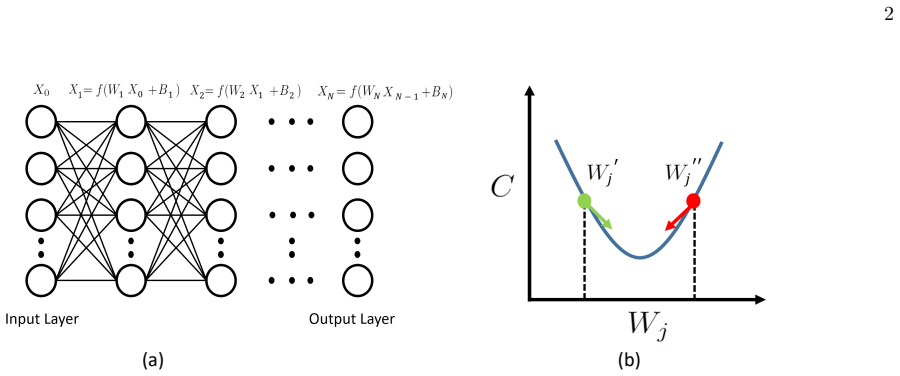
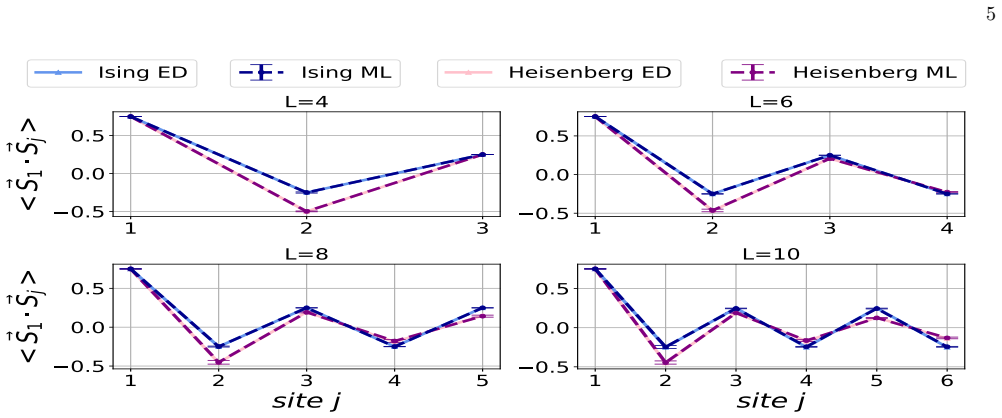
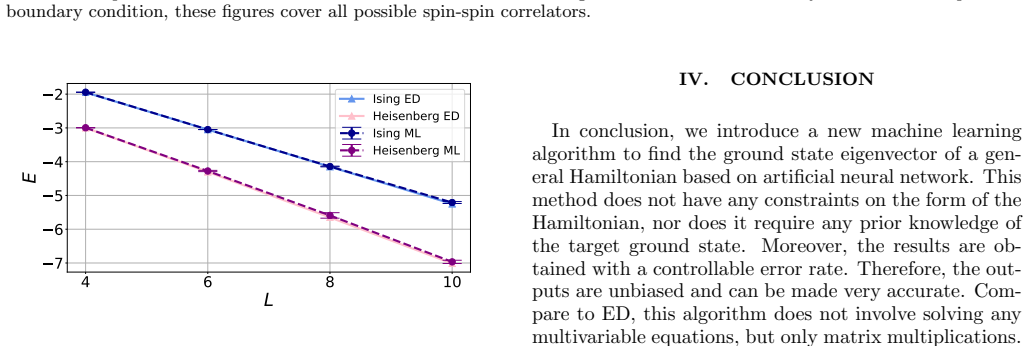
We propose a new unsupervised machine learning algorithm utilizing artificial neural networks to find the ground state of a general quantum many-body system. Without assuming the specific forms of the eigenvectors, this algorithm can find the eigenvectors in an unbiased way with well controlled accuracy. As examples, we apply this algorithm to 1D Ising and Heisenberg models, where the results match very well with exact diagonalization.
What carries the argument
The unsupervised optimization of an artificial neural network to represent and minimize the energy of the many-body wavefunction.
If this is right
- The algorithm applies to general quantum many-body systems.
- Accuracy can be controlled during the optimization.
- Results for the 1D Ising model match exact diagonalization.
- Results for the 1D Heisenberg model match exact diagonalization.
Where Pith is reading between the lines
- The representation could be applied to models in two or three dimensions where exact methods scale poorly.
- Changing the loss function might allow the same network to target excited states instead of the ground state.
- The approach could be hybridized with existing variational methods to handle larger system sizes.
Load-bearing premise
An artificial neural network can faithfully represent the ground-state wavefunction of a general quantum many-body system without any assumed functional form for the eigenvectors.
What would settle it
Applying the algorithm to the 1D Ising model and finding that the computed ground-state energy differs from the exact value obtained by diagonalization by more than the controlled accuracy bound.
Figures
read the original abstract
Solving ground states of quantum many-body systems has been a long-standing problem in condensed matter physics. Here, we propose a new unsupervised machine learning algorithm to find the ground state of a general quantum many-body system utilizing the benefits of artificial neural network. Without assuming the specific forms of the eigenvectors, this algorithm can find the eigenvectors in an unbiased way with well controlled accuracy. As examples, we apply this algorithm to 1D Ising and Heisenberg models, where the results match very well with exact diagonalization.
Editorial analysis
A structured set of objections, weighed in public.
Referee Report
Summary. The manuscript proposes an unsupervised machine learning algorithm that employs artificial neural networks to locate the ground states of general quantum many-body systems. It asserts that the method determines eigenvectors in an unbiased manner with controlled accuracy, without presupposing specific functional forms for the wavefunctions. The approach is illustrated on the one-dimensional Ising and Heisenberg models, where the obtained results are stated to agree well with exact diagonalization.
Significance. If the algorithm can be shown to deliver unbiased representations with quantifiable accuracy beyond the simplest cases, it would constitute a useful addition to the toolkit for quantum many-body problems by exploiting the flexibility of neural-network ansatzes. The unsupervised character and absence of assumed forms are positive features. At present, however, the evidential base is confined to one-dimensional models, limiting the immediate impact.
major comments (2)
- [Abstract] Abstract: The central claim that the algorithm finds eigenvectors 'in an unbiased way with well controlled accuracy' for a 'general quantum many-body system' is not supported by the reported evidence, which is restricted to 1D Ising and Heisenberg chains; no tests on higher-dimensional lattices, frustrated systems, or models with nontrivial sign structure are provided to substantiate generality.
- [Abstract] The manuscript supplies no derivation of the training procedure, loss function, or error-control mechanism that would establish how accuracy is 'well controlled' independently of the specific model; the agreement with exact diagonalization is asserted but lacks quantitative metrics, convergence data, or scaling analysis with system size.
minor comments (1)
- Notation for the neural-network parameters and the precise form of the variational wavefunction should be introduced explicitly before the numerical examples.
Simulated Author's Rebuttal
We thank the referee for the detailed and constructive report. We address each major comment below and outline revisions that will be incorporated to improve the manuscript.
read point-by-point responses
-
Referee: [Abstract] Abstract: The central claim that the algorithm finds eigenvectors 'in an unbiased way with well controlled accuracy' for a 'general quantum many-body system' is not supported by the reported evidence, which is restricted to 1D Ising and Heisenberg chains; no tests on higher-dimensional lattices, frustrated systems, or models with nontrivial sign structure are provided to substantiate generality.
Authors: We agree that the numerical evidence is confined to 1D models and that the phrasing 'general quantum many-body system' overstates the current validation. The algorithm is formulated without model-specific assumptions, but demonstrations remain limited. We will revise the abstract and introduction to qualify the scope, explicitly state that validation is on 1D chains, and add a paragraph on planned extensions to higher dimensions and sign-problem cases. revision: yes
-
Referee: [Abstract] The manuscript supplies no derivation of the training procedure, loss function, or error-control mechanism that would establish how accuracy is 'well controlled' independently of the specific model; the agreement with exact diagonalization is asserted but lacks quantitative metrics, convergence data, or scaling analysis with system size.
Authors: The main text contains a derivation of the unsupervised loss (variational energy expectation value) and the stochastic gradient updates used for training. However, we accept that quantitative support for controlled accuracy is insufficient. We will add explicit convergence plots versus training steps, tables of relative energy errors versus exact diagonalization, and finite-size scaling of the obtained ground-state energy to demonstrate error control. revision: yes
Circularity Check
No circularity: algorithm proposed and externally validated on 1D models
full rationale
The paper proposes an unsupervised ANN-based algorithm to locate ground states without assuming eigenvector forms, then validates it by direct numerical comparison to exact diagonalization on the 1D Ising and Heisenberg chains. No derivation step reduces by construction to its own inputs, no fitted parameter is relabeled as a prediction, and no load-bearing premise rests on a self-citation chain. The central claim is an empirical demonstration of matching accuracy rather than a tautological equivalence, making the derivation self-contained against external benchmarks.
Axiom & Free-Parameter Ledger
Reference graph
Works this paper leans on
-
[1]
Finding Quantum Many-Body Ground States with Artificial Neural Network
proposed a method using convolutional neural net- works. In condensed matter physics, one of the main hurdles is to find the eigenstates of interacting systems with rea- sonable system sizes. In the presence of interactions, the dimension of the Hilbert space grows exponentially with the system size, which prevents us from solving the Hamiltonian exactly e...
work page internal anchor Pith review Pith/arXiv arXiv 1906
-
[2]
G. Torlaiand R. G. Melko, Learning thermodynamics with boltzmann machines, Physical Review B 94, 165134 (2016)
work page 2016
-
[3]
Y. Wu, P. Zhang, H. Shen, and H. Zhai, Visualizing a neural network that develops quantum perturbation the- ory, Physical Review A 98, 010701 (2018)
work page 2018
-
[4]
S. J. Wetzel, Unsupervised learning of phase transitions: From principal component analysis to variational autoen- coders, Physical Review E 96, 022140 (2017)
work page 2017
-
[5]
Quantum phase recognition via unsupervised machine learning
P. Broecker, F. F. Assaad, and S. Trebst, Quantum phase recognition via unsupervised machine learning, arXiv preprint arXiv:1707.00663 (2017)
work page internal anchor Pith review Pith/arXiv arXiv 2017
-
[6]
W. Foulkes, L. Mitas, R. Needs, and G. Rajagopal, Quan- tum monte carlo simulations of solids, Reviews of Modern Physics 73, 33 (2001)
work page 2001
-
[7]
Suzuki, Quantum Monte Carlo methods in condensed matter physics (World scientific, 1993)
M. Suzuki, Quantum Monte Carlo methods in condensed matter physics (World scientific, 1993)
work page 1993
-
[8]
D. M. Ceperley, Path integrals in the theory of condensed helium, Reviews of Modern Physics 67, 279 (1995)
work page 1995
-
[9]
S. R. White, Density matrix formulation for quantum renormalization groups, Physical review letters 69, 2863 (1992)
work page 1992
-
[10]
S. R. White, Density-matrix algorithms for quantum renormalization groups, Physical Review B 48, 10345 (1993)
work page 1993
-
[11]
Schollw¨ ock, The density-matrix renormalization group, Reviews of modern physics 77, 259 (2005)
U. Schollw¨ ock, The density-matrix renormalization group, Reviews of modern physics 77, 259 (2005)
work page 2005
-
[12]
U. Schollw¨ ock, The density-matrix renormalization group in the age of matrix product states, Annals of Physics 326, 96 (2011)
work page 2011
-
[13]
G. Carleoand M. Troyer, Solving the quantum many- body problem with artificial neural networks, Science 355, 602 (2017)
work page 2017
discussion (0)
Sign in with ORCID, Apple, or X to comment. Anyone can read and Pith papers without signing in.