Collecting and Analyzing Multidimensional Data with Local Differential Privacy
Pith reviewed 2026-05-25 13:49 UTC · model grok-4.3
The pith
New local differential privacy mechanisms collect multidimensional numeric and categorical data with lower worst-case noise variance than prior methods.
A machine-rendered reading of the paper's core claim, the machinery that carries it, and where it could break.
Core claim
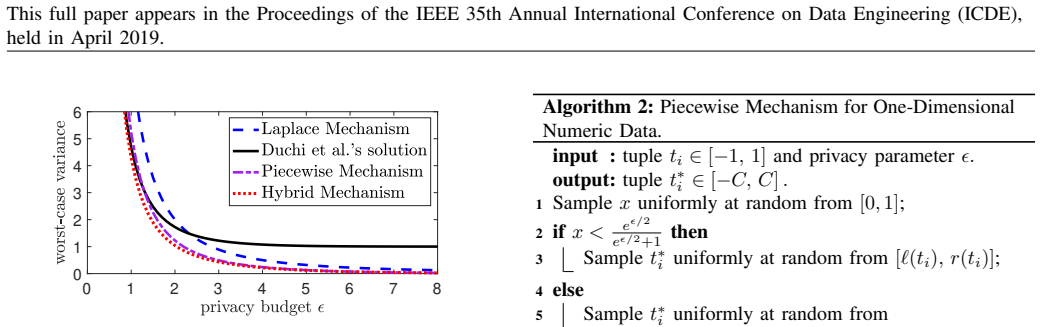
The authors propose novel LDP mechanisms for collecting a numeric attribute whose accuracy is at least no worse (and usually better) than existing solutions in terms of worst-case noise variance. They extend these mechanisms to multidimensional data that can contain both numeric and categorical attributes, where the mechanisms always outperform existing solutions regarding worst-case noise variance. As a case study, they apply the solutions to build an LDP-compliant stochastic gradient descent algorithm.
What carries the argument
Perturbation mechanisms that minimize worst-case noise variance while satisfying local differential privacy for numeric attributes and their extension to mixed numeric-categorical multidimensional data.
If this is right
- Mean estimation and similar statistics over single or multiple attributes become more accurate under LDP.
- LDP-compliant stochastic gradient descent can train models with less noise than previous LDP baselines.
- Systems collecting mixed-type user data can preserve more utility while meeting local privacy guarantees.
- Basic data-collection primitives improve, which benefits any downstream LDP analysis that relies on them.
Where Pith is reading between the lines
- The same variance-reduction approach might apply to other statistics or learning objectives if the perturbation design generalizes beyond means and gradients.
- If worst-case variance aligns with observed utility in deployed systems, the methods could raise data quality in existing LDP deployments such as browser telemetry.
- Evaluating performance when attributes are correlated could expose further gains or edge cases not addressed by the independent-attribute analysis.
Load-bearing premise
Worst-case noise variance fully captures practical utility, and the perturbation schemes meet the LDP definition for any input distribution without assumptions on attribute ranges or correlations.
What would settle it
A calculation or experiment on any multidimensional dataset with numeric and categorical attributes that shows an existing LDP mechanism achieving strictly lower worst-case noise variance than the proposed mechanisms.
Figures



read the original abstract
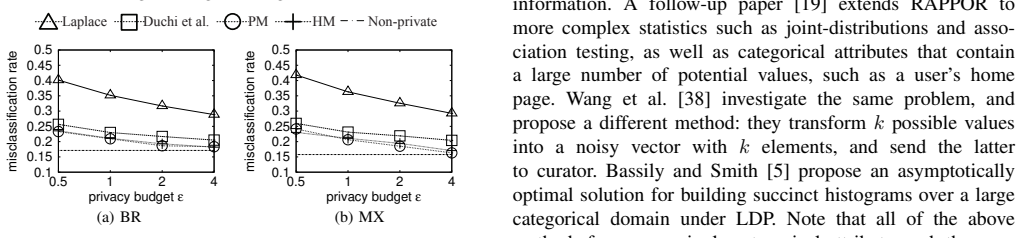
Local differential privacy (LDP) is a recently proposed privacy standard for collecting and analyzing data, which has been used, e.g., in the Chrome browser, iOS and macOS. In LDP, each user perturbs her information locally, and only sends the randomized version to an aggregator who performs analyses, which protects both the users and the aggregator against private information leaks. Although LDP has attracted much research attention in recent years, the majority of existing work focuses on applying LDP to complex data and/or analysis tasks. In this paper, we point out that the fundamental problem of collecting multidimensional data under LDP has not been addressed sufficiently, and there remains much room for improvement even for basic tasks such as computing the mean value over a single numeric attribute under LDP. Motivated by this, we first propose novel LDP mechanisms for collecting a numeric attribute, whose accuracy is at least no worse (and usually better) than existing solutions in terms of worst-case noise variance. Then, we extend these mechanisms to multidimensional data that can contain both numeric and categorical attributes, where our mechanisms always outperform existing solutions regarding worst-case noise variance. As a case study, we apply our solutions to build an LDP-compliant stochastic gradient descent algorithm (SGD), which powers many important machine learning tasks. Experiments using real datasets confirm the effectiveness of our methods, and their advantages over existing solutions.
Editorial analysis
A structured set of objections, weighed in public.
Referee Report
Summary. The paper proposes novel LDP mechanisms for numeric attributes that achieve worst-case noise variance at least as good as (and usually better than) prior solutions such as the Laplace mechanism. It extends these to multidimensional mixed numeric/categorical data, claiming strict outperformance on the same metric, and applies the mechanisms to construct an LDP-compliant SGD algorithm. Experiments on real datasets are reported to confirm the advantages.
Significance. If the variance bounds and LDP proofs hold, the work improves practical utility for LDP data collection tasks used in production systems (Chrome, iOS) and for downstream ML. Credit is due for focusing on an explicit, comparable metric (worst-case noise variance) and for including both mechanism constructions and an SGD case study with real-data experiments.
major comments (2)
- [§3.2] §3.2, variance analysis: the claim that the new numeric mechanism is 'at least no worse' than baselines requires an explicit inequality proof comparing the derived worst-case variance (e.g., Eq. (X)) against Duchi et al. and Laplace for all ε; without it the central improvement claim rests on the abstract statement alone.
- [§4.3] §4.3, multidimensional extension: the 'always outperform' statement for mixed attributes (Table 2) assumes attribute independence in the variance calculation; if the paper's LDP proof or variance bound does not address possible correlations, the outperformance may not hold for arbitrary input distributions.
minor comments (2)
- [Abstract] The abstract states accuracy claims without referencing the specific variance equations or theorems; add forward references to §3 and §4.
- [§3] Notation for the perturbation functions (numeric vs. categorical) would benefit from a summary table of input ranges and output domains.
Simulated Author's Rebuttal
We thank the referee for the thorough review and the recommendation for minor revision. We address the major comments below and will revise the manuscript accordingly.
read point-by-point responses
-
Referee: [§3.2] §3.2, variance analysis: the claim that the new numeric mechanism is 'at least no worse' than baselines requires an explicit inequality proof comparing the derived worst-case variance (e.g., Eq. (X)) against Duchi et al. and Laplace for all ε; without it the central improvement claim rests on the abstract statement alone.
Authors: We concur that an explicit proof is required to rigorously support the claim. The revised manuscript will include a dedicated lemma that proves the worst-case variance of our proposed numeric mechanism is at most that of the Laplace mechanism and Duchi et al.'s approach for every ε > 0. This follows directly from algebraic comparison of the respective variance formulas derived in §3.2. revision: yes
-
Referee: [§4.3] §4.3, multidimensional extension: the 'always outperform' statement for mixed attributes (Table 2) assumes attribute independence in the variance calculation; if the paper's LDP proof or variance bound does not address possible correlations, the outperformance may not hold for arbitrary input distributions.
Authors: The mechanisms for numeric and categorical attributes are applied independently to each attribute, and the worst-case noise variance is the sum of the per-attribute worst-case variances. This bound holds irrespective of any correlations among attributes, as the worst-case is taken over all possible input values for each attribute separately. The LDP property is satisfied locally per user without assuming independence. We will add a clarifying remark in §4.3 to emphasize that the outperformance claim is with respect to this worst-case metric and does not depend on data correlations. revision: yes
Circularity Check
No significant circularity in derivation chain
full rationale
The paper introduces novel LDP mechanisms for numeric attributes and their multidimensional extensions, with claims of improved worst-case noise variance over prior solutions. The abstract presents these as explicit new constructions whose accuracy is analyzed and compared directly to existing work, without any self-definitional loops, fitted inputs relabeled as predictions, or load-bearing self-citations that collapse the central results to the inputs by construction. The derivation chain for the mechanisms, extensions, and SGD case study remains independent of the target claims, consistent with a self-contained presentation against external benchmarks.
Axiom & Free-Parameter Ledger
Reference graph
Works this paper leans on
-
[1]
Integrated public use microdata series, 2017. https://www.ipums.org
work page 2017
-
[2]
https://sites.google.com/site/icde2019tr/tr
Collecting and analyzing multidimensional data with local differential privacy (technical report), 2018. https://sites.google.com/site/icde2019tr/tr
work page 2018
- [3]
-
[4]
R. Bassily, K. Nissim, U. Stemmer, and A. Thakurta. Practical locally private heavy hitters. In NIPS, pages 2285–2293, 2017
work page 2017
-
[5]
R. Bassily and A. Smith. Local, private, efficient protocols for succinct histograms. In ACM STOC, pages 127–135, 2015
work page 2015
- [6]
-
[7]
M. Bun, J. Nelson, and U. Stemmer. Heavy hitters and the structure of local privacy. In ACM PODS, pages 435–447, 2018
work page 2018
-
[8]
R. Chen, H. Li, A. K. Qin, S. P. Kasiviswanathan, and H. Jin. Private spatial data aggregation in the local setting. In IEEE ICDE, pages 289– 300, 2016
work page 2016
-
[9]
G. Cormode, S. Jha, T. Kulkarni, N. Li, D. Srivastava, and T. Wang. Privacy at scale: Local differential privacy in practice. In ACM SIGMOD Tutorials, 2018
work page 2018
-
[10]
G. Cormode, T. Kulkarni, and D. Srivastava. Marginal release under local differential privacy. In ACM SIGMOD, 2018
work page 2018
-
[11]
C. Cortes and V . Vapnik. Support-vector networks. Machine Learning, 20(3):273–297, 1995
work page 1995
-
[12]
B. Ding, J. Kulkarni, and S. Yekhanin. Collecting telemetry data privately. In NIPS, pages 3574–3583, 2017
work page 2017
-
[13]
J. C. Duchi, M. I. Jordan, and M. J. Wainwright. Local privacy and statistical minimax rates. In IEEE FOCS, pages 429–438, 2013
work page 2013
-
[14]
J. C. Duchi, M. I. Jordan, and M. J. Wainwright. Minimax optimal procedures for locally private estimation. Journal of the American Statistical Association, 113(521):182–201, 2018
work page 2018
-
[15]
J. C. Duchi, M. J. Wainwright, and M. I. Jordan. Local privacy and minimax bounds: Sharp rates for probability estimation. In NIPS, pages 1529–1537, 2013
work page 2013
- [16]
-
[17]
C. Dwork and A. Roth. The algorithmic foundations of differential privacy. Foundations and Trends in Theoretical Computer Science , 9(3- 4):211–407, 2014
work page 2014
-
[18]
´U. Erlingsson, V . Pihur, and A. Korolova. RAPPOR: Randomized aggregatable privacy-preserving ordinal response. In ACM CCS, pages 1054–1067, 2014
work page 2014
- [19]
-
[20]
Local Private Hypothesis Testing: Chi-Square Tests
M. Gaboardi and R. Rogers. Local private hypothesis testing: Chi-square tests. arXiv preprint arXiv:1709.07155 , 2017
work page internal anchor Pith review Pith/arXiv arXiv 2017
-
[21]
Q. Geng, P. Kairouz, S. Oh, and P. Viswanath. The staircase mechanism in differential privacy. J. Sel. Topics Signal Processing, 9(7):1176–1184, 2015
work page 2015
-
[22]
J. Hamm, A. C. Champion, G. Chen, M. Belkin, and D. Xuan. Crowd- ML: A privacy-preserving learning framework for a crowd of smart devices. In IEEE ICDCS, pages 11–20, 2015
work page 2015
-
[23]
P. Kairouz, K. Bonawitz, and D. Ramage. Discrete distribution estima- tion under local privacy. In ICML, 2016
work page 2016
-
[24]
P. Kairouz, S. Oh, and P. Viswanath. Extremal mechanisms for local differential privacy. In NIPS, pages 2879–2887, 2014
work page 2014
-
[25]
S. P. Kasiviswanathan, H. K. Lee, K. Nissim, S. Raskhodnikova, and A. Smith. What can we learn privately? In IEEE FOCS, pages 531–540, 2008
work page 2008
-
[26]
J. W. Kim, D.-H. Kim, and B. Jang. Application of local differential privacy to collection of indoor positioning data. IEEE Access, 6:4276– 4286, 2018
work page 2018
-
[27]
S. Krishnan, J. Wang, M. J. Franklin, K. Goldberg, and T. Kraska. PrivateClean: Data cleaning and differential privacy. In ACM SIGMOD, pages 937–951, 2016
work page 2016
-
[28]
C. Liu, S. Chakraborty, and P. Mittal. DEEProtect: Enabling inference- based access control on mobile sensing applications. arXiv preprint arXiv:1702.06159, 2017
work page internal anchor Pith review Pith/arXiv arXiv 2017
-
[29]
F. McSherry and K. Talwar. Mechanism design via differential privacy. In IEEE FOCS, pages 94–103, 2007
work page 2007
-
[30]
T. Murakami, H. Hino, and J. Sakuma. Toward distribution estima- tion under local differential privacy with small samples. PoPETs, 2018(3):84–104, 2018
work page 2018
-
[31]
K. Nissim and U. Stemmer. Clustering algorithms for the centralized and local models. In Algorithmic Learning Theory (ALT) , pages 619–653, Apr 2018
work page 2018
-
[32]
A. Pastore and M. Gastpar. Locally differentially-private distribution estimation. In IEEE International Symposium on Information Theory (ISIT), pages 2694–2698, 2016
work page 2016
-
[33]
Z. Qin, Y . Yang, T. Yu, I. Khalil, X. Xiao, and K. Ren. Heavy hitter estimation over set-valued data with local differential privacy. In ACM CCS, pages 192–203, 2016
work page 2016
-
[34]
X. Ren, C. M. Yu, W. Yu, S. Yang, X. Yang, J. A. McCann, and P. S. Yu. LoPub: High-dimensional crowdsourced data publication with local differential privacy. IEEE Transactions on Information Forensics and Security, 13(9):2151–2166, Sept 2018
work page 2018
-
[35]
J. Soria-Comas and J. Domingo-Ferrer. Optimal data-independent noise for differential privacy. Inf. Sci., 250:200–214, 2013
work page 2013
-
[36]
J. Tang, A. Korolova, X. Bai, X. Wang, and X. Wang. Privacy loss in Apple’s implementation of differential privacy on macOS 10.12. arXiv preprint arXiv:1709.02753, 2017
work page internal anchor Pith review Pith/arXiv arXiv 2017
-
[37]
N. Wang, X. Xiao, Y . Yang, T. D. Hoang, H. Shin, J. Shin, and G. Yu. PrivTrie: Effective frequent term discovery under local differential privacy. In IEEE ICDE, 2018
work page 2018
-
[38]
T. Wang, J. Blocki, N. Li, and S. Jha. Locally differentially private protocols for frequency estimation. In USENIX Security, 2017
work page 2017
-
[39]
T. Wang, N. Li, and S. Jha. Locally differentially private heavy hitter identification. arXiv preprint arXiv:1708.06674 , 2017
work page internal anchor Pith review Pith/arXiv arXiv 2017
-
[40]
T. Wang, N. Li, and S. Jha. Locally differentially private frequent itemset mining. In IEEE Symposium on Security and Privacy (S&P) , 2018
work page 2018
-
[41]
S. L. Warner. Randomized response: A survey technique for eliminating evasive answer bias. Journal of the American Statistical Association , 60(309):63–69, 1965
work page 1965
- [42]
discussion (0)
Sign in with ORCID, Apple, or X to comment. Anyone can read and Pith papers without signing in.