Logarithmic correlation functions for critical dense polymers on the cylinder
Pith reviewed 2026-05-24 22:29 UTC · model grok-4.3
The pith
Lattice correlation functions for critical dense polymers on a cylinder match ratios of conformal correlators at central charge c=-2.
A machine-rendered reading of the paper's core claim, the machinery that carries it, and where it could break.
Core claim
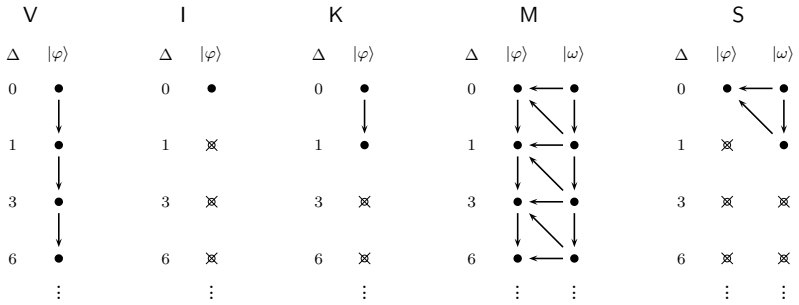
We find explicit expressions for these correlators for finite n using the representation of the enlarged periodic Temperley-Lieb algebra in the XX spin chain. The resulting asymptotics as n→∞ are expressed as simple integrals that depend on the parameter τ=(x-1)/n ∈(0,1). For small τ, the leading behaviours are proportional to τ^{1/4}, τ^{1/4} log τ, log τ and log²τ. We interpret the lattice results in terms of ratios of conformal correlation functions. We assume that the corresponding boundary changing fields are highest weight states in irreducible, Kac or staggered Virasoro modules, with central charge c=-2 and conformal dimensions Δ=-1/8 or Δ=0. We obtain differential equations satisfied
What carries the argument
Boundary condition changing fields in Virasoro modules with c=-2 and dimensions Δ=-1/8 or 0, whose correlators satisfy differential equations that match the lattice asymptotics.
If this is right
- The leading small-τ behaviors of the correlators are τ to the power 1/4, τ^{1/4} log τ, log τ, and log squared τ.
- Structure constants appearing in the operator product expansions can be computed from the solutions of the differential equations.
- The fusion of the boundary condition changing fields is non-abelian.
- Ratios of these structure constants are determined explicitly.
Where Pith is reading between the lines
- If the agreement holds, similar lattice-to-CFT mappings could apply to other values of the loop fugacity or different boundary conditions.
- The non-abelian fusion suggests that the operator algebra may have a richer structure than in rational CFTs, potentially affecting higher-point functions.
- Extensions to the full cylinder or other topologies might reveal additional logarithmic terms in the correlators.
Load-bearing premise
The boundary changing fields correspond to highest weight states in irreducible, Kac or staggered Virasoro modules with central charge c=-2 and conformal dimensions -1/8 or 0.
What would settle it
A mismatch between the small-τ asymptotic expansions derived from the lattice partition function ratios and those obtained by solving the differential equations for the conformal correlators would falsify the interpretation.
Figures


read the original abstract
We compute lattice correlation functions for the model of critical dense polymers on a semi-infinite cylinder of perimeter $n$. In the lattice loop model, contractible loops have a vanishing fugacity whereas non-contractible loops have a fugacity $\alpha\in(0,\infty)$. These correlators are defined as ratios $Z(x)/Z_0$ of partition functions, where $Z_0$ is a reference partition function wherein only simple arcs are attached to the boundary of the cylinder. For $Z(x)$, the boundary is also decorated with simple arcs, but it also has two positions $1$ and $x$ where the boundary condition is different. We investigate two such kinds of boundary conditions: (i) there is a single node at each of these points where a long arc is attached, and (ii) there are pairs of adjacent nodes at these points where two long arcs are attached. We find explicit expressions for these correlators for finite $n$ using the representation of the enlarged periodic Temperley-Lieb algebra in the XX spin chain. The resulting asymptotics as $n\to\infty$ are expressed as simple integrals that depend on the parameter $\tau=\frac{x-1}n\in(0,1)$. For small $\tau$, the leading behaviours are proportional to $\tau^{1/4}$, $\tau^{1/4}\log \tau$, $\log\tau$ and $\log^2\tau$. We interpret the lattice results in terms of ratios of conformal correlation functions. We assume that the corresponding boundary changing fields are highest weight states in irreducible, Kac or staggered Virasoro modules, with central charge $c=-2$ and conformal dimensions $\Delta = -\frac18$ or $\Delta=0$. We obtain differential equations satisfied by the conformal correlators, solve these equations, and find a perfect agreement with the lattice results. We compute structure constants and ratios thereof which appear in the operator product expansions of the boundary condition changing fields. The fusion of these fields is found to be non-abelian.
Editorial analysis
A structured set of objections, weighed in public.
Referee Report
Summary. The manuscript computes explicit expressions for correlation functions in the critical dense polymer model on a cylinder using the XX spin chain representation of the enlarged periodic Temperley-Lieb algebra. The n→∞ asymptotics are given as integrals over τ=(x-1)/n, with small-τ expansions showing behaviors proportional to τ^{1/4}, τ^{1/4} log τ, log τ and log²τ. These are matched to ratios of conformal correlators at c=-2 by assuming the boundary changing fields are highest-weight states in irreducible, Kac or staggered Virasoro modules with Δ=-1/8 or Δ=0, deriving and solving the corresponding null-vector differential equations, and reporting perfect agreement. Structure constants and their ratios are computed from the OPEs, and the fusion of the fields is concluded to be non-abelian.
Significance. If the reported matching holds, the work supplies a non-circular, lattice-derived verification of logarithmic correlators and fusion rules in c=-2 LCFT. The lattice side proceeds from an independent XX-chain representation and explicit integrals without CFT input, while the CFT side solves the differential equations under the stated module assumptions; the agreement therefore constitutes a genuine test of the operator identification. Explicit structure constants are obtained, providing concrete, falsifiable numbers for further checks in polymer models and LCFT.
minor comments (2)
- The abstract states that the asymptotics 'are expressed as simple integrals' but does not display the explicit integral expressions; including them in the main text (with the precise measure and limits) would improve reproducibility.
- A short table or side-by-side comparison of the numerical coefficients extracted from the lattice integrals and those obtained from the CFT solutions would make the 'perfect agreement' claim easier to inspect at a glance.
Simulated Author's Rebuttal
We thank the referee for their positive assessment of the manuscript, accurate summary of the results, and recommendation to accept. We are pleased that the work is viewed as providing a genuine, non-circular test of logarithmic correlators and fusion rules in c=-2 LCFT.
Circularity Check
No significant circularity identified
full rationale
The paper first derives explicit finite-n correlators and their n→∞ asymptotic integrals directly from the XX spin-chain representation of the enlarged periodic Temperley-Lieb algebra, without reference to CFT or module assumptions. It then separately assumes the boundary fields lie in standard c=-2 Virasoro modules (Kac or staggered) with given Δ values, derives the corresponding null-vector differential equations, solves them, and reports agreement with the already-computed lattice integrals. Because the lattice side is self-contained and independent of the CFT assumptions, the match constitutes an external test rather than a reduction of any claimed derivation to its own inputs. No self-citations are invoked as load-bearing uniqueness theorems, and no fitted parameters are relabeled as predictions.
Axiom & Free-Parameter Ledger
axioms (1)
- domain assumption Boundary changing fields are highest weight states in irreducible, Kac or staggered Virasoro modules with c=-2 and Δ=-1/8 or Δ=0
Reference graph
Works this paper leans on
-
[1]
L. Onsager. Crystal statistics. I. A two-dimensional mo del with an order-disorder transition. Phys. Rev. , 65:117, 1944
work page 1944
-
[2]
K.W. Wilson and J. Kogut. The renormalization group and t heǫ expansion. Phys. Rep., 12:75–199, 1974
work page 1974
-
[3]
A.A. Belavin, A.M. Polyakov, and A.B. Zamolodchikov. In finite conformal symmetry in two- dimensional quantum field theory. Nucl. Phys. B , 241:333–380, 1984
work page 1984
-
[4]
P. Di Francesco, P. Mathieu, and D. S´ en´ echal.Conformal Field Theory . Springer, 1997
work page 1997
-
[5]
L.D. Faddeev, E.K. Sklyanin, and L.A. Takhtajan. The qua ntum inverse problem method. Teor. Mat. Fiz. , 40:194–220, 1979
work page 1979
-
[6]
R.J. Baxter. Exactly solved models in statistical mechanics . Academic Press, 1982
work page 1982
-
[7]
V.E. Korepin, N.M. Bogoliubov, and A.G. Izergin. Quantum inverse scattering method and cor- relation functions . Cambridge University Press, 1993
work page 1993
-
[8]
D. Friedan, Z. Qiu, and S. Shenker. Conformal invariance , unitarity, and critical exponents in two dimensions. Phys. Rev. Lett. , 52:1575–1578, 1984
work page 1984
-
[9]
V. Kac, A. Raina, and N. Rozhkovskaya. Bombay lectures on highest weight representations of infinite dimensional Lie algebras , volume 29 of Advanced Series in Mathematical Physics . World Scientific, Singapore, 1988
work page 1988
-
[10]
K. Iohara and Y. Koga. Representation theory of the Virasoro algebra . Springer Monographs in Mathematics. Springer-Verlag, London, 2011
work page 2011
-
[11]
L. Rozansky and H. Saleur. Quantum field theory for the mu lti-variable Alexander-Conway poly- nomial. Nucl. Phys. B , 376:461–509, 1992
work page 1992
-
[12]
V. Gurarie. Logarithmic operators in conformal field th eory. Nucl. Phys. B , 410:535–549, 1993. arXiv:hep-th/9303160. 35
work page internal anchor Pith review Pith/arXiv arXiv 1993
-
[13]
J.L. Cardy. Logarithmic correlations in quenched rand om magnets and polymers, 1999. arXiv:cond-mat/9911024
work page internal anchor Pith review Pith/arXiv arXiv 1999
-
[14]
Conformal Algebras of 2D Disordered Systems
V. Gurarie and A.W.W. Ludwig. Conformal algebras of two -dimensional disordered systems. J. Phys. A: Math. Gen. , 35:L377, 2002. arXiv:cond-mat/9911392
work page internal anchor Pith review Pith/arXiv arXiv 2002
-
[15]
Conformal field theory at central charge c=0: a measure of the indecomposability (b) parameters
J. Dubail, J.L. Jacobsen, and H. Saleur. Conformal field theory at central charge c = 0: A measure of the indecomposability ( b) parameters. Nucl. Phys. B , 834:399–422, 2010. arXiv:1001.1151 [math-ph]
work page internal anchor Pith review Pith/arXiv arXiv 2010
-
[16]
Indecomposability parameters in chiral Logarithmic Conformal Field Theory
R. Vasseur, J.L. Jacobsen, and H. Saleur. Indecomposab ility parameters in chiral logarithmic conformal field theory. Nucl. Phys. B , 851:314–345, 2011. arXiv:1103.3134 [math-ph]
work page internal anchor Pith review Pith/arXiv arXiv 2011
-
[17]
Standard Modules, Induction and the Temperley-Lieb Algebra
D. Ridout and Y. Saint-Aubin. Standard modules, induct ion and the structure of the Temperley- Lieb algebra. Adv. Theor. Math. Phys. , 18:957–1041, 2014. arXiv:1204.4505 [math-ph]
work page internal anchor Pith review Pith/arXiv arXiv 2014
-
[18]
On Reducible but Indecomposable Representations of the Virasoro Algebra
F. Rohsiepe. On reducible but indecomposable represen tations of the Virasoro algebra, 1996. arXiv:hep-th/9611160
work page internal anchor Pith review Pith/arXiv arXiv 1996
-
[19]
Indecomposable Fusion Products
H. Kausch and M. Gaberdiel. Indecomposable fusion prod ucts. Nucl. Phys. B , 477:293–318, 1996. arXiv:hep-th/9604026
work page internal anchor Pith review Pith/arXiv arXiv 1996
-
[20]
From Percolation to Logarithmic Conformal Field Theory
P. Mathieu and D. Ridout. From percolation to logarithm ic conformal field theory. Phys. Lett. B , 657:120–129, 2007. arXiv:0708.0802 [hep-th]
work page internal anchor Pith review Pith/arXiv arXiv 2007
-
[21]
Logarithmic M(2,p) Minimal Models, their Logarithmic Couplings, and Duality
P. Mathieu and D. Ridout. Logarithmic M (2,p ) minimal models, their logarithmic couplings, and duality. Nucl. Phys. B , 801:268–295, 2008. arXiv:0711.3541 [hep-th]
work page internal anchor Pith review Pith/arXiv arXiv 2008
-
[22]
On Staggered Indecomposable Virasoro Modules
K. Kyt¨ ol¨ a and D. Ridout. On staggered indecomposable Virasoro modules. J. Math. Phys. , 50:123503, 2009. arXiv:0905.0108 [math-ph]
work page internal anchor Pith review Pith/arXiv arXiv 2009
-
[23]
A. Gainutdinov, D. Ridout, and I. Runkel (Guest Editors ). Special issue on logarithmic conformal field theory. J. Phys. A: Math. Theor. , 46 (49), 2013
work page 2013
-
[24]
A.M. Gainutdinov, J.L. Jacobsen, H. Saleur, and R. Vass eur. A physical approach to the classifica- tion of indecomposable Virasoro representations from the b lob algebra. Nucl. Phys. B , 873:614–681,
-
[25]
arXiv:1212.0093 [hep-th]
work page internal anchor Pith review Pith/arXiv arXiv
-
[26]
P.A. Pearce and J. Rasmussen. Solvable critical dense p olymers. J. Stat. Mech. , 0702:P02015,
-
[27]
arXiv:hep-th/0610273
work page internal anchor Pith review Pith/arXiv arXiv
-
[28]
P.A. Pearce, J. Rasmussen, and J.-B. Zuber. Logarithmi c Minimal Models. J. Stat. Mech. , 0611:P11017, 2006. arXiv:hep-th/0607232
work page internal anchor Pith review Pith/arXiv arXiv 2006
-
[29]
H.G. Kausch. Curiosities at c = − 2. arXiv:hep-th/9510149
work page internal anchor Pith review Pith/arXiv arXiv
-
[30]
A Local Logarithmic Conformal Field Theory
M.R. Gaberdiel and H.G. Kausch. A local logarithmic con formal field theory. Nucl. Phys. B , 538:631–658, 1999. arXiv:hep-th/9807091
work page internal anchor Pith review Pith/arXiv arXiv 1999
-
[31]
H.G. Kausch. Symplectic fermions. Nucl. Phys. B , B583:513–541, 2000. arXiv:hep-th/0003029
work page internal anchor Pith review Pith/arXiv arXiv 2000
-
[32]
Modular transformation and boundary states in logarithmic conformal field theory
S. Kawai and J.F. Wheater. Modular transformation and b oundary states in logarithmic conformal field theory. Phys. Lett. B , 508:203–210, 2001. arXiv:hep-th/0103197
work page internal anchor Pith review Pith/arXiv arXiv 2001
-
[33]
Boundary States in c=-2 Logarithmic Conformal Field Theory
A. Bredthauer and M. Flohr. Boundary states in c = − 2 logarithmic conformal field theory. Nucl. Phys. B , 639:450–470, 2002. arXiv:hep-th/0204154. 36
work page internal anchor Pith review Pith/arXiv arXiv 2002
-
[34]
J.J. Graham and G.I. Lehrer. Cellular Algebras. Invent. Math. , 123:1–34, 1996
work page 1996
-
[35]
Pre-logarithmic and logarithmic fields in a sandpile model
G. Piroux and P. Ruelle. Pre-logarithmic and logarithm ic fields in a sandpile model. J. Stat. Mech. , page P10006, 2004. arXiv:hep-th/0407143
work page internal anchor Pith review Pith/arXiv arXiv 2004
-
[36]
M. Jeng, G. Piroux, and P. Ruelle. Height variables in th e Abelian sandpile model: scaling fields and correlations. J. Stat. Mech. , page P10015, 2006. arXiv:cond-mat/0609284 [cond-mat.stat-mech]
work page internal anchor Pith review Pith/arXiv arXiv 2006
-
[37]
P. Ruelle. Logarithmic conformal invariance in the Abe lian sandpile model. J. Phys. A: Math. Theor., 46:494014, 2013. arXiv:1303.4310 [hep-th]
work page internal anchor Pith review Pith/arXiv arXiv 2013
-
[38]
Correlation Functions of Dense Polymers and c=-2 Conformal Field Theory
E.V. Ivashkevich. Correlation functions of dense poly mers and c = − 2 conformal field theory. J. Phys. A: Math. Gen. , 32:1691, 1999. arXiv:cond-mat/9801183 [cond-mat.stat-mech]
work page internal anchor Pith review Pith/arXiv arXiv 1999
-
[39]
E.V. Ivashkevich and C.K. Hu. Exact multileg correlati on functions for the dense phase of branch- ing polymers in two dimensions. Phys. Rev. E , 71:015104, 2005
work page 2005
-
[40]
Two-point boundary correlation functions of dense loop models
A. Morin-Duchesne and J.L. Jacobsen. Two-point bounda ry correlation functions of dense loop models. SciPost Phys. , 4:034, 2018. arXiv:1712.08657 [cond-mat.stat-mech]
work page internal anchor Pith review Pith/arXiv arXiv 2018
-
[41]
Logarithmic observables in critical percolation
R. Vasseur, J.L. Jacobsen, and H. Saleur. Logarithmic o bservables in critical percolation. J. Stat. Mech. , page L07001, 2012. arXiv:1206.2312 [cond-mat.stat-mech]
work page internal anchor Pith review Pith/arXiv arXiv 2012
-
[42]
X. Tan, R. Couvreur, Y. Deng, and J.L. Jacobsen. Observa tion of non-scalar and logarithmic correlations in 2D and 3D percolation. Phys. Rev. E , 99:050103, 2019. arXiv:1809.06650 [cond-mat.stat-mech]
work page internal anchor Pith review Pith/arXiv arXiv 2019
-
[43]
Operator content of the critical Potts model in d dimensions and logarithmic correlations
R. Vasseur and J.L. Jacobsen. Operator content of the cr itical Potts model in d dimensions and logarithmic correlations. Nucl. Phys. B , 880:435–475, 2014. arXiv:1311.6143 [cond-mat.stat-mech]
work page internal anchor Pith review Pith/arXiv arXiv 2014
-
[44]
Non-scalar operators for the Potts model in arbitrary dimension
R. Couvreur, J.L. Jacobsen, and R. Vasseur. Non-scalar operators for the Potts model in arbitrary dimension. J. Phys. A: Math. Theor. , 50:474001, 2017. arXiv:1704.02186 [cond-mat.stat-mech]
work page internal anchor Pith review Pith/arXiv arXiv 2017
-
[45]
M. Flohr. Bits and pieces in logarithmic conformal field theory. Int. J. Mod. Phys. A , 18:4497– 4591, 2003. arXiv:hep-th/0111228
work page internal anchor Pith review Pith/arXiv arXiv 2003
-
[46]
J.L. Cardy. Boundary conditions, fusion rules and the V erlinde formula. Nucl. Phys. B , 324:581– 596, 1989
work page 1989
-
[47]
J.L. Cardy. Boundary conformal field theory. arXiv:hep-th/0411189
work page internal anchor Pith review Pith/arXiv arXiv
-
[48]
Conformal two-boundary loop model on the annulus
J. Dubail, J.L. Jacobsen, and H. Saleur. Conformal two- boundary loop model on the annulus. Nucl. Phys. B , 813:430–459, 2009. arXiv:0812.2746 [math-ph]
work page internal anchor Pith review Pith/arXiv arXiv 2009
-
[49]
Finite-size corrections for universal boundary entropy in bond percolation
J. de Gier, J.L. Jacobsen, and A. Ponsaing. Finite-size corrections for universal boundary entropy in bond percolation. SciPost Phys. , 1:012, 2016. arXiv:1610.04006 [math-ph]
work page internal anchor Pith review Pith/arXiv arXiv 2016
-
[50]
Continuum limit and symmetries of the periodic gl(1|1) spin chain
A.M. Gainutdinov, N. Read, and H. Saleur. Continuum lim it and symmetries of the periodic gℓ(1|1) spin chain. Nucl. Phys. B , 871:245–288, 2013. arXiv:1112.3403 [hep-th]
work page internal anchor Pith review Pith/arXiv arXiv 2013
-
[51]
Bimodule structure in the periodic gl(1|1) spin chain
A.M. Gainutdinov, N. Read, and H. Saleur. Bimodule stru cture in the periodic gℓ(1|1) spin chain. Nucl. Phys. B , 871:289–329, 2013. arXiv:1112.3407 [hep-th]
work page internal anchor Pith review Pith/arXiv arXiv 2013
-
[52]
Jordan cells of periodic loop models
A. Morin-Duchesne and Y. Saint-Aubin. Jordan cells of p eriodic loop models. J. Phys. A: Math. Theor., 46:494013, 2013. arXiv:1302.5483 [math-ph] . 37
work page internal anchor Pith review Pith/arXiv arXiv 2013
-
[53]
A.M. Gainutdinov, N. Read, H. Saleur, and R. Vasseur. Th e periodic sℓ(2|1) alternating spin chain and its continuum limit as a bulk logarithmic conformal field theory atc = 0. J. High Energ. Phys. , page 114, 2015. arXiv:1409.0167 [hep-th]
work page internal anchor Pith review Pith/arXiv arXiv 2015
-
[54]
D. Levy. Algebraic structure of translation-invarian t spin- 1 2 XXZ and q-Potts quantum chains. Phys. Rev. Lett. , 67:1971–1974, 91
work page 1971
-
[55]
On an algebraic approach to higher dimensional statistical mechanics
P. Martin and H. Saleur. On an algebraic approach to high er dimensional statistical mechanics. Commun. Math. Phys. , 158:155–190, 1993. arXiv:hep-th/9208061
work page internal anchor Pith review Pith/arXiv arXiv 1993
-
[56]
J.J. Graham and G.I. Lehrer. The representation theory of affine Temperley-Lieb algebras. En- seign. Math. , 44:173–218, 1998
work page 1998
-
[57]
R.M. Green. On representations of affine Temperley-Lieb algebras. CMS Conf. Proc. , 24:245–261, 1998
work page 1998
-
[58]
On representations of affine Temperley-Lieb algebras, II
K. Erdmann and R.M. Green. On representations of affine Te mperley-Lieb algebras, II. Pac. J. Math. , 191:243–274, 1999. arXiv:math/9811017 [math.RT]
work page internal anchor Pith review Pith/arXiv arXiv 1999
-
[59]
Solvable Critical Dense Polymers on the Cylinder
P.A. Pearce, J. Rasmussen, and S.P. Villani. Solvable c ritical dense polymers on the cylinder. J. Stat. Mech. , page P02010, 2010. arXiv:0910.4444 [hep-th]
work page internal anchor Pith review Pith/arXiv arXiv 2010
-
[60]
Modular invariant partition function of critical dense polymers
A. Morin-Duchesne, P.A. Pearce, and J. Rasmussen. Modu lar invariant partition function of critical dense polymers. Nucl. Phys. B , 874:312–357, 2013. arXiv:1303.4895 [hep-th]
work page internal anchor Pith review Pith/arXiv arXiv 2013
-
[61]
F.W.J. Olver, D.W. Lozier, R.F. Boisvert, and C.W. Clar k. NIST Handbook of Mathematical Functions. Cambridge University Press, 2010
work page 2010
- [62]
-
[63]
V. Pasquier and H. Saleur. Common structures between fin ite systems and conformal field theories through quantum groups. Nucl. Phys. B , 330:523–556, 1990
work page 1990
-
[64]
A.B. Zamolodchikov and V.A. Fateev. Disorder fields in t wo-dimensional conformal quantum field theory and N = 2 extended supersymmetry. Sov. Phys. JETP , 63:913, 1986
work page 1986
-
[65]
V.S. Dotsenko and V.A. Fateev. Conformal algebra and mu ltipoint correlation functions in 2 d statistical models. Nucl. Phys. B , 240:1984, 312–348
work page 1984
-
[66]
P. Di Francesco, H. Saleur, and J.-B. Zuber. Relations b etween the Coulomb gas picture and conformal invariance of two-dimensional critical models. J. Stat. Phys. , 49:57–79, 1987
work page 1987
-
[67]
R.J. Baxter, S.B. Kelland, and F.Y. Wu. Equivalence of t he Potts model or Whitney polynomial with an ice-type model. J. Phys. A: Math. Gen. , 9:397–406, 1976
work page 1976
-
[68]
J.L. Cardy. Critical percolation in finite geometries. J. Phys. A , 25:1992, L201. arXiv:hep-th/9111026
work page internal anchor Pith review Pith/arXiv arXiv 1992
-
[69]
Conformal boundary loop models
J.L. Jacobsen and H. Saleur. Conformal boundary loop mo dels. Nucl. Phys. B , 788:2008, 137–166. arXiv:math-ph/0611078
work page internal anchor Pith review Pith/arXiv arXiv 2008
-
[70]
H. Saleur and M. Bauer. On some relations between local h eight probabilities and conformal invariance. Nucl. Phys. B , 320:591–624, 1989
work page 1989
-
[71]
The Blob Algebra and the Periodic Temperley-Lieb Algebra
P. Martin and H. Saleur. The blob algebra and the periodi c Temperley-Lieb algebra. Lett. Math. Phys. , 30:189–206, 1994. arXiv:hep-th/9302094
work page internal anchor Pith review Pith/arXiv arXiv 1994
-
[72]
P. Martin and D. Woodcock. On the structure of the blob al gebra. J. Alg. , 225:957–988, 2000. 38
work page 2000
discussion (0)
Sign in with ORCID, Apple, or X to comment. Anyone can read and Pith papers without signing in.