Role of coherence in the plasmonic control of molecular absorption
Pith reviewed 2026-05-24 15:03 UTC · model grok-4.3
The pith
Molecular electronic decoherence can switch metal-nanoparticle effects on nearby-molecule absorption from enhancement to suppression.
A machine-rendered reading of the paper's core claim, the machinery that carries it, and where it could break.
Core claim
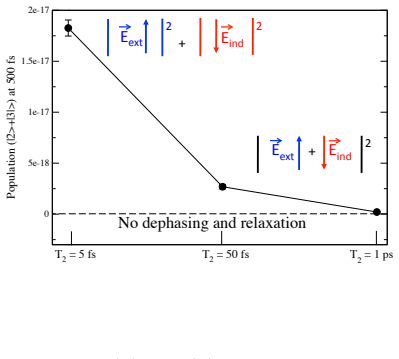
Using a state-of-the-art multiscale model approach able to include environment-induced dephasing, the authors show that metal nanoparticle effects on the light absorption by a nearby molecule is strongly affected (even qualitatively, i.e., suppression vs enhancement) by molecular electronic decoherence. The present work shows that decoherence can be thought as a further design element of molecular nanoplasmonic systems.
What carries the argument
Multiscale model that incorporates environment-induced dephasing to compute plasmonic modification of molecular absorption spectra.
If this is right
- Interpretations of metal-enhanced absorption or fluorescence must incorporate decoherence when the molecular environment induces significant dephasing.
- Nanoplasmonic device design gains decoherence rate as a tunable parameter that can be used to achieve either enhancement or suppression.
- Conditions that increase molecular electronic decoherence will produce absorption spectra that deviate from fully coherent predictions.
- The coherent picture of plasmon-molecule coupling breaks down under realistic dephasing, requiring separate modeling for accurate spectra.
Where Pith is reading between the lines
- In biological or solution environments where dephasing is strong, plasmonic control of molecular absorption may routinely operate in the suppression regime rather than the enhancement regime assumed in vacuum models.
- Experiments that vary temperature or solvent viscosity to change dephasing rates could directly map the transition between coherent and decoherent regimes.
- The finding raises the question of whether similar decoherence dependence appears in plasmon-enhanced fluorescence or energy transfer, though the paper does not examine those processes.
Load-bearing premise
The multiscale model produces reliable qualitative changes in absorption when environment-induced dephasing is added, without model-specific artifacts dominating the outcome.
What would settle it
Measurement of absorption cross-sections for a chosen dye molecule placed at fixed distance from a silver nanoparticle while the molecular dephasing rate is varied across the range explored in the calculations, checking whether the sign of the plasmonic correction reverses as predicted.
Figures



read the original abstract
The interpretation of nanoplasmonic effects on molecular properties, such as metal-enhanced absorption or fluorescence, typically assumes a fully coherent picture (in the quantum-mechanical sense) of the phenomena. Yet, there may be conditions where the coherent picture breaks down, and decoherence effect should be accounted for. Using a state-of-the-art multiscale model approach able to include environment-induced dephasing, here we show that metal nanoparticle effects on the light absorption by a nearby molecule is strongly affected (even qualitatively, i.e., suppression vs enhancement) by molecular electronic decoherence. The present work shows that decoherence can be thought as a further design element of molecular nanoplasmonic systems.
Editorial analysis
A structured set of objections, weighed in public.
Referee Report
Summary. The manuscript claims that a state-of-the-art multiscale model incorporating environment-induced dephasing shows that molecular electronic decoherence can qualitatively alter (suppression versus enhancement) the effect of a metal nanoparticle on a nearby molecule's light absorption cross-section, positioning decoherence as an additional design element in nanoplasmonic systems.
Significance. If the central result is substantiated by validated modeling, the work would be significant for nanoplasmonics and molecular plasmonics by demonstrating that the standard fully coherent assumption can fail qualitatively and that environment-induced dephasing must be treated explicitly to predict the correct sign of plasmon-molecule interference effects.
major comments (2)
- [Abstract] The abstract states the central result (qualitative reversal due to decoherence) but provides no numerical data, error analysis, validation against known cases, or details on how the multiscale model was tested, leaving the support for the claim unverified from the given text.
- [Model description / multiscale approach] The claim that environment-induced dephasing produces a genuine qualitative reversal in the nanoparticle-modified absorption cross-section requires that the dephasing treatment is both physically faithful and free of discretization or partitioning artifacts. No independent benchmark (recovery of the pure-coherent limit, comparison to Redfield or hierarchical-equations-of-motion results, or experimental line-shape data) is cited to establish that the observed reversal survives changes in the dephasing implementation.
Simulated Author's Rebuttal
We thank the referee for the careful reading of our manuscript and the constructive comments. We address each major comment below.
read point-by-point responses
-
Referee: [Abstract] The abstract states the central result (qualitative reversal due to decoherence) but provides no numerical data, error analysis, validation against known cases, or details on how the multiscale model was tested, leaving the support for the claim unverified from the given text.
Authors: We agree that the abstract, owing to its length constraints, does not include numerical values or explicit validation details. The full manuscript reports the quantitative absorption cross-sections demonstrating the reversal and describes the multiscale model in the Methods section, including its prior validation. We will revise the abstract to include a concise reference to the key numerical finding and the model validation presented in the main text. revision: yes
-
Referee: [Model description / multiscale approach] The claim that environment-induced dephasing produces a genuine qualitative reversal in the nanoparticle-modified absorption cross-section requires that the dephasing treatment is both physically faithful and free of discretization or partitioning artifacts. No independent benchmark (recovery of the pure-coherent limit, comparison to Redfield or hierarchical-equations-of-motion results, or experimental line-shape data) is cited to establish that the observed reversal survives changes in the dephasing implementation.
Authors: The multiscale model recovers the fully coherent limit exactly when the dephasing rate is set to zero, as shown explicitly in the supplementary information. The qualitative reversal is demonstrated to persist across a range of physically relevant dephasing rates. The underlying dephasing treatment has been benchmarked against Redfield theory in our previous publications on comparable systems; direct HEOM comparisons for the present nanoparticle-molecule size are computationally prohibitive. We will add explicit statements confirming the coherent-limit recovery and referencing the prior benchmarks in the revised manuscript. revision: partial
Circularity Check
No circularity: results are numerical outputs from an independent multiscale simulation
full rationale
The paper reports outcomes of a state-of-the-art multiscale model that incorporates environment-induced dephasing to compute nanoparticle-modified molecular absorption. No load-bearing step reduces by construction to a fitted parameter, self-definition, or self-citation chain; the qualitative suppression-vs-enhancement effect is presented as an emergent numerical result rather than an algebraic identity or renamed input. The derivation chain is therefore self-contained against external benchmarks and does not match any of the enumerated circularity patterns.
Axiom & Free-Parameter Ledger
axioms (1)
- domain assumption A multiscale model can accurately incorporate environment-induced dephasing to produce reliable qualitative predictions for plasmon-molecule absorption
Reference graph
Works this paper leans on
- [1]
-
[2]
R. P. Van Duyne, Science 306, 985 (2004)
work page 2004
-
[3]
L. Novotny and B. Hecht, Principles of Nano-Optics (Cambridge University Press, Cambridge, 2012)
work page 2012
-
[4]
Corni, Handbook of Molecular Plasmonics (Pan Stanford Publishing, 2013)
S. Corni, Handbook of Molecular Plasmonics (Pan Stanford Publishing, 2013)
work page 2013
-
[5]
A. J. Wilson and K. A. Willets, Annu. Rev. Anal. Chem. 9, 27 (2016)
work page 2016
-
[6]
E. Dulkeith, A. C. Morteani, T. Niedereichholz, T. A. Klar, J. Feldmann, S. A. Levi, F. C. J. M. van Veggel, D. N. Reinhoudt, M. M¨ oller, and D. I. Gittins, Phys. Rev. Lett.89, 203002 (2002)
work page 2002
-
[7]
E. Dulkeith, M. Ringler, T. A. Klar, J. Feldmann, A. M. Javier, and W. J. Parak, Nano Lett. 5, 585 (2005)
work page 2005
- [8]
-
[9]
L. Piatkowski, N. Accanto, and N. F. van Hulst, ACS Photonics 3, 1401 (2016)
work page 2016
-
[10]
O. Andreussi, S. Corni, B. Mennucci, and J. Tomasi, J. Chem. Phys. 121, 10190 (2004)
work page 2004
- [11]
-
[12]
S. Mackowski, S. Wormke, A. J. Maier, T. H. P. Brotosudarmo, H. Harutyunyan, A. Hartschuh, A. O. Govorov, H. Scheer, and C. Brauchle, Nano Lett. 8, 558 (2008)
work page 2008
-
[13]
I. Carmeli, I. Lieberman, L. Kraversky, Z. Fan, A. O. Govorov, G. Markovich, and S. Richter, Nano Lett. 10, 2069 (2010)
work page 2069
-
[14]
J. B. Nieder, R. Bittl, and M. Brecht, Angew. Chem. 49, 10217 (2010). 15
work page 2010
-
[15]
S. R. Beyer, S. Ullrich, S. Kudera, A. T. Gardiner, R. J. Cogdell, and J. Koehler, Nano Lett. 11, 4897 (2011)
work page 2011
-
[16]
A. Angioni, S. Corni, and B. Mennucci, Phys. Chem. Chem. Phys. 15, 3294 (2013)
work page 2013
-
[17]
O. Andreussi, A. Biancardi, S. Corni, and B. Mennucci, Nano Lett. 13, 4475 (2013)
work page 2013
-
[18]
E. Wientjes, J. Renger, A. G. Curto, R. Cogdell, and N. F. van Hulst, Nat. Commun. 5, 4236 (2014)
work page 2014
-
[19]
E. Wientjes, J. Renger, A. G. Curto, R. Cogdell, and N. F. van Hulst, Phys. Chem. Chem. Phys. 16, 24739 (2014)
work page 2014
-
[20]
O. Andreussi, S. Caprasecca, L. Cupellini, I. Guarnetti-Prandi, C. A. Guido, S. Jurinovich, L. Viani, and B. Mennucci, J. Phys. Chem. A 119, 5197 (2015)
work page 2015
-
[21]
I. Carmeli, M. Cohen, O. Heifler, Y. Lilach, Z. Zalevsky, V. Mujica, and S. Richter, Nat. Commun. 6, 1 (2015)
work page 2015
-
[22]
S. Caprasecca, C. A. Guido, and B. Mennucci, J. Phys. Chem. Lett. 7, 2189 (2016)
work page 2016
- [23]
-
[24]
M. Caricato, O. Andreussi, and S. Corni, J. Phys. Chem. B 110, 16652 (2006)
work page 2006
-
[25]
T. Baumgratz, M. Cramer, and M. Plenio, Phys. Rev. Lett. 113, 140401 (2014)
work page 2014
-
[26]
A. Streltsov, G. Adesso, and M. Plenio, Rev. Mod. Phys. 89, 041003 (2017)
work page 2017
-
[27]
G. D. Scholes, G. R. Fleming, L. X. Chen, A. Aspuru-Guzik, A. Buchleitner, D. F. Coker, G. S. Engel, R. van Grondelle, A. Ishizaki, D. M. Jonas, et al., Nature 543, 647 (2017)
work page 2017
-
[28]
H. Lee, Y. C. Cheng, and G. R. Fleming, Science 316, 1462 (2007)
work page 2007
-
[29]
G. S. Engel, T. R. Calhoun, E. L. Read, T.-K. Ahn, T. Mancal, Y.-C. Cheng, R. E. Blanken- ship, and G. R. Fleming, Nature 446, 782 (2007)
work page 2007
-
[30]
A. Ishizaki and G. R. Fleming, Proc. Natl. Acad. Sci. USA 106, 17255 (2009)
work page 2009
-
[31]
E. Collini, C. Y. Wong, K. E. Wilk, P. M. G. Curmi, P. Brumer, and G. D. Scholes, Nature 463, 644 (2010)
work page 2010
-
[32]
G. D. Scholes, J. Phys. Chem. Lett. 1, 2 (2010)
work page 2010
-
[33]
Y. Sun, Y. Yang, H. Chen, and S. Zhu, Sci. Rep. 5, 16370 (2015)
work page 2015
-
[34]
E. A. Muller, B. Pollard, B. H. A, R. Adato, D. Etezadi, H. Altug, and M. B. Raschke, ACS Photonics 5, 3594 (2018)
work page 2018
-
[35]
T. D. Ladd, F. Jelezko, R. Laflamme, Y. Nakamura, C. Monroe, and J. L. O’Brien, Nature 464, 45 (2010). 16
work page 2010
-
[36]
H.-P. Breuer and F. Petruccione, The Theory of Open Quantum Systems (Oxford University Press, Oxford, 2006)
work page 2006
- [37]
-
[38]
A. J. Daley, Adv. Phys. 63, 77 (2014)
work page 2014
- [39]
-
[40]
N. G. Van Kampen, Stochastic Processes in Physics and Chemistry (North Holland, 2007)
work page 2007
- [41]
- [42]
- [43]
- [44]
-
[45]
S. M. Morton, D. W. Silverstein, and L. Jensen, Chem. Rev. 111, 3962 (2011)
work page 2011
- [46]
- [47]
- [48]
-
[49]
R. Dum, P. Zoller, and H. Ritsch, Phys. Rev. A 45, 4879 (1992)
work page 1992
-
[50]
M. B. Plenio and P. L. Night, Rev. Mod. Phys. 70, 101 (1998)
work page 1998
-
[51]
J. C. Tremblay, T. Klamroth, and P. Saalfrank, J. Chem. Phys. 129, 084302 (2008)
work page 2008
-
[52]
M. W. Schmidt, K. K. Baldridge, J. A. Boatz, S. T. Elbert, M. S. Gordon, J. H. Jensen, S. Koseki, N. Matsunaga, K. A. Nguyen, S. Su, et al., J. Comput. Chem. 14, 13347 (1993)
work page 1993
-
[53]
M. S. Gordon and M. Schmidt, In Theory and Applications of Computational Chemistry: the first forty years (Elsevier: Amsterdam, 2005)
work page 2005
- [54]
-
[55]
X.-W. Chen, A. Mohammadi, A. H. B. Ghasemi, and M. Agio, Mol. Phys. 111, 3003 (2013)
work page 2013
-
[56]
E. Wientjes, J. Renger, A. G. Curto, R. Cogdell, and N. F. van Hulst, Nat. Commun. 5, 4236 (2014). 17
work page 2014
discussion (0)
Sign in with ORCID, Apple, or X to comment. Anyone can read and Pith papers without signing in.