REVIEW 4 major objections 4 minor 44 references
The effect of thermal history on the atomic structure and mechanical properties of amorphous alloys
T0 review · 4 major / 4 minor · reviewed 2026-08-14 · deepseek-v4-flash
Pith's one-line read In a simulated binary metallic glass, annealing closer to the glass transition temperature lowers the potential energy and raises the shear modulus and yield stress, while higher annealing temperatures produce ductile, homogeneous deformation.
desk verdict A competent, systematic MD scan of annealing temperature in the Kob-Andersen glass; the qualitative trends are believable, but the low-Ta data and the Ta=fictive-temperature assumption need more support before the strong claims are published as-is. read the letter →
The pith
A machine-rendered reading of the paper's core claim, the machinery that carries it, and where it could break.
The reading
Extended reading notes
Core claim
The abstract states that 'glasses prepared at higher annealing temperatures are relocated to higher energy states and their average glass structure remains more disordered' and that 'both the shear modulus and yielding peak increase significantly when the annealing temperature approaches T_g from above,' with the deformation mode changing 'from brittle to ductile upon increasing annealing temperature.' If the paper is correct, thermal history alone, specifically the annealing temperature before a rapid quench, sets the energy, short-range order, elastic modulus, yield stress, and strain-rate sensitivity of the model metallic glass.
Load-bearing premise
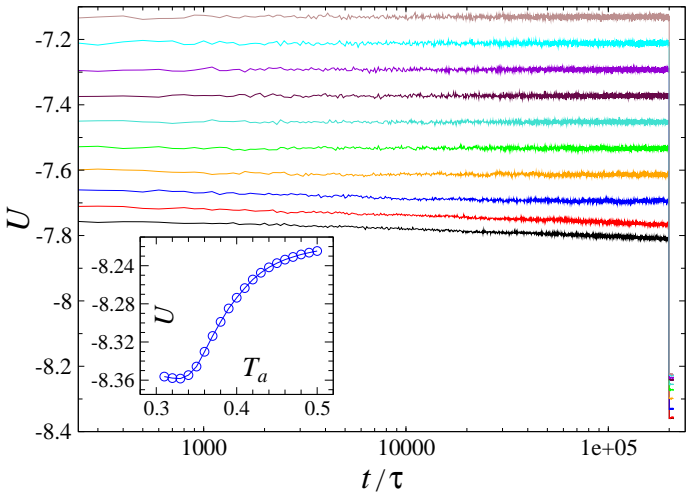
The load-bearing premise is that the instantaneous quench to T_LJ = 0.01 preserves the structure equilibrated at T_a, so that T_a can be equated with the fictive temperature. The paper states this in Section III: 'In the limiting case of an infinitely fast quenching rate, used in the present study, the fictive temperature essentially coincides with the annealing temperature at which the system is equilibrated before the quench.' At low T_a the assumption is fragile, because aging during 2x10^5 tau is incomplete: the MSD value of 1.64 sigma^2 at T_a = 0.32 indicates ongoing structural relaxation, and the paper reports (without showing) that U measured at 0.01 increases when T_a is reduced below 0.30. If the quench does not faithfully freeze the T_a state, the attributed annealing-temperature trends would be mixed with quench-rate and aging artifacts.
Signed reviews
Editorial analysis
A structured set of objections, weighed in public.
Referee Report
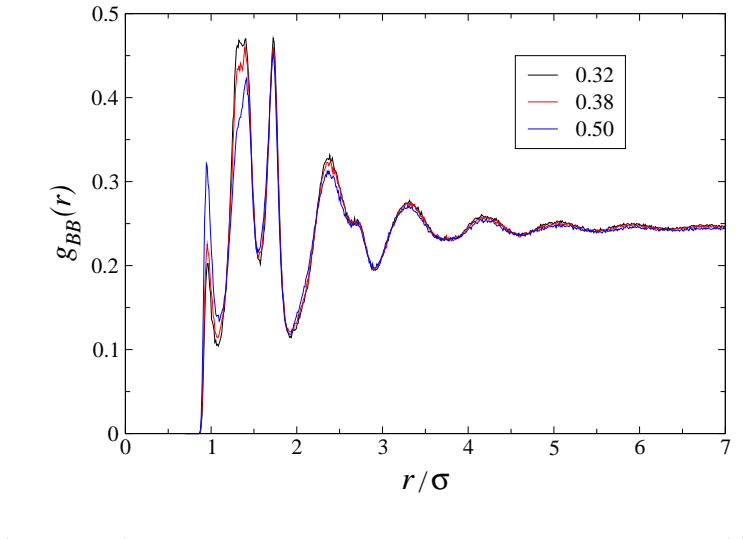
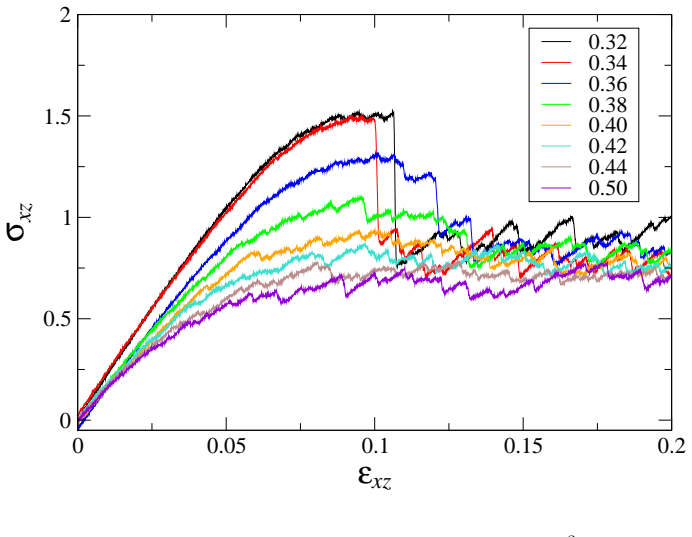
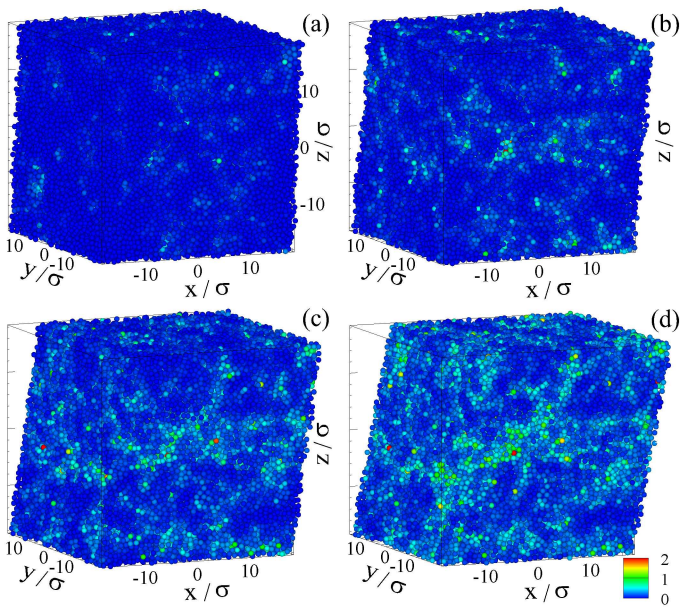
Summary. This manuscript reports molecular-dynamics simulations of the Kob-Andersen 80:20 binary Lennard-Jones mixture (N = 60,000) aimed at isolating the effect of the annealing temperature Ta on the structure and mechanical response of the resulting glass. The preparation protocol is: cool from T = 1.0 to Ta in 10^4 tau, hold at Ta for 2 x 10^5 tau, quench instantaneously to T = 0.01, relax for 10^4 tau, then shear at constant volume at strain rates from 10^-5 to 10^-3 tau^-1. The paper reports that the potential energy after quenching decreases as Ta approaches Tg ≈ 0.35 from above; that the nearest-neighbor peak of g_BB becomes less pronounced at lower Ta; that the shear modulus and stress-overshoot peak increase strongly as Ta decreases toward Tg; that the shear modulus becomes strain-rate dependent only for Ta > Tg; and that nonaffine-displacement snapshots show a transition from shear-band localization at Ta = 0.32 to homogeneous deformation at Ta = 0.50. The authors frame these results as evidence that thermal history, specifically the fictive temperature set by Ta, controls the energy, short-range order, and mechanical properties of the model metallic glass.
Significance. If the central premise is accepted, the paper provides a clean computational demonstration of fictive-temperature control over the mechanical properties of a model metallic glass, complementing recent experimental work on toughening transitions. The qualitative trends—higher energy and more disordered structure for higher Ta, larger modulus and yield stress near Tg from above, and a brittle-to-ductile crossover—are physically reasonable and are supported by the stress-strain curves, energy curves, and nonaffine snapshots. The paper also has strengths in explicit multi-sample averaging over 15 independent samples, a well-defined preparation protocol, and a clear attempt to connect the results to the fictive-temperature framework. However, the load-bearing identification of Ta with the fictive temperature is not established at low Ta, where structural relaxation is incomplete; because the Ta = 0.32 and 0.34 data in Figs. 3-5 are in this regime, the claimed annealing-temperature trends are not fully isolated from aging and cooling-history effects. The omitted low-Ta data and the absence of error bars in Fig. 4 further limit the quantitative robustness of the transition claim.
major comments (4)
- [III, after Fig. 1; fictive-temperature identification] The claim that Ta equals the fictive temperature is load-bearing and is not supported for Ta ≤ 0.36. Figure 1 shows that the potential energy continues to decrease during the entire 2 x 10^5 tau annealing interval at these temperatures, and the reported MSD of about 1.64 sigma^2 at Ta = 0.32 indicates ongoing structural relaxation. Therefore the instantaneous quench does not freeze an equilibrated Ta structure, and the trends for Ta = 0.32 and 0.34 in Figs. 3-5 may reflect partial aging during the finite annealing window rather than the equilibrium state at Ta. The authors should demonstrate that longer annealing (or an independent measurement of the fictive temperature, e.g., from the inherent-structure energy) leaves the reported trends unchanged, or restrict the central claims to the equilibrated range.
- [III, inset to Fig. 1; abstract] The text states that for 0.28 ≤ Ta ≤ 0.30 the potential energy U measured at TLJ = 0.01 increases as Ta is decreased, but these data are not shown. This nonmonotonicity means that the potential energy is not a single-valued function of Ta, and the abstract's statement that 'glasses prepared at higher annealing temperatures are relocated to higher energy states' is therefore valid only over the restricted range 0.32-0.50. The omitted data should be included, and the abstract and conclusions should be qualified accordingly.
- [III, Fig. 4] No error bars or other measures of statistical uncertainty are given for sigma_Y and G despite the statement that the data are averaged over 15 independent samples. The central quantitative claims—that the mechanical properties change sharply when Ta crosses Tg and that the shear modulus becomes strain-rate dependent only for Ta > Tg—cannot be assessed without an indication of the sample-to-sample scatter. Error bars (or a table of mean plus or minus standard error) should be added to Fig. 4 and its inset.
- [III, definition of Tg] The value Tg ≈ 0.35 is taken from the author's prior work [13] and was obtained with a cooling-rate protocol (10^-5 epsilon/kB tau); this value is then used to locate the mechanical transition in Fig. 4. Since the glass transition temperature depends on the cooling rate and the thermal protocol, the location of the observed transition relative to Tg should either be confirmed within the present preparation protocol or discussed as potentially shifted relative to the cited value.
minor comments (4)
- [Throughout] Exponents are frequently missing in the text (e.g., '10 4tau' and '2 x 10 5tau'); these should be typeset as 10^4 tau and 2 x 10^5 tau.
- [III, nonaffine-displacement definition] The sentence containing 'the nonaddine measure' should read 'the nonaffine measure'.
- [References] Reference [39] on laser welding of glasses appears unrelated to the discussion of fictive temperature; please verify whether it was intended to be cited or replace it with a more relevant reference.
- [III, Figs. 5-7] The brittle-to-ductile interpretation is based on snapshots from individual samples; the authors should state whether the deformation-mode change was observed consistently in all 15 samples.
Circularity Check
No circularity: central results are direct MD observables; self-cited Tg is a non-load-bearing reference.
full rationale
The paper's claims are supported by direct molecular dynamics measurements: potential energy after quenching, g_BB(r), stress-strain curves, shear modulus, yield stress, and nonaffine displacement fields, all computed from trajectories of a standard Kob-Andersen mixture. The independent variable is the annealing temperature Ta; no output quantity is fitted to the claimed trends, and no prediction reduces to an input by construction. The only imported numerical value is Tg ≈ 0.35, cited from the author's earlier work [13]; it is used solely to label the temperature region 'near Tg' and does not enter the computation of U, G, or σY. That prior value is a separate simulation result with stated assumptions that do not include the present mechanical data, so it is not a circular load-bearing self-citation. The paper itself flags validity limitations in Section III: incomplete aging at Ta ≤ 0.36 (MSD ≈ 1.64 σ² at Ta = 0.32) and a non-monotonic quenched energy for Ta ≤ 0.30, with the passage 'Test simulations at lower annealing temperatures, 0.28ε/kB ⩽Ta ⩽ 0.30ε/kB, have shown thatU, measured at TLJ = 0.01ε/kB, continues to increase upon further reducing Ta (not shown).' These are correctness concerns about whether Ta equals the fictive temperature at low Ta, not circularity, because the mechanical observables are independent of that equality.
Assumptions & free parameters
free parameters (3)
- Glass transition temperature T_g =
0.35 epsilon/k_B (LJ units)
- Annealing equilibration time =
2 x 10^5 tau
- Linear cooling time from T=1.0 to T_a =
10^4 tau
assumptions (5)
- domain assumption The Kob-Andersen binary Lennard-Jones mixture is a valid proxy for metallic glasses.
- domain assumption The cited value T_g = 0.35 epsilon/k_B applies to the preparation protocol used here.
- domain assumption Instantaneous quenching to T_LJ = 0.01 freezes the T_a structure without altering it.
- domain assumption The Falk-Langer nonaffine displacement measure identifies localized shear transformations.
- domain assumption Periodic boundary conditions do not bias the observed shear band orientation or the brittle-to-ductile interpretation.
Cite this review
Pith. "Pith review of The effect of thermal history on the atomic structure and mechanical properties of amorphous alloys." pith.science (2026). https://pith.science/paper/P6TQ67QT
@misc{pith2026190800464,
  author       = {Pith},
  title        = {Pith review of: The effect of thermal history on the atomic structure and mechanical properties of amorphous alloys},
  year         = {2026},
  howpublished = {\url{https://pith.science/paper/P6TQ67QT}},
  note         = {Machine review of arXiv:1908.00464}
}
abstract
The influence of thermal processing on the potential energy, atomic structure, and mechanical properties of metallic glasses is examined using molecular dynamics simulations. We study the three-dimensional binary mixture, which was first relaxed near the glass transition temperature, and then rapidly cooled deep into the glass phase. It was found that glasses prepared at higher annealing temperatures are relocated to higher energy states and their average glass structure remains more disordered, as reflected in the shape of the pair correlation function. The results of mechanical testing demonstrate that both the shear modulus and yielding peak increase significantly when the annealing temperature approaches $T_g$ from above. Moreover, the shear modulus becomes a strong function of strain rate only for samples equilibrated at sufficiently high temperatures. Based on the spatial distribution of nonaffine displacements, we show that the deformation mode changes from brittle to ductile upon increasing annealing temperature. These results can be useful for the design and optimization of the fabrication processes of bulk glassy alloys with improved plasticity.
Figures
Figures from the paper (4 more)


Reference graph
Works this paper leans on
-
[13]
N. V. Priezjev, Atomistic modeling of heat treatment processes for tuning the mechanical properties of disordered solids, J. Non-Cryst. Solids 518, 128 (2019)
2019
-
[1]
J. C. Qiao, Q. Wang, J. M. Pelletier, H. Kato, R. Casalini, D. Crespo, E. Pineda, Y. Yao, Y. Yang, Structural heterogeneities and mechanical behavior of amorphous alloys, Prog. Mater. Sci. 104, 250 (2019)
work page 2019
-
[2]
Y. Sun, A. Concustell, and A. L. Greer, Thermomechanical processing of metallic glasses: Extending the range of the glassy state, Nat. Rev. Mater. 1, 16039 (2016)
2016
-
[3]
Park, C.-M
K.-W. Park, C.-M. Lee, M. Wakeda, Y. Shibutani, M. L. Falk, and J.-C. Lee, Elastostatically induced structural disordering in amorphous alloys, Acta Materialia 56, 5440 (2008)
2008
-
[4]
Y. Tong, W. Dmowski, Y. Yokoyama, G. Wang, P. K. Liaw, and T. Egami, Recovering compressive plasticity of bulk metallic glasses by high-temperature creep, Scripta Materialia 69 570 (2013)
2013
-
[5]
A. L. Greer, and Y. H. Sun, Stored energy in metallic glasses due to strains within the elastic limit, Philos. Mag. 96, 1643 (2016)
2016
- [6]
-
[7]
J. Pan, Y. X. Wang, Q. Guo, D. Zhang, A. L. Greer, and Y. Li, Extreme rejuvenation and softening in a bulk metallic glass, Nat. Commun. 9, 560 (2018)
2018
Show all 44 references
-
[8]
Samavatian, R
M. Samavatian, R. Gholamipour, A. A. Amadeh, and S. Mirdamadi, Role of tensile elastostatic 9 loading on atomic structure and mechanical properties of Zr55Cu30Ni5Al10 bulk metallic glass, Mater. Sci. Eng. A 753, 218 (2019)
2019
-
[9]
N. V. Priezjev, Aging and rejuvenation during elastostatic loading of amorphous alloys: A molecular dynamics simulation study, Comput. Mater. Sci. 168, 125 (2019)
2019
-
[10]
Wakeda, J
M. Wakeda, J. Saida, J. Li, and S. Ogata, Controlled rejuvenation of amorphous metals with thermal processing, Sci. Rep. 5, 10545 (2015)
2015
-
[11]
Kuchemann, P
S. Kuchemann, P. M. Derlet, C. Liu, D. Rosenthal, G. Sparks, W. S. Larson, and R. Maass, Energy Storage in Metallic Glasses via Flash Annealing, Adv. Funct. Mater. 28, 1805385 (2018)
2018
-
[12]
M. Wang, H. Liu, J. Mo, Y. Zhang, Z. Chen, C. Yin, and W. Yang, Thermal-pressure effects on energy state of metallic glass Cu 50Zr50, Comput. Mater. Sci. 155, 493 (2018)
2018
-
[14]
S. V. Ketov, Y. H. Sun, S. Nachum, Z. Lu, A. Checchi, A. R. Beraldin, H. Y. Bai, W. H. Wang, D. V. Louzguine-Luzgin, M. A. Carpenter, and A. L. Greer, Rejuvenation of metallic glasses by non-affine thermal strain, Nature 524, 200 (2015)
2015
-
[15]
Shang, P
B. Shang, P. Guan, and J.-L. Barrat, Role of thermal expansion heterogeneity in the cryogenic rejuvenation of metallic glasses, J. Phys.: Mater. 1, 015001 (2018)
2018
-
[16]
N. V. Priezjev, The effect of cryogenic thermal cycling on aging, rejuvenation, and mechanical properties of metallic glasses, J. Non-Cryst. Solids 503, 131 (2019)
2019
-
[17]
Liu and N
Q.-L. Liu and N. V. Priezjev, The influence of complex thermal treatment on mechanical properties of amorphous materials, Comput. Mater. Sci. 161, 93 (2019)
2019
-
[18]
W. Guo, J. Saida, M. Zhao, S. Lu, and S. Wu, Rejuvenation of Zr-based bulk metallic glass matrix composite upon deep cryogenic cycling, Materials Letters 247, 135 (2019)
2019
-
[19]
N. V. Priezjev, Heterogeneous relaxation dynamics in amorphous materials under cyclic load- ing, Phys. Rev. E 87, 052302 (2013)
2013
-
[20]
Fiocco, G
D. Fiocco, G. Foffi, and S. Sastry, Oscillatory athermal quasistatic deformation of a model glass, Phys. Rev. E 88, 020301(R) (2013)
2013
-
[21]
Regev, T
I. Regev, T. Lookman, and C. Reichhardt, Onset of irreversibility and chaos in amorphous solids under periodic shear, Phys. Rev. E 88, 062401 (2013)
2013
-
[22]
N. V. Priezjev, Dynamical heterogeneity in periodically deformed polymer glasses, Phys. Rev. 10 E 89, 012601 (2014)
2014
-
[23]
Regev, J
I. Regev, J. Weber, C. Reichhardt, K. A. Dahmen, and T. Lookman, Reversibility and criti- cality in amorphous solids, Nat. Commun. 6, 8805 (2015)
2015
-
[24]
N. V. Priezjev, Reversible plastic events during oscillatory deformation of amorphous solids, Phys. Rev. E 93, 013001 (2016)
2016
-
[25]
N. V. Priezjev, Nonaffine rearrangements of atoms in deformed and quiescent binary glasses, Phys. Rev. E 94, 023004 (2016)
2016
-
[26]
Leishangthem, A
P. Leishangthem, A. D. S. Parmar, and S. Sastry, The yielding transition in amorphous solids under oscillatory shear deformation, Nat. Commun. 8, 14653 (2017)
2017
-
[27]
N. V. Priezjev, Collective nonaffine displacements in amorphous materials during large- amplitude oscillatory shear, Phys. Rev. E 95, 023002 (2017)
2017
-
[28]
N. V. Priezjev, Molecular dynamics simulations of the mechanical annealing process in metallic glasses: Effects of strain amplitude and temperature, J. Non-Cryst. Solids 479, 42 (2018)
2018
-
[29]
N. V. Priezjev, The yielding transition in periodically sheared binary glasses at finite temper- ature, Comput. Mater. Sci. 150, 162 (2018)
2018
-
[30]
Y. C. Lo, H. S. Chou, Y. T. Cheng, J. C. Huang, J. R. Morris, P. K. Liaw, Structural relaxation and self-repair behavior in nano-scaled Zr-Cu metallic glass under cyclic loading: Molecular dynamics simulations, Intermetallics 18, 954 (2010)
2010
-
[31]
N. V. Priezjev, Slow relaxation dynamics in binary glasses during stress-controlled, tension- compression cyclic loading, Comput. Mater. Sci. 153, 235 (2018)
2018
-
[32]
Kumar, P
G. Kumar, P. Neibecker, Y. H. Liu, and J. Schroers, Critical fictive temperature for plasticity in metallic glasses, Nat. Commun. 4, 1536 (2013)
2013
-
[33]
Ketkaew, W
J. Ketkaew, W. Chen, H. Wang, A. Datye, M. Fan, G. Pereira, U. D. Schwarz, Z. Liu, R. Yamada, W. Dmowski, M. D. Shattuck, C. S. O’Hern, T. Egami, E. Bouchbinder, and J. Schroers, Mechanical glass transition revealed by the fracture toughness of metallic glasses, Nat. Commun. 9...
2018
-
[34]
Kob and H
W. Kob and H. C. Andersen, Testing mode-coupling theory for a supercooled binary Lennard- Jones mixture: The van Hove correlation function, Phys. Rev. E 51, 4626 (1995)
1995
-
[35]
T. A. Weber and F. H. Stillinger, Local order and structural transitions in amorphous metal- metalloid alloys, Phys. Rev. B 31, 1954 (1985)
1985
-
[36]
S. J. Plimpton, Fast parallel algorithms for short-range molecular dynamics, J. Comp. Phys. 11 117, 1 (1995)
1995
-
[37]
M. P. Allen and D. J. Tildesley, Computer Simulation of Liquids (Clarendon, Oxford, 1987)
1987
-
[38]
A. Q. Tool, Relation between inelastic deformability and thermal expansion of glass in its annealing range, J. Am. Ceram. Soc. 29, 240 (1946)
1946
-
[39]
Richter, F
S. Richter, F. Zimmermann, A. Tunnermann, and S. Nolte, Laser welding of glasses at high repetition rates – Fundamentals and prospects, Optics and Laser Technology 83, 59 (2016)
2016
-
[40]
M. Utz, P. G. Debenedetti, and F. H. Stillinger, Atomistic simulation of aging and rejuvenation in glasses, Phys. Rev. Lett. 84, 1471 (2000)
2000
-
[41]
Vollmayr, W
K. Vollmayr, W. Kob, and K. Binder, How do the properties of a glass depend on the cooling rate? A computer simulation study of a Lennard-Jones system, J. Chem. Phys. 105, 4714 (1996)
1996
-
[42]
F. H. Stillinger and T. A. Weber, Packing structures and transitions in liquids and solids, Science 225, 983 (1984)
1984
-
[43]
M. L. Falk and J. S. Langer, Dynamics of viscoplastic deformation in amorphous solids, Phys. Rev. E 57, 7192 (1998)
1998
-
[44]
G. P. Shrivastav, P. Chaudhuri, and J. Horbach, Yielding of glass under shear: A directed percolation transition precedes shear-band formation, Phys. Rev. E 94, 042605 (2016). 12 Figures 13 1000 10000 1e+05 t / τ -8.4 -8.2 -8 -7.8 -7.6 -7.4 -7.2U 0.3 0.4 0.5 Ta-8.36 -8.32 -8.2...
2016
Reviewed August 14, 2026 · model on record in the stance chip above.
Discussion (0). Continue with ORCID to comment.