REVIEW 3 major objections 3 minor 48 references
Interplay between surface and bending energy helps membrane protrusion formation
T0 review · 3 major / 3 minor · reviewed 2026-08-14 · deepseek-v4-flash
Pith's one-line read For a fixed bending rigidity, a membrane pushed by growing filaments moves fastest at intermediate surface tension: the protrusion-energy cost itself is non-monotonic in tension.
desk verdict A directly simulated non-monotonic protrusion velocity vs surface tension, with a plausible shape-change mechanism, but the linearized Hamiltonian is used where gradients may be too large — needs a nonlinear check and error bars. read the letter →
The pith
A machine-rendered reading of the paper's core claim, the machinery that carries it, and where it could break.
The reading
What carries the argument
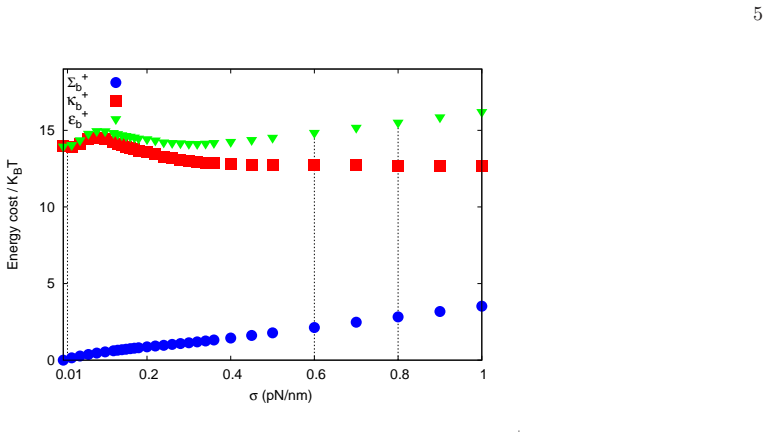
The machinery is the discrete Helfrich Hamiltonian, $H = \sigma \sum_i (h_i-h_{i-1})^2 + \kappa \sum_i (h_{i-1}-2h_i+h_{i+1})^2$, where $h_i$ is a one-dimensional height field on a lattice and $\sigma$, $\kappa$ are proportional to surface tension and bending rigidity. From this Hamiltonian the paper derives the energy cost of raising or lowering the binding-site height by one polymer-monomer step $\delta$, and decomposes it into a surface part $\Sigma_b^\pm$ controlled by the second difference $h''_b$ and a bending part $K_b^\pm$ controlled by the discrete fourth derivative $h''''_b = h_{b-2} - 4h_{b-1} + 6h_b - 4h_{b+1} + h_{b+2}$. The fourth derivative is the load-bearing quantity: it rises as the protrusion kink sharpens and then falls when the membrane switches to a rounded profile, making $K_b^+$ peak with $\sigma$. A linearized evolution equation with a point force, solved in the co-moving frame, gives an analytic height profile of the same shape-switching form used to support the mechanism.
What would settle it
Rerun the lattice model with the full nonlinear Helfrich Hamiltonian at $\kappa = 1.2$ pN/nm from $\sigma = 0.01$ to $0.8$ pN/nm: if the bending-energy peak and the velocity rise vanish, the claimed effect is an artifact of linearization.
Extended reading notes
Core claim
At a fixed bending rigidity $\kappa$, the membrane velocity $V$ is not a monotonic function of surface tension $\sigma$. For small $\kappa$, $V$ decreases with $\sigma$, as expected. For moderate or large $\kappa$, $V$ first falls to a minimum, then rises to a maximum, and finally decays exponentially for large $\sigma$. The paper locates the origin of this in the energy cost $E_b^+$ of raising the binding-site height by one monomer step: the surface-energy part $\Sigma_b^+$ increases monotonically with $\sigma$, but the bending-energy part $K_b^+$ has a peak. Because of this peak, there is a range of $\sigma$ where the total protrusion-energy cost decreases as tension increases, making protrusion formation easier. The mechanism is a qualitative shape change near the binding site: at large tension the height profile is almost linear, at intermediate tension its slope steepens, and at low tension it switches to a rounded form with a smaller curvature contribution.
Load-bearing premise
The energy calculation is done with a linearized Helfrich Hamiltonian that assumes height gradients are small everywhere; at the lowest surface tensions the simulated protrusions are hundreds of nanometers high, so this assumption may not hold.
Editorial extensions
If this is right
- At moderate or large $\kappa$, increasing $\sigma$ from zero first slows the membrane, then accelerates it to a peak, then drives an exponential decay; the dip-and-peak is a prediction that can be looked for in force-velocity curves.
- The peak tension $\sigma^*$ shifts to smaller values as $\kappa$ grows, and also as the membrane's relaxation time-scale $S/L$ grows, so stiffer or faster-fluctuating membranes show the rise at lower tension.
- For small $\kappa$ the effect disappears: the height profile stays linear at all tensions and $V$ falls monotonically with $\sigma$.
- If the filament monomer step $d$ is larger than the membrane fluctuation step $\delta$, the peak in $V$ survives but the preceding minimum is absent, and the rise is driven by the tension dependence of downward membrane moves.
- At large $\sigma$, $V$ decays as $\exp(-2\beta\delta^2\sigma)$, consistent with a nearly flat membrane whose only remaining cost is surface energy.
Reading between the lines
- If the shape-switch mechanism is generic, the same non-monotonic energy cost should appear whenever a localized pusher deforms any interface governed by a quadratic surface-plus-bending energy; one test is to look for it in reconstituted lipid vesicles pushed by actin comet tails.
- The two-dimensional version is left open by the authors; a concrete extension would be to simulate the 2D Helfrich membrane with pushing filaments near a flat barrier and measure whether the peak-tension position moves to higher or lower values when bending energy is larger.
- The dependence of the peak position on the membrane/filament time-scale ratio suggests a dynamical criterion: tuning membrane fluidity or filament speed could move a cell in or out of the tension-helpful regime, which is a testable prediction even though the paper does not make it.
Signed reviews
Editorial analysis
A structured set of objections, weighed in public.
Referee Report
Summary. The manuscript studies a one-dimensional lattice model of an elastic membrane pushed by polymerizing filaments, with the membrane height governed by a linearized Helfrich Hamiltonian that includes surface and bending terms. Using kinetic Monte Carlo simulations, the authors report that for fixed moderate or large bending rigidity κ, the average membrane velocity V as a function of surface tension σ is non-monotonic: V first decreases to a minimum, then increases to a maximum, and finally decays exponentially. They decompose the energy cost of a protrusion at the filament binding site into surface and bending contributions and show that the bending contribution, and hence the total cost, has a peak as a function of σ, so that over a range of σ increasing surface tension lowers the cost of protrusion. The mechanism is attributed to a qualitative change in the membrane shape around the binding site, from a sharply kinked linear profile at high σ to a rounded profile at low σ, which reduces the fourth derivative of the height. An approximate analytical calculation of the velocity from the energy costs is offered to explain the full V–σ curve.
Significance. If the reported effect is real, it is a counterintuitive and potentially important result for models of actin-driven membrane protrusion: surface tension, normally expected to suppress protrusions, can enhance them through its interplay with bending rigidity. The paper's strengths are its simple, clearly specified model; direct stochastic simulation of the full dynamics; checks of system-size dependence (Fig. S-5); and an explicit parameter set in physical units that makes the prediction testable. The central non-monotonicity is large (roughly a factor of 3 in V) and appears smoothly over many values of σ, which makes it unlikely to be a small-sample artifact. However, the physical relevance of the result depends on the validity of the linearized Hamiltonian in the low-σ regime, and the absence of statistical error bars weakens the quantitative support.
major comments (3)
- [Sec. II, Eq. (1), Fig. 5(c)] The linearization of the Helfrich Hamiltonian is asserted but never quantitatively validated. The non-monotonicity in E_b^+ and V occurs precisely at small σ where protrusion amplitudes are largest: Fig. 5(c) shows heights of roughly 400–500 nm, and the manuscript never reports the maximum value of |h_i − h_{i−1}| or the magnitude of the neglected quartic surface term relative to σ(h_i − h_{i−1})^2. Since Eqs. (2)–(5) and the Metropolis rates all derive from the quadratic Hamiltonian, if height gradients approach order unity on the lattice scale, the bending-energy peak and the velocity dip-and-peak could be artifacts of the linearization. The analytical check in Sec. III of the Supplementary Material (Eqs. S-1 and S-2) uses the same linearized operator and therefore cannot serve as independent validation. Please provide a quantitative gradient check over the full σ range, including σ = 0.01, and if necessary repeat the energy-cost calculation with the full nonlinear surface term.
- [Figs. 3–5 and supplementary figures] No error bars or number of independent runs are reported for any averaged quantity. The central claim is the non-monotonic dip-and-peak in V(σ) and the corresponding peak in E_b^+(σ); without statistical uncertainties the reader cannot judge whether the dip and peak are significant or whether the apparent decrease of E_b^+ after the peak is within noise. Please report standard errors over independent steady-state runs for the main curves (at least Figs. 3 and 4).
- [Sec. III.C, Eqs. (3)–(5)] The 'more quantitative explanation' replaces the fluctuating local energy costs E_b^± by their steady-state averages inside exponential rates. Because the exponential is nonlinear, this replacement is not generally a controlled approximation, and the manuscript presents no direct comparison between the predicted V(σ) obtained from Eqs. (3)–(5) and the simulated V(σ) in Fig. 3. Without such a comparison, Eqs. (3)–(5) constitute a consistency argument rather than a quantitative explanation. Please add the comparison or explicitly label the calculation as a qualitative consistency check.
minor comments (3)
- [Eq. (5)] In the large-σ limit E_b^+ ≈ E_b^-, so the downward thermal-fluctuation term does not vanish. Combining the terms in Eq. (3) gives a prefactor δ[(U0+2)p0−1] e^{−6βδ^2κ}, not δ(U0+1)p0 e^{−6βδ^2κ}. The exponential decay constant is unaffected, but the prefactor in Eq. (5) is incorrect as written.
- [Abstract and Sec. VII of Supplementary Material] The abstract and introduction state without qualification that protrusions are more easily formed as σ increases, but Sec. VII of the Supplementary Material shows that for d > δ the energy cost E_b^+(δ) is monotonic in σ (inset of Fig. S-6) and only the velocity retains a peak. Please qualify the claim to the d = δ case.
- [Throughout] There are several typographical errors, including 'membran e' in the title and the line break in 'filem nt' in the abstract; these should be corrected.
Circularity Check
No significant circularity: the nonmonotonic velocity and energy costs are direct simulation outputs, and the h''''_b-based explanation is a post-hoc consistency check rather than a fitted prediction.
full rationale
The paper's central claim—that V(σ) and the protrusion energy cost E_b^+(σ) are nonmonotonic for fixed moderate or large κ—is a direct simulation result (Figs. 3 and 4), generated from the Metropolis dynamics with the Helfrich Hamiltonian in Eq. (1). The quantitative explanation in Sec. III C uses the measured fourth derivative h''''_b from the same simulation in Eq. (4); this is a consistency argument, not a fitted parameter renamed as a prediction, and it is not used to generate Fig. 3. The analytical shape solution in Eq. (S-2) of the Supplementary Material is derived from the same linear operator, but it is presented as an approximate illustration of the shape change, not as an independent validation of the simulation. Self-citations [27,36,37] provide the model setup, rate constants, and prior checks; the nonmonotonic effect itself is not imported from those references. The linearization in Eq. (1) is an explicit modeling assumption with a physical scale justification; whether it remains valid at low σ is a correctness question, not a circularity. No load-bearing step reduces the central claim to its own inputs.
Assumptions & free parameters
assumptions (5)
- domain assumption The Helfrich Hamiltonian with surface tension and bending rigidity describes membrane elasticity.
- domain assumption Nonlinear terms in the height field can be neglected because height gradients are small.
- domain assumption Filaments are rigid rods that polymerize and depolymerize with rates U0 and W0, and push the membrane only at binding sites.
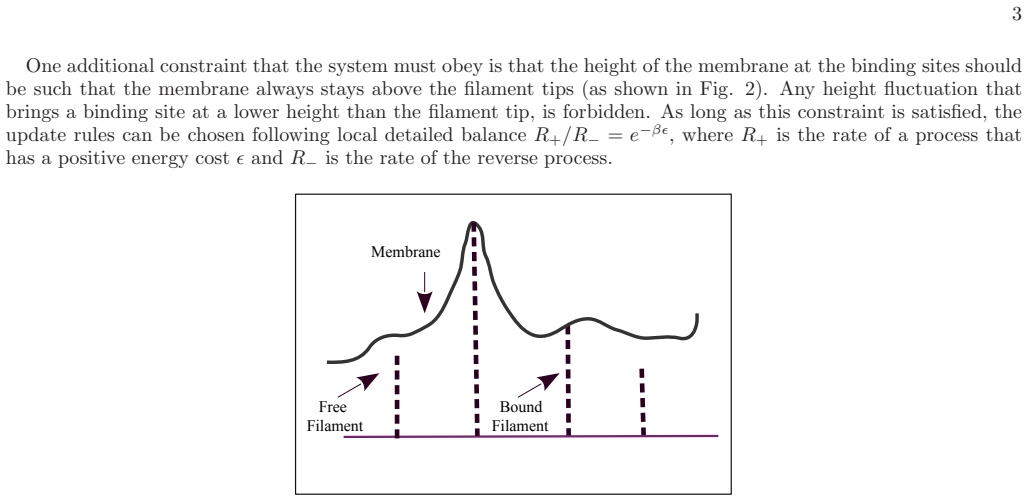
- domain assumption The membrane height at a binding site must stay above the filament tip.
- domain assumption Metropolis update rule with local detailed balance R+/R- = exp(-beta E) governs membrane dynamics.
Cite this review
Pith. "Pith review of Interplay between surface and bending energy helps membrane protrusion formation." pith.science (2026). https://pith.science/paper/6K7DFN4I
@misc{pith2026190800712,
  author       = {Pith},
  title        = {Pith review of: Interplay between surface and bending energy helps membrane protrusion formation},
  year         = {2026},
  howpublished = {\url{https://pith.science/paper/6K7DFN4I}},
  note         = {Machine review of arXiv:1908.00712}
}
read the original abstract
We consider a one-dimensional elastic membrane, which is pushed by growing filaments. The filaments tend to grow by creating local protrusions in the membrane and this process has surface energy and bending energy costs. Although it is expected that with increasing surface tension and bending rigidity, it should become more difficult to create a protrusion, we find that for a fixed bending rigidity, as the surface tension increases, protrusions are more easily formed. This effect also gives rise to nontrivial dependence of membrane velocity on the surface tension, characterized by a dip and a peak. We explain this unusual phenomenon by studying in detail the interplay of the surface and the bending energy and show that this interplay is responsible for a qualitative shape change of the membrane, which gives rise to the above effect.
Figures


Figures from the paper (2 more)

Reference graph
Works this paper leans on
-
[1]
The vertical lines show σ values used in Fig
2pN/nm respectively. The vertical lines show σ values used in Fig. 5. Left inset: peak position σ ∗ shifts leftward with κ. Right inset: Exponential fall of V for large σ with κ = 1. 2pN/nm . The decay constant 3 . 6 matches closely with the analytical prediction 2 βδ 2. Here, for all the plots, we use L = 64. The filament depolymerization rate, W0 = 1 . 4...
-
[2]
Howard, Mechanics of motor proteins and the cytoskele ton, Sunderland, MA: Sinauer Associates (2001)
J. Howard, Mechanics of motor proteins and the cytoskele ton, Sunderland, MA: Sinauer Associates (2001)
work page 2001
-
[3]
T. D. Pollard and J. A. Cooper, Actin, a central player in c ell shape and movement, Science 326, 1208 (2009)
work page 2009
-
[4]
L. Blanchoin, R. B. Paterski, C. Sykes and J. Plastino, Ac tin dynamics, architecture and mechanics in cell motility, Physiol Rev 94, 235 (2014)
work page 2014
-
[5]
P. Friedl and D. Gilmour, Collective cell migration in mo rphogenesis, regeneration and cancer, Nat. Rev. Mol. Cell B iol. 10, 445 (2009)
work page 2009
-
[6]
J. Plastino and C. Sykes, The actin slingshot, Curr. Opin . Cell Biol. 17, 62 (2005)
work page 2005
-
[7]
B. Farrell, F. Qian, A. Kolomeisky, B. Anvari and W. E. Bro wnell, Measuring forces at the leading edge: a force assay fo r cell motility, Integr. Biol. 5, 204 (2013)
work page 2013
- [8]
Show all 48 references
-
[9]
N. C. Gauthier, M. A. Fardin, P. Roca-Cusachs and M. P. She etz, Temporary increase in plasma membrane tension coordinates the activation of exocytosis and contraction d uring cell spreading, Proc. Natl. Acad. Sci. U.S.A. 108 14467 (2011)
2011
-
[10]
Raucher and M
D. Raucher and M. P. Sheetz, Cell spreading and lamellipo dial extension rate is regulated by membrane tension, J. Cel l Biol. 148 127 (2000)
2000
-
[11]
E. L. Batchelder, G. Hollopeter, C. Campillo, X. Mezang es, E. M. Jorgensen, P. Nassoy, P. Sens and J. Plastino, Membr ane tension regulates motility by controlling lamellipodium o rganization, Proc. Natl. Acad. Sci. U.S.A. 108, 11429 (2011)
2011
-
[12]
Helfrich, Elastic properties of lipid bilayers: The ory and possible experiments, Z
W. Helfrich, Elastic properties of lipid bilayers: The ory and possible experiments, Z. Naturforsch C28, 693-703 (1973)
1973
-
[13]
L. C. L. Lin, N. Gov and F. L. H. Brown, Nonequilibrium mem brane fluctuations driven by active proteins, J. Chem. Phys. 124, 074903 (2006)
2006
-
[14]
Peleg, A
B. Peleg, A. Disanza, G. Scita and N. Gov, Propagating ce ll-membrane waves driven by curved activators of actin poly - merization, PLoS One 6, e18635 (2011)
2011
-
[15]
S. Mark, R. Shlomovitz, N. S. Gov, M. Poujade, E. G. Mongr ain and P. Silberzan, Physical model of the dynamic instabil ity in an expanding cell culture, Biophys. J. 98, 361-370 (2010)
2010
-
[16]
E. B. Isaac, U. Manor, B. Kachar, A. Yochelis and N. S. Gov , Linking actin networks and cell membrane via a reaction- diffusion-elastic description of nonlinear filopodia initi ation, Phys. Rev. E 88, 022718 (2013)
2013
-
[17]
Shlomovitz, N
R. Shlomovitz, N. S. Gov and A. Roux, Membrane-mediated interactions and the dynamics of dynamin oligomers on membrane tubes, New. J. Phys. 13, 065008 (2011)
2011
-
[18]
Weichsel and P
J. Weichsel and P. L. Geissler, The more the tubular: Dyn amic bundling of actin filaments for membrane tube formation , PLoS Comput. Biol. 12, e1004982 (2016)
2016
-
[19]
L. C. L. Lin and F. L. H. Brown, Dynamic simulations of mem branes with cytoskeletal interactions, Phys. Rev. E 72, 011910 (2005)
2005
-
[20]
Daillant, E
J. Daillant, E. B. Amalric, A. Braslau, T. Charitat, G. F ragneto, F. Graner, S. Mora, F. Rieutord and B. Stidder, Stru cture and fluctuations of a single floating lipid bilayer, Proc. Nat l. Acad. Sci. U.S.A. 102, 11639 (2005)
2005
-
[21]
Quemeneur, J
F. Quemeneur, J. K. Sigurdsson, M. Renner, P. J. Atzberg er, P. Bassereau and D. Lacoste, Shape matters in protein mobility within membranes, Proc. Natl. Acad. Sci. U.S.A. 111, 5083 (2014)
2014
-
[22]
G. V. Bossa, B. K. Berntson and S. May, Curvature elastic ity of the electric double layer, Phys. Rev. Lett. 120, 215502 (2018)
2018
-
[23]
J. B. Fournier, Dynamics of the force exchanged between membrane inclusions, Phys. Rev. Lett. 112, 128101 (2014)
2014
-
[24]
M. Lenz, D. J. G. Crow and J. F. Joanny, Membrane buckling induced by curved filaments, Phys. Rev. Lett. 103, 038101 (2009)
2009
-
[25]
Veksler and N
A. Veksler and N. S. Gov, Phase transitions of the couple d membrane-cytoskeleton modify cellular shape, Biophys. J . 93, 3798-3810 (2007)
2007
-
[26]
Veksler and N
A. Veksler and N. S. Gov, Calcium-actin waves and oscill ations of cellular membranes, Biophys. J. 97, 1558-1568 (2009). 8
2009
-
[27]
G. Orly, M. Naoz and N. S. Gov, Physical model for the geom etry of actin-based cellular protrusions, Biophys. J. 107, 576-587 (2014)
2014
-
[28]
R. K. Sadhu and S. Chatterjee, Actin filaments growing ag ainst an elastic membrane: Effect of membrane tension, Phys. Rev. E 97, 032408 (2018)
2018
-
[29]
S. L. Narasimhan and A. Baumgaertner, Dynamics of a driv en surface, J. Chem. Phys. 133, 034702 (2010)
2010
-
[30]
Baumgaertner, Crawling of a driven adherent membran e, J
A. Baumgaertner, Crawling of a driven adherent membran e, J. Chem. Phys. 137, 144906 (2012)
2012
-
[31]
Lipowsky and S
R. Lipowsky and S. Grotehans, Renormalization of hydra tion forces by collective protrusion modes, Biophys. Chem. 49 27 (1994); R. Lipowsky and S. Grotehans, Hydration vs. protr usion forces between lipid bilayers, Europhys. Lett. 23 599 (1993)
1994
-
[32]
Volmer, U
A. Volmer, U. Seifert and R. Lipowsky, Critical behavio r of interacting surfaces with tension, Eur. Phys. J. B 5, 811 (1998)
1998
-
[33]
Nelson, T
D. Nelson, T. Piran and S. Weinberg, Statistical mechanics of membranes and surfaces , (World Scientific, Singapore, 2004)
2004
-
[34]
N. S. Gov and A. Gopinathan, Dynamics of membranes drive n by actin polymerization, Biophys. J. 90, 454 (2006)
2006
-
[35]
Kabaso, R
D. Kabaso, R. Shlomovitz, K. Schloen, T. Stradal, and N. S. Gov, Theoretical model for cellular shapes driven by prot rusive and adhesive forces, PLoS Comput. Biol. 7, e1001127 (2011)
2011
-
[36]
S. R. Bolsover, J. S. Hyams, E. A. Shephard, H. A. White an d C. G. Wiedemann, Cell Biology: A Short Course , (Wiley, Hoboken, NJ 2004)
2004
-
[37]
R. K. Sadhu and S. Chatterjee, Actin filaments growing ag ainst a barrier with fluctuating shape, Phys. Rev. E 93, 062414 (2016)
2016
-
[38]
R. K. Sadhu and S. Chatterjee, Actin filaments pushing ag ainst a membrane: Comparison between two force generation mechanisms, Eur. Phys. J. E 42, 15 (2019)
2019
-
[39]
Li and A
X. Li and A. B. Kolomeisky, The role of multifilament stru ctures and lateral interactions in dynamics of cytoskeleto n proteins and assemblies, J. Phys. Chem. B 119, 4653 (2015)
2015
-
[40]
See Supplementary Material for details of simulations and additional data
-
[41]
Tsekouras, D
K. Tsekouras, D. Lacoste, K. Mallick and J. F. Joanny, Co ndensation of actin filaments pushing against a barrier, New J. Phys. 13, 103032 (2011)
2011
-
[42]
T. D. Pollard, Rate constants for the reactions of ATP-a nd ADP-actin with the ends of actin filaments, J. Cell. Biol. 103, 2747 (1986)
1986
-
[43]
D. K. Hansda, S. Sen and R. Padinhateeri, Branching influ ences force-velocity curve and length fluctuations in actin networks, Phys. Rev. E 90, 062718 (2014)
2014
-
[44]
Shlomovitz and N
R. Shlomovitz and N. S. Gov, Membrane Waves Driven by Act in and Myosin, Phys. Rev. Lett 98, 168103 (2007); Exciting cytoskeleton-membrane waves, Phys. Rev. E 78 041911 (2008)
2007
-
[45]
Marcy, J
Y. Marcy, J. Prost, M. F. Carlier, and C. Sykes, Forces ge nerated during actin-based propulsion: A direct measureme nt by micromanipulation, Proc. Natl. Acad. Sci. U.S.A. 101, 5992 (2004)
2004
-
[46]
Brangbour, O
C. Brangbour, O. du Roure , E. Helfer, D. D´ emoulin, A. Ma zurier, M. Fermigier, M. F. Carlier, J. Bibette and J. Baudry , Force-velocity measurements of a few growing actin filament s, PLoS Biol. 9, e1000613 (2011)
2011
-
[47]
S. H. Parekh, O. Chaudhuri, J. A. Theriot and D. A. Fletch er, Loading history determines the velocity of actin-netwo rk growth, Nat. Cell Biol. 7, 1219 (2005)
2005
-
[48]
Dimova, Recent developments in the field of bending ri gidity measurements on membranes, Adv
R. Dimova, Recent developments in the field of bending ri gidity measurements on membranes, Adv. Colloid Interface S ci. 208, 225 (2014). 9 Supplementary Material: Interplay between surface and ben ding energy helps membrane protrusion formation I. DETAILS OF SIMULATIONS We per...
2014
Reviewed August 14, 2026 · model on record in the stance chip above.
Discussion (0). Continue with ORCID to comment.