REVIEW 4 major objections 5 minor 29 references
Word2vec to behavior: morphology facilitates the grounding of language in machines
T0 review · 4 major / 5 minor · reviewed 2026-08-14 · deepseek-v4-flash
Pith's one-line read The paper introduces a method for grounding natural-language commands in robots by initializing evolved neural controllers with word2vec vectors, and presents evidence that the robot's body plan can facilitate or obstruct zero-shot…
desk verdict Clever method and a truly held-out zero-shot test, but the main metric rewards returning to the origin, not stopping, and the authors fixed it only in the balanced subset. read the letter →
The pith
A machine-rendered reading of the paper's core claim, the machinery that carries it, and where it could break.
The reading
What carries the argument
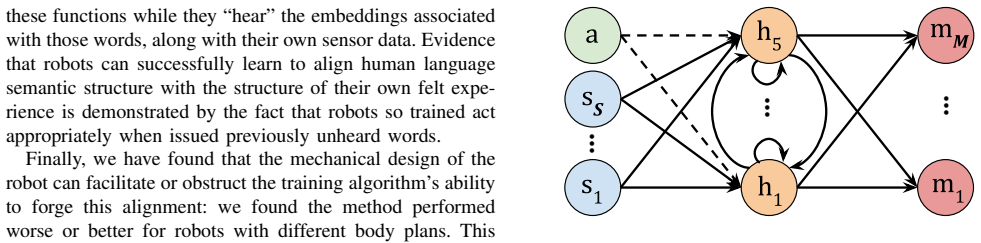
The central mechanism is the word2vec command vector used as a pre-behavior initialization signal. Before each evaluation, the vector for the commanded word is fed serially through a single auditory neuron into the five recurrent hidden neurons of the robot's three-layer neural controller; those auditory synapses are then removed, the sensor and motor neurons are attached, and the robot behaves in closed loop. The same recurrent network is then optimized by an age-fitness Pareto evolutionary algorithm (AFPO) against objective functions paired with each command: forward and backward commands reward displacement along the x-axis, and stop commands reward staying near the origin. The experimental contrast that carries the argument is between the true word2vec vectors and randomly permuted versions of the same vectors, which preserve the numeric distribution of each vector while destroying the semantic neighbourhood structure (for example, cosine similarities among stop synonyms drop from roughly 0.4–0.6 to near zero). That contrast isolates the semantic geometry of the embedding as the cause of any zero-shot generalization.
What would settle it
Measure each morphology's zero-shot advantage after equalizing search difficulty—for instance, scale AFPO population size and generations until all morphologies reach the same median training score under the control treatment, or record the number of evaluations required to reach a fixed training threshold. If a morphology that currently shows no word2vec benefit begins to show it once search effort is matched, the morphology-dependence conclusion is an artifact of optimization hardness; if the pattern of red-bracket morphologies is unchanged, the conclusion survives.
Extended reading notes
Core claim
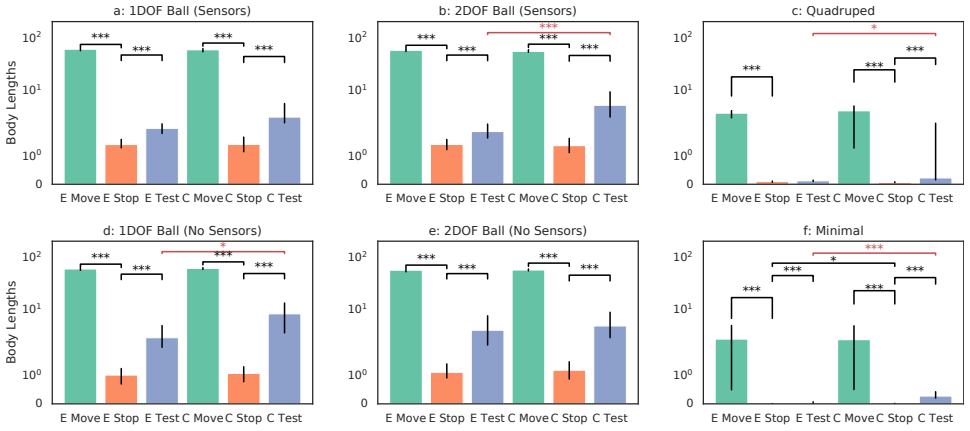
On the paper's own terms, the discovery is that word2vec embeddings can be used as initial conditions for evolved recurrent controllers, creating a mapping from semantic neighbourhood in language to behavioural neighbourhood in a robot: synonyms of 'stop' induce similar motor suppression even when one synonym was absent from training. The evidence is the comparison of experimental treatment (true word2vec command vectors) with control treatment (vectors with the same entries randomly permuted): champions from the experimental treatment generalized to the held-out stop synonym in four of six morphologies, and a per-task balanced retraining of the quadruped reproduced the pattern. The paper interprets this as showing that the latent structure of the embedding, not memorization of training commands, carries the zero-shot behavior, and that the effect depends on body plan.
Load-bearing premise
The claim that body shape itself facilitates or obstructs grounding assumes that the six body plans are equally easy for the evolutionary search to optimize; the paper does not control for per-body-plan search difficulty, so a body plan that is merely easier to optimize could be mistaken for one that is better at grounding language.
Editorial extensions
If this is right
- Evolved controllers initialized with word2vec vectors can respond to a previously unheard synonym of a trained command, at least in simulation.
- The robot's body plan is not neutral: only some morphologies show the zero-shot generalization advantage, so mechanical design is a factor in whether language grounding succeeds.
- The result is not explained by the training set being dominated by 'stop' commands; a per-task balanced retraining of the quadruped still showed the experimental advantage.
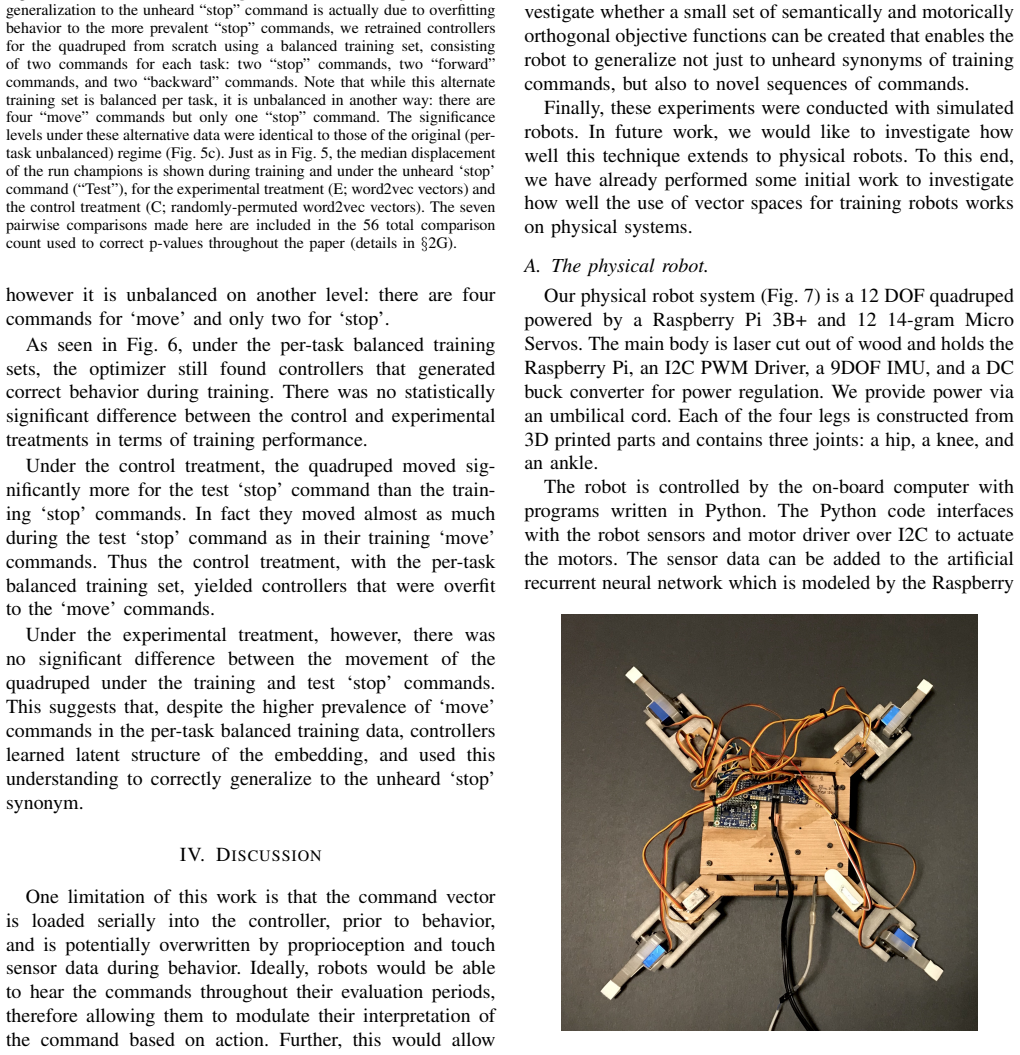
- Physical-robot transfer is currently partial: most controllers optimized in simulation did not transfer adequately, but some produced distinguishable movement patterns for forward, backward, and stop commands.
Reading between the lines
- If body plan is causal rather than merely correlated, co-evolving morphology together with the controller under a language-grounding objective is a direct extension; the paper's stated future work of evolving body plans would test that hypothesis.
- Because the command vector is read only once before behavior and the auditory synapses are then detached, the demonstration bounds what one-shot embedding injection can do; supplying the vector continuously during behavior might yield stronger or more compositional grounding.
- A sharper experiment would match body plans for evolutionary search difficulty—same controller parameter count, same population size, and measured evaluations to a fixed training score—before attributing the zero-shot difference to mechanics.
- The same training scheme could be applied to embeddings of action words in other languages or to synthetic embeddings with controlled geometric properties, which would directly test whether the semantic distance structure, rather than any specific word2vec artifact, drives the result.
Signed reviews
Editorial analysis
A structured set of objections, weighed in public.
Referee Report
Summary. This paper presents a method for grounding word2vec command embeddings in robot behavior. A recurrent neural network controller is initialized by feeding a command embedding through an auditory neuron into the hidden layer, after which the network operates with sensor feedback for the behavior episode. Controllers are evolved with AFPO to maximize task-specific objectives for five commands (one 'forward', one 'backward', and three 'stop' synonyms), and the best controller is then tested on a sixth, held-out 'stop' synonym. The experimental treatment uses unpermuted word2vec vectors; the control treatment uses randomly permuted vectors. Across six simulated morphologies, the paper reports that for four of the six, the experimental treatment yields significantly lower final displacement under the held-out command than the control, interpreting this as evidence that morphology can facilitate or hinder the grounding of language. A balanced-training-set check on the quadruped and a preliminary physical-robot transfer study are also reported.
Significance. If the zero-shot generalization result holds, the paper would make a useful contribution by showing that a standard word embedding can directly initialize a policy network and yield appropriate behavior for an unheard synonym, without fine-tuning. The permutation control, 100 independent evolutionary runs per condition, held-out command design, and Holm-Bonferroni correction are careful and are genuine strengths. The additional claim that robot morphology moderates the ability to align linguistic and sensorimotor structure is intriguing and relevant to embodied language grounding and evolutionary robotics. However, as detailed below, the evidence currently does not discriminate between genuine grounding and an artifact of the evaluation metric, and the morphology claim is confounded with optimization difficulty and morphological covariates. The paper is worth revising rather than rejecting.
major comments (4)
- [Section II.A and III, Fig. 5] The primary evidence for zero-shot generalization is the comparison of final displacement under the held-out 'stop' command (E Test vs C Test in Fig. 5). The score for all 'stop' commands is negative Euclidean distance from the origin at the end of the 500-step episode, and the test error is the final displacement. As the paper itself notes in the balanced-set paragraph in Section III, the reward was changed in that check specifically to 'protect against the perverse instantiation of oscillating around the origin.' That fix was applied only to the balanced quadruped condition, not to the Fig. 5 results. Because the Fig. 5 metric does not penalize movement during the episode, a controller that oscillates around the origin receives the same score as one that stays still. The central claim that experimental champions understand the unseen synonym could therefore be an artifact of controllers that wander and return near the origin. Please re-analyze the Fig. 5 data with a total-movement metric (or otherwise demonstrate that final displacement is not dominated by oscillation).
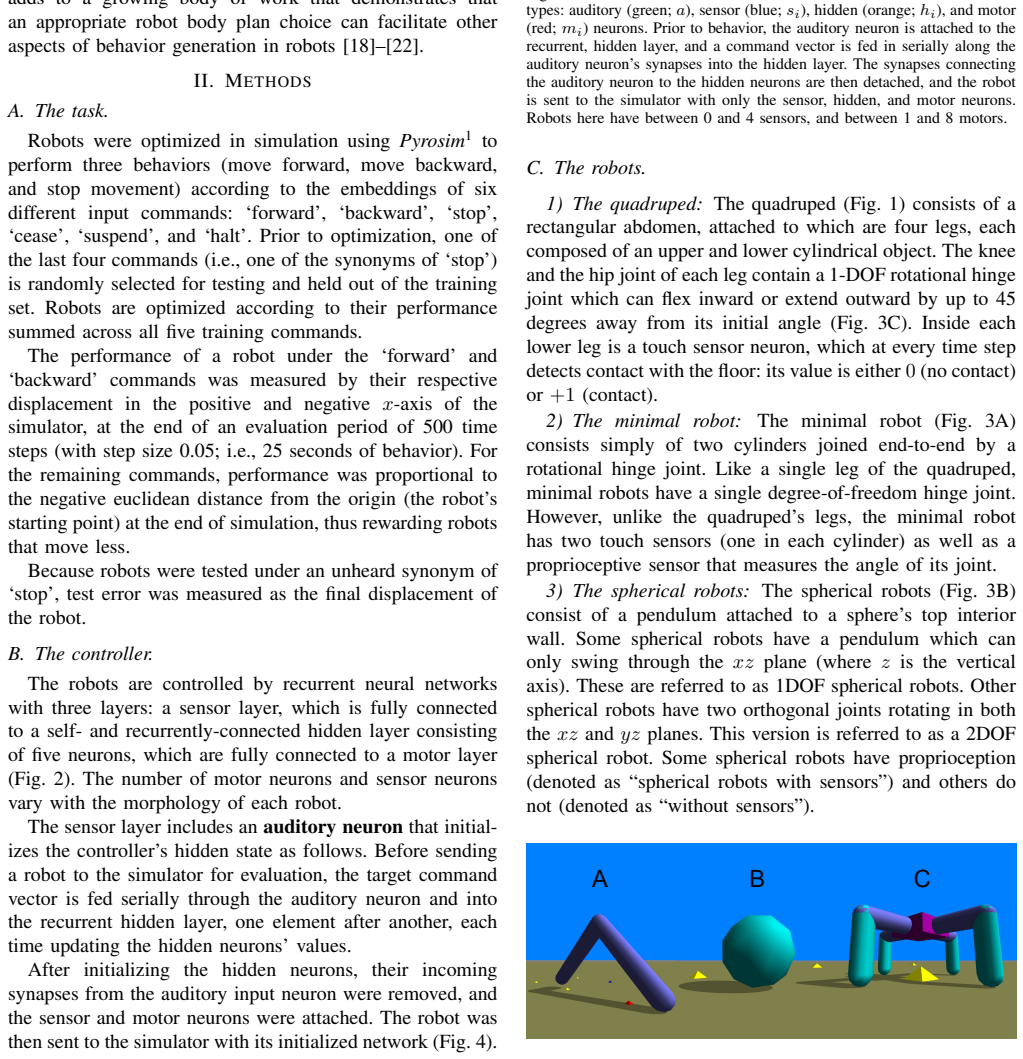
- [Section II.C and III, Fig. 5] The paper interprets the red significance brackets in Fig. 5 as evidence that 'morphology affects the grounding of the stop commands.' This inference is not yet supported, because the six morphologies differ in many ways beyond body plan: the number of sensors ranges from 0 to 4, the number of motors from 1 to 8, and some spherical robots have no sensors, meaning their controllers run open-loop after initialization. The morphology variable is therefore confounded with sensor feedback and controller dimensionality. At minimum, report the full sensor/motor configuration for each morphology and provide a control that varies morphology while holding the sensor suite fixed, or vice versa. Without this, the title claim about mechanical structure is not established.
- [Section II.D and III, Fig. 5] The observed differences across morphologies could be due to differences in the difficulty of the AFPO search landscape rather than to any property of the body plan per se. The paper does not report per-morphology convergence or the distribution of training fitness under the control treatment. A concrete test would be to compare the training-fitness distributions under the control treatment across morphologies: if the morphologies that show the experimental/control test difference are also those that are easiest to optimize (e.g., highest control-treatment training fitness or fastest convergence), the 'morphology facilitates grounding' claim would be confounded. Please add such an analysis or an explicit control for search difficulty (e.g., matching generations or fitness levels).
- [Section III, Fig. 5 and Section II.G] The manuscript says that 56 pairwise comparisons were made and corrected with Holm-Bonferroni, but the text only states that red brackets appear for 'four of the six morphologies' without listing which morphologies are significant at which level. A reader cannot verify the morphology claim from the figure alone because the brackets and panels are not labeled in a machine-readable way. Please report explicitly, for each morphology, the E-Test vs C-Test p-value after correction, and also test the treatment-by-morphology interaction (e.g., a rank-based interaction test) rather than relying on pairwise brackets, so that the claim that morphology modulates the treatment effect is actually supported.
minor comments (5)
- [Section II.B, Fig. 2] The text says the command vector is fed 'serially' through the auditory neuron, but the dimensionality of the word2vec vectors is not stated; this matters for the initialization procedure and should be reported.
- [Section II.A] The sentence 'Because robots were tested under an unheard synonym of stop, test error was measured as the final displacement of the robot' conflates the test command with the test metric; clarify that the test error uses the same final-distance metric as the training 'stop' commands.
- [Section III, Fig. 6 caption] The caption refers to 'details in §2G' but the correct cross-reference is Section II-G; please fix the reference.
- [Section IV.A] The physical-robot experiment is clearly described as preliminary and the transfer is acknowledged as poor; this is a limitation, but the paper should state explicitly that the sim2real results are anecdotal and were not used to support the main claims.
- [Table III] The p-values are reported with Holm-Bonferroni correction for 56 comparisons, but the table shows only six comparisons; clarify how the 56 comparisons were distributed across the figures.
Circularity Check
No significant circularity; the held-out synonym test is a genuine prediction with an external permuted-vector control.
full rationale
The paper's central claim is that controllers initialized with word2vec command embeddings generalize to a previously-unheard synonym of 'stop' better than controllers trained on randomly permuted embeddings. The test command is explicitly held out of the training set, and the test error is measured as final displacement under that held-out command. The permuted-vector control preserves the training objective while destroying semantic structure, providing an external baseline that is not fitted to the test outcome. No parameter is estimated from the test subset, and the zero-shot result is not a consequence of the training objective alone. The morphology claim is supported by independent evolutionary runs across six body plans, and the observed differences are not defined in terms of the treatment effect. Self-citations to prior morphology work (e.g., [18]-[22]) appear as related-work context and are not used as the evidence for the present empirical results. The reviewer's concern about the net-displacement metric (oscillation near the origin) is a question of experimental validity, not a circularity reduction, because it applies equally to treatment and control and does not make the prediction equivalent to the input by construction.
Assumptions & free parameters
assumptions (4)
- domain assumption Word2vec cosine similarity among command words reflects the semantic similarity the authors exploit.
- domain assumption The Pyrosim/ODE simulator produces robot dynamics faithful enough that results about morphology are meaningful.
- ad hoc to paper AFPO with population 50 for 6000 generations is a sufficient optimizer for all six morphologies.
- domain assumption Randomly permuting the command vectors preserves their non-semantic statistical properties, making the control treatment valid.
Cite this review
Pith. "Pith review of Word2vec to behavior: morphology facilitates the grounding of language in machines." pith.science (2026). https://pith.science/paper/PGPLECSB
@misc{pith2026190801211,
  author       = {Pith},
  title        = {Pith review of: Word2vec to behavior: morphology facilitates the grounding of language in machines},
  year         = {2026},
  howpublished = {\url{https://pith.science/paper/PGPLECSB}},
  note         = {Machine review of arXiv:1908.01211}
}
read the original abstract
Enabling machines to respond appropriately to natural language commands could greatly expand the number of people to whom they could be of service. Recently, advances in neural network-trained word embeddings have empowered non-embodied text-processing algorithms, and suggest they could be of similar utility for embodied machines. Here we introduce a method that does so by training robots to act similarly to semantically-similar word2vec encoded commands. We show that this enables them to act appropriately, after training, to previously-unheard commands. Finally, we show that inducing such an alignment between motoric and linguistic similarities can be facilitated or hindered by the mechanical structure of the robot. This points to future, large scale methods that find and exploit relationships between action, language, and robot structure.
Figures

Figures from the paper (5 more)



Reference graph
Works this paper leans on
-
[1]
Distributed representations of words and phrases and their composi- tionality,
T. Mikolov, I. Sutskever, K. Chen, G. S. Corrado, and J. Dean, “Distributed representations of words and phrases and their composi- tionality,” inAdvances in neural information processing systems, 2013, pp. 3111–3119
work page 2013
-
[2]
Efficient estimation of word representations in vector space,
T. Mikolov, K. Chen, G. Corrado, and J. Dean, “Efficient estimation of word representations in vector space,”arXiv preprint arXiv:1301.3781, 2013
arXiv 2013
-
[3]
Support vector machines and word2vec for text classification with semantic features,
J. Lilleberg, Y . Zhu, and Y . Zhang, “Support vector machines and word2vec for text classification with semantic features,” in 2015 IEEE 14th International Conference on Cognitive Informatics & Cognitive Computing (ICCI* CC) . IEEE, 2015, pp. 136–140
work page 2015
-
[4]
Learning sentiment-specific word embedding for twitter sentiment classifica- tion,
D. Tang, F. Wei, N. Yang, M. Zhou, T. Liu, and B. Qin, “Learning sentiment-specific word embedding for twitter sentiment classifica- tion,” in Proceedings of the 52nd Annual Meeting of the Association for Computational Linguistics (Volume 1: Long Papers) , vol. 1, 2014, pp. 1555–1565
work page 2014
-
[5]
Sentiment analysis of investor opinions on twitter,
B. Dickinson and W. Hu, “Sentiment analysis of investor opinions on twitter,” Social Networking, vol. 4, no. 03, p. 62, 2015
work page 2015
-
[6]
Language, embodiment, and the cognitive niche,
A. Clark, “Language, embodiment, and the cognitive niche,” Trends in cognitive sciences , vol. 10, no. 8, pp. 370–374, 2006
work page 2006
-
[7]
Lakoff and M
G. Lakoff and M. Johnson, Metaphors we live by . University of Chicago press, 2008
2008
-
[8]
The brain’s concepts: The role of the sensory-motor system in conceptual knowledge,
V . Gallese and G. Lakoff, “The brain’s concepts: The role of the sensory-motor system in conceptual knowledge,” Cognitive neuropsy- chology, vol. 22, no. 3-4, pp. 455–479, 2005
work page 2005
Show all 29 references
-
[9]
Active perception: sensorimotor cir- cuits as a cortical basis for language,
F. Pulverm ¨uller and L. Fadiga, “Active perception: sensorimotor cir- cuits as a cortical basis for language,” Nature reviews neuroscience , vol. 11, no. 5, p. 351, 2010
2010
-
[10]
A natural language interface to a robot assembly system,
M. Selfridge and W. Vannoy, “A natural language interface to a robot assembly system,” IEEE Journal on Robotics and Automation , vol. 2, no. 3, pp. 167–171, 1986
1986
-
[11]
Evolving grounded communication for robots,
L. Steels, “Evolving grounded communication for robots,” Trends in cognitive sciences, vol. 7, no. 7, pp. 308–312, 2003
2003
-
[12]
Lingodroids: Studies in spatial cognition and language,
R. Schulz, A. Glover, M. J. Milford, G. Wyeth, and J. Wiles, “Lingodroids: Studies in spatial cognition and language,” in2011 IEEE International Conference on Robotics and Automation . IEEE, 2011, pp. 178–183
2011
-
[13]
Lingodroids: Learning terms for time,
S. Heath, R. Schulz, D. Ball, and J. Wiles, “Lingodroids: Learning terms for time,” in 2012 IEEE International Conference on Robotics and Automation. IEEE, 2012, pp. 1862–1867
2012
-
[14]
Learning to parse natural language commands to a robot control system,
C. Matuszek, E. Herbst, L. Zettlemoyer, and D. Fox, “Learning to parse natural language commands to a robot control system,” in Experimental Robotics. Springer, 2013, pp. 403–415
2013
-
[15]
Visual word2vec (vis-w2v): Learning visually grounded word embeddings using ab- stract scenes,
S. Kottur, R. Vedantam, J. M. Moura, and D. Parikh, “Visual word2vec (vis-w2v): Learning visually grounded word embeddings using ab- stract scenes,” in Proceedings of the IEEE Conference on Computer Vision and Pattern Recognition , 2016, pp. 4985–4994
2016
-
[16]
Sound-word2vec: Learning word representations grounded in sounds,
A. K. Vijayakumar, R. Vedantam, and D. Parikh, “Sound-word2vec: Learning word representations grounded in sounds,” arXiv preprint arXiv:1703.01720, 2017
2017 arXiv
-
[17]
Grasp2vec: Learning object representations from self-supervised grasping,
E. Jang, C. Devin, V . Vanhoucke, and S. Levine, “Grasp2vec: Learning object representations from self-supervised grasping,” arXiv preprint arXiv:1811.06964, 2018
2018 arXiv
-
[18]
Morphological change in machines accelerates the evo- lution of robust behavior,
J. Bongard, “Morphological change in machines accelerates the evo- lution of robust behavior,” Proceedings of the National Academy of Sciences, vol. 108, no. 4, pp. 1234–1239, 2011
2011
-
[19]
Evolving robot morphology facilitates the evolution of neural modularity and evolvability,
J. C. Bongard, A. Bernatskiy, K. Livingston, N. Livingston, J. Long, and M. Smith, “Evolving robot morphology facilitates the evolution of neural modularity and evolvability,” in Proceedings of the 2015 annual conference on genetic and evolutionary computation . ACM, 2015, pp. 129–136
2015
-
[20]
Morphology dictates a robot’s ability to ground crowd-proposed language,
Z. Mahoor, J. Felag, and J. Bongard, “Morphology dictates a robot’s ability to ground crowd-proposed language,” arXiv preprint arXiv:1712.05881, 2017
2017 arXiv
-
[21]
How morphological devel- opment can guide evolution,
S. Kriegman, N. Cheney, and J. Bongard, “How morphological devel- opment can guide evolution,” Scientific reports, vol. 8, no. 1, p. 13934, 2018
2018
-
[22]
Automated shapeshifting for function recovery in damaged robots,
S. Kriegman, S. Walker, D. Shah, M. Levin, R. Kramer-Bottiglio, and J. Bongard, “Automated shapeshifting for function recovery in damaged robots,” in Proceedings of Robotics: Science and Systems , 2019
2019
-
[23]
Age-fitness pareto optimization,
M. Schmidt and H. Lipson, “Age-fitness pareto optimization,” in Genetic Programming Theory and Practice VIII . Springer, 2011, pp. 129–146
2011
-
[24]
On a test of whether one of two random variables is stochastically larger than the other,
H. B. Mann and D. R. Whitney, “On a test of whether one of two random variables is stochastically larger than the other,” The annals of mathematical statistics , pp. 50–60, 1947
1947
-
[25]
A simple sequentially rejective multiple test procedure,
S. Holm, “A simple sequentially rejective multiple test procedure,” Scandinavian journal of statistics , pp. 65–70, 1979
1979
-
[26]
Resilient machines through continuous self-modeling,
J. Bongard, V . Zykov, and H. Lipson, “Resilient machines through continuous self-modeling,” Science, vol. 314, no. 5802, pp. 1118– 1121, 2006
2006
-
[27]
Vr-goggles for robots: Real-to-sim domain adaptation for visual control,
J. Zhang, L. Tai, P. Yun, Y . Xiong, M. Liu, J. Boedecker, and W. Burgard, “Vr-goggles for robots: Real-to-sim domain adaptation for visual control,” IEEE Robotics and Automation Letters , vol. 4, no. 2, pp. 1148–1155, 2019
2019
-
[28]
Learning agile and dynamic motor skills for legged robots,
J. Hwangbo, J. Lee, A. Dosovitskiy, D. Bellicoso, V . Tsounis, V . Koltun, and M. Hutter, “Learning agile and dynamic motor skills for legged robots,” Science Robotics, vol. 4, no. 26, 2019
2019
-
[29]
Task-agnostic self-modeling ma- chines,
R. Kwiatkowski and H. Lipson, “Task-agnostic self-modeling ma- chines,” Science Robotics, vol. 4, no. 26, 2019
2019
Reviewed August 14, 2026 · model on record in the stance chip above.
Discussion (0). Continue with ORCID to comment.