REVIEW 3 major objections 5 minor 22 references
Optimistic planning for the near-optimal control of nonlinear switched discrete-time systems with stability guarantees
T0 review · 3 major / 5 minor · reviewed 2026-08-14 · deepseek-v4-flash
Pith's one-line read A reworked optimistic-planning algorithm controls nonlinear switched systems near-optimally and with stability guarantees.
desk verdict The algorithm and concepts are worthwhile, but the main theorems are deferred to an unpublished companion and the paper cannot be fully verified as submitted. read the letter →
The pith
A machine-rendered reading of the paper's core claim, the machinery that carries it, and where it could break.
The reading
What carries the argument
The engine is Assumption 1, a uniform detectability/dissipation condition on every mode, together with the optimistic tree search inherited from OP. In the tree, each leaf carries the cost of the switching sequence that reaches it; OPmin always expands the leaf with the smallest such cost, so the first fully explored level yields an exact finite-horizon optimum, and the resulting horizon $d(x)$ is as large as the budget allows. The dissipation inequality is what turns the tail of the infinite-horizon cost into a bounded, state-dependent error term $v_{\gamma,d(x)}(x)$, and the same inequality serves as the Lyapunov decrement that produces the stability bound.
What would settle it
For a two-mode scalar switched linear system with quadratic stage costs, compute $V_{\gamma,\infty}$ exactly by value iteration and run OPmin with a known budget; if the measured gap $V_{\gamma,\infty}-V_{\gamma,d(x)}$ exceeds the bound $v_{\gamma,d(x)}(x)$ from Theorem 1, or the receding-horizon trajectory fails to enter the predicted $\delta$-neighborhood within the budget prescribed by Theorem 2, the central claims are false.
Extended reading notes
Core claim
Under Assumption 1 — a Lyapunov-like dissipation inequality $W(f_u(x))-W(x) \le -\alpha_W(\sigma(x))+\ell_u(x)$ together with a stabilizability bound $V_{\gamma,\infty}(x)\le \alpha_V(\sigma(x))$ — the paper proves for every state $x$, discount factor $\gamma\in(0,1]$, and state-dependent horizon $d(x)$ that $V_{\gamma,d(x)}(x)\le V_{\gamma,\infty}(x)\le V_{\gamma,d(x)}(x)+v_{\gamma,d(x)}(x)$, where $v_{\gamma,d(x)}(x)$ is an explicit function built from the comparison functions. The same assumptions imply that the receding-horizon closed loop satisfies $\sigma(\varphi(k,x))\le \max\{\beta(\sigma(x),k),\delta\}$ for arbitrary $\delta,\Delta>0$ once the discount factor is close enough to $1$ and the budget large enough; with linear comparison functions this becomes global exponential stability. The paper further shows that the running cost of the receding-horizon scheme lies within $w_{\gamma,\bar d}\,\sigma(x)$ of the infinite-horizon optimal value, with $w_{\gamma,\bar d}$ decaying exponentially in the minimum horizon.
Load-bearing premise
The guarantees rest on Assumption 1(ii), the detectability/dissipation inequality that must hold for every mode and every stage cost, and on the correctness of the companion-paper results [6] that Theorem 1 and Theorem 2 are derived from; if that inequality fails or those results are wrong, the claims collapse.
Editorial extensions
If this is right
- OPmin can be applied to optimal control problems with stage costs that are arbitrary nonnegative functions, including quadratic costs, and with discount factor $\gamma=1$; the error bound remains finite and decays as the horizon grows.
- For any prescribed initial-state bound $\Delta$ and final tolerance $\delta$, a budget and discount factor can be chosen so that every receding-horizon trajectory converges to the $\delta$-neighborhood of the attractor, so the scheme gives certified practical stability.
- Under linear comparison functions, the closed loop is globally exponentially stable and the mismatch between the running cost and $V_{\gamma,\infty}$ decays exponentially in the minimum horizon $\bar d$ (equivalently, in the budget).
- The algorithm provides both an open-loop near-optimal switching sequence and a receding-horizon feedback law from the same computation, so the same tool covers planning and feedback stabilization.
Reading between the lines
- Because Theorem 3 requires no terminal cost or terminal constraint, the paper suggests a model-predictive-control formulation whose only tuning knobs are budget and discount factor; a testable extension is whether the state-dependent horizon can be shortened near the attractor without losing the guarantees.
- The exponential factor $\left(1-\frac{a_W}{\bar a_V+\bar a_W}\right)^{\bar d}$ in Corollary 1 quantifies how 'detectable' the cost is; one could turn this into a design guideline for choosing stage costs that make the error small quickly.
- The bound in Theorem 1 vanishes as $\sigma(x)\to 0$, which the authors note; a natural extension is to use OPmin as a local stabilizer after a coarse global schedule, or to certify performance in a neighborhood of the attractor.
Signed reviews
Editorial analysis
A structured set of objections, weighed in public.
Referee Report
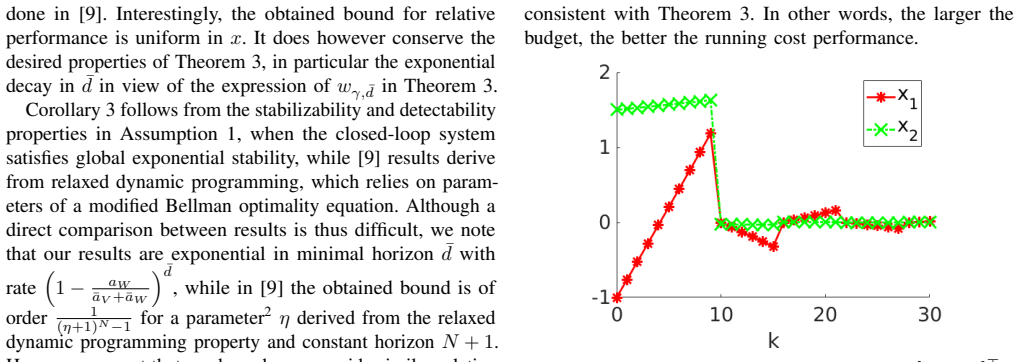
Summary. The paper proposes OPmin, a modification of the optimistic planning (OP) algorithm of Hren and Munos, adapted to the minimization of discounted or undiscounted infinite-horizon costs for nonlinear switched discrete-time systems with finite input sets and arbitrary nonnegative stage costs. The algorithm is described in Algorithm 1, and the authors state that it computes, for a given budget, the exact finite-horizon value function V_{γ,d(x)}(x) for a state-dependent horizon d(x). Under a standing assumption on existence of optimal infinite-horizon sequences and under Assumption 1, which combines a stabilizability bound on V_{γ,∞} and a detectability/dissipation inequality involving a Lyapunov-like function W, the paper claims: Theorem 1, a two-sided bound between V_{γ,d(x)} and V_{γ,∞} with an explicit state- and horizon-dependent error v_{γ,d(x)}; Corollary 1, a linear-growth version of the bound that decays exponentially in d(x); Theorem 2, semiglobal practical stability of the receding-horizon closed-loop system; Corollary 2, global exponential stability under strengthened linear assumptions; Theorem 3 and Corollary 3, bounds on the running cost relative to V_{γ,∞}. A numerical example with the cubic integrator is reported. The main proofs of Theorem 1 and Corollary 2 are omitted and deferred to the authors' unpublished companion manuscript [6], and the appendix proof of Theorem 2 and Proposition 3 also import key steps from [6].
Significance. If the results are correct, the paper makes a useful contribution by adapting optimistic planning to a control-oriented setting: it removes the stage-cost normalization to [0,1], allows the undiscounted case γ=1, treats cost minimization directly, and provides stability guarantees for a receding-horizon implementation, which are absent from the original OP analysis. The state-dependent horizon appearing both in the algorithm and in the error bounds is a genuine conceptual step beyond the fixed-horizon analysis in the authors' companion work. The result relating the running cost to the infinite-horizon value function, with exponential decay in the horizon, is also valuable. However, the significance is conditional: each of these claims depends on proofs that are not present in this manuscript and are instead deferred to an unpublished companion paper. The reader cannot verify that the companion's assumptions, which may involve fixed horizons and a specific discounted setting, transfer to the state-dependent horizons, γ=1, and generic nonnegative costs treated here.
major comments (3)
- [Section IV-B, Theorem 1 and Eq. (8)] The central near-optimality inequality is not proved in this manuscript; the text states that 'Theorem 1 follows from [6, Theorem 3], therefore the proof is omitted.' Reference [6] is described only as 'submitted for journal publication' and is not an archival, publicly citable source. A reader therefore cannot check whether [6] covers γ=1, nonnegative stage costs outside [0,1], and state-dependent horizons, all of which are explicit claimed improvements over OP. Please provide a self-contained proof of Theorem 1, or make the companion paper publicly verifiable and show explicitly that its assumptions and proof steps extend to OPmin with state-dependent horizons.
- [Section IV-C, Corollary 2 and Eq. (12)] The global exponential stability result is stated with 'the proof is omitted' and with justification that it follows from [6, Corollary 2] plus 'the modifications given in the appendix.' Because the receding-horizon implementation uses a state-dependent horizon d(x), uniformity of the Lyapunov decay over all horizon sequences generated by OPmin is a load-bearing issue. The full proof must appear in this paper, including verification that the Lyapunov decrease in Proposition 3 holds uniformly over the possible state-dependent horizons.
- [Appendix, proof of Theorem 2 and Proposition 3] The appendix proof of Theorem 2 is not self-contained: it explicitly imports 'item (i) of Theorem 1 in [6]', 'the same manipulations as in the proof of Theorem 1 in [6]', and 'the steps of [6]'. Proposition 3, which is the key Lyapunov property used for Theorem 2, is therefore not verifiable from the manuscript alone. Please provide a complete proof of Proposition 3 and of Theorem 2 that does not rely on unpublished companion results.
minor comments (5)
- [Section IV-B, Theorem 1] The definitions of the class-K functions in the error term are garbled: the text reads 'αY = αY := αW, αY := αV + αW', which defines αY twice and leaves the intended upper and lower functions unclear. Please introduce αY and αY with distinct, consistent definitions.
- [Section III-B, Algorithm 1] In the paragraph defining leaves, there is a typo: 'the the set of all leaves' should be 'the set of all leaves'.
- [Remark 1] The verb 'chosing' should be 'choosing'.
- [Section V, Table I] Table I reports 'estimated running cost' computed over 200 simulation steps, whereas Theorem 3 concerns the infinite-horizon running cost. A sentence on the truncation error or on why 200 steps is sufficient would help the reader interpret the numerical comparison.
- [Section IV-B, Remark 1] The remark notes that the error bound v_{γ,d(x)} is not monotonic in γ because of competing terms; the discussion would be clearer if the two terms were displayed explicitly.
Circularity Check
Central near-optimality and stability theorems are not proved in the manuscript: Theorem 1 and Corollary 2 are explicitly deferred to the authors' unpublished companion [6], and Theorem 2's appendix imports [6]; the main claims therefore reduce to an unverifiable self-citation chain.
-
self citation load bearing
[Section IV-B, Theorem 1 (Eq. 8)]
"Theorem 1 follows from [6, Theorem 3], therefore the proof is omitted."
The paper's principal near-optimality guarantee, inequality (8), is not derived in this manuscript; it is imported from [6, Theorem 3]. Reference [6] is the authors' own companion submission, not published and available only through a reviewer URL, so the citation is not an independent, checkable proof. The paper's advertised adaptations (generic stage costs, gamma = 1, state-dependent horizon d(x)) are exactly where the transfer from [6] would need to be demonstrated, but the proof is omitted.
-
self citation load bearing
[Section IV-C, Corollary 2]
"Since it follows the same arguments as in [6, Corollary 2] and the modifications given in the appendix, the proof is omitted."
This is the paper's global exponential stability result for the OPmin closed loop. The proof is not present; it is asserted to follow from the same authors' [6, Corollary 2] plus modifications in the appendix. The condition (12) and the constants K and lambda come from [6]. Thus the strongest stability claim is load-bearing on an unverified companion rather than being established in this paper.
2 more flagged steps
-
self citation load bearing
[Appendix, Proof of Theorem 2]
"The proof of Theorem 2 follows the same steps as the proof of [6, Theorem 2]. The difference is that the horizon in cost (4) is not fixed as in [6], but depends on the state. Nevertheless, as noted in [6, Remark 3], the results can be modified to hold for varying horizons, provided that considered horizons are lower-bounded by a sufficiently large constant, ¯d in our case."
The semiglobal practical stability theorem, a central advertised result, is justified by following [6, Theorem 2] and by invoking [6, Remark 3] for precisely the state-dependent-horizon generalization that the paper claims as a novelty over [6,7]. The only part proved in the appendix, Proposition 3, is itself obtained by following [6, proof of Theorem 1]. Without [6], Theorem 2 is unsupported.
-
self citation load bearing
[Appendix, Proposition 3 proof]
"The proof works by following the steps in [6, proof of Theorem 1], only one step needs to be carefully modified."
Proposition 3 provides the Lyapunov decrease inequality on which Theorem 2 relies. Its proof is not self-contained: it adopts the framework, inequalities, and iteration arguments of [6, proof of Theorem 1] and modifies one step. Since [6] is unpublished, the validity of the Lyapunov construction and therefore of Theorem 2 depends entirely on the same authors' unavailable companion.
full rationale
The OPmin algorithm itself, Propositions 1 and 2 on the budget/horizon relation, and Theorem 3's running-cost argument are genuinely developed in the text. However, the two central guarantees that justify the algorithm are not proved here: the near-optimality inequality (8) is explicitly stated to follow from [6, Theorem 3], and the global exponential stability result of Corollary 2 is explicitly stated to follow from [6, Corollary 2]. Theorem 2's proof consists of following [6, Theorem 2] with a state-dependent-horizon patch supported by [6, Remark 3], and Proposition 3's proof follows [6, proof of Theorem 1]. Reference [6] is a companion submission by the same five authors, described as 'submitted for journal publication' and available only to reviewers, so it is not machine-checked, code-reproduced, or independently falsifiable within the paper. This is load-bearing self-citation rather than cosmetic citation. The paper does contain original contributions, so it is not equivalent to its inputs by definition, but the central derivation chain reduces to an unverifiable companion, warranting a high circularity score.
Assumptions & free parameters
assumptions (5)
- domain assumption Standing Assumption (SA): for every x and gamma in (0,1], an optimal infinite-horizon input sequence exists and the value function is finite.
- domain assumption Assumption 1(i): there exist alpha_V and sigma such that V_gamma,infty(x) <= alpha_V(sigma(x)) for all x and gamma.
- domain assumption Assumption 1(ii): existence of W, alpha_W, alpha_W such that W(x) <= alpha_W(sigma(x)) and W(f_u(x)) - W(x) <= -alpha_W(sigma(x)) + ell_u(x) for all x and u.
- ad hoc to paper Validity of the companion results in [6]: Theorem 3 (near-optimality bound), Theorem 2 and Corollary 2 (stability) of [6].
- domain assumption Linear growth conditions in Corollaries 1 and 2: alpha_V(s) <= bar_a_V s, alpha_W(s) <= bar_a_W s, and alpha_W(s) >= a_W s for all s >= 0.
Cite this review
Pith. "Pith review of Optimistic planning for the near-optimal control of nonlinear switched discrete-time systems with stability guarantees." pith.science (2026). https://pith.science/paper/DG3QQC5Z
@misc{pith2026190801404,
  author       = {Pith},
  title        = {Pith review of: Optimistic planning for the near-optimal control of nonlinear switched discrete-time systems with stability guarantees},
  year         = {2026},
  howpublished = {\url{https://pith.science/paper/DG3QQC5Z}},
  note         = {Machine review of arXiv:1908.01404}
}
read the original abstract
Originating in the artificial intelligence literature, optimistic planning (OP) is an algorithm that generates near-optimal control inputs for generic nonlinear discrete-time systems whose input set is finite. This technique is therefore relevant for the near-optimal control of nonlinear switched systems, for which the switching signal is the control. However, OP exhibits several limitations, which prevent its application in a standard control context. First, it requires the stage cost to take values in [0,1], an unnatural prerequisite as it excludes, for instance, quadratic stage costs. Second, it requires the cost function to be discounted. Third, it applies for reward maximization, and not cost minimization. In this paper, we modify OP to overcome these limitations, and we call the new algorithm OPmin. We then make stabilizability and detectability assumptions, under which we derive near-optimality guarantees for OPmin and we show that the obtained bound has major advantages compared to the bound originally given by OP. In addition, we prove that a system whose inputs are generated by OPmin in a receding-horizon fashion exhibits stability properties. As a result, OPmin provides a new tool for the near-optimal, stable control of nonlinear switched discrete-time systems for generic cost functions.
Figures
Reference graph
Works this paper leans on
-
[6]
M. Granzotto, R. Postoyan, L. Bu¸ soniu, D. Neši ´c, and J. Daafouz. Finite-horizon discounted optimal control: stability and performance. In submitted for journal publication . Available for reviewers at https: //tinyurl.com/y4y2njr5
-
[10]
J.-F. Hren and R. Munos. Optimistic planning of deterministic systems. In European Workshop on Reinforcement Learning , pages 151–164, Villeneuve d’Ascq, France, 2008. Springer
work page 2008
-
[1]
D. Antunes and W. P. M. H. Heemels. Linear quadratic regulation of switched systems using informed policies. IEEE Transactions on Automatic Control, 62(6):2675–2688, 2017
work page 2017
-
[2]
L. Bu¸ soniu, J. Daafouz, M. C. Bragagnolo, and I.-C. Mor ˘arescu. Planning for optimal control and performance certification in nonlinear systems with controlled or uncontrolled switches. Automatica, 78:297 – 308, 2017
work page 2017
-
[3]
L. Bu¸ soniu, R. Postoyan, and J. Daafouz. Near-optimal strategies for nonlinear and uncertain networked control systems. IEEE Transactions on Automatic Control , 61(8):2124–2139, 2016
work page 2016
-
[4]
G. S. Deaecto and J. C. Geromel. Stability and performance of discrete- time switched linear systems. Systems & Control Letters , 118:1 – 7, 2018
work page 2018
-
[5]
F. Della Rossa and F. Dercole. Tree-based algorithms for the stability of discrete-time switched linear systems under arbitrary and constrained switching. IEEE Transactions on Automatic Control , 2018
work page 2018
-
[7]
M. Granzotto, R. Postoyan, L. Bu¸ soniu, D. Neši ´c, and J. Daafouz. Stability analysis of discrete-time finite-horizon optimal control with discounted cost. In IEEE Conference on Decision and Control , Miami, USA, 2018
work page 2018
Show all 22 references
-
[8]
Grimm, M
G. Grimm, M. J. Messina, S. E. Tuna, and A. R. Teel. Model predictive control: for want of a local control Lyapunov function, all is not lost. IEEE Transactions on Automatic Control , 50(5):546–558, 2005
2005
-
[9]
Grüne and A
L. Grüne and A. Rantzer. On the infinite horizon performance of receding horizon controllers. IEEE Transactions on Automatic Control , 53(9):2100–2111, 2008
2008
-
[11]
Keerthi and E
S. Keerthi and E. Gilbert. An existence theorem for discrete-time infinite-horizon optimal control problems. IEEE Transactions on Automatic Control, 30(9):907–909, 1985
1985
-
[12]
Lincoln and B
B. Lincoln and B. Bernhardsson. LQR optimization of linear system switching. IEEE Transactions on Automatic Control, 47(10):1701–1705, 2002
2002
-
[13]
Munos et al
R. Munos et al. From bandits to Monte-Carlo tree search: The optimistic principle applied to optimization and planning. Foundations and Trends® in Machine Learning , 7(1):1–129, 2014
2014
-
[14]
Postoyan, L
R. Postoyan, L. Bu¸ soniu, D. Neši´c, and J. Daafouz. Stability analysis of discrete-time infinite-horizon optimal control with discounted cost. IEEE Transactions on Automatic Control , 62(6):2736–2749, 2017
2017
-
[15]
A. Rantzer. Relaxed dynamic programming in switching systems. IEEE Proceedings - Control Theory and Applications , 153(5):567–574, 2006
2006
-
[16]
J. B. Rejeb, L. Bu¸ soniu, I. Mor˘arescu, and J. Daafouz. Near-optimal control of nonlinear switched systems with non-cooperative switching rules. In American Control Conference (ACC) , pages 2648–2653, Seattle, W A, USA, 2017
2017
-
[17]
Riedinger
P. Riedinger. A switched LQ regulator design in continuous time. IEEE Transactions on Automatic Control , 59(5):1322–1328, 2014
2014
-
[18]
Rinehart, M
M. Rinehart, M. Dahleh, and I. Kolmanovsky. Value iteration for (switched) homogeneous systems. IEEE Transactions on Automatic Control, 54(6):1290–1294, 2009
2009
-
[19]
Xu and P
X. Xu and P. J. Antsaklis. Results and perspectives on computational methods for optimal control of switched systems. In O. Maler and A. Pnueli, editors, Hybrid Systems: Computation and Control , pages 540–555, Berlin, Heidelberg, 2003. Springer
2003
-
[20]
Zhang, J
W. Zhang, J. Hu, and A. Abate. On the value functions of the discrete- time switched LQR problem. IEEE Transactions on Automatic Control, 54(11):2669–2674, 2009
2009
-
[21]
Zhang, J
W. Zhang, J. Hu, and A. Abate. Infinite-horizon switched LQR problems in discrete time: A suboptimal algorithm with performance analysis. IEEE Transactions on Automatic Control , 57(7):1815–1821, 2012
2012
-
[22]
Zhu and P
F. Zhu and P. J. Antsaklis. Optimal control of hybrid switched systems: A brief survey. Discrete Event Dynamic Systems , 25(3):345–364, Sep 2015
2015
Reviewed August 14, 2026 · model on record in the stance chip above.
Discussion (0). Continue with ORCID to comment.