REVIEW 3 major objections 5 minor 49 references
Stabilized Pair Density Wave via Nanoscale Confinement of Superfluid $^3$He
T0 review · 3 major / 5 minor · reviewed 2026-08-14 · deepseek-v4-flash
Pith's one-line read Confined superfluid helium-3 hosts a thermodynamically stable pair density wave between the A and B phases, the paper argues.
desk verdict A careful experimental mapping of confined superfluid 3He that reveals a new intermediate phase; the PDW interpretation is the leading candidate but is inferential, so the concluding claim should be softened. read the letter →
The pith
A machine-rendered reading of the paper's core claim, the machinery that carries it, and where it could break.
The reading
What carries the argument
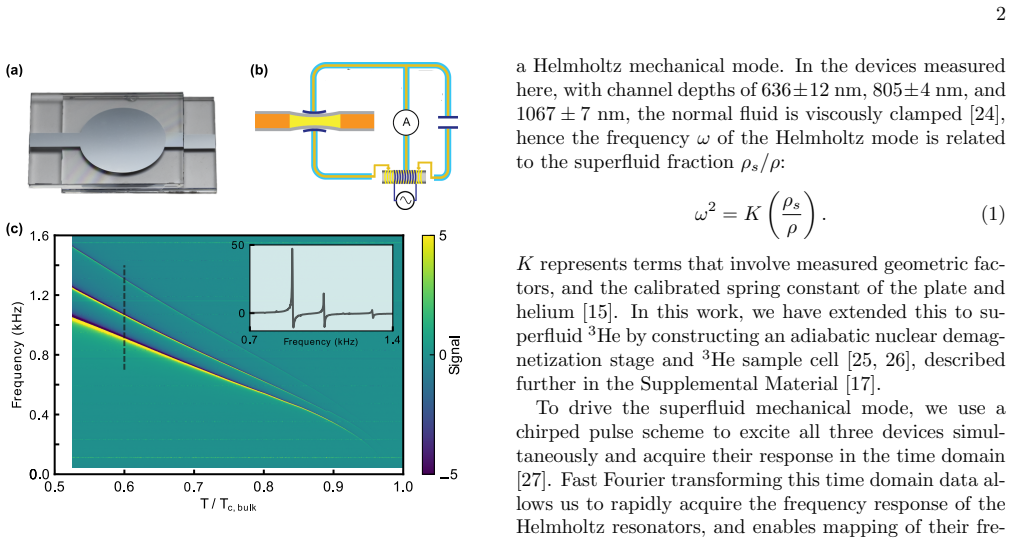
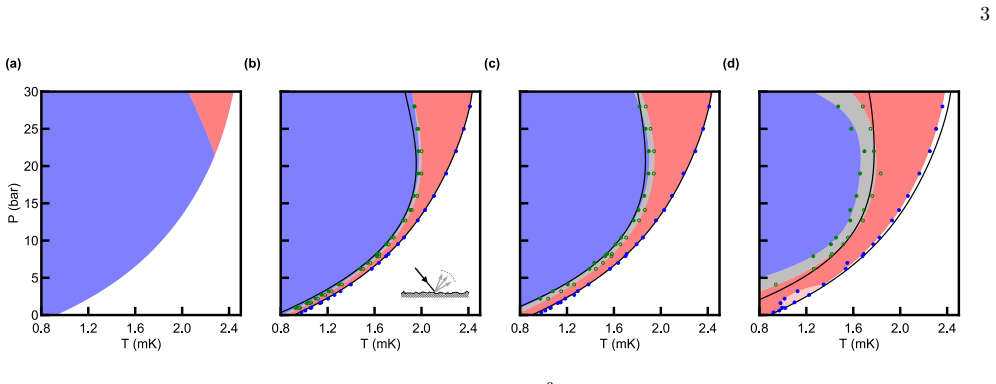
The measurement rests on microfabricated Helmholtz resonators: an applied voltage deflects electrodes and pushes superfluid out of nanoscale channels, and the resonance frequency obeys $\omega^2 = K(\rho_s/\rho)$, so the superfluid fraction is read directly. Three devices with channel depths of 636 nm, 805 nm, and 1067 nm are driven simultaneously with chirped pulses and measured in parallel. The theoretical side uses Ginzburg–Landau equations for the $3\times3$ order-parameter matrix $A_{\mu j}$ in a slab geometry, with strong-coupling corrections and diffuse boundary conditions, to fix the planar-distorted B-phase and A-phase boundaries without adjustable parameters. The grey region is assigned to a PDW through the mechanism of periodically spaced domain walls in which $\Delta_\perp$ changes sign, lowering the pairbreaking cost at the confining walls.
What would settle it
A measurement sensitive to the spatial structure of the order parameter in the grey region, such as NMR resolving the predicted domain-wall period or a spectroscopic signature of the PDW's collective modes, would settle the claim. If the grey region shows no periodic modulation of $\Delta_\perp$ with the predicted spacing, or if a competing inhomogeneous texture reproduces the superfluid-fraction data equally well, the central assignment fails.
Extended reading notes
Core claim
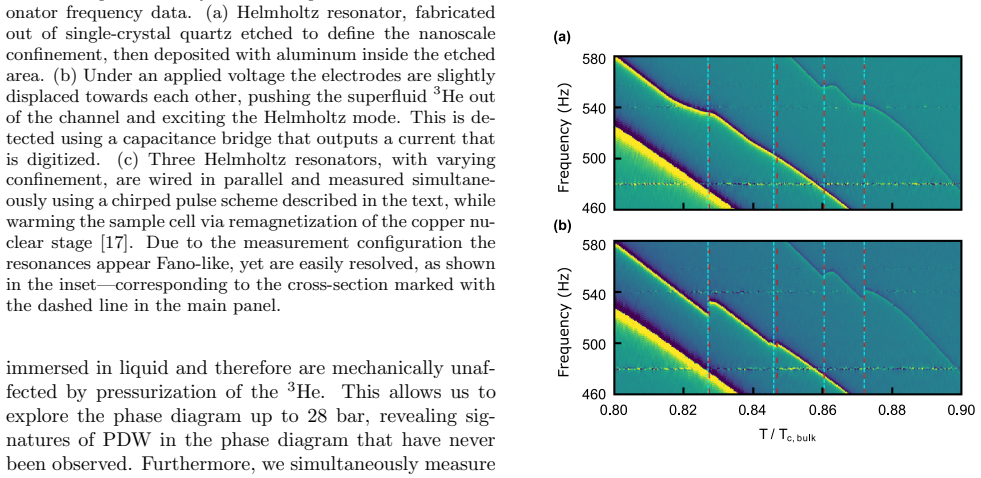
The central claim is that the grey phase in the measured pressure–temperature diagrams is a genuine thermodynamic phase, not an artifact of non-uniform confinement or heating. The evidence is the superfluid fraction, read from the frequency of a Helmholtz resonance, which shows two sharp first-order transitions in each device, with the same transition temperatures on warming and cooling. The phase sits between the A-phase and the planar-distorted B-phase and widens as the channel depth decreases, matching the expected behavior of a domain-wall state. Because the Ginzburg–Landau calculations that reproduce the other phase boundaries admit no uniform phase in that region, and because domain walls that reverse the sign of the perpendicular order-parameter component $\Delta_\perp$ reduce surface-pairbreaking energy, the paper concludes that the region is a PDW, most likely the predicted stripe phase.
Load-bearing premise
The identification of the grey region as a pair density wave rests on the theoretical result that the only thermodynamically allowed phase between the A-phase and the planar-distorted B-phase under this confinement is a PDW, while the experiment itself measures only the superfluid fraction and never directly images the spatial modulation.
Editorial extensions
If this is right
- Confined helium-3 provides a tunable platform for studying pair density waves, with channel depth and pressure as control knobs.
- The widening of the grey region with confinement predicts that thinner channels should stabilize the PDW over an even broader pressure–temperature range.
- The absence of hysteresis between the A-phase and planar-distorted B-phase transitions is explained by the intervening PDW lowering the nucleation barrier, so the PDW acts as a bridge between the two uniform phases.
- The observed PDW stability at pressures up to 28 bar extends beyond the range where simple estimates expected the stripe phase, giving a quantitative test for strong-coupling and boundary-condition theories.
- The identification points to new experimental targets: collective modes of the PDW and Majorana bound states at its domain walls.
Reading between the lines
- Because the experiment measures only the scalar superfluid fraction, the stripe-versus-polka-dot question is not settled by this data; a direct probe of the spatial periodicity would be the natural next test.
- The anomalous low-pressure region in the thinnest device, where transitions are not always reproducible, may be a competing inhomogeneous state or a boundary-condition effect; if it is another PDW variant, the phase diagram is richer than the grey region alone.
- The same Helmholtz technique could be extended to measure direction-dependent superfluid response, which might distinguish a unidirectional stripe phase from a two-dimensional polka-dot lattice through anisotropic fourth sound.
Editorial analysis
A structured set of objections, weighed in public.
Referee Report
Summary. The manuscript reports pressure-temperature phase diagrams of superfluid 3He confined in nanoscale channels of depth 636, 805, and 1067 nm, measured with simultaneously operated Helmholtz resonators that probe the superfluid fraction. The central observation is a grey intermediate region between the A-phase and the planar-distorted B-phase, bounded by two reproducible, hysteresis-free transitions. The authors assign this region to a thermodynamically stable pair density wave (PDW), relying on theoretical arguments from Refs. [8,30] that a PDW must lie between these two uniform phases. Their own Ginzburg-Landau calculation, which assumes translational invariance in the plane, reproduces the A/pdB boundaries but not the grey region. The paper concludes that nanoscale confinement stabilizes a PDW state breaking both gauge and translational symmetry.
Significance. If the identification is correct, this would be the first experimental demonstration of a thermodynamically stable PDW in superfluid 3He, providing a clean platform for studying PDW physics relevant to unconventional superconductors. The paper has substantial strengths: the measurements are carried out with three devices simultaneously, the transitions are reproducible on warming and cooling, and the thermal-effects analysis in Appendix C is careful and convincingly rules out heating artifacts. The Ginzburg-Landau curves for the A and planar-distorted B phase boundaries are parameter-free and agree well with experiment for the two thicker devices. The main weakness is that the PDW identification is inferential: the experiment measures only the scalar superfluid fraction, and the paper's own uniform-order-parameter calculation does not produce the grey region, so competing inhomogeneous states are not excluded.
major comments (3)
- [Fig. 4 and text after Eq. (4)] The central claim that the grey region is a PDW rests on the premise, taken from Refs. [8,30], that a PDW is the only thermodynamically possible phase between the A-phase and the planar-distorted B-phase under this confinement. The paper's own Ginzburg-Landau analysis is restricted to order parameters that are translationally invariant in the plane (Eqs. (3)-(4)) and explicitly does not capture the grey region, so it cannot exclude competing states such as a phase-separated A/pdB mixture, a disordered domain-wall texture, or a uniform state outside the restricted order-parameter families. Because the measurement probes only the superfluid fraction (Eq. (1)), a scalar quantity, it provides no direct evidence of broken translational symmetry. I recommend either adding a three-dimensional inhomogeneous Ginzburg-Landau calculation that stabilizes a PDW in the observed parameter range, or revising the conclusion to state that the grey region is consistent with, but not proven to be, a PDW.
- [Paragraph beginning 'While this argument alone...'] The paper states that the cited explicit calculations [8,30,42] stabilize a stripe PDW only at low pressures for D~10ξ, and then notes that the observed PDW 'unexpectedly persists at pressures up to 30 bar'. This is a serious discrepancy: the theoretical uniqueness argument used to identify the grey region covers only the 0-15 bar range, while the experimental grey region extends to 28 bar. The high-pressure identification is therefore unsupported by the cited theory. The authors need either to provide a calculation for pressures above 15 bar or to restrict the PDW claim to the pressure range where the cited theory applies.
- [Fig. 3 and text in 'Zoom-in around phase transitions'] The claim that 'observation of two first-order phase transitions demonstrates not only that the PDW state at intermediate temperatures is stable' is stronger than the data warrant. The data show reproducible kinks in the superfluid fraction with no temperature hysteresis; this is evidence for transitions, but it does not by itself establish that the intermediate state is an equilibrium thermodynamic phase rather than a long-lived metastable or disorder-stabilized state. The absence of hysteresis is consistent with an intermediate phase lowering nucleation barriers [31], but it does not prove thermodynamic stability. The wording should be softened to match the evidence.
minor comments (5)
- [Abstract and Conclusion] The abstract and conclusion use phrases such as 'demonstrated the existence' and 'we have demonstrated', while the main text acknowledges that the grey region is not reproduced by the Ginzburg-Landau calculation and that the stripe/polka-dot debate cannot be resolved; the level of certainty should be made consistent throughout.
- [Appendix B, Table I] The table lists separate basin and channel confinements, but the uncertainty in the channel confinement is given only in the main text; including these uncertainties in the table would be helpful.
- [Fig. 3 caption] The transitions are called 'first-order' based on the shape of the frequency response and the evolution of latent heat, but no direct discontinuity in a thermodynamic quantity is shown; consider calling them 'transitions' unless a discontinuity is resolved.
- [Appendix C, Eq. (10)] The thermal calculation uses a temperature gap of 0.2 mK at 20 bar; the main text reports that the largest gap occurs at 20 bar, but the grey region width varies with pressure and device, so it would be useful to specify the exact pressure and device to which this calculation refers.
- [Main text, 'anomalous region'] The non-reproducible region in the 636 nm device between 0.95 and 4.10 bar is a limitation of one of the three phase diagrams; since it is not discussed in the abstract or conclusion, a brief mention there would help readers assess the completeness of the phase diagram.
Circularity Check
No significant circularity: the PDW identification rests on external theory, and the experiment's phase transitions are independently resolved.
full rationale
The central claim—that the grey intermediate region is a stable pair density wave—is not obtained by fitting or by self-citation. The two first-order transitions are directly observed in the superfluid fraction, and the grey region is simply the interval between them. The assignment to a PDW relies on Refs. [8,30], which are external theory papers (Vorontsov & Sauls; Wiman & Sauls), not on the present authors' prior results, and the paper does not claim to derive that uniqueness internally. The Ginzburg-Landau calculation is explicitly parameter-free, assumes in-plane translational invariance, and is used only to identify the A-phase and planar-distorted B-phase boundaries; the paper openly states that it does not capture the grey region. Thus no fitted parameter is renamed as a prediction, and no load-bearing step reduces to its own inputs by construction. The 1067 nm device is used as a secondary thermometer but is cross-calibrated against a melting-curve thermometer and a tuning fork, so the thermometer calibration is not circular. The possible concern that a scalar superfluid-fraction measurement underdetermines broken translational symmetry is a question of evidence sufficiency or competing explanations, not circularity. Therefore the circularity score is 0.
Assumptions & free parameters
assumptions (4)
- domain assumption Ginzburg-Landau theory with strong-coupling corrections (Ref [32]) and diffuse boundary conditions accurately describes the relative stability of A and planar-distorted B phases under confinement.
- domain assumption The theoretical result that a PDW is the only phase possible between the A-phase and the planar-distorted B-phase (Refs [8,30]).
- domain assumption The 1067 nm device's superfluid fraction follows the bulk temperature dependence, making it a valid secondary thermometer.
- domain assumption Diffuse boundary conditions model the surface roughness of the etched quartz channels.
Cite this review
Pith. "Pith review of Stabilized Pair Density Wave via Nanoscale Confinement of Superfluid $^3$He." pith.science (2026). https://pith.science/paper/7OUCQ7YZ
@misc{pith2026190801779,
  author       = {Pith},
  title        = {Pith review of: Stabilized Pair Density Wave via Nanoscale Confinement of Superfluid $^3$He},
  year         = {2026},
  howpublished = {\url{https://pith.science/paper/7OUCQ7YZ}},
  note         = {Machine review of arXiv:1908.01779}
}
abstract
Superfluid $^3$He under nanoscale confinement has generated significant interest due to the rich spectrum of phases with complex order parameters that may be stabilized. Experiments have uncovered a variety of interesting phenomena, but a complete picture of superfluid $^3$He under confinement has remained elusive. Here, we present phase diagrams of superfluid $^3$He under varying degrees of uniaxial confinement, over a wide range of pressures, which elucidate the progressive stability of both the $A$-phase, as well as a growing region of stable pair density wave (PDW) state.
Figures

Figures from the paper (1 more)
Reference graph
Works this paper leans on
- [31]
-
[1]
D. Vollhardt and P. W¨ olfle, The Superfluid Phases of Helium 3 (Dover Publications, Mineola, NY, 2013)
work page 2013
- [2]
- [3]
- [4]
-
[5]
S. Miyawaki, K. Kawasaki, H. Inaba, A. Matsubara, O. Ishikawa, T. Hata, and T. Kodama, Phys. Rev. B 62, 5855 (2000)
work page 2000
-
[6]
K. Kawasaki, T. Yoshida, M. Tarui, H. Nakagawa, H. Yano, O. Ishikawa, and T. Hata, Phys. Rev. Lett. 93, 105301 (2004)
work page 2004
- [7]
Show all 49 references
-
[8]
Vorontsov and J.A
A.B. Vorontsov and J.A. Sauls, Phys. Rev. Lett. 98, 045301 (2007)
2007
-
[9]
Agterberg, J.C
D.F. Agterberg, J.C. S´ eamus Davis, S.D. Edkins, E. Fradkin, D.J. Van Harlingen, S.A. Kivelson, P.A. Lee, L. Radzihovsky, J.M. Tranquada, and Y. Wang, arXiv:1904.09687
1904 arXiv
-
[10]
Holmvall, A.B
P. Holmvall, A.B. Vorontsov, M. Fogelstr¨ om, and T.L¨ ofwanderNature Commun. 9, 2190 (2018)
2018
-
[11]
Levitin, R.G
L.V. Levitin, R.G. Bennett, A. Casey, B. Cowan, J. Saun- ders, D. Drung, Th. Schurig, and J.M. Parpia, Science 340, 841 (2013)
2013
-
[12]
Levitin, B
L.V. Levitin, B. Yager, L. Sumner, B. Cowan, A.J. Casey, J. Saunders, N. Zhelev, R.G. Bennett, and J.M. Parpia, Phys. Rev. Lett. 122, 085301 (2019)
2019
-
[13]
Zheng, W.G
P. Zheng, W.G. Jiang, C.S. Barquist, Y. Lee, and H.B. Chan, Phys. Rev. Lett. 117, 195301 (2016)
2016
-
[14]
Zhelev, T.S
N. Zhelev, T.S. Abhilash, E.N. Smith, R.G. Bennett, X. Rojas, L. Levitin, J. Saunders, and J.M. Parpia, Nat. Commun. 8, 15963 (2017)
2017
-
[15]
Rojas and J.P
X. Rojas and J.P. Davis, Phys. Rev. B 91, 024503 (2015)
2015
-
[16]
Souris, X
F. Souris, X. Rojas, P.H. Kim, and J.P. Davis,Phys. Rev. Applied 7, 044008 (2017)
2017
-
[17]
1, 18–23
See appendix for details on cryogenic apparatus, device geometry, thermal effects, and includes Refs. 1, 18–23
-
[18]
Kapitza, J
P.L. Kapitza, J. Phys. USSR 4, 181 (1941)
1941
-
[19]
I. L. Bekarevich, and I. M. Khalatnikov. J. Low Temp. Phys. 12, 1187 (1961)
1961
-
[20]
A. C. Anderson, J. I. Connolly, and J. C. Wheatley,Phys. Rev. 135, A910 (1964)
1964
-
[21]
H. E. Hall, J. R. Hook. Progress in Low Temp. Phys. 9, 143 (1986)
1986
-
[22]
Haard, Ph.D
T. Haard, Ph.D. thesis, Northwestern University, 2001
2001
-
[23]
J. P. Harrison. J. Low Temp. Phys. 37, 467 (1979)
1979
-
[24]
Kojima, D.N
H. Kojima, D.N. Paulson, and J.C. Wheatley, J. Low Temp. Phys. 21, 283 (1975)
1975
-
[25]
Pollanen, Ph.D
J. Pollanen, Ph.D. thesis, Northwestern University, 2012
2012
-
[26]
Krusius, D.N
M. Krusius, D.N. Paulson, and J.C. Wheatley, Cryogen- ics 18, 649 (1978)
1978
-
[27]
Doolin, Ph.D
C. Doolin, Ph.D. thesis, University of Alberta, 2019
2019
-
[28]
Osheroff, R.C
D.D. Osheroff, R.C. Richardson, and D.M. Lee, Phys. Rev. Lett. 28, 885 (1972)
1972
-
[29]
Richardson, Nobel Lectures, Physics 1996-2000, Ed- itor G
R.C. Richardson, Nobel Lectures, Physics 1996-2000, Ed- itor G. Ekspong, World Scientific Publishing Co., Singa- pore, 2002
1996
-
[30]
Wiman and J.A
J.J. Wiman and J.A. Sauls, J. Low Temp. Phys. 184, 1054 (2016)
2016
-
[32]
Choi, J.P
H. Choi, J.P. Davis, J. Pollanen, T. M. Haard, and W. P. Halperin, Phys. Rev. B 75, 174503 (2007)
2007
-
[33]
Li and T.-L
Y.-H. Li and T.-L. Ho, Phys. Rev. B 38, 2362 (1988)
1988
-
[34]
Parpia, D.G
J.M. Parpia, D.G. Wildes, J. Saunders, E.K. Zeise, J.D. Reppy, and R.C. Richardson, J. Low Temp. Phys. 61, 337 (1985)
1985
-
[35]
Wu and J.A
H. Wu and J.A. Sauls, Phys. Rev. B 88, 184506 (2013)
2013
-
[36]
Blaauwgeers, M
R. Blaauwgeers, M. Blazkova, M. ˇCloveˇ cko, V.B. Eltsov, R. de Graaf, J. Hosio, M. Krusius, D. Schmoranzer, W. Schoepe, L. Skrbek, P. Skybam, R.E. Solntsev, and D.E. Zmeev, J. Low Temp. Phys. 146, 537 (2007)
2007
-
[37]
Carless, H.E
D.C. Carless, H.E. Hall, and J.R. Hook, J. Low Temp. 6 Phys. 50, 6O5 (1983)
1983
-
[38]
Wiman and J.A
J.J. Wiman and J.A. Sauls, Phys. Rev. B 92, 144515 (2015)
2015
-
[39]
Ambegaokar, P.G
V. Ambegaokar, P.G. de Gennes, and D. Rainer, Phys. Rev. A 9, 2676 (1974)
1974
-
[40]
Salomaa and G.E
M.M. Salomaa and G.E. Volovik, Phys. Rev. B 37, 9298 (1988)
1988
-
[41]
Silveri, T
M. Silveri, T. Turunen, and E. Thuneberg, Phys. Rev. B 90, 184513 (2014)
2014
-
[42]
Aoyama, J
K. Aoyama, J. Phys. Soc. Jpn. 85, 094604 (2016)
2016
-
[43]
Davis, H
J.P. Davis, H. Choi, J. Pollanen, and W.P. Halperin, Phys. Rev. Lett. 97, 115301 (2006)
2006
-
[44]
Volovik, JETP Lett
G.E. Volovik, JETP Lett. 90, 398 (2009)
2009
-
[45]
Chung and S.C
S.B. Chung and S.C. Zhang, Phys. Rev. Lett. 103, 235301 (2009)
2009
-
[46]
Davis, J
J.P. Davis, J. Pollanen, H. Choi, J.A. Sauls, W.P. Halperin, and A.B. Vorontsov, Phys. Rev. Lett. 101, 085301 (2008)
2008
-
[47]
Murakawa, Y
S. Murakawa, Y. Wada, Y. Tamura, M. Wasai, M. Saitoh, Y. Aoki, R. Nomura, Y. Okuda, Y. Nagato, M. Ya- mamoto, S. Higashitani, and K. Nagai,J. Phys. Soc. Jpn. 80, 013602 (2011)
2011
-
[48]
Park, S.B
Y.J. Park, S.B. Chung, and J. Maciejko, Phys. Rev. B 91, 054507 (2015)
2015
-
[49]
Mizushima and J.A
T. Mizushima and J.A. Sauls, arXiv:1801.02277. APPENDIX A: LOW-TEMPERA TURE SETUP Our low-temperature setup consists of an adiabatic nu- clear demagnetization stage, incorporated into a commer- cial dilution fridge. The nuclear stage was made from high-purity copper, and vacuu...
Reviewed August 14, 2026 · model on record in the stance chip above.
Discussion (0). Continue with ORCID to comment.