REVIEW 3 major objections 6 minor 54 references
Robby is Not a Robber (anymore): On the Use of Institutions for Learning Normative Behavior
T0 review · 3 major / 6 minor · reviewed 2026-08-14 · deepseek-v4-flash
Pith's one-line read Social norms encoded as an institution can automatically shape robot rewards, and the resulting abstract policy transfers to a different robot and environment via re-grounding.
desk verdict Norm-guided reward shaping is a solid, clearly formalized idea, but the paper's headline claim of cross-domain transfer rests on a single qualitative result with no zero-shot curve. read the letter →
The pith
A machine-rendered reading of the paper's core claim, the machinery that carries it, and where it could break.
The reading
What carries the argument
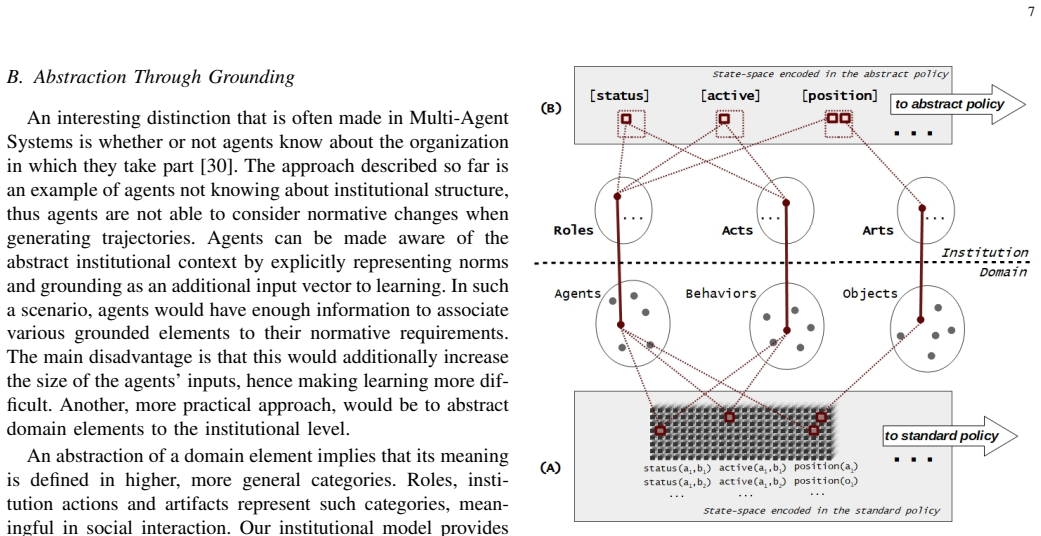
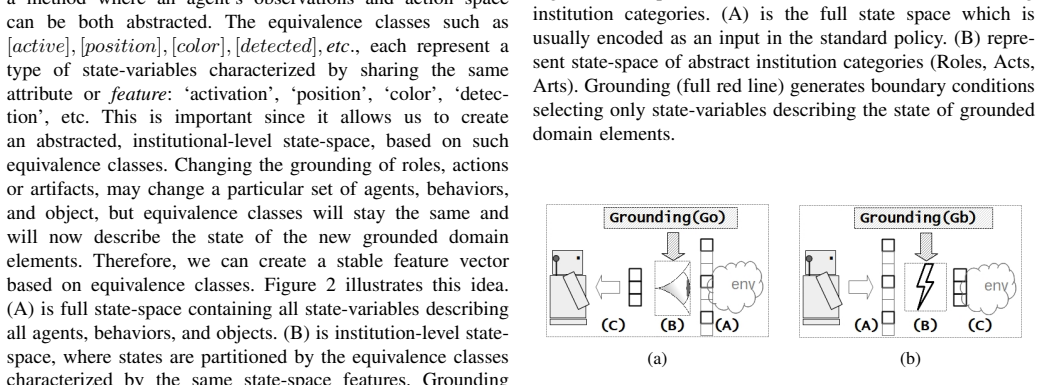
The central object is the institution: a tuple $\langle Arts, Roles, Acts, Norms\rangle$, with each norm a qualifier applied to role–action–artifact triples, e.g., $\text{must}(\text{Buyer}, \text{Pay}, \text{Cash})$. The mechanism is grounding—a mapping from these abstract categories to concrete agents, behaviors, and objects—together with norm semantics that classify any execution trajectory as fulfilling, violating, or neutral with respect to each norm. This classification drives the reward-shaping function $F_{norm}$ over norm-state transitions, and the same semantics defines equivalence classes of state variables that yield an abstract input vector for the policy, reducing the store's full 162-element observation to 39 elements.
What would settle it
Take a norm that requires distinguishing two objects that share the same state-variable classes (same active and position features) but have different normative status, say one object is 'goods' to pay for and another visually identical object must not be taken. If the original institution never had a feature class for this distinction, the abstract policy re-grounded onto the new domain will treat both objects the same and violate the norm; observing this failure would refute the claim that re-grounding preserves the normative semantics.
Extended reading notes
Core claim
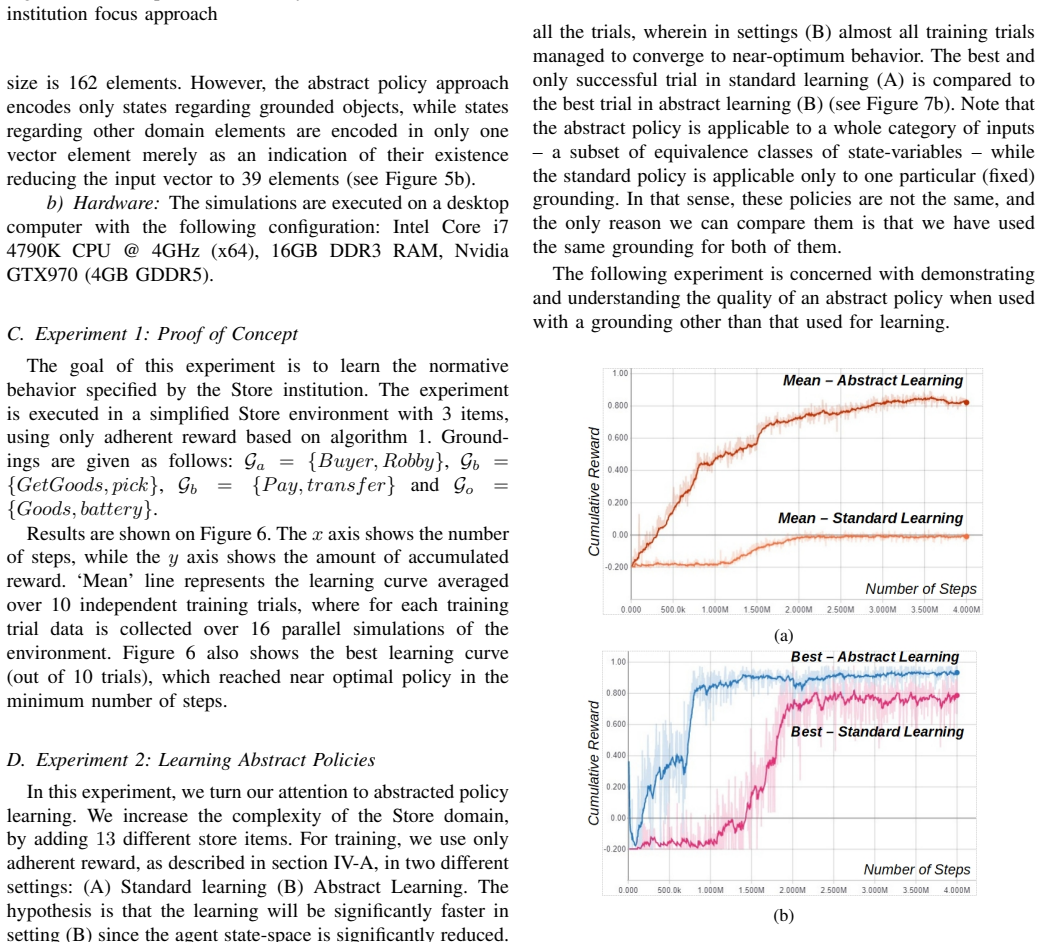
The central claim is that an institution's declarative norms—statements like 'a buyer must use the goods and pay at the pay place before leaving'—can be given execution-level semantics as sets of trajectories, and this semantics provides everything needed to (a) build an automatic reward signal that steers learning toward adherence, and (b) define an abstract state and action space based on equivalence classes of state variables ([active], [position], etc.) that stays stable when the institution is grounded onto new agents, behaviors, and objects. Learning at this institutional level produces an abstract policy that encodes procedural knowledge of how to fulfill the norms, and that policy transfers to a different domain with the same categories. In the paper's experiments, standard learning in the large store state space failed in almost all trials within four million steps, while abstract learning converged; and the store-learned abstract policy, directly re-grounded, let the factory robot perform the normative task in a dynamic environment where learning from scratch did not achieve significant results.
Load-bearing premise
The transfer works only if the equivalence classes that the abstract policy sees—things like 'active' and 'position'—carry the same meaning in the new domain as they did in the original one, for the new agents, behaviors, and objects.
Editorial extensions
If this is right
- Normative reward shaping can be built automatically from a declarative norm specification, removing the need to hand-engineer dense reward functions.
- Abstract policies learned at the institution level reduce the observation space and make learning feasible where full-state learning fails.
- A policy trained in a simple simulator can be transferred to a dynamically complex domain by re-grounding, which is a route to sim-to-real for normative behavior.
- The same mechanism extends to multi-agent settings: agents grounded to different roles receive role-specific norm feedback and learn to cooperate on shared norms.
- The method is not tied to a specific RL algorithm, since the institution supplies only a feedback signal.
Reading between the lines
- If primitive norm policies (one per qualifier like 'at' or 'before') can be learned and recombined, they could serve as reusable, composable skills for an agent, effectively building procedural knowledge from declarative pieces.
- The equivalence-class abstraction suggests a testable connection to schema theory: the abstract policy may predict that agents re-ground faster when the new domain shares the same sensorimotor features, a hypothesis that could be measured in human or robotic learning experiments.
- The approach could be extended to automatically search for admissible groundings during learning, which would make the method data-efficient in novel environments by rewarding any trajectory that is adherent under some grounding.
- Hierarchically grounding norms in terms of other norms, as the authors sketch for 'before' defined over two 'must' norms, points toward compositional norm understanding, but this is only implicitly explored in the paper.
Signed reviews
Editorial analysis
A structured set of objections, weighed in public.
Referee Report
Summary. The paper proposes to use a formal model of social institutions to guide reinforcement-learning agents toward normative behavior. An institution is defined as a tuple of roles, actions, artifacts, and norms, and each norm has fulfillment and violation semantics over trajectories. A grounding maps these abstract elements to a concrete domain, and state variables are grouped into equivalence classes such as [active] or [position]. During execution, norm states (fulfilled, violated, neutral) are computed and transformed by a reward function F_norm into RL feedback. The authors introduce "abstract policies" trained on the institution-level state space and claim that these policies transfer across domains via re-grounding. Experiments in a simulated store show a robot learning to pick and pay for goods, compare standard and abstract learning, report transfer to a factory domain, evaluate reward-shaping variants, and demonstrate a two-agent seller/buyer scenario.
Significance. If the transfer claims hold, the paper makes a useful bridge between normative multi-agent systems and deep RL: it provides a declarative and reusable way to encode social knowledge, converts norm semantics into automatic reward shaping, and reduces the state space through institution-level abstraction. The formal model is clearly presented, the framework is RL-algorithm agnostic, and the multi-agent extension is a genuine plus. The empirical study is best read as a proof of concept; the main weakness is that the decisive zero-shot transfer result (B1) is not quantitatively reported, so the central "apply the same set of norms over different domains" claim is not yet demonstrated at the level of the paper's own headline. The norm-state reward is constructed from the same semantics that define fulfillment and violation, which is a legitimate reward-shaping design rather than a hidden circularity.
major comments (3)
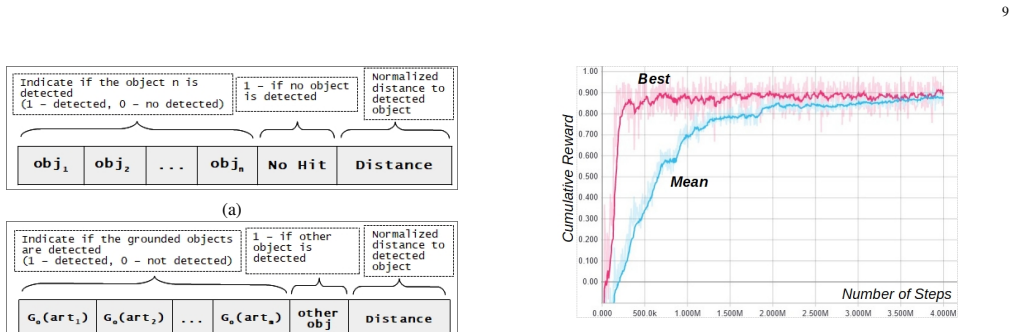
- [Section V-E, Fig. 9] The central transfer claim is not quantitatively supported because B1, the zero-shot application of the Store-trained abstract policy to Forky, is reported only as a qualitative statement ("in most of the episodes manages to reach the hatch"), with no success rate, reward curve, or variance. Figure 9 compares B2 (transferred policy plus 200k additional training steps) with B3 (from scratch), and B2's cumulative reward declines; this comparison cannot separate the representational transfer claimed in Section IV-B from target-domain fine-tuning. Please report B1's quantitative behavior (e.g., episode success rate and return as a function of episodes) or revise the conclusion to claim only fine-tuned transfer.
- [Section V-E, Fig. 9] It is not stated whether B3 (from scratch) uses the same abstract institution-level state representation as B2 or the full 162-element state space described in Section V-B. If B3 uses the full representation, the comparison conflates the effect of abstraction with the effect of transfer, and the claim that "learning from scratch did not manage to achieve any significant results" is not a controlled baseline. Specify B3's observation and action spaces, and if necessary rerun B3 with the abstract representation.
- [Section V-D, Fig. 7] The claim that abstract learning is "significantly faster" rests on mean curves without error bars or confidence intervals, and Fig. 7b compares only the best trial from each setting. Since RL runs have high variance, report the full distribution (e.g., interquartile ranges, per-trial success rates at a fixed step budget) and define the "success" criterion used to classify trials as converged or failed.
minor comments (6)
- [Section V-B, Table I] The hyperparameters were chosen via pilot tests that are not reported; for reproducibility, include the full hyperparameter set (including entropy coefficient, learning rate schedule if any, and number of seeds) in an appendix, and ideally a sensitivity check on the reward-shaping constants.
- [Section V-C] The sentence "Mean line represents the learning curve averaged over 10 independent training trials, where for each training trial data is collected over 16 parallel simulations" should specify how the 16 parallel simulations are aggregated before averaging over the 10 trials.
- [Section V-E] The phrase "in the trail (A)" should read "in the trial (A)"; the same typo appears elsewhere in the experiment descriptions.
- [Section II] There is a duplicated article in "the the credit assignment problem" in the first sentence of Section II.
- [Table II] The row for "Abstract Learning - Success Failed (Learning) Success (Transfer)" is syntactically confusing and should be reformatted, for example into separate rows for "Abstract, no shaping" and "Abstract with transfer".
- [Section V-F] The norm-state reward values are specified as 1.0/(number of norms) for the (n,f) transition, but the paper does not state how multiple norms are combined when several transitions occur in the same step, nor whether a norm that goes directly from neutral to violated receives the same penalty as one that was previously fulfilled; please make this explicit for reproducibility.
Circularity Check
No significant circularity: the norm reward is the intended learning objective by design, and the transfer claim is a representational construction tested empirically, not a fitted quantity disguised as a prediction.
full rationale
After walking the derivation chain, I find no step in which a stated prediction or first-principles result reduces to its own inputs by construction. Section IV-A defines the norm reward function Fnorm over norm-state transitions, and Algorithm 1 returns reward 1 exactly when all norms are in the fulfilled state. This is deliberately the learning objective: the paper claims that norms can guide reinforcement learning by defining a reward from norm semantics, and the experiments then show that agents can optimize that reward. That is a standard reward-shaping design, not a hidden circularity, because the rewards are not fitted parameters renamed as predictions. Section IV-B defines abstract policies over equivalence classes of state variables such as [active] and [position], and states that changing grounding preserves those equivalence classes. This is a definitional property of the abstraction, so the in-principle transfer claim follows from the construction; however, the paper does not present this as a statistically fitted prediction, and it attempts to test it empirically in Experiment 3. The transfer evidence is weaker than the abstract claims: the zero-shot condition B1 is only qualitatively reported ('in most of the episodes manages to reach the hatch'), and the plotted comparison B2 includes 200k additional training steps in the target domain. This is a threat to the empirical force of the transfer claim, but it is an evidence-quality issue rather than circularity. The paper also cites its own prior work [24] for the formal verification machinery used to evaluate norm states, but the empirical RL results are measured against environment behavior and are not derived from that citation alone; the self-citation supplies implementation machinery, not the conclusion. Section VI-C explicitly acknowledges that automatic grounding in novel domains remains open, which further indicates that the paper does not claim a forced derivation beyond its own representational construction. Overall, the central claims have independent empirical content and no significant circularity was found.
Assumptions & free parameters
free parameters (3)
- PPO hyperparameters =
beta=6e-3, gamma=0.99, lambda=0.95, learning rate=3e-4, 3 layers of 256 units, time horizon=1024, batch size=1024
- Norm transition reward values =
1.0/(number of norms) for (n,f), 1.0 for full adherence, 0 after violation, per-step penalty 1.0e-4
- Episode length cap =
2000 steps
assumptions (5)
- domain assumption Norm semantics functions correctly capture the intended social norms
- domain assumption All groundings used in the experiments are admissible
- domain assumption Equivalence classes of state variables remain invariant under re-grounding
- domain assumption The agent's observation vector is sufficient for the normative policy
- domain assumption PPO converges to near-optimal policies in the tested domains
Cite this review
Pith. "Pith review of Robby is Not a Robber (anymore): On the Use of Institutions for Learning Normative Behavior." pith.science (2026). https://pith.science/paper/U4WNOX2I
@misc{pith2026190802138,
  author       = {Pith},
  title        = {Pith review of: Robby is Not a Robber (anymore): On the Use of Institutions for Learning Normative Behavior},
  year         = {2026},
  howpublished = {\url{https://pith.science/paper/U4WNOX2I}},
  note         = {Machine review of arXiv:1908.02138}
}
read the original abstract
Future robots should follow human social norms in order to be useful and accepted in human society. In this paper, we leverage already existing social knowledge in human societies by capturing it in our framework through the notion of social norms. We show how norms can be used to guide a reinforcement learning agent towards achieving normative behavior and apply the same set of norms over different domains. Thus, we are able to: (1) provide a way to intuitively encode social knowledge (through norms); (2) guide learning towards normative behaviors (through an automatic norm reward system); and (3) achieve a transfer of learning by abstracting policies; Finally, (4) the method is not dependent on a particular RL algorithm. We show how our approach can be seen as a means to achieve abstract representation and learn procedural knowledge based on the declarative semantics of norms and discuss possible implications of this in some areas of cognitive science.
Figures

Figures from the paper (7 more)


Reference graph
Works this paper leans on
-
[24]
Norms, Institutions, and Robots
S. Tomic, F. Pecora, and A. Saffiotti, “Norms, insti- tutions, and robots,” arXiv preprint arXiv:1807.11456 , 2018
work page Pith review arXiv 2018
-
[1]
Playing atari with deep reinforcement learning,
V . Mnih, K. Kavukcuoglu, D. Silver, A. Graves, I. Antonoglou, D. Wierstra, and M. Riedmiller, “Playing atari with deep reinforcement learning,” arXiv preprint arXiv:1312.5602, 2013
arXiv 2013
-
[2]
Mastering the game of go without human knowledge,
D. Silver, J. Schrittwieser, K. Simonyan, I. Antonoglou, A. Huang, A. Guez, T. Hubert, L. Baker, M. Lai, A. Bolton et al. , “Mastering the game of go without human knowledge,” Nature, vol. 550, no. 7676, p. 354, 2017
2017
-
[3]
Mastering chess and shogi by self-play with a general reinforcement learning al- gorithm. 2017,
D. Silver, T. Hubert, J. Schrittwieser, I. Antonoglou, M. Lai, A. Guez et al. , “Mastering chess and shogi by self-play with a general reinforcement learning al- gorithm. 2017,” URL: http://arxiv. org/pdf/1712.01815 , 2017
arXiv 2017
-
[4]
Starcraft ii: A new challenge for reinforcement learning,
O. Vinyals, T. Ewalds, S. Bartunov, P. Georgiev, A. S. Vezhnevets, M. Yeo, A. Makhzani, H. K ¨uttler, J. Aga- piou, J. Schrittwieser et al. , “Starcraft ii: A new challenge for reinforcement learning,” arXiv preprint arXiv:1708.04782, 2017
arXiv 2017
- [5]
-
[6]
Learning dexterous in-hand manipulation,
M. Andrychowicz, B. Baker, M. Chociej, R. Jozefow- icz, B. McGrew, J. Pachocki, A. Petron, M. Plappert, G. Powell, A. Ray et al. , “Learning dexterous in-hand manipulation,” arXiv preprint arXiv:1808.00177 , 2018
arXiv 2018
-
[7]
Decision-theoretic planning: Structural assumptions and computational leverage,
C. Boutilier, T. Dean, and S. Hanks, “Decision-theoretic planning: Structural assumptions and computational leverage,” J. Artif. Int. Res. , vol. 11, no. 1, pp. 1–94, Jul. 1999. [Online]. Available: http://dl.acm.org/citation. cfm?id=3013545.3013546
arXiv 1999
Show all 54 references
-
[8]
What is an institution,
J. R. Searle, “What is an institution,” Journal of institu- tional economics, vol. 1, no. 1, pp. 1–22, 2005
2005
-
[9]
D. C. North, Institutions, institutional change and eco- nomic performance. Cambridge university press, 1990
1990
-
[10]
Ostrom, Understanding institutional diversity
E. Ostrom, Understanding institutional diversity. Prince- ton university press, 2009
2009
-
[11]
Computers and thought,
M. Minsky, E. Feigenbaum, and J. Feldman, “Computers and thought,” 1963
1963
-
[12]
Adaptive control processes,
R. Bellman, “Adaptive control processes,” Princeton Uni- versity Press, 1961
1961
-
[13]
Reinforcement learning in the multi-robot domain,
M. J. Matari ´c, “Reinforcement learning in the multi-robot domain,” in Robot colonies. Springer, 1997, pp. 73–83
1997
-
[14]
Policy invariance under reward transformations: Theory and application to reward shaping,
A. Y . Ng, D. Harada, and S. Russell, “Policy invariance under reward transformations: Theory and application to reward shaping,” in ICML, vol. 99, 1999, pp. 278–287
1999
-
[15]
Between mdps and semi-mdps: A framework for temporal abstraction in reinforcement learning,
R. S. Sutton, D. Precup, and S. Singh, “Between mdps and semi-mdps: A framework for temporal abstraction in reinforcement learning,” Artificial intelligence, vol. 112, no. 1-2, pp. 181–211, 1999
1999
-
[16]
Learning in behavior-based multi-robot systems: Policies, models, and other agents,
M. J. Matari ´c, “Learning in behavior-based multi-robot systems: Policies, models, and other agents,” Cognitive Systems Research, vol. 2, no. 1, pp. 81–93, 2001
2001
-
[17]
Decision making in reinforcement learning using a modified learn- ing space based on the importance of sensors,
Y . Kishima, K. Kurashige, and T. Kimura, “Decision making in reinforcement learning using a modified learn- ing space based on the importance of sensors,” Journal of Sensors, vol. 2013, 2013
2013
-
[18]
Learning to use selective at- tention and short-term memory in sequential tasks,
A. K. McCallum et al. , “Learning to use selective at- tention and short-term memory in sequential tasks,” in From animals to animats 4: proceedings of the fourth international conference on simulation of adaptive be- havior, vol. 4. MIT Press, 1996, p. 315
1996
-
[19]
Algorithms for inverse reinforcement learning
A. Y . Ng, S. J. Russell et al. , “Algorithms for inverse reinforcement learning.” in Icml, vol. 1, 2000, p. 2
2000
-
[20]
Norms, rewards, and the intentional stance: Comparing machine learning approaches to ethical training,
D. Kasenberg, T. Arnold, and M. Scheutz, “Norms, rewards, and the intentional stance: Comparing machine learning approaches to ethical training,” in Proceedings of the 2018 AAAI/ACM Conference on AI, Ethics, and Society. ACM, 2018, pp. 184–190
2018
-
[21]
Deep reinforcement learning from human preferences,
P. F. Christiano, J. Leike, T. Brown, M. Martic, S. Legg, and D. Amodei, “Deep reinforcement learning from human preferences,” in Advances in Neural Information Processing Systems, 2017, pp. 4299–4307
2017
-
[22]
Institutional environments,
P. Silva, R. Ventura, and P. U. Lima, “Institutional environments,” inProc of AAMAS Workshop: From agent theory to agent implementation , 2008, pp. 157–164
2008
-
[23]
Making norms concrete,
H. Aldewereld, S. ´Alvarez-Napagao, F. Dignum, and J. V ´azquez-Salceda, “Making norms concrete,” in Pro- ceedings of the 9th International Conference on Au- tonomous Agents and Multiagent Systems: volume 1- Volume 1. International Foundation for Autonomous Agents and Multiage...
2010
-
[25]
Towards norm realization in institutions mediating human-robot societies,
A. Wasik, S. Tomic, A. Saffiotti, F. Pecora, A. Martinoli, and P. U. Lima, “Towards norm realization in institutions mediating human-robot societies,” in 2018 IEEE/RSJ In- ternational Conference on Intelligent Robots and Systems (IROS). IEEE, 2018, pp. 297–304
2018
-
[26]
Towards institutions for mixed human-robot societies,
S. Tomic, A. B. Wasik, P. U. Lima, A. Martinoli, F. Pec- ora, and A. Saffiotti, “Towards institutions for mixed human-robot societies,” in Proc. of the 17th International Conference on Autonomous Agents and Multiagent Sys- tems (AAMAS 2018) , no. CONF, 2018, pp. 2216–2217
2018
-
[27]
Temporal constraint networks,
R. Dechter, I. Meiri, and J. Pearl, “Temporal constraint networks,” Artificial intelligence, vol. 49, no. 1, pp. 61– 95, 1991
1991
-
[28]
Constraint-based attribute and interval planning,
J. Frank and A. J ´onsson, “Constraint-based attribute and interval planning,” Constraints, vol. 8, no. 4, pp. 339– 364, 2003
2003
-
[29]
Unifying planning and scheduling as timelines in a component-based per- spective,
S. Fratini, F. Pecora, and A. Cesta, “Unifying planning and scheduling as timelines in a component-based per- spective,”Archives of Control Science, vol. 18, no. 2, pp. 231–271, 2008
2008
-
[30]
Orga- nization oriented programming: From closed to open organizations,
O. Boissier, J. F. H ¨ubner, and J. S. Sichman, “Orga- nization oriented programming: From closed to open organizations,” in Engineering Societies in the Agents World. Springer, 2007, pp. 86–105
2007
-
[31]
https://unity.com/,
U. Technologies, “https://unity.com/,” 2019
2019
-
[32]
Proximal policy optimization algorithms,
J. Schulman, F. Wolski, P. Dhariwal, A. Radford, and O. Klimov, “Proximal policy optimization algorithms,” arXiv preprint arXiv:1707.06347 , 2017
2017 arXiv
-
[33]
Unity: A general platform 16 for intelligent agents,
A. Juliani, V .-P. Berges, E. Vckay, Y . Gao, H. Henry, M. Mattar, and D. Lange, “Unity: A general platform 16 for intelligent agents,” arXiv preprint arXiv:1809.02627, 2018
2018 arXiv
-
[34]
Concrete problems in ai safety,
D. Amodei, C. Olah, J. Steinhardt, P. Christiano, J. Schul- man, and D. Man ´e, “Concrete problems in ai safety,” arXiv preprint arXiv:1606.06565 , 2016
2016 arXiv
-
[35]
Curriculum learning,
Y . Bengio, J. Louradour, R. Collobert, and J. Weston, “Curriculum learning,” inProceedings of the 26th annual international conference on machine learning . ACM, 2009, pp. 41–48
2009
-
[36]
Culture and cognition,
P. DiMaggio, “Culture and cognition,” Annual review of sociology, vol. 23, no. 1, pp. 263–287, 1997
1997
-
[37]
Remembering: A study in social and experimental psychology,
F. C. Bartlett, “Remembering: A study in social and experimental psychology,” 1932
1932
-
[38]
P. J. Hampson and P. E. Morris, Understanding cognition. Wiley-Blackwell, 1996
1996
-
[39]
Is memory schematic?
J. W. Alba and L. Hasher, “Is memory schematic?” Psychological Bulletin, vol. 93, no. 2, p. 203, 1983
1983
-
[40]
A framework for representing knowledge,
M. Minsky, “A framework for representing knowledge,” The Psychology of Computer Vision , 1975
1975
-
[41]
E.(1980). schemata: The building blocks of cognition,
D. Rumelhart, “E.(1980). schemata: The building blocks of cognition,” Theoretical Issues in Reading Comprehen- sion, pp. 9 781 315 107 493–4, 1980
1980
-
[42]
Thagard, Mind: Introduction to cognitive science
P. Thagard, Mind: Introduction to cognitive science . MIT press Cambridge, MA, 2005, vol. 17
2005
-
[43]
Grounded cognition,
L. W. Barsalou, “Grounded cognition,” Annu. Rev. Psy- chol., vol. 59, pp. 617–645, 2008
2008
-
[44]
A review of abstract concept learning in embodied agents and robots,
A. Cangelosi and F. Stramandinoli, “A review of abstract concept learning in embodied agents and robots,” Philo- sophical Transactions of the Royal Society B: Biological Sciences, vol. 373, no. 1752, p. 20170131, 2018
2018
-
[45]
Perceptions of perceptual symbols,
L. W. Barsalou, “Perceptions of perceptual symbols,” Behavioral and brain sciences , vol. 22, no. 4, pp. 637– 660, 1999
1999
-
[46]
Making sense of embod- iment: Simulation theories and the sharing of neural circuitry between sensorimotor and cognitive processes,
H. Svensson and T. Ziemke, “Making sense of embod- iment: Simulation theories and the sharing of neural circuitry between sensorimotor and cognitive processes,” in Proceedings of the Annual Meeting of the Cognitive Science Society, vol. 26, 2004
2004
-
[47]
Computational grounded cognition: a new alliance between grounded cognition and computational modeling,
G. Pezzulo, L. W. Barsalou, A. Cangelosi, M. H. Fischer, K. McRae, and M. Spivey, “Computational grounded cognition: a new alliance between grounded cognition and computational modeling,” Frontiers in psychology , vol. 3, p. 612, 2013
2013
-
[48]
J. A. Fodor, The language of thought. Harvard university press, 1975, vol. 5
1975
-
[49]
Jean piaget— cognitive theory— simply psychology.[online] simplypsychology. org,
S. McLeod, “Jean piaget— cognitive theory— simply psychology.[online] simplypsychology. org,” 2009
2009
-
[50]
Johnson and G
M. Johnson and G. Lakoff, Metaphors we live by . Uni- versity of Chicago Press Chicago, 2003
2003
-
[51]
Reasons to doubt the present evidence for metaphoric representation,
G. L. Murphy, “Reasons to doubt the present evidence for metaphoric representation,” Cognition, vol. 62, no. 1, pp. 99–108, 1997
1997
-
[52]
Analogy and analogical reasoning,
P. Bartha, “Analogy and analogical reasoning,” in The Stanford Encyclopedia of Philosophy , spring 2019 ed., E. N. Zalta, Ed. Metaphysics Research Lab, Stanford University, 2019
2019
-
[53]
Structure-mapping: A theoretical frame- work for analogy,
D. Gentner, “Structure-mapping: A theoretical frame- work for analogy,” Cognitive science , vol. 7, no. 2, pp. 155–170, 1983
1983
-
[54]
Analogical reasoning: A core of cognition
H. Gust, U. Krumnack, K.-U. K ¨uhnberger, and A. Schw- ering, “Analogical reasoning: A core of cognition.” KI, vol. 22, no. 1, pp. 8–12, 2008
2008
Reviewed August 14, 2026 · model on record in the stance chip above.
Discussion (0). Continue with ORCID to comment.