REVIEW 3 major objections 9 minor 28 references
Superparamagnetic dwell times and tuning of switching rates in perpendicular CoFeB/MgO/CoFeB tunnel junctions
T0 review · 3 major / 9 minor · reviewed 2026-08-14 · deepseek-v4-flash
Pith's one-line read The paper claims that thermally driven switching in perpendicular CoFeB/MgO/CoFeB junctions is governed by a ~17 nm activation volume, not the full 70 nm electrode, and that entropic pathway counting resolves the fast-dwell-time puzzle.
desk verdict Entropic explanation of fast MTJ switching is plausible but rests on an untested N! pathway-count ansatz; the tuning-curve demonstration is the solid part. read the letter →
The pith
A machine-rendered reading of the paper's core claim, the machinery that carries it, and where it could break.
The reading
What carries the argument
The central object is the entropic multiplicity $w$ of switching pathways in the free-energy barrier. The paper writes the mean dwell time as $\bar{\tau} = (\tau_0/w) \exp(\Delta E/k_B T)$, so that a large $w$ shortens the effective prefactor without changing the barrier. To estimate $w$, it assumes switching can nucleate in any of $N$ interchangeable sub-volumes, giving $w \approx N!$; with $\ln w \approx 35$ this yields $N \approx 17$ and an activation radius $r_A = r_E/\sqrt{K/K^*} \approx 17\,\text{nm}$. This entropic prefactor is what reconciles the measured Arrhenius slopes with the fast observed switching.
What would settle it
Measure dwell times on electrodes with different diameters (e.g., 100 nm, 140 nm, 200 nm) at fixed thickness and temperature; if the entropic model is right, the inferred activation radius stays near 17 nm regardless of electrode size, whereas if nucleation is tied to grain size or the full electrode, the radius would scale with electrode size.
Extended reading notes
Core claim
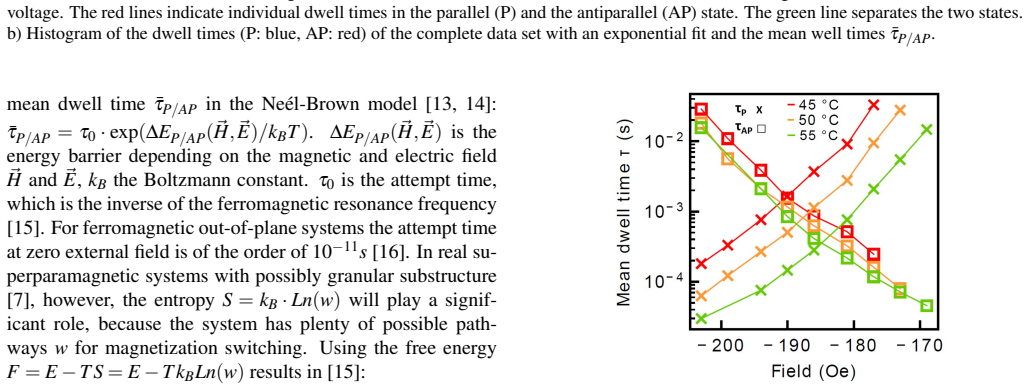
The central claim is that the inconsistency between measured superparamagnetic dwell times and the single-domain thermal-activation barrier disappears once the entropy $S = k_B \ln w$ of switching pathways is added to the free energy. With the free energy $F = E - T S$, the mean dwell time becomes $\bar{\tau}_{P/AP} = (\tau_0/w) \exp(\Delta E_{P/AP}/k_B T)$. Fitting the field and temperature dependence gives an activation energy $\Delta E$ and an apparent anisotropy $K^* = \Delta E/V_E$ that is 13 to 24 times smaller than the measured anisotropy $K$. Interpreting the ratio as a reduced magnetic activation volume yields $r_A = r_E/\sqrt{K/K^*} = (17\pm4)\,\text{nm}$, and the same volume makes the extracted saturation magnetization fall in the reported 500 kA/m to 1 MA/m range. The paper also reports that the same 17 nm radius follows from counting $w \approx N! \approx 10^{15}$ nucleation pathways, with $N \approx 17$. For the bias-voltage response, the spin-torque contribution scales exponentially with MgO thickness while the anisotropy contribution scales as $1/t_{\text{MgO}}$, allowing the two to be separated; the resulting switching-rate tuning curves are Gaussian in both magnetic and electric fields.
Load-bearing premise
The 17 nm activation radius rests on the assumption that switching can nucleate in any of N sub-volumes and that the number of distinct pathways is N!, so a different relationship between pathway count and sub-volume count would change the inferred radius and could erase the agreement with the energy-based estimate.
Editorial extensions
If this is right
- Dwell-time statistics of superparamagnetic MTJs can be described by the Arrhenius law once the entropic prefactor is included, with an activation volume of roughly 17 nm radius rather than the full electrode.
- The bias-voltage effect separates by MgO thickness: spin-transfer torque dominates thin barriers and voltage-induced anisotropy change becomes relatively stronger for thick barriers.
- Switching rate as a function of magnetic field or voltage is a Gaussian whose peak position can be shifted by the other input, satisfying the tuning-curve requirements of population-coding neural networks.
- Quasistatic coercivity measurements become time-scale dependent: if the measurement time exceeds the mean dwell time, the apparent coercive field drops to zero even though the intrinsic anisotropy remains.
- Using the reduced activation volume instead of the full electrode volume restores physically plausible saturation magnetization values for these CoFeB films.
Reading between the lines
- Going beyond the paper, if the $N!$ pathway count is taken literally, the inferred 17 nm region is comparable to the domain-wall width in similar CoFeB films, suggesting reversal may nucleate and expand from a small reversed domain; time-resolved magnetic imaging of individual switching events could test this directly.
- A further implication is that the pathway-counting assumption is the softest link; an independent measurement of the attempt prefactor $\tau_0/w$ from ferromagnetic resonance or from the temperature dependence of the dwell-time distribution would constrain $w$ without relying on combinatorial arguments.
- Another testable extension is to vary the electrode diameter at fixed thickness: the entropic model predicts the activation radius should remain near 17 nm, while a model that ties sub-volumes to grain size would predict a different scaling.
- Finally, the demonstrated Gaussian, shiftable tuning curves suggest that populations of such junctions could implement basis-function coding; a concrete next step is checking whether the peak-shift behaviour survives when many junctions are averaged in parallel.
Signed reviews
Editorial analysis
A structured set of objections, weighed in public.
Referee Report
Summary. This manuscript reports time-resolved measurements of thermally driven switching in perpendicular CoFeB/MgO/CoFeB magnetic tunnel junctions with 140-nm-diameter pillars, a 1.1-nm free CoFeB electrode and MgO barriers of 1.2, 1.4 and 1.6 nm. The devices show a clean two-level telegraph with exponentially distributed dwell times. From the temperature and magnetic-field dependence of the mean dwell times the authors extract, for each barrier thickness, an activation energy ΔE and a Zeeman-energy product V·M_S. Because ΔE/V_E corresponds to an apparent anisotropy 12.7 to 24.3 times smaller than the quasistatically measured effective anisotropy K ≈ 330 kJ/m³, they infer a magnetic activation volume V_A = ΔE/K with radius r_A = r_E/√(K/K*) = (17±4) nm; recomputing M_S with V_A brings the saturation magnetization into the literature range. The Arrhenius intercept yields ln w ≈ 35 (w ≈ 10^15), and assuming w ≈ N! pathways among N switching sub-volumes gives N ≈ 17 and an equivalent radius of about 17 nm, which the authors call a remarkable agreement between the energetic and thermodynamic routes. Bias-voltage sweeps at the three barrier thicknesses are decomposed into a spin-torque contribution that decays exponentially with barrier thickness and a voltage-induced anisotropy contribution, and the switching-rate tuning curves obtained by sweeping field at fixed bias and bias at fixed field are Gaussian, matching a requirement for neural-like population coding.
Significance. If the central claims hold, the paper is a useful contribution to the sp-MTJ literature: it provides quantitative evidence that the thermally active volume in these nominally single-domain 140-nm electrodes is far smaller than the electrode (about 17 nm radius), that the independently measured quasistatic anisotropy combined with that volume reconciles the barrier heights, and that the resulting saturation magnetization agrees with literature values. The clean telegraph data, the verified exponential dwell-time statistics, the use of an independent anisotropy measurement as a cross-check, and the demonstration of Gaussian tuning curves shifted by bias voltage are genuine strengths; the paper also candidly admits that the anisotropy/spin-torque separation is not reliable. The specifically entropic result is, however, conditional: the values w ≈ 10^15, N ≈ 17 and the claimed corroboration of the activation volume rest on an unverified w ≈ N! pathway-counting model. As it stands, the paper establishes the reduced activation volume through the energetic analysis but does not establish the entropic mechanism announced in the abstract.
major comments (3)
- [Entropic estimate of activation volume (p. 3)] This step is load-bearing for the abstract's claim that including entropic effects leads to a magnetic activation volume much smaller than the electrode. The entropy-derived radius r_A ≈ 17 nm is obtained exclusively from the assumption w ≈ N!, i.e., that the magnetization can switch through any ordering of N sub-volumes; no microscopic justification is given, and the paper flags the step only with 'If we assume'. The assumption is in tension with the data in Fig. 1a, which show switching between exactly two resistance states: a process of a single nucleation event followed by rapid wall propagation would naturally have w ∝ N (the choice of nucleation site), and with w ∝ N the value ln w = 35 would force N ≈ 10^15 sub-volumes and a sub-atomic activation radius, destroying the entropic explanation. Because N is fixed by the same Arrhenius intercept that the model is meant to explain, the 'remarkable' agreement of the two radii tests only the assumed functional form. I ask the authors to justify N! microscopically, test it by measuring ln w versus pillar diameter (for w ≈ N! a doubling of diameter changes ln w by roughly a factor of four plus a large additive term, whereas for w ∝ N it changes by only ln 4), or reframe the entropic estimate as a hypothesis rather than as confirmation.
- [Table I and Arrhenius/field fits (pp. 2-3)] The primary extracted quantities — ΔE, V·M_S, K*, M_S and r_A — are reported without error bars; the (17±4) nm uncertainty is only the spread across three barrier thicknesses, not a propagated fit error, and no fit ranges, numbers of points or weighting are given. The value ln w ≈ 35 is the intercept of the same Arrhenius regression and depends fully on the assumed attempt time τ0 = 10^-11 s (Ref. [16]): a factor-of-ten change in τ0 shifts ln w by 2.3 and N by about two to three sub-volumes, and a temperature dependence of K or τ0 over the measured range would bias the slope and intercept simultaneously. Since the paper's central message is an agreement of 'almost the same radii', the absence of error propagation makes that agreement impossible to evaluate; please provide uncertainties derived from the fits and a sensitivity statement for τ0.
- [Spin-torque/anisotropy separation (Eq. (3), Fig. 3)] The decomposition of the bias-voltage effect rests on only three barrier thicknesses, and the paper itself states that the anisotropy contribution is 'not very reliable'. The quoted parameters confirm the concern: the spin-torque decay length is 13±6/nm (about 46% relative error) and the anisotropy coefficient is β = (30±15) fJ/(V·m) (about 50% relative error). In addition, the extracted activation energies are non-monotonic in barrier thickness (2.5, 1.3 and 2.4 eV for 1.2, 1.4 and 1.6 nm), which is unexplained and weakens confidence in the thickness trends used for the separation. The abstract's claim that the data allow one to separate the impacts of Zeeman energy, spin-transfer torque and voltage-induced anisotropy is therefore stronger than the evidence supports; the voltage-anisotropy value should be presented as tentative.
minor comments (9)
- [Eq. (4)] The Gaussian tuning curve as printed, ν = ν0·exp(½((C−C0)/σ)²), is inverted (it has a minimum at C0 and maxima at the wings); even in a letter, the missing minus sign will confuse readers, since Fig. 4 shows peaked curves. It should read ν = ν0·exp(−½((C−C0)/σ)²).
- [Abstract] The abstract uses the spelling 'Zeman energy' twice; the standard spelling is 'Zeeman energy'.
- [Title consistency] The in-paper title 'Tuning superparamagnetism in perpendicular magnetic tunnel junctions' (p. 1) differs from the submission title 'Superparamagnetic dwell times and tuning of switching rates in perpendicular CoFeB/MgO/CoFeB tunnel junctions'; the two should be made consistent.
- [Table I] Table I uses decimal commas (e.g., 9,28; 2,5) inconsistently with the main text, and the column header 'V_E/A M_S, Anm²' does not state the power-of-ten prefactor of the units.
- [Fig. 1 caption] The caption of Fig. 1b contains 'the mean well times ¯τP/AP'; 'well' should be 'dwell'.
- [Measurement details (p. 2)] The manuscript does not state how many junctions were measured for each barrier thickness, how many switching events were collected per dwell-time value, or the temperature range and number of points used in the Arrhenius fits; these details are needed to judge the fit quality.
- [Supplement] The grain-size result from supplement appendix C is the only microstructural evidence supporting granularity and is used to compare with the 17 nm radius; a one-sentence summary of the measured grain size should appear in the main text.
- [Bias-voltage discussion (p. 3)] The statement that 'for thick barriers the change of the anisotropy can have larger impact' is not borne out by the data in Fig. 3b, where the spin-torque term (about 0.045 eV/V) still exceeds the anisotropy term (about 0.021 eV/V) at t_MgO = 1.6 nm; please clarify the intended claim.
- [Ref. [8]] Reference [8] contains a typo ('EUropean patent submission') and should be formatted as a standard patent reference.
Circularity Check
No significant circularity: activation-volume estimates use independent slope/intercept parameters and external anchors.
full rationale
The paper's two activation-volume estimates are not equivalent by construction. The energy-based radius rA = rE/sqrt(K/K*) uses the Arrhenius slope (Delta E), the independently measured anisotropy K from quasistatic film data, and the electrode radius; the entropy-based radius uses the Arrhenius intercept ln w approx 35 plus an explicit N! pathway-count ansatz. These are different fit parameters (slope versus intercept) of the same data, so agreement between the resulting radii is a nontrivial consistency check rather than a mathematical identity. The MS values in Table I are anchored to literature values, and the spin-torque and anisotropy-change separations are compared with external results (Endo et al.). The N! ansatz is an unverified model assumption, but the paper explicitly labels it as an assumption ('If we assume...'), and an unverified model assumption is a correctness risk, not circularity. No load-bearing self-citation: the skyrmion entropy reference [15] is from an independent group, and the authors' own patent [8] plays no role in the derivation. Therefore no step reduces to its own input by construction.
Assumptions & free parameters
free parameters (5)
- Activation energy ΔE =
2.5 eV (t=1.2 nm), 1.3 eV (t=1.4 nm), 2.4 eV (t=1.6 nm)
- Product V_A·M_S (or V_E/A·M_S) =
9.28, 8.33, 6.29 (table units, t=1.2/1.4/1.6 nm)
- Entropy factor ln(w) =
≈35
- Voltage-induced anisotropy coefficient β =
(30±15) fJ/V·m
- Spin-torque prefactor parameters =
Δ- = -(20±2) pJ/V · exp(-(13±6)/nm · tMgO)
assumptions (6)
- domain assumption Arrhenius-Neel-Brown model with exponential dependence of dwell time on barrier height
- domain assumption Attempt time τ0 ≈ 10^-11 s constant from literature
- domain assumption Entropy of switching paths S = k_B ln(w), with free energy F = E - T S
- ad hoc to paper Number of pathways w ≈ N! and activation volume radius r_A = r_E/√N
- domain assumption Collinear magnetization and field, so barrier changes linearly with H'
- domain assumption Quasistatically measured K applies to the activation volume
Cite this review
Pith. "Pith review of Superparamagnetic dwell times and tuning of switching rates in perpendicular CoFeB/MgO/CoFeB tunnel junctions." pith.science (2026). https://pith.science/paper/34UMDPRQ
@misc{pith2026190802139,
  author       = {Pith},
  title        = {Pith review of: Superparamagnetic dwell times and tuning of switching rates in perpendicular CoFeB/MgO/CoFeB tunnel junctions},
  year         = {2026},
  howpublished = {\url{https://pith.science/paper/34UMDPRQ}},
  note         = {Machine review of arXiv:1908.02139}
}
read the original abstract
Thin electrodes of magnetic tunnel junctions can show superparamagnetism at surprisingly low temperature. We analysed their thermally induced switching for varying temperature, magnetic and electric field. Although the dwell times follow an Arrhenius law, they are orders of magnitude too small compared to a model of single domain activation. Including entropic effects removes this inconsistency and leads to a magnetic activation volume much smaller than that of the electrode. Comparing data for varying barrier thickness then allows to separate the impact of Zeman energy, spin-transfer-torque and voltage induced anisotropy change on the dwell times. Based on these results, we demonstrate a tuning of the switching rates by combining magnetic and electric fields, which opens a path for their application in noisy neural networks.
Figures


Figures from the paper (1 more)

Reference graph
Works this paper leans on
-
[16]
J.-M. Beaujour, D. Ravelosona, I. Tudosa, E.E. Fullerton, and A.D. Kent. Ferromagnetic resonance linewidth in ultrathin films with perpendicular magnetic anisotropy. Physical Review B, 80(180415(4)), 2009
work page 2009
- [1]
-
[2]
Stefan Maat and Arley C. Marley. Physics and design of hard disk drive magnetic recording read heads. In Yongbing Xu, David D. Awschalom, and Junsaku Nitta, editors, Handbook of Spintronics, pages 977–1028. Springer Netherlands, Dordrecht, 2016
work page 2016
-
[3]
K. L. Wang, J. G. Alzate, and P. Khalili Amiri. Low-power non-volatile spintronic memory: Stt-ram and beyond. Journal of Physics D: Applied Physics , 46(7):074003, 2013
work page 2013
-
[4]
Spin-transfer torque switching at ultra low current densities
Johannes Christian Leutenantsmeyer, Vladyslav Zbarsky, Mar- vin von der Ehe, Steffen Wittrock, Patrick Peretzki, Henning Schuhmann, Andy Thomas, Karsten Rott, Guenter Reiss, nter, Tae Hee Kim, Michael Seibt, Mü, and Markus nzenberg. Spin-transfer torque switching at ultra low current densities. Materials Transactions, 56(9):1323–1326, 2015
work page 2015
- [5]
-
[6]
Random number generation by differential read of stochastic switching in spin-transfer torque memory
Roberto Carboni, Wei Chen, Manzar Siddik, Jon Harms, Andy Lyle, Witold Kula, Gurtej Sandhu, and Daniele Telmini. Random number generation by differential read of stochastic switching in spin-transfer torque memory. IEEE Electron De- vice Letters, 39(7):951–954, 2019
work page 2019
-
[7]
C.C Tsai, Chih-Wei Cheng, Meng-Chiau Tsai, and G. Chern. Superparamagnetic states and perpendicular magnetic anisotropy in ultrathin MgO/CoFeB/ta structures. IEEE Transactions of Magnetics, 50(1):1401404, 2014
work page 2014
Show all 28 references
-
[8]
Apparatus, ic and system for generating real random numbers: Euopean patent submission ep17190931
Guenter Reiss and Karsten Rott. Apparatus, ic and system for generating real random numbers: Euopean patent submission ep17190931
-
[9]
Alice Mizrahi, Julie Grollier, Damien Querlioz, and M. D. Stiles. Overcoming device unreliability with continuous learn- ing in a population coding based computing system. Journal of Applied Physics, 124(15):152111, 2018
2018
-
[10]
Neural- like computing with populations of superparamagnetic basis functions
Alice Mizrahi, Tifenn Hirtzlin, Akio Fukushima, Hitoshi Kub- ota, Shinji Yuasa, Julie Grollier, and Damien Querlioz. Neural- like computing with populations of superparamagnetic basis functions. Nature communications, 9(1):1533, 2018
2018
-
[11]
Manos, P
O. Manos, P. Bougiatioti, D. Dyck, T. Huebner, K. Rott, J.-M. Schmalhorst, and G. Reiss. Correlation of tunnel magnetore- sistance with the magnetic properties in perpendicular CoFeB- based junctions with exchange bias.Journal of Applied Physics, 125:023905, 2019
2019
-
[12]
T. Zhu, Y . Yang, R.C. Yu, H. Ambaye, V . Lauter, and J.Q. Xiao. The study of perpendicular magnetic anisotropy in CoFeB sandwiched by MgO and tantalum layers using polarized neu- tron reflectometry. Applied Physics Letters , 100(20):202406, 5 2012
2012
-
[13]
Petracic
O. Petracic. Superparamagnetic nanoparticle ensembles. Su- perlattices and Microstructures, 47(5):569–578, 2010
2010
-
[14]
Thermal fluctuations of a single-domain particle
William Fuller Brown. Thermal fluctuations of a single-domain particle. Physical Review, 130(5):1677–1686, 1963
1963
-
[15]
Johannes Wild, Thomas N. G. Meier, Simon Pöllath, Matthias Kronseder, Andreas Bauer, Alfonso Chacon, Marco Halder, Marco Schowalter, Andreas Rosenauer, Josef Zweck, Jan Müller, Achim Rosch, Christian Pfleiderer, and Christian H. Back. Entropy-limited topological protection of s...
2017
-
[17]
Fruchart, J.-P
O. Fruchart, J.-P. Nozières, W. Wernsdorfer, D. Givord, F. Rousseaux, and D. Decanini. Enhanced coercivity in submicrometer-sized ultrathin epitaxial dots with in-plane mag- netization. Physical Review Letters, 82(6):1305–1308, 1999
1999
-
[18]
Kirilyuk, J
A. Kirilyuk, J. Ferré, V . Grolier, J. P. Jamet, and D. Renard. Magnetization reversal in ultrathin ferromagnetic films with perpendicular anisotropy. Journal of Magnetism and Magnetic Materials, 171(1-2):45–63, 1997
1997
-
[19]
R. D. Kirby, M. Yu, and D. J. Sellmyer. Activation volumes in thin film and particulate systems. Journal of Applied Physics , 87:5696, 2000
2000
-
[20]
Yamanouchi, A
M. Yamanouchi, A. Jander, P. Dhagat, S. Ikeda, F. Matsukura, and H. Ohno. Domain structure in CoFeB thin films with perpendicular magnetic anisotropy. IEEE Magnetics Letters , 2:3000304, 2011
2011
-
[21]
Electric field- induced modification of magnetism in thin-film ferromagnets
Martin Weisheit, Sebastian Fähler, Alain Marty, Yves Souche, Christiane Poinsignon, and Dominique Givord. Electric field- induced modification of magnetism in thin-film ferromagnets. Science (New York, N.Y.), 315(5810):349–351, 2007
2007
-
[22]
Kanai, M
S. Kanai, M. Yamanouchi, S. Ikeda, Y . Nakatani, F. Matsukura, and H. Ohno. Electric field-induced magnetization reversal in a perpendicular-anisotropy CoFeB-MgO magnetic tunnel junc- tion. Applied Physics Letters, 101(12):122403, 2012
2012
-
[23]
Wei-Gang Wang, Mingen Li, Stephen Hageman, and C. L. Chien. Electric-field-assisted switching in magnetic tunnel junctions. Nature materials, 11(1):64–68, 2011
2011
-
[24]
M. Endo, S. Kanai, S. Ikeda, F. Matsukura, and H. Ohno. Electric-field effects on thickness dependent magnetic anisotropy of sputtered MgO/co40fe40b20/ta structures. Applied Physics Letters, 96(21):212503, 2010
2010
-
[25]
Niranjan, Chun-Gang Duan, Sitaram S
Manish K. Niranjan, Chun-Gang Duan, Sitaram S. Jaswal, and Evgeny Y . Tsymbal. Electric field effect on magnetiza- tion at the fe/MgO(001) interface. Applied Physics Letters , 96(22):222504, 2010
2010
-
[26]
Quantita- tive evaluation of voltage-induced magnetic anisotropy change by magnetoresistance measurement
Yoichi Shiota, Shinichi Murakami, Frédéric Bonell, Takayuki Nozaki, Teruya Shinjo, and Yoshishige Suzuki. Quantita- tive evaluation of voltage-induced magnetic anisotropy change by magnetoresistance measurement. Applied Physics Express , 4(4):43005, 2011
2011
-
[27]
Salinas and L
E. Salinas and L. F. Abbott. Transfer of coded information from sensory to motor networks. The Journal of Neuroscience, 15(10):6461–6474, 1995
1995
-
[28]
Informa- tion processing with population codes
Alexandre Pouget, Peter Dayan, and Richard Zemel. Informa- tion processing with population codes. Nature Reviews Neuro- science, 1(2):125, 2000
2000
Reviewed August 14, 2026 · model on record in the stance chip above.
Discussion (0). Continue with ORCID to comment.