REVIEW 3 major objections 4 minor 65 references
Force, metric, or mass: Disambiguating causes of uniform gravity
T0 review · 3 major / 4 minor · reviewed 2026-08-14 · deepseek-v4-flash
Pith's one-line read A nonconstant Higgs field mimics gravity and may explain the dark energy density.
desk verdict Useful trajectory-based disambiguation of gravity's possible causes; the dark-energy coincidence is a free-parameter consistency check, not a prediction. read the letter →
The pith
A machine-rendered reading of the paper's core claim, the machinery that carries it, and where it could break.
The reading
What carries the argument
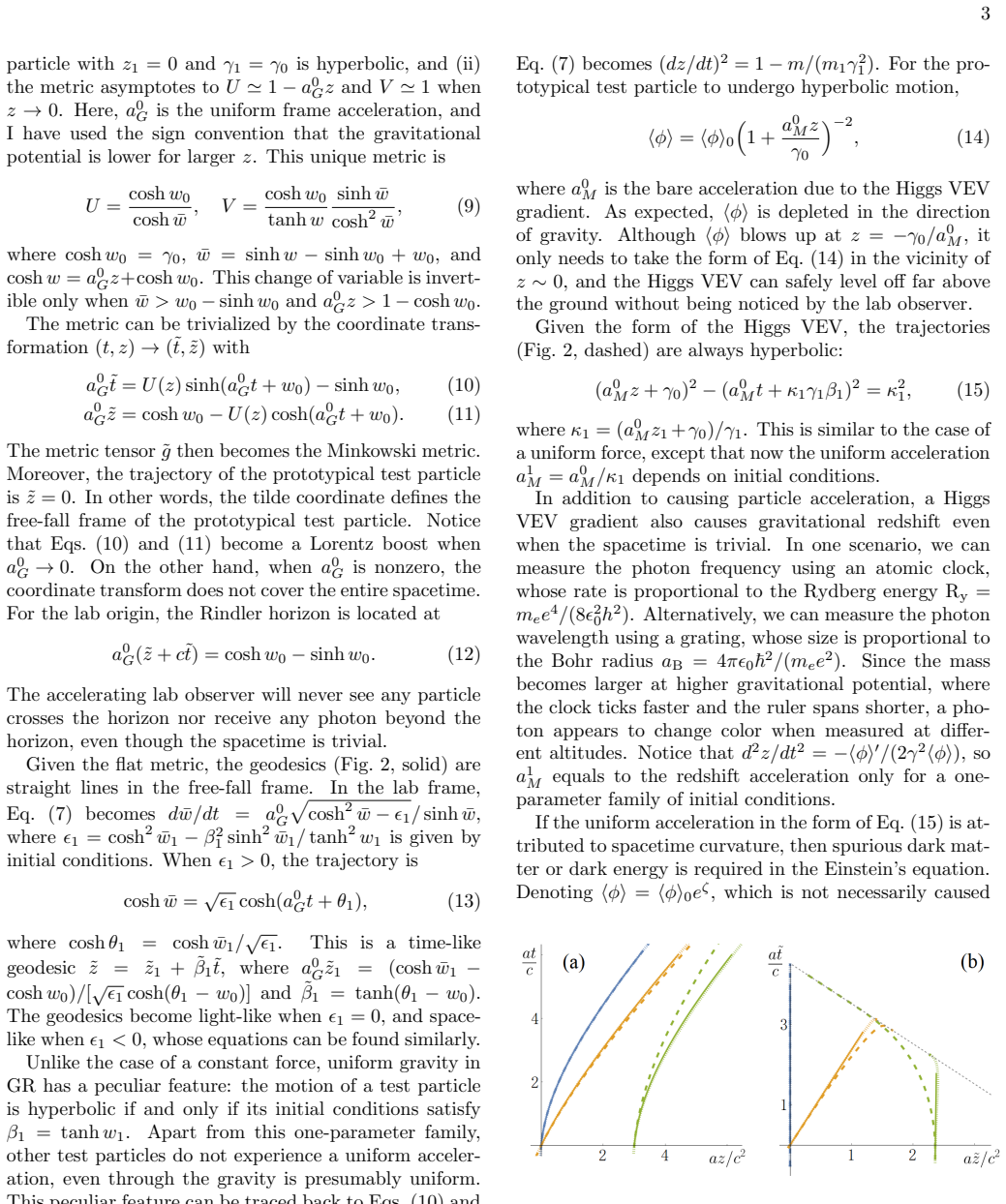
The machinery is the mass-gradient connection $S^\alpha_{\mu\nu}$ arising from a spacetime-dependent particle mass, together with its geometric avatar, the Weyl-rescaled metric $(mg)_{\mu\nu} = g_{\mu\nu}/m$. The connection $S^\alpha_{\mu\nu}$ shifts geodesics exactly as an effective curvature would, and feeding the resulting Ricci tensor into Einstein's equation produces the spurious stress-energy tensor $t_{\mu\nu}$. For uniform acceleration, the required Higgs profile is $\langle\varphi\rangle = \langle\varphi\rangle_0(1 + a_M^0 z/\gamma_0)^{-2}$, whose gradient scale length sets the characteristic spurious density $\rho_s = (a_M^0)^2/(8\pi G c^2)$.
What would settle it
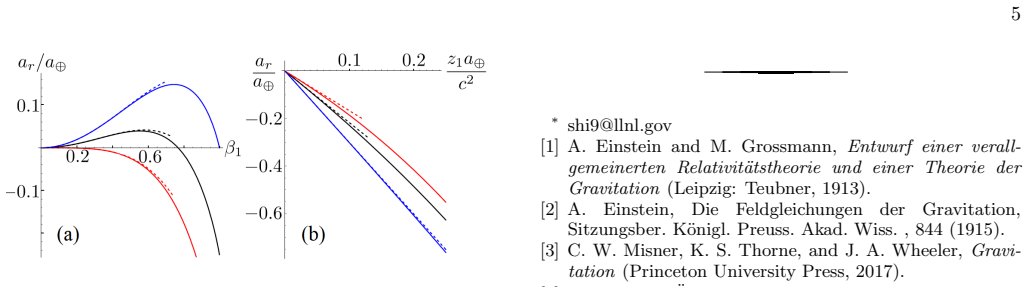
Perform a differential free-fall experiment in which test particles with initial velocities $\beta_1 = 0.01, 0.02, 0.05$ are launched from the same height against a cancelled background acceleration. The residual acceleration scales as $\beta^4$ with a negative coefficient in pure GR but as $\beta^2$ with a positive coefficient for a Higgs gradient; measuring this scaling and its sign at the predicted magnitudes would settle which mechanism operates. A complementary cosmological check: if the dark energy were entirely due to a Higgs gradient, precision measurements of the equation of state would find $w = -1$ exactly; any significant deviation would falsify this contribution.
Extended reading notes
Core claim
The central discovery is that a nonconstant Higgs vacuum expectation value (VEV) modifies the geodesic equation by a universal connection term $S^\alpha_{\mu\nu}$ that is independent of the Yukawa coupling, so all massive test particles feel the same extra acceleration while photons do not. When the Higgs VEV has the specific form that yields uniform acceleration, the resulting trajectories are always hyperbolic, but the acceleration depends on the particle's initial energy—unlike the cases of a constant force (same acceleration for all particles) or of general relativity (where only a one-parameter family of trajectories is exactly hyperbolic). The paper further shows that if this mass-gradient effect is falsely interpreted as spacetime curvature, the effective Ricci tensor demands a spurious stress-energy tensor; for a uniform-acceleration Higgs profile this tensor takes the vacuum form $\rho g_{\mu\nu}$ with $\rho = -[\Lambda_0 + 3(a_M^0)^2/(\gamma_0 + a_M^0 z)^2]/(8\pi G)$. Choosing $a_M^0 \sim -c q H$ on cosmological scales yields $\rho_s \sim 10^{-27}\,\mathrm{kg\,m^{-3}}$, coinciding with the observed dark energy density.
Load-bearing premise
The load-bearing premise is that a Higgs VEV gradient exists on cosmological scales with magnitude $a_M^0 \sim -c q H$, set by the observed Hubble and deceleration parameters, even though the paper does not derive this gradient from the Standard Model or any other microphysical mechanism.
Editorial extensions
If this is right
- A Higgs-VEV gradient induces a universal extra redshift for photons, so cosmological distances inferred from redshift alone would be overestimated; part of the Hubble tension could reflect this effect.
- On galactic scales, the matter-induced depletion of the Higgs VEV creates a mass barrier that can confine gas and stars, and the associated spurious density falls within the range usually attributed to dark matter.
- The residual acceleration of a test particle after cancelling the leading gravitational acceleration scales as $\beta^2$ with a positive sign for a Higgs gradient but as $\beta^4$ with the opposite sign in general relativity, giving an experimental discriminant on Earth.
- Clocks and rulers whose rates depend on particle mass differently (e.g., atomic transitions versus plasma oscillations) will display different gravitational redshifts if a Higgs gradient is present, providing a direct test.
- If the cosmological dark energy is entirely spurious, its equation of state must be exactly that of a cosmological constant ($w=-1$) with no anisotropic stress, a prediction testable with next-generation surveys.
Reading between the lines
- Inference: the same $S^\alpha_{\mu\nu}$ formalism applies to any theory with a spacetime-dependent mass, so condensed-matter or plasma analogues (e.g., photon mass in inhomogeneous plasmas) could be used to simulate the Higgs-gravity signatures in tabletop experiments.
- Inference: if a cosmologically rolling Higgs VEV exists, it should show up as a time or redshift dependence of dimensionless constants such as the proton-to-electron mass ratio; current bounds on such variation could already constrain the assumed gradient.
- Inference: the lopsidedness mechanism suggests a specific kinematic test—spectral-line distortions that scale with frequency and correlate with local matter density—which could be searched for in large galaxy surveys without new hardware.
- Inference: the paper's separation of 'force, metric, mass' causes suggests a broader principle: any apparent universal acceleration can be decomposed into these three categories, and experiments with multiple test particles at distinct initial conditions are a general disambiguation tool.
Signed reviews
Editorial analysis
A structured set of objections, weighed in public.
Referee Report
Summary. The paper studies the classical motion of a test particle whose mass depends on a spacetime-dependent Higgs vacuum expectation value, and compares three possible causes of uniform acceleration: a Newtonian force, spacetime curvature (including frame acceleration), and a Higgs VEV gradient. It derives a modified geodesic equation with an explicit connection contribution S from the mass gradient, constructs a metric for uniform gravity in GR, finds a Higgs profile that yields hyperbolic motion, and computes the effective Ricci tensor and a spurious stress-energy tensor that would be required if the Higgs effect were reinterpreted as curvature. It then gives residual-acceleration formulas for laboratory tests that could distinguish the three mechanisms, and applies the formalism to cosmological, galactic, and Earth scales, claiming that the spurious density matches the observed dark energy density and may explain aspects of dark matter and the Hubble tension.
Significance. The formal core of the paper is a useful contribution: the derivation of the varying-mass geodesic equation and the explicit comparison of force, metric, and Higgs-gradient trajectories are self-contained, checkable, and lead to concrete, falsifiable predictions, such as the residual accelerations in Eqs. (20) and (21). If the cosmological interpretation were supported by an independent derivation of the VEV gradient, the paper would be considerably more significant. As it stands, the main value is the disambiguation analysis and the observation that a nonconstant Higgs VEV can mimic some gravitational effects, which is interesting but not yet a quantitative model of dark energy or dark matter.
major comments (3)
- [Paragraph after Eq. (16)] The dark-energy claim is an assumed input rather than a derived prediction. The statement 'On cosmological scales, the expansion of the universe is associated with a0_M ∼ −c q H' is not derived from Eq. (2), from the Standard Model, or from any independent microphysical mechanism. Since Eq. (16) defines ρ_s ∝ (a0_M)^2, inserting a0_M of order cH makes ρ_s of order H^2/(8πG) by construction. Moreover, using the paper's own numbers (q ≈ −0.55, H ≈ 70 km s^−1 Mpc^−1) gives ρ_s ≈ 9×10^−28 kg m^−3 ≈ 0.11 ρ_crit, whereas the fitted dark-energy density is about 0.68 ρ_crit; the 'coincidence' is only order-of-magnitude at best. This should be presented as a consistency check on a free parameter, not as a derived result, or the abstract's wording should be weakened accordingly.
- [Galactic paragraph after Eq. (16)] The galactic dark-matter statement is similarly not a derivation. The two estimates a0_M ∼ (150 km/s)^2/(10 kpc) and φ/φ' ∼ 3 kpc are both chosen to produce density values that bracket the observed dark matter density, and the resulting range spans roughly 15 orders of magnitude (from 10^−29 to 10^−14 kg m^−3). Without a model for how a galactic Higgs profile is generated from the matter distribution, the sentence 'The observed dark matter density falls within the above estimates' is too weak to constitute evidence. Please either provide a quantitative galactic VEV profile or explicitly label this as an illustrative range rather than an inference.
- [Following Eq. (16)] The relation stated in the text, a0_M/c^2 ∼ ⟨φ⟩'/⟨φ⟩, is not consistent with the profile in Eq. (14). For φ = φ0 (1 + a0_M z/γ0)^−2, one finds d ln φ/dz = −2a0_M/(γ0 + a0_M z), so near z = 0 the exact relation is a0_M/c^2 = −(γ0/2) d ln φ/dz. Dropping the factor γ0/2 changes ρ_s by a factor of 4. Either define a0_M in terms of c^2 φ'/(2φ) or state explicitly that the relation is only order-of-magnitude; as written, the numerical estimates in the cosmological and galactic paragraphs are not tightly tied to the profile of Eq. (14).
minor comments (4)
- [References] The sentence 'This additional redshift may contribute to the Hubble tension [48]' cites Ref. [48], which is a cold-atom gravimetry paper, not a Hubble-tension reference. The manuscript should cite an appropriate source for the Hubble tension discussion.
- [Abstract and text] The phrasing 'motion of all particles are hyperbolic with the same acceleration' for the force case is imprecise because the acceleration in Eq. (8) is the proper acceleration, not the coordinate acceleration; please clarify this distinction, which is otherwise handled correctly in the main text.
- [Final paragraph] The suggestion that 'the depletion of ⟨φ⟩ by matter in the galaxy creates a mass barrier that may contribute to the confinement of gases and stars' is speculative and not connected to any quantitative model in the paper; it would be safer to identify it as an open possibility rather than a conclusion.
- [Eq. (14)] The Higgs profile in Eq. (14) is introduced for a prototypical particle, but it would be helpful to state explicitly that φ is not assumed to be produced by the toy-model matter density in Eq. (2); the paper notes this later, but an early caveat would prevent misreading.
Circularity Check
Dark-energy and dark-matter claims reduce to free parameters a0_M chosen from the very cosmological and galactic data they claim to explain; the formal trajectory disambiguation is self-contained.
-
fitted input called prediction
[Section on spurious stress-energy tensor, Eq. (16) and following paragraph (p. 4)]
"The characteristic scale is ρs = (a0_M)^2/(8πGc^2), where a0_M/c^2∼⟨φ⟩′/⟨φ⟩ is determined by the gradient scale length of the Higgs VEV... On cosmological scales, the expansion of the universe is associated with a0_M∼−cqH, where q≈−0.55 is the deceleration parameter and H≈70 km·s−1·Mpc−1 is the Hubble parameter. Then, ρs∼10−27 kg·m−3 coincides with the observed dark energy density."
a0_M is not derived from Eq. (2), from the Standard Model, or from any independent microphysical mechanism; the paper chooses it to be proportional to H. Substituting a0_M ∼ cH into Eq. (16) gives ρs ∼ q^2 H^2/(8πG), i.e. about 0.1 of the critical density, so the later 'coincidence' with the observed dark energy density (about 0.68 of critical) is a dimensional consistency check on a free input rather than a prediction. H and q are themselves fitted from the cosmological background that the paper aims to explain, so the agreement is not independent evidence.
-
fitted input called prediction
[Paragraph beginning 'For galaxies...' after Eq. (16) (p. 4)]
"For galaxies, if we take a0_M∼ (150 km·s−1)^2/(10 kpc) to be the orbiting acceleration, then ρs∼ 10−29 kg·m−3. To estimate an upper bound, take ⟨φ⟩/⟨φ⟩′∼ 3 kpc to be the typical galactic density scale length, then ρs∼ 10−14 kg·m−3. The observed dark matter density falls within the above estimates."
The lower estimate sets a0_M equal to the observed galactic orbital acceleration, which is precisely the quantity from which dark matter is inferred; the upper bound sets the Higgs gradient scale length from typical galactic density structure. The paper then reports that the observed dark matter density 'falls within' the resulting range. Because both input values are read off from the galactic data being explained, and the range spans five orders of magnitude, the agreement is an inverse fit rather than a derived prediction.
full rationale
The formal core of the paper — the action (3), the geodesic equation (4) with the Higgs-gradient connection term (5), the Weyl-rescaling argument, the profile (14) that produces hyperbolic motion, the trajectories (15), and the residual-acceleration estimates (17)–(21) — is internally derived and does not reduce to the quantities it claims to compare. The force, metric, and Higgs-gradient cases are distinguished by their own equations of motion and initial-condition dependence, and that analysis is self-contained. The circularity is limited to the cosmological and galactic applications. Equation (16) defines a spurious density from the free parameter a0_M, and the paper then sets a0_M ∼ −c q H on cosmological scales and a0_M from observed orbital accelerations on galactic scales. Those choices are taken from the same observations that the dark-energy and dark-matter claims are meant to explain, so the 'coincidence' with observed densities is a consistency check on fitted inputs, not an independent prediction. The self-citation [40] (Shi, Fisch, Qin on effective-action wave propagation in plasmas) is used only as an analogy and is not load-bearing. Overall score 6: partial circularity, because the central formal derivation is independent while one advertised headline result reduces to a free parameter chosen from the target data.
Assumptions & free parameters
free parameters (4)
- a0_M at Earth scale =
a⊕ ≈ 9.8 m/s^2 (assumed)
- a0_M at cosmological scale =
~ -c q H with q ≈ -0.55, H ≈ 70 km/s/Mpc (assumed)
- a0_M at galactic scale =
(150 km/s)^2/(10 kpc) for the lower bound; ⟨φ⟩/⟨φ⟩' ~ 3 kpc for the upper bound (assumed)
- a0_G (GR frame acceleration) =
free variable (e.g., a⊕ when modeling Earth)
assumptions (4)
- domain assumption The action (3) with spacetime-dependent mass m(⟨φ⟩) governs classical particle motion on a prescribed background.
- ad hoc to paper The Higgs VEV is depleted by ambient matter according to the toy Lagrangian (1) and the expression (2).
- ad hoc to paper A cosmological-scale Higgs VEV gradient exists with acceleration scale a0_M ~ -c q H.
- ad hoc to paper Galactic Higgs VEV gradients have scale lengths of order kiloparsecs or produce accelerations of order the observed rotation curve acceleration.
Cite this review
Pith. "Pith review of Force, metric, or mass: Disambiguating causes of uniform gravity." pith.science (2026). https://pith.science/paper/ZDPSWJZ5
@misc{pith2026190802159,
  author       = {Pith},
  title        = {Pith review of: Force, metric, or mass: Disambiguating causes of uniform gravity},
  year         = {2026},
  howpublished = {\url{https://pith.science/paper/ZDPSWJZ5}},
  note         = {Machine review of arXiv:1908.02159}
}
read the original abstract
In addition to nonzero forces and nontrivial metrics, here I show that a nonconstant Higgs expectation value, which endows elementary particles with their masses, also leads to apparent universal particle accelerations and photon frequency shifts. When effects of the Higgs is attributed to spacetime curvatures, a spurious stress-energy tensor is required in Einstein's equation. On cosmological scales, the spurious density coincides with the observed dark energy density. On smaller scales, effects of the Standard Model Higgs gradients are unlikely observable except near compact astrophysical bodies. To estimate the experimental precision required to disambiguate causes of apparent accelerations, I compare distinct effects of the force, metric, and Higgs profiles that cause uniform acceleration of a test particle. When the acceleration is caused by a force, the motion of all particles are hyperbolic with the same acceleration. However, when the cause is a metric, only a one-parameter family of particles undergo hyperbolic motion. In comparison, when the cause is a Higgs gradient, the trajectory of all particles are hyperbolic, but the acceleration is larger when the particle's energy is higher. The discrepancies among the three causes are minuscule on laboratory scales, which makes experimental tests very challenging.
Figures

Reference graph
Works this paper leans on
-
[1]
(7) becomes (dz/dt)2 = 1− 1/[γ1 +a0 E(z−z1)]2
= 1, and Eq. (7) becomes (dz/dt)2 = 1− 1/[γ1 +a0 E(z−z1)]2. The trajectory is hyperbolic: [a0 E(z−z1) +γ1]2− (a0 Et +γ1β1)2 = 1, (8) where a0 E = eE0/m0 is the bare acceleration due to a constant force field. Second, let us consider uniform gravity in GR, which is indistinguishable from a uniform frame acceleration ac- cording to the equivalence principle....
-
[2]
A. Einstein and M. Grossmann, Entwurf einer verall- gemeinerten Relativit¨ atstheorie und einer Theorie der Gravitation (Leipzig: Teubner, 1913)
work page 1913
-
[3]
Einstein, Die Feldgleichungen der Gravitation, Sitzungsber
A. Einstein, Die Feldgleichungen der Gravitation, Sitzungsber. K¨ onigl. Preuss. Akad. Wiss. , 844 (1915)
work page 1915
-
[4]
C. W. Misner, K. S. Thorne, and J. A. Wheeler, Gravi- tation (Princeton University Press, 2017)
work page 2017
-
[5]
A. Einstein, ¨Uber den Einfluß der Schwerkraft auf die Ausbreitung des Lichtes, Annalen der Physik 35, 898 (1911)
work page 1911
-
[6]
R. V. Pound and G. A. Rebka, Apparent Weight of Pho- tons, Phys. Rev. Lett. 4, 337 (1960)
work page 1960
-
[7]
R. F. C. Vessot, M. W. Levine, E. M. Mattison, E. L. Blomberg, T. E. Hoffman, G. U. Nystrom, B. F. Farrel, R. Decher, P. B. Eby, C. R. Baugher, J. W. Watts, D. L. Teuber, and F. D. Wills, Test of Relativistic Gravitation with a Space-Borne Hydrogen Maser, Phys. Rev. Lett. 45, 2081 (1980)
work page 1980
-
[8]
H. M¨ uller, A. Peters, and S. Chu, A precision measure- ment of the gravitational redshift by the interference of matter waves, Nature 463, 926 (2010)
work page 2010
Show all 65 references
-
[9]
C. W. Chou, D. B. Hume, T. Rosenband, and D. J. Wineland, Optical Clocks and Relativity, Science 329, 1630 (2010)
2010
-
[10]
Newcomb, Tables of the four inner planets, in As- tronomical Papers prepared for the use of the American Ephemeris and Nautical Almanac , Vol
S. Newcomb, Tables of the four inner planets, in As- tronomical Papers prepared for the use of the American Ephemeris and Nautical Almanac , Vol. 6 (Washington: Bureau of Equipment, Navy Department, 1898) 2nd ed
-
[11]
Freudlich, ¨Uber die Erkl¨ arung der Anomalien im PlanetenSystem durch die Gravitationswirkung inter- planetarer Massen, Astronomische Nachrichten 201, 49 (1915)
E. Freudlich, ¨Uber die Erkl¨ arung der Anomalien im PlanetenSystem durch die Gravitationswirkung inter- planetarer Massen, Astronomische Nachrichten 201, 49 (1915)
1915
-
[12]
Einstein, Erkl¨ arung der Perihelbewegung des Merkur aus der allgemeinen Relativit¨ atstheorie, Sitzungsber
A. Einstein, Erkl¨ arung der Perihelbewegung des Merkur aus der allgemeinen Relativit¨ atstheorie, Sitzungsber. K¨ onigl. Preuss. Akad. Wiss. , 831 (1915)
1915
-
[13]
Schwarzschild, ¨Uber das Gravitationsfeld eines Massenpunktes nach der Einsteinschen Theorie, Sitzungsber
K. Schwarzschild, ¨Uber das Gravitationsfeld eines Massenpunktes nach der Einsteinschen Theorie, Sitzungsber. K¨ onigl. Preuss. Akad. Wiss. , 189 (1916)
1916
-
[14]
X. X. Newhall, E. M. Standish, Jr., and J. G. Williams, DE 102: a numerically integrated ephemeris of the moon and planets spanning forty-four centuries, Astron. Astro- phys. 125, 150 (1983)
1983
-
[15]
H. J. von Soldner, ¨Ueber die Ablenkung eines Licht- strals von seiner geradlinigen Bewegung, durch die At- traktion eines Weltk¨ orpers, an welchem er nahe vorbei geht, Berliner Astronomisches Jahrbuch , 161 (1804)
-
[16]
Einstein, Die Grundlage der allgemeinen Relativitts- theorie, Annalen der Physik 354, 769 (1916)
A. Einstein, Die Grundlage der allgemeinen Relativitts- theorie, Annalen der Physik 354, 769 (1916)
1916
-
[17]
F. W. Dyson, A. S. Eddington, and C. Davidson, IX. A determination of the deflection of light by the sun’s gravitational field, from observations made at the total eclipse of May 29, 1919, Philos. T. R. Soc. S-A 220, 291 (1920)
1920
-
[18]
von Kl¨ uber, The determination of Einstein’s light- deflection in the gravitational field of the sun, Vistas As- tron
H. von Kl¨ uber, The determination of Einstein’s light- deflection in the gravitational field of the sun, Vistas As- tron. 3, 47 (1960)
1960
-
[19]
R. D. Reasenberg, I. I. Shapiro, P. E. MacNeil, R. B. Goldstein, J. C. Breidenthal, J. P. Brenkle, D. L. Cain, T. M. Kaufman, T. A. Komarek, and A. I. Zygielbaum, 6 Viking relativity experiment - Verification of signal retar- dation by solar gravity, Astrophys. J. 234, L219 (1979)
1979
-
[20]
S. S. Shapiro, J. L. Davis, D. E. Lebach, and J. S. Gre- gory, Measurement of the Solar Gravitational Deflection of Radio Waves using Geodetic Very-Long-Baseline Inter- ferometry Data, 1979–1999, Phys. Rev. Lett. 92, 121101 (2004)
2004
-
[21]
B. P. Abbott, R. Abbott, T. D. Abbott, M. R. Aber- nathy, F. Acernese, K. Ackley, C. Adams, T. Adams, P. Addesso, R. X. Adhikari, et al. (LIGO Scientific Collaboration and Virgo Collaboration), Observation of Gravitational Waves from a Binary Black Hole Merger, Phys. Rev. Lett....
2016
-
[22]
B. P. Abbott, R. Abbott, T. D. Abbott, F. Acernese, K. Ackley, C. Adams, T. Adams, P. Addesso, R. X. Ad- hikari, V. B. Adya, et al. (LIGO Scientific Collabora- tion and Virgo Collaboration), GW170817: Observation of Gravitational Waves from a Binary Neutron Star In- spiral, Phy...
2017
-
[23]
Akiyama, R
K. Akiyama, R. Azulay, A.-K. Baczko, M. Balokovi, J. Barrett, L. Blackburn, K. L. Bouman, G. C. Bower, C. D. Brinkerink, et al. (The Event Horizon Telescope Collaboration), First M87 Event Horizon Telescope Re- sults. I. the Shadow of the Supermassive Black Hole, As- trophys. ...
2019
-
[24]
Weinberg, The cosmological constant problem, Rev
S. Weinberg, The cosmological constant problem, Rev. Mod. Phys. 61, 1 (1989)
1989
-
[25]
Bertone, D
G. Bertone, D. Hooper, and J. Silk, Particle dark matter: Evidence, candidates and constraints, Phys. Rep. 405, 279 (2005)
2005
-
[26]
J. A. Frieman, M. S. Turner, and D. Huterer, Dark en- ergy and the accelerating universe, Annu. Rev. Astron. Astrophys. 46, 385 (2008)
2008
-
[27]
Brans and R
C. Brans and R. H. Dicke, Mach’s Principle and a Rel- ativistic Theory of Gravitation, Phys. Rev. 124, 925 (1961)
1961
-
[28]
Khoury and A
J. Khoury and A. Weltman, Chameleon Fields: Awaiting Surprises for Tests of Gravity in Space, Phys. Rev. Lett. 93, 171104 (2004)
2004
-
[29]
C. M. Will, Theory and experiment in gravitational physics (Cambridge University Press, 2018)
2018
-
[30]
Tegmark, M
M. Tegmark, M. A. Strauss, M. R. Blanton, K. Abaza- jian, S. Dodelson, H. Sandvik, X. Wang, D. H. Weinberg, I. Zehavi, N. A. Bahcall, et al. , Cosmological parameters from SDSS and WMAP, Phys. Rev. D69, 103501 (2004)
2004
-
[31]
Komatsu, K
E. Komatsu, K. M. Smith, J. Dunkley, C. L. Bennett, B. Gold, G. Hinshaw, N. Jarosik, D. Larson, M. R. Nolta, L. Page, et al. , Seven-year Wilkinson microwave anisotropy probe (WMAP) observations: Cosmological interpretation, Astrophys. J. Suppl. S. 192, 18 (2011)
2011
-
[32]
P. A. R. Ade, N. Aghanim, C. Armitage-Caplan, M. Ar- naud, M. Ashdown, F. Atrio-Barandela, J. Aumont, C. Baccigalupi, A. J. Banday, R. B. Barreiro, et al. (Planck Collaboration), Planck 2013 results. XVI. Cos- mological parameters, Astron. Astrophys. 571, A16 (2014)
2014
-
[33]
P. A. R. Ade, N. Aghanim, M. Arnaud, M. Ashdown, J. Aumont, C. Baccigalupi, A. J. Banday, R. Barreiro, J. G. Bartlett, N. Bartolo, et al. (Planck Collaboration), Planck 2015 results-XIII. cosmological parameters, As- tron. Astrophys. 594, A13 (2016)
2016
-
[34]
Tanabashi, K
M. Tanabashi, K. Hagiwara, K. Hikasa, K. Naka- mura, Y. Sumino, F. Takahashi, J. Tanaka, K. Agashe, G. Aielli, C. Amsler, et al. (Particle Data Group), Review of particle physics, Phys. Rev. D 98, 030001 (2018)
2018
-
[35]
P. W. Higgs, Broken Symmetries and the Masses of Gauge Bosons, Phys. Rev. Lett. 13, 508 (1964)
1964
-
[36]
D¨ urr, Z
S. D¨ urr, Z. Fodor, J. Frison, C. Hoelbling, R. Hoffmann, S. D. Katz, S. Krieg, T. Kurth, L. Lellouch, T. Lippert, et al. , Ab initio determination of light hadron masses, Science 322, 1224 (2008)
2008
-
[37]
Borsanyi, S
S. Borsanyi, S. Durr, Z. Fodor, C. Hoelbling, S. D. Katz, S. Krieg, L. Lellouch, T. Lippert, A. Portelli, K. K. Sz- abo, et al. , Ab initio calculation of the neutron-proton mass difference, Science 347, 1452 (2015)
2015
-
[38]
S. Aoki, Y. Aoki, D. Beˇ cirevi´ c, C. Bernard, T. Blum, G. Colangelo, M. Della Morte, P. Dimopoulos, S. D¨ urr, H. Fukaya,et al., Review of lattice results concerning low- energy particle physics, Eur. Phys. J. C 77, 112 (2017)
2017
-
[39]
Y.-B. Yang, J. Liang, Y.-J. Bi, Y. Chen, T. Draper, K.- F. Liu, and Z. Liu, Proton Mass Decomposition from the QCD Energy Momentum Tensor, Phys. Rev. Lett. 121, 212001 (2018)
2018
-
[40]
P. W. Anderson, Plasmons, Gauge Invariance, and Mass, Phys. Rev. 130, 439 (1963)
1963
-
[41]
Y. Shi, N. J. Fisch, and H. Qin, Effective-action approach to wave propagation in scalar QED plasmas, Phys. Rev. A 94, 012124 (2016)
2016
-
[42]
A. S. Eddington, Space, time and gravitation: an out- line of the general relativity theory (Cambridge university press, 1920)
1920
-
[43]
Weyl, Gravitation and electricity, Sitzungsber
H. Weyl, Gravitation and electricity, Sitzungsber. K¨ onigl. Preuss. Akad. Wiss. 26, 465 (1918)
1918
-
[44]
Nordstr¨ om, Zur theorie der gravitation vom stand- punkt des relativit¨ atsprinzips, Annalen der Physik 42, 533 (1913)
G. Nordstr¨ om, Zur theorie der gravitation vom stand- punkt des relativit¨ atsprinzips, Annalen der Physik 42, 533 (1913)
1913
-
[45]
Ni, Yang’s gravitational field equations, Phys
W.-T. Ni, Yang’s gravitational field equations, Phys. Rev. Lett. 35, 319 (1975)
1975
-
[46]
C. N. Yang, Integral formalism for gauge fields, Phys. Rev. Lett. 33, 445 (1974)
1974
-
[47]
E. L. Hill, On the Kinematics of Uniformly Accelerated Motions and Classical Electromagnetic Theory, Phys. Rev. 72, 143 (1947)
1947
-
[48]
Rohrlich, The principle of equivalence, Ann
F. Rohrlich, The principle of equivalence, Ann. Phys. 22, 169 (1963)
1963
-
[49]
Poli, F.-Y
N. Poli, F.-Y. Wang, M. G. Tarallo, A. Alberti, M. Prevedelli, and G. M. Tino, Precision Measurement of Gravity with Cold Atoms in an Optical Lattice and Com- parison with a Classical Gravimeter, Phys. Rev. Lett. 106, 038501 (2011)
2011
-
[50]
J. G. Williams, S. G. Turyshev, and D. H. Boggs, Progress in lunar laser ranging tests of relativistic grav- ity, Phys. Rev. Lett. 93, 261101 (2004)
2004
-
[51]
Schlamminger, K.-Y
S. Schlamminger, K.-Y. Choi, T. A. Wagner, J. H. Gund- lach, and E. G. Adelberger, Test of the Equivalence Prin- ciple Using a Rotating Torsion Balance, Phys. Rev. Lett. 100, 041101 (2008)
2008
-
[52]
Touboul, G
P. Touboul, G. M´ etris, M. Rodrigues, Y. Andr´ e, Q. Baghi, J. Berg´ e, D. Boulanger, S. Bremer, P. Carle, R. Chhun, et al., MICROSCOPE mission: first results of a space test of the equivalence principle, Phys. Rev. Lett. 119, 231101 (2017)
2017
-
[53]
Colella, A
R. Colella, A. W. Overhauser, and S. A. Werner, Obser- vation of Gravitationally Induced Quantum Interference, Phys. Rev. Lett. 34, 1472 (1975)
1975
-
[54]
Kasevich and S
M. Kasevich and S. Chu, Measurement of the gravita- tional acceleration of an atom with a light-pulse atom interferometer, Appl. Phys. B 54, 321 (1992). 7
1992
-
[55]
Peters, K
A. Peters, K. Y. Chung, and S. Chu, Measurement of gravitational acceleration by dropping atoms, Nature 400, 849 (1999)
1999
-
[56]
G. S. Shostak, Aperture synthesis study of H I in the galaxy IC 10, Astron. Astrophys. 31, 97 (1974)
1974
-
[57]
R. J. Cohen, The unusual kinematics of the galaxy IC 10, Mon. Not. R. Astron. Soc. 187, 839 (1979)
1979
-
[58]
J. E. Baldwin, D. Lynden-Bell, and R. Sancisi, Lopsided galaxies, Mon. Not. R. Astron. Soc. 193, 313 (1980)
1980
-
[59]
Bosma, 21-cm line studies of spiral galaxies
A. Bosma, 21-cm line studies of spiral galaxies. I. Obser- vations of the galaxies NGC 5033, 3198, 5055, 2841, and 7331., Astron. J. 86, 1791 (1981)
1981
-
[60]
Richter and R
O.-G. Richter and R. Sancisi, Asymmetries in disk galax- ies. How often? How strong?, Astron. Astrophys. 290, L9 (1994)
1994
-
[61]
V. C. Rubin, A. H. Waterman, and J. D. P. Kenney, Kine- matic Disturbances in Optical Rotation Curves among 89 Virgo Disk Galaxies, Astrophys. J. 118, 236 (1999)
1999
-
[62]
J., and Puerari, I., Lopsided spiral galaxies: evidence for gas accretion, As- tron
Bournaud, F., Combes, F., Jog, C. J., and Puerari, I., Lopsided spiral galaxies: evidence for gas accretion, As- tron. Astrophys. 438, 507 (2005)
2005
-
[63]
C. J. Jog and F. Combes, Lopsided spiral galaxies, Phys. Rep. 471, 75 (2009)
2009
-
[64]
van Eymeren, E
J. van Eymeren, E. J¨ utte, C. Jog, Y. Stein, and R.-J. Dettmar, Lopsidedness in WHISP galaxies-I. Rotation curves and kinematic lopsidedness, Astron. Astrophys. 530, A29 (2011)
2011
-
[65]
D. R. Andersen and M. A. Bershady, The photometric and kinematic structure of face-on disk galaxies. III. kine- matic inclinations from Hα velocity fields, Astrophys. J. 768, 41 (2013)
2013
Reviewed August 14, 2026 · model on record in the stance chip above.
Discussion (0). Continue with ORCID to comment.