REVIEW 4 major objections 6 minor 74 references
Quantum Mechanics of Proteins in Explicit Water: The Role of Plasmon-Like Solute-Solvent Interactions
T0 review · 4 major / 6 minor · reviewed 2026-08-14 · deepseek-v4-flash
Pith's one-line read Many-body van der Waals dispersion forces change which protein states are stable in water, destabilizing the isolated native fold while collective protein-water interactions stabilize it.
desk verdict A clear, well-specified computational study showing that many-body dispersion shifts the balance of intra-protein and protein-water energetics; the qualitative claim is credible, but the gas-phase reference is computed on water-stripped solvated snapshots and should be treated as conditional. read the letter →
The pith
A machine-rendered reading of the paper's core claim, the machinery that carries it, and where it could break.
The reading
What carries the argument
The central machinery is the Many-Body Dispersion (MBD) formalism, a model in which each atom's response is represented by a screened quantum harmonic oscillator and the coupled oscillators are diagonalized to give collective electronic eigenmodes. From the DFTB electron density, effective atomic polarizabilities are obtained, screened self-consistently, and used to build the dipole-coupled Hamiltonian of Equations (2)-(3); the zero-point energy of the coupled oscillators, Equation (5), is the dispersion energy, and a unitary transform generates plasmon-like collective fluctuations. This setup lets the authors decompose the vdW solvation energy into contributions from individual collective modes and compute the radial range of protein-water correlation, which is what reveals the 25 angstrom persistence and the stabilizing role of delocalized electronic motion.
What would settle it
Recompute the isolated-protein energetics on structures that are genuinely equilibrated in the gas phase, rather than solvent-stripped snapshots from explicit-water trajectories; the claim predicts the MBD-versus-pairwise destabilization of the native state should persist at about 4 to 6 kcal/mol on that ensemble as well. If the sign or magnitude changes materially, the compensation argument in water loses its foundation.
Extended reading notes
Core claim
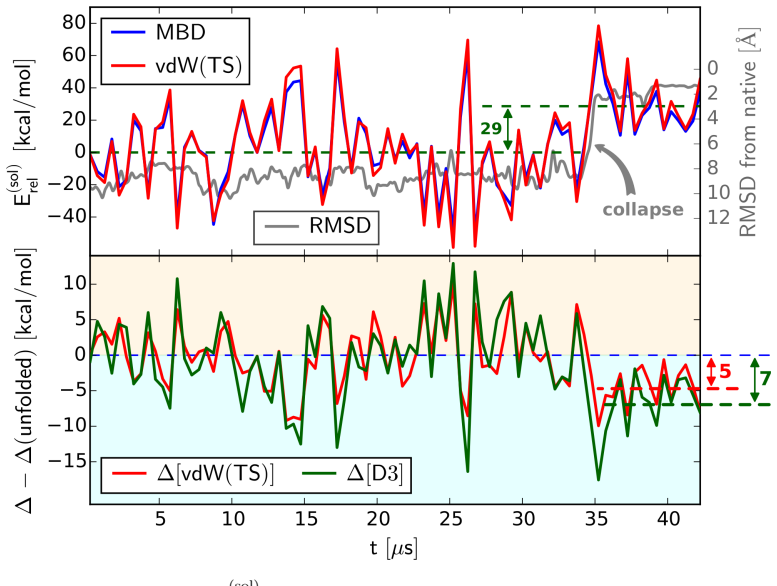
The paper's central claim is that many-body van der Waals dispersion interactions, not just pairwise additive potentials, play a central role in protein folding energetics in water. Using the MBD formalism, which models electronic fluctuations as coupled quantum harmonic oscillators, the authors find that pairwise treatments such as vdW(TS), D2, and D3 overestimate the stability of the native state of an isolated protein by roughly 4.5 to 6 kcal/mol; about half of this excess comes from neglecting the self-consistent screening of atomic polarizabilities and half from neglecting many-body interactions beyond pairwise terms. When the protein is placed in explicit water, the same many-body treatment shows that the protein-water dispersion interaction acquires a collective, delocalized character that acts oppositely, stabilizing native conformations and transition states by 5 to 7 kcal/mol relative to the unfolded ensemble. The authors trace this stabilization to low-frequency, plasmon-like electronic fluctuations around 450 THz, and show that correlation between protein and solvent remains significant at distances up to 25 angstroms, far beyond the range of pairwise dispersion models.
Load-bearing premise
The load-bearing premise is that taking solvated molecular dynamics snapshots and removing the water yields a valid representation of the isolated protein's gas-phase ensemble; if those conformations are not representative, the reported 4.5 to 6 kcal/mol many-body destabilization of the native state could shrink or even reverse.
Editorial extensions
If this is right
- Pairwise-additive dispersion models systematically overstabilize the gas-phase native state by about 4.5 to 6 kcal/mol, so gas-phase protein structure and stability predictions require a many-body correction.
- Many-body protein-water dispersion stabilizes folded conformations by a comparable amount, so solvation models that treat dispersion pairwise may be missing a folding driving force.
- The vdW contribution to the solvation energy drops by 20 to 30 kcal/mol at the hydrophobic collapse, making it a usable folding descriptor even though the total electronic solvation energy is not.
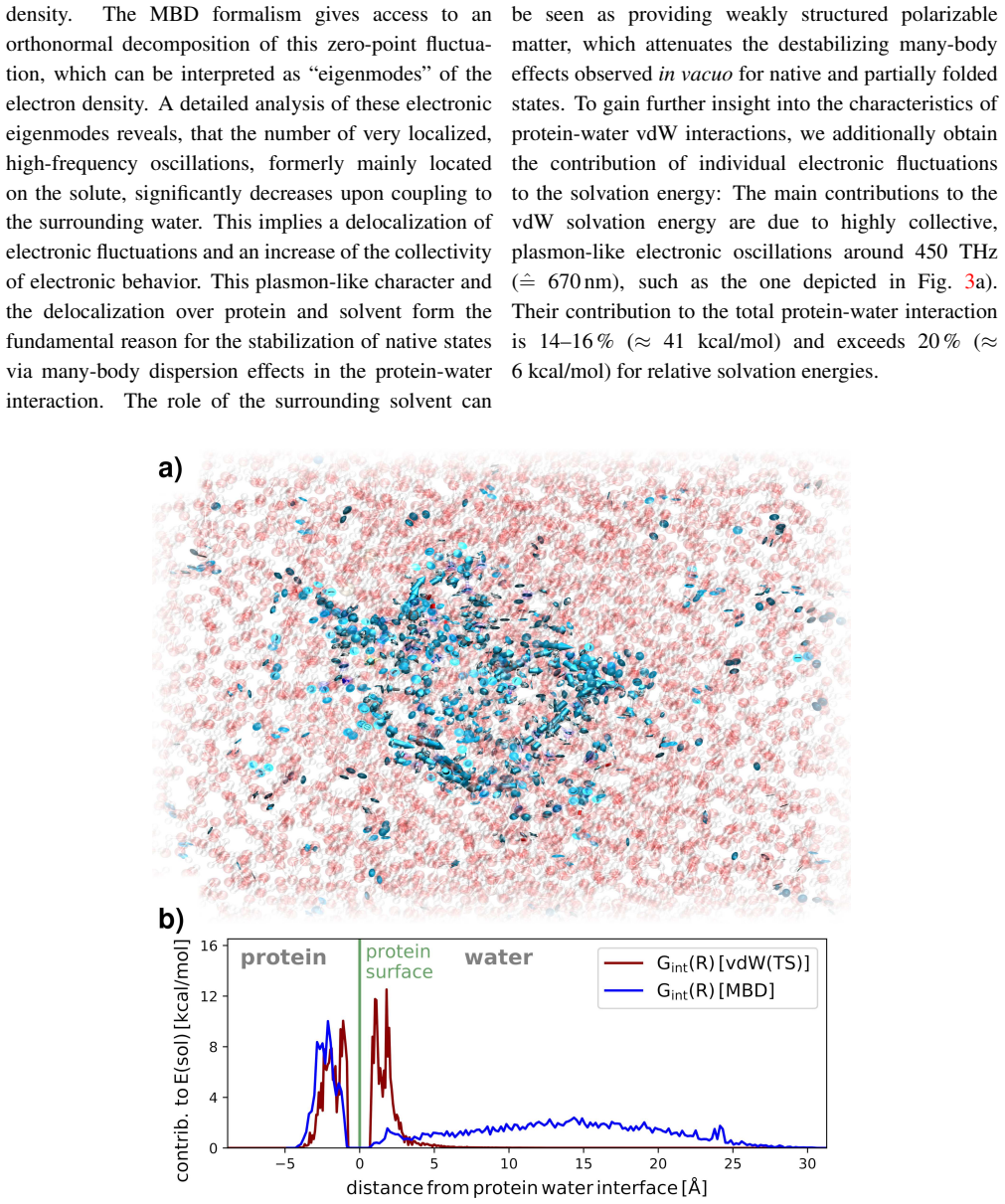
- Electronic correlation between protein and solvent is significant up to 25 angstroms, implying that long-range dispersion forces in aqueous biomolecular systems cannot be treated as local.
- For the three proteins studied, the effect is independent of secondary structure (beta-sheet, hairpin, and helix), so the conclusion is not specific to one fold type.
Reading between the lines
- If correlation persists through water at the computed range, the same mechanism should mediate solvent-assisted dispersion interactions between two solutes or between distant parts of a large biomolecule; this is an extension the paper raises but does not compute.
- The 450 THz collective modes suggest a concrete spectroscopic test: terahertz-domain probes of solvated proteins should show collective electronic response that tracks folding state, beyond the local water dynamics.
- Because MBD softens low-frequency vibrational modes in molecular crystals, the same many-body effects may contribute to folding entropy and free energy, not just internal energy; quantifying entropy is a natural next step.
- A testable extension would be to compare MBD-based vdW solvation energies between proteins of different sizes to see whether the pairwise-additivity failure grows with system size, as the 25 angstrom range suggests.
Signed reviews
Editorial analysis
A structured set of objections, weighed in public.
Referee Report
Summary. This manuscript uses density-functional tight-binding combined with the many-body dispersion (MBD) formalism and with pairwise vdW models (vdW(TS), D2, D3) to evaluate van der Waals energies along pre-existing explicit-water MD folding trajectories of three small proteins (Fip35-WW, cln025, HP35-NleNle). The authors report that beyond-pairwise dispersion reduces the relative stability of the native state of the isolated protein by roughly 4–6 kcal/mol, while the many-body character of protein–water interactions increases the relative stability of native conformations in solution, with low-frequency collective electronic eigenmodes contributing substantially to solvation and correlation ranging to ~25 Å from the protein surface. The paper interprets these modes as plasmon-like solute–solvent interactions and argues that pairwise force fields miss a compensating balance between intra-protein and protein–water vdW effects.
Significance. The result, if reliable, is significant: it identifies a concrete, computationally testable failure mode of pairwise-additive dispersion in biomolecular modeling and suggests a physical mechanism (collective electronic fluctuations) that could be probed by THz spectroscopy. The study has notable strengths: the qualitative trend is reproduced for three proteins with different secondary structures and across three pairwise baselines; the MBD parameters and DFTB parameter sets are inherited from previous benchmarks rather than fitted to the proteins studied; and the mode-resolved decomposition (Eqs. 6–7) gives a mechanistic picture rather than a purely energetic correction. The main risk is that the central gas-phase comparison is performed at water-stripped solvated geometries, so the headline numbers may depend on conformational relaxation that the paper does not consider.
major comments (4)
- [Results, first paragraph; Eq. (1)] The isolated-protein energies E_vdW[p] are computed by 'artificially removing the surrounding solvent' from explicit-water MD snapshots, so the gas-phase leg of the central claim is a single-point energy difference at solvated geometries rather than an energy difference between equilibrium gas-phase conformers. The reported 4–6 kcal/mol many-body destabilization is comparable in size to expected conformational relaxation energies, so it could be altered or inverted by gas-phase relaxation; please re-optimize or shortly propagate the stripped structures in the gas phase, or otherwise demonstrate that the solvated geometries are representative of the gas-phase ensemble.
- [Supplementary §3.2 vs. Fig. 4] For cln025 the SI states that 'we still find a slight destabilization of native states via many-body dispersion effects (2 kcal/mol)' in solvation, while the main text and Fig. 4 present the many-body protein–water contribution as consistently stabilizing native states across all systems. Because the 'independent of secondary structure' claim depends on this uniformity, the sign and decomposition of the cln025 net effect must be reconciled and stated explicitly.
- [Fig. 3b and 'Plasmon-like character' section] The claim that electronic correlation 'is still relevant for the protein-water interaction' up to 25 Å from the interface is not quantifiable as stated. Long-range dipole-coupled models have nonzero contributions at all distances; without an explicit threshold, convergence criterion, or a defined fraction of the integrated G_int, the 25 Å value is not a falsifiable prediction. Please define 'relevant' quantitatively and report the integrated fraction as a function of cutoff.
- [Results and Supplementary Material] No statistical uncertainties or block-averaging estimates are reported for the 2–7 kcal/mol differences between MBD and pairwise models, and the trajectories are single runs per protein. As these differences are the basis for the qualitative conclusions, please provide at least an estimate of the noise from conformational subsampling or replicate trajectories.
minor comments (6)
- [Introduction] The statement that vdW interactions 'can account for up to 30% of the total solvation energy' appears without a direct derivation in the Results; either locate the number in the figures or SI, or qualify it as an estimate.
- [Eq. (1)] Define explicitly that 'gas phase' means the protein geometry extracted from the solvated trajectory, and use a notation such as E_vdW[p(solv)] to avoid implying a gas-phase ensemble.
- [Supplementary Fig. S1 and main text] The 'average over-stabilization' values differ between the main text ('6 kcal/mol on average') and the SI (6 kcal/mol for vdW(TS), 4 kcal/mol for D2, and 3 kcal/mol for SCS and D3); clarify which average is meant.
- ['Plasmon-like character' section] The criteria for classifying modes as 'localized' versus 'delocalized' and for defining the low-frequency 450 THz band are not given; specify how the modes were selected for the 14–16% and >20% contribution estimates.
- [Methods and SI] The term 'plasmon-like' is used repeatedly without a precise definition of the analogy; a sentence defining the diagnostic (e.g., a participation ratio of the eigenmodes) would help.
- [Methods] Minor typographical and clarity issues include the garbled 'semp disp corr .F90' file name and the need to identify in the Fig. 1 caption which curve corresponds to vdW(TS)@SCS.
Circularity Check
No significant circularity; the paper applies a pre-parameterized many-body dispersion method to independent folding trajectories and does not reduce its central claims to fitted inputs.
full rationale
The paper's central claims are computed by applying the MBD formalism and pairwise dispersion models to atomic configurations taken from independent molecular dynamics simulations. No equation in the paper fits a parameter to the proteins studied; the DFTB-derived polarizabilities, MBD screening parameters, and pairwise C6 coefficients are fixed by previously published, parameter-free procedures. The gas-phase many-body destabilization is defined as the difference between MBD and pairwise van der Waals energies on the same stripped-protein snapshots, and the solvation energies are defined by Eq. (1). These are operational definitions and model outputs, not predictions that reduce to their inputs by construction. The mode-resolved decomposition in Eq. (6) is likewise an exact rearrangement of the MBD Hamiltonian and is not used to fit the reported stabilization energies. Some methodological references are self-citations, but the cited method is externally validated and is not invoked as a forced uniqueness argument. The use of solvated geometries with water removed for the 'gas-phase' leg is a structural limitation of the physical setup, not a circularity: the comparison is still a well-defined single-point energy difference and does not presuppose the claimed native-state destabilization. If gas-phase relaxation would change the result, that is a correctness risk, not an instance of circular reasoning.
Assumptions & free parameters
free parameters (3)
- MBD Fermi damping parameters (beta and s_R) =
Not stated; inherited from Refs. [13,46]
- DFTB parameter sets (mio-1-1 and 3ob) =
mio-1-1 for Fip35-WW and HP35; 3ob for cln025
- Free-atom polarizabilities and C6 coefficients =
Tabulated reference values (not listed in manuscript)
assumptions (5)
- domain assumption The MBD coupled quantum harmonic oscillator model (Eqs. 2-3) with atom-centered dipoles and dipole approximation faithfully captures many-body dispersion interactions in proteins and water.
- domain assumption SCC-DFTB with mio-1-1/3ob parameters yields sufficiently reliable ground-state populations and polarizabilities for protein-water systems.
- domain assumption Classical MD trajectories from Shaw et al., Lindorff-Larsen et al., and Ensign et al. sample the relevant folding ensembles, and single-point DFTB+MBD energies on these snapshots are representative.
- ad hoc to paper Gas-phase protein energetics can be computed on geometries taken from solvated MD trajectories after artificially removing water, without re-optimization or gas-phase sampling.
- standard math The zero-point energy of the coupled oscillator model equals the dispersion energy (Eq. 5), as established in prior work.
invented entities (1)
-
Plasmon-like collective electronic eigenmodes (xi_i)
Cite this review
Pith. "Pith review of Quantum Mechanics of Proteins in Explicit Water: The Role of Plasmon-Like Solute-Solvent Interactions." pith.science (2026). https://pith.science/paper/WQKMBGIK
@misc{pith2026190802181,
  author       = {Pith},
  title        = {Pith review of: Quantum Mechanics of Proteins in Explicit Water: The Role of Plasmon-Like Solute-Solvent Interactions},
  year         = {2026},
  howpublished = {\url{https://pith.science/paper/WQKMBGIK}},
  note         = {Machine review of arXiv:1908.02181}
}
abstract
Quantum-mechanical van der Waals dispersion interactions play an essential role for both intra-protein and protein-water interactions -- the two main driving forces for the structure and dynamics of proteins in aqueous solution. Typically, these interactions are only treated phenomenologically via pairwise potential terms in classical force fields. Here, we use an explicit quantum-mechanical approach based on density-functional tight-binding with the many-body dispersion formalism, which allows us to demonstrate the unexpected relevance of the many-body character of dispersion interactions for protein energetics and the protein-water interaction. In contrast to commonly employed pairwise approaches, many-body effects significantly decrease the relative stability of the native state in the absence of water. In an aqueous environment, the collective character of the protein-water van der Waals interaction counteracts this effect and stabilizes native conformations and transition states. This stabilization arises due to a high degree of delocalization and collectivity of protein-water dispersion interactions, suggesting a remarkable persistence of long-range electron correlation through aqueous environments. Our findings are exemplified on prototypical showcases of proteins forming $\beta$-sheets, hairpins, and helices, emphasizing the crucial role of plasmon-like solute-solvent interactions in biomolecular systems.
Figures

Figures from the paper (1 more)

Reference graph
Works this paper leans on
-
[1]
F. Xu, T. A. Cross, Proceedings of the National Academy of Sciences of the United States of America 96, 9057 (1999)
work page 1999
-
[2]
A. Patriksson, C. M. Adams, F. Kjeldsen, R. A. Zubarev, D. van der Spoel, The Journal of Physical Chemistry B 111, 13147 (2007)
work page 2007
-
[3]
Bellissent-Funel, et al., Chemical Reviews 116, 7673 (2016)
M.-C. Bellissent-Funel, et al., Chemical Reviews 116, 7673 (2016)
work page 2016
-
[4]
Kauzmann, Advances in Protein Chemistry(Elsevier, 1959), vol
W. Kauzmann, Advances in Protein Chemistry(Elsevier, 1959), vol. 14, pp. 1–63
work page 1959
- [5]
-
[6]
B. Honig, A.-S. Yang, Protein Stability (Academic Press, 1995), vol. 46 of Advances in Protein Chemistry, pp. 27–58
work page 1995
-
[7]
Fersht, Structure and Mechanism in Protein Science (World Scientific, 2017)
A. Fersht, Structure and Mechanism in Protein Science (World Scientific, 2017)
work page 2017
- [8]
Show all 74 references
-
[9]
G. A. Cisneros, et al. , Chemical Reviews 116, 7501 (2016)
2016
-
[10]
J. J. Dannenberg, Peptide Solvation and H-Bonds (Aca- demic Press, 2005), vol. 72 of Advances in Protein Chemistry, pp. 227–273
2005
-
[11]
Rossi, W
M. Rossi, W. Fang, A. Michaelides, The Journal of Physical Chemistry Letters 6, 4233 (2015)
2015
-
[12]
Schubert, et al
F. Schubert, et al. , Physical Chemistry Chemical Physics 17, 7373 (2015)
2015
-
[13]
Tkatchenko, R
A. Tkatchenko, R. A. DiStasio, R. Car, M. Scheffler, Physical Review Letters 108, 236402 (2012)
2012
-
[14]
V . V . Gobre, A. Tkatchenko,Nature Communications 4, 2341 (2013)
2013
-
[15]
Ambrosetti, D
A. Ambrosetti, D. Alf `e, R. A. DiStasio, A. Tkatchenko, The Journal of Physical Chemistry Letters 5, 849 (2014)
2014
-
[16]
A. M. Reilly, A. Tkatchenko, Physical Review Letters 113, 55701 (2014)
2014
-
[17]
A. M. Reilly, A. Tkatchenko, Chemical Science 6, 3289 (2015)
2015
-
[18]
Hermann, D
J. Hermann, D. Alf `e, A. Tkatchenko, Nature Communi- cations 8, 14052 (2017)
2017
-
[19]
J. Hoja, A. M. Reilly, A. Tkatchenko, Wiley Interdisci- plinary Reviews: Computational Molecular Science 7, e1294 (2017)
2017
-
[20]
J. F. Dobson, T. Gould, G. Vignale, Physical Review X 4, 1 (2014)
2014
-
[21]
Kronik, A
L. Kronik, A. Tkatchenko, Accounts of Chemical Re- search 47, 3208 (2014)
2014
-
[22]
A. P. Jones, F. S. Cipcigan, V . P. Sokhan, J. Crain, G. J. Martyna, Physical Review Letters 110, 227801 (2013)
2013
-
[23]
V . P. Sokhan, A. P. Jones, F. S. Cipcigan, J. Crain, G. J. Martyna, Proceedings of the National Academy of Sci- ences of the United States of America 112, 6341 (2015)
2015
-
[24]
W. Gao, Y . Chen, Q. Jiang,Physical Review Letters117, 246101 (2016)
2016
-
[25]
Ambrosetti, N
A. Ambrosetti, N. Ferri, R. A. DiStasio, A. Tkatchenko, Science 351, 1171 (2016)
2016
-
[26]
H. Yada, M. Nagai, K. Tanaka,Chemical Physics Letters 473, 279 (2009)
2009
-
[27]
Folpini, et al., Physical Review Letters 119, 097404 (2017)
G. Folpini, et al., Physical Review Letters 119, 097404 (2017)
2017
-
[28]
Fr ¨ohlich, International Journal of Quantum Chem- istry 2, 641 (1968)
H. Fr ¨ohlich, International Journal of Quantum Chem- istry 2, 641 (1968)
1968
-
[29]
Acbas, K
G. Acbas, K. A. Niessen, E. H. Snell, A. G. Markelz, Nature Communications 5, 3076 (2014)
2014
-
[30]
Preto, M
J. Preto, M. Pettini, J. A. Tuszynski, Physical Review E 91, 52710 (2015)
2015
-
[31]
Nardecchia, et al
I. Nardecchia, et al. , Physical Review X 8, 031061 (2018)
2018
-
[32]
Kurian, G
P. Kurian, G. Dunston, J. Lindesay, Journal of Theoreti- cal Biology 391, 102 (2016)
2016
-
[33]
Kurian, A
P. Kurian, A. Capolupo, T. Craddock, G. Vitiello, Physics Letters A 382, 33 (2018)
2018
-
[34]
T. J. Craddock, et al., Scientific Reports 7, 9877 (2017)
2017
-
[35]
Baldauf, M
C. Baldauf, M. Rossi, Journal of Physics: Condensed Matter 27, 493002 (2015). 11
2015
-
[36]
Knott, R
M. Knott, R. B. Best, PLoS Computational Biology 8, e1002605 (2012)
2012
-
[37]
R. B. Best, W. Zheng, and J. Mittal,Journal of Chemical Theory and Computation 10 5113 (2014)
2014
-
[38]
Piana, A
S. Piana, A. G. Donchev, P. Robustelli, D. E. Shaw, The Journal of Physical Chemistry B 119, 5113 (2015)
2015
-
[39]
St ¨ohr, G
M. St ¨ohr, G. S. Michelitsch, J. C. Tully, K. Reuter, R. J. Maurer, The Journal of Chemical Physics 144, 151101 (2016)
2016
-
[40]
Porezag, T
D. Porezag, T. Frauenheim, T. K ¨ohler, G. Seifert, R. Kaschner, Physical Review B 51, 12947 (1995)
1995
-
[41]
Elstner, et al., Physical Review B 58, 7260 (1998)
M. Elstner, et al., Physical Review B 58, 7260 (1998)
1998
-
[42]
Tkatchenko, M
A. Tkatchenko, M. Scheffler, Physical Review Letters 102, 73005 (2009)
2009
-
[43]
Grimme, Journal of Computational Chemistry 27, 1787 (2006)
S. Grimme, Journal of Computational Chemistry 27, 1787 (2006)
2006
-
[44]
Grimme, J
S. Grimme, J. Antony, S. Ehrlich, H. Krieg, The Journal of Chemical Physics 132, 154104 (2010)
2010
-
[45]
Grimme, S
S. Grimme, S. Ehrlich, L. Goerigk, Journal of Compu- tational Chemistry 32, 1456 (2011)
2011
-
[46]
Tkatchenko, A
A. Tkatchenko, A. Ambrosetti, R. A. DiStasio, The Journal of Chemical Physics 138, 074106 (2013)
2013
-
[47]
Liu, et al
F. Liu, et al. , Proceedings of the National Academy of Sciences of the United States of America 105, 2369 (2008)
2008
-
[48]
Honda, et al., Journal of the American Chemical So- ciety 130, 15327 (2008)
S. Honda, et al., Journal of the American Chemical So- ciety 130, 15327 (2008)
2008
-
[49]
Kubelka, T
J. Kubelka, T. K. Chiu, D. R. Davies, W. A. Eaton, J. Hofrichter, Journal of Molecular Biology 359, 546 (2006)
2006
-
[50]
D. E. Shaw, et al., Science 330, 341 (2010)
2010
-
[51]
Lindorff-Larsen, S
K. Lindorff-Larsen, S. Piana, R. O. Dror, D. E. Shaw, Science 334, 517 (2011)
2011
-
[52]
D. L. Ensign, P. M. Kasson, V . S. Pande, Journal of Molecular Biology 374, 806 (2007)
2007
-
[53]
D. L. Ensign, P. M. Kasson, V . S. Pande, Molecular Sim- ulation Trajectories Archive of a Villin Variant (2007)
2007
-
[54]
S. Yang, Y . Jiang, S. Li, W. Liu, Carbon 111, 513 (2017)
2017
-
[55]
Rossi, S
M. Rossi, S. Chutia, M. Scheffler, V . Blum,The Journal of Physical Chemistry A 118, 7349 (2014)
2014
-
[56]
Persson, P
F. Persson, P. S ¨oderhjelm, B. Halle, The Journal of Chemical Physics 148, 215104 (2018)
2018
-
[57]
Ebbinghaus, S
S. Ebbinghaus, S. J. Kim, M. Heyden, X. Yu, U. Heugen, M. Gruebele, D. M. Leitner, M. Havenith, Proceedings of the National Academy of Sciences of the United States of America 104, 20749 (2007)
2007
-
[58]
Meister, S
K. Meister, S. Ebbinghaus, Y . Xu, J. G. Duman, A. De- Vries, M. Gruebele, D. M. Leitner, M. Havenith, Pro- ceedings of the National Academy of Sciences of the United States of America 110, 1617 (2013)
2013
-
[59]
Y . Xu, M. Havenith, The Journal of Chemical Physics 143, 170901 (2015)
2015
-
[60]
Tkatchenko, M
A. Tkatchenko, M. Rossi, V . Blum, J. Ireta, M. Scheffler, Physical Review Letters 106, 118102 (2011)
2011
-
[61]
Rossi, M
M. Rossi, M. Scheffler, V . Blum, The Journal of Physi- cal Chemistry B 117, 5574 (2013)
2013
-
[62]
A. V . Melkikh, D. K. Meijer,Progress in Biophysics and Molecular Biology 132, 57 (2018)
2018
-
[63]
R. M. Levy, D. Perahia, M. Karplus, Proceedings of the National Academy of Sciences of the United States of America 79, 1346 (1982)
1982
-
[64]
Zheng, H
W. Zheng, H. Wen, Current Opinion in Structural Biol- ogy 42, 24 (2017)
2017
-
[65]
Aradi, B
B. Aradi, B. Hourahine, T. Frauenheim, The Journal of Physical Chemistry A 111, 5678 (2007)
2007
-
[66]
The development version of the DFTB+ code, which has been used in the current work, is available at https://github.com/aradi/dftbplus.git (mbd branch)
-
[67]
J. F. Dobson, J. Wang, B. P. Dinte, K. McLennan, H. M. Le, International Journal of Quantum Chemistry 101, 579 (2005)
2005
-
[68]
M. Gaus, Q. Cui, M. Elstner, Journal of Chemical The- ory and Computation 7, 931 (2011)
2011
-
[69]
M. Gaus, A. Goez, M. Elstner, Journal of Chemical The- ory and Computation 9, 338 (2013)
2013
-
[70]
M. Gaus, X. Lu, M. Elstner, Q. Cui,Journal of Chemical Theory and Computation 10, 1518 (2014)
2014
-
[71]
Kubillus, T
M. Kubillus, T. Kuba ˇr, M. Gaus, J. ˇRez´aˇc, M. Elstner, Journal of Chemical Theory and Computation 11, 332 (2015)
2015
-
[72]
S. J. Clark, et al., Zeitschrift f¨ur Kristallographie - Crys- talline Materials 220 (2005)
2005
-
[73]
S. Bahn, K. Jacobsen, Computing in Science & Engi- neering 4, 56 (2002)
2002
-
[74]
vdW(TS)@SCS
B. Aradi, GitHub - aradi/dftd3-lib: Library version of S. Grimme’s DFTD3 code. (2016). 12 Supplementary Material Quantum Mechanics of Proteins in Explicit Water: The Role of Plasmon-Like Solute-Solvent Interactions Martin St¨ohr and Alexandre Tkatchenko∗ Physics and Materials ...
2016 arXiv
Reviewed August 14, 2026 · model on record in the stance chip above.
Discussion (0). Continue with ORCID to comment.