REVIEW 4 major objections 3 minor 10 references
Compressive-strain induced enhancement of exchange interactions and short-range magnetic order in Sr$_2$IrO$_4$ investigated by Raman spectroscopy
T0 review · 4 major / 3 minor · reviewed 2026-08-14 · deepseek-v4-flash
Pith's one-line read In-plane compressive strain enhances the exchange interaction between Jeff = 1/2 pseudospins in Sr2IrO4, shifting the two-magnon Raman peak and raising the Néel temperature.
desk verdict Solid qualitative strain-tuning result in Sr2IrO4; the quantitative 4% J increase rests on an arithmetic error and unexplained line shapes. read the letter →
The pith
A machine-rendered reading of the paper's core claim, the machinery that carries it, and where it could break.
The reading
What carries the argument
The load-bearing object is the two-magnon Raman peak in the $B_{2g}$ channel, a broad excitation near 1300 cm$^{-1}$ whose energy is set by the exchange constant through $\omega_{2M}\approx 2.7J$ for a two-dimensional $S=1/2$ Heisenberg antiferromagnet. To isolate the nearest-neighbor exchange $J_1$, the paper uses the broken-bond expression $\omega_{2M}=3J_1-4J_2-4J_3$, which cancels the longer-range couplings measured by resonant inelastic x-ray scattering. The microscopic interpretation rests on the multi-orbital $J_\mathrm{eff}=1/2$ Hamiltonian, where the hopping parameters of the $t_{2g}$ orbitals are obtained from density functional theory and Wannier projection; the relevant quantities are the effective hopping $t$, the inter-orbital hopping $t_z$, and the resulting exchange $J=\sqrt{J_1^2+D^2}$ with $J_1=4(t^2-t_z^2)/\tilde{U}$ and a Dzyaloshinskii-Moriya term $D\propto 8tt_z/\tilde{U}$. The machinery connects a measurable Raman shift to a microscopic hopping change.
What would settle it
Measure the magnetic excitation dispersion of the same Sr$_2$IrO$_4$ films by resonant inelastic x-ray scattering: if the zone-boundary magnon energy (proportional to $J$) does not increase by roughly 4% from the tensile film to the compressive film, the strain-induced $J$ enhancement inferred from the two-magnon Raman shift is not correct.
Extended reading notes
Core claim
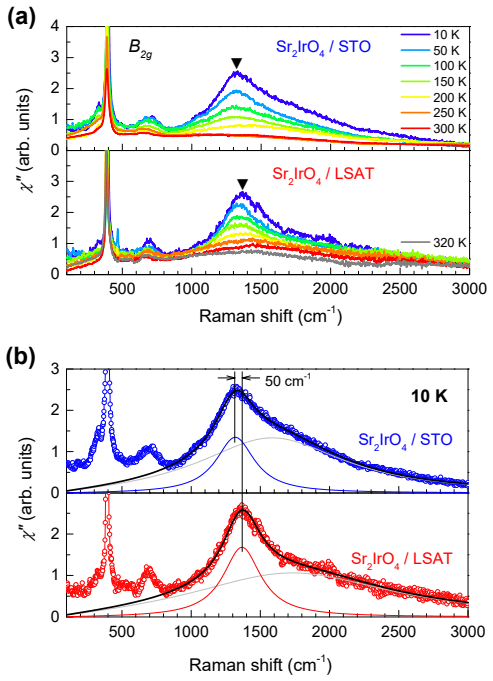
The central claim is that in-plane compressive strain enhances the superexchange interaction between $J_\mathrm{eff}=1/2$ pseudospins in Sr$_2$IrO$_4$. The evidence is the two-magnon Raman peak: its energy rises by about 50 cm$^{-1}$ (6.2 meV) between Sr$_2$IrO$_4$ on SrTiO$_3$ (+0.4% tensile strain) and Sr$_2$IrO$_4$ on LSAT ($-0.7$% compressive strain), and the integrated spectral weight shifts to higher energy, so the peak shift does not depend on the fitting model. Using the two-dimensional $S=1/2$ Heisenberg relation $\omega_{2M}\approx 2.7J$ and the broken-bond cancellation $3J_1 - 4J_2 - 4J_3$, the paper infers $J$ increasing from 61.1 meV to 63.2 meV, with $T_N$ rising by about 10 K. The mechanism proposed is multi-orbital: compression decreases the Ir-O-Ir bond angle, which would reduce hopping in a single-orbital picture, but the $J_\mathrm{eff}=1/2$ wave function mixes $t_{2g}$ orbitals, and the dominant $d_{xz}/d_{yz}$ hoppings increase with compression. Ab initio calculations reproduce this increase in effective hopping and exchange interaction, and also account for the previously puzzling red shift of the optical gap under compression.
Load-bearing premise
The paper assumes the observed ~50 cm$^{-1}$ shift of the phenomenologically fitted two-magnon peak reflects a change in the nearest-neighbor exchange $J$ with the same $2.7J$ conversion and the same cancellation of longer-range couplings in both films, even though the two-magnon line shape is not quantitatively understood.
Editorial extensions
If this is right
- The nearest-neighbor exchange $J$ in Sr$_2$IrO$_4$ can be tuned by substrate choice: an in-plane strain change of about 1% moves $J$ by roughly 4%, and $T_N$ moves with it.
- The density functional calculations predict the trend continues for larger compressive strain, so stronger strain should shift the two-magnon peak further before relaxation sets in.
- Strain-dependent Raman measurements on other $J_\mathrm{eff}=1/2$ iridates could reveal whether the multi-orbital enhancement of hopping is generic.
- The enhanced short-range magnetic order under compression means fluctuation-dominated magnetic correlations survive to higher temperature, which is relevant to proposals of a cuprate-like magnetic route to unconventional superconductivity.
Reading between the lines
- Inference not stated in the paper: a direct test independent of Raman line shapes would be to measure the magnon dispersion of the same two films by resonant inelastic x-ray scattering; a ~4% increase in the zone-boundary magnon energy would confirm the extracted $J$ enhancement.
- Inference not stated in the paper: the same DFT mechanism predicts that compressive strain slightly reduces the Dzyaloshinskii-Moriya interaction (from 12 to 11 meV in the table), so a sensitive probe of the DM term, such as the magnon gap at the zone center, could distinguish the multi-orbital mechanism from a trivial bond-length effect.
- Inference not stated in the paper: because the two-magnon line shape is not quantitatively understood, tracking the full line shape, not just the fitted peak, as a function of strain would separate genuine exchange changes from resonance or line-shape effects.
- Inference not stated in the paper: in thicker films where strain relaxes, the two-magnon peak should move back toward the unstrained value; mapping peak energy versus residual strain measured by X-ray diffraction would give a calibration curve for strain-engineering exchange interactions.
Signed reviews
Editorial analysis
A structured set of objections, weighed in public.
Referee Report
Summary. This manuscript reports Raman spectroscopy of two-magnon excitations in ~50 nm epitaxial Sr2IrO4 films on STO and LSAT substrates, which impose tensile (+0.4%) and compressive (-0.7%) in-plane misfit strain, respectively. The two-magnon peak blueshifts by ~50 cm^-1 at 10 K under compressive strain, with a corresponding shift in integrated spectral weight, and the Néel temperature increases by ~10 K. Density functional theory calculations predict that the effective Jeff=1/2 hopping t and Heisenberg exchange J increase under compressive strain. The authors interpret the Raman shift as an increase of J from 61.1 to 63.2 meV (about 4%) and argue that the multi-orbital character of the Jeff=1/2 wavefunction is responsible for this counterintuitive strain dependence.
Significance. If the central result holds, the paper offers a useful demonstration of strain as a tuning parameter for the primary exchange interaction in a 5d spin-orbit Mott insulator, with implications for the layered iridates and for strain-engineering of magnetic interactions in correlated oxides. The experimental evidence is internally consistent: the peak shift is confirmed by the integrated spectral weight (Fig. S4), TN rises with compression, and DFT reproduces the sign of the effect. The paper also presents a plausible microscopic explanation via the multi-orbital composition of the Jeff=1/2 state. The quantitative claim, however, is more fragile than the qualitative trend, as detailed below.
major comments (4)
- [Footnote 29] Footnoote 29 contains an arithmetically inconsistent cancellation argument. The text states that the two-magnon peak energy is given by ω2M = 3J1 - 4J2 - 4J3 and that J2/J3 contributions cancel, but with the values cited in the same footnote (J2 = -20 meV, J3 = 15 meV) the J2/J3 term evaluates to -4(-20) - 4(15) = +20 meV, which does not cancel. The main-text sentence claiming J2 is 'of the order of 1 meV' is also inconsistent with these RIXS values. Because the quantitative claim that J increases by about 4% is derived from the fixed relation ω2M = 2.7J1, this internal inconsistency undermines the quantitative extraction and must be repaired or explicitly qualified.
- [Main text, two-magnon extraction after Fig. 2(b)] The paper concedes that the asymmetric two-magnon line shape is 'not quantitatively understood' and extracts ω2M from a two-Lorentzian fit. The 1.96 eV excitation is near the charge-transfer gap, which Ref. [10] reports red-shifts by about 0.3 eV under compressive strain, so the resonance conditions differ between the two films; strain-induced changes in the relative weights of the two Lorentzians can move the fitted peak position without any change in J1. The integrated spectral-weight comparison (Fig. S4) convincingly demonstrates a genuine blueshift of magnetic spectral weight, but it cannot by itself determine a quantitative ΔJ1. The J values 61.1 meV and 63.2 meV should therefore be presented as model-dependent estimates, not as directly measured quantities.
- [Table II and DFT section] The DFT calculations give J = 50 meV for Sr2IrO4/STO and J = 51 meV for Sr2IrO4/LSAT, a ~2% increase, whereas the experimental claim is a ~4% increase (61.1 to 63.2 meV). The absolute values also differ from experiment by about 20% and depend on the choice Ueff = 2 eV. The theory thus supports the sign but not the magnitude of the claimed effect. The paper should state explicitly that the 4% figure is an experimental estimate that is not independently confirmed by the DFT results, and should avoid implying quantitative agreement.
- [Table I and strain comparison] The quantitative comparison rests on single films on STO and LSAT, with no error bars reported for the fitted two-magnon peak positions or for the resulting J values. Given that the central quantitative claim (ΔJ ≈ 2.2 meV) is derived from a ~50 cm^-1 shift, reproducibility across multiple films would be needed to establish the precision of this number. I recommend either providing repeated measurements on multiple films or clearly labeling the 4% enhancement as a single-pair estimate.
minor comments (3)
- [Throughout] The notation for the two-magnon peak, ω2M, appears garbled in several places (e.g., '𝜔ଶெଵ'), making the text difficult to read; please fix the equation and symbol encoding throughout.
- [Main text, Lorentz oscillator model] The displayed formula for the two-Lorentzian fit is not rendered correctly; please ensure it appears as a sum of two damped oscillators with unambiguous symbols for amplitude, width, and resonant frequency.
- [Table I] The total in-plane strain difference between Sr2IrO4/STO (+0.4%) and Sr2IrO4/LSAT (-0.7%) is 1.1%, not 1%; please state the exact difference when describing the 'overall 1% change' in the text.
Circularity Check
No significant circularity: the strain-enhanced J claim is converted from an independent two-magnon relation and the DFT calculation is not fitted to the Raman data.
full rationale
The central experimental result is that the two-magnon peak blueshifts by ~50 cm^-1 under compressive strain, and the paper converts this to a J increase using the independent 2D S=1/2 Heisenberg result ω2M = 2.7J from Ref. [23] (Weber and Ford), not by fitting J to the data. The two-Lorentzian fit is a phenomenological description of the line shape, and the paper explicitly checks the blueshift with integrated spectral weights (Fig. S4), so no fitted parameter is silently renamed as a prediction. The DFT branch is also self-contained in relevant respects: VASP structural relaxations and Wannier hoppings are computed with a fixed Ueff = 2 eV, and the Jeff = 1/2 exchange formulas from Ref. [7] are a prior published derivation by one of the authors, not a result that contains the strain-dependent outcome. That self-citation is not load-bearing because the formula has stated large-U/Jeff assumptions and the ab initio hoppings supply independent content. The main weaknesses are correctness risks rather than circularity: the paper admits the asymmetric two-magnon line shape is 'not quantitatively understood,' so the peak-position assignment is model dependent, and footnote 29's broken-bond cancellation is arithmetically inconsistent with the cited J2 = -20 meV and J3 = 15 meV, since 3J1 - 4J2 - 4J3 = 3J1 + 20 meV rather than 2.7J1. These concerns affect how reliable the 4% J enhancement is, but they do not make the derivation equivalent to its inputs by construction.
Assumptions & free parameters
free parameters (2)
- U_eff (U - J_H) =
2 eV
- Two-Lorentzian fit parameters (a_n, Gamma_n, omega_0n) =
Not stated; fitted to each Raman spectrum
assumptions (4)
- domain assumption Jeff=1/2 pseudospin model and superexchange formulas from Carter, Shankar, and Kee (Ref [7])
- domain assumption Two-magnon peak energy equals 2.7J1 for a 2D S=1/2 Heisenberg antiferromagnet, with J2/J3 contributions cancelling
- domain assumption DFT+U with PBEsol and U_eff=2 eV captures the strain dependence of the t2g hopping parameters
- domain assumption The STO and LSAT films are identical except for strain, with negligible oxygen vacancies and no other defect-driven differences
Cite this review
Pith. "Pith review of Compressive-strain induced enhancement of exchange interactions and short-range magnetic order in Sr$_2$IrO$_4$ investigated by Raman spectroscopy." pith.science (2026). https://pith.science/paper/DJXUKREZ
@misc{pith2026190802716,
  author       = {Pith},
  title        = {Pith review of: Compressive-strain induced enhancement of exchange interactions and short-range magnetic order in Sr$_2$IrO$_4$ investigated by Raman spectroscopy},
  year         = {2026},
  howpublished = {\url{https://pith.science/paper/DJXUKREZ}},
  note         = {Machine review of arXiv:1908.02716}
}
abstract
We have carried out Raman spectroscopy experiments to investigate two-magnon excitations in epitaxial thin films of the quasi-two-dimensional antiferromagnetic Mott insulator Sr$_2$IrO$_4$ under in-plane misfit strain. With in-plane biaxial compression, the energy of the two-magnon peak increases, and the peak remains observable over a wider temperature range above the N\'eel temperature, indicating strain-induced enhancement of the superexchange interactions between $\it{J}_{eff}$ = 1/2 pseudospins. From density functional theory calculations, we have found an increase of the nearest-neighbor hopping parameter and exchange interaction with increasing biaxial compressive strain, in agreement with the experimental observations. Our experimental and theoretical results provide perspectives for systematic, theory-guided strain control of the primary exchange interactions in 5$\it{d}$ transition metal oxides.
Figures


Reference graph
Works this paper leans on
-
[10]
Gretarsson, J
H. Gretarsson, J. Sauceda, N. H. Sung, M. Höppner, M. Minola, B. J. Kim, B. Keimer, and M. Le Tacon, Phys. Rev. B 96, 115138 (2017)
2017
- [1]
-
[2]
Kresse and D
G. Kresse and D. Joubert, Phys. Rev. B 59, 1758 (1999)
1999
-
[3]
J. P. Perdew, A. Ruzsinszky, G. I. Csonka, O. A. Vydrov, G. E. Scuseria, L. A. Constantin, X. Zhou, and K. Burke, Phys. Rev. Lett. 100, 136406 (2008)
2008
-
[4]
J. P. Perdew, A. Ruzsinszky, G. I. Csonka, O. A. Vydrov, G. E. Scuseria, L. A. Constantin, X. Zhou, and K. Burke, Phys. Rev. Lett. 102, 039902 (2009)
work page 2009
-
[5]
S. L. Dudarev, G. A. Botton, S. Y. Savrasov, C. J. Humphreys, and A. P. Sutton, Phys. Rev. B 57, 1505 (1998)
1998
-
[6]
Marzari and D
N. Marzari and D. Vanderbilt, Phys. Rev. B 56, 12847 (1997)
1997
-
[7]
Souza, N
I. Souza, N. Marzari, and D. Vanderbilt, Phys. Rev. B 65, 035109 (2001)
2001
Show all 10 references
-
[8]
A. A. Mostofi, J. R. Yates, Y.-S. Lee, I. Souza, D. Vanderbilt, and N. Marzari, Comput. Phys. Commun. 178, 685 (2008)
2008
-
[9]
Carter, V
J.-M. Carter, V. Shankar V., and H.-Y. Kee, Phys. Rev. B 88, 035111 (2013)
2013
Reviewed August 14, 2026 · model on record in the stance chip above.
Discussion (0). Continue with ORCID to comment.