REVIEW 2 major objections 5 minor 45 references
Microwave quantum illumination using a digital receiver
T0 review · 2 major / 5 minor · reviewed 2026-08-14 · deepseek-v4-flash
Pith's one-line read Microwave quantum illumination beats classical noise radar
desk verdict A solid experimental step for microwave quantum illumination: the raw QI-vs-CI advantage is measured, but the stronger advantage over coherent homodyne is a clearly labeled simulation that depends on the idler calibration. read the letter →
The pith
A machine-rendered reading of the paper's core claim, the machinery that carries it, and where it could break.
The reading
What carries the argument
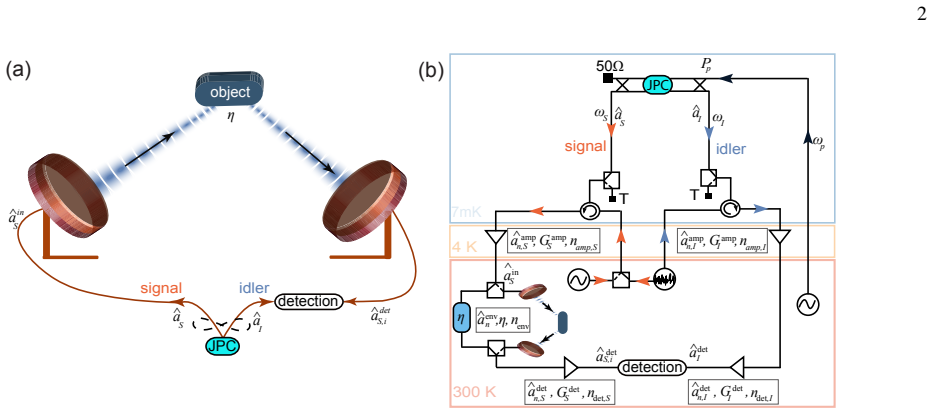
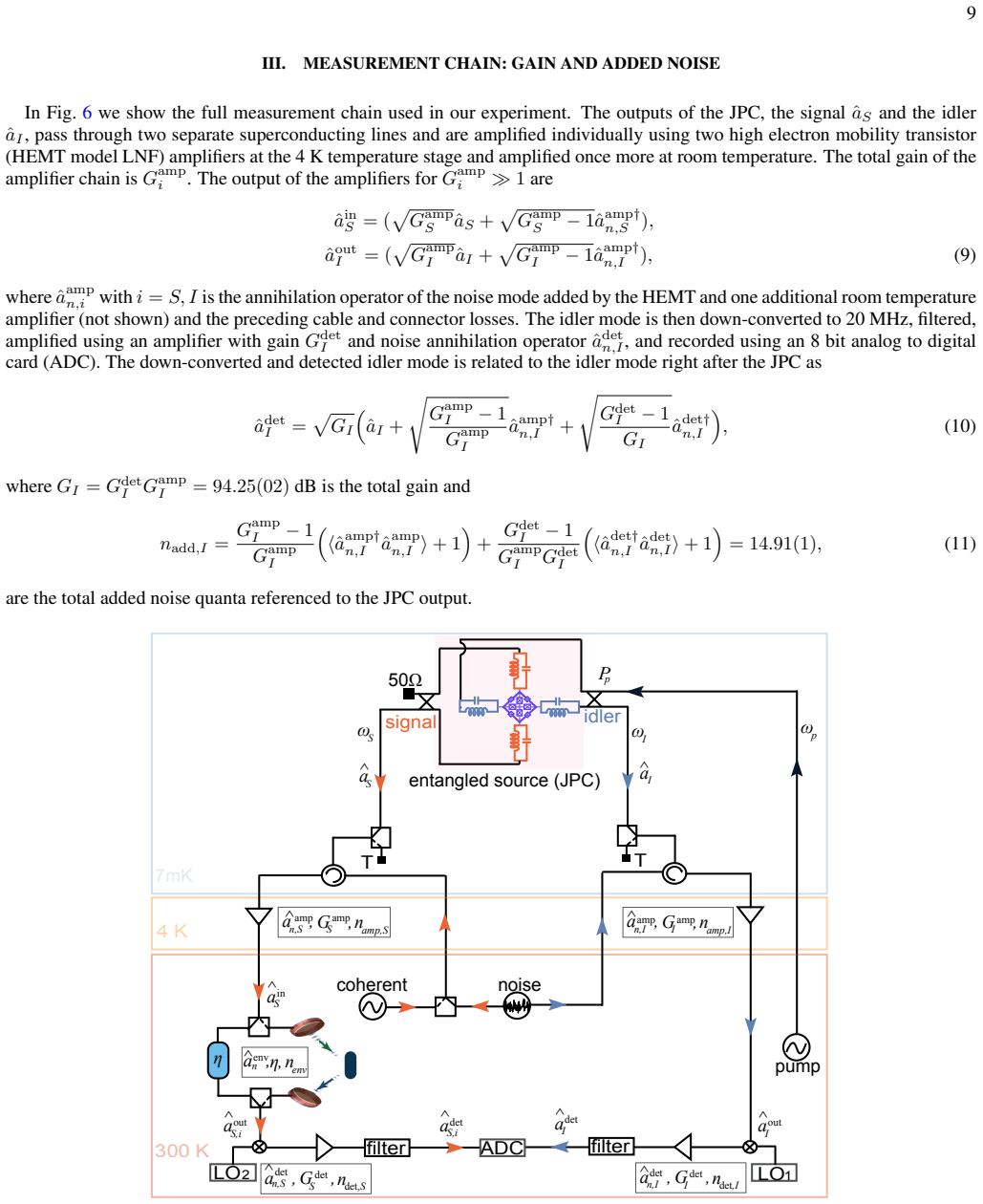
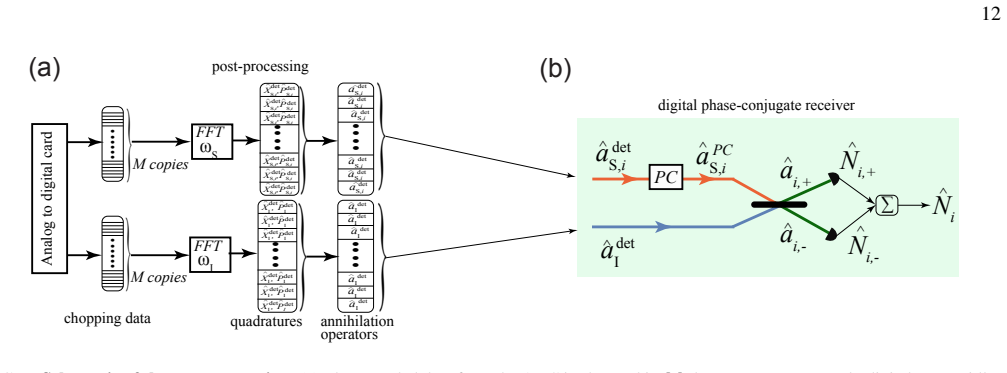
The central object is the Josephson parametric converter (JPC), a superconducting three-wave-mixing amplifier that emits two-mode squeezed microwave fields with a non-zero phase-sensitive cross-correlation between signal and idler; it supplies the entangled source. The carrying mechanism is the digital phase-conjugate receiver: the returned signal is phase-conjugated, mixed with the retained idler on a 50-50 beam splitter, and the photon-count difference is used as the test statistic, with all operations performed in post-processing on digitized quadrature measurements. The SNR formula for this receiver is evaluated from the measured covariance matrix, and the simulated ideal-idler result follows from reducing the measured idler variance by the calibrated added noise and vacuum contribution. The receiver's job is to convert the surviving signal-idler correlations into a detection advantage after entanglement has been broken by loss and noise.
What would settle it
Replace the calibrated idler post-processing with a real microwave photon-number-resolving detector at the JPC output and measure the SNR for the same target at $N_S<0.4$ photons per mode; if the realized advantage over coherent-state homodyne detection does not reach the predicted ~1 dB (or the heterodyne advantage does not reach ~4 dB), the simulated idler calibration is the point of failure.
Extended reading notes
Core claim
The paper's central claim is that quantum illumination works at microwave frequencies under realistic conditions: a Josephson parametric converter produces entangled signal and idler fields at 10.09 and 6.8 GHz, the signal is amplified and sent through a free-space link to a room-temperature copper target, and a digital phase-conjugate receiver reconstructs the full covariance matrix from linear quadrature measurements. Using the resulting SNR for the binary target-absence/presence decision, the authors find that quantum illumination beats a symmetric classically correlated noise radar by up to 3 dB at low signal photon numbers, and that the measured data are consistent with theory down to less than one photon per mode. They then extrapolate from the measured idler noise to the case of an ideal idler photon-number detector and report an advantage over coherent-state heterodyne detection of up to 4 dB and over coherent-state homodyne detection of about 1 dB in the entangled regime. The paper is explicit that without this calibration the raw digital receiver cannot outperform coherent homodyne detection, so the quantum advantage is demonstrated only under the assumption of perfect idler photon counting.
Load-bearing premise
The headline quantum advantage over coherent-state homodyne detection rests on the assumption that subtracting the measured idler detector noise and vacuum contribution reproduces exactly what an ideal photon-number-resolving idler detector would see, even though no such detector was used.
Editorial extensions
If this is right
- A microwave quantum-illumination radar with a digital phase-conjugate receiver can outperform a symmetric classically correlated noise radar by up to 3 dB in raw SNR at the same power, bandwidth, and signal path.
- If ideal idler photon-number detection is available, the same protocol would beat coherent heterodyne illumination by up to 4 dB and coherent homodyne illumination by about 1 dB at low photon numbers, where entanglement is present.
- Because all receiver operations are done in post-processing, the scheme avoids the idler-storage time that limits analog photodetection receivers, so the usable radar range is not constrained by memory.
- At less than one signal photon per mode, the protocol operates in a regime suitable for non-invasive scanning and short-range low-power radar, assuming the amplifier-noise challenge is handled.
Reading between the lines
- The paper's own calibration step is the load-bearing extrapolation: a direct test would build a real microwave photon-number-resolving detector on the idler arm and compare the achieved SNR with the calibrated curve; if real detector inefficiency or dark counts degrade the result, the 1-4 dB advantage may not survive.
- Because the demonstrated experiment uses a high-gain amplifier whose noise dominates the room-temperature environment, a passive detector of amplifier noise would actually outperform the quantum receiver in this exact setup; translating the quantum advantage into a practical radar therefore requires lower-gain, quantum-limited amplification or direct photon counting, a parameter regime the paper i
- The methodological template of linear quadrature recording plus post-processed phase conjugation could be applied to other continuous-variable sensors, where the same covariance-based receiver could be tuned to different frequency bands without changing the digital post-processing.
Signed reviews
Editorial analysis
A structured set of objections, weighed in public.
Referee Report
Summary. The paper reports a microwave quantum illumination (QI) experiment in which a Josephson parametric converter generates entangled signal-idler fields, the signal probes a room-temperature target (including a free-space link at 1 m), and a digital phase-conjugate receiver is implemented from linear quadrature measurements. The central experimental results are a measured SNR comparison between QI and a symmetric classically-correlated illumination (CI) benchmark, showing up to 3 dB raw advantage of QI at low photon numbers, and an inferred/simulated SNR for perfect idler photon-number detection, which the authors report as up to 4 dB over coherent heterodyne and about 1 dB over coherent homodyne detection. The paper explicitly states that without the idler calibration the digital receiver cannot outperform coherent homodyne, and that in the implemented setup passive detection of the amplifier noise would give a much higher SNR than any of the compared active protocols.
Significance. If the results hold, this is a valuable experimental milestone: it is a microwave QI demonstration with a room-temperature target, independent calibration of gains and added noise, direct measurement of the QI-versus-CI SNR difference, and a careful separation of measured raw performance from simulated ideal-idler performance. The entanglement verification and the explicit acknowledgment of the passive-detection limitation are commendable. The main significance beyond the raw comparison is the claimed simulated quantum advantage over coherent-state benchmarks, and that claim is the part that needs the closest scrutiny.
major comments (2)
- [Methods V, Eq. (22); main text around Fig. 2(b)] The calibrated/ideal-idler SNR is obtained by replacing the idler photon number in Eq. (22) with <a†_I a_I> = <a†_{det,I} a_{det,I}>/G_I − (nadd,I + 1), while the other moments in Eq. (22), namely <N_i,+> and <N_i,−>, are evidently taken from the measured detected modes. For a phase-preserving idler amplifier, the transformation from the JPC-output idler mode to the detected idler mode also rescales signal-idler cross-correlations and modifies the fourth-order moments that enter <N_i,+> and <N_i,−>. Subtracting a single mean value from one term of Eq. (22) is not equivalent to inverse-calibrating the full two-mode covariance matrix. The manuscript should either provide the covariance-level inverse transformation and evaluate Eq. (22) entirely in terms of the calibrated JPC-output parameters, or explicitly relabel the dashed curves in Figs. 2(b) and 3 as a model-dependent extrapolation rather than an inferred measured SNR. As written, the claimed 1 dB advantage over homodyne and 4 dB advantage over heterodyne are not supported by the displayed calculation.
- [Fig. 2(b) and text near 'approximately 1 dB larger'] The calibrated QI advantage over coherent homodyne is reported as approximately 1 dB in the region N_S < 0.4, but the manuscript does not provide an uncertainty estimate on this difference or on the inferred SNR values used to establish it. Since Fig. 3(b) omits the homodyne benchmark because the expected advantage is said to be smaller than systematic errors, the reader cannot tell whether the 1 dB advantage in Fig. 2(b) is statistically significant. The authors should report the inferred SNR difference with propagated statistical and systematic uncertainties, or temper the claim accordingly.
minor comments (5)
- [Main text, paragraph after Eq. (3)] The calibration formula is written as <a†_I a_I> = <a†_{det,i} a_{det,i}>/G_I − (nadd,I + 1); the index i is not defined there and the subscript on the detected mode does not match the left-hand side. Please clarify the notation and reconcile the '+1' with the definition of nadd,I in the Supplementary Information, Eq. (11).
- [Fig. 2(b) caption and legend] The legend uses 'raw SNR' and 'calibrated idler' but the caption does not define these terms; please state explicitly that 'raw' means no idler calibration and 'calibrated idler' means the simulated perfect-idler-photon-detection result.
- [Fig. 3(b)] The figure shows both object distance and total loss on the horizontal axis, but the caption does not explain how the loss values are derived from the free-space distances; please add a sentence describing the loss model used.
- [Abstract and Conclusion] The abstract describes the advantage as being 'compared to the relative classical benchmark'; since the only measured advantage is against symmetric CI and the coherent-state advantages are simulated, please state this distinction explicitly in the abstract as well as in the conclusion.
- [Throughout] Equation (3) in the main text and Eq. (19) in the Methods are the same expression; please use a single equation number or cross-reference to avoid duplication.
Circularity Check
No significant circularity: the raw QI-versus-CI comparison and the coherent-state benchmarks are measured in the same apparatus; the calibrated idler-photon-number simulation is a clearly labeled extrapolation, not a fitted quantity renamed as a prediction.
full rationale
The paper's central raw claim—that the digital phase-conjugate receiver outperforms a symmetric classically-correlated noise radar by up to 3 dB—rests on measured quadrature data for both sources in the same setup (Fig. 2b, solid lines), so no definitional circularity is present. The coherent homodyne and heterodyne benchmarks are likewise measured in the same apparatus rather than imported from the paper's model. The calibrated idler simulation in Methods V (Eq. 22) replaces the measured idler photon number with <a†_I a_I> = <a†_det,I a_det,I>/G_I − (n_add,I + 1). This is a model-based noise subtraction, and the paper explicitly labels it a simulation rather than a direct photon-counting measurement; it also concedes that without this calibration the raw digital receiver cannot beat coherent homodyne. The simulated advantage still depends on the measured signal-idler cross-correlation <a_S a_I>, not solely on the calibration constants, so the result is not equivalent to its inputs by construction. The self-citations (e.g., Refs. 12, 16, 23, 31) provide theoretical context and calibration methodology but are not the load-bearing evidence for any measured data point. The disclosed limitations therefore reduce the strength of the headline claim but do not establish circularity.
Assumptions & free parameters
free parameters (3)
- Detection channel gain GS, GI =
GS = 93.98(01) dB, GI = 94.25(02) dB
- Added noise quanta nadd,S, nadd,I =
nadd,S = 9.61(04), nadd,I = 14.91(1)
- JPC output moments NS, NI, and signal-idler correlation =
Varies with pump power, e.g. NS = 0.2 to 5 photons per second per hertz at JPC output
assumptions (4)
- domain assumption Signal and idler modes and the classical noise source are zero-mean Gaussian states fully described by their covariance matrix.
- domain assumption Target and environment are modeled as a beam splitter with loss eta and a single thermal mode with n_env = 672, with stable or known phase.
- ad hoc to paper Subtracting calibrated idler vacuum and amplifier noise from measured idler variance reproduces an ideal photon-number-detection receiver SNR.
- domain assumption Classically-correlated noise from the arbitrary waveform generator, routed through the same JPC reflections and detection chain, is a fair symmetric classical noise radar benchmark.
Cite this review
Pith. "Pith review of Microwave quantum illumination using a digital receiver." pith.science (2026). https://pith.science/paper/ZQ7EPFBE
@misc{pith2026190803058,
  author       = {Pith},
  title        = {Pith review of: Microwave quantum illumination using a digital receiver},
  year         = {2026},
  howpublished = {\url{https://pith.science/paper/ZQ7EPFBE}},
  note         = {Machine review of arXiv:1908.03058}
}
read the original abstract
Quantum illumination is a powerful sensing technique that employs entangled signal-idler photon pairs to boost the detection efficiency of low-reflectivity objects in environments with bright thermal noise. The promised advantage over classical strategies is particularly evident at low signal powers, a feature which could make the protocol an ideal prototype for non-invasive biomedical scanning or low-power short-range radar. In this work we experimentally investigate the concept of quantum illumination at microwave frequencies. We generate entangled fields using a Josephson parametric converter to illuminate a room-temperature object at a distance of 1 meter in a free-space detection setup. We implement a digital phase conjugate receiver based on linear quadrature measurements that outperforms a symmetric classical noise radar in the same conditions despite the entanglement-breaking signal path. Starting from experimental data, we also simulate the case of perfect idler photon number detection, which results in a quantum advantage compared to the relative classical benchmark. Our results highlight the opportunities and challenges on the way towards a first room-temperature application of microwave quantum circuits.
Figures


Figures from the paper (4 more)


Reference graph
Works this paper leans on
-
[1]
S. Pirandola, B. R. Bardhan, T. Gehring, C. Weedbrook, S. Lloyd, Advances in Photonic Quantum Sensing.Nat. Photon. 12, 724-733 (2018)
work page 2018
-
[2]
M. A. Nielsen, I. L. Chuang, Quantum computation and quantum information (Cambridge University Press, Cambridge, 2000)
work page 2000
-
[3]
C. Weedbrook, S. Pirandola, R. Garcia-Patron, N. J. Cerf, T. C. Ralph, J. H. Shapiro, S. Lloyd, Gaussian quantum information. Rev. Mod. Phys. 84, 621-669 (2012)
work page 2012
-
[4]
Hayashi, Quantum Information Theory: Mathematical F oun- dation (Springer-Verlag, 2017)
M. Hayashi, Quantum Information Theory: Mathematical F oun- dation (Springer-Verlag, 2017)
work page 2017
-
[5]
Watrous, The theory of quantum information (Cambridge Uni- versity Press, Cambridge, 2018)
J. Watrous, The theory of quantum information (Cambridge Uni- versity Press, Cambridge, 2018)
work page 2018
-
[6]
S. L. Braunstein, C. M. Caves, Statistical distance and the geom- etry of quantum states. Phys. Rev. Lett. 72, 3439-3443 (1994)
work page 1994
-
[7]
R. J. Schoelkopf, S. M. Girvin, Wiring up quantum systems. Na- ture 451, 664-669 (2008)
work page 2008
-
[8]
H. J. Kimble, The quantum internet. Nature 453, 1023 (2008)
work page 2008
Show all 45 references
-
[9]
Pirandola, S
S. Pirandola, S. L. Braunstein, Unite to build a quantum Internet. Nature 532, 169 (2016)
2016
-
[10]
Wehner, D
S. Wehner, D. Elkouss, R. Hanson, Quantum internet: A vision for the road ahead. Science 362, eaam9288 (2018)
2018
-
[11]
Lloyd, Enhanced sensitivity of photodetection via quantum illumination
S. Lloyd, Enhanced sensitivity of photodetection via quantum illumination. Science 321, 1463-1465 (2008)
2008
-
[12]
Erkmen, Vittorio Giovannetti, Saikat Guha, Seth Lloyd, Lorenzo Maccone, Stefano Pirandola, Jeffrey H
Si-Hui Tan, Baris I. Erkmen, Vittorio Giovannetti, Saikat Guha, Seth Lloyd, Lorenzo Maccone, Stefano Pirandola, Jeffrey H. Shapiro, Quantum illumination with Gaussian States. Phys. Rev. Lett. 101, 253601 (2008)
2008
-
[13]
E. D. Lopaeva, I. Ruo Berchera, I. P. Degiovanni, S. Olivares, G. Brida, and M. Genovese, Experimental Realization of Quan- tum Illumination. Phys. Rev. Lett. 110, 153603 (2013)
2013
-
[14]
Zheshen Zhang, Maria Tengner, Tian Zhong, Franco N. C. Wong, Jeffrey H. Shapiro, Entanglement’s Benefit Survives an Entanglement-Breaking Channel. Phys. Rev. Lett. 111, 010501 (2013)
2013
-
[15]
Zheshen Zhang, Sara Mouradian, Franco N. C. Wong and Jef- frey H. Shapiro, Entanglement-Enhanced Sensing in a Lossy and Noisy Environment. Phys. Rev. Lett. 114, 110506 (2015)
2015
-
[16]
Weedbrook, S
C. Weedbrook, S. Pirandola, J. Thompson, V . Vedral and M. Gu, How discord underlies the noise resilience of quantum illu- mination.New Journal of Physics 18, 043027 (2016)
2016
-
[17]
Shapiro, The Quantum Illumination Story
Jeffrey H. Shapiro, The Quantum Illumination Story. arXiv:1910.12277 (2019)
2019 arXiv
-
[18]
J. Choi, V . Va, N. Gonzalez-Prelcic, R. Daniels, C. R. Bhat, R. W. Heath, Millimeter-Wave Vehicular Communication to Sup- port Massive Automotive Sensing. IEEE Communications Mag- azine, 54, 160 (2016). Page(s): 160 - 167
2016
-
[19]
Lin, Microwave sensing of physiological movement and volume change: A review
J.C. Lin, Microwave sensing of physiological movement and volume change: A review. Bioelectromagnetics 13, 557 (1992)
1992
-
[20]
C. W. Sandbo Chang, A. M. Vadiraj, J. Bourassa, B. Balaji, C. M. Wilson, Quantum-enhanced noise radar. Appl. Phys. Lett. 114, 112601 (2019)
2019
-
[21]
Luong, C
D. Luong, C. W. Sandbo Chang, A. M. Vadiraj, A. Damini, C. M. Wilson, B. Balaji, Receiver Operating Characteris- tics for a Prototype Quantum Two-Mode Squeezing Radar. arXiv:1903.00101
1903 arXiv
-
[22]
Erkmen, Gaussian-state quantum- illumination receivers for target detection
Saikat Guha, Baris I. Erkmen, Gaussian-state quantum- illumination receivers for target detection. Phys. Rev. A 80, 052310 (2009)
2009
-
[23]
Shapiro, and Stefano Pirandola, Microwave quantum illumination
Shabir Barzanjeh, Saikat Guha, Christian Weedbrook, David Vitali, Jeffrey H. Shapiro, and Stefano Pirandola, Microwave quantum illumination. Phys. Rev. Lett. 114, 080503 (2015)
2015
-
[24]
Bergeal, R
N. Bergeal, R. Vijay, V .E. Manucharyan, I. Siddiqi, R. Schoelkopf, S. Girvin, and M. Devoret, Phase-preserving ampli- fication near the quantum limit with a Josephson ring modulator. Nat. Phys. 6, 296 (2010)
2010
-
[25]
B. Abdo, A. Kamal, M. H. Devoret, Nondegenerate three-wave 7 mixing with the Josephson ring modulator. Phys. Rev. B 87, 014508 (2013)
2013
-
[26]
Flurin, N
E. Flurin, N. Roch, F. Mallet, M. Devoret, B. Huard, Generat- ing entangled microwave radiation over two transmission lines. Phys. Rev. Lett. 109, 183901 (2012)
2012
-
[27]
Devoret, S
Matti Silveri, Evan Zalys-Geller, Michael Hatridge, Zaki Legh- tas, Michel H. Devoret, S. M. Girvin, Theory of remote entangle- ment via quantum-limited phase-preserving amplification. Phys. Rev. A 93, 062310 (2016)
2016
-
[28]
da Silva, Deniz Bozyigit, Andreas Wallraff, Alexan- dre Blais, Schemes for the observation of photon correlation functions in circuit QED with linear detectors
Marcus P. da Silva, Deniz Bozyigit, Andreas Wallraff, Alexan- dre Blais, Schemes for the observation of photon correlation functions in circuit QED with linear detectors. Phys. Rev. A 82, 043804 (2010)
2010
-
[29]
Bozyigit, C
D. Bozyigit, C. Lang, L. Steffen, J. M. Fink, C. Eichler, M. Baur, R. Bianchetti, P. J. Leek, S. Filipp, M. P. da Silva, A. Blais and A. Wallraff, Antibunching of microwave-frequency photons observed in correlation measurements using linear de- tectors. Nat. Phys. 7, 154 (2011)
2011
-
[30]
Eichler, D
C. Eichler, D. Bozyigit, A. Wallraff, Characterizing quantum microwave radiation and its entanglement with superconducting qubits using linear detectors. Phys. Rev. A 86, 032106 (2012)
2012
-
[31]
Barzanjeh, E
S. Barzanjeh, E. S. Redchenko, M. Peruzzo, M. Wulf, D. P. Lewis, G. Arnold, J. M. Fink, Stationary entangled radiation from micromechanical motion. Nature 570, 480-483 (2019)
2019
-
[32]
E. P. Menzel, R. Di Candia, F. Deppe, P. Eder, L. Zhong, M. Ihmig, M. Haeberlein, A. Baust, E. Hoffmann, D. Ballester, K. Inomata, T. Yamamoto, Y . Nakamura, E. Solano, A. Marx, R. Gross, Path entanglement of continuous-variable quantum mi- crowaves. Phys. Rev. Lett. 109, 2505...
2012
-
[33]
L.-M. Duan, G. Giedke, J. I. Cirac, P. Zoller, Inseparability cri- terion for continuous variable systems.Phys. Rev. Lett. 84, 2722- 2725 (2000)
2000
-
[34]
Yurke, L
B. Yurke, L. R. Corruccini, P. G. Kaminsky, L. W. Rupp, A. D. Smith, A. H. Silver, R. W. Simon, E. A. Whittaker, Observation of parametric amplification and deamplification in a Josephson parametric amplifier. Phys. Rev. A 39, 2519-2533 (1989)
1989
-
[35]
M. A. Castellanos-Beltran, K. W. Lehnert, Widely tunable para- metric amplifier based on a superconducting quantum interfer- ence device array resonator. Applied Physics Letters 91 083509 (2007)
2007
-
[36]
Macklin, K
C. Macklin, K. O’Brien, D. Hover, M. E. Schwartz, V . Bolkhovsky, X. Zhang, W. D. Oliver, I. Siddiqi, A near-quantum- limited Josephson traveling-wave parametric amplifier. Science 350, 307 (2015)
2015
-
[37]
S. Kono, K. Koshino, Y . Tabuchi, A. Noguchi, Y . Nakamura, Quantum non-demolition detection of an itinerant microwave photon. Nature Physics, 14, 546-549, (2018)
2018
-
[38]
Jean-Claude Besse, Simone Gasparinetti, Michele C. Collodo, Theo Walter, Philipp Kurpiers, Marek Pechal, Christopher Eich- ler, Andreas Wallraff, Single-shot quantum nondemolition detec- tion of individual itinerant microwave photons, Phys. Rev. X ,8, 021003 (2018)
2018
-
[39]
arXiv:1902.05102
Raphael Lescanne, Samuel Deleglise, Emanuele Albertinale, Ulysse Reglade, Thibault Capelle, Edouard Ivanov, Thibaut Jacqmin, Zaki Leghtas, Emmanuel Flurin, Detecting itiner- ant microwave photons with engineered non-linear dissipation. arXiv:1902.05102
1902 arXiv
-
[40]
Shapiro, Op- timum Mixed-State Discrimination for Noisy Entanglement- Enhanced Sensing
Quntao Zhuang, Zheshen Zhang, and Jeffrey H. Shapiro, Op- timum Mixed-State Discrimination for Noisy Entanglement- Enhanced Sensing. Phys. Rev. Lett.,118, 040801 (2017). SUPPLEMENTARY INFORMATION I. JOSEPHSON PARAMETRIC CONVERTER We use a nondegenerate three-wave mixing Joseph...
2017
-
[41]
The M copies of the signal and idler modes, generated in post-processing, are sent one by one to the digital phase-conjugate receiver
(b) The digital phase-conjugate receiver used to infer the SNR of QI and CI. The M copies of the signal and idler modes, generated in post-processing, are sent one by one to the digital phase-conjugate receiver. A 50-50 beam splitter mixes the phase conjugated signal mode ˆaPC...
-
[42]
B. Abdo, J. M. Chavez-Garcia, M. Brink, G. Keefe, J. M. Chow, Time-multiplexed amplification in a hybrid-less and coil-less Josephson parametric converter. Appl. Phys. Lett. 110, 082601 (2017)
2017
-
[43]
Flurin, N
E. Flurin, N. Roch, F. Mallet, M. Devoret, B. Huard, Generating entangled microwave radiation over two transmission lines. Phys. Rev. Lett. 109, 183901 (2012)
2012
-
[44]
H. S. Ku, W. F. Kindel, F. Mallet, S. Glancy, K. D. Irwin, G. C. Hilton, L. R. Vale, K. W. Lehnert, Generating and verifying entangled itinerant microwave fields with efficient and independent measurements. Phys. Rev. A 91, 042305 (2015)
2015
-
[45]
Erkmen, Gaussian-state quantum-illumination receivers for target detection
Saikat Guha, Baris I. Erkmen, Gaussian-state quantum-illumination receivers for target detection. Phys. Rev. A 80, 052310 (2009)
2009
Reviewed August 14, 2026 · model on record in the stance chip above.
Discussion (0). Continue with ORCID to comment.