REVIEW 3 major objections 4 minor 72 references
Structure of odd-odd Cs isotopes within the interacting boson-fermion-fermion model based on the Gogny-D1M energy density functional
T0 review · 3 major / 4 minor · reviewed 2026-08-14 · deepseek-v4-flash
Pith's one-line read Using a mapped interacting boson-fermion-fermion model with microscopic energy-density-functional input, the paper claims that the odd-odd cesium isotopes 124–132Cs can be described from low-spin spectra to high-spin bands, and identifies…
desk verdict A solid, honest application of the authors' IBFFM-2 framework to odd-odd Cs isotopes; the spectroscopy is useful, but the chirality interpretation rests on a diagnostic that the model's non-triaxial core cannot actually ground. read the letter →
The pith
A machine-rendered reading of the paper's core claim, the machinery that carries it, and where it could break.
The reading
What carries the argument
The central object is the IBFFM-2 Hamiltonian, which couples an IBM-2 neutron-proton boson core to one unpaired neutron and one unpaired proton in the 50–82 shell. Its parameters are fixed by mapping the Hartree-Fock-Bogoliubov deformation energy surface onto the boson coherent state, and by using the single-particle energies and occupation probabilities from the same mean-field calculation in the boson-fermion coupling terms; only the quadrupole, exchange, and monopole strengths plus the short-range delta and tensor residual neutron-proton interaction are adjusted to experiment. The diagonalized wave functions yield energies, $E2$ and $M1$ transition rates, and static moments, and it is the spin dependence of the $M1$ rates that carries the chirality argument.
What would settle it
Measure the $B(M1;I\to I-1)$ staggering in the predicted partner bands of $^{126}\mathrm{Cs}$, where the yrast and side bands are built on different single-particle configurations in this calculation; if the staggering phase disagrees with the prediction, or if adding three-body boson terms that restore the core's triaxial minimum removes the near-degenerate doublets, the chirality claim would fail.
Extended reading notes
Core claim
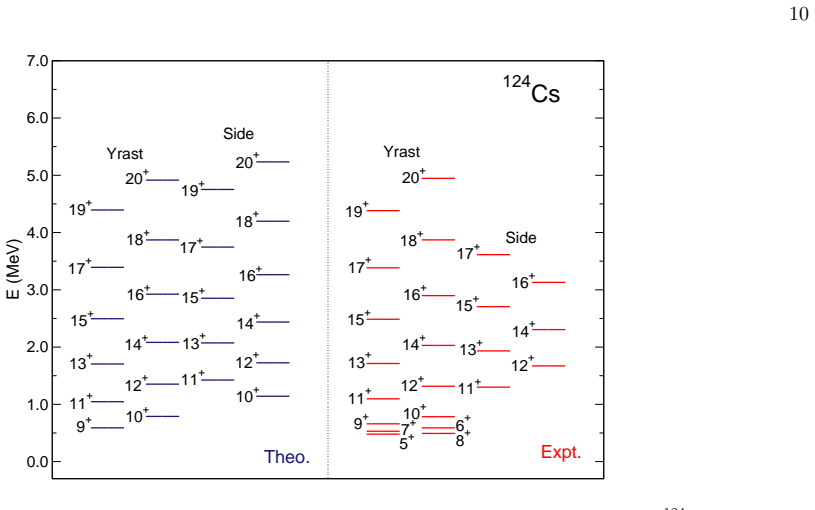
On the paper's own terms, the central discovery is that the IBFFM-2 Hamiltonian assembled from constrained Hartree-Fock-Bogoliubov energy surfaces and single-particle data, with only a few boson-fermion and residual neutron-proton strengths fitted, yields reasonable quantitative agreement with the low-lying spectra of $^{124,126,128}\mathrm{Cs}$ and reproduces the higher-spin positive-parity doublet-like bands up to $I\approx 20$ in most of $^{124-132}\mathrm{Cs}$. The paper further claims that the calculated $B(M1;I\to I-1)$ rates show a staggering pattern with increasing spin in most of the considered isotopes, matching the phase expected from the chiral-doublet selection rule, and therefore many of these odd-odd nuclei are good candidates for chiral doublet bands.
Load-bearing premise
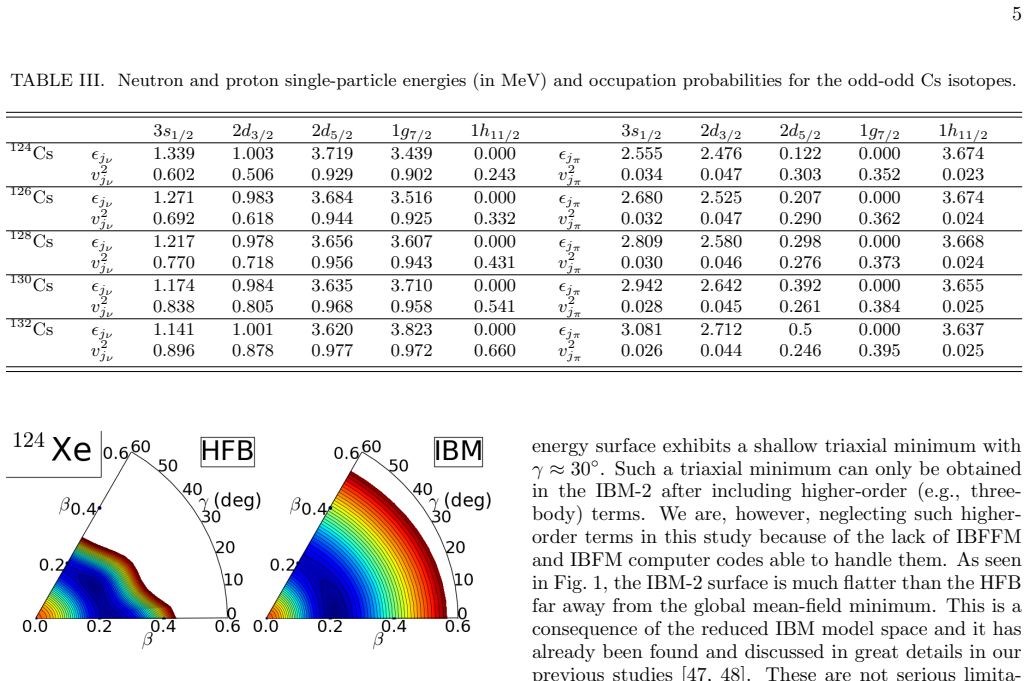
The argument assumes that omitting higher-order boson terms in the core Hamiltonian does not spoil the chiral interpretation, although the resulting mapped core surface is much flatter than the Hartree-Fock-Bogoliubov surface and cannot reproduce the shallow triaxial minimum at $\gamma\approx 30^\circ$ for $^{124}\mathrm{Xe}$.
Editorial extensions
If this is right
- The same mapped IBFFM-2 procedure can be applied to other odd-odd nuclei in the $A\approx 130$ region, predicting which nuclei should show chiral partner bands without per-nucleus refitting beyond a few residual-interaction constants.
- For $^{124,126,128}\mathrm{Cs}$, the model's agreement with low-spin data and high-spin bands up to $I\approx 20$ gives a basis for assigning spins and parities to states that experiment has not firmly classified.
- The calculated $B(M1)/B(E2)$ ratios reproduce the empirical staggering trend, so the model can guide searches for new chiral candidates even where its absolute transition rates deviate from measured values.
- The systematic degradation toward $^{132}\mathrm{Cs}$ marks the practical limit set by the small boson number near the $N=82$ shell closure and by fixed residual-interaction strengths.
Reading between the lines
- If the truncated core is the reason the mapped surface is too flat, adding three-body boson terms and refitting would test whether the predicted chiral doublets survive a genuinely triaxial core; this is a test the authors leave for future work.
- Because the $(\nu h_{11/2})^{-1}\otimes\pi h_{11/2}$ configuration is common in neighboring odd-odd nuclei, the same machinery could predict the chiral-band landscape across the whole mass region, not just the cesium chain.
- The sign errors in the quadrupole and magnetic moments for $^{130,132}\mathrm{Cs}$ suggest that precise moment measurements, rather than level energies alone, would separate deficiencies in the core or single-particle input from deficiencies in the residual interaction.
- If future data show no $B(M1)$ staggering in $^{126}\mathrm{Cs}$, that would not necessarily falsify the low-spin description but would indicate that grouping states into yrast and side bands by lowest energy is too simple there.
Signed reviews
Editorial analysis
A structured set of objections, weighed in public.
Referee Report
Summary. The paper constructs IBFFM-2 Hamiltonians for the odd-odd nuclei 124–132Cs from Gogny-D1M HFB calculations: the IBM-2 core parameters are obtained by mapping the constrained HFB (β,γ) energy surfaces of 124–132Xe, the single-particle energies and occupation probabilities for the odd neutron and proton are taken from HFB, and the boson-fermion couplings are partly fixed to odd-mass spectra. A residual neutron-proton interaction with fitted delta and tensor strengths completes the Hamiltonian. The authors compare low-spin positive- and negative-parity spectra, static moments, and high-spin band structures with experiment, and on the basis of near-degenerate yrast/side bands and staggering of B(M1;I→I-1) rates they identify many of these nuclei as candidates for chiral doublet bands.
Significance. If the chiral interpretation holds, the paper demonstrates that a largely microscopic IBFFM-2 approach with only a few adjusted constants can describe both low-spin odd-odd spectroscopy and high-spin bands up to I≈20, and it provides a concrete list of chiral-doublet candidates in the A≈130 region. The systematic chain calculation, the use of HFB-derived single-particle inputs, the comparison with moments and transitions, and the sensitivity study of uD and uT are genuine strengths. The main limitation is that chiral assignment is inferred from energy degeneracy and B(M1) staggering alone; the model core lacks the triaxial minimum found in the Gogny surface, and no chiral geometry is computed.
major comments (3)
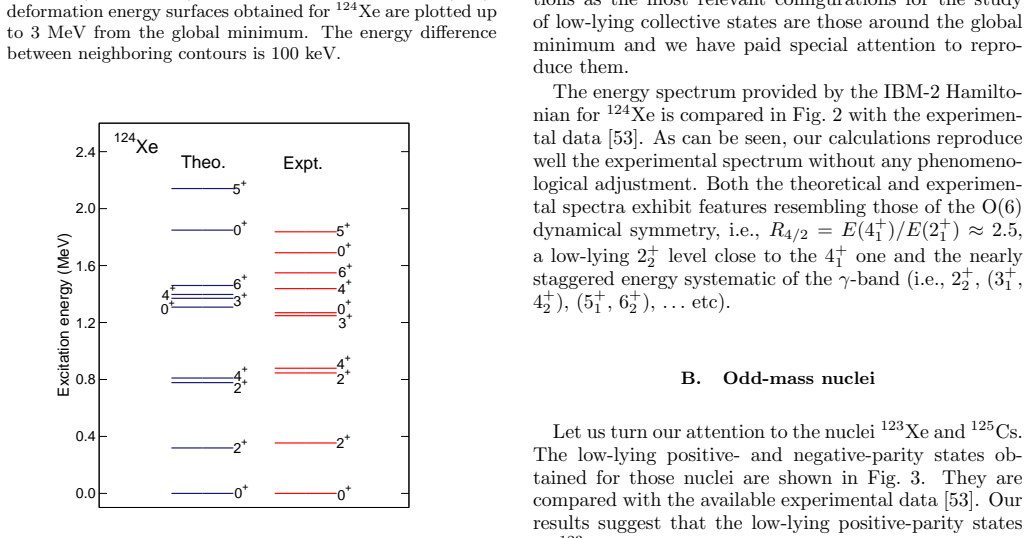
- [Sec. III A and Sec. III C 4] The chirality conclusion is load-bearing but is not supported by the model's geometry. In Sec. III A the authors state that the Gogny-D1M HFB surface for 124Xe has a shallow triaxial minimum near γ≈30°, while the adopted IBM-2 Hamiltonian of Eq. (2) gives a much flatter surface because higher-order three-body boson terms are omitted. Since chiral doublet bands are associated with an aplanar orientation of the three angular-momentum vectors, and since a γ-soft core can itself generate near-degenerate bands and M1 staggering through angular-momentum coupling, the observed B(M1) staggering cannot by itself certify chirality. No calculation of the relative angles or any other chiral order parameter is presented. I request either a direct wave-function/geometry diagnostic or a clear revision of the conclusions so that the bands are described as 'chiral-like' candidates without confirming chiral geometry.
- [Sec. II B and Table II] The high-spin agreement is partly a fitting result, so the chiral-candidate conclusion should be framed accordingly. The parameters Γπ for the proton h11/2 configuration in 128,130,132Cs were explicitly modified (values in parentheses in Table II) to lower the high-spin states, and uD and uT were fitted to low-lying odd-odd spectra in step 4 of Sec. II B. Consequently, the near-degenerate high-spin doublets and their B(M1) staggering are not independent predictions. The authors should quantify how the doublet splitting and the B(M1) staggering pattern change when Γπ and uT are varied over the ranges discussed in Sec. III C 5, and should clearly separate fitted from predicted content in the concluding claims.
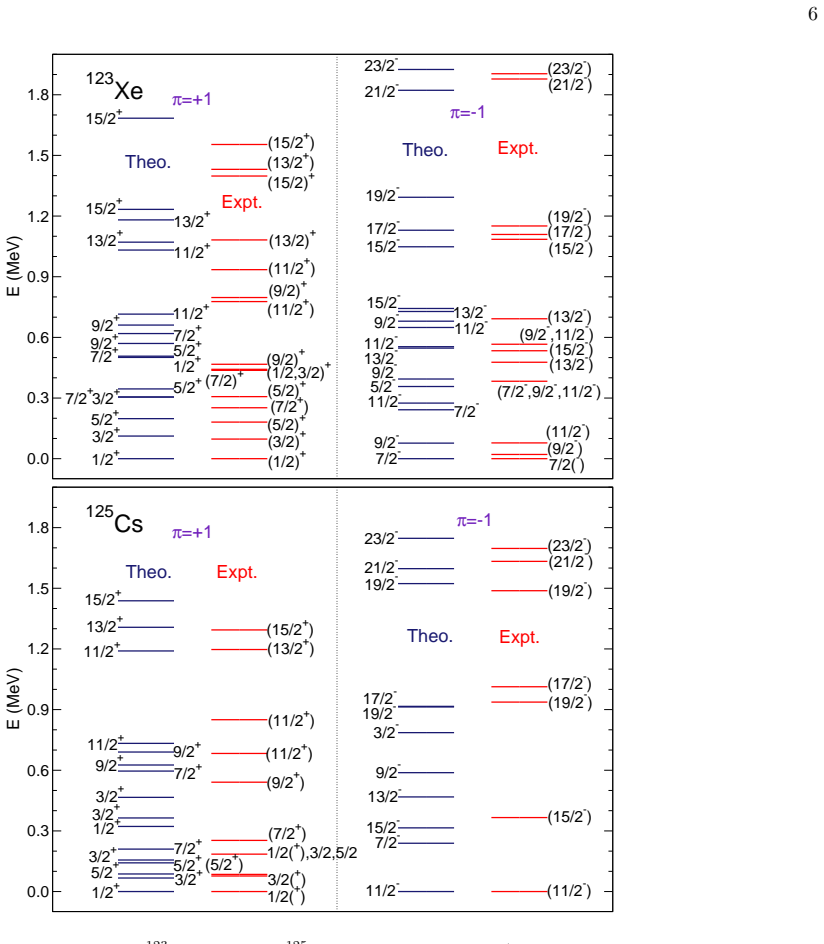
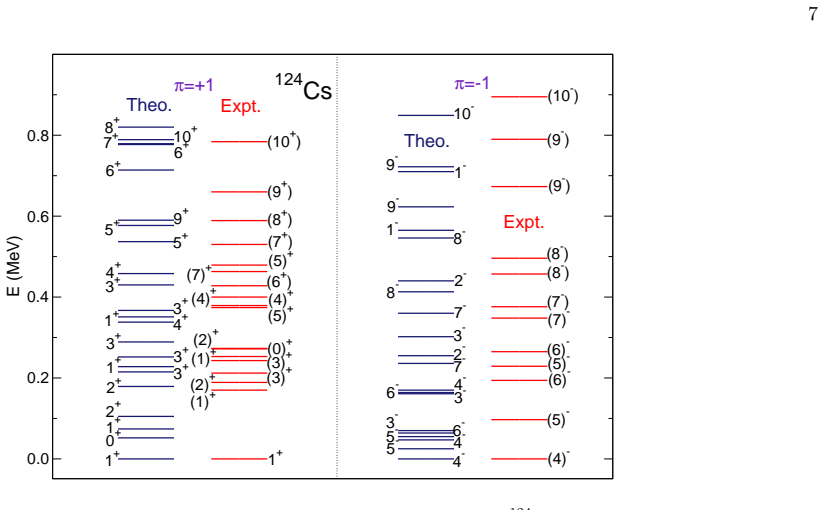
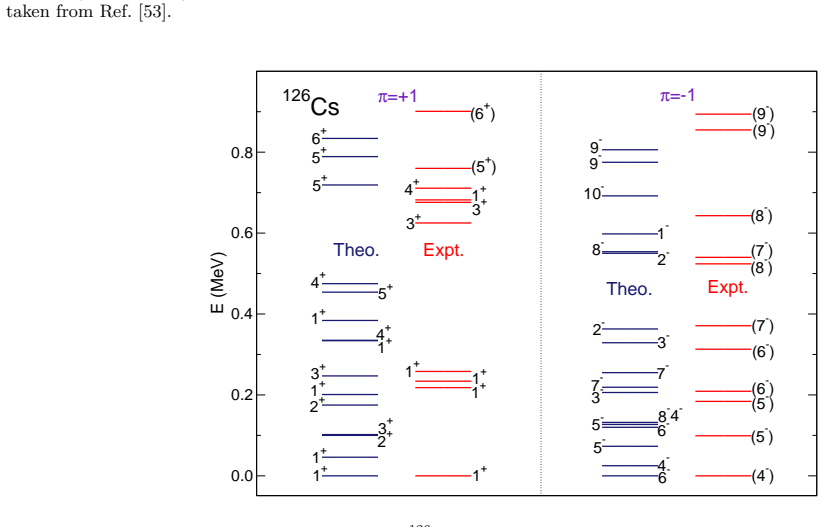
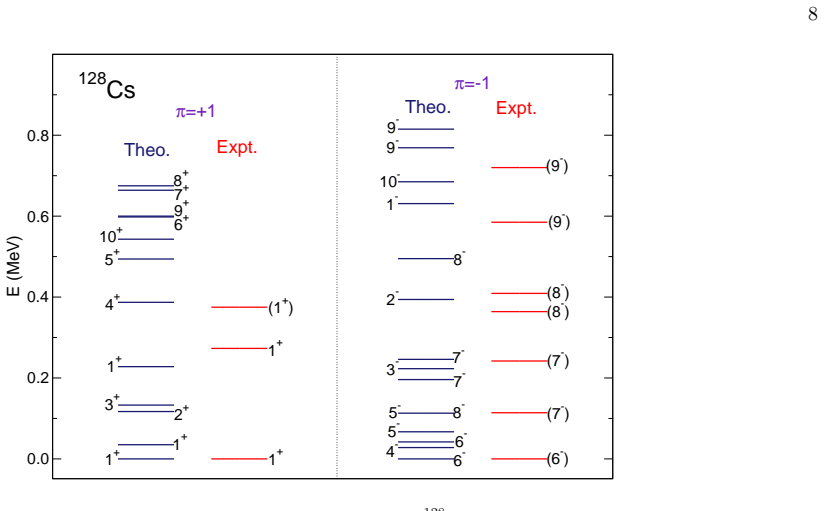
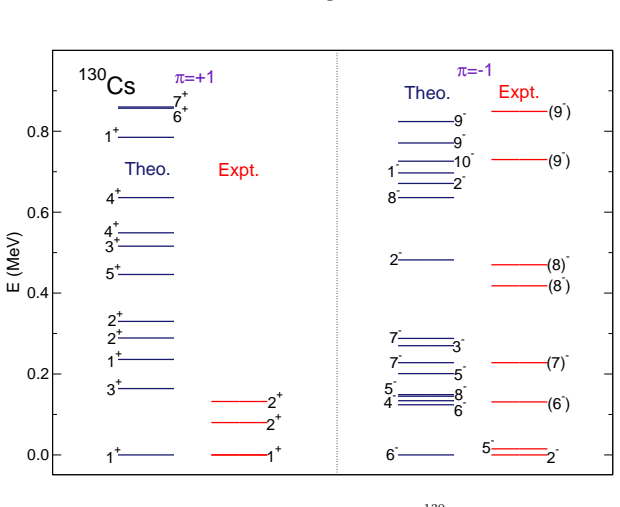
- [Sec. III C 1 and Sec. III C 3] For 130Cs and 132Cs the low-spin description is poor (e.g., the experimental 2+ states in 130Cs are overestimated by about a factor of three, several negative-parity states are too high, and Table IV shows wrong-sign moments for some states), and for 126Cs the yrast and side bands have different wave-function content, with the authors noting that the simple I1/I2 grouping into bands is sometimes inadequate. These facts weaken the blanket statement that 'many' of these nuclei are good chiral candidates; the claim should be restricted to the cases where the band assignment is robust or accompanied by an analysis of the wave-function composition of the doublet partners.
minor comments (4)
- [Sec. III C 4 and Fig. 15] The exponent notation '10□1' and '10□2' in the panels of Fig. 15 should be replaced by standard superscripts; several labels are unreadable as printed.
- [Sec. II A] The notation 'A+1XeN +1' near the end of Sec. III A is unclear; the isotope-labeling convention should be defined explicitly.
- [Various] There are several typographical issues: 'T ransition' in the section heading, duplicated sentences in the acknowledgments, and some awkward phrasing such as 'A reasonable accuracy' should be corrected.
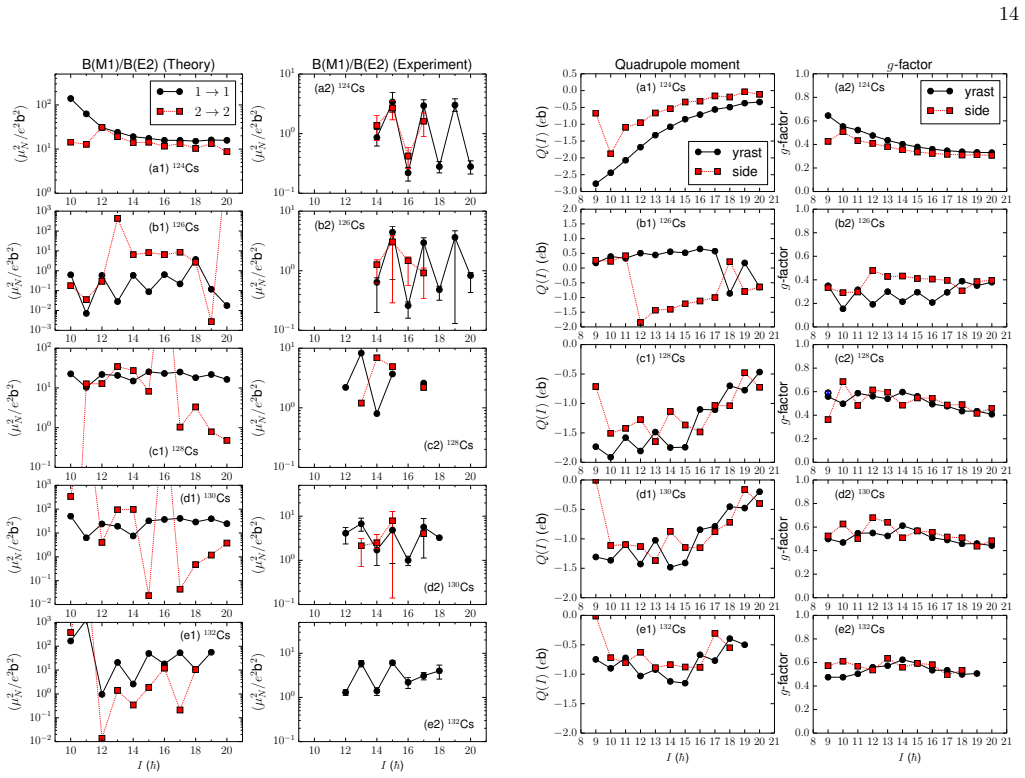
- [Fig. 14 and Sec. III C 3] The text notes that the simple I1/I2 band assignment is inadequate for some states, especially in 126Cs; the figure caption for panel (b1) should state explicitly that the B(E2) curve is not meaningful where the band assignment fails.
Circularity Check
Partial circularity: the low-spin spectra and high-spin band energies are fitted inputs presented as predictions, while the B(M1) staggering used for the chiral-doublet claim is an independent output.
-
fitted input called prediction
[Sec. II B, item 4 (procedure to build the IBFFM-2 Hamiltonian); compared in Sec. III C.1.]
"Finally, the parameters uD and uT, in the residual interaction Vres, are determined so as to reproduce with reasonable accuracy the low-lying spectra in the odd-odd nuclei under consideration."
Section III C.1 then presents the same low-lying spectra as a prediction, e.g., "In the case of 124Cs ... the predicted positive- and negative-parity states agree well with the experimental ones." Since uD and uT were explicitly chosen to reproduce the low-lying odd-odd spectra, the level-energy agreement reported in Figs. 4-8 is a fit-quality statement, not an independent test of the Hamiltonian. The wave-function compositions and moments are independent, but the energies being compared are the fitting target by construction.
-
fitted input called prediction
[Sec. II B, paragraph after Table II; Sec. III C.3.]
"For the positive-parity states in 128,130,132Cs, the values of Γπ for the proton h11/2 configuration (which are fitted to the odd-mass nuclei 129,131,133Cs, respectively) have been modified so that the higher-spin positive-parity states, which are mainly composed of the (νh11/2)−1⊗πh11/2 configuration, become lower in energy."
The stated purpose of the modification is to bring the (νh11/2)−1⊗πh11/2 bands down to Ex≈0.5 MeV. Section III C.3 then reports for 128Cs that "the structures of the bands identified experimentally are well reproduced up to I≈16+" and for 130,132Cs "a good agreement with the experimental spectra up to relatively low spin." To the extent these claims concern the band energy scale and band-head positions, the agreement is a restatement of the manually adjusted Γπ, not a prediction. The calculated B(M1) and B(M1)/B(E2) staggering patterns are not fitted and therefore retain independent content.
full rationale
Most of the model construction is not circular: the IBM-2 parameters come from mapping the Gogny-D1M HFB energy surfaces (Sec. II B.1), the single-particle energies and occupations come from HFB, and the boson-fermion strengths are fixed to neighboring odd-mass nuclei rather than to the odd-odd targets. Citations to Refs. [8,47,48,50,51,54] supply the method, but they are not invoked as an unverified uniqueness argument, so they do not raise the circularity score. The genuine reduction is confined to two fitted inputs presented as achieved agreement: the residual neutron-proton strengths uD and uT are fitted to the low-lying odd-odd spectra that are later called "predicted", and Γπ is modified for 128,130,132Cs to lower the h11/2 high-spin bands whose energies are then quoted as reproduced. The central chiral-doublet claim, however, rests mainly on the calculated B(M1) staggering and B(M1)/B(E2) ratios, computed from diagonalized wave functions with fixed g-factors and effective charges; no parameter was fitted to those staggering patterns. Hence the central claim has independent content and the paper is only partially circular, not a case where the main result reduces to its inputs. The absence of the HFB triaxial minimum in the IBM-2 core (Sec. III A) and the use of the triaxial particle-rotor selection rule [29] as a benchmark are physical limitations or model mismatches for a chiral-geometry interpretation, but they are correctness risks, not circularity.
Assumptions & free parameters
free parameters (6)
- Boson-fermion neutron strengths Gamma_nu, Lambda_nu, A_nu =
Table II (Gamma_nu 1.00-3.20 MeV, Lambda_nu 0.20-4.80 MeV, A_nu -0.14 to -0.48 MeV)
- Boson-fermion proton strengths Gamma_pi, Lambda_pi, A_pi =
Table II (Gamma_pi 0.60-1.20 MeV, Lambda_pi 0.40-0.58 MeV, A_pi -0.50 to -2.20 MeV; modified Gamma_pi 2.40-3.00 MeV…
- uD (delta residual neutron-proton interaction strength) =
0.7 MeV
- uT (tensor residual neutron-proton interaction strength) =
0.02 MeV
- Effective charges eB_nu, eB_pi, eF_nu, eF_pi =
0.15, 0.15, 0.5, 1.5 eb
- g-factors gB_nu, gB_pi, and quenched Schmidt gs values =
0, 1.0, and Schmidt values with 30 percent quenching
assumptions (3)
- domain assumption The IBM-2 Hamiltonian with only s and d bosons and no three-body terms is sufficient to describe the even-even core and the odd-odd spectra.
- domain assumption Single-particle energies and occupation probabilities computed with Gogny-D1M HFB at zero deformation are realistic inputs for the fermion and boson-fermion parts of the Hamiltonian.
- ad hoc to paper The residual neutron-proton interaction can be restricted to delta and tensor terms with constant strengths across the whole isotopic chain.
Cite this review
Pith. "Pith review of Structure of odd-odd Cs isotopes within the interacting boson-fermion-fermion model based on the Gogny-D1M energy density functional." pith.science (2026). https://pith.science/paper/PPAKK5VL
@misc{pith2026190803322,
  author       = {Pith},
  title        = {Pith review of: Structure of odd-odd Cs isotopes within the interacting boson-fermion-fermion model based on the Gogny-D1M energy density functional},
  year         = {2026},
  howpublished = {\url{https://pith.science/paper/PPAKK5VL}},
  note         = {Machine review of arXiv:1908.03322}
}
abstract
The spectroscopic properties of the odd-odd isotopes $^{124-132}$Cs have been studied within the interacting boson-fermion-fermion model based on the Gogny-D1M energy density functional framework. Major ingredients to build the interacting boson-fermion-fermion Hamiltonian, such as the ($\beta,\gamma$)-deformation energy surfaces for the even-even core nuclei $^{124-132}$Xe as well as single-particle energies and occupation probabilities of the odd nucleons, have been computed microscopically with the constrained Hartree-Fock-Bogoliubov method. A few coupling constants of the boson-fermion and residual neutron-proton interactions are fitted to reproduce with a reasonable accuracy the experimental excitation energy of the low-lying levels of the odd-mass and odd-odd nuclei. The method is applied to describe the low-energy low-spin spectra of the odd-odd Cs nuclei and the band structures of higher-spin higher-energy states, mainly based on the $(\nu h_{11/2})^{-1}\otimes\pi h_{11/2}$ configuration. Many of those odd-odd Cs nuclei have been identified as candidates for exhibiting chiral doublet bands.
Figures
Figures from the paper (14 more)





Reference graph
Works this paper leans on
-
[1]
for a general introduction to the latter method. From a computational point of view, systematic applications of these approaches are very demanding, if not impos- sible, for heavy nuclei, especially when a large number of valence nucleons are involved and/or multiple shape ∗ knomura@phy.hr degrees of freedom have to be taken into account in the generator ...
work page Pith review arXiv 1908
-
[2]
Once the form of the IBM-2 Hamiltonian is fixed, the parametersϵ,κ,χν, andχπ are uniquely deter- mined [47, 48] by mapping the ( β,γ )-deformation energy surface obtained from the constrained Gogny-D1M [10] HFB calculation onto the expec- tation value of the IBM-2 Hamiltonian in the boson coherent state [49]
-
[3]
The single-neutron Hamiltonian ˆHν F and the boson- fermion Hamiltonian ˆHν BF for odd-N Xe isotopes are built by using the procedure of [50] (see also
-
[4]
Finally, the parameters uD and uT, in the residual interaction ˆVres, are determined so as to reproduce with reasonable accuracy the low-lying spectra in the odd-odd nuclei under consideration. For sim- plicity, we have taken the fixed values uD = 0.7 MeV and uT = 0.02 MeV for all the considered nuclei and for both parities. The values of the IBM-2 paramet...
-
[5]
We use for the IBFFM-2 Hamiltonian in the odd- odd Cs the same strength parameters Γ ν, Λν, and Aν (Γπ, Λπ, and Aπ) obtained for the odd-N Xe (odd-Z Cs) nuclei in the previous step. The single- particle energies and occupation probabilities are, however, computed independently for each of the studied odd-odd systems
-
[6]
J. Dobaczewski, A. Afanasjev, M. Bender, L. Rob- ledo, and Y. Shi, Nuclear Physics A 944, 388 (2015), ISSN 0375-9474, special Issue on Superheavy Ele- ments, URL http://www.sciencedirect.com/science/ article/pii/S0375947415001633
work page 2015
-
[7]
We will consider low-spin low-energy states up to an excitation energy Ex≈ 1 MeV
Energy spectra for the low-spin low-energy states Let us now discuss the results obtained for odd-odd Cs nuclei. We will consider low-spin low-energy states up to an excitation energy Ex≈ 1 MeV. Our calculation indicates that those states are mainly based on normal- parity (i.e., sdg) orbitals. The spectra obtained for 124,126,128,130,132Cs are de- picted...
-
[8]
E2 and M1 moments of lowest-lying states As for the electromagnetic properties of the lowest- lying states in odd-odd Cs isotopes, experimental data are only available for the quadrupole Q(I) and magnetic TABLE IV. Theoretical and experimental quadrupole Q(I) (in eb units) and magnetic µ(I) (in µN units) moments for 124−132Cs. The experimental values are ...
Show all 72 references
-
[9]
We have paid special attention to the possible doublet structure expected as a result of the coupling between a neutron hole and a proton in the unique-parity 1h11/2 orbital
Band structure of higher-spin states We have further studied the detailed band structure of the higher-lying higher-spin states in the considered odd-odd Cs isotopes. We have paid special attention to the possible doublet structure expected as a result of the coupling between ...
-
[10]
Our analy- sis of theB(E2) andB(M1) patterns suggests that there are many examples in the odd-odd Cs nuclei that can be considered candidates to display chirality
B(E2) and B(M1) systematic in the high-spin states To identify possible signatures of chirality we have con- sidered, in addition to energy levels, the systematic of the E2 and M1 transitions with increasing spin. Our analy- sis of theB(E2) andB(M1) patterns suggests that ther...
2010
-
[11]
Iachello and A
F. Iachello and A. Arima, The interacting boson model (Cambridge University Press, Cambridge, 1987)
1987
-
[12]
Dependence on the residual neutron-proton interaction Finally we examine how the spectroscopic results from the IBFFM-2 depend on the choice of the strength pa- rameters for the residual neutron-proton interaction ˆVres (see, Eq. (7)). In Fig. 17 we depict the evolution of the...
2018
-
[13]
Scholten, Prog
O. Scholten, Prog. Part. Nucl. Phys. 14, 189 (1985)
1985
-
[14]
Ring and P
P. Ring and P. Schuck, The nuclear many-body problem (Berlin: Springer-Verlag, 1980)
1980
-
[15]
Bender, P.-H
M. Bender, P.-H. Heenen, and P.-G. Reinhard, Rev. Mod. Phys. 75, 121 (2003)
2003
-
[16]
L. M. Robledo, T. R. Rodrguez, and R. R. Rodrguez- Guzmn, Journal of Physics G: Nuclear and Particle Physics 46, 013001 (2019), URL http://stacks.iop. org/0954-3899/46/i=1/a=013001
2019
-
[17]
Bally, B
B. Bally, B. Avez, M. Bender, and P.-H. Heenen, Phys. Rev. Lett. 113, 162501 (2014)
2014
-
[18]
Borrajo and J
M. Borrajo and J. L. Egido, The European Physical Journal A 52, 277 (2016), ISSN 1434-601X, URL http: //dx.doi.org/10.1140/epja/i2016-16277-8
2016 doi
-
[19]
Vogel, P
O. Vogel, P. Van Isacker, A. Gelberg, P. von Brentano, and A. Dewald, Phys. Rev. C 53, 1660 (1996), URL https://link.aps.org/doi/10.1103/PhysRevC. 53.1660
1996 doi
-
[20]
Caurier, G
E. Caurier, G. Mart´ ınez-Pinedo, F. Nowacki, A. Poves, and A. P. Zuker, Rev. Mod. Phys. 77, 427 (2005)
2005
-
[21]
Nomura, R
K. Nomura, R. Rodr´ ıguez-Guzm´ an, and L. M. Robledo, Phys. Rev. C 99, 034308 (2019), URL https://link. aps.org/doi/10.1103/PhysRevC.99.034308
2019 doi
-
[22]
Decharge and M
J. Decharge and M. Girod and D. Gogny, Phys. Lett. B 55, 361 (1975)
1975
-
[23]
Goriely, S
S. Goriely, S. Hilaire, M. Girod, and S. P´ eru, Phys. Rev. Lett. 102, 242501 (2009)
2009
-
[24]
Cejnar, J
P. Cejnar, J. Jolie, and R. F. Casten, Rev. Mod. Phys. 82, 2155 (2010)
2010
-
[25]
Iachello and O
F. Iachello and O. Scholten, Phys. Rev. Lett. 43, 679 (1979)
1979
-
[26]
Coquard, N
L. Coquard, N. Pietralla, T. Ahn, G. Rainovski, L. Bet- termann, M. P. Carpenter, R. V. F. Janssens, J. Leske, C. J. Lister, O. M¨ oller, et al., Phys. Rev. C 80, 061304 (2009), URL https://link.aps.org/doi/10. 1103/PhysRevC.80.061304
2009
-
[27]
Iachello and P
F. Iachello and P. Van Isacker, The interacting boson- fermion model (Cambridge University Press, Cambridge, 1991)
1991
-
[28]
Brant, V
S. Brant, V. Paar, and D. Vretenar, Zeitschrift f¨ ur Physik A Atoms and Nuclei 319, 355 (1984), ISSN 0939-7922, URL https://doi.org/10.1007/BF01412551
1984 doi
-
[30]
Sevrin, K
A. Sevrin, K. Heyde, and J. Jolie, Phys. Rev. C 36, 2631 (1987), URL https://link.aps.org/doi/10. 1103/PhysRevC.36.2631
1987
-
[31]
J. Yan, O. Vogel, P. von Brentano, and A. Gelberg, Phys. Rev. C 48, 1046 (1993), URL https://link.aps.org/ doi/10.1103/PhysRevC.48.1046
1993 doi
-
[32]
is shown as an open circle
-
[33]
Mizusaki and T
T. Mizusaki and T. Otsuka, Prog. Theor. Phys. Suppl. 125, 97 (1996)
1996
-
[34]
Yoshinaga and K
N. Yoshinaga and K. Higashiyama, Phys. Rev. C 69, 054309 (2004), URL https://link.aps.org/doi/10. 1103/PhysRevC.69.054309
2004
-
[35]
Z. P. Li, T. Nikˇ si´ c, D. Vretenar, and J. Meng, Phys. Rev. C 81, 034316 (2010)
2010
-
[36]
Nomura, N
K. Nomura, N. Shimizu, D. Vretenar, T. Nikˇ si´ c, and T. Otsuka, Phys. Rev. Lett. 108, 132501 (2012)
2012
-
[37]
Higashiyama and N
K. Higashiyama and N. Yoshinaga, Phys. Rev. C 88, 034315 (2013), URL https://link.aps.org/doi/10. 1103/PhysRevC.88.034315
2013
-
[38]
R. F. Casten and N. V. Zamfir, Phys. Rev. Lett. 85, 3584 (2000), URL http://link.aps.org/doi/10.1103/ PhysRevLett.85.3584
2000
-
[39]
Brant, N
S. Brant, N. Yoshida, and L. Zuffi, Phys. Rev. C 74, 024303 (2006), URL https://link.aps.org/doi/ 10.1103/PhysRevC.74.024303
2006 doi
-
[40]
Iachello, Phys
F. Iachello, Phys. Rev. Lett. 85, 3580 (2000), URL http: //link.aps.org/doi/10.1103/PhysRevLett.85.3580
2000 doi
-
[41]
Frauendorf and J
S. Frauendorf and J. Meng, Nuclear Physics A 617, 131 (1997), ISSN 0375-9474, URL http://www.sciencedirect.com/science/article/ pii/S0375947497000043
1997
-
[42]
Koike, K
T. Koike, K. Starosta, and I. Hamamoto, Phys. Rev. Lett. 93, 172502 (2004), URL https://link.aps.org/ doi/10.1103/PhysRevLett.93.172502
2004 doi
-
[43]
Grodner, J
E. Grodner, J. Srebrny, A. A. Pasternak, I. Zalewska, T. Morek, C. Droste, J. Mierzejewski, M. Kowalczyk, J. Kownacki, M. Kisieli´ nski, et al., Phys. Rev. Lett. 97, 172501 (2006), URL https://link.aps.org/doi/ 10.1103/PhysRevLett.97.172501
2006 doi
-
[44]
Starosta and T
K. Starosta and T. Koike, Physica Scripta 92, 093002 (2017), URL https://doi.org/10.1088%2F1402-4896% 2Faa800e
2017
-
[45]
Grodner, J
E. Grodner, J. Srebrny, C. Droste, L. Pr´ ochniak, S. G. Rohozi´ nski, M. Kowalczyk, M. Ionescu-Bujor, C. A. Ur, K. Starosta, T. Ahn, et al., Phys. Rev. Lett. 120, 022502 (2018), URL https://link.aps.org/doi/ 10.1103/PhysRevLett.120.022502
2018 doi
-
[46]
Brant, D
S. Brant, D. Vretenar, and A. Ventura, Phys. Rev. C 69, 017304 (2004), URL https://link.aps.org/doi/ 10.1103/PhysRevC.69.017304
2004 doi
-
[48]
Higashiyama, N
K. Higashiyama, N. Yoshinaga, and K. Tanabe, Phys. Rev. C 72, 024315 (2005), URL https://link.aps.org/ doi/10.1103/PhysRevC.72.024315. 18
2005 doi
-
[49]
and Yoshinaga, N., Eur
Higashiyama, K. and Yoshinaga, N., Eur. Phys. J. A 33, 355 (2007), URL https://doi.org/10.1140/epja/ i2007-10457-7
2007 doi
-
[50]
Nomura, T
K. Nomura, T. Nikˇ si´ c, and D. Vretenar, Phys. Rev. C 93, 054305 (2016)
2016
-
[51]
for further details ). In those references, the single-particle energies and occupation probabili- ties of the odd nucleon, entering both ˆHν F and ˆHν BF, are obtained from Gogny-D1M HFB calculations at zero deformation. The optimal values of the boson- fermion interaction st...
-
[52]
L. Zuffi, S. Brant, and N. Yoshida, Phys. Rev. C 68, 034308 (2003), URL https://link.aps.org/doi/ 10.1103/PhysRevC.68.034308
2003 doi
-
[53]
Mardones, J
E. Mardones, J. Barea, C. E. Alonso, and J. M. Arias, Phys. Rev. C 93, 034332 (2016), URL https://link. aps.org/doi/10.1103/PhysRevC.93.034332
2016 doi
-
[54]
Engel and J
J. Engel and J. Men´ endez, Reports on Progress in Physics 80, 046301 (2017), URL https://doi.org/10.1088% 2F1361-6633%2Faa5bc5
2017
-
[56]
Otsuka, A
T. Otsuka, A. Arima, and F. Iachello, Nucl. Phys. A 309, 1 (1978)
1978
-
[57]
J. M. Arias, C. E. Alonso, and M. Lozano, Phys. Rev. C 33, 1482 (1986), URL https://link.aps.org/doi/10. 1103/PhysRevC.33.1482
1986
-
[58]
Yoshida and F
N. Yoshida and F. Iachello, Progress of Theoretical and Experimental Physics 2013, 043D01 (2013), URL http: //dx.doi.org/10.1093/ptep/ptt007
2013 doi
-
[59]
Morrison, A
I. Morrison, A. Faessler, and C. Lima, Nuclear Physics A 372, 13 (1981), ISSN 0375-9474, URL http://www.sciencedirect.com/science/article/ pii/037594748190083X
1981
-
[60]
Nomura, N
K. Nomura, N. Shimizu, and T. Otsuka, Phys. Rev. Lett. 101, 142501 (2008)
2008
-
[61]
Nomura, N
K. Nomura, N. Shimizu, and T. Otsuka, Phys. Rev. C 81, 044307 (2010)
2010
-
[62]
J. N. Ginocchio and M. W. Kirson, Nucl. Phys. A 350, 31 (1980)
1980
-
[64]
Nomura, R
K. Nomura, R. Rodr´ ıguez-Guzm´ an, and L. M. Robledo, Phys. Rev. C 96, 014314 (2017), URL https://link. aps.org/doi/10.1103/PhysRevC.96.014314
2017 doi
-
[65]
Yoshida and A
N. Yoshida and A. Arima, Physics Letters B 164, 231 (1985), ISSN 0370-2693, URL http://www.sciencedirect.com/science/article/ pii/0370269385903156
1985
-
[66]
Brookhaven National Nuclear Data Center, http://www.nndc.bnl.gov
-
[67]
Nomura, R
K. Nomura, R. Rodr´ ıguez-Guzm´ an, and L. M. Robledo, Phys. Rev. C 96, 064316 (2017), URL https://link. aps.org/doi/10.1103/PhysRevC.96.064316
2017 doi
-
[68]
Li, Y.-J
X.-F. Li, Y.-J. Ma, Y.-Z. Liu, J.-B. Lu, G.-Y. Zhao, L.- C. Yin, R. Meng, Z.-L. Zhang, L.-J. Wen, X.-H. Zhou, et al., The European Physical Journal A - Hadrons and Nuclei 17, 523 (2003), ISSN 1434-601X, URL https:// doi.org/10.1140/epja/i2002-10159-8
2003 doi
-
[69]
Stone, At
N. Stone, At. Data Nucl. Data Tables 90, 75 (2005)
2005
-
[70]
Xiong and Y
B. Xiong and Y. Wang, Atomic Data and Nu- clear Data Tables 125, 193 (2019), ISSN 0092- 640X, URL http://www.sciencedirect.com/science/ article/pii/S0092640X18300329
2019
-
[71]
Gizon, J
A. Gizon, J. Timr, J. Gizon, B. Weiss, D. Barnoud, C. Foin, J. Genevey, F. Hannachi, C. Liang, A. Lopez- Martens, et al., Nuclear Physics A 694, 63 (2001), ISSN 0375-9474, URL http://www.sciencedirect.com/ science/article/pii/S0375947401009769
2001
-
[72]
S. Wang, Y. Liu, T. Komatsubara, Y. Ma, and Y. Zhang, Phys. Rev. C 74, 017302 (2006), URL https://link. aps.org/doi/10.1103/PhysRevC.74.017302
2006 doi
-
[73]
E. S. Paul, D. B. Fossan, Y. Liang, R. Ma, and N. Xu, Phys. Rev. C 40, 619 (1989), URL https://link.aps. org/doi/10.1103/PhysRevC.40.619
1989 doi
-
[74]
A. J. Simons, P. Joshi, D. G. Jenkins, P. M. Rad- don, R. Wadsworth, D. B. Fossan, T. Koike, C. Vaman, K. Starosta, E. S. Paul, et al., Journal of Physics G: Nu- clear and Particle Physics 31, 541 (2005), URL https: //doi.org/10.1088%2F0954-3899%2F31%2F7%2F001
2005
-
[75]
Rainovski, E
G. Rainovski, E. S. Paul, H. J. Chantler, P. J. Nolan, D. G. Jenkins, R. Wadsworth, P. Raddon, A. Si- mons, D. B. Fossan, T. Koike, et al., Phys. Rev. C 68, 024318 (2003), URL https://link.aps.org/doi/ 10.1103/PhysRevC.68.024318
2003 doi
-
[3554]
FPA2015-65929-MINECO and FIS2015- 63770-MINECO
The work of LMR was supported by the Spanish Ministry of Economy and Competitiveness (MINECO) Grants No. FPA2015-65929-MINECO and FIS2015- 63770-MINECO
Reviewed August 14, 2026 · model on record in the stance chip above.
Discussion (0). Continue with ORCID to comment.