REVIEW 3 major objections 6 minor 26 references
Improving cosmological parameter estimation with the future 21 cm observation from SKA
T0 review · 3 major / 6 minor · reviewed 2026-08-14 · deepseek-v4-flash
Pith's one-line read Adding SKA 21 cm data sharply tightens cosmological constraints, the paper argues.
desk verdict A competent but modest forecast paper: SKA BAO mocks improve dark-energy parameter constraints, yet the headline percentages rest on an underspecified and possibly optimistic mock likelihood. read the letter →
The pith
A machine-rendered reading of the paper's core claim, the machinery that carries it, and where it could break.
The reading
What carries the argument
The central object is a mock BAO dataset constructed from the relative errors in the Hubble expansion rate σH/H and the angular diameter distance σDA/DA extracted from Fig. 3 of Bull et al. (2015), applied to SKA1-MID Band 1, Band 2, and SKA2. These errors are used to build a Gaussian likelihood for the distances, which is combined with the Planck 2018 CMB distance priors, optical BAO measurements (6dFGS, SDSS-MGS, BOSS DR12), and the Pantheon supernova compilation. The fit is performed with the CosmoMC Markov chain Monte Carlo package, and the constraint improvement is quantified by comparing 1σ errors and relative precisions ε(ξ) = σ(ξ)/ξbf across data combinations.
What would settle it
When the real SKA2 data arrive, one could compare the actual measured BAO correlation-function errors in each redshift bin against the assumed σH/H and σDA/DA values; if the real errors are larger or correlated, the predicted improvement fractions of 34–70% on Ωm and 52–73% on H0 would shrink accordingly.
Extended reading notes
Core claim
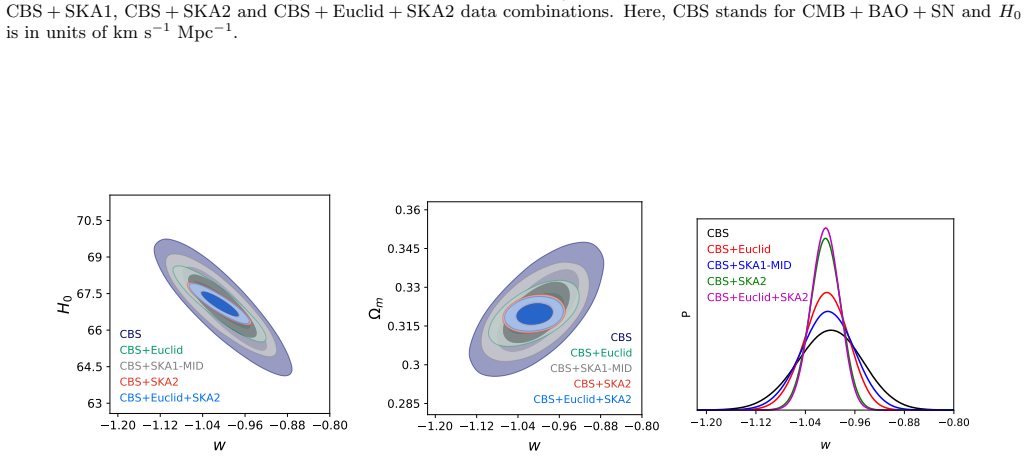
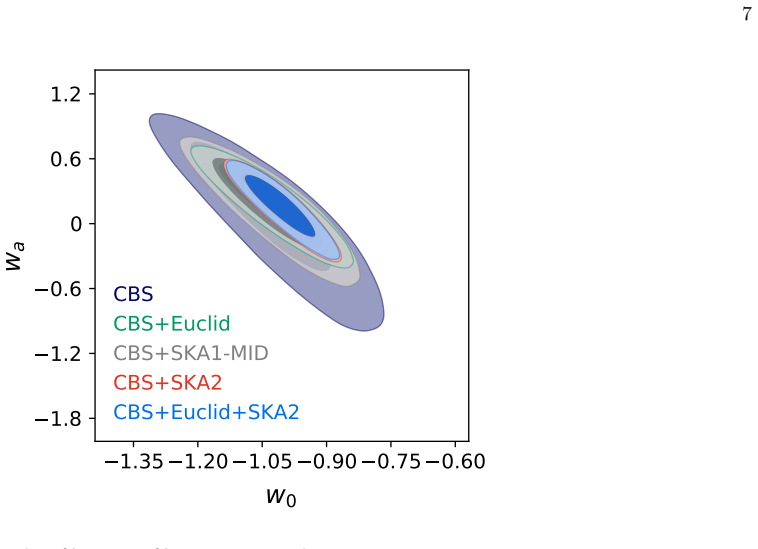
The central claim is that future SKA 21 cm intensity-mapping BAO mock data, when added to the current CMB+optical BAO+supernova dataset ('CBS'), dramatically improve posterior constraints on the standard cosmological parameters and on dark energy equation-of-state parameters. For the ΛCDM model, adding SKA2 data improves the constraint precision on Ωm from 2.65% to 1.00% and on H0 from 0.93% to 0.25%. For the wCDM model, the dark energy equation-of-state parameter w improves from 5.18% to 2.33%. For the CPL model, w0 improves from 9.66% to 5.16% and the absolute error on wa shrinks from 0.3646 to 0.1836. The paper also finds that SKA2 data break degeneracies between Ωm and H0 in ΛCDM and between Ωm and w in wCDM, and that SKA2 outperforms both SKA1-MID and the future Euclid optical survey in constraining power.
Load-bearing premise
The forecast assumes that the relative errors on the Hubble expansion rate and angular diameter distance taken from the Bull et al. (2015) simulation are accurate predictions for the real SKA measurements, with no unaccounted systematic errors or correlations between redshift bins.
Editorial extensions
If this is right
- If the SKA2 mock data reflect real future measurements, then a single radio survey could cut the uncertainty on the Hubble constant to roughly a quarter of its current CMB+BAO+SN level, reaching sub-percent precision in ΛCDM.
- Combining SKA2 with Euclid would further tighten the dark energy equation-of-state constraints, suggesting that joint radio and optical BAO surveys will be a powerful way to test whether dark energy evolves with redshift.
- The demonstrated degeneracy-breaking between Ωm and H0 means SKA BAO data could help arbitrate the current tension between early- and late-universe determinations of H0, if systematics are controlled.
- Because the improvement is largest in the more flexible dark energy models (wCDM and CPL), the 21 cm probe is especially suited for testing deviations from a cosmological constant.
- The comparison with Euclid indicates that while SKA1 may be less competitive than Euclid, SKA2 would become the most constraining BAO experiment of its era.
Reading between the lines
- The paper does not attempt to forecast the SKA constraints on the neutrino mass sum or on curvature, but the same mock BAO data would likely also sharpen those parameters; a natural extension is to add Σmν and Ωk to the parameter space and rerun the forecast.
- The derived improvements assume the mock central values are fixed to a fiducial cosmology, but a more realistic forecast would marginalize over the fiducial model or use a data-driven mean; this could widen the reported errors.
- The relative error extraction from Bull et al. (2015) ignores possible redshift-space distortion and foreground contamination effects beyond those already in the simulation, so the real improvement fractions may be lower if systematics correlate between redshift bins.
- A testable next step would be to apply the same likelihood to real data from the upcoming HIRAX, CHIME, or Tianlai pathfinder surveys, checking whether the measured BAO scales actually reach the assumed precision.
Signed reviews
Editorial analysis
A structured set of objections, weighed in public.
Referee Report
Summary. The paper forecasts the impact of future 21 cm intensity-mapping BAO measurements from the Square Kilometre Array (SKA1-MID and SKA2) and Euclid on cosmological parameter constraints. Using current CMB distance priors from Planck 2018, optical BAO data, and the Pantheon supernova compilation (abbreviated CBS), the authors run CosmoMC fits to the ΛCDM, wCDM, and CPL models, adding mock BAO likelihoods built from relative errors σH/H and σDA/DA digitized from Bull et al. (2015). They report that adding SKA2 mock data improves constraints on Ωm by 34%–70%, on H0 by 52%–73%, and on dark-energy equation-of-state parameters by roughly 50% (Tables I–III, Section IV). The central claim is that future SKA IM BAO data will significantly sharpen cosmological constraints and break parameter degeneracies, especially between Ωm and H0 and between Ωm and w.
Significance. The paper's strength is its systematic comparison across three dark-energy models and five data combinations using standard MCMC methods; the qualitative conclusion that low-redshift BAO data from SKA2 will substantially improve constraints on Ωm, H0, and dark-energy parameters is plausible and consistent with earlier forecasts. The quantitative improvement percentages, however, are the paper's main quantitative output, and they rest on the fidelity of the mock likelihood built from digitized diagonal errors without an explicit data vector or covariance. Because those assumptions are not fully documented, the numerical results should be treated as indicative rather than definitive; the paper would be considerably strengthened by providing the full mock data and error model. The manuscript ships no code or data, so reproducibility rests entirely on the description of the likelihood.
major comments (3)
- [Section II] The likelihood is constructed from relative errors σH/H and σDA/DA 'directly extracted from Fig. 3' of Ref. [15], but the paper never specifies the central values of the mock H(z) and DA(z) data points or the fiducial cosmology used to generate them. Without this information the Gaussian likelihood is not fully defined and the MCMC results cannot be reproduced or checked. The authors should provide the full mock data vector (e.g., in a table or appendix) and state the fiducial cosmology, or explicitly present the mock constraints as relative measurements so the forecast is transparent.
- [Section II] The likelihood uses only the diagonal components of the BAO error budget. Anisotropic BAO measurements in Bull et al. (2015) generally yield a correlated 2×2 covariance between ln H and ln DA within each redshift bin, and bin-to-bin correlations can also be present. If correlations are neglected, the information content attributed to SKA is inflated, which would bias the improvement percentages in Tables I–III and Section IV upward. The authors should adopt the full covariance from the simulation or justify with a sensitivity test why the diagonal approximation is adequate.
- [Section IV] The conclusion states that wa is 'promoted by 49.6%' based on relative error, yet Section III explicitly warns that the relative error for wa is unreliable because its central value is near zero and recommends using the absolute error instead. The relative improvement for wa (0.9044 vs. 1.4309, Table III) is not a meaningful metric, and using it in the summary-level claim overstates the improvement. The headline improvements should be based on the absolute error or a model-independent figure of merit.
minor comments (6)
- [Section I] The name 'Chevalliear-Polarski-Linder' is a typo for 'Chevallier-Polarski-Linder'.
- [Section II] The paper should specify which version of the Planck 2018 distance priors is used (Ref. [20] is Chen et al., which is fine) and whether CMB lensing is included, since these choices can affect the baseline constraints.
- [Figure 1] The axis label 'm' should be 'Ωm' with the subscript omega for clarity; the same issue appears in Figure 2.
- [Section III] The phrase 'the data of Euclid behave much better than SKA1 but worse than SKA2' is vague; it would be clearer to give the quantitative comparative precisions from the tables.
- [References] The paper should cite the original Planck 2018 likelihood paper (Aghanim et al. 2018) in addition to the distance-priors paper, since it is the source of the CMB data used.
- [Table III] The values of ε(wa) are very large and unstable because wa is near zero; consider reporting only the absolute error for wa in the abstract and conclusion, as the text itself advises.
Circularity Check
No significant circularity: the SKA forecast uses external mock errors from Bull et al. as input data, and the claimed improvements are a direct forecast consequence rather than a fitted quantity renamed as a prediction.
full rationale
The paper's derivation chain is a standard forecast exercise. It combines current CMB, optical BAO, and supernova data with externally simulated SKA and Euclid BAO measurements from Bull et al. (2015), using the relative errors sigma_H/H and sigma_DA/DA extracted from Fig. 3 of that reference. The reported improvements in parameter constraints follow directly from adding these external mock likelihoods to the existing data set; no parameter is fitted to the mock data and then presented as a prediction of the same quantity. The paper is explicit that the data are simulated, so the central claim is about the constraining power of a future experiment, not a claim that a fitted input has been independently predicted. The only same-author citation is Ref. [19], used as a consistency remark about breaking degeneracies, and it is not load-bearing for the central derivation. Concerns about omitted fiducial central values and diagonal-only error bars are reproducibility and optimism issues, not circularity, and therefore do not affect the circularity score.
Assumptions & free parameters
free parameters (1)
- SKA mock relative errors (σH/H, σDA/DA) and central values =
Extracted from Fig. 3 of Bull et al. 2015; central values not explicitly stated
assumptions (4)
- domain assumption The universe is spatially flat (Friedmann equations used with Ωk=0).
- domain assumption The mock BAO likelihood is Gaussian with independent data points.
- domain assumption Planck 2018 distance priors are a sufficient summary of the CMB data.
- domain assumption The wCDM and CPL parameterizations are adequate to describe dark energy.
Cite this review
Pith. "Pith review of Improving cosmological parameter estimation with the future 21 cm observation from SKA." pith.science (2026). https://pith.science/paper/SIUQEUBY
@misc{pith2026190803732,
  author       = {Pith},
  title        = {Pith review of: Improving cosmological parameter estimation with the future 21 cm observation from SKA},
  year         = {2026},
  howpublished = {\url{https://pith.science/paper/SIUQEUBY}},
  note         = {Machine review of arXiv:1908.03732}
}
read the original abstract
Future observations of 21 cm emission from neutral hydrogen survey will become a promising approach to probe the large scale structure of Universe. In this paper, we investigate the impacts of Square Kilometer Array (SKA) 21 cm observation on the estimation of cosmological parameters. We use the simulated data of the baryonic acoustic oscillation (BAO) measurements based on the future SKA experiment with the intensity mapping (IM) technique to do the analysis. For the current observations, we use the latest cosmic microwave background (CMB) observation from {\it Planck} 2018, the optical BAO measurements, and the Type Ia supernovae (SN) observation (Pantheon compilation). We find that the SKA mock data could break the degeneracy between the matter density and the Hubble constant, further improving the cosmological constraints to a great extent. We also find that the constraint on the equation of state parameters of dark energy could be significantly improved by including the SKA mock data into the cosmological global fit.
Figures

Reference graph
Works this paper leans on
-
[19]
J. F. Zhang, B. Wang and X. Zhang, arXiv:1907.00179 [astro-ph.CO]
arXiv 1907
-
[15]
P. Bull, S. Camera, A. Raccanelli, C. Blake, P. G. Fer- reira, M. G. Santos and D. J. Schwarz, PoS AASKA14 (2015) 024 [arXiv:1501.04088 [astro-ph.CO]]
arXiv 2015
- [1]
-
[2]
N. Aghanim et al. [Planck Collaboration], Astron. Astro- phys. 594, A11 (2016) doi:10.1051/0004-6361/201526926 [arXiv:1507.02704 [astro-ph.CO]]
arXiv 2016
-
[3]
P. A. R. Ade et al. [Planck Collaboration], Astron. Astro- phys. 594, A13 (2016) doi:10.1051/0004-6361/201525830 [arXiv:1502.01589 [astro-ph.CO]]
arXiv 2016
-
[4]
P. A. R. Ade et al. [Planck Collaboration], Astron. Astro- phys. 571, A16 (2014) doi:10.1051/0004-6361/201321591 [arXiv:1303.5076 [astro-ph.CO]]
arXiv 2014
-
[5]
A. G. Riess et al. [Supernova Search Team], Astron. J. 116, 1009 (1998) doi:10.1086/300499 [astro-ph/9805201]
arXiv 1998
-
[6]
S. Perlmutter et al. [Supernova Cosmology Project Collaboration], Astrophys. J. 517, 565 (1999) doi:10.1086/307221 [astro-ph/9812133]
arXiv 1999
Show all 26 references
-
[7]
B. A. Reid et al. , Mon. Not. Roy. Astron. Soc. 404, 60 (2010) doi:10.1111/j.1365-2966.2010.16276.x [arXiv:0907.1659 [astro-ph.CO]]
2010
-
[8]
B. A. Reid et al. , Mon. Not. Roy. Astron. Soc. 426, 2719 (2012) doi:10.1111/j.1365-2966.2012.21779.x [arXiv:1203.6641 [astro-ph.CO]]
2012
-
[9]
A. J. Ross, L. Samushia, C. Howlett, W. J. Percival, A. Burden and M. Manera, Mon. Not. Roy. Astron. Soc. 449, no. 1, 835 (2015) doi:10.1093/mnras/stv154 [arXiv:1409.3242 [astro-ph.CO]]
2015 arXiv
-
[10]
Beutler et al
F. Beutler et al. , Mon. Not. Roy. Astron. Soc. 416, 3017 (2011) doi:10.1111/j.1365-2966.2011.19250.x [arXiv:1106.3366 [astro-ph.CO]]
2011
-
[11]
R. A. Battye, I. W. A. Browne, C. Dickinson, G. Heron, B. Maffei and A. Pourtsidou, Mon. Not. Roy. As- tron. Soc. 434, 1239 (2013) doi:10.1093/mnras/stt1082 [arXiv:1209.0343 [astro-ph.CO]]
2013 arXiv
-
[12]
Bandura et al
K. Bandura et al. , Proc. SPIE Int. Soc. Opt. Eng. 9145, 22 (2014) doi:10.1117/12.2054950 [arXiv:1406.2288 [astro-ph.IM]]
2014 arXiv
-
[13]
Chen, Int
X. Chen, Int. J. Mod. Phys. Conf. Ser. 12, 256 (2012) doi:10.1142/S2010194512006459 [arXiv:1212.6278 [astro- ph.IM]]
2012 arXiv
-
[14]
D. J. Bacon et al. [SKA Collaboration], [arXiv:1811.02743 [astro-ph.CO]]
- [16]
-
[17]
G. B. Zhao, D. Bacon, R. Maartens, M. Santos and A. Raccanelli, arXiv:1501.03840 [astro-ph.CO]
-
[18]
C. Li, X. Ren, M. Khurshudyan and Y. F. Cai, arXiv:1904.02458 [astro-ph.CO]
1904 arXiv
-
[20]
L. Chen, Q. G. Huang and K. Wang, JCAP 8 1902, 028 (2019) doi:10.1088/1475-7516/2019/02/028 [arXiv:1808.05724 [astro-ph.CO]]
2019 arXiv
-
[21]
Alam et al
S. Alam et al. [BOSS Collaboration], Mon. Not. Roy. Astron. Soc. 470, no. 3, 2617 (2017) doi:10.1093/mnras/stx721 [arXiv:1607.03155 [astro- ph.CO]]
2017 arXiv
-
[22]
D. M. Scolnic et al., Astrophys. J. 859, no. 2, 101 (2018) doi:10.3847/1538-4357/aab9bb [arXiv:1710.00845 [astro- ph.CO]]
2018 arXiv
-
[23]
Lewis and S
A. Lewis and S. Bridle, Phys. Rev. D 66, 103511 (2002) doi:10.1103/PhysRevD.66.103511 [astro-ph/0205436]
2002 arXiv
-
[24]
Amendola et al
L. Amendola et al. [Euclid Theory Working Group], Living Rev. Rel. 16, 6 (2013) doi:10.12942/lrr-2013-6 [arXiv:1206.1225 [astro-ph.CO]]
2013 arXiv
-
[25]
Chevallier and D
M. Chevallier and D. Polarski, Int. J. Mod. Phys. D 10, 213 (2001) doi:10.1142/S0218271801000822 [gr- qc/0009008]
2001
-
[26]
E. V. Linder, Phys. Rev. Lett. 90, 091301 (2003) doi:10.1103/PhysRevLett.90.091301 [astro-ph/0208512]
2003 arXiv
Reviewed August 14, 2026 · model on record in the stance chip above.
Discussion (0). Continue with ORCID to comment.