REVIEW 1 major objections 4 minor 47 references
Radial Anharmonic Oscillator: Perturbation Theory, New Semiclassical Expansion, Approximating Eigenfunctions. I. Generalities, Cubic Anharmonicity Case
T0 review · 1 major / 4 minor · reviewed 2026-08-14 · deepseek-v4-flash
Pith's one-line read A three-parameter trial wavefunction approximates anharmonic ground states uniformly to 1e-4.
desk verdict Solid, useful variational energies with an independent cross-check; the uniform 1e-4 wavefunction claim is plausible but rests on an unverified proxy. read the letter →
The pith
A machine-rendered reading of the paper's core claim, the machinery that carries it, and where it could break.
The reading
What carries the argument
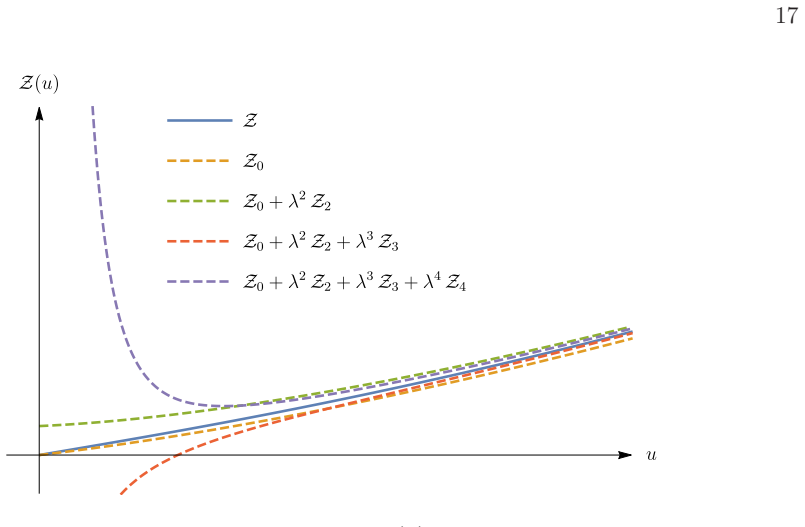
The machinery is the logarithmic derivative $y = -\partial_r \log \Psi$, which turns the radial Schrödinger equation into a first-order Riccati equation. The paper introduces two rescaled versions: the Riccati-Bloch equation in the variable $v = (2M/\hbar^2)^{1/4} r$, whose weak-coupling perturbation theory generates the small-$r$ Taylor series of $y$, and the Generalized Bloch equation in the variable $u = gr$, whose weak-coupling perturbation theory generates a semiclassical expansion at large $u$ that coincides with the loop expansion of the Euclidean path integral. Strong-coupling perturbation theory in the two equations supplies the complementary large-$r$ and small-$u$ expansions. Interpolating all four expansions yields the Approximant phase; the key identity is that the corrections $Z_n(u)$ from the Generalized Bloch equation act as generating functions for the large-$r$ coefficients of the Riccati-Bloch expansion, which is what makes the interpolation systematic.
What would settle it
Compute the exact ground state of the radial Schrödinger equation for $V = r^2 + g r^3$ by an independent high-precision method, such as a Lagrange mesh or spectral basis with many points, for example at $D = 1, 3$ and $g = 0.1, 1, 10$, and evaluate the relative deviation $|\Psi_{\mathrm{exact}} - \Psi_{\mathrm{Approximant}}|/\Psi_{\mathrm{Approximant}}$ on a fine grid extending to large $r$; if any deviation exceeds about $10^{-4}$, the uniform wavefunction claim fails, while if $|y_1/y_0|$ is small but the wavefunction deviation is large, the error-proxy assumption is falsified.
Extended reading notes
Core claim
On the paper's own terms, the central discovery is that four asymptotic expansions of the logarithmic derivative $y(r)$ can be knitted into a closed analytic interpolant whose three free parameters are fixed variationally. In the weak-coupling regime, perturbation theory in the Riccati-Bloch equation reproduces the small-$r$ Taylor expansion, while the same expansion in the Generalized Bloch equation produces a new semiclassical expansion valid at large $gr$, identified with the loop expansion of the Euclidean path integral. The strong-coupling expansions fill the complementary regions. The interpolating phase, Eq. (V.13), plus two constraints, gives the Approximant Eq. (V.16); with optimal parameters, the ground state wavefunction is claimed to deviate from the exact one by less than about $10^{-4}$ uniformly for $r \in [0, \infty)$, and low-lying variational energies reach 7 to 8 significant digits, with second-order perturbative corrections at the $10^{-7}$ level.
Load-bearing premise
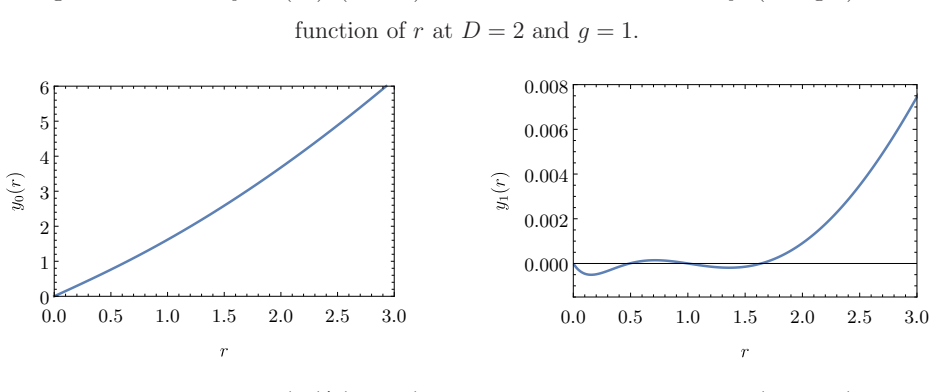
The uniform wavefunction accuracy claim rests on the untested assumption that the smallness of the first perturbative correction $y_1$, computed around the Approximant, bounds the true relative error of the wavefunction; the paper does not prove such a bound or compare the Approximant against an independent wavefunction.
Editorial extensions
If this is right
- For any $g \geq 0$ and integer $D$, the ground state of the cubic radial anharmonic oscillator can be approximated by a three-parameter elementary function with claimed uniform relative wavefunction error below about $10^{-4}$.
- Variational energies of low-lying states reach 7 to 8 significant digits, with second-order perturbative corrections near $10^{-7}$, so energy levels can be obtained essentially exactly without large basis sets.
- The new semiclassical expansion from the Generalized Bloch equation provides a compact route to higher-order WKB and loop corrections for radial anharmonic potentials.
- The Non-Linearization Procedure around the Approximant converges rapidly, with successive corrections dropping by a factor near $10^{-2}$, so the Approximant can serve as a zeroth order for systematic perturbative improvement of other observables.
- The same interpolation scheme is announced to extend to quartic and sextic radial anharmonic oscillators, indicating a family of accurate analytic-looking approximations for polynomial radial potentials.
Reading between the lines
- If the error-proxy assumption holds, the reported $10^{-4}$ uniform wavefunction accuracy is likely conservative: the observed fast decay of higher corrections suggests the Approximant could be iterated to substantially higher precision, producing essentially exact analytic-like wavefunctions.
- The identification of the Generalized Bloch expansion with the Euclidean path-integral loop expansion suggests the Approximant might be re-derived by summing a particular subset of fluctuation loops; a testable extension is to check whether the optimal variational parameters correspond to a resummation of a specific diagram class.
- The paper's conjecture on square-root branch points in the strong-coupling plane could be probed numerically with the Approximant: locate the nearest branch point in the $g^{-4/5}$ variable by analytic continuation of the variational energy and compare it with the apparent convergence radius of the strong-coupling expansion.
Signed reviews
Editorial analysis
A structured set of objections, weighed in public.
Referee Report
Summary. The paper develops a unified perturbative and semiclassical framework for D-dimensional radial anharmonic oscillators, based on the Riccati-Bloch (RB) equation in r-space and a Generalized Bloch (GB) equation in (gr)-space. It constructs a compact three-parameter trial wavefunction, the Approximant, by interpolating the small- and large-distance expansions of the logarithmic derivative, and fixes the parameters variationally. For the cubic anharmonic oscillator V(r)=r^2+gr^3, the authors report variational energies accurate to 7-8 significant digits for low-lying states, verified by an independent Lagrange Mesh calculation, and claim that the ground-state Approximant deviates from the exact wavefunction pointwise by at most about 10^-4 for all r in [0,∞), all studied g≥0, and all integer D≥1.
Significance. If the wavefunction accuracy claim is secured, this would be a genuinely useful result: a compact analytic trial function providing both highly accurate energies and a uniform approximation to the ground state of a non-solvable anharmonic problem, across coupling and dimension. The energy part of the paper is credible and well supported: the variational energies in Tables I-IV are cross-checked against the independent Lagrange Mesh method to nine decimal digits, and the second-order perturbative corrections E2 are consistently of order 10^-7 to 10^-8. The formal development of the RB and GB equations, the generating-function interpretation of the coefficients c_k^(n), and the identification of the GB expansion with a loop/semiclassical expansion are interesting and appear carefully derived. The main weakness is that the headline wavefunction claim, Eq. (V.18), is not validated by any independent wavefunction comparison and rests on a heuristic error proxy; this claim needs additional numerical support or a proof before it can be accepted.
major comments (1)
- [§V.C, Eq. (V.18)] The paper cites the boundedness of the first correction, |Y1(v)|≤Const, as the convergence criterion of the Non-Linearization Procedure (Eq. (II.13)), but for the cubic case it later states that y1 is not bounded and only the ratio |y1/y0| is bounded and small. Thus the theoretical guarantee quoted in Section II.A does not apply to the present Approximant. This does not invalidate the independently checked energies, but it removes the only theoretical rationale given for the wavefunction error estimate and reinforces the need for an independent wavefunction check.
minor comments (4)
- [§V.C, text after Table I] The phrase '1 /greaterorsimilarr ≥ 0' appears twice in the discussion of the domain dominating the energy integrals; this looks like a corrupted comparison symbol and should be corrected to something like '1 ≲ r' or 'r≳1'.
- [Table III] The table layout is inconsistent: for D=1 only E_0^(1) is shown, while for D=2 the columns include E_0^(1), -E2, and E_0^(2). Please use the same column structure for all dimensions or add a note explaining why the D=1 corrections are omitted.
- [Tables I-IV, §V.C] The statement that 'all printed digits are exact' is stronger than what the comparison shows; the Lagrange Mesh method confirms the displayed digits at the nine-decimal level. I suggest replacing 'exact' by 'confirmed by independent Lagrange Mesh calculation to nine decimal digits' to avoid overclaiming.
- [Appendix A, Eqs. (A.3)] The formulas for G3 and G4 contain log[(w-1)/(w+1)] with w=(1+gr)^{1/2}; for r>0 this argument is positive and less than 1, but it may be worth stating the branch choice explicitly to avoid ambiguity.
Circularity Check
No circularity: variational energies are independently verified by Lagrange Mesh; the wavefunction accuracy estimate is heuristic but not an input-equivalent prediction.
full rationale
No circularity found. The Approximant (V.16) is an interpolating ansatz whose three parameters are fixed by variational minimization of the energy functional, not by matching the target energies or wavefunctions. The resulting variational energies are then compared to independent Lagrange Mesh calculations (Tables I–IV), so the central energy claim does not reduce to an input. The wavefunction accuracy assertion (V.18) is supported only by the smallness of the first-order Non-Linearization correction y1 computed around the same Approximant; this is a self-consistency estimate rather than a proof and lacks an external wavefunction benchmark, but it is not a case of a fitted parameter being renamed a prediction or of an equation reducing to itself by construction. Self-citations to the Non-Linearization Procedure [21] and the GB equation method [22–24] provide methodological background and are rederived in the text; they are not load-bearing in the sense of importing the paper's conclusions. Therefore the derivation chain is not circular, though the uniform wavefunction accuracy claim carries a rigor gap that belongs to correctness risk, not circularity.
Assumptions & free parameters
free parameters (2)
- Variational parameters {a0, a2, b3} of the cubic Approximant =
Not tabulated; smooth functions of g shown in Fig. 4 for D=2,3,6
- Interpolation fit parameter a in Eq. (V.23) =
a=3.281 (D=1), 3.922 (D=2), 4.823 (D=3), 5.994 (D=6)
assumptions (5)
- domain assumption The D-dimensional radial Schrodinger operator with a polynomial potential bounded below has a unique nodeless normalizable ground state and a discrete spectrum.
- standard math The exponential representation Psi = exp(-Phi/hbar) with boundary conditions Psi(0)=1 and Psi(infinity)=0 is valid for the ground state.
- standard math The Non-Linearization Procedure converges when the first correction is bounded, or when y1 is small compared to y0; this is cited from [21].
- ad hoc to paper The interpolating phase ansatz (IV.1), specialized to (V.13), represents the exact phase uniformly for all r.
- ad hoc to paper The first-order perturbative correction y1 computed around the Approximant gives a valid estimate of the exact wavefunction deviation.
Cite this review
Pith. "Pith review of Radial Anharmonic Oscillator: Perturbation Theory, New Semiclassical Expansion, Approximating Eigenfunctions. I. Generalities, Cubic Anharmonicity Case." pith.science (2026). https://pith.science/paper/TSC3ISHA
@misc{pith2026190803799,
  author       = {Pith},
  title        = {Pith review of: Radial Anharmonic Oscillator: Perturbation Theory, New Semiclassical Expansion, Approximating Eigenfunctions. I. Generalities, Cubic Anharmonicity Case},
  year         = {2026},
  howpublished = {\url{https://pith.science/paper/TSC3ISHA}},
  note         = {Machine review of arXiv:1908.03799}
}
abstract
For the general $D$-dimensional radial anharmonic oscillator with potential $V(r)= \frac{1}{g^2}\,\hat{V}(gr)$ the Perturbation Theory (PT) in powers of coupling constant $g$ (weak coupling regime) and in inverse, fractional powers of $g$ (strong coupling regime) is developed constructively in $r$-space and in $(gr)$ space, respectively. The Riccati-Bloch (RB) equation and Generalized Bloch (GB) equation are introduced as ones which govern dynamics in coordinate $r$-space and in $(gr)$-space, respectively, exploring the logarithmic derivative of wavefunction $y$. It is shown that PT in powers of $g$ developed in RB equation leads to Taylor expansion of $y$ at small $r$ while being developed in GB equation leads to a new form of semiclassical expansion at large $(g r)$: it coincides with loop expansion in path integral formalism. In complementary way PT for large $g$ developed in RB equation leads to an expansion of $y$ at large $r$ and developed in GB equation leads to an expansion at small $(g r)$. Interpolating all four expansions for $y$ leads to a compact function (called the {\it Approximant}), which should uniformly approximate the exact eigenfunction at $r \in [0, \infty)$ for any coupling constant $g \geq 0$ and dimension $D > 0$. Free parameters of the Approximant are fixed by taking it as a trial function in variational calculus. As a concrete application the low-lying states of the cubic anharmonic oscillator $V=r^2+gr^3$ are considered. It is shown that the relative deviation of the Approximant from the exact ground state eigenfunction is $\lesssim 10^{-4}$ for $r \in [0, \infty)$ for coupling constant $g \geq 0$ and dimension $D=1,2,\ldots$. In turn, the variational energies of the low-lying states are obtained with unprecedented accuracy 7-8 s.d. for $g \geq 0$ and $D=1,2,\ldots$.
Figures


Figures from the paper (4 more)


Reference graph
Works this paper leans on
-
[1]
Physically Relevant Trial Function Probably, the simplest physically relevant trial function, see [21] fo r discussion, for the potential (III.14) was proposed for the first time in [35, 36] handlin g the one-dimensional 23 case. Undoubtedly, the similar trial function is also appropriate for the D-dimensional case of the radial potentials, Ψ 0,0 = e−a1/2 ...
-
[2]
Interpolation One can construct another physically relevant trial function for t he RB Equation (III.13). Let us find the asymptotic behavior of y(r) at small w, y = (2 Mℏm) 1 m+2 × ( ˜ε0 Dw + ˜ε2 0 D2 (D + 2)w3 − a2pδp,3/2 D + 3 w4 + 2˜ε3 0 −a2pD3(D + 2)δp,2 D3(D + 2)(D + 4) w5 + ... ) (III.24) and large w y = (2 Mℏm) 1 m+2 × ( a1/2 2p wp + 1 2 (D +p − 1)...
-
[3]
A. V. Turbiner, Lett. Math. Phys. 74, 169 (2005)
work page 2005
-
[4]
C. M. Bender and T. T. Wu, Phys. Rev. 184, 1231 (1969)
work page 1969
-
[5]
L. N. Lipatov, Sov. Phys. 44, 1055 (1976)
work page 1976
-
[6]
C. M. Bender and T. T. Wu, Phys. Rev. D 7, 1620 (1973)
work page 1973
-
[7]
A. V. Turbiner, Int. J. Mod. Phys. A 25, 647 (2010)
work page 2010
- [8]
Show all 47 references
-
[9]
H. J. Silverstone, J. G. Harris, J. ˇC ´ ıˇ zek, and J. Paldus, Phys. Rev. A32, 1965 (1985)
1985
-
[10]
E. J. Weniger, Ann. Phys. 246, 133 (1996)
1996
-
[11]
S. Graffi, V. Grecchi, and B. Simon, Phys. Lett. B B 32 , 631 (1970)
1970
-
[12]
Loeffel, A
J. Loeffel, A. Martin, B. Simon, and A. Wightman, Phys. Let t. B 30, 656 (1969)
1969
-
[13]
Eletsky and V
V. Eletsky and V. Popov, Phys. Lett. B 94, 65 (1980)
1980
-
[14]
F. M. Fern´ andez and R. Guardiola, J. Phys. A 30, 7187 (1997)
1997
-
[15]
Tater and A
M. Tater and A. V. Turbiner, J Phys A 26, 697 (1993)
1993
-
[16]
M. R. M. Witwit, Pramana 41, 493 (1993)
1993
-
[17]
S. N. Biswas et al. , Phys. Rev. D 4, 3617 (1971)
1971
-
[18]
Yukalova and V
E. Yukalova and V. Yukalov, Phys. Lett. A 175, 27 (1993)
1993
-
[19]
P. Lu, J. Chem. Phys. 47, 815 (1967)
1967
-
[20]
F. Hioe, D. Macmillen, and E. Montroll, Physics Reports 43, 305 (1978)
1978
-
[21]
A. V. Turbiner, Phys. Usp. 27, 668 (1984)
1984
-
[22]
Ari and M
N. Ari and M. Demiralp, J. Math. Phys. 26, 1179 (1985)
1985
-
[23]
L. D. Landau and M. Lifshitz, Quantum Mechanics, Non-Relativistic Theory (Pergamon, 1977)
1977
-
[24]
Shuryak and A
E. Shuryak and A. V. Turbiner, Phys. Rev. D 98, 105007 (2018)
2018
-
[25]
M. A. Escobar-Ruiz, E. Shuryak, and A. V. Turbiner, Phys . Rev. D 93, 105039 (2016)
2016
-
[26]
M. A. Escobar-Ruiz, E. Shuryak, and A. V. Turbiner, Phys . Rev. D 96, 045005 (2017)
2017
-
[27]
A. D. Dolgov and V. S. Popov, Phys. Lett. 86B, 185 (1979). 49
1979
-
[28]
M¨ uller, Spherical Harmonics (Springer-Verlag, 1966)
C. M¨ uller, Spherical Harmonics (Springer-Verlag, 1966)
1966
-
[29]
Efthimiou and C
C. Efthimiou and C. Frye, Spherical Harmonics in p Dimensions (World Scientific, 2014)
2014
-
[30]
Lynch and H
R. Lynch and H. Mavromatis, J. Comput. Appl. Math. 30, 127 (1990)
1990
-
[31]
D. J. Doren and D. R. Herschbach, Phys. Rev. A 34, 2654 (1986)
1986
-
[32]
J. C. del Valle and D. J. Nader, J. Math. Phys. 59, 102103 (2018)
2018
-
[33]
This fact can be seen in the partia l sums of (II.26), see Figs
and as for the discussion [21]. This fact can be seen in the partia l sums of (II.26), see Figs. 1 and 2. Let us emphasize that the presence of a single odd degree monomial term in u in the potentialV (u) breaks the feature (II.31): the expansion for Z(u) in powers of λ only s...
-
[34]
T. I. Banks and C. M. Bender, J. Math. Phys. 13, 1320 (1972)
1972
-
[35]
Killingbeck, J
J. Killingbeck, J. of Phys. A 14, 1005 (1981)
1981
-
[36]
Dyson, Phys
F. Dyson, Phys. Rev. 85, 631 (1952)
1952
-
[37]
A. V. Turbiner and A. G. Ushveridze, J. Math. Phys. 29, 2053 (1988)
1988
-
[38]
A. V. Turbiner, Soviet Phys. – Pisma ZhETF 30, 379 (1979)
1979
-
[39]
A. V. Turbiner, J. Phys. A 14, 1641 (1981)
1981
-
[40]
Bateman, Higher Transcendental Functions, Vol
H. Bateman, Higher Transcendental Functions, Vol. 1 (McGraw-Hill Book Company, 1953)
1953
-
[41]
A. V. Turbiner, Soviet Phys. – ZhETF 79, 1719 (1980)
1980
-
[42]
A. D. Dolgov and V. S. Popov, Zh. Eksp. Teor. Fiz. 75, 668 (1978)
1978
-
[43]
Genz and A
A. Genz and A. Malik, J. Comput. Appl. Math. 6, 295 (1980)
1980
-
[44]
Baye, Phys
D. Baye, Phys. Rep. 565, 1 (2015)
2015
-
[45]
Olivares-Pil´ on and A
H. Olivares-Pil´ on and A. V. Turbiner, Annals of Physic s 393, 335 (2018)
2018
-
[46]
Eremenko and A
A. Eremenko and A. Gabrielov, Comm. Math. Phys. 287, 431 (2009)
2009
-
[47]
J. C. del Valle and A. V. Turbiner, Radial Anharmonic Oscillator: Perturbation Theory, New Semiclassical Expansion, Approximating Eigenfunctions. II. Quartic and Sectic Anharmonic- ity Cases (in preparation)
Reviewed August 14, 2026 · model on record in the stance chip above.
Discussion (0). Continue with ORCID to comment.